Disclosure: As an Amazon Associate, kajuandouglas.com earns from qualifying purchases. Links on this page are affiliate links; they cost you nothing extra. Prices and availability change often, so check the current Amazon listing before you buy.
Above the mainstream brands sits a smaller, stranger tier of the switch world, and this durock jwk tecsee boutique switches guide is your map of it. The boutique makers — Durock, JWK, and Tecsee are the names that anchor this guide — do not compete on volume or on price. They compete on character: exotic housing materials, springs tuned like instruments, factory lubrication applied as a craft, and small design decisions that the big factories consider beneath their notice. The result is switches with personalities strong enough to have fan bases. This guide explains what the boutique tier is, tours the verified Durock and Tecsee switches you can actually buy through the links below, treats JWK honestly in prose — because its most famous switch could not be verified for linking here, and this site does not link what it cannot verify — and teaches you how to shop the tier without paying tuition to its hype.
Durock Jwk Tecsee Boutique Switches Guide: What “Boutique” Means in a Switch
A mainstream switch is designed for a million boards. A boutique switch is designed for a sound, a feel, a specific idea of what a keystroke should be — and produced in numbers that let the maker chase that idea properly. The ingredients differ in kind, not just in degree. Housings come in full POM, in polycarbonate blends, in proprietary compounds with names like the PME material in Tecsee’s line. Springs come in lengths and curves the mainstream does not stock, chosen for how the force builds rather than for a headline number. Lubrication is applied as a finishing process rather than as a production shortcut. And the quality control is artisanal in the literal sense: smaller batches, inspected like products rather than sampled like commodities.
None of that guarantees a better switch for your hands — boutique character is pronounced, and pronounced character divides people — but it guarantees a more deliberate one. The five linked picks below are the tier’s accessible ambassadors: four from Durock, the most established of the boutique houses, and one from Tecsee, its material-science rival. JWK, the third name in the title, is discussed where it belongs in the text: as the factory behind some of the hobby’s most beloved designs, including switches manufactured for other labels.
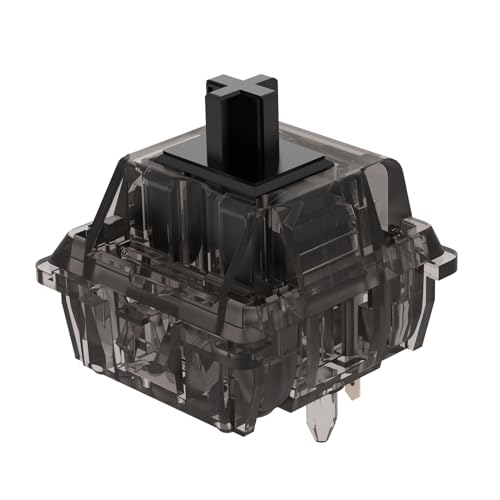
DUROCK L7 — the boutique linear, benchmark edition
Badge: Best for a first boutique linear; the L series is the house reference.
- Type: linear, pre-lubed, 5-pin
- Variant in this listing: L7 Smokey, 62 g class
- Pack: 90 switches
- Character: smooth in the way that gives the tier its reputation
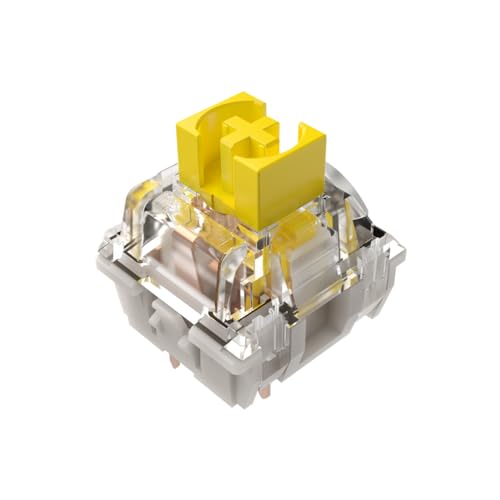
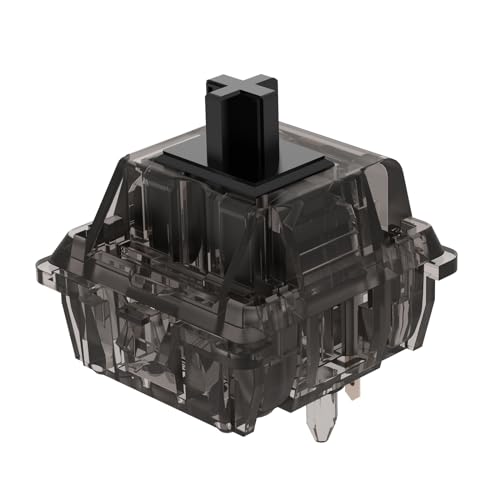
Durock’s L series is where many enthusiasts learn what the boutique premium actually purchases. The stroke is the lesson: an even, cushioned glide with none of the faint scratch that mainstream switches ask you to forgive, a spring that builds force with unusual grace, and a landing that sounds like the case cost more than it did. The Smokey housing gives the switch its moody, translucent look and a voice on the deeper side of neutral. At a 62 g class weight it sits firmer than the mainstream’s light linears, which suits the deliberate, full-stroke typing the boutique world tends to practise.
Strengths
- A genuinely refined stroke that justifies the tier’s premise
- Firm, graceful spring curve for deliberate typists
- Large pack covers a full board in one purchase
Trade-offs
- Firmer than mainstream light linears; gamers may prefer lighter
- Boutique positioning within the switch market’s pricing landscape
- Its polish is wasted in a hollow, echoing case
Best for: custom builders and typing-focused enthusiasts. Not suited for: feather-touch competitive players.

DUROCK T1 — the boutique tactile with a real bump
Badge: Best for tactile seekers who found mainstream bumps too polite.
- Type: tactile, pre-lubed, 5-pin, gold-plated spring
- Weight: 67 g class — firmly deliberate
- Variant in this listing: Clear T1
- Pack: 90 switches
- Character: a heavy, clean ledge of a bump
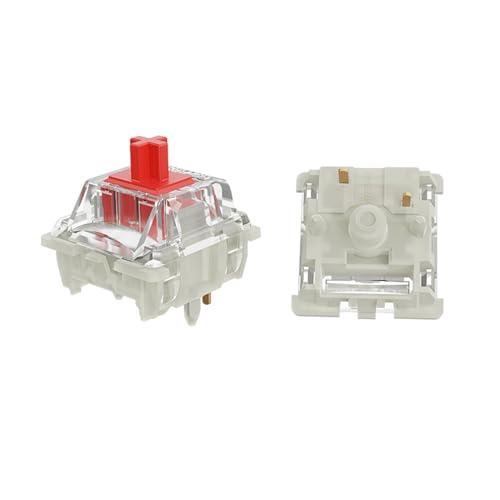
The T1 is the switch that explains why tactile enthusiasts leave the mainstream. Where a Brown’s bump is a rumour, the T1’s is a statement: a distinct, rounded ledge early in the stroke that the finger reads unmistakably, followed by a firm spring that makes the whole press feel intentional. It is a heavy switch by mainstream standards, and that weight is the personality — presses feel chosen, accidents are rare, and the board acquires the grave rhythm that the silent version of this design, met elsewhere in this cluster, also trades on. If your complaint about tactiles has always been that they whisper, the T1 is the one that speaks up.
Strengths
- The most decisive mainstream-adjacent bump in this guide
- Heavy spring eliminates accidental presses
- Factory lubrication keeps the big bump clean rather than scratchy
Trade-offs
- The firmest press here; light hands will tire
- Its deliberateness fights rapid, shallow gaming inputs
- Too much switch for a casual first build
Best for: tactile devotees and heavy, deliberate typists. Not suited for: light-fingered players or beginners sampling the hobby.

DUROCK Ice King — the transparent sound-chaser
Badge: Best for RGB builds that refuse to compromise on sound.
- Type: linear, pre-lubed, fully transparent nylon housing
- Weight: 62 g class
- Pack: 90 switches
- Character: a smooth glide with a deep, resonant voice
The Ice King exists to refute a compromise the hobby had accepted: that a switch could be transparent for the light show or opaque for the sound, not both. Its fully transparent nylon housing passes backlight like glass while the material and the factory finish keep the stroke smooth and the voice deep — the maker’s own description reaches for the vocabulary of resonance, and for once the vocabulary is earned. In a foam-filled showcase case, a board of Ice Kings is the boutique tier’s party trick: a keyboard that looks like a light installation and sounds like a much more expensive neighbourhood.
Strengths
- Full transparency without surrendering the sound
- Smooth, pre-lubed stroke in the house style
- Deep voice that flatters showcase builds
Trade-offs
- Its talents are wasted on a non-backlit board
- Firm weight, like its L-series sibling
- Showcase pricing logic within the tier
Best for: backlit custom builds and sound-conscious gamers. Not suited for: plain, unlit work boards.

DUROCK POM Piano — the full-POM deep diver
Badge: Best for the deepest sound in the guide and the smoothest material story.
- Type: linear, factory pre-lubed
- Materials: full POM housing with a UHMWPE long-pole stem
- Weight: 63.5 g class
- Pack: 70 switches
- Character: the boutique material experiment, fully committed
The Piano is the tier’s materials thesis in a single switch. POM — the self-lubricating engineering plastic the hobby prizes — forms the entire housing, and the stem is a long-pole design in UHMWPE, the slipperiest of the switch plastics. The combination aims at two targets at once: friction so low the stroke feels poured rather than pressed, and a long-pole landing that deepens the voice into the register sound chasers describe with the hobby’s favourite adjective. It is the most specialised switch in this guide, and the one most likely to be bought by a builder who already knows exactly which sound they are chasing — because they have heard it, in someone else’s board, and cannot unhear it.
Strengths
- Full-POM housing and UHMWPE stem: the low-friction dream team
- The deepest, most resonant voice in this line-up
- Long-pole stem gives a distinctive, focused landing
Trade-offs
- Long-pole feel is a strong flavour; not every finger loves it
- Firm weight, in the house pattern
- The most specialised purchase in the guide
Best for: sound chasers and material enthusiasts. Not suited for: buyers who want a neutral, forgettable switch.

TECSEE Purple Panda — the material-science tactile
Badge: Best for a characterful tactile from the tier’s other great house.
- Type: tactile, long stem, 5-pin, plate-mounted format
- Materials: PME-material housing, per the maker’s designation
- Pack: 90 switches in this listing
- Character: a snappy, characterful bump with a voice of its own
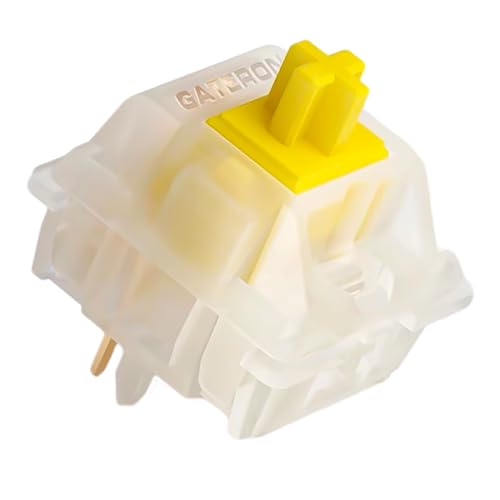
Tecsee is the boutique house that talks like a materials laboratory, and the Purple Panda is its calling card: a tactile switch built around the company’s PME housing material, with a long stem that sharpens both the bump’s definition and the landing’s voice. The Panda name places it in the hobby’s tactile aristocracy — the family of designs descended from the original Panda frankenswitch, whose story is told in this cluster’s frankenswitch guide — and the Tecsee execution is very much its own: snappier, brighter, and more theatrical than Durock’s grave T1. Choosing between the two tactiles in this guide is choosing between two theories of the bump, and both theories have passionate parishes.
Strengths
- A distinctive, snappy tactile character unlike the mainstream’s
- Proprietary housing material with a voice of its own
- Long stem sharpens both feel and sound
Trade-offs
- Strong character divides typists; trial before a full set
- Long-stem landing is firmer than standard-stroke tactiles
- Less documented than Durock’s lines for new buyers
Best for: tactile explorers and Panda-lineage enthusiasts. Not suited for: buyers who want the safest, most-reviewed option.
In this guide
JWK: the name in the title, treated honestly
JWK occupies a peculiar and honourable position in this tier: it is as much a manufacturer behind other labels as a brand on a box. Its best-known design, the Alpaca — a smooth, film-friendly linear that became a community reference — is manufactured by JWK and sold under the Alpaca name, and JWK-made switches sit inside several beloved boutique lines whose storefronts carry other logos. For this guide, searches for a verifiable JWK Alpaca listing returned no exact match in the site’s Amazon data, so — per this site’s standing rule — no switch is linked under the Alpaca name, and no substitute is dressed up as one. What can be said in prose is the useful part: if you shop the boutique tier, you will meet JWK’s work constantly, often without its name attached, and the Alpaca’s reputation — a deeply smooth linear with a soft, full voice — is the standard against which the Durock linears in this guide are routinely compared. Buyers who specifically want the Alpaca should buy it from a keyboard-specialist vendor who stocks it under its own name, with the same trial discipline this guide prescribes for every boutique purchase.
How the boutique tier differs, criterion by criterion
Materials
The mainstream builds in proven commodity plastics; the boutique tier experiments — full POM, UHMWPE stems, proprietary compounds, transparent nylon — and the experiments are audible and palpable. This is the tier’s most honest advantage, because materials are physics, not marketing.
Springs
Boutique springs are specified like instrument parts: lengths, curves, and weights chosen for how force builds across the stroke, often firmer and more deliberate than mainstream defaults. The Durock picks in this guide cluster in the low-sixties gram class for a reason — the tier’s typical hand presses on purpose.
Lubrication and finishing
Factory lubrication here is a finishing craft rather than a production step, and it shows in strokes that need nothing. The tier’s owners open switches to tune, not to rescue — a distinction the mainstream has only recently begun to blur.
Sound design
Boutique switches are voiced, deliberately, the way instruments are: housing, stem length, and material chosen for a target register. If the mainstream sells switches that happen to sound a way, the boutique tier sells switches that sound that way on purpose.
Economics
Smaller batches and finer finishing cost more per switch, in the qualitative sense that needs no figures: this tier asks a premium over the mainstream and returns character for it. Whether the exchange is fair depends entirely on whether your ears and fingers can spend the character — which is why every guide in this cluster, this one loudest, prescribes trials before full sets.
How to shop the boutique tier without paying tuition
Step 1: Earn the tier first
Build one good mainstream board and live with it for a season. Boutique character is only legible against a baseline; without one, you are buying adjectives. The mainstream foundations are covered in keyboard switches explained for beginners and the five-brand comparison in this cluster.
Step 2: Buy a trial quantity, always
Boutique switches are the strongest flavours in the hobby, and the trial rule that applies everywhere applies here with interest. A partial set on the letter keys for a fortnight is the tier’s honest audition.
Step 3: Judge in your best case, not your worst
These switches are designed for good builds. A boutique linear in a hollow case is a violin in a stairwell — the judgement you reach will be about the room. Give the trial your foam, your good caps, and your tuned stabilisers.
Step 4: Read the community’s instruments, not its adjectives
Force curves and recorded sound tests from reviewers whose ears you have calibrated against your own are the tier’s reliable literature. Superlatives are free and therefore worthless; measurements and recordings cost their makers effort and are priced accordingly in credibility.
Step 5: Keep the mainstream board
Boutique boards are instruments for moods and hours. Most owners keep a mainstream board for the ordinary day, and the boutique board’s specialness survives precisely because it is not asked to be ordinary. Budget and desk space permitting, that two-board settlement is the tier’s happiest ending.
Common mistakes in the boutique tier
The first is buying a full set on a sound test recorded through a flagship case you do not own; the case was half the sound, and it does not ship with the switches. The second is chasing the community’s current favourite in sequence, accumulating five half-loved sets instead of one understood one — the tier rewards depth over novelty more than any other in the hobby. The third is lubing a factory-finished boutique switch on arrival, undoing with enthusiasm the exact craft you paid for. The fourth is judging a firm boutique spring by mainstream habits: these switches expect a deliberate press, and a feather-touch audition misreads them as heavy rather than intentional.
Fifth: assuming boutique means better for every job. A T1-weight tactile on a gaming cluster, or a long-pole linear under a shared office’s microphone, is a fine switch in a wrong assignment, and the tier’s premiums make wrong assignments expensive. Sixth: neglecting the frankenswitch lesson — that several boutique legends began as community combinations of mainstream parts, and a builder with a parts bin and patience can approach boutique character from below. That craft is this cluster’s frankenswitches complete guide, and it is the boutique tier’s own origin story, which the tier’s vendors would prefer you to forget and this guide declines to.
Final recommendation
Enter the tier through Durock: the L7 if you are a linear typist, the T1 if tactility is your religion, the Ice King if your build has lights and standards, the POM Piano if sound is the whole point. Meet Tecsee through the Purple Panda when you want the bump with theatre in it. Honour JWK by knowing its work when you meet it under other names, and by buying the Alpaca from a specialist when nothing else will do. And keep the mainstream board — the boutique tier is a spice rack, not a grocery store, and it seasons a keyboard life best when the staples are already in the house. Readers arriving from the mainstream should start with cherry mx vs gateron vs kailh vs outemu vs razer switches which is best for the map of the world below this one, and the budget-minded should note that the tier beneath, in best budget linear switches under 30 cents, is better than it has any right to be.
The boutique ecosystem: group buys, vendors, and patience
Shopping this tier differs from shopping the mainstream in its logistics as much as in its products. Many boutique designs are sold through specialist keyboard vendors, sometimes in group buys — pre-orders that fund a production run and ship months later — and the Amazon listings linked in this guide represent the tier’s more established, stocked end. The group-buy model explains much of the tier’s character: a design can be daring when its buyers have committed before it exists, and a community that funds its own switches gets switches that answer to it rather than to a mass market. The costs are patience and a certain tolerance for uncertainty, and the rewards are designs that no volume business case would ever approve. Newcomers should start where this guide starts — with stocked, documented lines like Durock’s — and treat the group-buy frontier as a second expedition, undertaken with a vendor the community trusts and a delivery horizon the buyer genuinely accepts.
The second-hand market in this tier is unusually lively, for a structural reason: boutique switches are bought on character, character is personal, and one owner’s near-miss is another’s grail. Sets circulate with their batch identities intact, and a buyer who missed a production run can often find it again at a fair exchange. That liquidity softens the tier’s trial problem considerably — a boutique set that does not suit you is among the easiest keyboard purchases to pass on — provided you buy documented lines from traceable sources, which is the same advice this guide gives about everything in the tier.
Materials science, briefly and honestly
The boutique tier’s favourite conversation deserves a sober summary. POM earns its reputation honestly: it is self-lubricating, wear-resistant, and produces a deep, soft voice, which is why it appears in housings and stems across the tier’s best designs. UHMWPE is the friction champion — slippery beyond POM — and appears in stems like the Piano’s, where its softness is balanced by the housing around it. Polycarbonate is the transparent traditionalist, bright in voice and clear for light. Nylon is the deep-voiced elder, softer and warmer in sound. Proprietary compounds like Tecsee’s PME are the tier’s research frontier: blends tuned for a specific combination of slip, sound, and moulding behaviour, whose virtues must be taken from trials rather than from theory, because the recipes are the makers’ secrets. The honest buyer’s rule is that material names predict tendencies, not outcomes — two POM switches can sound like cousins or like strangers, depending on the springs, stems, and cases around the material. Buy the switch, not the polymer.
Boutique tactiles versus boutique linears: two churches
The tier divides its faithful by switch type, and the division is theological enough to deserve a map. The linear church prizes the uninterrupted stroke: its saints are smoothness and sound, its rituals are material selection and spring tuning, and its representative texts in this guide are the L7, the Ice King, and the Piano. The tactile church prizes the event: a bump engineered like a signature, felt identically ten thousand times, and its texts are the T1 and the Purple Panda. Converts between the churches are rare and usually temporary, because the preference is in the hands rather than in the arguments. The practical consequence for shoppers is that the boutique decision tree starts where the mainstream one does — with type — and the brand and model questions only become interesting inside the right church. A buyer still unsure of their church should not be shopping this tier yet; the mainstream’s gentler tactiles and linears will identify their congregation at a friendlier tuition.
The case for owning exactly one boutique board
There is a settled pattern among long-term enthusiasts that newcomers rarely believe and veterans rarely dispute: the collection converges. After the exploratory years, most owners keep a small number of boards in active rotation, and the boutique board among them is the one that gets described with a name rather than a specification. It is the board for the good hours — the writing that matters, the game that deserves ceremony, the evening session when the desk is a pleasure rather than a workstation. The mainstream boards handle the volume; the boutique board handles the meaning. Framed that way, the tier’s premium is not really per switch at all. It is the price of one object in your working life that was made, deliberately and skilfully, to be exactly what it is — and in a market of competent commodities, that deliberateness is the scarcest good on sale. Buy it once, buy it knowingly, and let it be enough.
How the boutique tier will try to fool you
Every market has its weather, and this tier’s is hype in a particular costume: the limited run, the sold-out drop, the community favourite anointed in a fortnight and forgotten in a season. The defences are the ones this guide has prescribed throughout, stated here as a creed. Never buy a full set you have not trialled in your own case. Never pay a scarcity premium for a switch whose character you know only from recordings made in someone else’s flagship build. Never confuse a design’s rarity with its quality — the correlation in this tier is weak and occasionally inverse, because the best boutique lines, like Durock’s, tend to stay in production precisely because they are good. And never let a group buy’s deadline make a decision your fingers have not made; the tier produces new objects of desire monthly, and the one that got away is a renewable resource. The buyer who holds that creed can enjoy the boutique world as it deserves — as a gallery of deliberate, characterful engineering — without funding its weather.
Boutique switches and the working day
A question the tier’s marketing never asks: can a boutique board do a job? The answer, on the evidence of the owners, is that the best of them do the job beautifully — the T1’s deliberateness suits precision work, the L7’s smoothness suits long drafting, the silent members of these houses suit offices — with one honest caveat about weight. The tier’s springs run firm, in the deliberate register, and an owner whose hands tire easily should trial across full working days rather than enthusiastic evenings before committing a work board to the tier. The boutique board as a second, ceremonial instrument sidesteps the question entirely, which is why so many working owners arrange their desks that way: the mainstream board earns, the boutique board celebrates, and the hands get both a tool and an instrument in the same week.
Frequently asked questions
What makes a switch “boutique”?
Intent and scale: a design chased for character — materials, springs, lubrication, and voicing chosen deliberately — produced in smaller batches with finer finishing than the mainstream’s volume lines. Durock, JWK, and Tecsee are the tier’s representative houses in this guide. Boutique does not automatically mean better for your hands; it means more pronounced, which is why trials matter more here than anywhere else in the market.
Are boutique switches worth the premium over Gateron or Cherry?
For builders who can hear and feel what the premium buys — and who own a case good enough to express it — yes, demonstrably, in their own boards. For a first build, a hollow case, or a buyer still forming preferences, the mainstream delivers more happiness per commitment. The tier is a second purchase, and it rewards being bought second.
Why is JWK discussed without a linked product?
Because this site links only products it can verify in its own Amazon data, and JWK’s best-known switch, the Alpaca, returned no exact verified match when searched. Rather than substitute another brand’s switch under the Alpaca name, the guide treats JWK in prose — including the practical advice to buy the Alpaca from a keyboard-specialist vendor — and links the verified Durock and Tecsee switches that represent the tier here.
Durock or Tecsee: which house should I try first?
Durock, for most buyers: its lines are the tier’s most documented, its L and T series are reference designs, and its character is pronounced but disciplined. Tecsee is the second visit — the house for buyers who want their switch’s materials and voice to be a conversation piece as well as a mechanism. Both reward the same trial discipline.
Do boutique switches fit standard keyboards?
Yes. Every pick in this guide is an MX-pattern switch for standard hot-swap sockets and keycaps, mostly in 5-pin format for rigid seating. The boutique difference is inside the switch, not in its footprint — which is the tier’s great convenience: a mainstream board can be promoted, one row at a time, without changing anything else you own.
One sentence for the reader still hovering over the buy button?
Buy the trial quantity of the switch whose description you have reread twice — desire that survives rereading is data — and let your own case, your own foam, and your own fortnight deliver the verdict this guide has been carefully refusing to deliver for you.
Which pick suits a first custom build with no backlighting?
The L7 or the Piano, whose talents are all in the fingers and the ears and none in the light path. The Ice King’s transparency earns its keep only under LEDs, and an unlit build should spend its character budget where the darkness can appreciate it — in stroke and in voice. Unlit boutique boards have a particular monastic beauty, and these two switches are their natural inhabitants.
What is the last word on the boutique tier?
That it exists to prove a switch can be made the way a violin is made — on purpose, by hand-guided processes, for a sound and a feel that a committee would never approve — and that some typists, having felt that deliberateness once, arrange a corner of their keyboard life around it forever. This guide’s five switches are the proof in purchasable form. The rest is your fortnight’s trial.
Is there a boutique switch for someone who dislikes firm springs?
Fewer than the firm-spring faithful enjoy, because the tier’s typical hand presses deliberately — but the lighter variants within these houses’ lines exist, and a spring swap, the hobby’s gentlest surgery, can re-voice any of this guide’s picks to a lighter hand without surrendering the housing’s character. An owner whose only objection to a beloved boutique switch is its weight is one spring set away from contentment, and the community’s spring libraries make the experiment cheap.
What do boutique owners know that mainstream owners do not?
That a switch can be an end in itself. The mainstream buys switches as components of keyboards; the tier’s owners collect the keystroke the way listeners collect pressings of a recording — the same music, a different and deliberate rendering. Neither party is wrong, and most enthusiasts live in both countries across a week. The boutique tier simply keeps the second country’s flag flying, and this guide’s five linked switches are its most welcoming border towns.
Should my first boutique board be a full build or a switch swap?
A swap, almost always: it isolates the variable, it costs a fraction of a build, and it tells you whether the tier’s character survives contact with your actual desk life. The full boutique build — case, plate, caps, and switches chosen as one composition — is the tier’s graduation ceremony, and it means more, and risks less, when the switches’ character is already known to your hands from the swap that preceded it.
What is the best way to record my impressions while trialling?
Notes, dated, in your own adjectives — because memory revises and paper does not. Record the spring across a long session, the landing’s sound at night versus morning, and the bump’s clarity when your hands are tired, since those are the conditions the full set will actually live in. A fortnight of honest notes is the difference between a collection and a curation, and this tier, more than any other, rewards the curator.
Can boutique switches go in a prebuilt keyboard?
Yes, in any hot-swap prebuilt with standard sockets — and that is quietly one of the tier’s best uses, because a good prebuilt’s case and plate give the switches the room they were designed for. The one caution is pin format: these are mostly 5-pin switches, and a 3-pin-only socket plate will ask for the plastic legs to be clipped, a small and standard surgery. Soldered boards are the exception, as everywhere in the hobby.
What separates a boutique switch from a merely expensive one?
Documentation and intent that survive inspection: a named material with a reason, a spring with a curve, a finishing process the maker describes, and a community of owners who can articulate what the switch does differently. Price alone certifies nothing — the tier contains expensive mediocrity like every market — which is why this guide anchors on lines whose virtues are described in mechanisms rather than in adjectives, and why your own trial remains the final certification.
Which boutique switch is best for a shared home office?
The quiet end of the tier: a silenced Durock design, or a deep-voiced linear like the L7 in a well-damped case, whose sound stays inside the room’s manners. Avoid the long-pole Piano and the Panda’s snap where calls and concentration share the air — magnificent switches, wrong parish. The shared office rewards the boutique tier’s refinement and punishes its theatre, in exactly the proportions this guide has described.
Final question: is there one boutique switch everyone should try once?
If the tier had a passport stamp, it would be a great tactile and a great linear, one from each church — in this guide’s terms, a week on the T1 and a week on the L7 or the Piano. Two weeks, two churches, and the traveller returns knowing the tier’s whole argument in their hands. Everything after that is refinement of a verdict already honestly reached.
What is the boutique tier’s relationship with the mainstream improving?
Upward pressure, gratefully received in both directions. The mainstream’s factory lubrication, materials, and finishing have all improved under the tier’s example, and the tier’s prices and availability have improved under the mainstream’s logistics. A buyer in either market today is shopping in the other’s debt. The guides in this cluster are written in that reconciled spirit: the tiers are a ladder, not a war, and every rung of it is better than it was five years ago.
Do boutique switches work with low-profile or laptop-style boards?
No — this tier is entirely standard-height MX-pattern, and low-profile boards use their own incompatible switch families. The boutique sensibility exists in miniature in a few low-profile lines, but the houses in this guide build for full-size custom and enthusiast boards. A low-profile owner charmed by this guide’s philosophy should look for its echoes — materials, springs, finishing — in their own format’s premium lines, and accept a smaller gallery.
Which of this guide’s picks is the safest single recommendation?
The L7, for the same reason it anchors the guide: it is the tier’s lesson in its clearest form, documented across years and owners, in a weight and character that suit the widest range of deliberate typists. A recommender who must name one boutique switch for an unknown enthusiast names the L7 and accepts the tactile church’s polite disagreement — the T1 being the equally safe answer on the other side of the aisle.
Are boutique switches a good investment?
As instruments, yes; as assets, no — and the distinction protects buyers. Established lines hold their value decently in the hobby’s lively second-hand exchange, which softens mistakes, but no switch should be bought as a store of value. Buy the typing, keep the receipts of your own enjoyment, and let any resale be a refund of a lesson rather than a return on a portfolio.
What is the single most convincing boutique experience for a sceptic?
A side-by-side row: five mainstream linears and five L7s, in the same good case, typed blind. Scepticism about the tier usually survives articles and dies at that row, because the difference the premium buys — the evenness, the landing, the voice — is precisely the kind that fingers verify and words fumble. If the row does not convince you, believe your hands and keep your money; the tier’s honest vendors would rather lose the sale than the argument.
Does the boutique tier make sense on a budget board?
As a final flourish, occasionally; as a foundation, no. The arithmetic of builds is unforgiving: a modest case with boutique switches is outclassed by a good case with mainstream switches, because the case sets the ceiling the switches perform under. Sequence the upgrades case-first, switches-second, and the boutique tier will meet you at the top of a build that can honour it. That ordering is this guide’s most money-saving sentence.
How many boutique switches should a first buyer order?
A trial quantity for the letters and the gaming cluster first — enough to live with, not enough to regret — and the full set only after the fortnight’s verdict. When you do commit, order the layout’s count plus a genuine spares margin, because boutique batches end and a matched spare bought today is worth three approximate ones bought in three years. That margin is the tier’s one piece of financial advice that never ages.
What should I do with the mainstream switches the boutique set replaces?
Keep them, labelled, as the board’s understudies and your own control group. Boutique enthusiasm has seasons, and more than one owner has returned to a mainstream set for a working month and been glad the box was in the drawer. The replaced switches are also your lending library — the means by which friends get their own first trial — and your frankenswitch parts bin, should that craft call. Nothing in this tier asks you to burn the boats behind you.
Are there boutique silent switches?
Yes — silence is one of the tier’s active frontiers, and this guide’s own Durock family includes the Silent Shrimp, a silenced T1 descendant that this cluster’s silent-switch guide links and discusses. The boutique silent switches answer the mainstream’s mush problem with firmer pads and stronger bumps, at the tier’s usual premium. A quiet-seeking reader should read the silent guide first and the boutique catalogue second, in that order.
What is the best first boutique purchase for a Gateron owner?
The Durock L7, because it teaches the tier’s lesson in the dialect a Gateron owner already speaks: a linear, judged on smoothness and voice, executed a level finer. The Gateron owner who finds the L7 merely pleasant has learned the tier is not for them, cheaply and honourably. The one who finds it revelatory has found their next parish, and the T1 and the Piano are its further sacraments.
How do boutique switches compare with frankenswitches?
They are the same impulse at different addresses. A frankenswitch is a boutique recipe assembled by its owner from parts; a boutique switch is a frankenswitch that a maker productised, finished, and warranted. Many boutique legends began as community combinations, and the tier’s makers are frank about the lineage. A builder with a parts bin can chase boutique character from below at the cost of evenings; a buyer of this guide’s picks pays to have the evenings already spent, by professionals, with the recipe written down.
Is the boutique tier a good gift for an enthusiast?
It is the connoisseur’s gift category, with one rule: gift the documented lines, not the scarce ones. A set of L7s or T1s tells the recipient you know their church; a hyped limited run tells them you know a headline. If you do not know whether they are a linear or a tactile soul, the honest gift is a trial quantity of each church’s representative, with a note inviting the verdict — enthusiasts treasure being consulted by their own presents.
What case and keycaps suit boutique switches best?
The best you own. These switches were designed on the assumption of a serious build — a solid or gasket-mounted case, foam where the design calls for it, thick keycaps that keep the voice in the switch. That assumption is the tier’s hidden system requirement, and it is why this guide keeps refusing to judge boutique switches in budget cases: the pairing is not a snobbery, it is the design brief. A builder whose case is still a starter shell should upgrade the shell first and let the boutique switches arrive to a room prepared for them.
Do boutique switches need films or other modifications?
Rarely. Switch films exist to tighten loose housings, and the tier’s housings are moulded and finished to tolerances that usually leave nothing to tighten. An owner who films a boutique switch should have a named reason — a specific rattle in a specific batch — rather than a general habit imported from the mainstream, where the film’s work was real. In this tier, modification is seasoning on a cooked dish: possible, occasionally inspired, and wrong as a reflex.
Which boutique switch should a writer buy?
The T1 if the writer types by feel and wants every keystroke confirmed like a full stop; the L7 if the writer types by flow and wants the stroke to disappear into the prose. Both are firm, deliberate switches that reward the long session’s rhythm rather than the sprint’s. A writer still deciding should trial the T1 on the home row for a week — tactile preference declares itself faster than any other in the tier, and a week of real pages is the cheapest editor this purchase will ever have.
What is the difference between Durock and JWK?
The two names are entangled in the hobby’s history — the houses are closely associated, and JWK is widely understood to manufacture designs sold under several boutique labels, with Durock the most prominent storefront among them. For the buyer, the practical translation is simple: a Durock switch is a designed, documented, stocked product you can buy today, while JWK is the engineering name you will meet behind other labels and in designs like the Alpaca. This guide links the stocked products and discusses the engineering house in prose, which matches how the market itself presents them.
Are boutique switches durable?
Yes — the tier’s materials are engineering plastics chosen partly for wear, and its smaller batches receive closer inspection than volume lines. The honest caveat is institutional rather than mechanical: a boutique line may not be in production in five years, so a buyer building for a decade should stock spares from the original purchase, when the batch is current and the match is perfect. That is the tier’s one real longevity tax, and it is paid in foresight rather than in money.
What does “thock” mean, and which of these switches does it?
It is the hobby’s onomatopoeia for a deep, soft, resonant bottom-out sound — the opposite of a bright clack. Of this guide’s picks, the POM Piano is the deepest diver, with the L7 and the Ice King in the same register’s neighbourhood. Remember that the case composes at least half the effect: a thocky switch in a hollow case is a promise the room will not keep, which is why this guide keeps pairing its boutique advice with good foam and solid cases.
What is a long-pole stem, and why does the tier love it?
A long-pole stem extends further down the switch’s travel, so the stem’s pole meets the housing floor earlier and more decisively than a standard stem’s rails do. The effect is a shorter, firmer landing with a deeper, more focused sound — the register the hobby prizes — at the cost of some total travel. Boutique linears like the Piano use it as a voicing decision. Typists who love a cushioned, full-length stroke should trial carefully; the long pole is a strong flavour by design.
Are boutique switches good for gaming?
The lighter, smoother linears can game very well, and some players swear by the tier’s polish. But the tier’s centre of gravity — firm springs, deliberate strokes, sound-first design — is typing and custom building, and competitive players will usually find their geometry-first needs better served by the speed and magnetic categories. Buy boutique for character; if your character happens to game beautifully, that is a dividend, not the prospectus.
How do I know a boutique line is established rather than hype?
Look for the boring evidence: multiple production runs across time, documentation and measurements from several independent reviewers, a vendor trail beyond a single drop, and a community that still recommends the line a year after its launch. Durock’s L and T series pass that audit easily, which is why this guide anchors on them. A line whose entire reputation is a fortnight old may become established — but let someone else’s patience establish it.
Should I lube boutique switches?
Almost never on arrival. The factory finishing is the product; adding lubricant before you have lived with the switch is repainting a picture you just bought. Owners who tune later do so switch by switch, for a named reason — a spring’s ping, a housing’s rattle — with the restraint of people adjusting an instrument rather than rescuing a part.
Related reading: are silent switches worth it · gateron switches complete guide · akko switches complete guide