Disclosure: As an Amazon Associate, kajuandouglas.com earns from qualifying purchases. Links on this page are affiliate links; they cost you nothing extra. Prices and availability change often, so check the current Amazon listing before you buy.
No brand rewards a complete map like Gateron, and this gateron switches complete guide is that map. Gateron’s catalogue is the hobby’s most generous and most confusing: families within families, generations overlapping, the same colour meaning different switches in different lines, and — threaded through it all — some of the best-loved switches at every level of the market. This guide walks the whole territory in order: the milky line that made the brand’s reputation, the G Pro generations that carry its mainstream, the Oil King and Smoothie flagships that chase the boutique tier, and the silent line that quiets the whole enterprise. Seven verified switches are linked below as the territory’s landmarks. Read it once and the catalogue never confuses you again; read it with a board to fill and it will fill the board well.
Gateron Switches Complete Guide: The Shape of the Catalogue
Gateron is best understood as several switchmakers sharing one name and one factory’s improving craft. The milky family is the elder line: housings in the namesake translucent material, a deep and soft voice, and the Yellow that became the budget-linear legend. The G Pro family is the modernised mainstream: the classic colours — Red, Brown, Blue — rebuilt with factory lubrication, refined moulds, and generation numbers that actually mean something. The enthusiast flagships, Oil King and Smoothie, are the brand’s answer to the boutique tier: exotic materials, obsessive factory finishing, and prices of ambition to match. And the KS-series silent line applies the house smoothness to the quiet market. Each family answers to a different buyer, and the guide treats them in that order — reputation first, mainstream second, flagships third, silence last — because that is the order in which the brand itself grew.
Two naming warnings before the tour. First, colours repeat across families with different internals: a G Pro Red and a milky Red are cousins, not twins, and the family name is the switch’s surname — never buy on colour alone. Second, generations matter here more than at any rival: the Pro lines’ numbered revisions changed lubrication, moulds, and stems materially, so the generation in a listing is a specification, not a garnish. The picks below are the current, verified generations, named in full.

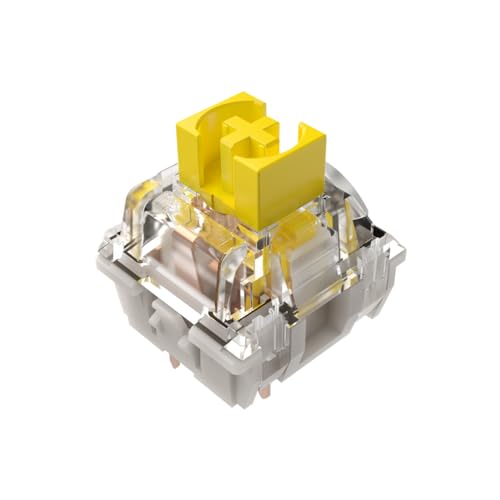
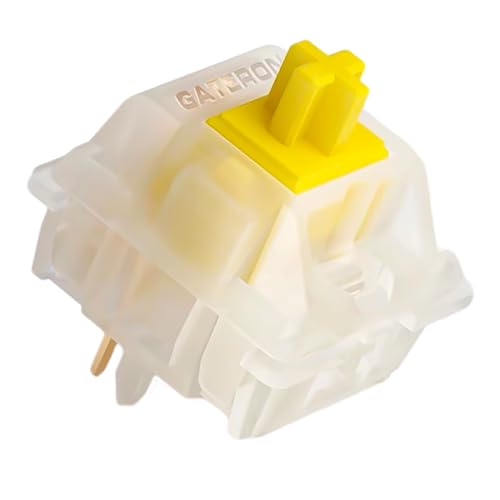
Gateron Milky Yellow Pro V2 — the legend, current generation
Badge: Best for the default Gateron recommendation; the milky family’s flagship.
- Type: linear, pre-lubed, 5-pin
- Force class: 50 gf
- Pack: 72 switches
- Character: the deep-voiced, forgiving glide the brand is famous for
If one switch carries Gateron’s reputation, it is this one’s lineage. The Milky Yellow line taught a generation of builders that a switch could be inexpensive and beloved at the same time, and the Pro V2 generation is the legend with its homework done: factory lubrication that finally matches the community’s hand-lubed standard, refined moulds, and the milky housing’s signature — a voice deeper and softer than clear shells produce, wrapping a stroke that forgives imperfect technique. Its middleweight force suits the widest range of hands in the catalogue. A buyer who reads nothing else in this guide and buys this switch has still bought well; it is the catalogue’s centre of gravity, and the standard against which its siblings are described below.
Strengths
- The beloved milky voice and glide, factory-finished properly
- Middleweight force that suits nearly every hand
- Generous pack covers a full board
Trade-offs
- Milky housing dims RGB backlighting
- Too familiar to excite collectors chasing novelty
- Its popularity means listings vary; verify the Pro V2 generation
Best for: almost everyone, first. Not suited for: showcase RGB builds.

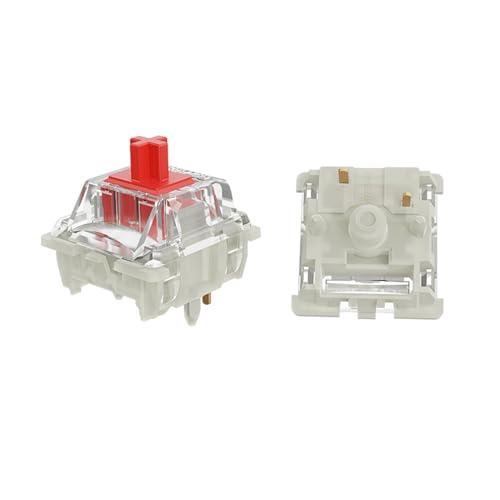
Gateron G Pro 3.0 Red — the modernised classic linear
Badge: Best for a light, clear-housed linear in the classic mould.
- Type: linear, pre-lubed, 5-pin, RGB-friendly housing
- Generation: G Pro 3.0
- Pack: 35 switches in this listing
- Character: the classic light linear, rebuilt with modern finishing
The G Pro 3.0 Red is the catalogue’s handshake with the classic era: the light linear formula that the whole market recognises, executed with the third generation’s refinements — factory lubrication, improved pins and moulds, and a housing that passes light the way the milky line cannot. It is the Gateron to buy when the build has backlighting to feed or when the Milky’s middleweight press feels heavy at midnight. Against its own sibling above, it trades voice and weight for light and lightness, and the choice between them is the catalogue’s most common fork — this guide’s advice is to decide by housing first and force second, since the two switches’ virtues divide exactly along that line.
Strengths
- Light, classic press with modern factory finishing
- Clear light path for backlit builds
- The G Pro generation’s refinements throughout
Trade-offs
- Smaller pack in this listing; full boards need multiples
- Brighter voice than the milky line
- Light force invites bottoming out for heavy hands
Best for: gamers and backlit builds. Not suited for: deep-voice sound builds.

Gateron G Pro 3.0 Brown — the house tactile
Badge: Best for typists who want the classic gentle bump, Gateron-smooth.
- Type: tactile, pre-lubed, pin-enhanced format
- Force class: 55 gf
- Pack: 108 switches in this listing
- Character: a polite bump with the house glide underneath
Every catalogue needs its diplomat, and the G Pro 3.0 Brown is Gateron’s: the classic gentle tactile bump — present, confirming, never theatrical — carried on the smooth stroke the brand’s linears made famous. It is the switch for the working board, the shared office, the writer who wants feedback without a performance. Tactile extremists will find it tame, and this guide will not argue; the bump is a courtesy, not a declaration. But courtesy, executed this smoothly, across a full working week, is why the Brown formula has outlived every fashion around it — and this generation is its most refined Gateron form, in a pack sized for a board and its spares.
Strengths
- The classic gentle bump with Gateron’s smoothness
- Office-safe voice and manners
- Large pack covers board plus spares
Trade-offs
- Too polite for bump devotees
- Pin format differs from the 5-pin picks; check your sockets
- Less distinctive than the catalogue’s flagships
Best for: typists and shared workspaces. Not suited for: tactile thrill-seekers.

Gateron G Pro 3.0 Blue — the house clicky
Badge: Best for click lovers who want the classic sound with modern smoothness.
- Type: clicky, pre-lubed, pin-enhanced format
- Force class: 60 gf
- Pack: 108 switches in this listing
- Character: the traditional click, on the house’s smooth chassis
The G Pro 3.0 Blue carries the oldest idea in the catalogue — the click bar’s ancestor, the jacket click — in its most modern Gateron execution. The click is the classic one: bright, mechanical, unapologetic, the sound that defined mechanical keyboards for the public. What the generation adds is everything around the click: a smoother stroke approaching and leaving the event, better moulds, and factory finishing that keeps the mechanism consistent across a board. It is the right Blue for a solo room and the wrong one for every other kind, which is not a flaw but the clicky covenant, stated in this cluster’s clicky guide and honoured here: buy it for a door that closes.
Strengths
- The definitive classic click with modern consistency
- Smoother stroke than clickies of earlier generations
- Firm force suits the click’s deliberate character
Trade-offs
- Solo rooms only, as all true clickies are
- Heavier than the linears in this guide
- The click divides households permanently
Best for: click devotees in private spaces. Not suited for: offices, calls, or shared walls.

Gateron Oil King — the flagship deep diver
Badge: Best for the deepest voice in the catalogue and a flagship feel.
- Type: linear, pre-lubed
- Force class: 55 g
- Pack: 108 switches in this listing
- Character: dark housing, deep register, boutique ambitions
The Oil King is Gateron’s letter to the boutique tier: a linear built around a dark housing and a factory finish the maker describes in the vocabulary of oil — slick, sealed, and silent-running — aimed squarely at the deep-voiced sound the hobby prizes most. In a foamed case it produces the catalogue’s most luxurious register, and its firmer-than-mainstream weight gives the stroke a gravity the light linears lack. This is the Gateron for the builder who has stopped asking whether the brand can play at the top table; the Oil King is the top table’s Gateron seat, and the comparison with the boutique houses in this cluster’s boutique guide is a fair fight rather than a courtesy.
Strengths
- The deepest, richest voice in the catalogue
- Flagship factory finishing, switch after switch
- Firm weight suits deliberate, sound-led builds
Trade-offs
- Dark housing is no friend to backlighting
- Flagship positioning in the brand’s range
- Its gravity is wasted on feather-touch players
Best for: sound chasers and custom builders. Not suited for: RGB showcases or light-press gamers.

Gateron Smoothie — the full-POM experiment
Badge: Best for material enthusiasts; the catalogue’s smoothest idea.
- Type: linear, factory pre-lubed, 5-pin, RGB LED format
- Materials: full POM construction
- Spring: 22 mm dual-stage, 40 gf class — light
- Pack: 105 switches in this listing
- Character: the slippery flagship with a long-spring glide
Where the Oil King chases depth, the Smoothie chases frictionlessness. Its full-POM construction — housing and stem in the self-lubricating plastic the boutique tier prizes — gives it the catalogue’s most literally slippery stroke, and the long dual-stage spring stretches the force curve into an unusually even build. It is also the lightest flagship here, which makes it the enthusiast line’s gift to gamers: boutique materials at a sprinter’s weight. The Smoothie is the clearest evidence in this guide that Gateron’s range is not a ladder but a landscape — its two flagships face opposite directions, and both are worth the walk.
Strengths
- Full-POM construction: the smoothest stroke in the catalogue
- Light weight with an enthusiast’s materials
- Long dual-stage spring for an even force build
Trade-offs
- Lightness plus slipperiness can feel uncontrolled to heavy hands
- A specialist’s switch; trial before committing a board
- Its voice is softer than the Oil King’s drama
Best for: gamers and smoothness connoisseurs. Not suited for: heavy, deliberate typists.

Gateron KS-9 Silent Red — the quiet line
Badge: Best for a genuinely quiet Gateron board.
- Type: silent linear, pre-lubed, 5-pin, RGB LED format
- Pack: 35 switches in this listing
- Character: the house smoothness with the volume removed
The KS-9 Silent Red closes the catalogue where the working world lives: in quiet rooms. Its damping does the standard silent work — cushioning both ends of the stroke — while the Gateron chassis keeps what many silent switches lose, a stroke that still feels like a mechanism rather than a membrane’s apology. It is the pick that makes a Gateron board welcome in a shared office, a studio flat, or a house with a sleeping child, and it pairs with this cluster’s silent-switch guide, where its virtues and its mush-avoidance are weighed against the whole quiet field. Within this catalogue, it is the specialist every family needs and few celebrate — until the first late-night session.
Strengths
- Real quiet with a mechanical stroke intact
- House smoothness in a silent execution
- Standard fit for hot-swap boards
Trade-offs
- Damped landing softens the bottom-out feel
- Small pack in this listing
- No tactile sibling linked here for bump lovers
Best for: shared spaces and night work. Not suited for: sound chasers.
In this guide
How to choose inside the Gateron catalogue
By family first
Decide the family before the colour: milky for voice, G Pro for the modern mainstream, flagship for character, KS for quiet. Family is the catalogue’s real taxonomy; colour is a detail within it. Most confused Gateron purchases are family errors wearing colour costumes.
By housing and light
Backlit builds need the clear-housed lines — G Pro and Smoothie — and sound builds want the milky and Oil King shells. The housing decision is irreversible per switch, so make it before the force decision, which springs can later adjust.
By force, honestly
The catalogue spans the light Smoothie to the firm Blue and Oil King. Your hands’ honest weight — measured across a working day, not a showroom minute — picks the class; the generation and family then pick the switch. This guide’s centre of gravity, the Milky Yellow Pro, exists because the middle class is where most hands honestly live.
By generation, always
Buy the current generation of whichever line you choose. Gateron’s revisions are substantive — lubrication, moulds, stems — and the catalogue’s second-hand and old-stock listings are a museum that charges admission. The picks in this guide are the current verified generations for exactly that reason.
How to get the best from a Gateron board
Step 1: Match the case to the family
Milky and Oil King switches earn their voice in foamed, solid cases; G Pro switches are forgiving anywhere; the Smoothie rewards a rigid plate that lets its glide read cleanly. The catalogue’s families were designed against serious builds, and the case is the first place that seriousness is repaid. General build grounding lives in build first custom keyboard guide.
Step 2: Leave the factory finish alone for a week
Current-generation Gaterons arrive lubed as a design decision. Type them stock for a week before any brush comes out — most owners find the factory work sufficient, and the minority who tune do so with knowledge rather than habit. The finishing arts, when wanted, are in how to lube keyboard switches.
Step 3: Tune the stabilisers before blaming the switches
On a Gateron board, as on every board, the spacebar’s rattle is the stabiliser’s confession, not the switch’s. Owners who tune the big keys first report the whole board improving — because it has, in the only places the ear was actually complaining about.
Step 4: Keep a row of the Milky Yellow Pro as your control
Whatever family you settle in, a reference row of the catalogue’s centre teaches you what your flagship is doing differently. Gateron’s range is wide enough that owners drift; the control row is how drift becomes knowledge. It is also the frankenswitcher’s favourite donor shelf, as frankenswitches complete guide explains.
Common Gateron mistakes
The first is buying on colour across families — a Red is not a Red is not a Red in this catalogue — and discovering the error at the board. The second is buying an older generation at a tempting listing and receiving the museum version of a switch whose current form is materially better. The third is lubing a current-generation switch on arrival, undoing factory work that was the reason to buy the generation. The fourth is judging the milky line under full backlight, or the G Pro line in a sound build: each family has a room it was voiced for, and cross-room auditions misjudge them all.
Fifth: assuming the flagships obsolete the mainstream. The Oil King and Smoothie are specialists; the Milky Yellow Pro remains the catalogue’s best answer for most boards, and an owner who skips it for a flagship has sometimes bought a narrower switch at a wider commitment. Sixth: neglecting the silent line until the life change — the new job, the new baby, the new flatmate — arrives, and then rebuilding in a hurry. A row of KS-9s bought calmly, in advance, is the catalogue’s cheapest insurance.
Gateron among its rivals
This guide’s brand sits in a five-brand world, mapped fully in cherry mx vs gateron vs kailh vs outemu vs razer switches which is best, and its head-to-head with the standard’s keeper is in cherry mx vs gateron switches which is better. Gateron’s position in that world is the iterator’s: the brand that revises fastest, covers widest, and prices its mainstream like it wants to be bought in full sets — which, on the evidence of this catalogue, it deserves to be. Its ceiling has risen to meet the boutique tier while its floor stayed friendly, a combination none of its mainstream rivals currently matches across the whole range.
Final recommendation
Start at the centre: the Milky Yellow Pro V2 is the default Gateron and the right first purchase for most readers. Move by need — G Pro Red for light and light-show, G Pro Brown for the working tactile, G Pro Blue for the private click, Oil King for depth, Smoothie for frictionless speed, KS-9 Silent Red for the quiet hours. Respect the generations, decide family before colour, and let the factory finish prove itself for a week before you reach for a brush. A catalogue this wide rewards readers who navigate it deliberately, and it punishes almost no one who starts at its centre. Readers comparing across brands should keep akko switches complete guide and the budget field in best budget linear switches under 30 cents open beside this guide.
The catalogue’s history in one page
Gateron’s rise is the hobby’s favourite business story because it happened in the open. The brand began as the budget alternative — the switch in inexpensive boards, judged kindly for its smoothness and dismissed for everything else. Then the milky line landed, and the dismissal became difficult: here was a cheap switch with a voice and a glide that expensive boards envied, and the community’s frankenswitchers adopted its housings as donor royalty. The brand read its own reviews and reinvested — better moulds, factory lubrication taken seriously, generations that revised in public — until the G Pro lines stood as the mainstream’s modern form and the flagships could challenge the boutique tier without blushing. The lesson the history teaches shoppers is to date every opinion they read about this brand: a verdict from the budget era describes switches the current catalogue no longer sells, and Gateron punishes stale research more than any rival because it improves faster than its reputation.
Reading a Gateron listing like a native
Four fields decide whether a listing is the switch you mean. The family name — Milky, G Pro, KS, or a flagship’s proper name — comes first and matters most. The generation follows: Pro V2, 3.0, the numbered revisions that mark real engineering changes. The colour or model name comes third, meaningful only inside its family. And the pin format and pack size close the listing’s identity, the logistics that decide whether the purchase fits your board and covers it. A listing that hides any of the four — above all the generation — is asking you to buy the museum version at the current version’s confidence, and the correct response is to find a listing that shows its papers. Every pick in this guide was verified against exactly those fields, which is why their names in this article are long: in this catalogue, the long name is the true one.
Frequently asked questions
Are Gateron switches good?
Yes — across an unusually wide range, from the budget linears that anchor value builds to flagships that contest the boutique tier. The brand’s modern generations are factory-lubed, well-moulded, and consistent, and its Milky Yellow line is one of the hobby’s reference switches. The honest caveat is navigational: the catalogue is wide and its naming overlaps, which is the problem this guide exists to solve.
Which Gateron switch is best overall?
The Milky Yellow Pro V2, as the catalogue’s centre: the voice, glide, and middleweight force that suit the most hands and boards. “Best” splits immediately by purpose after that — Oil King for depth, Smoothie for frictionless lightness, G Pro Brown for the working tactile, KS-9 for quiet — and this guide’s reviews are organised to make that split easy to navigate.
What is the difference between Gateron Milky and G Pro switches?
Family and intent. The milky line is built around its translucent housing material and the deep, soft voice it produces; the G Pro line is the modernised classic range — the traditional colours rebuilt with current lubrication, moulds, and light-friendly housings. A milky switch is chosen for its room; a G Pro switch is chosen for its all-round modern execution. Both are current, both are good, and they are not interchangeable descriptions of one another.
Do Gateron switches fit my keyboard?
Standard hot-swap boards, yes: the picks here are MX-pattern switches in 5-pin and pin-enhanced formats, with standard stems for normal keycaps. A 3-pin-only socket plate may ask a 5-pin switch for its plastic legs to be clipped, a standard small surgery. Soldered boards accept them with soldering, as always.
Are Gateron switches better than Cherry?
At the stroke, for most current buyers, Gateron’s modern lines are smoother and better finished from the factory; at the standard, Cherry remains the reference the market describes itself against. This cluster’s head-to-head argues the full case. The short version: Gateron wins the audition, Cherry wins the institution, and the right answer depends on which of those your purchase is actually buying.
Does this guide’s advice apply to Gateron switches in prebuilt boards?
Yes — the families and generations are the same inside prebuilts, and a prebuilt’s listing deserves the same four-field reading as a switch pack’s. Many fine boards ship with current G Pro or milky switches fitted; knowing which family is inside tells you what the board will feel like before it arrives, and what its first upgrade should be if your hands file a complaint.
What if I can only afford one switch this month?
Then buy the trial pack, not the board set, and spend the month learning — the catalogue rewards the patient in exact proportion to their patience, and a month of knowledge is worth more than a board of guesses. The Milky Pro’s small-pack audition is the cheapest tuition in the hobby that still counts as progress.
And finally: which single sentence should I remember?
Start at the milky centre, decide family before colour, buy the current generation, and let a fortnight of your own typing — not a listing, not a video, not even this guide — cast the deciding vote.
One more: is the catalogue still improving?
On the evidence of its own revision history, yes — each Pro generation has answered the previous one’s documented complaints, which is the most trustworthy trajectory in the switch market. Buy the current generation for the current improvements, expect the next revision to tempt you, and remember the discipline this guide teaches: upgrade when a revision answers your complaint, not when it merely exists.
Which Gateron should I put on the spacebar?
The same family as your alphas, one temperament firmer if your thumb is heavy — the spacebar’s switch works alone under a stabiliser and rewards a deliberate press. Many owners use the spacebar as the board’s tuning fork: a Milky Pro there deepens the whole board’s signature note, and an Oil King there turns every sentence’s end into a soft full stop. Tune the stabiliser first, as this guide insists, or the switch will be blamed for the wire’s sins.
Last word: what do Gateron owners know that others do not?
That a switch catalogue can be a landscape rather than a ladder — that the budget legend and the flagship are not rungs but regions, each worth inhabiting in its season. Owners who learn that here tend to shop every other brand more wisely afterwards, because they have stopped asking which switch is best and started asking which region their life is currently in. That question, more than any single product, is this guide’s gift.
What is the best first Gateron order, itemised?
One pack of the Milky Yellow Pro V2 in board quantity, and one small pack of whichever family your reading nominated as the challenger — G Pro Red for the gamers, Brown for the writers, KS-9 for the night workers. Install the challenger on a row, live with both for a fortnight, and let the second order be the verdict’s. That two-order pattern has launched more satisfied Gateron boards than any single confident purchase this guide could name.
Is the Gateron catalogue a good place to spend a whole hobby?
It is one of the few catalogues wide enough to hold one: value linears for the first board, a diplomatic tactile for the working years, flagships for the connoisseur phase, silents for the life changes, and donor stock for the craft phase. Most owners still wander — the hobby encourages it — but a Gateron-only path is complete in a way few brands can claim, and this guide’s seven landmarks mark its whole length.
What should a Cherry owner expect from their first Gateron board?
A smoother first week and a quieter conscience about lubrication — the factory finish does what Cherry owners historically did by hand. The adjustment is navigational rather than tactile: the catalogue is wider, the names overlap, and the generation matters more. This guide exists for that adjustment. Most Cherry converts keep a reference row of their old switches, and most report the same discovery — that the two brands are answers to the same question asked in different decades.
Do Gateron switches stem-wobble more than rivals?
Current generations, no more than their class — the mould refinements across the Pro revisions tightened stem fit materially, which is one of the quieter reasons this guide insists on generation discipline when shopping. A loose-feeling Gateron in the wild is usually an old-generation or basic-line switch being judged as the brand’s present tense. Judge the current lines in this guide and the wobble conversation becomes the ordinary one every mainstream brand shares.
What is the best Gateron for typing speed?
Speed follows the typist more than the switch, but the catalogue’s contribution is a stroke that never argues: the Milky Pro’s even glide and the Smoothie’s frictionless run are the two fastest-feeling members here, for different hands. The honest ceiling is ergonomic — a typist chasing speed should trial both across timed sessions on their own text, because the switch that wins a burst test and the switch that wins an hour are often different members of this same catalogue.
Should I choose Gateron for a soldered build?
Only with a proven recipe: soldering converts every trial into a commitment, and this catalogue’s width means the wrong family is a desoldering session waiting to happen. Trial the candidates in a hot-swap board first — the catalogue’s small packs exist for exactly this — and solder only the verdict. Builders who follow that order find Gateron an excellent soldered citizen; the switches were never the risk, the uncertainty was.
What does “pin-enhanced” mean in the G Pro listings?
It is the maker’s term for the reinforced contact-pin format used on several G Pro 3.0 listings in this guide — pins designed for a firmer, more reliable seat in the socket. The practical meaning for buyers is fit discipline: check whether your board’s sockets and plate expect that format or the standard 5-pin format before ordering, the same check this guide prescribes for every pick. Format is a logistics question, not a quality ranking.
Are Gateron switches good for a shared family computer?
The G Pro Brown is the household diplomat: quiet enough for the room, clear enough in feedback for every typist in the family, and neutral enough that nobody lobbies against it. The KS-9 Silent Red is the answer when the computer shares a wall with a bedroom. Family boards fail on politics more than on parts, and this catalogue’s polite centre exists precisely for the politics.
Final question: if I buy only one Gateron switch this year, which one teaches me the most?
The Milky Yellow Pro V2, because it is the catalogue’s reference point: every other family’s difference is measured from it, every rival’s comparison names it, and a month on it converts this guide from prose into personal knowledge. The switch that teaches the most is rarely the most exotic one; it is the one the whole conversation is about, and in this catalogue that conversation has a milky centre.
What is the best Gateron for someone with heavy hands?
The firmer end of the catalogue: the Oil King’s gravity, the G Pro Blue’s deliberate press, or a Milky Pro whose spring has been stepped up a class. Heavy hands punish light switches twice — once in accidental presses, once in a bottom-out that lands like a dropped tool — and the catalogue’s firm members were built for exactly those hands. Trial across a full working day; heavy-hand fatigue and light-hand fatigue are different complaints and peak at different hours.
Which Gateron switch suits a tenkeyless board versus a full-size?
The board’s size changes nothing about the switch and everything about the pack: a tenkeyless needs fewer switches and forgives a trial-sized pack, while a full-size board with a number pad is a commitment that should be preceded by the row audition this guide prescribes. Buyers of large boards should also weight consistency across the set — a virtue the current generations’ factory finishing serves well — because a full-size board exposes variance the way a small one hides it.
What is the difference between the Oil King and the Smoothie?
Direction. The Oil King spends its flagship budget on depth — a dark housing, a firm weight, the catalogue’s deepest register. The Smoothie spends its on frictionlessness — full POM, a long dual-stage spring, the lightest flagship press. They are the same ambition aimed at opposite virtues, and choosing between them is the purest taste question in this guide: whether your ideal keystroke sounds like a cellar door or feels like a skater’s glide.
Are Gateron switches a good platform for learning switch craft?
The best in the mainstream: inexpensive enough to open without fear, well-made enough that the lessons are about switches rather than about defects, and common enough that every tutorial, recipe, and donor guide in the hobby speaks their names. The frankenswitch and lubrication guides in this cluster assume a Gateron on the tray more often than any other brand, and a learner who starts there joins the conversation at its centre.
What pack size should I order?
Your layout’s count, plus a spares margin from the same purchase — switches are batched, and a matched spare bought today beats an approximate one bought in three years. The packs in this guide vary from trial-sized to board-and-spares, which is a feature: the small packs are the catalogue’s built-in audition, and the large ones are its commitment format. Audition first in every family; commit in the one your month of typing elects.
One sentence for the reader lost in the catalogue?
Family first, generation second, colour third, format last — and when in doubt, the Milky Yellow Pro V2, which has been the right answer to that exact confusion for more buyers than any switch in this guide.
Which Gateron is the best gift for an enthusiast?
The Oil King for the sound-led, the Smoothie for the speed-led, and the Milky Pro for the not-yet-known — in ascending order of how well you need to know the recipient. All three say something true: that you know the catalogue has summits as well as a centre, and that you chose deliberately among them. Add a note naming the family and generation; enthusiasts read labels the way wine people do, and the note is half the present.
What is the last word on Gateron?
That it is the catalogue the modern hobby grew up with: the budget hero that became the mainstream’s modern form and then reached, credibly, for the boutique tier — without ever closing the door behind it at the value end. A buyer can enter at the Milky Pro, live at the G Pro centre, and graduate to the flagships without ever changing brands, and that unbroken ladder is the brand’s real product. The switches are just how it is delivered.
How do I keep up with new Gateron generations?
Read the generation, not the rumour: when a line revises, the maker publishes the changes in moulds, lubrication, and stems, and reviewers whose measurements you trust will verify them. Upgrade only when a revision addresses a complaint you actually have — the catalogue’s pace rewards the disciplined, because last generation’s flagship is next season’s bargain, and a switch you love does not become worse when its successor ships.
What is the catalogue’s best-kept secret?
The G Pro Brown’s working-week excellence. It wins no sound tests and headlines no videos, and it types more professional words per year than every flagship in this guide combined. Catalogues are remembered for their summits, but they are lived in at their centres — and a Brown board, tuned stabilisers and all, is the centre at its most quietly competent. Every catalogue should be so lucky in its diplomats.
Do Gateron switches work for frankenswitching?
Superbly — the milky housings are the craft’s favourite donor rooms, and the Milky Pro’s stems calm scratchier housings across the hobby. This cluster’s frankenswitch guide builds on exactly that stock. A Gateron owner is therefore always one donor away from the craft’s first recipes, which is a hidden dividend of the catalogue’s popularity: its switches are the hobby’s common currency, in boards and in parts bins alike.
What should I buy second, after the Milky Pro?
The family your typing complains about lacking: the Brown if the alphas feel unguided, the Oil King if the room feels unvoiced, the KS-9 if the household feels unconsulted, the Smoothie if the stroke feels unpolished. Second purchases in this catalogue are diagnoses, and the Milky Pro’s month of service is the diagnostic instrument. That is the deepest reason this guide anchors on it: it is not only a switch, it is the question the rest of the catalogue answers.
Which Gateron suits a backlit gaming rig?
The G Pro Red for the classic light press with a clear light path, or the Smoothie when the rig’s owner also wants the enthusiast materials and the catalogue’s lightest flagship stroke. Avoid the milky and Oil King housings in a showcase build — their voices are worth their dimness in a sound build, and a waste of both virtues in a light show. The housing decides first, as this guide keeps insisting, because it is the one choice the listing cannot undo.
What is the one Gateron purchase this guide forbids?
An unlabelled bargain listing with no family and no generation in its name. Whatever arrives will be a Gateron of some era, and the savings will be spent several times over in uncertainty. The catalogue’s virtues are all in its current, named generations; buy those, from listings that show their papers, and the brand will never disappoint you in the specific way that anonymous stock disappoints everyone.
Is there a Gateron switch for a membrane refugee?
Any of the linears will feel like a promotion, and the G Pro Brown is the gentlest teacher of what mechanical feedback means. The refugee’s real decision is type, not brand, and this catalogue offers all three types in their friendliest modern forms. Start with the Brown if the hands want guidance, the Milky Pro if they want glide, and let a month of typing — not a day of novelty — deliver the verdict.
What keycaps and case bring out a Gateron board?
Thick caps and a case with foam for the voiced families; a rigid plate for the Smoothie’s glide; light-passing caps for the clear-housed lines. The general law is the one this cluster repeats: the switch is the soloist, the build is the orchestra, and Gateron’s soloists are unusually responsive to their accompaniment. A Milky board in a good case is the hobby’s most reliable inexpensive pleasure; the same switches in a hollow shell are a rumour of it.
Are the flagship Gaterons worth it over the Milky Pro?
For the builder whose case, caps, and ears can spend what the flagships add — depth from the Oil King, frictionlessness from the Smoothie — yes, and the difference is audible in a good room. For everyone else, the Milky Pro remains the catalogue’s best ratio of virtue to commitment, and the flagships wait patiently at the top of a range that is not going anywhere. Buy the centre first; the flagships are a second Gateron purchase, and they reward being bought second.
What is the Gateron switch for someone who hates bottoming out?
A firmer, longer-spring member of the catalogue — the Oil King’s gravity or a spring-swapped Milky — because bottoming out is a conversation between your force and the spring’s curve, and the cure is a curve that answers earlier. The frankenswitch arts in this cluster treat the general problem; within this catalogue alone, stepping up a force class and choosing the long-spring lines solves most of it without opening a single switch.
Can I mix Gateron families on one board?
Yes, and zoned boards do it deliberately: Milky linears on the alphas, a G Pro Brown’s courtesy on the modifiers, a KS-9 where the spacebar’s noise used to live. The cautions are consistency of feel across the typing field — the alphas should match each other even when the zones differ — and honesty about why each zone exists. Mixing for a reason is buildcraft; mixing from leftover stock is archaeology.
Gateron or Akko: which catalogue should a value buyer learn?
Both, in sequence — they are the value market’s two great schools, and this cluster maintains a complete guide to each. Gateron’s catalogue is the wider and more stratified, with flagships reaching toward the boutique tier; Akko’s is the more curated. A value buyer who learns Gateron’s families first can read any catalogue in the market afterwards, because Gateron’s naming discipline — family, generation, colour, format — is the grammar the whole industry increasingly speaks.
What is the best Gateron switch for a first custom build?
The Milky Yellow Pro V2, and the reasoning is the guide’s whole argument in miniature: it is forgiving of imperfect cases, kind to unformed preferences, deep-voiced enough to make a first build sound expensive, and cheap enough in commitment that a changed mind costs little. First builds teach; this switch teaches gently and remains worth keeping as the control row when the second build arrives with flagships in it.
How long do Gateron switches last?
They are rated in the tens of millions of presses like every serious modern switch, and in household terms that is a decade-scale service life. The realistic limits are institutional rather than mechanical: lines are revised, batches end, and a buyer who wants matched spares in five years should buy the spares with the set. Kept clean and typed normally, a Gateron board’s switches will outlast the keycaps above them and probably the case around them.
Are Gateron switches pre-lubed?
The current generations in this guide are, as a stated part of their design — the Pro lines, the flagships, and the silent line all arrive with factory lubrication the makers stand behind. Older stock and the most basic lines vary, which is another reason this guide keeps returning to generation discipline. The practical rule: buy current, type stock for a week, and lube only a named complaint. Most owners of the current lines never open a switch.
Why are there so many Gateron Yellows?
Because the Yellow was the hit, and hits get generations: the original milky Yellow, its Pro revision, the Pro V2 in this guide, and cousins in other families wearing the same colour. Treat “Yellow” as a first name and the family-plus-generation as the surname, and the crowd resolves into a lineage. The current Milky Yellow Pro V2 is the line’s present tense — the one this guide links and the one a buyer today should mean when they say the name.
What Gateron switch should a gamer buy?
By style: the Smoothie for the lightest, fastest stroke in the catalogue; the G Pro Red for the classic light linear in a light-friendly housing; the Milky Yellow Pro for the middleweight that suits mixed gaming and typing. Competitive specialists should also read this cluster’s speed and magnetic coverage, since the fastest categories now live there — but within mechanical switches, those three are the gaming podium, in an order your hands should settle by trial.
What Gateron switch should a writer buy?
The G Pro Brown for feedback with office manners, or the Milky Yellow Pro for flow-state glide across long pages. Writers who type by ear in private rooms may graduate to the Oil King’s register, which turns a drafting session into something with a soundtrack. All three survive full working weeks without taxing the hands, which is the writer’s first specification and the one showroom trials measure worst.
Which Gateron switch is quietest?
The KS-9 Silent Red in this guide — a true silent switch with damping at both ends of the stroke. Among the non-silent lines, the Oil King and the milky family are the deepest and softest-voiced, but deep is not quiet: in a genuinely shared room, only the silent line keeps the peace, and this cluster’s silent guide weighs it against the whole quiet field.
Related reading: keyboard switches explained for beginners · best clicky switches for your mechanical keyboard · are silent switches worth it