Disclosure: As an Amazon Associate, kajuandouglas.com earns from qualifying purchases. Links on this page are affiliate links; they cost you nothing extra. Prices and availability change often, so check the current Amazon listing before you buy.
Every switch in this frankenswitches complete guide began life as something else. A frankenswitch is a switch that no factory sells: a hybrid assembled by its owner from the parts of two or more donor switches — one switch’s housing, another’s stem, a third’s spring — combined into a mechanism with a feel none of its parents had alone. The name is the hobby’s honest joke about the surgery involved, and the practice is the custom keyboard world’s founding craft: several of the most famous switches ever sold began as frankenswitches in someone’s parts bin. This guide teaches the craft properly — what the parts do, which donors are worth buying, how to assemble and test a hybrid, and how to avoid the expensive litter of almost-right combinations. The three linked products below are presented exactly as the craft uses them: as donor components and as one famous commercial descendant, not as ready-made frankenswitches, because a frankenswitch is something you build, not something you buy.
Frankenswitches Complete Guide: Anatomy of a Hybrid
A mechanical switch has four swappable organs, and each contributes a different sense to the finished keystroke. The housing — top and bottom shells — governs stability, wobble, and much of the sound: its material sets the voice’s register, its tolerances set how straight the stem travels. The stem is the soul: its legs carve the tactile bump (or its absence), its pole’s length sets the landing, and its material colours the sound of every contact. The spring is the temperament: weight, length, and curve decide how force builds and returns across the stroke. The leaf and contacts are the one part frankenswitchers leave alone — the electrical heart stays with the bottom housing it was tuned in. Every recipe in the craft is a claim about which parent’s organ should govern which sense, and every famous hybrid is a claim that turned out to be right.
The founding legend is the Holy Panda: an enthusiast combined the housing of one tactile switch with the stem of another, and produced a bump so round, so pronounced, and so musical that the combination became the hobby’s most imitated recipe and eventually a commercial product line. The picks below are chosen for their donor value in exactly that tradition. One is the legend’s own commercial descendant, bought whole because its recipe is already the answer. The other two are classic donor stock — a housing-and-stem donor beloved for its milky shells, and a housing donor from Cherry’s own reissue programme — the raw material from which your own recipes will come.

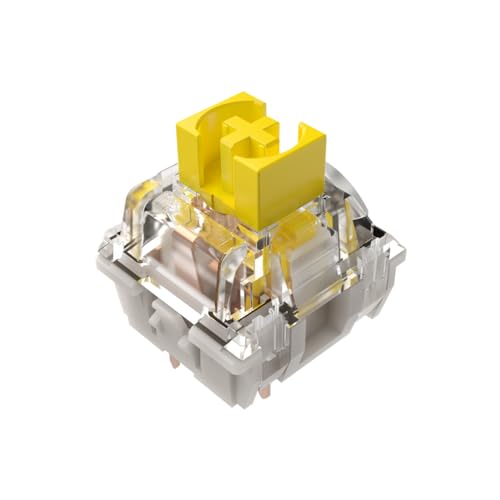
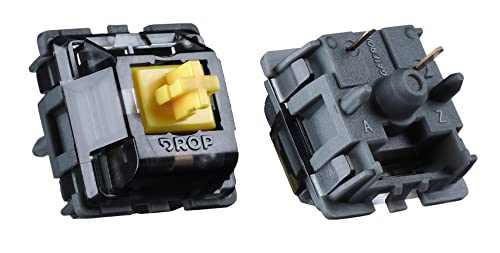
Drop Holy Panda X — the legend, productised
Badge: Best for the frankenswitch feel without the surgery; the benchmark every recipe is judged against.
- Type: tactile, PCB-mount 5-pin, quiet-tactile execution
- Weight: 65 g class
- Pack: 35 switches in this listing
- Role in this guide: the commercial descendant of the original Holy Panda frankenswitch
The Holy Panda X is what happens when a frankenswitch grows up and gets a factory. The original recipe — a particular housing married to a particular stem — produced the roundest, most emphatic bump in the hobby, and Drop’s X generation reproduces that character as a finished, consistent product, in a quieter-tactile execution suited to shared rooms. For the frankenswitcher, its role is double: it is a superb switch in its own right, and it is the reference standard. Build your hybrids, then type them against a row of Panda X switches; the recipes that survive that comparison are the ones worth a full board. Buying the descendant is also the honest shortcut for readers who love the legend’s feel and have no appetite for the operating table — no shame attaches; the factory’s consistency is its own virtue.
Strengths
- The famous round bump, reproduced consistently at factory scale
- Quiet-tactile manners for shared spaces
- The reference standard for judging your own recipes
Trade-offs
- Buying it teaches your fingers, not your hands — no craft is learned
- Small pack size; a full board needs several
- Its polish sets a bar home recipes rarely clear on the first attempt
Best for: tactile lovers and recipe judges. Not suited for: purists who want the surgery itself.

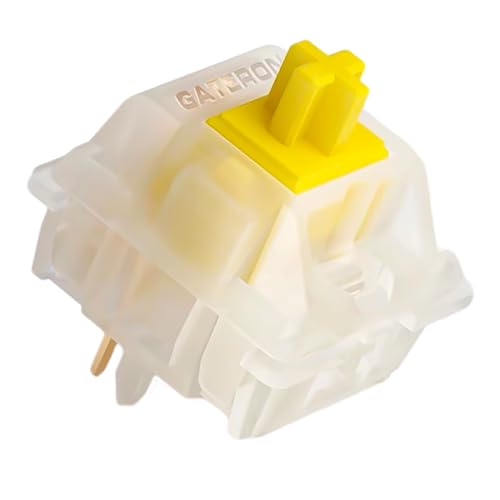
Gateron Milky Yellow Pro V2 — the housing-and-stem donor
Badge: Best donor for milky housings and smooth linear stems.
- Type: linear, pre-lubed, 5-pin, 50 gf class
- Pack: 72 switches
- Donor value: milky housings for deep-voiced builds; stems for smooth linear hybrids
- Also: an excellent complete switch if a recipe falls through
Every frankenswitcher’s shelf holds a Gateron milky switch, and the Milky Yellow Pro V2 is the current generation of that staple. As a donor it gives two gifts. Its milky housings are the hobby’s favourite sound treatment — a shell that deepens and softens whatever stem travels inside it, used in countless recipes to civilise a bright or harsh partner. Its stem is a smooth, well-finished linear slider that has calmed scratchier housings in hybrids across the community. And because the complete switch is itself one of the best budget linears sold, a failed experiment leaves you with a board’s worth of excellent switches rather than a bin of regrets — the donor equivalent of a safety net, and a real consideration when a recipe calls for buying two switches to build one.
Strengths
- Milky housings deepen and soften partner stems beautifully
- Smooth stems rescue housings with character but scratch
- The intact switch is excellent, so experiments carry no waste
Trade-offs
- Its voice is so distinctive that it can dominate a recipe
- As a linear donor it contributes no tactile event
- Popular stock; batches vary slightly across production runs
Best for: first-time hybrid builders and sound chasers. Not suited for: recipes needing a tactile stem donor.
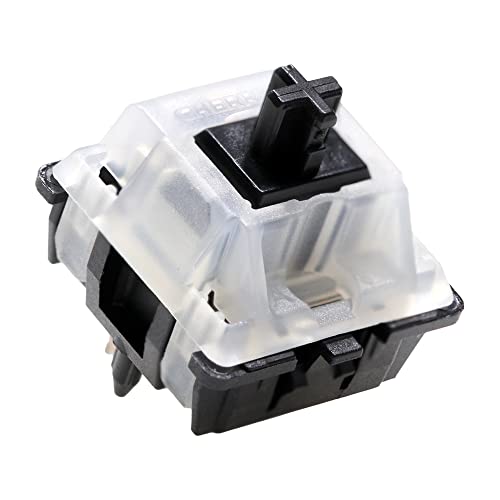
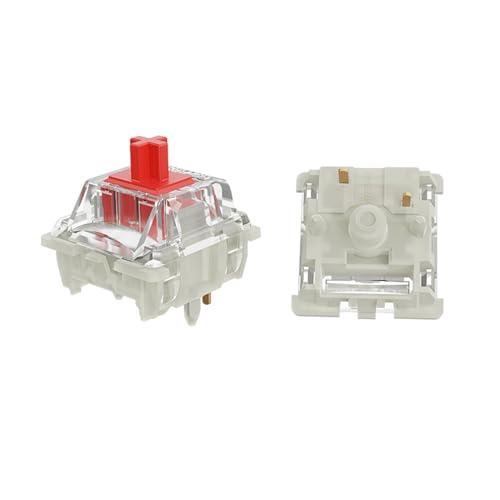
Cherry MX Black Clear-Top “Nixie” — the housing donor with a pedigree
Badge: Best donor for builders who want Cherry’s own vintage-style housings in their recipes.
- Type: linear, 5-pin, 63.5 g class
- Identity: the clear-top reissue of Cherry’s vintage-style black switch, sold under the community’s “Nixie” nickname
- Pack: 90 switches in this listing
- Donor value: housings with a distinctive deep voice and retro character
The Nixie is a donor with a story: Cherry’s clear-top black switch, reissued in the style of the vintage boards whose housings frankenswitchers once harvested from decades-old keyboards at considerable trouble. The clear top passes light like a modern switch while the housing’s material and moulding keep the deep, old-school voice that made the originals worth harvesting. As a donor it contributes that voice and Cherry-grade tolerances to any stem you marry into it — the classic use is a tactile stem in a Nixie housing, for a bump with a vintage bass line. Buying the reissue also retires a whole category of donor-hunting: no more desoldering relics to get the shells your recipe wants.
Strengths
- Vintage-style housings without harvesting old boards
- Deep voice and Cherry tolerances for partner stems
- Clear top keeps RGB builds possible
Trade-offs
- Firm spring class; many recipes will swap it out anyway
- Its character is strong enough to fight delicate stems
- A donor bought for housings leaves stems and springs as surplus
Best for: recipe builders chasing the vintage voice. Not suited for: builders who want a neutral, invisible housing.
In this guide
The donor shelf: what each part contributes, and how to stock it
Housings set the room
Think of the housing as the room the keystroke happens in. Its material is the room’s acoustics — milky and POM rooms are carpeted and deep; polycarbonate rooms are tiled and bright — and its tolerances are the room’s dimensions, deciding how much the stem may wander. Donor housings are bought for rooms: the Milky’s soft hall, the Nixie’s vintage parlour. When a recipe fails, it is most often because two strong rooms were combined and the keystroke cannot decide where it lives.
Stems carry the event
The stem is the actor. Its legs write the tactile script — the height, position, and roundness of the bump — and its pole decides how the final line is delivered, long poles landing early and loud, standard poles cushioned and late. A frankenswitch recipe is usually, at heart, a casting decision: a beloved stem, miscast in its factory housing, given a better room. The Holy Panda legend is exactly that — a stem whose performance deserved a different theatre.
Springs set the temperament
The spring is the director’s note on pacing: how the force gathers, how the return snaps, whether the press feels leisurely or urgent. Spring swaps are the cheapest frankenswitching of all — no donor switch is consumed, the spring library is small and reusable, and a single switch can be re-temperamented in minutes. Every beginner should start here, because the lesson is pure: change nothing but the spring, and learn how much of a switch’s personality was the spring all along.
Stocking the shelf honestly
A working donor shelf needs one smooth linear donor, one characterful housing donor, one tactile stem source you love, and a spring library across weights and lengths. The three picks in this guide cover the first two shelves and the benchmark; your tactile stem source should be the tactile switch your fingers already trust, bought as donors without guilt. Buy donors in switch-sized quantities, label everything the day it arrives, and keep a written log — the craft’s only real sin is the unlabelled baggie, from which no recipe has ever been reproduced.
How to build your first frankenswitch
Step 1: Choose one variable
Your first recipe changes exactly one organ. A stem into a new housing, or a spring into a stock switch. Two changed organs teach you nothing, because you cannot attribute the result — and attribution is the entire craft. Write the recipe down before you open anything.
Step 2: Open with the right tool, over a tray
A switch opener matched to your housings’ latch style, a tray with a lip, and tweezers. Work over the tray: springs are escape artists, and a frankenswitch session that ends on the carpet ends badly. The general switch-handling skills are covered in how to remove replace switches on a hot swappable keyboard.
Step 3: Assemble a row, not a switch
Build ten of the recipe and install them across the home row, with the parent switches flanking them for comparison. One hybrid switch is a curiosity; a row is a verdict. Type real work on it for days, not minutes — hybrids, like wines, have a second-day character that the first hour hides.
Step 4: Tune one sense at a time
If the row is close but not right, adjust the cheapest variable first: springs before stems, lubricant before parts. The craft’s finishing arts — a whisper of lube on a stem’s legs to soften a bump, film to tighten a loose housing — are covered in how to lube keyboard switches, and they rescue more recipes than any donor purchase.
Step 5: Log, label, and only then scale
Record the recipe, the verdict, and the date. Label the donor bags the session consumed. Only a recipe that survives a week and a log entry earns a full board — the discipline that separates a frankenswitcher from a person with a drawer of open switches, which is a distinction your future self will thank you for enforcing.
Common frankenswitch mistakes
The first is combining two celebrities: famous housings and famous stems whose characters were each designed to dominate, producing a switch that argues with itself. Recipes work by hierarchy — one star, one supporting organ — not by assembling an all-star team. The second is judging a hybrid in the first hour, before the parts have settled and your fingers have stopped noticing novelty; novelty is the craft’s most misleading flavour, and it evaporates by the third day. The third is lubing before testing: lubricant is a finishing decision that masks the very information — scratch, bump shape, spring noise — that the trial exists to reveal. Test dry, judge, then finish.
Fourth: ignoring the leaf. Aggressive stem swaps can stress the contact leaf in the bottom housing, and a hybrid that feels wonderful and registers erratically is a paperweight with good publicity. Test registration across the whole row, at speed, before scaling. Fifth: building for a sound you heard in a video, in a case you do not own — the recurring tragedy of this entire cluster of guides, and doubly tragic here, where the parts bill is two switches deep. Sixth: losing the thread of your own shelf. Unlabelled donors and unlogged recipes turn a craft into an archaeology of your own desk within a single season.
Famous recipes and what they teach
The Holy Panda teaches casting: a great stem in the wrong room is a rumour, and in the right room, a legend. The long tradition of milky-housing swaps teaches acoustics: that a shell can civilise almost any stem, and that half of what the hobby calls a switch’s sound is its housing’s. The vintage-housing recipes — the ones the Nixie reissue now serves without the harvesting — teach respect for tolerances and materials from an era when switches were built for terminals that could not fail. And the humblest recipe of all, the spring swap, teaches the craft’s deepest lesson: that a switch is a system, that its personality is distributed across four cheap organs, and that the builder who understands the distribution can tune almost any switch toward almost any taste. That lesson is why frankenswitching survives every wave of excellent factory switches, including the boutique wave documented in durock jwk tecsee boutique switches guide: the factories keep answering questions, and the frankenswitchers keep asking new ones.
Final recommendation
Start with a spring library and one variable. Graduate to the Milky Yellow Pro as your housing donor and the Nixie when a recipe wants the vintage voice. Keep a row of Holy Panda X switches as the standard your recipes must beat, and be honest when they do not — the descendant exists precisely because the original recipe was very, very good. Log everything. The craft’s rewards are real and cumulative: a shelf of understood parts is worth more than a drawer of famous switches, because the shelf can answer questions the drawer has never heard. Readers new to switch anatomy should ground themselves first in keyboard switches explained for beginners, and readers comparing the factory-made alternatives should see holy pandas vs glorious pandas tactile switch compared and the tactile field in cherry mx switches complete guide.
The economics and ethics of the parts bin
Frankenswitching has an honest cost structure that newcomers should face before the first donor order. A finished hybrid consumes its donors: the housing donor’s stem and the stem donor’s housing become shelf stock, useful only to future recipes. A builder who scales a recipe to a full board has therefore bought, roughly, two boards’ worth of switches — which is why the craft’s elders trial in rows and scale only verdicts. The offsetting truth is that the shelf is never really waste. Surplus organs are the currency of the next recipe, the lending library for friends, and the raw material of the second-hand exchange, where documented donor parts circulate briskly. The ethics are equally plain: sell or gift your surplus as what it is — parts, with their parentage named — and the bin stays honest. The one transaction the community frowns on is the unlabelled hybrid sold as a factory switch, a small fraud the craft’s log-keeping exists to prevent.
There is also a sustainability footnote the hobby rarely mentions: frankenswitching is reuse. Every harvested housing is a part kept in service, every recipe built from shelf stock is a switch that did not need manufacturing. The vintage-harvesting era carried that logic furthest — rescuing housings from boards older than their builders — and the Nixie reissue has retired the need, but the principle survives in every parts bin: the greenest switch is the one already on your shelf, waiting for its right stem.
Troubleshooting hybrids: when a recipe misbehaves
A hybrid that feels gritty usually has a stem and housing whose tolerances disagree — the stem’s rails are riding a housing channel moulded for a different slider. The cure is a different pairing, not more lubricant; grease hides friction it cannot fix and ruins the diagnostic value of the trial. A hybrid with an inconsistent bump across the row has a leaf problem or a stem-leg problem: check that no stem was seated against a stressed leaf, and that the donor stems themselves are uniform — a bent or worn donor leg writes its flaw into every housing it visits. A hybrid that sounds wonderful on the letter keys and hollow on the spacebar row is innocent; stabilised keys and case regions voice differently, and the recipe should be judged where it lives. And a hybrid that registers double-presses has a leaf that its stem is over-flexing — retire that pairing, however lovely it feels, because a frankenswitch that cannot be trusted electrically is a sculpture, not a switch.
A starter shelf, specified
For the reader who wants the shopping list version: one pack of the Milky Yellow Pro V2 as the standing housing-and-stem donor, one pack of the Nixie clear-tops when a recipe calls for the vintage room, a spring library spanning the weights you plausibly type at in two lengths, and one tactile donor — the tactile switch your fingers already love, bought in donor quantity. Add the Holy Panda X row as the benchmark when the budget allows. That shelf, with a log and a tray, supports a year of recipes: linear stems in milky rooms, tactile stems in vintage rooms, every spring temperament applied to both, and the finishing arts practised on combinations whose parents you can name. The shelf’s discipline matters more than its size. A small shelf, understood completely, outperforms a large one browsed at random — the same law this cluster’s guides apply to switch collections generally, stated here in its sharpest form because frankenswitching multiplies every unknown by every other unknown.
Frankenswitches for gamers and for writers
The craft serves both of this cluster’s great tribes, differently. Gamers frankenswitch for geometry: a light spring in a smooth housing for the movement cluster, a deliberate tactile in a deep housing for the ability keys, each zone of the board tuned like a racing car’s corners. The hybrid board that results looks eccentric and plays like an argument — every key’s feel is a decision. Writers frankenswitch for the long session: a bump tuned to exactly the confirmation their prose rhythm wants, in a housing voiced for the hour they write in, on springs that pace a ten-thousand-word day without taxing it. Both tribes should note the craft’s standing warning with fresh force: a hybrid board is a personal instrument, and its resale or lending value is mostly sentimental. Build it for the hands that will live on it, which are yours.
Frequently asked questions
What is a frankenswitch, exactly?
A switch assembled by its owner from the parts of two or more donor switches — typically one switch’s housing, another’s stem, and sometimes a third’s spring — to create a feel or sound no factory sells. The name jokes about the surgery; the practice is the custom hobby’s founding craft, and several famous commercial switches, the Holy Panda line above all, began as frankenswitch recipes.
Can I buy a frankenswitch ready-made?
Not truly — a ready-made hybrid is, by definition, a product, and this guide’s links honour that distinction. What you can buy are the donor components the craft uses, plus commercial descendants like the Holy Panda X, whose recipe reproduces the original frankenswitch’s character at factory consistency. Some specialist vendors sell hand-assembled hybrids, which is the closest the market comes; the craft’s own answer is that building it is the point.
What tools do I need to start frankenswitching?
A switch opener matched to your housings, tweezers, a tray, a switch puller, and somewhere to write recipes down. Lubricant and films are finishing tools for later. The whole kit is modest, and the most important instrument is the log: frankenswitching without records is just opening switches, and the records are what turn experiments into a shelf of reproducible recipes.
Which part swap makes the biggest difference?
The stem, for feel: it carries the tactile event and the landing. The housing, for sound: it is the room the event happens in. The spring, for temperament: it is the cheapest and most reversible change, which is why this guide starts beginners there. A recipe is a decision about which of those three senses you are trying to change, and the donor shelf should be stocked accordingly.
What is the best way to photograph and document a finished hybrid board?
Plainly, in daylight, with the recipe card in the frame. The craft’s records are working documents, not portfolio pieces, and a clear photograph of the board beside its log entry — parents named, spring noted, date written — has settled more ownership and recipe questions than any glamour shot. Document for the builder you will be in two years, squinting at a shelf of similar switches; that builder deserves evidence, not aesthetics.
Last word: what should be in the first line of my recipe log?
The date, the parents, and the hope — in that order. “Milky housing, my tactile stem, its own spring; hoping for the bump with a softer room.” Every entry after that is the hope meeting the evidence. Keep the log for a year and you will own something no store sells: a written record of your own hands learning, recipe by recipe, exactly what they love.
What if my favourite switch is already perfect?
Then your frankenswitching education can be entirely theoretical, and this guide envies you in one sentence. Keep a spring library anyway — perfection’s weight drifts with hands, seasons, and desks — and let the tray stay closed until the day the perfect switch is one sense wrong. On that day, you will be glad the craft exists and that somebody wrote down how it works.
Does lubing count as part of a recipe?
Yes — record it as an ingredient, with the lubricant and the places it touched, because two builders following the same parts list with different finishing are building different switches. The standing order in this guide is test dry, judge, then finish: lubricant applied before the verdict hides the evidence, and lubricant omitted from the log makes the recipe a rumour. Treat it like the fourth organ and the log stays honest.
What is the best way to share a recipe with the community?
Publish the log, not the legend: the exact parents with their batches where known, the spring’s weight and length, any finishing you applied, the case and caps you judged it in, and your honest week-two verdict including what it does badly. Recipes shared at that standard get built, tested, and improved by other hands — which is how a private combination becomes a named citizen of the craft, and how the next Holy Panda will actually happen.
One sentence for the reader with a tray of open switches in front of them?
Change one thing, write it down, and type on it for a week — the whole craft, its legends and its logbooks, is that sentence repeated with better donors.
Are vintage housings still worth harvesting?
Rarely, now that reissues like the Nixie serve the same recipes from new stock — the harvest made sense when the housings existed only inside ageing boards. A genuine vintage housing in good condition remains a fine donor and a piece of the craft’s history, but no recipe in this guide requires one, and beginners should spend their evenings building rather than desoldering relics. Honour the era; buy the reissue.
What does frankenswitching teach that buying cannot?
Attribution. A buyer knows which switches they like; a frankenswitcher knows which organ to thank, which to blame, and which to change — a diagnostic skill that transfers to every future purchase, build, and recommendation they will ever make. It is the difference between having taste and understanding it, and it is why this guide treats the craft as the hobby’s university: the tuition is donors, the degree is permanent, and the graduation piece is a switch with your name in its log.
How do I know when a recipe is finished?
When a week of typing produces no new complaint and the log entry writes itself in the past tense. Finished recipes have a recognisable stillness: you stop reaching for the opener. Protect that stillness — the urge to improve a finished recipe is the craft’s tax on contentment, and it should be paid only from a second board, never by reopening the one that types your life.
What is the best first purchase after reading this guide?
The donor, not the dream: one pack of the Milky Yellow Pro V2, a switch opener, and a notebook. That trio, plus switches you already own, supports your first month of recipes. Every grander purchase should wait for the log’s evidence about which senses you actually chase — the shelf you build from evidence will fit you; the shelf you build from enthusiasm will fit the internet.
Is there a frankenswitch for quiet offices?
Yes — the silent stem is the most portable organ in the craft, carrying its damping into whatever housing hosts it, and a silent stem in a deep milky housing is among the quietest mechanisms that still feels mechanical. Judge it by the office’s real test, which is the return stroke at night-quiet volume, and remember the Holy Panda X in this guide proves the market agrees: its quiet-tactile execution exists because the legend’s fans needed a version their colleagues could live with.
What do I do when two recipes both claim to be my favourite?
Live with each for a full week of real work, on the whole board if you can bear the swaps, and let the second week’s boredom arbitrate — novelty flatters challengers, and only time strips it. The recipe that survives being ordinary is the favourite; the other goes into the log as a honoured finalist and onto the shelf as a known quantity. Many builders rotate the two seasonally and call that, correctly, a collection.
Which keys benefit most from a hybrid treatment?
The spacebar first — the largest key, the most heard, the one whose switch works alone under a stabiliser and rewards a deeper, firmer recipe. Then the modifiers your style leans on, then the alphas if a recipe earns them. Many settled frankenswitch boards are, on inspection, factory boards with a hybrid heart on five or six keys — which is not a compromise but the craft’s most efficient form: surgery only where the patient asked for it.
Final question: is frankenswitching a phase or a destination?
For most builders, a season — the education that teaches them what switches are, after which factory and boutique switches are chosen with a surgeon’s eye. For a stubborn and happy minority, it is the hobby itself, and their shelves are the community’s research institutes. Either outcome repays the tuition: you will never press a key again without knowing, precisely, what you are feeling and which organ to thank for it.
What is the craft’s oldest lesson?
That the switch you want may already exist inside two switches you can buy. The factories design for the distribution’s middle; the tails of taste — very round bumps, very deep voices, very particular springs — are served by combination. Every era of the hobby rediscovers this, from the vintage-harvest years to the milky-housing wave to whatever next season’s shelf produces. The parts change; the arithmetic of combination does not.
Should I frankenswitch my only keyboard’s switches?
Not for your first recipes. Keep a working board intact while the donor shelf and the log are young; experiments belong on a second board or a trial row you can afford to leave mid-verdict. Once a recipe is proven and logged, promoting it to your main board is the craft’s natural graduation — and by then you will own the parents, the spares, and the knowledge to undo it in an evening if the season changes your mind.
What separates a great recipe from a merely good one?
Hierarchy and restraint. The great recipe has one idea — this stem, given this room — and every other choice serves it quietly. The merely good one has three ideas competing politely. When you read the community’s legendary recipes with that lens, their plainness is striking: famous parents, single variables, years of refinement. Aim for a recipe you can state in one sentence; if the sentence needs a semicolon, the switch probably does too much.
Do frankenswitches void anything or risk the keyboard?
No more than any switch swap does: the board sees an MX-pattern switch and asks no questions about its parentage. The risks are all inside the switch — a stressed leaf, a mismatched stem — and they are the recipe’s risks, borne by the parts, not the keyboard. Hot-swap sockets should be treated gently during the many swaps a trial season involves, as with any switch experimentation; that is the board’s only stake in your craft.
What is the one recipe this guide would have you build first?
A tactile stem you already love, seated in the Milky Yellow Pro’s housing, on its own spring, typed against the unmodified parents for a week. It is the Panda pattern reduced to a homework exercise: one star, one room, no other variables. If the result delights you, the craft has you, and the Nixie shelf is your next semester. If it does not, your log has its first honest entry, and the donors return to the shelf unharmed.
How long does it take to build a full board of frankenswitches?
An unhurried evening for the assembly of a recipe you know, once the donors are open and sorted — the opening is the slow part, and batch discipline (all housings first, then all stems, then all springs) turns it into meditation rather than labour. Your first board will take longer and teach more. Either way, the clock is part of the craft’s price, and builders who resent it should buy the descendants and spend the evening typing instead.
What safety rules apply to opening switches?
Gentle ones: work over a tray, never pry against the contact leaf, keep springs corralled, and stop when a housing resists — force is the sound of a latch becoming a casualty. The parts are small and forgiving, the tools are blunt, and the only real hazard in the craft is to the switches themselves and to the builder’s patience. Children and pets should be audience rather than assistants; a loose spring is a delicacy to neither.
Can I frankenswitch a single key?
Yes, and some of the craft’s best work lives on single keys: a spacebar tuned heavier and deeper than the alphas it serves, an Enter key with a ceremony the letters do not need, an Escape with a tactile signature that confirms the press blind. Single-key hybrids are also the cheapest tuition in the craft — one donor pair, one verdict — and many builders’ first logged recipe is a spacebar they can still describe years later.
What is the frankenswitcher’s view of boutique switches?
Respect, with a raised eyebrow kept in reserve. The boutique tier productises what the craft does by hand — recipes, finished and warranted — and its best lines are frankenswitches that went to finishing school. The eyebrow is for prices charged for recipes the shelf could build in an evening. Both attitudes are healthy, and the wisest builders hold them simultaneously: buy the boutique switch whose recipe you cannot reproduce, and build the ones you can.
How do I test a hybrid’s sound fairly?
In your own case, with your own keycaps, at your own desk, against its parents installed in the same board on the same day. Every other test — a bare switch in the hand, a recording, a friend’s flagship build — measures something else and reports it as the recipe. The frankenswitcher’s sound lab is a single board with three rows: parent, parent, hybrid. That arrangement has settled more arguments than the entire internet’s worth of sound tests, including the ones in videos you will inevitably watch anyway.
Which donor should I buy first?
The Milky Yellow Pro V2 in this guide, for three compounding reasons: its housings serve the widest range of recipes, its stems are independently useful, and its intact form is a genuinely good switch, so the purchase cannot be wasted. Add the Nixie housings when a recipe wants depth and pedigree, and the tactile donor your own fingers nominate. That order — versatile first, characterful second, personal third — is the shelf-building sequence this guide recommends to every beginner.
What is the difference between a frankenswitch and a modded switch?
A modded switch keeps its identity: lubed, filmed, or spring-swapped, it remains the switch it was, improved. A frankenswitch changes identity: its organs come from different parents, and its name — if it earns one — is new. The line blurs at the spring swap, which this guide counts as the craft’s kindergarten rather than its graduation. The distinction matters for honesty in the log and in the marketplace: a modded switch is sold as itself, a frankenswitch is sold as its recipe.
Is a frankenswitch a good gift?
A built row of a proven recipe, with its parentage written on a card, is one of the hobby’s most personal gifts — it says you know the recipient’s taste and spent evenings on it. A bag of unlabelled parts is the opposite gift. If you give hybrids, give them finished, documented, and in trial quantity, with the recipe included so the recipient can scale what they love. The Holy Panda X row in this guide is the factory-made alternative when your evenings are spoken for.
How do I keep stems and housings organised?
Small labelled containers, one per parent switch, with the recipe log cross-referencing them by name and date. The system matters less than the religion: nothing enters the shelf unlabelled, nothing leaves it unlogged. Builders who keep that rule for a single season find their shelf has become an instrument they can play; builders who do not, own a drawer of anonymous plastic and a hobby that quietly stops being fun.
Do frankenswitches work in any keyboard?
In any board that accepts their parents: standard MX-pattern sockets and keycaps, with the usual 5-pin and 3-pin considerations inherited from whichever bottom housing the recipe uses. A hybrid has no compatibility of its own — it borrows its housing’s. Soldered boards accept hybrids exactly as they accept any switch, with the standing advice that recipe trials belong in a hot-swap board until the verdict is final.
What should I do with a failed recipe?
Disassemble it, return the organs to their labelled bags, and log the failure with the same care as a success — the failed recipe is data, and its lesson (these two characters fight; this housing swallows that bump) will save a future recipe’s donors. The craft’s veterans are distinguished less by their successes than by the quality of their failure logs. Nothing about a failed frankenswitch is wasted except the evening, and even that taught your hands the surgery.
Can frankenswitching fix a switch I almost like?
That is its best use. A switch that is one sense wrong — right bump, wrong voice; right voice, wrong spring — is a recipe waiting for its missing organ, and the fix is usually a single swap aimed at the wrong sense alone. The discipline is diagnosis: name the wrong sense precisely, in writing, before opening anything. Vague dissatisfaction produces random hybrids; a precise complaint produces a recipe with a thesis, and theses can be tested, logged, and — when they fail — learned from.
What is a “frankenswitch” name, and how do recipes get them?
Community recipes acquire nicknames the way storms do — bestowed by usage, not by committee — usually honouring the parents, the builder, or the result’s character. The names are the craft’s folk taxonomy, and learning them is part of learning the literature: a recipe with a name has been built by many hands and survived, which makes a named recipe the closest thing frankenswitching has to a peer-reviewed result. When you invent a combination that deserves keeping, log it plainly; if the community ever names it, the log is your priority claim.
Are there frankenswitch recipes for beginners that are known to work?
The community’s nursery recipes share a shape: a loved stem, a forgiving housing. A smooth linear stem in a milky housing is the canonical first build because both parents are tolerant and the result is reliably pleasant. A tactile stem in a milky housing is the second — the Panda pattern in miniature. Beyond those, treat published recipes as hypotheses with good references: your case, your caps, and your hands still sit in judgement, and the log you keep is worth more than the recipe you borrowed.
What does “stem swapping” do to a switch’s sound?
More than newcomers expect. The stem is the moving part in every contact the switch makes — its pole strikes the floor, its top strikes the housing’s ceiling — so its material and length set the landing’s pitch and the return’s tick. A long-pole stem deepens and focuses the landing; a POM stem softens it; a standard stem in a new housing mostly keeps its own voice while the room changes around it. Recipe builders who chase sound should think stem-first and housing-second, which is the reverse of the order they usually shop in.
How many donor switches do I need for a full-board recipe?
Plan on a full set of each parent: a housing donor per key and a stem donor per key, with the surplus organs returning to the shelf. That is the craft’s real price of admission at board scale, and it is why every guide in this tradition, this one included, insists on the row trial first. A recipe that has survived a fortnight on the home row has earned its donors; one that has not would have consumed them for a drawer.
What is the easiest frankenswitch to make?
A spring swap: open a switch you own, exchange its spring for one of a different weight or length, close it, and type. Nothing is consumed, everything is reversible, and the lesson — how much of the switch was its spring — is the craft’s foundation. The second easiest is a stem into a milky housing, the pairing this guide’s Gateron donor exists for. Both can be done in an evening with the modest kit the earlier answer describes.
Do frankenswitches last as long as factory switches?
The parts do — they are factory parts, with factory wear ratings, and a well-matched hybrid ages like its parents. The caveat is matching: a stem that rides its housing under friction the pairing was not designed for will wear both faster, which is why this guide treats grittiness as a verdict rather than a challenge. Matched hybrids, logged and lubed with restraint, serve for years; the community’s oldest recipes are still in daily service.
Can I frankenswitch silent or clicky switches?
Yes, with adjusted expectations. Silent stems carry their damping pads with them into new housings, so a silent frankenswitch is usually a stem-led recipe whose quiet survives the move — provided the new housing’s floor meets the pads kindly. Clicky stems carry their click mechanism in the stem or jacket, and they transplant their voice faithfully, sometimes too faithfully: a click stem in a deep milky housing is one of the craft’s strangest and most debated creations. Both are legitimate recipes; log them like any other.
Is frankenswitching worth it when factory switches are so good now?
As a route to a specific, personal keystroke, yes — factories optimise for the middle of the taste distribution, and frankenswitching is how the edges get served. As a route to saving money, no: recipes consume two switches to build one. The honest accounting is that you are buying fit and knowledge, not bargains, and both compound — a builder with an understood shelf answers new taste questions in an afternoon.
What is the Holy Panda, and why does it matter here?
The hobby’s founding recipe: a tactile stem and housing combination, assembled by enthusiasts, whose round, emphatic bump became so beloved that it was commercialised — the Drop Holy Panda X in this guide is its current descendant. It matters because it proves the craft’s premise: that owners with parts bins can discover feels the factories had not, and that the factories, wisely, sometimes follow them.
Related reading: durock jwk tecsee boutique switches guide · gateron switches complete guide · advanced keyboard modding techniques guide