Disclosure: As an Amazon Associate, kajuandouglas.com earns from qualifying purchases. Links on this page are affiliate links; they cost you nothing extra. Prices and availability change often, so check the current Amazon listing before you buy.
Five names dominate the mainstream switch market, and this cherry mx vs gateron vs kailh vs outemu vs razer switches which is best comparison exists to give each of them a fair hearing in one room. Cherry is the standard’s owner. Gateron is the feel-and-sound challenger. Kailh is the engineer, with its sealed Box designs and its click bars. Outemu is the people’s manufacturer, putting honest switches into more boards than anyone. Razer is the gaming giant that built its own switch line to control its keyboards’ destinies. Six verified anchor packs represent them here — one or two per brand — and the verdict, stated early so the detail can be trusted, is that “best” splits by job: each brand is the right answer to a different question, and this article’s work is matching the questions to the names.
Cherry Mx Vs Gateron Vs Kailh Vs Outemu Vs Razer Switches Which Is Best: The Short Answer
For the reference standard and the longest horizon, Cherry. For the stroke, the sound, and the full-board budget, Gateron. For engineering character — sealed mechanisms, decisive click bars, spill-resistant designs — Kailh. For sheer value in bulk and for the world’s most proven budget boards, Outemu. For a gaming ecosystem’s own switches, tuned to its keyboards and its software-minded audience, Razer. The sections below defend each clause with the anchor switches themselves, score the five brands across the criteria buyers actually use, and end with a decision guide that starts from your desk rather than from any logo.

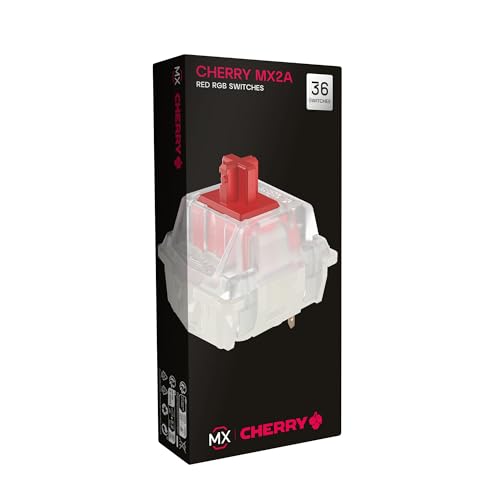
CHERRY MX2A Red — the standard, represented
Badge: Best for permanence, consistency, and the recipe that never changes.
- Type: linear, light spring class, smooth and direct
- Kit: 36 switches, RGB housing, current MX2A generation
- Character: neutral and uniform — the control sample of the industry
- Claim: the switch every other switch is described against
Cherry’s representative makes the brand’s whole argument by being unremarkable in the best sense: a hundred of these behave like one, the recipe will be buyable for years, and the entire keycap and socket world is built around its pattern. In a five-brand room it is the switch with the least theatre and the most infrastructure, and for a board meant to be a fixture, that trade is the wisest one on the table.
Strengths
- Unmatched consistency and recipe permanence
- The ecosystem’s reference for fit, caps, and advice
- Current-generation smoothness in the MX2A kits
Trade-offs
- Neutral voice; little sonic character of its own
- Kit economics sit above the bulk brands’
- Narrower catalogue than the challengers’
Best for: fixtures, purists, and long-term boards. Not suited for: sound chasers or bulk conversions on a budget.

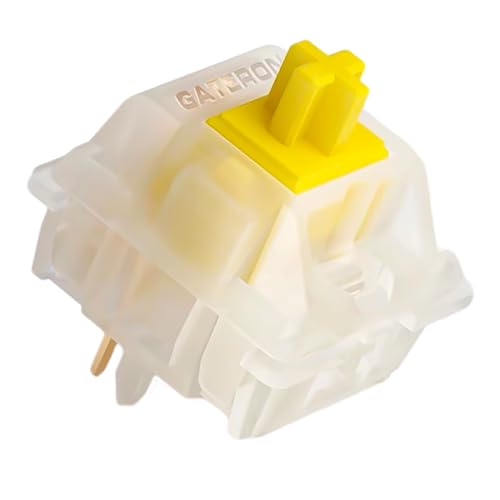
Gateron Milky Yellow Pro V2 — the people’s enthusiast switch
Badge: Best for sound, smoothness, and full-board value.
- Type: linear, pre-lubed, 5-pin, 50 gf class
- Pack: 72 switches, milky housing
- Character: deep-voiced and factory-smooth
- Claim: the stroke that made a challenger into a co-standard
Gateron’s anchor is the switch that taught the mainstream what factory lubrication and acoustic design could do at a friendly division of price by count. Its milky housing composes a deep, soft voice in almost any case, and its pack logic makes the full-board decision easy. Against Cherry it trades a shade of austerity for a surplus of pleasure, and most hands, given a blind week, take the trade.
Strengths
- The mainstream’s favourite sound in a linear
- Factory finish that needs nothing from the owner
- Bulk pack economics for whole layouts
Trade-offs
- Milky housing mutes backlighting
- Set consistency a shade looser than Cherry’s
- Soft voice unsuited to bright, clacky briefs
Best for: custom builds and sound-first buyers. Not suited for: RGB showcases or absolutists about uniformity.

Kailh Box Red — the engineer’s answer
Badge: Best for stability, spill resistance, and crisp high-volume builds.
- Type: linear, box-stem design, 3-pin, 45 g class
- Protection: IP56 dust and water resistance for the mechanism design
- Pack: 120 switches, via the Glorious pack
- Character: crisp, stable, and lively
Kailh’s Box architecture wraps the contact mechanism and collars the stem, and the dividends are the two things ordinary switches cannot promise: very low wobble and a mechanism that shrugs off the dust and splashes of real desks. The Box Red is the line’s straight linear — brighter and crisper than the Gateron beside it — and in its very large pack it is also a bulk contender. Kailh’s wider claim on this comparison rests on engineering range: the same house makes the click-bar switches that own the clicky category’s high end, a depth the kailh box switches complete guide explores in full.
Strengths
- Box-stem stability and genuine environmental resistance
- The largest pack in this comparison
- A crisp, alert feel that gaming boards flatter
Trade-offs
- Brighter voice than the deep-sound favourites
- Box stems deserve a gentle first fitting with very old keycaps
- Its engineering virtues are wasted in a pristine, quiet studio
Best for: messy desks, big layouts, and stability seekers. Not suited for: deep-sound purists.

Outemu Red — the world’s workhorse
Badge: Best for honest bulk value and first boards everywhere.
- Type: linear, 3-pin, dustproof design, 45 gf class
- Pack: 65 switches
- Character: light, simple, and serviceable
- Claim: more keyboards run on this class of switch than on any boutique line
Outemu’s representative will not win a sound test against the Gateron or a consistency audit against the Cherry, and it does not need to: its argument is that a light, honest linear, in a generous pack, at the friendliest division in the room, is what most keyboards on Earth actually require. It is the switch of first boards, second desks, gifts, and spares pools, and its enormous installed base makes its behaviour the most predictable quantity in this entire comparison. The longer appreciation of the brand lives in outemu switches are they good.
Strengths
- The friendliest bulk economics in the five-brand field
- Light, easy press that suits gaming and new typists
- Proven in more boards than any rival here
Trade-offs
- Plainest stroke and voice of the five anchors
- More sample variance than the premium brands
- 3-pin only, with the least rigid seating
Best for: first builds, big counts, and second desks. Not suited for: flagship custom builds.

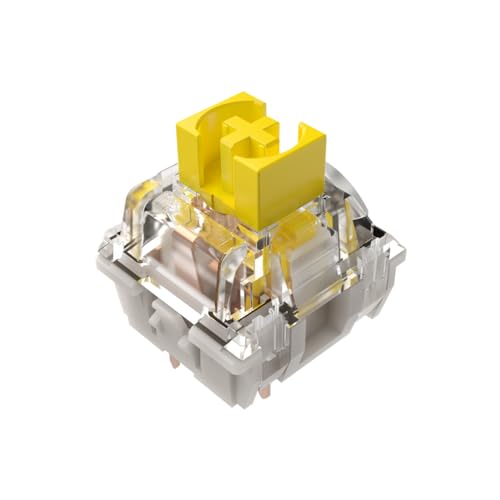
Razer Yellow — the gaming house’s own linear
Badge: Best for Razer keyboard owners and gaming-first replacements.
- Type: linear, third-generation Razer mechanical switch
- Housing: clear, with LED lens for the brand’s lighting ecosystems
- Format: 3-pin connectors, pack for the brand’s boards and builders
- Character: light and fast, tuned for gaming duty
Razer’s Yellow is the sound of a gaming company deciding that its keyboards’ hearts were too important to outsource. The third-generation design is a light, quick linear in a clear, light-friendly housing, specified for the rapid, repetitive duty of gaming boards and rated by its maker for long service. As a loose switch its natural constituency is the Razer ecosystem — owners replacing, zoning, or extending boards in the brand’s world — and judged there, it is exactly the right part: the factory character, available by the pack.
Strengths
- The authentic switch for Razer’s mechanical boards
- Light, fast linear character tuned for gaming
- Clear housing serves backlit builds properly
Trade-offs
- Its ecosystem logic is narrower than the universal brands’
- Less community tuning knowledge than Cherry or Gateron
- Character is gaming-first; typists may prefer rivals’ linears
Best for: Razer board owners and gaming-first builders. Not suited for: brand-agnostic custom builds chasing a specific sound.

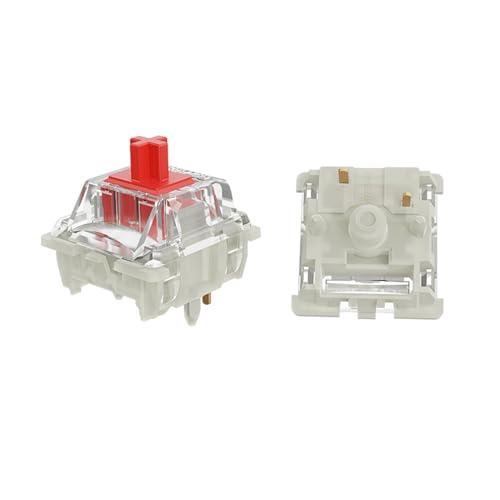
Razer Orange — the gaming house’s tactile
Badge: Best for tactile feedback inside the Razer ecosystem.
- Type: tactile, third-generation, box-style cross stem
- Actuation: 2.0 mm class at a 50 g class operating force, per the maker’s specification
- Pack: 36 switches
- Character: a definite bump without a click’s volume
The Orange completes Razer’s pair: where the Yellow is the speed entry, the Orange is the feel entry, giving the brand’s boards a tactile option with a clear bump and a transparent housing for the lighting. Its box-style stem keeps the cap steady through the bump, and its specified actuation sits in the classic tactile territory. Like its sibling, it is best understood as an ecosystem part with genuine merit — the right tactile for a Razer board, and a respectable one beyond it.
Strengths
- Clear tactile feedback at gaming-friendly weight
- Box-style stem keeps keycaps stable
- The matching tactile for Razer-board owners
Trade-offs
- Ecosystem-first positioning limits its custom-build following
- Bump character is less documented by the community than rivals’
- Smaller pack than the bulk brands offer
Best for: Razer owners wanting tactility, and deliberate players. Not suited for: tactile connoisseurs, who should look to the boutique guide.
In this guide
The five brands, criterion by criterion
Consistency and the standard
Cherry first, by design and by decades. Gateron’s current lines follow respectably; Kailh’s Box line is notably uniform within its designs; Outemu accepts wider bands as the price of its tier; Razer’s switches are consistent within an ecosystem that controls its own boards. Verdict: Cherry.
Sound and stroke pleasure
Gateron’s mainstream lead, earned by its milky housings and factory finish. Kailh’s click bars own the clicky summit, a category none of the other anchors contest. Cherry is neutral, Outemu plain, Razer bright and functional. Verdict: Gateron for linears, Kailh for clickies.
Engineering range
Kailh. Sealed box mechanisms, click bars, speed geometries, low-profile lines — no other brand in the five redesigns the switch as often or as variously. Cherry innovates at generational pace on purpose; the others iterate within the classic pattern. Verdict: Kailh.
Value in bulk
Outemu’s home ground, with Kailh’s big Box packs and Gateron’s mid-size boxes pressing the claim. Cherry and Razer sell smaller kits at ecosystem and standard premiums. Verdict: Outemu, with Kailh close behind on pack size.
Gaming identity
Razer’s switches exist for gaming boards and are tuned, housed, and lit for that world; Cherry answers with the Speed Silver’s geometry; Gateron and Kailh supply half the enthusiast gaming scene between them. For a branded gaming ecosystem, Razer; for geometry, Cherry; for feel, the challengers. Verdict: split, by what “gaming” means at your desk.
Ecosystem and permanence
Cherry’s pattern is the ecosystem — everyone else’s switches are, in a sense, guests in its house. Razer runs the opposite model, a walled garden kept to a high polish. Gateron, Kailh, and Outemu live as citizens of the open standard. Verdict: Cherry for the open world’s permanence, Razer for its own garden’s coherence.
The decision guide
Start with the board’s job. A permanent fixture argues Cherry. A tuned instrument argues Gateron. A board that lives dangerously — spills, dust, travel — argues Kailh. A board that must exist at all, on a real budget, argues Outemu. A board already inside Razer’s world argues Razer, because matching the ecosystem’s own parts is simply correct maintenance. Then check the type: the brand verdicts above are stated for the mainstream linears and tactiles in this guide, and they hold loosely across types, with Kailh’s click-bar exception noted. Finally, remember that all five brands share sockets and caps: the decision is revisable, zonable, and survivable, which is more than can be said for most five-way choices in technology. The two-brand version of this argument is conducted in cherry mx vs gateron switches which is better, and the foundations are in keyboard switches explained for beginners.
How to test five brands without buying five boards
Step 1: Anchor on type, not brand
Choose your type first — linear, in most gaming and mixed cases — and compare the brands inside it. Cross-type comparisons measure the type and credit the logo.
Step 2: Build one row per brand in one board
A hot-swappable board, one case, one set of caps: five rows, five brands, one honest afternoon of typing and gaming on each.
Step 3: Record and listen from the room
Sound separates these brands more than feel does at the mainstream level. Judge it from the listener’s chair, where it will actually be judged.
Step 4: Interrogate your own use case
Write down the board’s job in one sentence before the trial, and score each row against that sentence. Trials without a brief crown whichever switch is most novel, and novelty is the one judge this guide does not trust.
Step 5: Commit by zone if the verdict splits
Five brands can coexist in one board more gracefully than in one opinion. Zone the winner of each criterion where that criterion lives, and document the map.
Common mistakes in five-brand shopping
The first is importing loyalty from other products: a fine Razer mouse says nothing about its switches, and a beloved Cherry board from 2015 is running a different generation than the kits in this guide. The second is judging a brand by its cheapest line or its oldest reputation — every brand here has moved. The third is forgetting that Outemu and Kailh switches live inside millions of boards sold under other names, so your hands may already have voted in this election without knowing the candidates. The fourth is treating the boutique tier as a sixth contestant that invalidates the five: the boutiques are a different market with different economics, given their own guide in this cluster, and the mainstream five remain the right comparison for most boards.
Fifth: assuming the ecosystem brands’ switches are captive. Razer’s packs are sold as parts, Cherry’s kits fit everyone’s boards, and the open pattern underneath all five names means the walls in this market are low and the gates are wide. Sixth: deciding by the loudest voice in a forum thread, where the newest line from any brand is always the best switch ever made until the next one ships. The rows-in-one-board trial exists to protect you from exactly that weather.
Final recommendation
If your desk demands one name: Gateron for the greatest number of typical builders, on the strength of its stroke, its sound, and its packs; Cherry for the fixture-builders and the standard-keepers; Kailh for the engineers and the click devotees; Outemu for the realists and the first-timers; Razer for the citizens of its ecosystem. The five brands are best understood not as a podium but as a map — and a buyer who knows where their desk sits on it does not need a winner. They need the right name, which this guide has tried to make findable.
Five brands, five philosophies
It clarifies the whole field to state what each company believes a switch company is for. Cherry believes in the standard: a switch is a specification, kept faithfully, so that an industry can be built on it. Gateron believes in the stroke: a switch is an experience, refined relentlessly, and the catalogue is a conversation with the people who feel it. Kailh believes in the mechanism: a switch is an engineering problem that can always be re-solved — sealed, barred, shortened, magnetised — and its history is a trail of redesigns. Outemu believes in the multitude: a switch is a component the whole world should be able to afford, and quality at volume is its own form of excellence. Razer believes in the system: a switch is one organ of a gaming machine that includes the board, the lighting, the software, and the brand’s whole competitive theatre. A buyer choosing among the five is choosing among those beliefs as much as among the parts, and the choice tends to stick — not because the sockets lock you in, but because a philosophy that fits your desk keeps fitting it.
The prebuilt iceberg: where these brands actually live
Loose switches are the visible tip of this market; the mass of it is switches soldered or socketed inside other companies’ keyboards, and the five brands divide that hidden world instructively. Cherry’s name appears on specification sheets as a promise. Gateron’s switches power the enthusiast end of the prebuilt market and much of its value end besides. Kailh’s mechanisms live inside gaming boards from many houses, including designs it engineered for partners. Outemu is the iceberg’s largest single mass — the default heart of the world’s inexpensive mechanical keyboards, typed on daily by millions who will never learn its name. Razer, alone among the five, keeps its switches largely for its own boards, which is the ecosystem philosophy expressed as distribution. Understanding the iceberg matters because it calibrates the loose-switch market’s opinions: the brands the forums discuss loudest are not always the brands the world types on most, and both facts belong in a complete comparison.
What the next few years probably hold
A complete guide may glance forward, carefully. The mainstream five now compete under pressure from two directions: magnetic and optical technologies from above, promising programmable actuation, and the boutique makers from the side, promising character. The likely responses are already visible in embryo — Cherry refining its standard and extending into new formats, Gateron multiplying materials and lines, Kailh engineering across every switch technology at once, Outemu raising the floor of the budget tier year by year, Razer tightening its ecosystem’s integration. For the buyer, the forecast’s practical content is reassuring: the MX pattern’s installed base is so vast that all five brands will support it for years, and a switch bought from any of them today is a safe citizen of tomorrow’s boards. Buy for your desk’s present job; the future of this market is unusually committed to remaining compatible with it.
Brand by brand: the honest weakness of each
Fair hearings include the charges. Cherry’s weakness is pace: its catalogue evolves at a generational rhythm in a market that rewards seasons, and a buyer chasing novelty will feel underserved. Gateron’s weakness is sprawl: its lines multiply and revise quickly enough that yesterday’s beloved recipe can be hard to re-buy identically, and the catalogue demands homework. Kailh’s weakness is focus: its engineering restlessness produces brilliance and occasional oddity in the same catalogue, and the buyer must know which designs are the flagships. Outemu’s weakness is refinement: at its tier, variance and plainness are structural, and no amount of brand loyalty should pretend otherwise. Razer’s weakness is openness: its switches make the most sense inside its own boards, and the custom community’s knowledge, parts culture, and resale market are thinner around them. None of these weaknesses is a scandal; each is the shadow of the corresponding strength, priced into the brand’s offer. A comparison that printed only the strengths would be a brochure for five companies at once.
The tactile and clicky map across five brands
Because the anchors in this guide lean linear, the other types deserve a map of their own. In tactiles, the mainstream argument runs from Cherry’s restraint through Gateron’s presence to Razer’s ecosystem bump, with Kailh and Outemu fielding serviceable entries at their tiers; the connoisseur’s tactiles live above all five, in the boutique guide. In clickies, Kailh’s bars set the pace, Cherry’s jacket is the classic, Gateron’s Blue the polished traditionalist, and Outemu’s the world’s starter click. In silent switches, Cherry’s Silent Red and Gateron’s silent lines lead this cluster’s quiet coverage, with boutique and specialist makers pressing them. The pattern across all three maps is the comparison’s recurring one: no brand sweeps the board, each owns a province, and the buyer’s type matters more than the buyer’s brand. Choose the type with your room and your hands; then let this article’s brand verdicts operate inside that choice, where they belong.
Five desks, five winners
Run the comparison through five concrete desks and watch the podium rearrange itself, which is the surest proof that the rearrangement is the answer. The esports hopeful’s desk crowns Razer’s ecosystem switches or Cherry’s speed geometry, depending on whether the board came first or the switch did. The novelist’s desk crowns Cherry’s Brown or Blue, the standard’s tactile and clicky recipes, because permanence and rhythm are a long book’s infrastructure. The custom builder’s desk crowns Gateron, whose lines are the palette its hobby paints with. The student dorm desk crowns Outemu, whose economics turn a loan into a keyboard and whose switches survive the environment with the least ceremony. The streamer’s desk crowns whichever silent line — Cherry’s or Gateron’s — its microphone prefers, with the brand question demoted to second place by the room’s acoustics. Five desks, four different winners and one demotion: a market in that condition does not have a best brand. It has a best match, five times over.
How to read switch marketing across all five brands
A transferable skill ends the analysis: reading any of these brands’ claims with the same scepticism. Lifespan figures are laboratory numbers, useful for ranking within a brand’s own line and nearly useless across brands. Force figures describe the spring at a point, not the stroke your finger will meet. Sound claims are recordings made in the maker’s best case, on the maker’s best day. Generation numbers — a third generation here, a 3.0 there, an MX2A across the aisle — signal real revisions whose size only teardowns and trials can measure. The defences are uniform: prefer the like-for-like trial, prefer the community’s instruments to the brochure’s adjectives, and prefer the brand whose claims survive translation into your own room. All five brands in this guide can survive that scrutiny, which is more than the wider market can say, and is precisely why these five are the mainstream.
Frequently asked questions
Which switch brand is best overall?
There is no honest single answer, because the brands optimised for different virtues: Cherry for consistency and permanence, Gateron for feel and sound per money, Kailh for engineering range, Outemu for bulk value, Razer for its gaming ecosystem. For a typical enthusiast building one good board today, Gateron’s mainstream lines are the most common recommendation — with Cherry the most common alternative, for the opposite reasons.
Are all five brands compatible with the same keyboards?
Largely yes: all five build switches to the MX pattern, so they share hot-swap sockets and keycaps across brands, with the usual pin-count caveats. Razer’s switches are sold as parts for its boards and the wider market alike. Always confirm your board takes standard MX switches before ordering any brand’s pack.
Which brand makes the best budget switches?
Outemu is the budget tier’s defining name, with Gateron’s mainstream lines and Kailh’s big Box packs competing hard on the division of price by count. The budget roundup in this cluster is built largely from these three brands’ lines, which tells its own story about where value lives in the five-brand field.
Which brand is best for clicky switches?
Kailh, on the strength of its click-bar Box line — the Jade and White are the category’s reference points in this cluster’s clicky guide. Cherry’s Blue is the classic jacket alternative, Gateron’s Blue its modern polish, and Outemu’s Blue the budget entry. Razer’s clicky offering sits inside its own board line rather than in this guide’s loose-switch picks.
Which brand should a beginner start with?
Outemu for the lowest-commitment education, Gateron for the most enjoyable first stroke, Cherry for the reference experience against which everything else will be described. All three are legitimate first teachers. The beginner’s only real mistake is an unbranded switch that teaches none of the brands’ languages.
Which brand is best for a gift?
The one matched to the recipient’s world: Razer for the gamer inside its ecosystem, Cherry for the traditionalist who values the standard, Gateron for the builder who will modify everything, Kailh for the tinkerer, Outemu for the friend equipping a whole desk at once. A switch gift succeeds on fit, not on rank — which is this entire comparison’s argument, wrapped in paper.
Are five brands too many to keep track of?
Fewer than they appear: two philosophies of the standard (Cherry’s keeping, Gateron’s iterating), one engineer (Kailh), one democrat (Outemu), and one ecosystem (Razer). Learn the five roles and the catalogues organise themselves — the names become addresses in a town you know, rather than contestants in a contest you must judge.
What is the best first purchase after reading this comparison?
A row’s worth of the two brands your shortlist cannot separate, installed in your own board for a week. Five-brand questions are not settled by reading — not even by reading this — but by the cheapest experiment that puts the contenders under your own fingers in your own case. Buy the trial, not the verdict.
Which brand should a competitive player look at first?
At the geometry, before the brand: actuation depth and reset behaviour decide competitive value, and those live in specific models — Cherry’s speed line, Razer’s gaming-tuned switches, and the magnetic boards beyond this comparison’s scope. Among the five anchors here, the light linears from Razer, Cherry, and Gateron all serve competitive play honourably. The brand is the last five percent of a competitive setup; the player is the first ninety-five.
What is the best brand for someone upgrading from a membrane keyboard?
Any of the five will feel like a revelation, which is why the first mechanical board’s brand matters less than its type and its fit. If the upgrader games, Razer’s ecosystem or a Gateron-linear board makes the transition vivid; if they write, a Cherry or Gateron tactile teaches the hands what mechanical feedback means. The membrane graduate’s real curriculum is the type — linear, tactile, clicky — and the brands are the schools offering it.
Which brand is best for an RGB showcase build?
Razer’s clear housings are engineered for exactly this theatre, and Gateron’s light-friendly lines and Cherry’s RGB kit versions serve it well in open builds. The caution is the milky housing: beautiful for sound, wrong for a light show. Showcase builders should choose housing first and brand second — the one comparison in this article where a component detail outranks all five logos.
Final question: if the brands are all good, why does this choice feel so large?
Because the switch is the one component your body interrogates thousands of times a day, and because brand stories are how humans organise that interrogation into a decision. The size of the feeling is real; the risk underneath it is small, reversible, and shared by five competent makers. Feel it fully, decide it once, and then let the typing — the actual point of all five brands — resume.
Which brand’s name should I learn first as a newcomer?
Cherry’s colour language, because it is the market’s shared vocabulary — even rival brands are described in its terms — and then Gateron’s line names, because they are the enthusiast market’s second language. With those two literacies, the other three brands’ catalogues read themselves, and the newcomer is equipped for every conversation the hobby will offer them.
What is the best brand for a minimalist, one-keyboard life?
The minimalist needs the switch that will still be right when their taste finishes developing, which argues for the reference or the beloved all-rounder: Cherry’s Red or Brown for the standard’s safety, Gateron’s Milky Yellow Pro for the stroke’s enduring pleasure. Both have carried one-keyboard lives for years in the community’s experience. The minimalist should avoid the specialist brands’ flagships, not from any defect, but because specialism is a wardrobe virtue and minimalism is a uniform.
Is there a wrong answer among the five?
Only a mismatched one: a brand bought for a job it does not do — Cherry bought for novelty, Outemu bought for a flagship, Razer bought for an open custom build’s literature, Kailh bought without checking that its character suits the room. The switches themselves, matched to their provinces, are all right answers. That is the mainstream’s definition, and this guide’s five-way tie is really a five-way fitness certificate.
Which brand should I try second, after my first?
The one whose philosophy is furthest from your first brand’s, because contrast teaches fastest. Cherry owners should try Gateron’s milky line to learn what the stroke-first school values; Gateron owners should try a Cherry set to learn what the standard-keepers mean by consistency; Kailh owners should try a classic open switch; Outemu owners should try anything a tier up; Razer owners should try the open market their ecosystem abstracts away. Second brands are where taste becomes knowledge.
Does the brand choice affect how long my keyboard will last?
Less than the board’s own build and your care of it. All five brands’ switches are long-service parts, and keyboards usually retire for other reasons — a failed controller, a changed layout preference, a spill that reached the electronics. Choose the brand for feel and fit; longevity will follow any of the five home, provided the desk’s drink discipline holds.
Which brand is best for a shared family computer?
Cherry’s Browns or Reds for their predictability across many hands, or Outemu’s lines where the family board must also survive the family budget and the family’s juice. Shared boards reward the standard and the workhorse — the two brands whose virtues are collective rather than personal — while the character brands wait for the family members’ own desks, where their virtues can be appreciated individually.
What if I want one brand’s switches and another brand’s keyboard?
That is the open standard working as designed: buy the board for its case, layout, and electronics, and the switches for their feel, in whatever combination the trial crowns. Only soldered boards complicate the marriage, and even they yield to a determined weekend. The five brands’ shared pattern is the hobby’s founding convenience, and using it across logos is not disloyalty — it is literacy.
Which brand makes the best impression in a gift?
Razer’s presentation and ecosystem polish make its boards the most giftable objects, while a Cherry kit is the most respectful gift for an enthusiast whose system you know, and a Gateron set the most pleasurable for one whose taste you are feeding. Outemu powers the gift that introduces a newcomer without intimidating their wallet’s memory of it. Gifts, like boards, should be matched to their recipient’s job — the comparison’s rule survives even the wrapping paper.
How should a returning hobbyist re-enter the market?
Through the two-brand comparison first, because Cherry and Gateron frame the modern field, and then through this article for the wider map. The returning hobbyist’s pleasant shock will be how far the mainstream has come: factory lubrication everywhere, sound treated as engineering, and a budget tier that would have been the premium tier of their memory. Their old Cherry knowledge remains valid currency — one more dividend of the standard’s stability.
Which brand is best for someone who has never thought about switches before?
Whichever brand their first good board carries — and if they are choosing the board’s switches themselves, Gateron’s mainstream lines offer the friendliest first experience per money, while Cherry offers the most instructive one. The unthinkable outcome is not picking the “wrong” one of the five; it is never discovering that the choice existed, and typing for years on an accidental switch. This article exists to prevent that outcome, whichever name it leads to.
What is the single most useful sentence in this comparison?
That the brands specialised rather than ranked — so the buyer’s work is locating their desk on the map, not memorising a podium. Every criterion, story, and verdict in this article is a footnote to that sentence, and a reader who carries only it away still carries the comparison’s actual conclusion.
Which brand should I pick for a travel or second-location board?
Kailh’s Box line for its resilience, or Outemu for the economics of a board that might be lost, lent, or left behind. Travel boards live harder lives than desk boards, and the brands that engineered for hostile environments and honest replacement costs serve them best. The main desk’s fixture can wear Cherry or Gateron; the road has its own aristocracy.
Is the five-brand field the whole market?
No — it is the mainstream, which is a different and useful thing. Above it sit the boutique makers, whose small-batch switches chase character at boutique economics; below it sit unbranded switches whose quality is a lottery. A buyer who has mastered the five brands in this guide owns the vocabulary to judge both territories, and most buyers will find their switch inside the five, because the five exist precisely where quality, availability, and value intersect.
Which brand wins for a loud, proud build?
Kailh, through its click bars — the Jade above all — with Cherry’s Blue as the classic alternative and Gateron’s Blue as the polished one. Loudness is a category where engineering character beats brand system, and Kailh’s bars are the mainstream’s most deliberate noisemakers. The full etiquette and build advice for such a board lives in this cluster’s clicky roundup, which should be read before the neighbours are consulted — or at least before they complain.
What is the best brand for modders?
Gateron and Cherry share the modding mainstream: Gateron’s lines arrive close to finished, which suits result-modders, while Cherry’s tolerances and decades of interchangeable parts suit process-modders who tune from first principles. Kailh’s Box designs are the least mod-friendly of the five, being engineered as sealed units — a trade their owners accept for the stability it buys. Outemu mods like any classic switch and teaches the skills cheaply.
Which brand’s switches are easiest to find in stock?
Outemu and Gateron, by the logic of their volumes, are the most reliably available across pack sizes and regions, with Kailh’s popular Box lines close behind. Cherry’s kits are steady but in fewer configurations, and Razer’s packs follow its own boards’ cycles. Availability is a mundane criterion that decides real purchases more often than feel does — a switch that exists beats a switch that is theoretically superior, every time.
Do any of these brands make their own keyboards, and does it matter?
Razer does, completely, and its switches are best understood as organs of those boards. Cherry has a long keyboard history of its own alongside its component business. Gateron, Kailh, and Outemu are primarily component makers whose switches live in other houses’ boards. It matters for support and intent: an ecosystem brand optimises for its system, a component brand optimises for everyone’s boards, and the buyer’s situation — inside a system or building freely — decides which optimisation serves them.
What is the best brand for someone who types all day and games at night?
The dual-life desk is the mainstream’s centre of gravity, and its answer is usually a Gateron or Cherry linear — smooth enough for prose, quick enough for play — zoned or uniform according to taste. Razer’s Yellow serves the same life inside its ecosystem. The tactiles enter if the typing half of the day demands feedback, in which case the two Browns of the two-brand comparison become the relevant trial.
How do the five brands handle RGB and backlighting?
Razer’s clear housings are designed around its lighting ecosystem and perform accordingly; Gateron’s range includes light-friendly housings alongside its milky sound-first ones, so the buyer must choose which virtue leads; Cherry’s RGB kit versions pass light cleanly across the colours in this guide; Kailh’s Box line is generally light-friendly; Outemu’s budget housings vary by line. On a showcase board, housing choice can matter as much as brand — check the specific pick, not the logo.
Which brand is best if I can only ever buy one set of switches?
The one-set-for-life buyer should weight permanence and versatility above novelty: Cherry’s Red or Brown, in the current generation, is the set least likely to be regretted, matched, or orphaned by the market’s movement. The close second is Gateron’s Milky Yellow Pro, which trades a little of that permanence for a stroke most owners describe as the one they would keep. Either answer ages well; the choice between them is the whole comparison in miniature.
What role do keycaps and cases play in a brand comparison?
A larger one than brand loyalists admit. The same switch sings in a heavy case and rattles in a hollow one, and thick caps civilise every brand in this guide while thin caps expose each one’s rough edges. In practical terms, a mid-tier brand in a good build outperforms a flagship brand in a poor one, which is why this cluster’s guides keep prescribing same-board trials: they are the only comparisons where the brand is the variable rather than the excuse.
Is there a brand that wins on a switch tester but loses in a board?
Testers flatter switches with strong individual character — a pronounced bump, a dramatic click, a deep solo voice — and boards reward consistency across a hundred neighbours. Cherry is the brand most often underrated by testers and vindicated by boards, while the characterful challengers occasionally reverse the trick. That asymmetry is why every trial method in this cluster insists on rows in a real case rather than singles in a plastic frame.
Which brand should I choose for a child’s or a student’s first board?
Outemu, without much contest: its boards and packs forgive the budget, the environment, and the learning curve all at once, and its switches are good enough that the student’s taste can form honestly on them. When the student becomes an enthusiast — the common sequel — the board’s sockets accept every other brand in this guide, and the education continues upward through the market this article maps.
Do the five brands differ in how much maintenance they need?
Barely, with two exceptions worth knowing. Kailh’s sealed Box designs ask the least of a dusty environment, because the mechanism is sheltered by design. Razer’s and the other brands’ open switches ask the ordinary courtesies — air, a cover, dry hands’ worth of care. Lubrication is optional refinement for all five in their current generations, and the owner who never opens a switch will be served perfectly well by every brand in this guide.
Which brand is the safest choice for a workplace fleet?
Cherry, for the reasons institutions always choose standards: identical feel across every desk, spares that match years later, and a name any facilities manager can re-order without a hobbyist’s vocabulary. Outemu is the fleet answer where budgets rule absolutely. The other brands serve individuals better than institutions — which is a compliment to their character, not a criticism of their quality.
What if my keyboard came with one of these brands already?
Then you hold trial data most shoppers lack. If the board’s switches please you, the brand question is answered for your next board as well, and your upgrade path is that brand’s better lines. If they displease you, identify whether the fault is the type, the weight, or the brand’s character — the three are often confused — because each diagnosis points at a different next purchase, and only one of them points at a different logo.
Which brand is best for heavy typists?
Look to the firm end of each catalogue rather than to a logo: Cherry’s Black carries the industrial heritage for heavy hands, Kailh’s Box line adds stability that heavy striking appreciates, and Gateron’s heavier lines serve the same hands with more sound. Outemu’s mainstream weights run light for this constituency, and Razer’s Orange tactile is the ecosystem’s answer. Heavy typists should shop weights across all five brands before allegiances.
Are Razer switches compatible with non-Razer keyboards?
They are built to the standard MX pattern with 3-pin connectors, so they fit the same hot-swap sockets as the other brands here. Their clear housings and gaming tuning travel happily to other boards. The honest caveat is cultural rather than mechanical: the community’s tuning knowledge and the resale market are organised around the open-standard brands, so a Razer switch outside its ecosystem is a perfectly good part with a thinner support literature.
Which brand offers the most switch variety?
Gateron and Kailh contest the title: Gateron through its multiplying lines and materials within the classic pattern, Kailh through its willingness to redesign the mechanism itself — box, bar, speed, low-profile. Cherry deliberately offers the least variety, which its buyers experience as clarity rather than poverty. Outemu’s variety is narrower but covers the essentials at its tier, and Razer’s is bounded by its ecosystem’s needs.
Which brand makes the best silent switches?
Among these five, Cherry’s Silent Red and Gateron’s silent lines are the mainstream references — the Cherry for its consistency, the Gaterons for variety across weights and types. Kailh and Outemu field budget silent options that serve the trial end of the market well. The fullest treatment of the question, including boutique silent tactiles that out-feel all five, is this cluster’s silent-switch guide and its dedicated reviews.
Which brand is best for a hot-swappable starter board?
Any of the five will fit, which is the ecosystem’s gift; the choice is about the starter’s intent. Gateron rewards the builder who will keep experimenting, Outemu rewards the one counting the budget, Cherry rewards the one who wants the reference feel from day one, Kailh rewards the one with a messy desk, and Razer rewards the one whose board already wears its name.
Do professionals and enthusiasts prefer one brand?
Enthusiast custom builds lean Gateron and Kailh, with the boutique makers above them; professional and institutional boards lean Cherry; gaming-brand boards carry their houses’ own switches, Razer’s included; and the world’s volume quietly runs on Outemu. Preference follows the job so reliably that the pattern itself is the answer to the article’s question.
Related reading: cherry mx switches complete guide · gateron switches complete guide · best clicky switches for your mechanical keyboard · frankenswitches complete guide