Affiliate disclosure: this article contains affiliate links. If you buy through a link on kajuandouglas.com, the site may earn a commission at no extra cost to you.
Keyboard sizes are a taxonomy before they are a choice: a family of standard footprints, each with a conventional name, a key count range and a set of keys it keeps or surrenders. This reference lays the whole family out in order — from the full-size board that defines 100 percent, down through tenkeyless, the 96 and 75 percent compressions, the 65 and 60 percent compacts, and the sub-60 frontier — with the approximate dimensions and the precise key arithmetic for each, so that a buyer reading any listing in the market can place it on the map and know, without a photograph’s persuasion, exactly what its size includes and excludes. Where its sibling in this cluster, the keyboard size guide, deliberates about choosing, this page catalogues what there is to choose among.
The catalogue matters because size names are used loosely in the wild: one maker’s 75 percent is another’s 80, percentages describe key counts rather than physical dimensions, and the same board may be sold under two names in two regions. The reference therefore anchors each size to its invariants — the keys present, the keys layered, the width class — rather than to its marketing label, and it closes with the measurement method for placing an unlabelled board, a table of the family at a glance, and the questions that arise when the taxonomy meets a specific desk. Read it as a map; argue about destinations elsewhere.
Key takeaways
Sizes by keys kept: 100% = everything (104–108). TKL/80% = minus pad (~87). 96%/1800 = pad compressed in (~98–104). 75% = F-row + arrows, compressed nav (~82–84). 65% = arrows, no F-row (~67–68). 60% = alphas + mods only (~61). 40% = no number row (~40–47). Percentages count keys versus full-size, not centimetres — always verify a board by its key list, not its label.
In this guide
The Reference Sizes: 100 Percent and Tenkeyless
Full-size, 100 percent: 104 keys in the standard ANSI count (105 ISO, more in JIS), rising to 108 with media keys on some models; roughly 440–460 mm wide, 130–150 mm deep. Territories: main cluster, navigation cluster (Insert, Delete, Home, End, Page Up, Page Down and the arrow T), function row with Escape, and the number pad with its own Enter and arithmetic keys. This is the layout every percentage is measured against, and the only size at which the phrase ‘all the keys’ is literally true. Variants within the size are matters of extra media keys, knobs and macro columns — the census itself does not change, which is what makes it the reference.
Tenkeyless, TKL, conventionally 80 percent: 87 keys (88 ISO), roughly 355–370 mm wide. The definition is purely subtractive — the full-size board minus the number pad, every remaining key in its reference position. That purity is the size’s identity and its market role: it is the largest size at which nothing has been rearranged, which is why measurement-minded buyers treat it as the control condition of the taxonomy. Gaming’s long preference for TKL is a footprint story (the mouse’s territory widens by the pad’s width) told without any adaptation cost, a combination no smaller size can claim, since every step below TKL rearranges or layers something.
A note on the percentages themselves belongs in this section, because the reference sizes expose the convention: the percentage counts keys against the full-size census, not physical area. TKL keeps about 84 percent of the keys and about 80 percent of the width; the label rounds to the keys. As sizes shrink, the two measures diverge further — a 60 percent board holds 59 percent of the keys in barely half the reference’s width — and listings exploit whichever number flatters them. The catalogue’s discipline is to state both, and the reader’s defence is to ask for both, since a board is bought in centimetres and used in keys.
The Compressions: 96, 75 and 65 Percent
The 96 percent (1800) layout: 98 to 104 keys in roughly 380–400 mm — TKL’s width class with the pad restored by merging the navigation cluster into the main block and the pad’s own spacing. Its key arithmetic is ‘everything, adjacent’: no key is layered, but several are relocated, and the arrow cluster typically tucks under the Enter and right Shift area. The 96 vs 1800 keyboards guide on this site distinguishes the 1800 original from its modern 96 percent descendants. In the taxonomy it is the proof that key count and footprint can be negotiated independently — at the price of geography, which the catalogue records as its defining trade.
The 75 percent layout: 82 to 84 keys, roughly 315–330 mm wide. Definition by retention: the function row survives, the arrows survive, the alphas are untouched; the navigation cluster is compressed into a single column (typically Delete, with Home/End/Page keys rotated through it or layered), and a knob often occupies the top-right corner the compression freed. It is the smallest size at which the F-row and arrows are both physical, and the taxonomy’s most populated class — the 75 percent keyboard layout guide and the 75 mechanical keyboards survey on this site are its dedicated volumes. Makers’ 75s vary in the right column’s contents more than in any other territory, so the class label guarantees the census’s core, not its details.
The 65 percent layout: 67 to 68 keys, roughly 310–325 mm wide — nearly the 75’s footprint, spent differently. The function row is removed to the number row’s layer; the arrows remain physical, usually by shortening the right Shift and borrowing a key from the bottom row; a single column at the right (Delete, often Page Up/Down) survives from the navigation cluster. The 65 keyboard layout guide maps its layers. In the taxonomy, 65 is the first size whose definition includes an absence a typist feels hourly — the F-row’s physicality — and the last size whose absences are confined to a single row, which is why it functions as the compact frontier for most professional use.
The Compacts and the Frontier: 60, 40 and the Exotics
The 60 percent layout: 61 keys, roughly 295–300 mm wide. Definition: the alphas, the number row, and the modifiers — nothing else has a key. Arrows, function row and navigation live on the primary layer, conventionally under the right hand and across the numbers. The size divides into dialects — the standard ANSI 60, the HHKB arrangement detailed in this cluster’s HHKB Topre keyboards deep dive, the WKL (Winkeyless) and tsangan bottom rows of the custom world — which share the census and differ in the bottom row’s composition and the layer’s geography. It is the taxonomy’s travel standard and its most collected size, and the first at which the layer map, not the key list, is the product’s real specification.
The 40 percent frontier: roughly 40 to 47 keys, widths near 230–250 mm, defined by the number row’s removal — digits join the letters’ layers, and the board becomes a pure alphas-and-modifiers instrument. The 40 percent keyboard guide live on this site is the size’s full treatment. Around it cluster the exotics that complete the catalogue: the 50 percent and one-handed gaming keypads, the macro pads (censuses from 4 to 24 keys, sold as companions rather than keyboards), the split and ortholinear rearrangements that keep a standard census in non-standard geometry, and the southpaw inversion catalogued in this cluster’s left handed southpaw keyboards guide, which is a full-size census with its pad’s side reversed — a reminder that the taxonomy’s axes are count, arrangement and geometry, and size names only ever describe the first.
A closing catalogue note on naming chaos, offered as the reader’s armour: ’80 percent’ is used for TKL and occasionally for wide 75s; ’70 percent’ appears for boards between 65 and 75; ‘1800’, ‘96%’ and ‘980’ name the same compression family; and regional listings translate loosely. The defence is the one this reference has practised throughout — classify by the key list and the measured width, and let the label be a hint. A board’s size is what it keeps, what it layers and how wide it sits. Everything else is typography.
Keyboard Sizes: The Shortlist
One verified board per major class anchors the catalogue in purchasable reality — full-compression 96, the 75 and 65 standards, and the 60 percent reference. The boards standing for each size here were located in Amazon catalogue data this site verified.
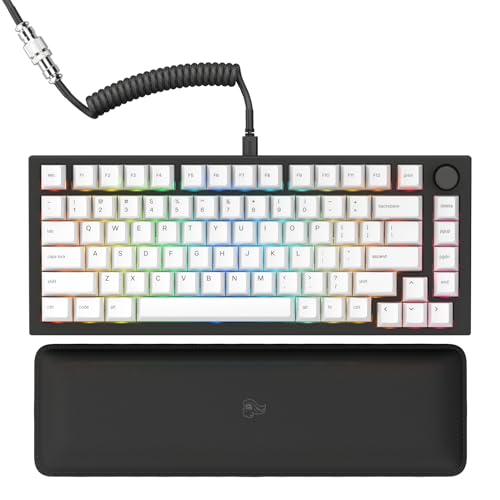
Keychron Q5
96% class anchor
- 96 percent, ~100 keys
- Number pad retained, compressed
- Aluminium, gasket mount
- Hot-swap, QMK/VIA
The Q5 is the catalogue’s 96 percent specimen: a census within a few keys of full-size, delivered in a width class closer to TKL, with the navigation compromises the class definition predicts. Handling it teaches the compression’s trade more efficiently than any diagram — everything is present, and the hands must relearn exactly where ‘present’ lives. As the taxonomy’s proof that count and footprint negotiate independently, it is the reference object for its class, and its flagship construction makes the lesson a pleasure to learn.
Buyers placing it should note the class’s variance: 96 percent boards differ in arrow placement and right-column contents more than full-size boards differ in anything. The listing’s layout photograph, checked against the class definition, is the verification step — the catalogue gives you the invariants, the photograph confirms the instance.
Strengths
- Near-full census, near-TKL width
- Flagship platform
- The compression class, exemplified
Trade-offs
- Relocated navigation geography
- Premium price
- Class variance demands checking
Best for: Catalogue readers whose census is ‘everything’ and whose desk disagrees.
Not suited for: Buyers who want reference positions preserved.
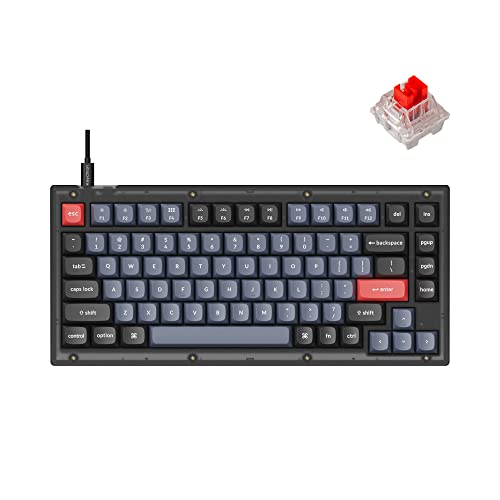
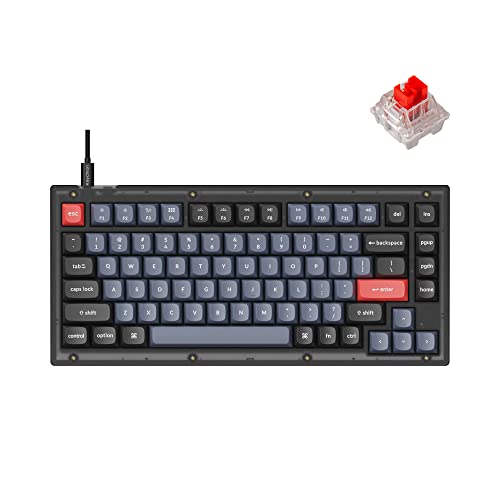
Keychron V1
75% class anchor
- 75 percent, ~82 keys
- F-row and arrows physical
- Hot-swap, QMK/VIA
- ~32 cm width class
The V1 anchors the catalogue’s most populated class at its most accessible price: the 75 percent census exactly as the definition states it — function row present, arrows present, navigation compressed into the right column, the whole in roughly thirty-two centimetres. It is the board this site reaches for whenever a reader needs to learn what 75 percent means with their hands rather than their eyes, because its price makes the lesson returnable and its completeness makes it representative. A size taxonomy is only as good as its specimens, and this is the specimen for the market’s centre.
Its class variance is the standard one — the right column’s exact population — and its own answer (Delete prominent, the rest layered or rotated) is the class’s most common dialect. Learn it here and every other 75 percent board reads as a variation, which is the catalogue working as intended.
Strengths
- The class definition, faithfully built
- Entry price for the market’s centre size
- Open firmware for the compressed keys
Trade-offs
- Right column varies by maker — check each
- Entry-tier case and caps
- No pad, by definition
Best for: Buyers verifying the 75 percent class first-hand.
Not suited for: Pad users and nav-cluster traditionalists.

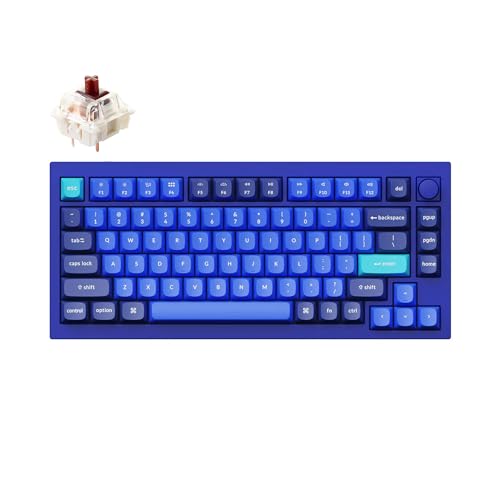
Drop ALT
65% class anchor
- 65 percent, 67 keys
- Arrows physical, F-row layered
- Hot-swap, aluminium case
- QMK underneath
In its reference enthusiast form, the ALT represents the 65 percent class: sixty-seven keys, the arrows defended, the function row retired to the layer, the right Shift shortened to pay for the geography. It embodies the class definition so cleanly that the catalogue can use it as the measuring stick — a 65 that keeps anything more is drifting toward 75, and one that keeps less is drifting toward 60. Its machined case and custom-world platform make it the class’s connoisseur specimen, priced accordingly.
For the catalogue’s reader, its value is calibration: type on the size’s best-regarded citizen and the class itself has been fairly tried, whatever the verdict. Sizes, like switches, are ultimately judged by their reference implementations, and the ALT is why 65 percent’s reputation survived its cheaper ambassadors.
Strengths
- The class’s reference implementation
- Enthusiast platform and finish
- Arrows exactly where the definition promises
Trade-offs
- Enthusiast price
- F-row layer is the class tax
- No knob in the classic layout
Best for: Readers calibrating the 65 percent class.
Not suited for: Budgets and F-row professionals.
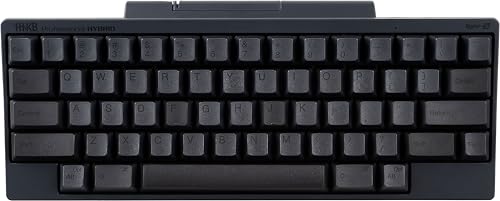
HHKB Professional Hybrid Type-S (Snow)
60% class anchor
- 60 percent, ~60 keys
- All navigation layered
- Topre switches, silenced
- Bluetooth and USB-C
The catalogue’s 60 percent anchor is the size’s most storied dialect: the HHKB arrangement, in which the layer geography is not an afterthought but a philosophy refined since the nineties — Control on the home row, arrows under the right hand’s strong fingers, the census reduced to its essence and the essence made fluent. In Snow, with printed legends, it is also the class’s most legible specimen for a newcomer, since its layer can be read from the caps while it is being learned. The taxonomy entry writes itself: sixty keys, zero dedicated navigation, complete capability — the size’s paradox in one product.
It anchors the class at a premium, with Topre’s feel as a confound the catalogue must disclose: judging 60 percent by the HHKB judges its best dialect on its best switches. Cheaper 60s teach the census more neutrally. But a catalogue’s anchors should be the classes’ citizens of record, and no 60 percent board has held citizenship longer or more completely than this one.
Strengths
- The size’s defining dialect
- Printed legends teach the layer
- Travel-perfect dimensions
Trade-offs
- Premium price confounds the size lesson
- Its dialect is its own
- Full layer commitment required
Best for: Readers meeting the 60 percent class at its source.
Not suited for: Neutral, budget-first size trials.
The Family at a Glance
The catalogue compressed: Full-size — 104–108 keys, ~450 mm, keeps everything, costs the mouse its station. TKL — ~87 keys, ~360 mm, deletes the pad, rearranges nothing. 96 percent — ~100 keys, ~390 mm, keeps the pad, rearranges the navigation. 75 percent — ~83 keys, ~320 mm, keeps F-row and arrows, compresses navigation to a column. 65 percent — ~68 keys, ~315 mm, layers the F-row, keeps the arrows. 60 percent — ~61 keys, ~295 mm, layers everything beyond the number row. 40 percent — ~44 keys, ~240 mm, layers the number row itself. Each row of that table is a complete purchasing brief in embryo: the census, the width, and the named sacrifice, which is all a size ever is.
Two cross-cutting measurements complete the glance. Depth varies less than width across the family — most boards sit between 110 and 150 mm — because the rows’ count changes less dramatically than the columns’. Height and angle, the third dimension, belong to case design rather than size class, though compact boards trend lower. And weight tracks case material more than census, with the aluminium compacts routinely outweighing plastic full-size boards — a fact that surprises every buyer who equates smaller with lighter, and that the travel-minded should note: the 60 percent board in a bag is chosen by grams, and grams are the case’s, not the size’s.
Placing an Unlabelled Board: the Measurement Method
Listings in the wild arrive mislabelled, unlabelled and translated, and the catalogue’s closing gift is the method for placing any board on the map in under a minute. Count the keys — physically, from the listing’s photograph, territory by territory — and note which of the reference territories are present as physical keys: pad, F-row, arrows, navigation column. Measure or find the width. Then classify by the invariants: pad present and navigation in reference position means full-size; pad absent and nothing rearranged means TKL; pad present in a TKL width means the 96 family; F-row and arrows present without a pad means 75; arrows without an F-row means 65; neither means 60; no number row means the 40 frontier. The label on the box is then checked against the classification, and where they disagree, the classification is right.
The method’s second half is the layer audit, because two boards of identical census can differ entirely in their layered geography — where the arrows live at 60 percent, which column hosts Delete at 75. Photographs of the caps’ secondary legends, or the configurator’s map, reveal it. A complete size description therefore has three parts — census, width, layer geography — and a buyer who can state all three for a board knows its size in every sense that will ever affect their typing. The taxonomy’s purpose is exactly that competence, and with it, the market’s size names become what they should always have been: a shorthand you can verify, rather than a claim you must trust.
Why the Percentages Refuse to Die
The percentage system is, by the standards of measurement, a scandal: undefined denominator, drifting definitions, marketing inflation at the borders — and it has outlived every attempt to replace it with honest dimensions, which tells us something true about how buyers think. A percentage is a promise about content, not about size: it answers ‘how much of the keyboard did they keep?’ in a single syllable, and that is the question the shopper at a listing actually has. Dimensions answer a question — will it fit the tray? — that arises later and less often. Systems of naming survive by answering the frequent question, and the percentages, for all their sins, answer it at a glance in a way that ‘342 by 118 millimetres’ never will. The catalogue in the main guide exists to give the promise its local meanings; this expansion explains why the promise, audited, is still worth more than the audit’s alternative.
The system’s drift has a pattern worth knowing, because it is not random: sizes inflate toward the prestigious direction of their era. When small was fashionable, boards borrowed downward — the ’65 percent’ with a function row’s ambitions. When completeness became the selling point, the 96 percent family stretched the definition of its own number to hold a full census. The drift is the market’s accent, and like an accent it is intelligible once heard for a while. The catalogue’s defence — count the keys, check the rows, read the photograph against the number — is simply fluency training, and it generalises to every named thing in the hobby, from switch colours to foam thicknesses: the name is the headline, the count is the article, and the reader who reads articles is rarely deceived.
And the percentages have one genuine virtue that dimensions lack: they encode the layout’s relationship to the standard, which is information about compatibility — with keycap sets, with cases, with the buyer’s own habits — that a millimetre figure cannot carry. A 75 percent board announces its keycap kit’s family and its layer’s likely contents; its dimensions announce its footprint. The wise listing gives both, the wise buyer reads both, and the catalogue’s job — this guide’s job — is to keep the two vocabularies honest about each other, size by size, until the reader can translate fluently in both directions.
The Forgotten Sizes: 40 Percent’s Neighbours and Other Exotics
Below the catalogue’s mainstream, the size spectrum continues into territories the main guide touches only at its edges, and a complete map should name them. The 30-something percent boards — alphas and almost nothing else — exist as demonstrations and as genuine instruments for layer virtuosos, their buyers self-selected and their resale a conversation between initiates. The ortholinear grids rearrange the same keys into columns, a geometry whose adherents type on them like instruments and whose sizes are counted in units rather than percentages, because the percentage’s promise (how much of the standard?) has stopped being the question. The split and ergonomic geometries abandon the rectangle entirely, and with it the size vocabulary — their dimensions are hand spans and tenting angles, measured on the body rather than against the standard, which is why the ergonomic mechanical keyboards wrist pain guide maintains its own catalogue in a different language.
The exotics matter to the mainstream reader for one practical reason: they are where the mainstream’s future is prototyped. The thumb cluster migrated from exotica to the 65 percent’s split spacebar; the layer discipline was the 40 percent world’s survival skill before it was the 75’s convenience; the rotary encoder walked from macro pads to flagship boards in five years. A reader who knows the exotics exist can read a new mainstream feature as a migration rather than a miracle, and price it accordingly — proven in the frontier, priced as a novelty. The 40 percent keyboard guide on this site is the frontier’s local embassy, and its readers will find the catalogue’s percentages dissolving there into a more interesting question: not how much of the standard a board keeps, but how much of the typist it trusts.
There is also a collector’s truth about the exotics: they are where the hobby’s design energy concentrates, because their makers are unconstrained by the standard’s gravity. The mainstream buyer need not follow them there. But the catalogue that omits them teaches a false map — one in which the sizes descend from full-size by subtraction and stop at 40 — when the truth is a branching territory whose far branches loop back, carrying ideas. Maps should show the whole territory, especially the parts the reader will never visit, because the visits of ideas are not announced in advance.
One Board, Several Sizes: The Modular Answer
A quiet trend answers the size question by refusing its premise: the board whose size is a configuration. Its forms are several — the main board plus a detachable or separate numpad that docks on either side; the macro pad that adds the F-row’s duties on demand; the layered small board whose owner’s second device is a pad that appears for the data week and vanishes for the writing month. The modular answer’s economics are the specialisation pattern from the size guide: two objects, each right in its context, replacing the compromise that was wrong in both. Its keycap and case compatibility is the standard’s, because each module is a standard object; its desk manners are the small board’s, with territory reclaimed by removing a module rather than by replacing a board.
The modular system’s honest costs are connection and coherence: the pad is a second device — a second cable or pairing, a second battery if wireless, a seam in the typing surface that the hand crosses a hundred times a day — and the left handed southpaw keyboards guide’s citizens, who dock pads on the left as a philosophy, will tell you the seam is a fair price for a geography no fixed board offers. The system’s verdict depends on the frequency of the size change: the worker whose pad week is monthly should dock; the worker whose pad use is hourly should buy the 96 or the full-size and be done. Modularity is a bet on the census’s variance, and like every bet in this cluster it should be placed from the tally sheet, not from the photograph of a docked pad looking clever.
And the modular idea reframes the catalogue itself: sizes stop being species and become states, and the buyer’s question changes from ‘which size am I?’ to ‘which sizes does my year contain, and how often does it change?’ That is a more grown-up question, and the market’s drift toward answering it — docks, pads, layers, second boards — is the size system’s own evolution, happening underneath the percentages’ static names. The catalogue will keep its names; the readers who thrive will hold them loosely, as the labels of states their desks move among, which is what sizes always were, before the listings froze them into identities.
Sizes Across the World: Regional Defaults
The size catalogue reads differently by region, because the world’s desks standardised on different defaults for reasons of history and housing. The Japanese market’s centre of gravity sits lower — compact boards for compact desks, the 60 and 65 percent sizes as unremarkable defaults, the jis keyboard layout’s bottom row making even its full-size boards feel space-conscious. The American market’s default remains the full-size, a inheritance of large desks and the pad’s place in its office culture, with the gaming scene pulling its average down a size per decade. Europe straddles, its iso vs ansi keyboard layout family adding the regional Enter to every size and its smaller homes making the TKL a common ceiling. None of these defaults is a verdict; they are the installed bases that decide what a region’s shops stock, what its used market holds, and what its keycap sets assume — the ecosystem terms every size decision silently includes.
The regional lens explains several otherwise puzzling market facts: why the finest compact boards so often come from Japanese makers (their home market demanded them first and hardest), why the full-size gaming flagship is an American genre, why ISO sets in small sizes are the keycap market’s rarest quadrant (two minorities multiplied). A buyer whose size is a regional minority should price the ecosystem as knowingly as the ISO buyer prices theirs — the boards ship globally, but the caps, the cases and the second-hand liquidity live locally. The catalogue’s percentages are global; their availability is not, and the difference is a line in the purchase’s true cost that no listing states.
And the defaults are converging, slowly, under the same forces everywhere: smaller homes, laptop-first work, the gaming scene’s global culture. The catalogue of 2035 will likely centre a size lower than today’s, and its percentages will have drifted again, and its readers will need a guide that teaches the counting rather than the names — which is, the attentive reader will notice, the guide this cluster has been writing all along, under every title it carries.
Measuring Your Desk: The Physical Audit
The catalogue’s percentages end, finally, in millimetres, and the physical audit that converts them deserves a procedure. Measure the desk’s working width — not the desk’s width, but the span the keyboard and mouse may occupy between the monitor’s feet, the lamp’s base and the notebook’s tenancy. Measure the tray if there is one, its width and its height clearance, because a tray’s ceiling has rejected more tall boards than any census. Then place the current board and mark its footprint’s corners with tape; live a day; and read the tape’s evidence — the mouse’s collisions with the right tape, the unused territory on the left — as the audit’s findings. The size that the audit names is frequently one step from the current board, in the direction the collisions point, and one step is the cheapest experiment in the whole size system: close enough to adapt in days, different enough to matter hourly.
The audit has a vertical half that buyers forget: the desk’s depth and the board’s distance from its edge decide the wrists’ territory as surely as width decides the mouse’s. A deep desk invites the board to migrate away, lengthening the reach; a shallow one crowds the board against the monitor’s feet. The size’s footprint interacts with both, and the audit should record the board’s working distance — from the desk’s edge to the spacebar — as faithfully as its width, because a narrower board placed too far is a worse desk than a wider board placed well. Placement is the size decision’s free variable, adjustable tonight, and the audit that discovers a placement fault has saved a purchase — the happiest outcome any guide in this cluster can produce.
Keep the audit’s numbers with the board’s records, beside the tally sheet and the keymap’s backup: the desk’s measurements, the mouse’s territory, the tray’s clearance. They are the specifications of the only system that matters — yours — and every future purchase in this catalogue will be graded against them. Buyers who keep them shop the whole market in an afternoon, because the market’s infinite variety collapses, against real numbers, into the handful of boards that fit the desk, the census and the hands. That collapse is not a limitation of choice. It is what choosing, properly instrumented, feels like from the inside.
The Catalogue’s Last Word: Sizes Are Verbs
A closing argument for holding the whole catalogue lightly. A keyboard’s size is usually spoken of as its identity — I am a 65 percent user — when the evidence of every section in this guide describes a state: of a desk, a job, a season, a pair of hands at a stage of their education. The writer’s 65 becomes the analyst’s 96 for a quarter; the gamer’s 60 becomes the parent’s full-size at the family desk; the traveller’s board and the desk’s board diverge and reconverge across a career. Owners who buy sizes as identities defend them past their usefulness and pay the defence in daily friction; owners who buy them as states rotate, dock, demote and promote their boards as the states change, and their equipment’s average fit across a decade is higher at a lower total cost. The catalogue’s percentages, held as verbs — to full-size the data week, to 65 the writing month — recover their original meaning as descriptions of arrangements, which is all they ever honestly were.
The states view also dissolves the size wars, the forum’s perennial theatre, in which partisans of one percentage argue its universal supremacy. Universality is the one claim no size can make, because the census that decides it is taken at one desk, in one life, and expires with both. What can be universal is the method — tally, measure, test, adapt — and the method’s practitioners recognise each other across the size divide as citizens of the same country, while the partisans are tourists in it, however loud. This guide has taught the method under the catalogue’s names, deliberately, because the names are where the readers arrive. Where they leave is the method’s country, and its citizenship is permanent.
So count the keys, measure the desk, run the tally, and choose the size your evidence names — then hold it as a state, with the old board kept for the states it still serves and the tally sheet kept for the day the evidence changes. The catalogue will be here, percentages drifting, exotics migrating, regions converging, when the next state arrives. It is, in the end, a map of arrangements between hands and work, and like all good maps it hopes to be used hard, annotated freely, and replaced in the reader’s affections by the territory itself.
A Note on Counting: How to Verify Any Size Claim in Two Minutes
Every claim in this catalogue can be verified with a photograph and two minutes, and teaching the verification is the catalogue’s final act of respect for its readers. Count the keys in rows: the alphas’ row holds its standard count on any honest board, and deviations announce themselves immediately — a missing key in the letter rows means a layout decision the percentage did not mention. Count the columns at the board’s widest: the full-size’s twenty-some against the TKL’s eighteenish against the 75’s seventeen, and the board’s true family is established regardless of its listing’s poetry. Then check the three landmarks whose presence defines the practical sizes: a dedicated F-row (or its absence), a separated nav cluster (or its absorption), and a pad (or its layer). Landmarks, not numbers, are what your hands will live with, and two minutes of counting converts every size claim you will ever read into the landmarks’ plain language.
The verification has a second half for the buyer in a shop or at a meetup: sit, place the hands, and run the three reaches — the F-row’s, the nav’s, the pad’s — because a size is a set of reaches before it is a set of counts, and the reaches are graded by the body in seconds. Photographs flatten reaches; counts enumerate them; the hands experience them, and experience is the catalogue’s final authority, as it is every guide’s in this cluster. A size that counts correctly and reaches wrongly is the wrong size, and the two minutes that discover it are the cheapest in the whole purchase.
Keep the counting habit for the rest of the market, because the percentages are only the most visible of its approximate names. Switch colours, foam thicknesses, spring weights — each is a name with a local meaning, verifiable by the same posture: find the measure beneath the name, take it, and let the name return to its proper job, which is conversation rather than specification. The catalogue’s readers who learn that posture stop needing catalogues, which is — the attentive reader will by now expect this ending — precisely what catalogues are for.
Verifying a Listing’s Size Before Purchase
Five checks, applicable to any board anywhere, that convert a label into a classification.
- Count the keys in the listing’s clearest photograph, territory by territory, and write the census down. If the photograph will not support a count, the listing has not earned the purchase yet.
- Identify the four territory markers: number pad present or absent; function row present or layered; arrow keys physical or layered; navigation keys present, compressed or absent. These four answers classify the board completely.
- Find the physical width in the specifications and sanity-check it against the class ranges in this catalogue. A ’75 percent’ board listed at 360 mm wide is a TKL wearing a costume.
- Read the secondary legends or the layer description for the layered territories’ geography — where the arrows and F-keys live — since that geography, not the census, decides the adaptation your hands face.
- Cross-check the maker’s own size name against your classification and note any disagreement in the order notes. If the board arrives as a different size than classified, the written record is the return’s foundation.
Taxonomy Mistakes Buyers Make With Labels
Trusting the percentage as a dimension.
Percentages count keys, not centimetres, and two boards at the same percentage can differ by centimetres of width and entire territories of arrangement. The catalogue’s ranges exist because the label does not suffice; measure the width and count the keys, and let the percentage be the last thing believed rather than the first.
Assuming 75 percent boards are interchangeable.
The class guarantees its core — F-row, arrows, alphas — and leaves its right column, its knob and its bottom row to each maker’s dialect. A keycap set, case or accessory bought for one 75 may not fit another’s geography. Class is a family resemblance, not a standard, below the reference sizes.
Calling every small board a 60 percent.
The compacts differ in the one thing their owners feel hourly — which keys survived. A 65 mistaken for a 60 in a listing means arrows expected and not found, or the reverse. The four-marker check takes a minute and is the difference between a taxonomy and a vibe.
Forgetting that ISO and JIS change the census.
The reference counts in this catalogue are ANSI’s; ISO adds a key, JIS adds several and rearranges the bottom row, per this cluster’s JIS keyboard layout explainer. A size classified across standards without adjusting the census will be wrong by exactly the keys that matter most to the typist who needs them.
Equating smaller with lighter for travel.
Case material writes the weight column, and the aluminium 65 can outweigh the plastic full-size board it replaces in the bag. Travel buyers should shop the gram specification with the same seriousness as the key census — the catalogue lists both because the journey feels both.
Treating your size as your identity.
The owner who is ‘a full-size person’ or ‘a 60 percent person’ has stopped running censuses and started defending a flag — and pays for the defence in daily friction whenever the work changes under the flag. Sizes are states of a desk and a job. Re-run the tally when either changes, keep the demoted board for the states it serves, and let the percentages be the catalogue’s vocabulary rather than your biography.
Frequently asked questions
What does the percentage in a keyboard size actually mean?
It is the board’s key count expressed against the full-size reference of roughly 104 keys — a 65 percent board holds about two-thirds of the keys, not two-thirds of the dimensions. Physical width shrinks faster than the percentage suggests at the top of the family and slower at the bottom. Treat the percentage as a census label and verify the centimetres separately, per this catalogue’s method.
Is TKL the same as 80 percent?
Yes, in the market’s settled usage: tenkeyless boards are the 80 percent class, holding about 87 of the reference’s 104 keys. The label is occasionally abused for wide 75 percent boards, which the four-marker check exposes immediately — a TKL rearranges nothing, while every 75 percent board compresses its navigation territory somehow.
Which size has a number pad but is not full-size?
The 96 percent (1800) family, and the southpaw arrangement, which keeps the full census with the pad moved to the left. The 96 achieves it by compression — everything present, navigation relocated — while the southpaw achieves it by inversion. Both are catalogued here because ‘has a pad’ and ‘is full-size’ stopped being synonyms the moment the compressions were designed.
What is the smallest size most people can work on?
For general professional work, 65 percent is the practical floor for most typists — arrows physical, one layer to learn — with 75 percent the floor for those whose software leans on function keys. Sixty percent is a fully workable size for prose and code once its layer is fluent, as its decades of professional owners prove, but it asks the full tuition. The catalogue’s role is to state the floors; the audit in the size guide decides which floor is yours.
Do compact keyboards come in ISO and JIS too?
Yes — the size taxonomy and the regional standards are independent axes, and every size class exists in ISO production from the major makers, with JIS strongest at the reference sizes and in its home market’s compacts. The census shifts by the standard’s own arithmetic, which is why this catalogue anchors classes to territories kept and layered rather than to raw counts alone.
Why are there so many sizes between 60 and 75 percent?
Because that band is where the negotiation between footprint and completeness is most contested — every key there is one some population refuses to layer and another refuses to house. The 70, 72 and 75 variants are makers exploring the exact border, one column at a time. The catalogue’s advice is to classify them by the four markers rather than by their novel labels, and the border will stop looking like chaos and start looking like what it is: a market arguing, productively, about a single column of keys.
What is the most popular keyboard size?
Full-size remains the installed base’s majority worldwide — it is the default of offices and bundles — while tenkeyless and 75 percent boards lead the enthusiast and gaming markets’ new purchases, and the compact sizes dominate in the Japanese market. Popularity is a stocking fact, not a fit fact: it tells you what will be easy to buy, cheap to dress in keycaps and simple to resell, which are real terms in a purchase — and it says nothing about your census, which is the term that decides whether the board is kept.
Are 60% keyboards good for programming?
For many programmers, yes, with the layer as the enabling condition: the symbols and navigation live on layers the firmware makes personal, and the desk gains the mouse territory or the centred posture the census may want. The populations that struggle are those whose tools lean on the F-row’s debugging keys hourly and those who share machines where their layers do not exist. It is, once more, a census question wearing a size’s clothes — and programmers, of all buyers, have the tally-keeping temperament to answer it from evidence.
Why do two boards with the same percentage have different key counts?
Because the percentage names a neighbourhood, not a number: makers round, include or exclude the knob’s key, count a split spacebar as one key or two, and define their 75 or 96 against slightly different ideals of the full-size standard. A difference of two or three keys between two boards of the same nominal size is normal and usually reflects the layout’s choices (an extra column, a different bottom row) rather than an error. Count the board you are buying, by its photograph, and let its own census — not its name’s average — into your decision.
A taxonomy’s job is to make a market legible, and keyboard sizes — for all their naming chaos — yield to three questions: what does it keep, what does it layer, and how wide does it sit? With those answered, every board in the catalogue has an address, every listing can be verified against its label, and every size debate can be conducted in terms that hands and desks can settle. The percentages were never the point. The keys are the point, and they can be counted.
Keep this reference beside the size guide’s deliberations: the catalogue to know what exists, the audit to know what you need, and the measurement method to confirm that the board in the box is the board on the map. Between the three, the size question — the first question of every keyboard purchase — becomes the one buyers stop getting wrong, which is the most a reference page can ever hope to achieve.