kajuandouglas.com is reader-supported. When you buy through links on our site, we may earn an affiliate commission.
Where to Buy a Camera for an RC Car, and Why Weight Is the First Specification
The best cameras for mounting to rc cars live under a law no other genre in this series obeys so brutally: every gram is a performance tax. An action camera on a tenth-scale buggy is a passenger the size of a brick on a go-kart — it raises the centre of gravity, dulls the suspension, shortens the run and, in the inevitable crash, becomes the most expensive part of the wreck. Choosing a camera for an RC car is therefore an exercise in honest trade-offs between footage, handling and the price of the inevitable. This guide makes those trade-offs explicit.
Buying, briefly: the linked names below open each camera’s Amazon listing, where the previous-generation and bundle pricing that this genre loves is worth hunting. Budget like an RC driver, not a filmmaker: camera, mounts and protective cases, a stack of cheap memory cards, and the replacement fund that honesty demands. The reviews below will repeatedly recommend spending less than you can afford on the camera and more than you planned on the mounting — because in this genre, the mount decides whether the camera survives to have an opinion about image quality.
Know your car before your camera. A crawler creeping over rocks wants a different witness than a short-course truck flying over triples or an on-road car cornering at the edge of its tyres. Crawlers reward wide views and patience; bashers reward durability and cheapness; racers reward lightness above all, and often answer this entire guide with ‘the smallest one, or nothing’. The picks are sequenced so each tribe can find itself, and each review names the handling cost its camera charges the car beneath it.
One more framing: onboard footage is a means, not an end. It serves the driving film, the setup diagnosis — watch the suspension work, hear the gear mesh, see the line you actually took — and the simple joy of the driver’s-eye view. A camera that serves those ends at the cost of the car’s pace may still be the right purchase, but it should be bought knowing the exchange rate. That is what ‘best’ means here.
A word about expectations before the picks: onboard footage will not look like the chase footage in the films that inspired you, and it is not supposed to. It looks like the truth from the car’s height — faster, rougher, more alive — and learning to love that grammar, rather than apologising for it, is the first skill this guide is really teaching. The cameras below were chosen by people who have made their peace with the truth and learned to frame it.
Key Takeaways
- Weight is destiny: every camera here is judged by what it does to the car’s handling, not just by its footage.
- The AKASO Brave 7 LE is the basher’s logic made plastic — cheap enough that a crash is a story, not a claim.
- The GoPro HERO12 Black is the balanced rig: reference stabilisation and ecosystem at last-generation weight and price.
- The Insta360 X4 turns one RC run into every angle at once — chase, driver’s view and the crash, reframed later.
- Crawlers should look to the DJI Action 5 Pro’s low light and patience; speed-run cars to the lightest thing they can carry.
- Mount low, mount central, tether always — and put the expensive camera on the chase car, not the one jumping.
In this guide
Quick Picks
| Camera | Badge | Why it suits RC duty |
|---|---|---|
| AKASO Brave 7 LE | Best for bashers and first onboard rigs | Cheap enough to crash, light enough to carry, and complete with mounts in the box — the expendable witness. |
| GoPro HERO12 Black | Best balanced onboard camera | Reference stabilisation that survives a buggy’s buzz, the deepest mount ecosystem, at last-generation pricing. |
| DJI Osmo Action 5 Pro | Best for crawlers and low light | A larger sensor for shaded trails and evening sessions, superb stabilisation and battery patience for slow work. |
| Insta360 X4 | Best for every angle from one run | 360 capture on the car records the chase, the driver’s view and the scenery in one pass — reframed into a whole film later. |
| GoPro HERO13 Black | Best flagship for serious RC films | The newest reference: lens options for the perfect onboard framing, top stabilisation and the ecosystem at full strength. |
| Insta360 Ace Pro 2 | Best image quality for scale realism | A large sensor and tuned optics that make a tenth-scale world look full-size, especially in golden light. |
How Did We Choose the Best Cameras for Mounting to RC Cars?
We weighed everything, literally and then again as a proportion of the cars. A camera that is a rounding error on a large-scale truck is a fifth of a small buggy’s ready-to-run weight, and the reviews scale their advice accordingly. Handling cost was assessed in the currencies drivers actually feel: centre of gravity and roll in corners, suspension behaviour over jumps, acceleration and runtime, and the crash bill when — not if — the car finds the fence.
Survivability was scored as a system: the camera’s own toughness, the protective housings available for it, and the mounting geometry that decides whether a rollover lands on the camera or slides past it. In this genre the case and the mount are not accessories; they are the insurance policy, and a camera with a cheap, replaceable protective ecosystem can be the rational choice over a tougher but naked flagship.
Footage quality was judged at RC scale, which is its own discipline: vibration frequencies higher and nastier than any motorcycle’s, horizons that somersault, light that strobes under trees at speed. Stabilisation that survives a buggy’s buzz, dynamic range for the sun-shade flicker of a track, and frame rates that slow a crash into diagnosable frames — those were the tests, and several famous cameras’ weaknesses live exactly there.
Finally, workflow for the pit table: files that reach a phone before the next heat, mounts that swap between cars in seconds with cold or muddy fingers, and batteries that outlast a race day or swap in a breath. RC is a social, hurried hobby conducted outdoors; the camera that fits that rhythm gets used, and the one that does not becomes a shelf ornament with a lens.
How Does a Camera Change the Way an RC Car Drives?
Start with the centre of gravity, because it is where the footage is paid for. A camera on a roof or roll cage sits at the car’s highest, most leveraged point; in a corner it is a sail and a pendulum at once, encouraging the roll that ends the run and the film simultaneously. Mounting low and central — on the chassis, within the body shell where the class allows, ahead of the rear axle — taxes the handling least, which is why experienced RC filmmakers treat mount position as a tuning decision, like shock oil or tyre compound, and test it with the same seriousness.
Suspension pays the second tax. Added mass high on the car asks the springs to manage weight they were not valved for, and the car’s landing from jumps — the genre’s money shots — becomes a negotiation between the camera’s survival and the chassis’ dignity. Heavier cars also land harder, which the camera experiences as impact and the driver experiences as parts bills. The crawler, moving at walking pace with torque to spare, pays almost none of this; the racer pays all of it, which is why their answers in this guide diverge so completely.
Runtime and temperature close the account. A heavier car draws more from its pack, runs its motor hotter, and shortens the session the camera was bought to record. The honest RC filmmaker therefore thinks of the camera as a tuning part with a frame rate, and chooses the lightest tool that tells the story — a discipline the picks below are arranged to serve, from the expendable to the exquisite.
What Does Onboard Footage Actually Teach a Driver?
More than the highlight reel admits. Watched critically, the onboard camera is a diagnostic instrument: it shows the line the car actually took against the one the driver intended, the moment the rear stepped out and why, the suspension compressing and rebounding through the rough section, the gear mesh’s sound changing two laps before the failure. Racers who review onboard footage the way athletes review game film improve at a rate the stopwatch respects, and several picks here — the high-frame-rate ones especially — are chosen partly as coaching tools.
It also teaches the car’s story to everyone else. The driver’s-eye view is the only footage that communicates what the hobby feels like — the speed that looks modest from the fence becomes visceral from the bonnet — and it is why onboard clips dominate the genre’s shared films. A camera that captures that feeling honestly, vibration and all, with stabilisation that civilises rather than sanitises, is worth more to a channel than a technically finer one that irons the life out.
And it preserves the crashes in diagnosable detail. The slow-motion replay of a roll — which wheel caught, which input preceded it — turns an expensive mystery into a setup note. Drivers who crash with cameras learn; drivers who crash without them guess. In a hobby built on iteration, that difference compounds across a season exactly like interest.
Which Six Cameras Belong on an RC Car? The Picks in Detail
Read each review with your car class in mind and your crash history in view. The right camera for a crawler’s patience would be a catastrophe on a basher, and the racer’s answer is mostly a weight with a lens attached.

AKASO Brave 7 LE — Best for bashers and first onboard rigs
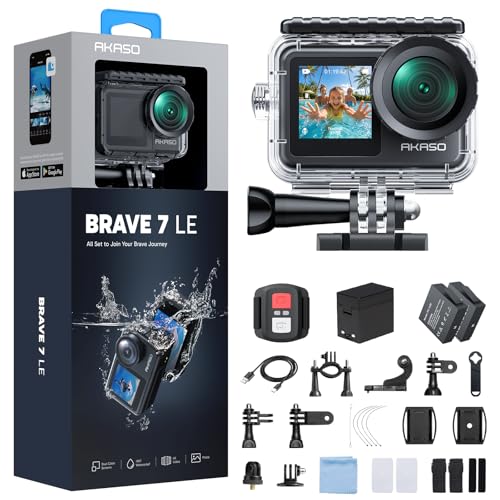
The Brave 7 LE is the RC genre’s founding logic in product form: the camera most likely to be destroyed should be the camera whose destruction is a shrug. Its price buys a complete kit — mounts, remote, weatherproof body — and its footage, stabilised and perfectly watchable in daylight, tells the onboard story completely: the line, the jumps, the crash in all its diagnostic glory. Mounted on a basher that lives to fly and land badly, it is not the cheap option; it is the only sane one, and experienced drivers who own flagships still keep one for the car that jumps.
Its lightness is its second virtue, taxing small cars less than the premium bodies and forgiving mounting sins a heavier camera would punish. The image concedes dynamic range and low light to the leaders, and its stabilisation, while willing, civilises rather than conquers a buggy’s buzz. None of that matters at the skate park at noon, which is where this camera’s footage is shot, and all of it matters less than the psychological freedom of a camera the driver is not protecting. Cars get driven properly when the camera aboard is expendable.
Buy two if the budget allows and the driving is brave: one on the car, one at the jump’s landing as the static witness, and the edit gains the cut that makes onboard footage legible. The pair still costs less than one flagship, which is the AKASO’s whole argument in this guide — in a genre defined by impact, redundancy beats excellence, and the bravest driving happens behind the cheapest lens.
- Kit: mounts and remote included, ready for a first rig
- Weight: light, kind to small cars’ handling
- Body: weatherproof for dirt, dust and spray
- Video: stabilised daylight footage that tells the story
Strengths
- A crash is a story, not an insurance claim
- Complete kit at an expendable price
- Light enough for small-scale cars
Trade-offs
- Image a class below the leaders
- Stabilisation civilises rather than conquers
- Low light is not its country
Best for: bashers, beginners and any car whose job is jumping. Not suited for: filmmakers selling polished onboard cinema.

GoPro HERO12 Black — Best balanced onboard camera
The HERO12 is where onboard footage grows up. Its stabilisation is the first in this guide that genuinely masters RC vibration — the high-frequency buzz that turns lesser footage into jelly — while keeping enough of the car’s motion to feel alive. The mount ecosystem puts it anywhere on any car in seconds, the protective housings are cheap and everywhere, and the image has the dynamic range for a track’s strobing sun and shade. As the single camera for a mixed fleet — crawler on Saturday, truck on Sunday — it is the balanced answer this guide gives first.
Its weight is the honest negotiation: heavier than the AKASO, lighter than a flagship with its case, and on a tenth-scale car it must be mounted with the low-and-central discipline this guide preaches. In return the footage gains slow-motion headroom for crash diagnosis, colours that grade into a real film, and a reliability across a race day that the budget tier cannot promise. The previous generation’s pricing completes the argument, funding the spare housings and mounts that RC duty consumes like tyres.
Consider it the club standard for a reason: at any track, someone has the mount you forgot, the housing you cracked, the setting that fixes the flicker. That social infrastructure is worth frames per second no specification can list, and it is why the HERO12, rather than its newer sibling, is this guide’s balanced recommendation for cars that crash for a living.
- Stabilisation: reference-class, masters RC buzz
- Mounts: the deepest ecosystem, housings everywhere
- Video: slow-motion headroom for crash diagnosis
- Value: last-generation price funds the spares
Strengths
- Footage that survives the vibration test
- A club’s worth of shared mounts and knowledge
- Grades into a genuine film
Trade-offs
- Weight demands disciplined mounting
- Newer sibling has refinements it lacks
- Premium housings add up across a season
Best for: mixed fleets and club racers wanting one serious onboard camera. Not suited for: the lightest race cars counting every gram.

DJI Osmo Action 5 Pro — Best for crawlers and low light
Crawling is onboard filming at walking pace through shade, water and rock — a genre of patience where the Action 5 Pro’s virtues align beautifully. Its larger sensor keeps the shaded trail and the dusk session clean where smaller cameras grain; its stabilisation smooths the crawler’s lurches without ironing out the articulation that is the whole visual point; and its battery patience suits a discipline whose runs are measured in hours rather than heats. On a crawler or a trail truck, it is the connoisseur’s pick in this guide.
The camera’s low-and-wide mounting options and its natural colour flatter the scale illusion — the art of making a tenth-scale truck look full-size among real rocks — which is the crawler film’s entire aesthetic. Its weight is midfield, a tax crawlers pay gladly with torque. Where it concedes is the basher’s world: it costs flagship money, and flying it off a triple is a decision its price makes emotional. Keep it for the slow cars and the shaded places, where it is not merely good but transformative.
There is a sound argument too: crawlers are quiet enough that the camera’s audio matters, and the DJI captures the servo whine, the tyre’s grip-and-slip on rock, the water in the creek crossing — the ASMR of scale realism that crawler audiences adore. A genre filmed in whispers deserves a camera that listens well, and this one does.
- Sensor: larger, clean in shade and dusk
- Stabilisation: smooths lurches, keeps articulation
- Battery: patience for hour-long trail runs
- Audio: captures the quiet mechanics of crawling
Strengths
- The crawler film’s best friend
- Low-light grace under tree cover
- Sound that serves scale realism
Trade-offs
- Flagship price on a crashable car
- Over-specified for noon bashing
- Weight wasted on pure racers
Best for: crawlers and trail trucks filmed in shade and at dusk. Not suited for: bashers whose cars land on their roofs weekly.

Insta360 X4 — Best for every angle from one run
The X4 on an RC car is a small absurdity that works: one run produces the forward chase view, the backward view of the following car, the wheel’s-eye drama and the scenery’s sweep, all reframed in the edit into a film that looks multi-camera. For the solo driver filming a crawler trail or a scale adventure — where the car cannot be re-run through the same light twice — that total capture is a genuine production method, and its stabilisation keeps the sphere eerily calm while the car beneath it claws over rock.
The cautions are physical and editorial. Physically, the camera is tall, top-heavy and lens-exposed — the worst shape for a rollover car and the best argument for mounting it on the crawler or the chase vehicle rather than the basher. Editorially, 360 files demand the reframing craft and the storage to match. Within those disciplines, though, the footage’s freedom is unmatched: the camera that looks back at the driver as the car crests the rise is a shot no fixed camera on the same run can offer.
Mount it as the production camera of a deliberate film, not as the everyday witness: the scale expedition, the trail documentary, the one perfect evening at the quarry. For those occasions it earns its fragility honestly, and the film it returns could not have been made any other way. The rest of the time, it can ride the chase car — which, as this guide’s final advice will insist, is where the valuable cameras belong.
- Capture: 360 sphere, every angle from one run
- Stabilisation: calm sphere over rough ground
- Mounting: best on crawlers and chase vehicles
- Workflow: reframing edit, generous storage needed
Strengths
- A multi-camera film from a single run
- Shots no fixed camera can offer
- Superb for scale expeditions and trails
Trade-offs
- Top-heavy and lens-exposed in a roll
- Heavy files and editing time
- Wrong tool for a basher’s roof
Best for: deliberate scale films and solo trail productions. Not suited for: cars that roll as a way of life.

GoPro HERO13 Black — Best flagship for serious RC films
When the RC film is the product — the channel, the sponsor’s content, the club’s showcase — the HERO13 is the flagship the HERO12 review kept glancing at. Its swappable lenses include the ultra-wide that suits the bonnet view and the anamorphic-leaning options that give scale footage a cinema accent; its stabilisation is the current state of the art against RC buzz; and its ecosystem, batteries and housings are the deepest in the genre. On the right car — the considered build, the film car, the chase vehicle — it produces onboard footage of genuine polish.
The discipline it demands is placement honesty. This is not the camera for the roof of the car that backflips; it is the camera for the car whose driving is choreographed, the crawler built as a film prop, the on-road car whose lines are clean. Its price, mounted, represents a significant fraction of many cars’ value, and the driver must be able to say the footage is worth the exposure. When that sentence is true, no camera here answers better.
It also future-proofs the pit table: the newest mounts, batteries and accessories will arrive for this body first, and a serious RC film practice amortises a flagship across seasons of content. Buy it as the studio camera of the fleet, protect it like one, and let the AKASO and HERO12 take the impacts — a division of labour this guide recommends as the mature shape of an RC film kit.
- Lenses: swappable, including ultra-wide onboard views
- Stabilisation: current state of the art
- Ecosystem: flagship batteries, housings and mounts
- Image: the polish a channel or sponsor expects
Strengths
- The finest onboard footage available here
- Lens choice for the perfect framing
- A flagship the practice can grow into
Trade-offs
- Price exposure on a crashable car
- Demands choreographed, careful driving
- Overkill for casual onboard clips
Best for: RC film channels, sponsors’ content and dedicated film cars. Not suited for: any car whose crashes are entertainment.

Insta360 Ace Pro 2 — Best image quality for scale realism
Scale realism is the RC film’s high art — the shot where the viewer’s brain accepts the truck as full-size — and it is made of image quality: dynamic range that holds a sunset sky behind a silhouette ridge, low-light cleanliness in the golden hour’s last minutes, colour with the richness of the real world. The Ace Pro 2, with its larger sensor and tuned optics, is the strongest scale-realism instrument among the conventional cameras here, and on a crawler or a slow scale build it produces footage that genuinely fools the eye.
Its flip screen is a pit-table luxury for framing the mounted shot precisely, and its stabilisation is fully competitive. The cautions mirror its sibling rivalry with the flagship GoPro: a thinner first-party accessory bench, and an image-first design whose talents are wasted — and risked — on a basher. Weight is midfield; mount it low, in its case, on the car whose driving is as considered as its looks.
Choose it when the film’s whole point is beauty: the scale expedition at dawn, the vintage-bodied crawler among real ferns, the on-road classic cornering in evening light. In those films the camera is not documenting the hobby; it is collaborating in an illusion, and the Ace Pro 2 collaborates better than anything else at its size. Just keep it off the jump line.
- Sensor: large, with golden-hour dynamic range
- Optics: tuned for rich, realistic colour
- Screen: flip design for precise pit-table framing
- Stabilisation: fully competitive smoothness
Strengths
- Scale realism that fools the eye
- Golden-hour footage of real beauty
- Precise framing with the flip screen
Trade-offs
- Accessory bench thinner than GoPro’s
- Talents wasted on a basher
- Premium price to risk on a car
Best for: scale-realism films on crawlers and considered builds. Not suited for: jump lines, skate parks and loaner cars.
How Do the Six Compare on the Car?
| Camera | RC strength | Best car | Watch out for |
|---|---|---|---|
| AKASO Brave 7 LE | Expendable completeness | Bashers, beginners | Image ceiling |
| GoPro HERO12 Black | Balanced mastery | Mixed fleets, club cars | Mounting discipline needed |
| DJI Osmo Action 5 Pro | Shade and patience | Crawlers, trail trucks | Price on a crashable car |
| Insta360 X4 | Total capture | Film crawlers, chase cars | Rollover exposure |
| GoPro HERO13 Black | Flagship polish | Film cars, channels | Must be protected like a studio |
| Insta360 Ace Pro 2 | Scale beauty | Considered scale builds | Not for jumping |
Decide by the car’s job and the crash’s cost. The basher takes the AKASO, the mixed fleet the HERO12, the crawler the DJI or the Ace Pro by light, the film production the X4 or HERO13 — and every car, whatever its camera, takes the low central mount and the tether. The table’s real lesson is that ‘best’ in this genre is a sentence with the car’s name in it.
How Do You Mount a Camera on an RC Car Without Ruining Either?
Begin with the mount’s three commandments: low, central, tethered. Low and central for the handling reasons this guide has prosecuted; tethered because adhesive and hope are not a retention system at forty miles an hour over gravel. Use the car’s own structure — chassis posts, body mounts, the roll cage’s lowest bar — rather than the body shell’s thin plastic where possible, and pad the interface: a layer of foam or a rubber gasket between mount and car damps the highest vibration frequencies before the stabilisation ever sees them, which is the cheapest image upgrade in the genre.
Test the mount like a part, because it is one: shake the car, roll it by hand, run a pack at moderate pace and review the footage before the heroics. A mount that creeps, buzzes or shades the lens with its own edge announces itself in rehearsal and assassinates in performance. The pit-table minute spent here is the genre’s version of the sound check, and the drivers who skip it star in the cautionary tales.
Finally, plan the camera’s crash before the car’s. Decide which part of the rig is sacrificial — the mount that bends, the case that cracks — and keep spares of exactly that part in the pit box. A rig designed to fail cheaply is not pessimism; it is the engineering that lets the driving stay brave.
How Do You Film Another RC Car: The Chase Problem?
The most cinematic RC footage is often shot from a second car — the chase view that puts the audience in the pack — and it inverts this guide’s risk logic usefully: the valuable camera rides the smooth driver, while the car being filmed takes the risks. Choose the chase driver for smoothness above speed, mount the camera forward and slightly high for the over-the-bonnet composition, and rehearse the following distance, because the chase car’s whole art is holding a gap that looks close and is not.
Communication is the chase’s safety system: a caller with eyes on both cars, agreed lines through the technical sections, and the understanding that the filmed car never performs for the camera beyond its driver’s comfort. The footage’s excitement must come from proximity and angle, not from either driver’s ambition — a rule whose violation is visible in the genre’s saddest videos.
Edit the chase and onboard together and the film gains its grammar: onboard for sensation, chase for context, the static camera at the feature for punctuation. A three-camera RC film can be made with the picks in this guide at a total cost below one flagship cinema camera, which is the genre’s democratic charm in a single sentence.
How Do You Use Onboard Footage to Set Up the Car?
Mount the camera where the chassis speaks: low at the rear to watch the suspension and the tyres’ contact, forward to read the line, at the side to catch body roll and the wheels’ work over the rough. Record a baseline run on a known setup, change one thing — one, the discipline matters — and record again. The comparison, frame by frame, shows what the stopwatch only totals: where the time lives, which wheel unloads, which landing the dampers mishandle.
Sound is data here. The gear mesh’s note, the slipper’s protest, the bearing’s new roughness two laps before its failure — a camera with honest audio, mounted close, hears the car’s confessions before the driver feels them. Several expensive failures in this hobby announce themselves audibly first, and the onboard archive is the only witness that was listening.
Keep the setup footage with the setup sheets, dated and named by configuration. A season later, that archive is a development history no memory can match — the evidence of what worked, at this track, in this weather, with these tyres. Racers at every scale win on records; the camera is simply the best record-keeper the pit has ever had.
What Frame Rates and Settings Suit RC Filming?
Match the rate to the story. Standard rates for the film’s flow; high frame rates wherever the car leaves the ground, rolls, or fails — because the crash and the landing are the genre’s analytical gold, and slow motion is how they are read. The higher-end picks here offer the rates that make a triple’s rotation legible; the budget pick’s honest rates still slow a tumble enough to learn from. Shoot the heroics fast and the cruising normally, and the card will last the day.
Stabilisation settings deserve a rehearsal of their own: the strongest mode is not always the truest, and on a car the horizon-lock that flatters a motorcycle can fight the body’s natural roll that tells the viewer the car is cornering. Test the modes on your car, on your surface, and choose the one whose footage feels like the drive felt — the genre’s only real calibration standard.
Lock the exposure for the run where the light strobes. A car flickering between sun and tree shade will send auto-exposure hunting in a way that screams amateur; a fixed exposure chosen for the bright sections, with the shadows allowed their drama, reads as intent. The picks with the best dynamic range forgive this discipline most, which is one more reason the flagship footage looks expensive.
How Do You Keep a Fleet’s Cameras Organised on a Race Day?
Label everything as if a stranger were running your pit, because by the third heat a stranger effectively is — tired, hurried you. Camera names on tape, cards numbered and married to their cameras, a charging rotation written on the pit box lid, and a single folder per car per day on the laptop before the light goes. Race days generate footage at a rate that punishes improvisation, and the teams whose films exist are the ones whose systems were boring in advance.
Assign the cameras their cars for the whole day. Swapping mid-meeting multiplies mount errors, setting mismatches and the classic footage of the inside of a pit bag during the final. The fleet discipline mirrors the full-size racing world’s, scaled to a pit table: preparation as a competitive advantage, visible mostly in what does not go wrong.
End the day with the copies made before the cars are cleaned. Mud can wait an hour; an overwritten card cannot be un-overwritten. The footage is the day’s second result sheet, and it deserves the same care as the first.
How Do You Film a Whole Race Meeting and Still Race in It?
Accept the division of labour the day imposes: your cameras work hardest in the heats you are not driving. Mount the onboard before your heat and forget it; place the static camera at the feature for the heats you marshal; let the chase film happen in the practice sessions when the track is kind. The driver who tries to produce a film and a result in the same heat usually achieves a mediocre version of both, and the footage of a frustrated meeting convinces nobody.
Automate everything automatable: loop and auto-start where the brief allows, mounts pre-fitted to each car the night before, settings locked and taped. Race day cognition is a scarce resource spent best on tyres, gearing and the start; the camera system that asks for none of it is the one whose footage exists at the trophy presentation.
Recruit the meeting’s natural pauses — the marshal’s minute, the rain delay, the lunch queue — as the production’s working hours: cards copied, batteries rotated, the static camera repositioned for the afternoon’s light. A race meeting filmed well looks effortless in the edit because its effort was hidden in the day’s cracks.
What Does the Camera See That the Driver Never Will?
The car’s life at ground level: the tyre’s sidewall rolling under in the fast corner, the stone that found the chassis, the exact blade of grass that started the roll. Drivers experience the car as intention and result; the camera experiences it as physics, and the gap between those accounts is where improvement lives. Watching your own car from its own deck, honestly, is the closest the hobby comes to a mirror.
It also sees the track as the car finds it — the rut that developed by the final, the marshal’s foot at the corner’s edge, the light changing across the afternoon — a record of the meeting’s conditions that explains results the stopwatch merely reports. Clubs that archive their meetings’ footage own a history of their tracks that no results sheet can reconstruct.
And it sees the driver, occasionally, in reflection and reaction — the hands at the transmitter in the frame’s edge, the flinch before the crash. There is a humility in that footage that every driver benefits from once a season: the car was telling the truth the whole time, and now there is film of it.
How Do Different Car Classes Rewrite the Camera Choice?
The crawler’s answer we know: weight is free, light is scarce, beauty is the brief. The basher’s answer is the AKASO’s: survival and price above all. Between them sits the short-course and stadium truck, the genre’s middle class, where the HERO12’s balance earns its name — real stabilisation for real jumps, a price that survives the landing, and slow motion for the mid-air corrections that are the class’s signature. The on-road and drift cars invert everything again: smooth surfaces forgive stabilisation, speed punishes drag and top-weight, and the camera becomes an aerodynamic decision as much as a photographic one.
Scale size redraws the map a second time. On large-scale cars, every camera in this guide is a feather and the flagship logic applies cleanly. On the smallest scales, even the AKASO is a monument, and the honest answers are the lightest compact you can adapt, a camera on the chase vehicle only, or the discipline of filming from the trackside and leaving the little car’s handling pure. Knowing when the answer is ‘no onboard camera’ is part of this guide’s advice, and racers of the smallest classes will recognise it as respect rather than omission.
Ask the class question before the camera question, in the shop and in the comments of every video you admire: what car, what surface, what driving? The footage that inspired you was made by a system — car, camera, mount, driver — and copying only the camera out of that system is how expensive disappointments are manufactured.
What Does a Season of Onboard Footage Do to a Driver?
It makes them honest at a rate practice alone cannot. The season’s archive shows the lines converging toward the fast ones, the crashes clustering around one corner and one habit, the setup changes that helped and the ones that merely felt fast. Drivers who review their seasons talk about their driving the way engineers talk about data — specifically, without folklore — and their second seasons are visibly built on the first’s evidence.
It also changes what the hobby is for. The season’s film becomes the winter’s entertainment, the club’s recruiting tool, the record of cars long sold and tracks long changed. Drivers discover, usually by accident, that they have been keeping the sport’s diary — and that the cheap camera bought for the crashes was the instrument of the whole archive. Buy for the season, not the session, is this guide’s quietest and best advice.
Keep the archive like the cars: cleaned, labelled, stored dry. A season per folder, a meeting per subfolder, the hero clips exported before the cards cycle. The driver who can find last June’s final in a minute owns a coaching library; the driver with a drawer of anonymous cards owns a guilt collection.
How Do You Film RC Cars in the Wet and the Dark?
Wet first: every camera here shrugs off rain in its case, but the lens is again the battlefield — a droplet at RC scale is a boulder in the frame. Hydrophobic treatments where the maker allows, a mount position sheltered by the bodywork, and the pit-table wipe between runs are the whole technology. Mud is the harder enemy, arriving ballistically; a sacrificial clear cover over the case’s lens, replaced when it scars, keeps the expensive glass innocent.
Dark inverts the genre’s values: the big-sensor picks — DJI, Ace Pro — inherit the earth, the budget pick retires, and the track’s own lighting becomes a production decision. Evening and indoor meetings reward the cameras with clean high sensitivity and punish vibration less, because speeds and jumps moderate under lights. The crawler at dusk with a light bar is, not coincidentally, one of the genre’s most beautiful films, and it is shot on exactly the picks this guide assigned to the slow cars.
Both conditions argue for the fleet approach one last time: no single camera in this guide is the wet, dark, jumping, racing answer, and the mature pit box holds two modest tools rather than one magnificent compromise.
Why Is the Sound of an RC Car Worth Recording Properly?
Because half the information is in it. The electric car’s whine maps its gearing and its strain; the nitro car’s note is the tuning itself, audible to any experienced ear as rich, lean, or about to be expensive. A camera with honest audio, mounted close and out of the worst wind, records a diagnostic channel that drivers and tuners read like telemetry — and for the audience, the sound is the speed: muted onboard footage feels slow at any velocity.
Electric cars pose the subtler problem: their quiet makes the camera’s own noises and the wind’s the loudest things in the film. Placement becomes everything — near the drivetrain for the mechanical song, sheltered from the slipstream that a fast car generates even at tenth scale. The crawler picks’ audio virtues, praised earlier, apply across the fleet: listen before you buy, because in this genre the microphone is a sensor too.
Edit the sound with the same respect as the picture: the run’s real note under the film, lowered for narration, never replaced by a library roar that belongs to a different machine. Audiences who know the hobby can hear a lie, and the genre’s trust is built one honest soundtrack at a time.
What Are the Most Common RC Camera Mistakes?
The genre’s original sin is the roof mount on the jumping car: highest point, worst leverage, first impact. It persists because it frames beautifully in the car park and destroys itself by the third lap. Mount low, mount central, and let the composition come from the car’s movement rather than the camera’s altitude. The second sin is the untethered camera, whose departure turns a toy car into a hazard and a good day into an apology.
Third, the flagship on the basher — not a technical error but an economic one, repeated by every generation of drivers exactly once. This guide’s expendable pick exists because the lesson is so universal. Fourth, the unreviewed first run: a whole race day filmed at a creeping angle or behind a mount’s edge because nobody watched ten seconds after the first pack. The rehearsal minute is the genre’s cheapest insurance and its most skipped.
Finally, letting the camera dictate the driving. The line chosen for the lens, the jump attempted for the clip, the crash that was really a performance — audiences can smell it, and so can the parts bill. The camera is the car’s witness, not its director, and the footage of honest driving outlasts the footage of showing off in every archive we know.
Final Recommendation
Match the camera to the car and the crash to the budget. Bashers and beginners: the AKASO Brave 7 LE, without hesitation. A mixed fleet or a club car: the GoPro HERO12 Black, rigged low and central. Crawlers in shade: the DJI Osmo Action 5 Pro; scale beauty: the Insta360 Ace Pro 2; a deliberate film: the Insta360 X4 on the crawler or chase car, and the GoPro HERO13 Black where the driving is choreographed and the footage is the product. Tether everything, rehearse the mount, and let the expensive cameras ride the smooth car — the footage, and the fleet, will both live longer. If you take one experiment from this guide, make it the comparison run: one pack with the camera mounted as high as it will go, one with it low and central, same car, same track, same driver. Watch the two films back to back and you will never need another lecture on mounting — the car will have taught it, in its own handling and in the footage’s honesty, more persuasively than any article can.
Related guides
Frequently Asked Questions
Will an action camera slow my RC car down?
Yes, measurably — mass is mass. The effect is smallest on large cars and crawlers, largest on small racers. Mount low and central to minimise it, choose the lightest camera that tells your story, and test with and without to learn your own car’s tax.
Where is the best place to mount a camera on an RC car?
Low, central and on structure rather than shell — within the body where class rules allow, or on the chassis or cage’s low points. The roof frames well and crashes first; the chassis survives and handles honestly.
How do I stop the footage shaking so much?
Pad the mount interface with foam or rubber, tighten every joint, use the camera’s strongest suitable stabilisation, and smooth your own driving inputs. Test stabilisation modes on your surface — the strongest is not always the truest on a car.
Is a cheap camera really good enough for onboard footage?
For bashing and learning, genuinely yes — the AKASO in this guide tells the onboard story completely in daylight, and its expendability improves the driving. Upgrade when your films, not your crashes, start demanding more.
Can I use a 360 camera on a basher?
You can, once. The X4’s height and exposed lenses make it the wrong roof for a rolling car; it belongs on crawlers, scale builds and chase vehicles, where its total capture is worth its fragility.
What is the best camera for an RC crawler?
The DJI Osmo Action 5 Pro for shade, patience and sound, or the Insta360 X4 when the trail film wants every angle from one pass. Crawlers forgive weight and reward image quality, which inverts the basher’s logic completely.
How do I film my car from another RC car?
Put the good camera on the smoother driver’s car, rehearse the following gap, use a caller for safety, and keep the filmed car’s driving honest. Chase footage plus onboard is the classic two-angle RC film.
Do I need a protective case for the camera?
On anything that jumps, rolls or races in company: yes. The case is the sacrificial part of the rig, cheaper than the camera by an order of magnitude, and this guide considers it part of the camera’s price.
Can I mount a camera inside the body shell?
Often yes, and it is the best-protected, lowest position when class rules and cooling allow. Watch for the shell flexing into the lens’ view and for heat on long runs — test in practice, not in the final.
Related Guides
The small-camera adventures continue with best cameras for motorcycling, best cameras for mtn climbing and best action cameras for beginners.


