kajuandouglas.com is reader-supported. When you buy through links on our site, we may earn an affiliate commission.
Where to Buy
Most “beginner camera” advice quietly assumes you want to film. This guide assumes the opposite: you want to take photographs — stills, only stills, and better ones than a phone delivers — and you want a camera that teaches you the craft while it serves you. The best cameras for beginners for stills are the ones with a proper viewfinder or a screen you can compose on thoughtfully, controls that put aperture and shutter within a finger’s reach, and image quality that rewards the learning curve: files that hold up when you crop, print, and eventually edit. The best cameras for beginners for stills also forgive — stabilisation for new hands, autofocus that finds the subject while you think about the frame, and menus that explain rather than intimidate. Buy through the Amazon listings linked in this guide, confirm the model name matches the pick, and spend what remains of the budget on a second lens before anything else; in stills photography, glass is the curriculum.
Why not simply use a phone? Because a phone’s photography is a negotiation with software that wants to decide for you, and learning stills means taking those decisions back: why this aperture, why this shutter speed, why this light. A dedicated camera makes those choices physical and visible, and its files — larger, deeper, more honest — show you the consequences of each one. That feedback loop, repeated over a year of weekends, is how a beginner becomes a photographer. It is also, not incidentally, why stills specialists so often describe the move from phone to camera as the moment photography stopped happening to them and started being done by them — a distinction every pick in this guide exists to make available to someone holding a camera seriously for the first time.
Every pick below is a stills-first camera. Some can shoot video, and we note it where it matters, but none was chosen for it. If your ambitions are moving pictures, this is the wrong list; if they are photographs — of family, streets, landscapes, the dog, the light itself — it is the right one.
Key Takeaways
- The Canon EOS R50 is the friendliest start in stills: guided menus, a proper viewfinder, and Canon colour that makes early work look encouragingly good.
- Nikon’s Z50 II is the stills purist’s beginner body, with enthusiast controls and subject detection that includes birds and animals as well as people.
- The Fujifilm X100VI teaches photography by constraint — one fixed lens, film-like colour — and its images explain its devoted following.
- The OM SYSTEM OM-5 Mark II brings stabilisation and weather sealing that forgive beginner technique in real weather.
- Canon’s EOS R10 adds speed for the beginner whose stills move — children, dogs, sport — at a modest step up in price.
- The Fujifilm X-T5 is the grow-into choice: dials, resolution and files that a beginner will not outgrow for years.
In this guide
Quick Picks
| Badge | Pick | Why it stands out |
|---|---|---|
| Best Overall Start | Canon EOS R50 | Guided learning with real image quality. |
| Best Stills Purist | Nikon Z50 II | Enthusiast controls and broad subject detection. |
| Best Teacher by Constraint | Fujifilm X100VI | One lens, film colour, total photographic focus. |
| Best for Bad Weather | OM SYSTEM OM-5 Mark II | Stabilisation and sealing for real conditions. |
| Best for Moving Subjects | Canon EOS R10 | Speed and tracking for family action. |
| Best to Grow Into | Fujifilm X-T5 | Dials and resolution for the long term. |
How We Chose These Picks
Stills-first criteria differ from the hybrid lists elsewhere, and we applied them strictly. The viewfinder or composing experience came first, because stills photography is a contemplative act performed through an eyepiece or a screen, and a camera that makes composing a pleasure gets used. Control layout came second: the beginner must be able to change aperture, shutter speed and ISO without a menu dive, because the exposure triangle is learned by fingers, not by reading. Third was the file — raw quality, dynamic range and colour that survive a beginner’s early editing enthusiasm without banding or falling apart.
Autofocus was judged for stills subjects specifically: faces at family distance, animals that will not pose, birds that will not wait. Stabilisation mattered because beginners shoot handheld in poor light and blame the camera for their own shake; a forgiving camera keeps them in the hobby. And we weighted the lens ecosystem honestly — a beginner body is the first instalment of a system, and the affordable primes and zooms available for it decide what the second year of photography looks like.
Video specifications were ignored except where they cost the stills photographer something. This list is a deliberate counterweight to an industry that sells beginners hybrid cameras for a craft many of them only want in its still form.
What Should a Beginner Learn From a Stills Camera?
Three things, in an order no app can reorder. First, light: its direction, its quality, its colour, and the habit of seeing it before seeing the subject. A stills camera teaches this because it does not fix the light for you — the beginner who shoots a face against a window and a face beside one has learned more in two frames than a month of filtered phone pictures teaches. Second, the exposure triangle as a creative instrument rather than a correctness test: the aperture that isolates a grandchild from a garden, the shutter that freezes or blurs the stream, chosen deliberately and understood by their consequences in the file.
Third, and slowest, composition: the discipline of the frame’s edges, learned through a viewfinder that shows exactly what will be kept and what will be cut. Phones teach composition too, but their computational kindness hides the mechanics; a stills camera’s honest files are a stricter and better teacher. The picks below were chosen as faculty for those three lessons — patient, legible, and good enough that the student’s progress, not the equipment, is always the visible variable.

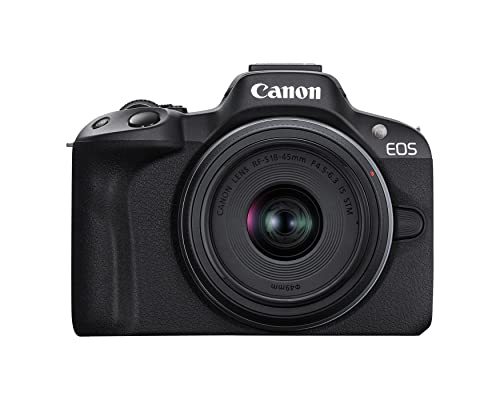
Canon EOS R50 — Best Overall Start
The R50 is the beginner camera that behaves like a good first teacher: it explains itself. Canon’s guided interface translates photography’s jargon into outcomes — more background blur, brighter, freeze the motion — and then, crucially, shows the student the real settings behind each choice, so the training wheels are transparent and come off by understanding rather than by courage. A beginner can make genuinely lovely photographs on day one and be learning the craft underneath them from the first week.
The hardware honours the teaching. There is a proper electronic viewfinder, because stills are composed better at the eye; the APS-C sensor delivers files with real depth for cropping and printing; eye autofocus finds the grandchild’s face while the beginner thinks about the light; and Canon’s colour makes skin and gardens look the way memory insists they were. The kit zoom covers the learning year, and the affordable portrait prime that usually follows it is the single most educational purchase in photography.
Its limits are honest ones — build, weather sealing and burst depth are enthusiast-lite — and a beginner will take a year or more to find them. By then the R50 will have done what the best first cameras do: made itself outgrown, proudly, by the photographer it created.
- Sensor: APS-C with forgiving, attractive colour
- Viewfinder: electronic, for proper stills composition
- Menus: guided modes that reveal real settings
- Autofocus: eye detection for people and animals
- Role: the default first stills camera
Strengths
- Teaches the craft while delivering results from day one.
- Viewfinder and files are a class above phone photography.
- Affordable lenses make the second year inexpensive.
Trade-offs
- Not weather-sealed for committed outdoor use.
- Buffer and burst are modest for serious action.
- Small body suits smaller grips and add-on lenses best.
Best for: the true beginner who wants photographs, guidance and growth in one body. Not suited for: the beginner who already knows they need flagship speed or sealing.

Nikon Z50 II — Best Stills Purist
Where the R50 teaches by translating, the Z50 II teaches by trusting. Its control layout is an enthusiast’s — dials where a photographer’s fingers expect them, a body that assumes its owner wants to drive — and for the beginner who is really a latent enthusiast, that trust is the faster education. Nothing is hidden; the exposure triangle is under your thumbs from the first afternoon, and the camera’s responses teach by consequence.
Its autofocus is the stills photographer’s kind: subject detection that recognises people, animals, birds and vehicles, so the beginner whose subjects are garden birds and the family dog gets professional assistance exactly where stills are hardest. The files from its APS-C sensor are clean and neutral, a retoucher’s starting point, and Nikon’s Z-mount lens range for crop bodies has matured into a sensible, affordable system.
Choose it over the Canon if your instincts run to wildlife, pets and the deliberate end of photography, or if Nikon’s handling simply fits your hands — a legitimate and underrated criterion, since the camera you enjoy holding is the camera that leaves the house.
- Sensor: APS-C with clean, neutral files
- Controls: enthusiast dials, nothing hidden
- Autofocus: people, animal, bird and vehicle detection
- Viewfinder: bright electronic finder for composing
- Role: first body for the latent enthusiast
Strengths
- Controls teach real photography at full speed.
- Bird and animal detection serves stills’ hardest subjects.
- Files edit cleanly for the beginner learning raw.
Trade-offs
- Less hand-holding than the Canon’s guided modes.
- No in-body stabilisation; the lens must provide it.
- Neutral colour asks a touch more editing for warmth.
Best for: beginners drawn to wildlife, pets and deliberate craft. Not suited for: the beginner who wants the camera to explain everything.

Fujifilm X100VI — Best Teacher by Constraint
The X100VI is the list’s beautiful argument that limitation teaches faster than freedom. It has one lens — a fine, fixed 35mm-equivalent — and it cannot be changed, zoomed or upgraded. The beginner who carries it learns photography’s oldest skill, moving their feet to compose, and learns it completely, because there is no other way to change the frame. Within a month, its owners pre-visualise in its focal length the way musicians hear in a key.
Everything else about it conspires toward stills purity: a hybrid viewfinder that can show the scene optically, with the world continuing beyond the frame lines as rangefinders have shown it for a century; film simulations that make colour a creative choice made in the camera, at the moment of seeing; a leaf-quiet shutter and a body that disappears in a coat pocket or a crowd. Its files are detailed and characterful, and its in-body stabilisation steadies the learner’s hand.
The honest warnings: it is in perennially short supply, it costs what system cameras cost without the system, and a beginner whose subjects are sport or wildlife will find its single wide-ish lens a wall, not a teacher. For the beginner drawn to street, travel, family and the documentary texture of daily life, it is less a camera than a course of study — the one their photographs will date their awakening from.
- Lens: fixed 35mm-equivalent, fast and sharp
- Viewfinder: hybrid optical/electronic, unique in class
- Colour: film simulations chosen at the moment of shooting
- Stabilisation: in-body, for handheld learning
- Role: the constraint that teaches seeing
Strengths
- One focal length builds compositional instinct fastest.
- Film colour makes finished photographs in-camera.
- Compact enough to be carried daily, which is the point.
Trade-offs
- No zoom and no lens changes, ever.
- Availability is notoriously limited.
- Wrong tool for sport, wildlife and tight portraits.
Best for: beginners drawn to street, travel and daily-life photography. Not suited for: beginners whose subjects need reach or variety of framing.

OM SYSTEM OM-5 Mark II — Best for Bad Weather
Beginners quit photography in the rain, on the shaky evening, at the dim family gathering — the moments when an unforgiving camera returns blurred, noisy evidence that the hobby is hard. The OM-5 Mark II is engineered against exactly those resignations. Its in-body stabilisation is among the most effective available, handing the beginner sharp handheld photographs at shutter speeds that would defeat them on any other system, and its weather sealing means the walk continues when the weather turns, which in many climates is when the light gets interesting.
The Micro Four Thirds system around it is the beginner’s friend in disguise: lenses are small, light and comparatively affordable, the crop factor turns modest telephotos into wildlife reach for the garden-bird phase, and the whole kit fits a small bag that a beginner will actually carry. Computational stills features — including in-camera neutral-density effects for silky streams — give the learner creative results that would otherwise wait for filters and tripods.
Its sensor is the smallest here, and at the extremes of darkness and printing size the bigger sensors pull ahead. Across the broad middle of real photography — daylight, evenings, prints for the wall — the OM-5’s forgiveness keeps beginners shooting, and shooting is the curriculum.
- Sensor: Micro Four Thirds, small and light system
- Stabilisation: class-leading in-body system
- Build: weather-sealed for real outdoor use
- Features: computational stills modes for creative effects
- Role: the all-weather, all-day beginner companion
Strengths
- Stabilisation rescues beginner technique in poor light.
- Sealing keeps the hobby going through real weather.
- Light lenses make a complete kit genuinely portable.
Trade-offs
- Smallest sensor here; trails at extreme ISO and print sizes.
- Menus run deep for a first-week beginner.
- Shallow-depth portraits need fast lenses to match larger formats.
Best for: outdoorsy beginners who shoot in all weathers and carry their kit far. Not suited for: beginners obsessed with the thinnest depth of field.

Canon EOS R10 — Best for Moving Subjects
Some beginners’ stills refuse to sit still: toddlers at full sprint, dogs at the park, a child’s first match, birds off the feeder. The R10 is the beginner body built for that household. It pairs Canon’s friendly colour and menus with a burst rate and tracking autofocus inherited from professional bodies — subject detection that understands people, animals and vehicles, and the speed to fire a sequence while the moment lasts and choose the frame afterwards.
That sequence habit is a legitimate stills education in itself: the beginner learns anticipation, timing and the ruthless editing that turns thirty frames into one photograph. The R10’s APS-C crop adds reach for the touchline and the garden, and the same affordable RF lenses that serve the R50 serve it, so the household system stays coherent if it becomes the family’s second body later.
It lacks in-body stabilisation and its buffer fills on the longest bursts; a beginner shooting considered subjects will never notice either. Buy it when the family’s photography is action wearing a beginner’s clothes.
- Sensor: APS-C with Canon colour
- Burst: fast continuous shooting for its class
- Autofocus: subject detection with strong tracking
- Viewfinder: electronic, with a responsive display
- Role: beginner action — children, pets, sport
Strengths
- Professional-grade tracking at a beginner price.
- Burst shooting teaches timing and editing.
- Crop reach helps at the touchline and the feeder.
Trade-offs
- No in-body stabilisation.
- Buffer limits the very longest sequences.
- Action talents are wasted on purely still subjects.
Best for: beginners photographing moving family life and sport. Not suited for: beginners whose world is landscape and still life alone.

Fujifilm X-T5 — Best to Grow Into
The X-T5 is the pick for the beginner who suspects — correctly — that they will not be one for long. Its traditional dials put shutter, aperture and exposure compensation under separate fingers in the manner of the film cameras photography was learned on for a century, and that tactile education is permanent: a photographer raised on dials understands exposure in their hands. Its high-resolution sensor produces files with the detail and cropping freedom of a professional tool, so the beginner’s archive stays printable at exhibition size as their eye improves.
Fujifilm’s film simulations give the learner a colour education alongside the exposure one — a dozen considered palettes to shoot deliberately rather than filter afterwards — and the system’s lenses include some of the finest affordable primes in photography, each one a small masterclass. In-body stabilisation, weather resistance and a tilting screen complete a body with no beginner-shaped compromises at all.
It costs more, and its resolution is unforgiving of sloppy technique in a way that is itself instructive. Buy it when the commitment is real and the budget allows the one-purchase answer; it is the camera on this list least likely to be replaced, because there is so little above it that a stills photographer actually needs.
- Sensor: high-resolution APS-C for detail and cropping
- Controls: dedicated dials for the classic exposure craft
- Colour: film simulations as a built-in colour education
- Stabilisation: in-body, with weather resistance
- Role: the long-term first camera
Strengths
- Nothing to outgrow for years of serious stills work.
- Dials build permanent, tactile exposure skill.
- Files print large and crop hard from the first month.
Trade-offs
- The highest price among these beginner picks.
- High resolution exposes shaky technique honestly.
- More camera than a casual beginner will use.
Best for: committed beginners buying once for the long term. Not suited for: the unsure beginner testing whether photography is for them.
How Do the Picks Compare for a Stills Beginner?
| Pick | Sensor | Viewfinder | Teaching style | Best first subjects |
|---|---|---|---|---|
| Canon EOS R50 | APS-C | Electronic | Guided translation | Family and everything |
| Nikon Z50 II | APS-C | Electronic | Trusted with controls | Wildlife and pets |
| Fujifilm X100VI | APS-C | Hybrid optical | Constraint | Street and daily life |
| OM SYSTEM OM-5 Mark II | Micro Four Thirds | Electronic | Forgiveness | Outdoors in all weather |
| Canon EOS R10 | APS-C | Electronic | Speed and sequences | Children, dogs, sport |
| Fujifilm X-T5 | APS-C high-res | Electronic | Classic dials | Everything, long-term |
The teaching-style column is the one to buy by. Cameras are curricula in disguise: choose the pedagogy that matches the learner — translation, trust, constraint, forgiveness, speed or tradition — and the technical columns will take care of themselves, because every body here is more capable than its beginner.
What Should You Learn First: Aperture, Shutter or ISO?
Aperture, because it is the creative one. A beginner who spends their first month shooting everything in aperture-priority, watching what the depth of field does to a portrait, a garden and a street scene, has learned the stills photographer’s central decision — what should be sharp, and what should melt — with the camera handling the arithmetic underneath. Add the portrait prime when it arrives and the lesson deepens physically: backgrounds separate, subjects glow, and the beginner understands in their portfolio why lenses matter.
Shutter speed comes second, as the motion decision: freezing the dog’s leap, blurring the waterfall, panning the cyclist. ISO comes last and least romantically, as the tax collector of the other two — the beginner who learns to raise it reluctantly and knowingly, rather than leaving it to chance, has understood the triangle as the budget it is. Shoot raw from early on, not because the beginner needs it in month one, but because the files they will want to re-edit in year two are being taken now.
Which First Lens Should a Stills Beginner Buy?
A fast prime at a natural focal length — the 50mm-equivalent class — is the traditional answer and remains the right one. It teaches fixed-focal composition, it opens apertures the kit zoom cannot reach, and it produces the shallow-depth portrait that convinces a beginner their camera was worth buying. Every system in this guide has an affordable version of this lens, and it should be bought before bags, filters or any other accessory is even considered.
After the prime, the beginner’s subjects should choose. The bird photographer graduates to a telephoto zoom, the street photographer to a wider prime, the family documentarian perhaps to nothing at all for a year — the kit zoom and the prime are a complete education in two lenses. Resist the collector’s drift: stills photography is learned by using lenses thoroughly, and a beginner with two lenses they know intimately will out-photograph one with six they are acquainted with.
What Mistakes Do Stills Beginners Make?
The first is shooting everything from standing eye level, which produces a world recorded at the height of a passer-by. Kneel for the child, climb for the landscape, lie down for the dog: stills composition begins with the feet. The second is centring everything, a habit the autofocus point encourages and the rule of thirds exists to break; the third is ignoring the background, so that trees grow from heads and bright signs steal scenes — the viewfinder shows all of it, and learning to see the edges is the beginner’s real graduation.
Fourth is deleting in-camera, ruthlessly, at the scene — the beginner discards the almost-frames that would have taught them the most, and fills cards with keepers they never study. Shoot generously, edit later at a screen, and keep a folder of instructive failures; every photographer in this guide’s audience has one, whether they admit it or not. Revisit that folder at the year’s end and it will show you, more honestly than any keeper, exactly how far your eye has travelled — the missed focus corrected, the centred composition abandoned, the light finally seen before the shutter rather than after it. Fifth is blaming the camera in month three and upgrading in month four. The plateau is the curriculum working; the way through it is a project, a subject pursued for a season, not a purchase.
How Do You Practise Stills Photography Deliberately?
Give the week a subject and the month a constraint. One lens, one walk, one hour: the exercises are old because they work. Photograph the same doorway across a day and learn what light does to an unglamorous subject; photograph a market without showing a face, then a portrait session without showing anything else. Constraints are the X100VI’s philosophy applied as homework, and they convert casual shooting into study without draining its pleasure.
Print monthly. A beginner who prints sees their photographs at the size where composition and focus tell the truth, chooses their best with an editor’s ruthlessness, and builds the wall that reminds them why they are learning. Join the local club or the online community with the thickest skin available, and ask for criticism of the work rather than praise of the effort — stills photography is a craft with standards, and hearing them early, kindly applied, is the fastest education there is.
Should a Stills Beginner Shoot JPEG or Raw?
Both, in sequence, for honest reasons. JPEG at the very start keeps the loop tight — shoot, see, learn — and the colour from these cameras, Canon’s warmth and Fujifilm’s simulations especially, is good enough that the beginner’s early portfolio need not wait for editing skills. But set the camera to record raw alongside once the basics settle, because the beginner’s eye improves faster than their archive can be reshot, and the raw files from their first year will repay re-editing for a decade.
When editing begins, begin gently: exposure, white balance, a crop with intent. The beginner who learns those three on their own honest files has learned post-processing; the one who begins with presets and filters has learned shopping. The cameras here were chosen partly because their raw files forgive a learner’s heavy hand without banding or breaking — the file, like the stabilisation, is part of the teaching staff.
How Should You Set Up the Camera on Day One?
Resist the full manual plunge and the full auto surrender alike; the beginner’s day-one configuration is a scaffold, not a destination. Set the camera to aperture-priority, auto ISO with a sensible ceiling, autofocus to its subject-detecting mode with eye detection on, and image quality to raw plus JPEG so both the lesson and the safety net are recorded. Set the date, format the card in the camera, and turn off every beep and grid you do not yet understand — then add the rule-of-thirds grid back in a week, when composition becomes the conversation.
Assign the control dials deliberately if the body allows it, because the habit of changing aperture without looking away from the viewfinder is built in the first month or not for a year. Learn where the exposure compensation lives before anything else; it is the beginner’s most-used control and the one that rescues the backlit portrait and the white dog in snow. Write your settings on a card in the camera bag. The day something is accidentally changed — and it will be — the card is the difference between a minute’s restoration and a factory reset performed in a temper.
Then go out and shoot the unglamorous circuit: the house, the garden, the street’s end, in the day’s ordinary light. The first hundred frames are calibration — of the camera to your hands and of your expectations to reality — and they should be spent on subjects that cannot be spoiled.
Which Genres Will Your Beginner Camera Meet First?
Family photography arrives first for most beginners, and it is a complete curriculum disguised as snapshots: faces in mixed light, children in motion, occasions that cannot be restaged. The R50 and R10 divide this world between them — guidance for the considered portrait, speed for the chaos — and both teach the family photographer the genre’s real skill, which is anticipation wearing a camera.
Landscape is the second teacher and the strictest about craft: it punishes tilted horizons, careless edges and midday laziness, and rewards the tripod patience the OM-5 and X-T5 support so well. Street and travel belong to the X100VI’s philosophy — small camera, fixed lens, photographer’s nerve — and they teach the fastest seeing of any genre. Wildlife begins in the garden for the Z50 II and R10 owners, whose subject detection and crop reach turn the bird feeder into a safari with honest difficulty.
The point of naming the genres is that no beginner camera is genre-neutral in its gifts. Buy for the photography you will actually do this year, and the camera will feel like a collaborator; buy for an imagined genre and it will feel like homework.
Should a Beginner Buy Used Instead?
Used equipment is photography’s honourable tradition, and a beginner with a knowledgeable friend to inspect the purchase can stretch a budget a full tier. The cautions are specific rather than general: shutter counts and sensor condition matter in stills bodies, a used camera’s menus arrive set to a stranger’s logic — factory-reset it before judging it — and the warranty gap is real money if the camera is the family’s only one. The picks in this guide were priced as new purchases because a first camera is also a first relationship with the craft, and a dud used body has ended more photographic beginnings than any bad photograph.
The smarter used purchase for most beginners is the second lens. Glass ages slowly, fails rarely and inspects easily, and the portrait prime bought used teaches exactly what the new one does. Bodies new, lenses used, budget respected: it is the allocation experienced photographers recommend to their own families, and it is the one this guide endorses.
How Do You Know When You Have Outgrown a Beginner Camera?
By the complaints, which change character. The beginner complains that photographs are blurry, dark or dull — technique’s complaints, all curable without spending. The advancing photographer complains that the buffer filled during the one sequence that mattered, that the rain ended the session the light was made for, that the file broke when the print went large — equipment’s complaints, each one naming a specification the way this guide’s reviews name them. When your frustrations read like a spec sheet, you have outgrown the camera; until then, the camera is still ahead of you, as every body in this list is designed to be for a good long while.
Outgrowing is also visible in the archive: a year of photographs in which the camera’s compromises — not the photographer’s — are the recurring flaw. Show that archive to any honest camera shop and the upgrade conversation becomes short, because the work itself makes the case. Until the work does, spend on lenses, printing and the occasional workshop, in that order.
What Role Does Printing Play in Learning Stills?
The decisive one, and the most neglected. A photograph on a screen is a rumour; a print is the fact — of focus, of composition, of whether the colours you imagined survived contact with the physical world. Beginners who print monthly learn at a rate screen-only photographers do not match, because the print cannot be zoomed, filtered or scrolled past: it hangs there, honest, while its maker studies it with a cup of tea. Every camera here produces files that print beautifully at home sizes, and the X-T5’s and Z50 II’s detail extends that honesty to the larger formats a growing photographer will attempt.
Start with the small ritual: the month’s best five, printed modestly, pinned where the household passes. The wall becomes a portfolio, a progress chart and an argument for the next lens all at once — and a beginner with a wall is a photographer with an audience, which is the condition under which craft grows fastest.
How Do the Seasons Teach a Stills Beginner?
A year of photography is a curriculum the calendar writes for free. Spring teaches macro and new growth — the OM-5’s close work and every system’s kit lens at its nearest — and the humility of photographing blossom in wind. Summer teaches harsh light and its avoidance: the beginner who learns to seek shade at noon and gold at eight has learned the year’s most transferable lesson, and the family holiday gives every pick here its happiest workout.
Autumn is the beginner’s reward: colour that flatters every sensor in this guide, low sun that models every face kindly, and mist that teaches atmosphere to anyone willing to rise early for it. Winter is the examination — short days, indoor light, weather that tests sealing and stabilisation and resolve — and the beginner who is still shooting in February, prints on the wall and a project under way, is a beginner in name only. Buy the camera before a season you love, and let the year do the teaching it has always done.
What About Low-Light and Night Stills?
Evenings are where beginners either fall for photography or quietly leave it, because the light that makes family life golden is the light that punishes slow lenses and shaky hands. The defences are layered and all six picks carry some of them: stabilisation that buys shutter speed, fast prime lenses that buy light itself, sensors whose high-ISO files stay clean enough to print, and autofocus that still finds an eye when the room dims to lamps. The OM-5’s stabilisation and the big-sensor Canons’ and Fujifilms’ file quality divide the honours by different means.
The beginner’s technique matters as much as the tools: brace, breathe, shoot in small bursts and let one frame in three be the still one; raise ISO with intent rather than apology; and learn the household’s light — which lamp flatters, which window works at dusk — the way a studio photographer learns theirs. Night stills are a genre of their own waiting beyond the family evening, and the beginner who masters the living room has already bought the ticket.
How Should a Beginner Care for the Camera?
Gently, routinely, and without fear. A blower for dust, a cloth for the lens, a bag that is the camera’s home and a strap that is its seatbelt: that is ninety percent of camera care, and it fits in a paragraph because it should fit in a life. Keep the camera out of the car’s heat and the bathroom’s steam, let a cold camera warm in its bag after a winter walk so condensation forms on the bag rather than in the lens, and change lenses with the body facing down and the weather at your back.
Batteries want charging before they are empty and storing neither full-flat nor forgotten; cards want formatting in the camera and retiring when they error, not after they fail. None of this is expertise — it is housekeeping, learned in the first month and costing minutes a year — and a beginner camera cared for this way will still be teaching somebody in a decade, which is more than can be said for most of the technology in the house.
What Does a Beginner’s First Year Look Like?
Month one is honeymoon and calibration: everything photographed, the guided modes earning their keep, the first print on the wall. Months two and three bring the plateau this guide has mentioned — the novelty spent, the flaws visible, the temptation to upgrade — and the photographers who pass through it do so on a project: the garden’s year, the street’s faces, the dog’s biography. The middle months are where the exposure triangle moves from the head to the hands, usually noticed in retrospect, on the day the photographer realises they changed three settings without thinking about any of them.
The year’s end brings the audit: an archive, a wall, a set of opinions about light that are now the photographer’s own. Some beginners stop there, happily, with a camera that serves family life for a decade. Others discover the itch that this list’s X-T5 was bought for. Both outcomes are successes, and both began the same way — with a stills camera, honestly chosen, and a year spent looking.
How Do You Photograph People Who Hate Being Photographed?
Most families contain one, and the beginner photographer’s diplomacy with them is a skill the camera can help with. Small cameras help first: the X100VI and the compacts of the world do not announce a photo session the way a large rig does, and candids taken in the flow of a gathering — hands working, laughter unposed — are both kinder and better than the formal portrait a reluctant sitter dreads. Ask anyway, respect the no, and show them the good ones; reluctant sitters are usually refugees from bad photographs, and a single flattering frame, delivered promptly and printed, renegotiates the treaty.
Technique serves the diplomacy: a longer lens and a greater distance lower the performance pressure, natural light flatters without the flash’s ambush, and conversation during shooting produces the expressions that posing never does. The beginner who learns to make people comfortable has learned the skill that professional portraitists charge for — the camera work, as the beauty photographers say, is the smaller half of it.
How Should You Keep a Year’s Photographs Safe?
With the seriousness the year’s work deserves, because a beginner’s archive is unrepeatable by definition — these are the first photographs, of people and places that will change. The routine is plain: copy the card to the computer the day of the shoot, keep the folder names dated and plain, and maintain a second copy somewhere that is not the same building’s same desk — a cloud account or a drive at a relative’s house. Delete nothing in the field, little in the month, and let time do the culling it is so good at.
Name the keepers as you print them, and let the archive’s structure mirror the wall’s: year, season, subject. The photographer who can find the photograph of the dog in the snow, three winters from now, in under a minute, owns an archive; the one who cannot owns a hard drive. It is the least romantic skill in this guide and, over a lifetime of stills, possibly the most valuable — the one that decides whether a lifetime’s looking survives as a family’s inheritance or evaporates as a failed drive nobody backed up in time.
What About Photographing Your Own Town?
The most underrated beginner subject is the one outside the door. A hometown photographed seriously for a year — its market, its weather, its unregarded corners — teaches composition faster than any expedition, because the exotic is not doing the work and the seeing must. It also produces the archive a family ends up treasuring most: not the holiday peaks but the home terrain, recorded by someone who loved it at walking pace. Every pick in this guide is small enough, or can be carried small enough, for the daily version of this project, and the X100VI was practically designed for it.
Start with the walk you already take, at the hour the light is kindest, and let the town surprise the person who thought they knew it better than anyone alive, including the person who has lived there for thirty years without once noticing the carving above the bakery door. Beginners consistently report that the camera changed their home before it changed their technique — streets they had crossed for years became subjects — and that change of attention, once it happens, does not switch off when the camera is put away. It is, in the end, what stills photography is for.
Final Recommendation
Start where your temperament points. The majority of stills beginners should buy the Canon EOS R50 and the portrait prime, and spend their first year on light and feet rather than equipment. Choose the Nikon Z50 II if wildlife and pets are the draw and you want the controls unhidden; the OM SYSTEM OM-5 Mark II if your photography lives outdoors in weather; the Canon EOS R10 if your subjects move for a living. Take the Fujifilm X100VI if its beautiful constraint calls to you and you can find one, and the Fujifilm X-T5 if you are buying once, seriously, for years. Then close the catalogue and go and look at the light — stills photography begins there, and no camera in this guide, however good, can do that part for you. What the right camera can do, and what each of these six was chosen to do, is stay out of the way while you learn it: answering your fingers honestly, forgiving your early technique, and handing you files good enough that your progress is the only variable anyone — including you, a year from now, looking at the wall — will ever notice.
Frequently Asked Questions
Why not just learn stills photography on my phone?
You can learn seeing on a phone, and should — it is the camera you always have. What a phone cannot teach is the craft’s mechanics, because its software keeps taking the decisions back: aperture is simulated, shutter is invisible, and the file is processed before you meet it. A dedicated stills camera makes every decision yours and shows you the consequences in full, which is the whole education itself.
Do I need a viewfinder, or is the screen enough?
A viewfinder helps stills specifically: it excludes the world outside the frame, steadies the camera against your face, and works in sunlight that defeats screens. Every pick here offers one. Screen-only composing suits some deliberate work — tripods, flat subjects — but for a beginner learning to see frames in a busy world, the eyepiece is the better classroom.
How many megapixels does a beginner need?
Enough to crop a little and print at the sizes a home displays — a threshold every camera in this guide clears comfortably. Beyond it, resolution buys cropping freedom and large prints, which is why the X-T5’s extra detail is a long-term luxury rather than a beginner’s necessity. Composition and light will limit your first year’s prints long before pixel count ever does.
Is full-frame worth it for a beginner?
Not as a first purchase, for most people. The APS-C and Micro Four Thirds systems here deliver files a beginner cannot distinguish in their first year, at prices that leave budget for the lenses that actually educate. Full-frame becomes a conversation when a photographer’s needs — extreme low light, the thinnest depth of field, professional printing — are proven rather than predicted.
What is the best first subject for a stills beginner?
The one within walking distance that you care about. Gardens teach light and patience, dogs teach timing, streets teach nerve, grandchildren teach everything at once. A subject you love survives the plateau every beginner meets in month three, and carries you through it; a subject chosen for prestige does not. Pick yours, pursue it for a season, and let the camera in this guide be the faithful witness.
Should a beginner join a camera club or take a course?
Both help, in different currencies. A club gives the beginner other photographers’ eyes on their work, monthly deadlines in the form of competitions and outings, and the company of people for whom a dawn start for the light is normal behaviour. A structured course compresses the exposure and composition fundamentals into weeks and answers questions at the moment they form. Neither is required — this guide’s cameras and a year of projects will teach the craft — but community is the strongest known antidote to the month-three plateau, and it costs less than any lens.
How long before a beginner takes good stills?
Good frames arrive in the first week — these cameras, properly chosen, see to that. Consistent good frames, the kind where the photographer meant everything in them, take a season of deliberate practice: the exposure triangle in the fingers, composition in the eye, light in the instincts. That timeline is not a warning; it is the pleasure of the craft, and it starts the day the camera arrives.
Related Guides
Stills are one branch of the beginner’s tree. Our general guide to the best cameras for beginners covers the hybrid picture, our roundup of the best cameras for beginner child photographers handles the younger end of the family, and our explainer on the best first lenses for new photographers goes deeper on the prime lens this guide keeps prescribing.