Disclosure: As an Amazon Associate, kajuandouglas.com earns from qualifying purchases. Links on this page are affiliate links; they cost you nothing extra. Prices and availability change often, so check the current Amazon listing before you buy.
Razer Doubleshot Pbt Keycap Review: The Upgrade Set, Judged Properly
A razer doubleshot pbt keycap review has to answer the question every gaming keyboard owner eventually asks: my board is fine, but the keys feel cheap and the WASD cluster is going shiny, so is a branded PBT upgrade set actually worth it, or should I disappear into the enthusiast keycap market instead? Razer’s set is the mainstream answer to that question. It replaces the thin stock ABS caps on standard mechanical and optical keyboards with thick-walled, double-shot PBT caps whose legends are molded through the keycap rather than printed on it, in a conventional profile that asks nothing new of your fingers. The Mercury White version reviewed here is the clean, bright colourway; the same set in pink is linked below as the colour alternative, and Razer’s bundle with a coiled cable is covered as the third option for buyers who want the desk aesthetic completed in one box.
The verdict, up front: this is the keycap upgrade to recommend to the largest number of people. It is not the most exotic set, the tallest profile, or the deepest cut for hobbyists who measure keycap walls for fun. It is the set that fits standard boards without research anxiety, survives years of play without shining or fading, and comes from a brand whose compatibility promises you can hold it to. The rest of this review examines the material, the legends, the fit, the sound change, and the honest limitations, including the big one: these are opaque caps, so your per-key RGB legends stop shining through, and that single fact decides the purchase for a specific kind of owner.

In this guide
The Review Subject: Razer Doubleshot PBT Keycap Upgrade Set (Mercury White)
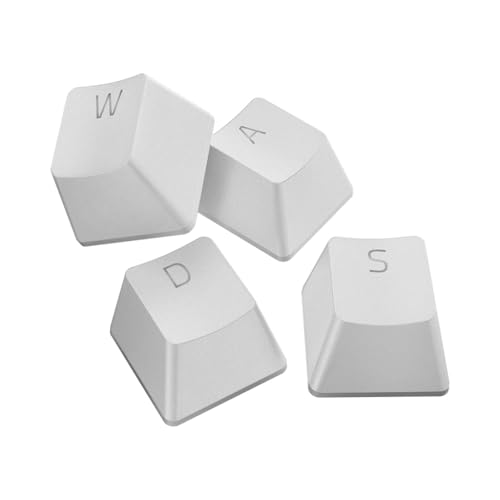
Badge: The set under review. Razer builds this set for standard 104/105 US and UK layouts and for both mechanical and optical keyboards, which covers the overwhelming majority of gaming boards sold in the last decade. The caps are double-shot PBT: a second shot of plastic forms each legend inside the cap wall, so the character you see is a physical inlay, not ink. Mercury White is the colourway on the test desk here, a bright white that suits light builds and makes RGB underglow look like frost.
- Material: PBT with double-shot legends
- Compatibility: standard 104/105 layouts, US and UK, mechanical and optical boards
- Profile: conventional sculpted gaming profile
- Finish: textured, oil-resistant surface
- Positioning: mid-tier branded upgrade set
Strengths
- Legends are structurally permanent; they cannot fade, rub off, or fill with grime the way printed legends do.
- The PBT surface refuses the shine that makes stock ABS caps look tired within a year of heavy play.
- Compatibility is the headline: one set covers the standard boards most gamers actually own, optical models included.
Trade-offs
- Opaque legends end shine-through RGB; backlight becomes a glow around the caps, not lit characters.
- The profile is safe and familiar, which reads as boring to enthusiasts chasing SA height or XDA flatness.
- Non-standard bottom rows and unusual layouts fall outside the set’s coverage and need checking before purchase.
Best for: owners of standard gaming boards who want one durable, no-drama PBT upgrade. Not suited for: shine-through RGB devotees or exotic-layout boards. Check price on Amazon
Material And Legends: Why Double-Shot PBT Is The Point
Two decisions define this set, and both are about permanence. The first is PBT itself, the harder polyester that resists the fingertip polishing which turns ABS glossy. On a gaming board, that polishing is not evenly distributed: it concentrates exactly where your fingers live, so a board ends up with a shiny WASD island in a matte sea, advertising its hours. PBT’s surface chemistry simply refuses that bargain for years at a time. The second decision is double-shot molding. Cheaper caps print legends on the surface, where thumbs and cleaning slowly erase them; dye-sublimation sinks legends into PBT and is equally durable, but cannot put a light legend on a dark cap. Double-shot solves the contrast problem physically, which is why this set can offer crisp legends in colourways where dye-sub could not. Together, the two choices mean the set’s day-one appearance is close to its year-three appearance, and that stability is the entire product.
Feel follows from the same material. The caps have the dry, faintly grained texture PBT is known for, giving fingers purchase during fast play without any sense of stickiness. Wall thickness is a clear step up from the thin caps bundled with most boards, and the typing sound drops in pitch accordingly: less hollow clack, more muted thock, especially on the larger keys where thin caps ring worst. Owners upgrading from stock caps on a mainstream board consistently describe the change as the keyboard sounding more expensive, which is a fair summary of what added mass at the fingertip does to a board’s voice.
Fit, Compatibility, And The Installation Experience
Compatibility is where branded sets quietly beat the enthusiast market for most buyers. The hobby’s beautiful sets often assume standard layouts and leave 75 percent boards, split spacebars, and odd bottom rows to fend for themselves with add-on kits. Razer’s set starts from the opposite direction: it is cut for the standard 104/105 boards that fill desks, in both US and UK variants, and it explicitly includes optical keyboards, whose owners are sometimes forgotten by mechanical-only sets. The standard bottom row is the detail to verify on your own board before ordering, because a handful of older gaming boards used non-standard spacebar and modifier widths that no mainstream set covers.
Installation is the usual pleasant ritual, with two Razer-specific comforts: the set is organized logically in its packaging, so you are not hunting a tray for the one 1.25u key at midnight, and the caps seat with consistent stem tolerance, neither rattling loose nor requiring the alarming force that makes you fear for a switch stem. Pull the old caps with a wire puller, work row by row, keep the stock set bagged and labeled for resale or warranty completeness, and the whole job takes a relaxed quarter of an hour. The spacebar and other stabilized keys deserve the standard care, even pressure from both ends, and once seated they sit flat and quiet, which is not a given with budget PBT sets whose long keys sometimes arrive with a whisper of warp.
The RGB Question, Answered Honestly
Every review of this set must spend a paragraph on what you lose. Stock gaming caps are usually shine-through ABS: translucent legends that light up with your board’s per-key RGB. These PBT caps are opaque. Your legends will be lit by room light, not by your keyboard, and in a dark room the board’s lighting becomes an underglow halo around each cap rather than readable glowing characters. For players who navigate by lit legends, that is a genuine functional loss and a legitimate reason to stay with ABS shine-through caps or hunt the rarer shine-through PBT sets. For the larger group who touch-type, play in lit rooms, or value the halo look, the trade is painless and often preferred within a week, because the board looks calmer and more premium. Decide which group you are in before buying; it is the only decision in this review that cannot be fixed later with accessories.
Sound And Feel After The Swap
Expect three changes. First, pitch drops across the board, most noticeably on the spacebar and Enter, where thin stock caps contribute a hollow edge that thicker PBT removes. Second, the surface feels drier and more secure under the fingers, which fast players describe as confidence on movement keys. Third, the board’s overall character tightens: individual keys sound more alike, because consistent wall thickness replaces the variable thinness of bundled caps. None of this transforms a bad keyboard into a good one; switches, case, and stabilizers still dominate. But on a decent board wearing cheap caps, which describes a large share of gaming keyboards in the wild, this set is the single highest-leverage upgrade available, ahead of switches, ahead of foam, because it changes the part your fingers and ears actually meet.

The Pink Colourway: Same Set, Different Personality
Badge: The colour alternative. This listing is the same double-shot PBT set in pink, with the same standard-layout compatibility, the same oil-resistant, extra-thick walls the listing highlights, and the same backlight-compatible, fade-resistant legend construction. Nothing in the review changes except the desk it suits: pink builds, gifts for players with themed setups, and anyone whose setup is deliberately soft-toned. It deserves its own link rather than a footnote because colourway availability is the most common reason buyers abandon a set they otherwise want. Check price on Amazon

The Bundle Alternative: PBT Keycap + Coiled Cable Upgrade Set (Black)
Badge: The desk-makeover bundle. Razer also sells the doubleshot PBT caps in black with a braided, tactically coiled cable, a keycap removal tool, and stabilizers in the box. Treat it as the same keycap decision plus an aesthetic and practical cable upgrade: coiled cables are the custom scene’s signature desk detail, they manage slack elegantly on shallow desks, and including the puller and stabilizer spares makes the bundle a small self-contained upgrade kit. Buy the bundle when your current cable is a plain straight cord you already dislike; buy the standalone set when your cable situation is solved and black is not your colourway.
- Contents: doubleshot PBT caps, coiled braided cable, keycap tool, stabilizers
- Colourway: black
- Compatibility: universal-fit positioning for standard boards
- Positioning: bundle tier above the standalone set
Strengths
- One purchase completes the two most visible upgrades a gaming desk gets: caps and cable.
- The included puller and stabilizers remove the two small-tool errands that stall first-time upgraders.
- Black caps suit the widest range of boards and hide a working desk’s evidence best.
Trade-offs
- You pay for a cable you may not need if your board is wireless or already well-dressed.
- Black only; the white and pink personalities live in the standalone listings.
- The same opaque-legend RGB trade-off applies unchanged.
Best for: a wired-board owner planning a full desk refresh in one order. Not suited for: wireless boards or buyers who only need caps. Check price on Amazon
Buying Guide: This Set Versus The Wider Keycap Market
Place the Razer set on the market map and its niche clarifies. Below it sit the no-name PBT sets: sometimes excellent, sometimes warped, thin, or misprinted, always a small gamble that confident hobbyists happily take and first-time upgraders often regret. Beside it sit other brands’ upgrade sets with similar promises, where the deciding factors become colourway, profile, and whether your exact board is named as compatible. Above it sits the enthusiast tier of group buys and in-stock designer sets, where money buys profiles, artwork, and sculpt quality beyond anything a gaming brand attempts, at the cost of layout research and occasional waiting. The Razer set wins its tier on certainty: known compatibility, known construction, retail availability, and a returns process. If certainty is not your bottleneck, if you enjoy the hunt and know your board’s measurements by heart, the enthusiast tier will reward you. If you want the upgrade done this weekend with no forum archaeology, this is the set the market built for you.
How To Install And Care For The Set
- Photograph your current layout before removing anything, especially if your board has media legends or a non-standard function row.
- Remove caps with a wire puller, pulling straight up, row by row, and keep the original set together in a labeled bag.
- Seat the new caps with even, straight-down pressure, checking each stabilized key for level seating and quiet travel as you go.
- Test the full board in a document, pressing every key once, before settling in; a high-seated cap reveals itself immediately.
- Clean every few months in warm water with a drop of dish soap, rinse well, and dry completely overnight before reinstalling.
- Store the board out of prolonged direct sunlight when possible, a habit that protects every plastic and finish on the desk.
Common Mistakes When Buying Branded Keycap Sets
The first mistake is assuming a gaming brand’s set fits every board that brand ever sold; older and budget models sometimes used non-standard bottom rows, so measure your spacebar and check your modifiers against the compatibility notes. The second is buying for RGB legends without noticing the caps are opaque, the one disappointment that recurs in this category. The third is discarding the stock caps, which you will want for warranty service, resale, or the day you sell the board to fund its successor. The fourth is judging the set in the first hour; PBT’s drier texture feels unfamiliar after slick ABS, and the fair trial is a week of real use. The fifth is paying bundle money for the coiled cable version when your board is wireless, a small absurdity that happens more often than anyone admits.
Final Recommendation
The Razer Doubleshot PBT set is the keycap upgrade for the mainstream gaming desk: permanent legends, a shine-proof surface, thicker walls that calm the board’s voice, and compatibility broad enough to buy without a research project. Choose Mercury White for light builds, pink for themed ones, and the black coiled-cable bundle when the desk is getting a full refresh. Stay with shine-through ABS only if lit legends are truly how you type in the dark. Everyone else can buy this set once and stop thinking about keycaps for years, which is the highest compliment a keycap set can earn. If a second set ever joins it, let it be for variety and joy, a different profile or a wild colorway for a second board, rather than for need. Need has been handled, thoroughly and permanently, by the set this review started with, and there is a particular satisfaction in a peripheral category where that sentence can be written honestly.
The Profile Question: Safe Shape, Deliberately
Enthusiast reviews sometimes treat this set’s conventional sculpted profile as a lack of ambition. It is better understood as the product’s thesis. A sculpted profile, where each row has its own height and angle, is what nearly every typist’s muscle memory already knows, because it is what nearly every keyboard ships with. Razer is selling an upgrade that changes material and construction while changing nothing about geometry, so the board feels familiar on the first keystroke and better by the hundredth. Buyers who want geometry to be the adventure, SA’s tall cups, XDA’s flat field, DSA’s low uniformity, should shop the profile comparison linked at the end of this review, where those shapes are the subject. Buyers who want their current keyboard, perfected, are this set’s audience, and there are more of them than the hobby’s loudest voices suggest.
Stock Caps Versus This Set: A Direct Comparison
| Property | Typical stock gaming caps | Razer doubleshot PBT set |
|---|---|---|
| Material | Thin ABS | Thick-walled PBT |
| Legends | Shine-through, printed or lasered | Double-shot, molded through the cap |
| Surface after a year | Shine on busy keys | Texture essentially unchanged |
| RGB legends | Lit characters | Opaque; glow around caps |
| Sound contribution | Brighter, hollower | Deeper, more muted |
| Feel | Smooth, sometimes slick | Dry, lightly textured grip |
A Year With The Set: The Wear Diary
Project the ownership forward. In month one, the change is all novelty: drier texture, deeper sound, a board that photographs like a product shot. By month three, the novelty has dissolved into the background, which is the point; the set has become simply what your keyboard is. Around month six, owners of un-upgraded boards start showing the first WASD shine, and your board does not, a divergence you will notice most in other people’s setup photos. At a year, the set needs nothing but its periodic wash, the legends are pixel-identical to day one, and the spacebar has not developed the slick center that makes stock spacebars feel like a different material from the rest of the board. At two years, the realistic conversation is about whether you want a second set for variety, not whether this one has worn out. Durability products live or die on this kind of boring timeline, and boring is the highest praise available here.
For Gamers Versus For Typists
Players buy this set for grip and permanence: movement keys that stay textured under sweaty, high-APM hands, and legends that survive the hours ranked play accumulates. Typists buy it for consistency: a surface that feels the same in month twelve as in week one protects the automaticity that fast typing depends on, and the deeper sound is kinder to shared rooms and call microphones. The interesting overlap is that both groups are buying the same property, surface stability, for different rituals. If your keyboard serves both lives, as most do, the set’s case strengthens rather than splits, and the only group with a genuine counter-argument remains the dark-room, legend-reading player whose RGB shine-through is functional rather than decorative.
When To Buy Enthusiast Sets Instead
This review recommends the Razer set broadly, not universally. Buy enthusiast instead when your board’s layout is non-standard and needs the add-on kits only the hobby market bothers to make. Buy enthusiast when a specific profile is your hobby’s current chapter, because no mainstream set will scratch that itch honestly. Buy enthusiast when keycaps are your collection, rotated and displayed, and variety itself is the product. And buy enthusiast when you want artwork, novelties, and colorways that a global gaming brand cannot justify producing. The Razer set’s virtue is that it makes the mainstream decision well; it does not pretend the hobby beyond the mainstream does not exist, and neither should its buyers.
Notes For UK Layout And Optical Board Owners
Two audiences deserve explicit reassurance because the wider market underserves them. UK layout owners get a set that acknowledges their layout exists, including the ISO enter and the extra legends UK boards carry, rather than the usual advice to make peace with a US kit’s gaps. Optical board owners get explicit compatibility rather than hopeful stem measurements, which matters because optical gaming boards are common, their owners upgrade caps at the same rate as everyone else, and being told a set is probably fine is not the same as being told it fits. If you belong to either audience, this set’s compatibility list is doing real work for you, and it is reasonable to weight that heavily against marginally cheaper sets that leave the question open.
The Spacebar Test And Stabilized Keys
Judge any keycap set by its spacebar, because the longest key exposes molding quality, stabilizer fit, and sound in one press. Cheap PBT spacebars sometimes arrive with a slight twist from cooling, rocking on their stabilizers and ticking at one end. This set’s spacebar sits flat and travels quietly, which tells you the molding process is controlled where it is hardest to control. Enter, Shift, and Backspace tell the same story at smaller scale: even seating, no rattle introduced by the caps themselves, and a deeper landing note than the stock caps they replaced. If your board’s stabilizers already rattled, new caps will not silence them, and the honest sequence is to tune or replace stabilizers first, the bundle version even includes a set, then let the caps finish the job. Owners who do both often describe the result as the board they thought they were buying originally.
How The Set Behaves On Different Switch Types
On linear switches, the set’s texture adds the fingertip information that smooth switches lack, and many players find reds and yellows feel more controlled under PBT. On tactile switches, the combination is the classic one: a bump you can feel through a surface that does not slide, which is why tactile gaming boards and PBT caps are paired so often. On clicky switches, the caps deepen the body of the sound without touching the click itself, making the board marginally less shrill for the people around you. On silent switches, thicker caps complete the quiet build, removing the hollow top-out note that thin caps leave behind. There is no switch family the set argues with, because its contribution, surface and mass, is orthogonal to what switches do; that neutrality is part of why a branded upgrade set can be recommended without asking what lives under your caps first.
Value Framing: What The Money Buys
The set sits in the mid tier of keycap pricing, above the marketplace lottery and below designer group buys. The honest accounting of what the premium over the cheapest PBT sets buys: molding consistency, including flat long keys; legend quality with no bleeding or blotching; compatibility research done for you, including optical boards and UK layouts; and a brand whose returns desk exists if your board turns out to be the exception. What it does not buy: exotic profiles, artisan extras, or the hobby’s fashion cycle. Buyers who understand that accounting rarely feel overcharged, because the set is priced as insurance against the category’s common disappointments as much as it is priced as plastic. Buyers who enjoy risk and research can sometimes beat it on value; they are also the buyers least likely to be reading a review of the safe option.
As A Gift And As A First Upgrade
Keycaps are the rare enthusiast gift that is safe to give, because they are consumable-free, size-free in the clothing sense, and reversible in minutes if the recipient’s taste differs. This set is the safest version of that gift: it fits the standard boards most players own, improves any of them visibly, and carries a brand the recipient recognizes. As a first upgrade for your own board, it teaches the hobby’s central lesson cheaply, that the surface you touch matters as much as the mechanism beneath it, and it leaves every future door open: switches next, a custom board eventually, or contentment, which is an underrated outcome. Many elaborate setups began with exactly this purchase and a surprised owner saying the keyboard feels finished now.
Troubleshooting The Rare Fit Problem
If a cap sits high, remove it and check for a bent switch pin or debris in the stem before applying more force; force is how stems crack. If a stabilized key binds, reseat it by pressing both ends evenly and confirm the stabilizer wire is clipped in on both sides. If one key sounds different from its neighbors, swap it with the same key from another row to learn whether the note follows the cap or the switch position. If your board turns out to have a non-standard spacebar, the set’s other keys still fit, and single spacebars in standard PBT are sold separately across the market, so the purchase is rarely a total loss. These are five-minute diagnoses, and they cover nearly everything that ever goes wrong with a mainstream set on a mainstream board.
How Double-Shot Molding Actually Works
The term deserves a plain explanation, because it justifies the set’s price and permanence. A double-shot cap is molded in two injections. The first shot forms the legend, a lattice of characters in one plastic color, standing in the mold like tiny signage. The second shot flows around it, forming the cap body in the contrasting color, encapsulating the legend so it runs through the wall’s thickness. Hold a double-shot cap to the light from underneath and you can see the legend’s structure inside the plastic, which is why no amount of typing, cleaning, or sunlight erases it: removing the legend would require removing the cap. The process demands precise tooling and a second molding cycle for every cap, which is why it costs more than printing and why it appears on sets meant to be final purchases. Dye-sublimation, the other permanent method, suits PBT artwork and multi-color designs but needs legends darker than their caps. Razer’s choice of double-shot is the choice that permits crisp legends on any of its colourways, and it is the technically correct one for a mainstream set sold on durability.
Care, Cleaning, And Keeping White Caps White
Mercury White asks the obvious question, so here is the maintenance reality. PBT cleans beautifully: a soak in warm water with dish soap lifts the accumulated oils and desk grime, and the textured surface releases dirt more completely than polished ABS, which holds grime in its shine. White caps show that grime sooner, which is a feature disguised as a chore, because the set gets washed before it gets disgusting. Dry caps fully before reinstalling, keep a small brush for the board’s plate while caps soak, and the whole ritual takes less active time than a coffee break every few months. Pink and black colourways follow the same care with less visible urgency. None of the colourways should meet bleach, solvents, or hot water, none needs them, and the legends are indifferent to washing in a way printed caps never are.
Resale And Hand-Me-Down Value
A durable branded set holds value in the small economy of used gear. Buyers trust a known set’s condition from photographs because PBT does not hide wear the way shiny ABS confuses it, and the Razer name makes the listing legible to people outside the hobby’s forums. Practically, this means the set is a reasonable thing to buy even if you suspect a custom board is in your future: it will serve the current board, then sell or migrate, because standard stems and layouts travel between boards. Keep the packaging and any included tools, photograph the set honestly if you sell, and expect the set to be one of the easier peripherals to move on. Few upgrades at this price offer that combination of daily improvement and exit flexibility.
The One-Paragraph Review For The Impatient
Razer’s doubleshot PBT set takes the standard gaming keyboard you already own and fixes the two things that age it: caps that shine and legends that fade. It fits the boards most people have, including optical and UK models, installs in fifteen minutes, deepens the board’s sound, and then disappears into years of unconsidered service. It asks one sacrifice, shine-through legends, and offers one personality choice among white, pink, or the black cable bundle. If that trade reads as obviously worth it, it is, and the rest of this review exists to confirm the details rather than to change the conclusion.
The Three Listings, Side By Side
| Option | Colourway | Extras | Buy it when |
|---|---|---|---|
| Doubleshot PBT Upgrade Set | Mercury White | Caps only | Your setup is light-toned or you want the cleanest look |
| Doubleshot PBT Keycap Set | Pink | Caps only | Your build is themed pink or pastel |
| PBT Keycap + Coiled Cable Set | Black | Coiled cable, puller, stabilizers | You want the full desk refresh in one box |
What Owners Typically Upgrade Next
A cap set this effective tends to expose the next weakest link, and the order owners follow is instructive. Stabilizers come first, because the spacebar’s new authority makes any residual rattle more noticeable by contrast. Switches come second, often a move to a preferred weight or a quieter family now that the caps have proven how much surface matters. A desk mat appears surprisingly often in the sequence, because the board suddenly looks like the serious object on the desk and the surface beneath it gets judged. Cables follow for wired boards, which is the bundle’s whole premise. Notice what is not on the list: another keycap set, at least not for need. Variety may call later, but the functional keycap question, once this set answers it, stays answered, and that staying power is the review’s core finding restated as an ownership pattern.
A Note On Buying For Someone Else’s Board
If this set is a gift for a board you do not own, do the two-minute diligence that makes it land well: confirm the recipient’s board is a standard layout, ideally by its model name, and glance at a photo of its bottom row and spacebar. If the board is a compact or an unusual gaming model with a split spacebar, choose a different gift from the keyboard shelf rather than forcing this set’s mainstream virtues onto a non-mainstream board. When the board is standard, and most are, the set is close to a guaranteed success, because it improves the recipient’s daily typing whether or not they had ever thought about keycaps, and it installs during one coffee without tools beyond the puller many sets and boards already include.
Grip, Sweat, And Long Sessions
There is a performance paragraph hiding inside this cosmetic product. During long or tense sessions, hands sweat, and smooth ABS caps become incrementally slippery in a way players feel as micro-corrections: fingers re-seating on movement keys, a slight uncertainty on the spacebar during jumps. PBT’s dry texture holds its friction in those conditions, which is why the listing’s oil-resistant language is not marketing garnish but a description of the material’s behavior under real hands. The effect is small per keystroke and large per session, the kind of advantage that never appears in a specification table and always appears in the third hour of a tournament night. Typists in warm climates report the same benefit across a workday. If your current board’s caps feel greasy by afternoon no matter how clean your hands are, that sensation is the material, not you, and this set is the direct fix.
Where The Set Sits In Razer’s Own Ecosystem
Razer sells keyboards at every tier wearing ABS caps chosen for Chroma shine-through, and then sells this set to the same customers, which tells a coherent story rather than a contradictory one. The boards optimize for the showroom and the stream, where lit legends sell; the upgrade set optimizes for the second year of ownership, where surface and legends are what remain. Owners who buy both are not being upsold so much as sequencing: the board first for its switches, layout, and features, the caps when the honeymoon ends and the shine begins. Viewed that way, the set is less an accessory than the line’s longevity package, and its existence is quietly one of the more consumer-friendly facts about the ecosystem: the upgrade path is official, compatible by design, and does not require leaving the brand’s warranty umbrella to achieve what third-party caps promise with more risk.
What This Set Will Not Fix
Honest boundaries protect the recommendation. The set will not silence rattly stabilizers, though it may reveal them. It will not change switch feel beyond surface and sound, so a board whose switches you dislike needs switches, not caps. It will not add wireless, macros, or media keys to a board that lacks them. It will not make a hollow, flexing case feel like a milled aluminum custom, because caps are the top layer of a stack whose other layers still speak. And it will not satisfy a buyer whose real desire is a new profile or a themed artwork set; that desire is legitimate and lives elsewhere in the market. What remains after those exclusions is still the most common upgrade case in the category: a good board with aging caps, owned by someone who wants it to feel new and stay that way. For that case, this set is close to a complete answer.
The Decision, Compressed
Ask three questions. Is your board a standard layout, mechanical or optical? If yes, compatibility is settled. Do you read your legends by RGB light in a dark room? If no, the set’s one sacrifice costs you nothing. Do your current caps shine, feel thin, or sound hollow? If yes to any, the set’s improvements are the ones you will feel daily. Three friendly answers make this the easiest recommendation in this review series; a no on the second question is the only true stop sign, and even then it points you to a specific alternative category rather than to buyer’s remorse. Everyone else can choose a colourway, or the cable bundle, and consider the keycap chapter of their setup closed for years.
Legend Style And Desk Aesthetics
A word on looks, since keycaps are the most visible part of any keyboard. The legends use Razer’s gaming typeface, angular and assertive, which suits Razer boards natively and reads as a deliberate style choice on other brands’ boards rather than a mismatch. Mercury White turns the whole board into the desk’s lightest object and makes colored underglow look pastel and soft; pink commits to a theme and rewards owners who build around it; black is the chameleon that disappears into any setup and lets the board’s own design speak. Because the caps are opaque, the board’s daytime appearance is its real appearance, with no dependence on lighting state, which photographers and tidy-desk people quietly prefer. If your setup is photographed, streamed, or simply looked at with pleasure every morning, that daytime honesty is worth weighing alongside the durability case, and for many buyers it is secretly the deciding factor that the practical arguments then justify.
Report Card, Narrated
Material: the right plastic, in the right thickness, doing exactly what PBT promises. Legends: the best construction available at this tier, permanent by physics rather than by promise. Compatibility: the set’s quiet superpower, covering the standard mechanical and optical boards that fill the real world, in US and UK layouts alike. Feel: drier, grippier, and more composed than the caps it replaces, with a sound that drops the hollow edge off a mainstream board. Aesthetics: three honest personalities, white, pink, and black, each with a desk it belongs on. Limitations: opaque legends, a safe profile, and no coverage for eccentric layouts, all disclosed rather than hidden. Value: mid-tier money buying certainty and years, which in this category is what money is for. The set does not win every category a hobbyist could name, and it was never trying to; it wins the categories its buyers actually live in, which is the definition of a well-aimed product and the reason this review can recommend it without a thicket of conditions.
Why Branded Upgrade Sets Exist At All
The category itself is worth a paragraph of context. A decade ago, a gaming keyboard’s caps were simply part of the keyboard, replaced only when the board died. The enthusiast scene demonstrated that caps were a modular surface with its own materials science, and mainstream owners began asking why their expensive boards wore the cheapest caps in the hobby. Brands answered with official upgrade sets, and the good ones, this set among them, are engineered admissions that the stock caps were a cost decision rather than a quality ceiling. That history explains the set’s positioning precisely: it is not competing with artisan group buys, and it is not a generic accessory. It is the manufacturer selling you the caps your board would have worn in a world without a bill of materials meeting. Judged as that, on compatibility, construction, and permanence, it is one of the most successful products of its kind, and the steady demand for it across colourways and bundles suggests owners agree with the diagnosis even when they have never heard it stated.
Day One Versus Day Thirty
Day one with this set is about contrast: the texture feels pronounced, the sound change is obvious, and you will catch yourself pressing keys just to hear them. Day thirty is about absence: you no longer notice the caps at all, which sounds like faint praise until you remember that the stock caps announced themselves constantly, through shine, slip, and hollow notes, for the entire time you owned them. The best upgrades in any category share this arc, loud at installation and silent in service, and it is why owner satisfaction with PBT sets tends to rise over time while satisfaction with flashier purchases falls. If you judge the set, judge it at day thirty, on a board you have stopped thinking about, in the middle of work or a match that has your full attention. That is the condition the set was designed for, and it is the condition in which its value quietly becomes obvious.
Care And Cleaning: Keeping PBT Honest
PBT’s durability invites neglect, so a short care protocol earns its place in a review of a set meant to be kept for years. Dust lifts with a soft brush or compressed air weekly; the deep clean, every few months, is a soak in warm water with a drop of dish soap, a gentle scrub of the tops with a soft cloth, and a full air dry before remounting, because a cap reinstalled damp will fog a backlit board’s look for days. Avoid solvents and abrasive pads entirely, as PBT’s texture is a molded surface that abrasion polishes into the very shine the material was chosen to avoid. Store the removed stock set, cleaned, in its tray if it has one, since a complete original set preserves the board’s resale completeness. Followed loosely, this routine keeps the Razer set looking like the upgrade it was on the day it arrived, indefinitely, which is the practical meaning of the word durable in this category.
A Word On The Pink And Black Variants
The colourways reviewed as siblings of the Mercury White subject deserve their own sentence of guidance, because they are not interchangeable moods. The pink set commits a desk to its palette completely and suits a themed build or a deliberate statement; the black bundle, with its coiled cable, is the configuration for buyers refreshing a whole top surface at once, caps and connection together. All three share the molding, the texture, and the fit that this review evaluated, so the choice among them is purely about the desk the set will live on, which is exactly the kind of choice a good product leaves to its buyer.
Frequently Asked Questions
Will this set fit my keyboard?
It fits standard 104/105 US and UK layouts on mechanical and optical boards, which covers most mainstream gaming keyboards. Verify two things on yours: a standard-width spacebar and a standard bottom row. Compact boards with unusual modifier sizes and split layouts are the exceptions that need a different set.
Do the legends wear off over time?
No. Double-shot legends are a second molding of plastic running through the cap wall, so there is no surface print to wear. The caps themselves will outlast several keyboards, and the legends will look the same on the last day as the first, which is the core reason to pay for double-shot construction.
Can I still see my RGB with these caps?
You will see backlight as a glow around and between the caps, but the legends themselves are opaque and will not light up. If readable glowing legends in a dark room are essential to how you play, choose a shine-through set instead and accept the ABS shine trade-off that comes with most of them.
How does the set change my keyboard’s sound?
Thicker PBT walls lower the pitch and remove much of the hollow edge that thin stock caps add, especially on the spacebar and other large keys. The change is noticeable but not magical; it refines a decent board rather than rescuing a rattly one, and stabilizer tuning still matters more for the spacebar specifically.
Is the pink set identical apart from color?
Yes, in every way that matters for the purchase: same double-shot PBT construction, same compatibility, same legend durability. Buy it for the setup it matches. The bundle with the coiled cable is the genuinely different product, adding the cable, puller, and stabilizers in black.
Are these caps good for optical keyboards?
Yes; the set is explicitly built for mechanical and optical boards with standard stems and layouts, which is not true of every keycap set on the market. Owners of optical gaming boards are exactly the buyers who get stranded by mechanical-only sets, so the explicit compatibility is a real feature here.
Will this set fit a keyboard with a non-standard bottom row?
Measure before you assume, because bottom rows are where compatibility quietly breaks. Many gaming boards use a wider or narrower spacebar and shorter right-side modifiers than the standard layout this kind of set is drawn around. Compare your spacebar length and the sizes of the keys beside it against the spares included in the box, and check whether extra modifier caps are actually the widths you need rather than simply present. If only the spacebar differs, you may be able to keep the stock spacebar and change everything else, though the colour match will rarely be exact. If several modifiers differ, the honest answer is to choose a set made for your layout instead of forcing stems onto switches at an angle.
How do I store the stock caps I take off so they stay usable?
Keep them in order, in a divided tray or in small labelled bags grouped by row, rather than tipped loose into one box. Row order matters because sculpted caps look almost identical at a glance yet sit at different heights, and rebuilding a set from a jumble takes far longer than the original swap. Store the tray away from direct sunlight and away from heat sources, since light-coloured stock caps discolour in storage just as they do on a board. Add the original puller and any spare caps from the new set to the same container. When you later sell the keyboard or return it to stock for a second desk, that organisation is what makes the reversal painless.
Related Guides
Compare materials in the PBT vs ABS keycap comparison and profiles in the five-profile keycap profile comparison, then browse the guide to picking a keycap set. Board upgraders may also enjoy the BlackWidow V4 75% review, whether Razer keyboards are worth it, and double-shot vs dye-sub keycaps explained.