Disclosure: this article contains affiliate links. If you buy through a link on this page, we may earn an affiliate commission at no extra cost to you.
Out past the last streetlight, free television stops being a given and starts being a small engineering project. The transmitters that city viewers take for granted sit forty, sixty, sometimes ninety miles from a farmhouse roof, and between the tower and your TV there may be a ridge, a stand of mature oaks, or nothing but open farmland and weather. An indoor antenna on the windowsill cannot solve that geometry. A properly chosen outdoor antenna, mounted high and aimed well, very often can — pulling in the major networks, PBS, and a surprising stack of subchannels with no monthly bill attached.
This guide is about that second kind of setup: outdoor antennas built for fringe and deep-fringe reception in rural areas. Every pick below is a real, currently sold outdoor model, and the emphasis throughout is on honest expectations. Antenna marketing loves round numbers, so we will spend real time on what a “100-mile” claim means when your horizon, your terrain, and the curvature of the Earth get a vote. We will also cover the parts that matter as much as the antenna itself — preamplifiers, rotors, masts, coax, and grounding — because in the country, the installation usually decides whether the antenna succeeds.
What to look for in a rural outdoor TV antenna
Range claims versus reception reality
Start by discounting the number on the box. There is no regulated standard behind antenna range claims, and a “150-mile antenna” is not receiving a watchable signal from 150 miles away under normal conditions. TV signals travel essentially in a straight line, and the Earth’s curvature drops a transmitter below your horizon surprisingly fast: a tower 1,000 feet tall and an antenna 30 feet up give a combined radio horizon of roughly 55 to 60 miles. Beyond that, signals can still arrive — refracted by the atmosphere, bounced off terrain, or boosted on cool mornings by tropospheric ducting — but they arrive weaker and less predictably.
A practical reading of the market looks like this. In flat, open country with a tall transmitter, a good outdoor antenna at rooftop height routinely delivers solid reception from 50 to 70 miles. At 70 to 90 miles you are in true fringe territory, where antenna gain, mounting height, and a preamplifier all matter and some channels may fade in summer heat or heavy rain. Past 90 miles, dependable everyday reception is the exception rather than the rule, though viewers in favorable spots — a hilltop home aiming across a valley or a lake — sometimes manage it. Treat any range figure as a rough class marker (medium-range, long-range, deep-fringe) rather than a promise, and weight your decision toward antenna design and your own site conditions.
UHF, VHF, and why your channel list decides the antenna
Most digital TV stations now broadcast on UHF, but a meaningful number — often including one or two major-network affiliates — still transmit on VHF, particularly the high-VHF band (channels 7–13) and occasionally low-VHF (channels 2–6). This matters enormously in rural shopping, because many sleek modern antennas are UHF-only designs that will silently miss a VHF station no matter how strong it is. Before choosing anything, look up which real (RF) channels your target stations use, not just the virtual channel numbers shown on your TV. If any station you care about sits on high-VHF, you need an antenna with dedicated VHF elements — the longer rods or the wider rear section on traditional designs. Low-VHF stations are the hardest case of all: their long wavelengths demand physically large elements, and only a few big traditional antennas handle them well.
Gain, directionality, and the beamwidth trade-off
Antenna gain is the honest spec hiding behind range claims. A directional antenna concentrates its sensitivity in one direction, like a flashlight beam, and that focus is exactly what fringe reception needs — figures in the range of 10 to 14 dB of UHF gain separate serious long-range models from casual ones. The cost of that focus is beamwidth: a high-gain antenna may only “see” a window 25 to 40 degrees wide, so if your stations broadcast from two cities in different directions, one fixed antenna cannot serve both. That is the situation rotors and dual-antenna setups exist for. Multi-directional and bowtie designs trade peak gain for a wider view, which suits rural viewers whose towers cluster within a broad arc. Decide which problem you actually have — weak signals from one direction, or decent signals from several — before falling for the biggest gain number.
Preamplifiers: when they help and when they hurt
A mast-mounted preamplifier boosts the signal at the antenna, before it suffers losses traveling down a long coax run to your TV. In deep-fringe country with 75 or 100 feet of cable between the roof and the television, a good low-noise preamp is often the difference between a picture that holds and one that pixelates every evening. Two cautions keep rural buyers out of trouble. First, a preamp cannot create signal that the antenna never captured; it only preserves what is there, so it never substitutes for height and aim. Second, if you happen to live within a few miles of one strong local transmitter — a translator tower on a nearby hill, say — a high-gain preamp can overload and actually wipe out channels. Adjustable-gain and filtered models, and preamps with built-in FM and LTE filtering, are worth the small premium out where stray signals and cell towers complicate the picture.
Mounting height and location
Height is the cheapest gain you will ever buy. Raising an antenna from a porch rail to the roof peak, or from the roof to a 30-foot mast, routinely does more for fringe reception than upgrading the antenna itself, because every extra foot clears trees, outbuildings, and terrain that block the signal path. A gable-end mount or a chimney mount suits many farmhouses; a freestanding mast or a repurposed tower suits properties where the house sits in a hollow. Wherever it goes, the antenna wants a clear shot toward the transmitters — a metal roof edge, a grain silo, or a big steel barn in the signal path can reflect and scatter signals enough to cause multipath breakup on channels that should be strong.
Build quality for weather that means it
A rural antenna lives a harder life than a suburban one. It takes the full force of prairie wind, ice loading in northern winters, and summer sun with no shade, and nobody wants to climb a mast in February to fix a cracked plastic housing. Look for solid aluminum elements rather than thin stamped ones, stainless or well-coated hardware, and UV-stable plastics on the parts that are plastic. Folding or snap-together designs are convenient but check that the elements lock positively; a bowtie panel that droops a few degrees after two storm seasons loses gain you paid for. Wind-load ratings are rarely published honestly, so heft and construction are your best proxies.
In this guide
The six picks at a glance
The table below summarizes the character of each antenna rather than laboratory numbers, because rural reception depends as much on your site as on the hardware. Use it to shortlist, then read the full review of the two or three models that match your situation.
| Antenna | Style | Best for | VHF? | Character |
|---|---|---|---|---|
| Antennas Direct ClearStream 4V | Multi-directional panel | Towers spread across a wide arc | Yes, high-VHF dipole | Premium, compact, strong UHF gain |
| Antennas Direct DB8e | Large multi-directional bowtie | Multiple cities in different directions | No — UHF design | Premium, very wide coverage |
| Winegard Elite Pro BW-2000 | Amplified directional | Simpler installs, moderate to deeper fringe | Yes, TwinAmp VHF/UHF | Mid-range, tidy, with a smart signal meter |
| GE Outdoor Yagi | Traditional yagi | One tower direction on a budget | Yes, wideband elements | Budget, classic long-boom design |
| Five Star Outdoor Antenna | Motorized rotating yagi | Distant towers in several directions | Yes | Budget, rotor included in the box |
| Televes Dat Boss Mix | Intelligent amplified yagi | Deep fringe, mixed strong and weak signals | Yes, high-VHF | Premium, self-adjusting gain |
The best outdoor TV antennas for rural areas, reviewed
Antennas Direct ClearStream 4V
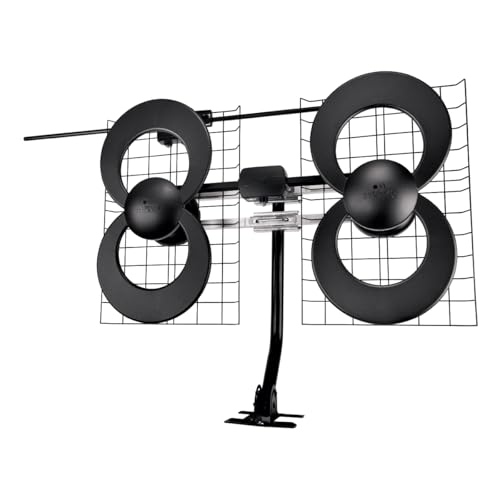
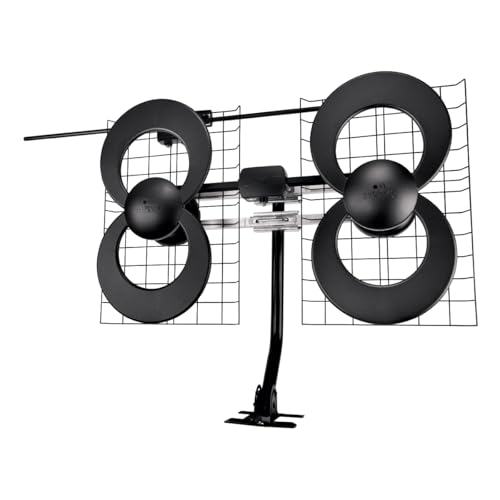
The ClearStream 4V is the antenna we would hand to a rural viewer whose stations are weak but reasonably grouped — say, two cities whose towers sit within about ninety degrees of each other across open farmland. Its four-loop UHF array delivers genuinely strong gain for its size, and the reflector behind the loops rejects signal arriving from the back, which reduces the multipath ghosting that plagues reception near metal barns and silos. A separate high-VHF dipole element rides on the same frame, so the many rural markets where one network affiliate still broadcasts on channel 9 or 11 are covered without a second antenna.
Strengths. The build quality is a clear step above the no-name panels that crowd the category: thick aluminum loops, a rigid frame, and hardware that survives re-aiming without stripping. It is also refreshingly compact for its performance, which makes it one of the easier long-range options to raise on a mast single-handed and less of a sail in high wind. Because it is multi-directional rather than a narrow yagi, small aiming errors are forgiven — helpful when you are aligning by compass on a roof. It suits pairing with a mast preamplifier extremely well, since the antenna itself is passive and clean, letting you add exactly as much amplification as your cable run needs.
Trade-offs. This is a premium-priced antenna, and the VHF dipole, while genuinely useful, is a single modest element: a weak low-VHF station or a very distant high-VHF one will still defeat it. The wide reception pattern that forgives aiming also means it cannot match a long yagi’s raw reach in one single direction at the far edge of coverage. Assembly is mostly painless but the reflector grid and loop alignment deserve a careful ten minutes on the ground.
Who it suits. Rural and exurban households 40 to 75 miles from their towers, with stations spread across a moderate arc and at least one high-VHF channel in the mix. If your transmitters all sit in one tight direction at 80-plus miles, look at the yagi picks instead. To see today’s deal, check price on Amazon.

Antennas Direct DB8e
The DB8e exists for a classic rural problem: your ABC and NBC come from the city to the northeast, your CBS and Fox from a smaller market to the southwest, and neither signal is strong. This is a big eight-element bowtie array from Antennas Direct whose two panels can be aimed together as one multi-directional antenna or turned so each half points in a genuinely different direction — in effect, two antennas on one mast feeding one cable. For farmhouses caught between two markets, that flexibility is worth more than any single gain figure.
Strengths. Few antennas gather as much UHF signal across as wide an arc, and the split-panel design means you are not forced into a rotor’s compromises. The construction is made for outdoor life: a rigid frame, weather-resistant materials, and mounting hardware included, built to stay on a mast for years rather than a season. Antennas Direct rates the design for extreme range, and on a tall mast with a good preamp, owners in open country regularly report reliable UHF lineups from two directions at 60 miles or more. Because both panels feed one downlead, a DVR household can record from two markets at once, which no rotor setup can do.
Trade-offs. Size is the obvious one — this is a large, visually prominent antenna that catches real wind, so the mast and mount must be chosen seriously, and a lightweight tripod will not do. It sits at the premium end of the market. Its breadth also works against it in one scenario: if all your stations are in a single direction at extreme range, a narrower, higher-gain yagi concentrates more sensitivity where you need it. Most importantly, it is a UHF antenna: a must-have station on high-VHF will need a separate VHF antenna combined into the feed, because no amount of aiming gives a bowtie panel elements it does not have.
Who it suits. Rural viewers between two broadcast markets, roughly 40 to 80 miles from each, who want both UHF lineups without a rotor — especially households that record from multiple networks and cannot tolerate a rotor’s one-direction-at-a-time limitation. For current availability — check price on Amazon.
Winegard Elite Pro BW-2000
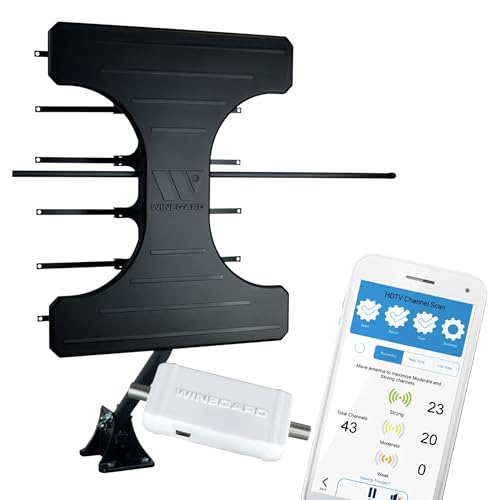
Not every rural home is in deep fringe. Plenty of country properties sit 30 to 50 miles from a metro tower farm — far enough that an indoor antenna gives up, close enough that a well-made outdoor antenna finishes the job without drama. The Winegard Elite Pro BW-2000 is built for exactly that band of country, and it reaches a little further than its tidy size suggests: Winegard rates it at 70-plus miles, it is an amplified directional design in a weather-sealed, outdoor-rated housing, and it is small enough to disappear against a gable end rather than announcing itself as a rooftop antenna farm.
Strengths. The amplification is the story here. Winegard’s TwinAmp design amplifies the VHF and UHF bands separately — the “10x TwinAmp” arrangement in the listing — so a weak high-VHF affiliate and a weak UHF network each get help tuned to their own band instead of one compromise setting, and Clear Circuit technology with a very low 1 dB noise figure works to keep that amplification from burying faint stations under its own hiss. The built-in Smart Signal Meter is the other genuinely useful extra: it helps you find the aim that actually peaks the signal while you are up at the mount, instead of the traditional routine of shouting down to someone watching the television. It is rated for NextGen TV broadcasts as well, which gives the install a longer useful horizon.
Trade-offs. Be honest about its ceiling: this is a mid-range tool, not a deep-fringe weapon. At the far end of its rated range, or with a ridge in the way, its modest aperture simply does not gather enough signal, and no amplifier — however quiet — can manufacture signal that never arrived. As a directional antenna it must be aimed with some care, which is where the signal meter earns its keep, and it will not serve two markets in opposite directions the way a wide-pattern design can. The integrated amplifier also means that if the electronics eventually fail after years outdoors, the whole unit is replaced rather than a cheap inline part.
Who it suits. Rural-fringe and small-town households roughly 30 to 60 miles out whose stations sit mostly in one general direction across a mix of UHF and high-VHF, and who value a clean, quick install and a guided aim over maximum reach. If your signal report shows deep red across the board at 80-plus miles, spend the money on a bigger passive antenna and a separate preamp instead. For a tidy amplified antenna that aims itself honestly — check price on Amazon.

GE Outdoor Yagi
The GE Outdoor Yagi is the traditional long-boom antenna your grandparents would recognize, sold at a budget-friendly tier by a mainstream brand — and for the classic rural layout, the traditional design remains hard to beat. When every station you want broadcasts from a single tower farm in one direction, a yagi’s focused beam is the most efficient way to gather weak signals, and this one’s long boom and full set of elements give it genuine reach for very little money. It also covers VHF properly, with elements long enough to matter, which many modern budget antennas quietly skip.
Strengths. Dollar for dollar, its single-direction fringe performance is excellent, and the wideband design handles the UHF-plus-VHF mix that defines most rural markets. The all-metal construction has no electronics outdoors to fail, and it pairs with any preamplifier you choose. It is also a forgiving antenna to learn on: aim it with a compass, tighten it down, and it will hold that aim through seasons of weather. For a cabin, a barn workshop TV, or a first antenna experiment at a new property, the economics are hard to argue with.
Trade-offs. A yagi is a one-direction tool. Stations outside its beam are simply not received, so multi-market households will need a rotor or a second antenna. The long boom needs a solid mount and is awkward to handle alone on a ladder, and the stamped-element construction, while serviceable, will not shrug off ice and hail quite like the premium aluminum on the ClearStream or Televes. Its effective range in difficult terrain is also less than the optimistic box claims — plan around the 50-to-70-mile class in real conditions.
Who it suits. Budget-conscious rural viewers whose stations all live in one direction, roughly 45 to 75 miles away, including VHF channels — the single most common rural scenario there is. Add a mast preamp if your coax run is long. For the current listing — check price on Amazon.
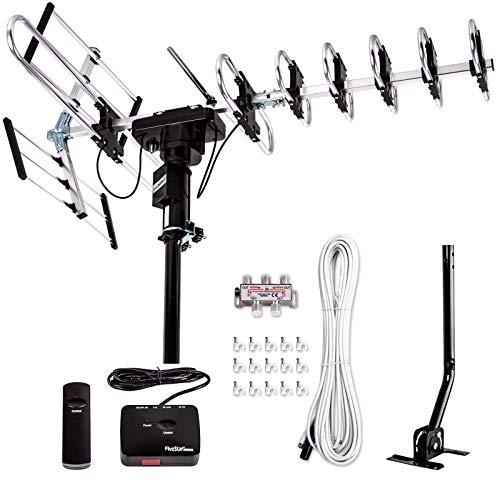
Five Star Outdoor Antenna
Five Star’s outdoor antenna is the budget market’s answer to a real rural dilemma: distant towers in several directions and no appetite for climbing the roof every time you change the channel. It is a compact yagi-style antenna on a motorized mount, driven from indoors by remote control, with a built-in amplifier. The concept is sound — a directional antenna that re-aims itself combines a yagi’s focused gain with multi-market coverage — and the whole kit costs less than many bare antennas in this roundup.
Strengths. The included rotor is the headline: for viewers whose stations sit in genuinely different directions, being able to swing the antenna from the couch solves the problem a fixed antenna cannot. The amplifier is built in, the assembly is light enough for one person to mount easily, and the low total weight makes it a realistic option for lighter masts and even some RV and cabin setups that split time between properties. As an inexpensive way to learn what your location can receive — scanning in every direction from the living room — it earns its keep quickly.
Trade-offs. Manage expectations on the two numbers that matter. The motor and housing are built to a price: owners in harsh-winter and high-wind regions report that the rotor mechanism is the first thing to tire, and the antenna’s actual gain is modest next to a full-size yagi, so realistic range is the 40-to-60-mile class in open country rather than the figures printed on the box. The built-in amplifier is not the quietest, and very strong nearby signals can overwhelm it. Think of this as a capable budget system, not a deep-fringe instrument.
Who it suits. Rural viewers 35 to 60 miles from towers in two or more directions who want remote-controlled aiming at a budget tier, and cabin or workshop installs where convenience beats ultimate reach. If your stations are extreme-range, invest in a full-size antenna and a proper standalone rotor instead. To see the current kit price — check price on Amazon.

Televes Dat Boss Mix
The Dat Boss Mix is the most technically interesting antenna in this group, and for genuinely difficult rural reception it may be the most effective. It is a yagi-style antenna with an intelligent amplifier built into its heart: the amplifier measures the incoming signals and adjusts its gain channel by channel, boosting the weak stations while refusing to over-amplify the strong ones. In fringe areas, the classic failure mode is a mix — one affiliate booming in from a nearby translator while the network you actually want whispers from 80 miles — and automatic gain control attacks exactly that failure mode. It also filters LTE interference intelligently, a growing rural problem.
Strengths. The self-adjusting amplification genuinely works as advertised, and it removes the guesswork of choosing preamp gain — too much gain is as destructive as too little, and this antenna threads that needle continuously. The “Mix” designation means it carries a proper high-VHF section alongside UHF, covering the band mix of most rural markets in one unit. Construction quality is broadcast-industry grade, unsurprising from a company that builds for professional installers: rigid elements, excellent weather sealing, and a design that holds alignment. In open terrain, this is the pick most likely to stabilize a marginal 70-to-90-mile station into an everyday channel.
Trade-offs. It is a premium-priced antenna, full stop, and its intelligence depends on its powered amplifier, so it needs its power inserter installed correctly indoors and is not a purely passive fallback. The directional pattern is properly narrow, which is the point, but it means one direction at a time — multi-market homes still face the rotor question. And while the automatic gain is excellent, it cannot rescue a station the elements never captured; terrain-blocked viewers still need height first.
Who it suits. Deep-fringe households 60 to 90 miles out in reasonably open terrain, with a troublesome mix of strong and weak stations, who want the best single-direction shot at reliable reception and are willing to pay a premium tier price for it. For today’s listing, stock status, and included mounting hardware — check price on Amazon.
Before you buy: read your own signal landscape
The single most valuable step in a rural antenna project costs nothing. Free online signal-analysis tools will take your exact address and produce a report listing every station predicted to reach you, its real RF channel, its direction on the compass, and its expected strength. Study that report before spending a cent, because it answers the three questions that decide your purchase. How far are the towers, really? Which directions do they sit in — one cluster, or several? And are any of your must-have stations on VHF, which rules out UHF-only antennas no matter how impressive their gain figures look?
Read the strength predictions with rural skepticism. The models behind these reports use terrain data, but they cannot see the forty-year-old cottonwoods in your yard, the new steel machine shed your neighbor built last spring, or the fact that your house sits in a creek bottom ten feet lower than the road. Treat a station predicted as “moderate” as a fair bet with a good outdoor antenna, “weak” as a project requiring height and gain, and anything at the very bottom of the report as a pleasant surprise rather than a plan. Also note the stations just below the cutoff — on clear winter mornings, atmospheric conditions sometimes deliver channels that are absent all summer, which is a bonus, not a baseline.
One concept ties those observations together: the signal does not travel as a pencil-thin line from tower to antenna, but as a swelling football-shaped volume called the Fresnel zone, widest at the midpoint of the path and still several yards across near your home. Obstacles intruding into that volume — the top half of a mature tree, the shoulder of a hill, the corner of a barn — weaken and distort the signal even when the antenna appears to have a clear visual line to the horizon. This is why “I can see the tower’s blinking light, why is the picture bad?” is a genuine puzzle with a real answer, and why small changes in antenna position, sideways or upward, sometimes produce disproportionate improvements: you are not just moving the antenna, you are moving it out of the shadow of something occupying the zone.
Finally, walk your property with the compass bearings in hand. Stand where the antenna might go and look toward the towers. What is actually in the way in the first few hundred yards matters more than what the map says about mile forty: a tree line, a hill shoulder, or a metal-roofed barn inside that first stretch can cost more signal than thirty extra miles of open air. Sometimes moving the mast thirty feet sideways on the property buys more reception than any equipment upgrade, and it is far easier to discover that before the concrete sets.
One direction or many: rotors, second antennas, and wide patterns
If your signal report shows towers in several directions, you have three honest options, and each rural household lands differently. The first is a wide-pattern antenna like the ClearStream 4V or DB8e, which receives a broad arc at once. This is the only approach that fully satisfies a DVR recording two networks from different directions at the same time, and it has no moving parts. Its cost is peak gain: breadth and reach trade against each other.
The second option is a directional antenna on a rotor. A rotor restores full yagi gain in every direction — eventually. The frictions are practical: re-aiming takes half a minute, everyone in the house must tolerate the ritual, and a DVR cannot rotate the antenna between recordings on different channels, which makes rotors a poor match for record-heavy households. Traditional ham-style rotors are far more durable than the lightweight motors bundled with budget antennas, and in wind country that difference decides whether the system works in year five.
The third option, often the best engineering answer, is two antennas: a fixed yagi for the main market and a second, smaller antenna for the secondary direction, combined into one feed. It costs more in hardware and setup time, but it delivers full gain in both directions with nothing to move or wear out. Whichever route you choose, decide before you buy the mount, because mast loading and cable runs differ between all three.
best cameras for long distance shots
Roof, chimney, or mast: getting the antenna up
Mounting is where rural installs succeed or quietly underperform. The common choices, in rough order of height gained, are a gable or wall mount on the house, a roof tripod or chimney strap mount, a push-up or telescoping mast anchored at the house, and a freestanding mast or tower in the yard. Each step upward tends to help fringe reception more than any other single change, but each step also adds wind load, climbing risk, and lightning exposure, so the right answer is the highest mount you can install safely and maintain.
A few practical rules from hard experience. Keep the antenna at least several feet above a metal roof’s surface and well clear of the roof edge in the signal direction; signals skimming a steel roof pick up reflections that scramble marginal channels. Never mount to a chimney that also serves a wood stove without checking the mortar and using proper strap mounts — a failing chimney plus a wind-loaded antenna is a roof repair waiting to happen. Use stainless hardware, drip loops in the coax so water runs off rather than into connections, and weatherproof every outdoor connector with proper sealing tape or boots; more rural reception problems trace back to a corroded bargain-bin connector than to any antenna. And keep the coax run as short and straight as the layout allows — every foot of cable between the antenna and the first amplifier is signal you do not get back.
Grounding and lightning: the section rural readers must not skip
A tall metal structure on a rural roof is, among other things, the most lightning-friendly object on the property, and open-country homes take more strikes and more nearby-strike surges than city homes do. Grounding an antenna system is not about the fantasy of safely absorbing a direct strike — nothing consumer-grade does that — it is about giving static charge and induced surges a path to earth that does not run through your television, and it is required by electrical code for good reason.
The essentials are straightforward. Bond the mast to a ground rod with heavy copper wire, as short and straight as you can route it. Install a coax grounding block where the cable enters the house, bonded to the same ground system — ideally the home’s main electrical ground, so everything rises and falls together during a surge. If your preamplifier or distribution amplifier sits indoors, a quality surge protector on that equipment is cheap insurance. Viewers in the high-plains and Southeast thunderstorm belts should treat this section as part of the purchase price, not an optional accessory, and anyone uncomfortable with the work should hire it out; an electrician’s hour costs less than a fried TV, let alone a fire.
Putting it together: a realistic rural installation
Assemble everything on the ground first. Build the antenna completely, attach the preamplifier at the mast position if you are using one, and connect a short test length of coax. Many a rooftop hour has been wasted discovering a missing bolt at twenty feet. If you can, do a ground-level or porch-roof test before the permanent mount: even at low height, a fringe antenna should hint at what it can do, and a station that is absent at eight feet but present at twenty-five tells you the permanent height is worth the effort.
Aim with data, not vibes. Start from the compass bearing your signal report gives for your main market — remembering that phone compasses drift near steel roofs and vehicles, so take the reading away from metal. Then fine-tune using the signal-strength or signal-quality meter hidden in your TV’s settings menu, with a helper watching the screen while you nudge the antenna a few degrees at a time. Signal quality (sometimes labeled SNR) matters more than raw strength for a stable picture. Peak the main market first, then check what the aim did to your secondary stations before tightening everything down.
Finish the job like weather is coming, because it is. Torque the mount hardware, seal every connector, secure the coax along its run so wind cannot whip it against the mast, and form drip loops at every entry point. Write down the final compass bearing and the channel results somewhere; when a storm shifts the antenna two winters from now, that note turns a weekend of guesswork into a ten-minute fix.
When channels come and go: weather, seasons, and troubleshooting
New rural antenna owners often panic the first time a channel that was perfect in April stutters in July. This is normal physics, not a broken antenna. Leaves are bags of water hanging in your signal path, so a station that cleared bare winter branches may struggle through full summer foliage. Tropospheric ducting on cool, calm mornings can temporarily deliver stations from 150 miles away — delightful, and a false promise about your everyday lineup. Rain fade on marginal UHF signals, temperature inversions, and even a wet tree line all move the boundary of what you receive by a few dB, which is exactly the margin fringe stations live on.
When a channel degrades, troubleshoot in order of likelihood. First, has anything changed — new leaves, a shifted antenna after a storm, a new metal structure in the signal path? Second, check the physical plant: connectors corrode, coax gets chewed by squirrels and pinched by ladders, and preamplifier power inserters get unplugged by houseguests more often than anyone admits. Third, re-scan your TV after any significant change; stations occasionally move RF channels, and a set that never re-scans will report a “lost” channel that simply moved. Only after those checks should you conclude the antenna itself is undersized — and if you do, remember the hierarchy of fixes: height first, then aim, then gain, then amplification.
Matching the antenna to your distance: three rural scenarios
Abstract specs are easier to use when translated into the situations rural readers actually describe to us. Consider three common ones. In the first, a home sits 35 to 45 miles from a metro tower farm across flat cropland, with every station in one direction and one affiliate on high-VHF. This is the friendliest fringe scenario there is: the GE Yagi or the Winegard Elite Pro will usually deliver the full lineup, and money is better spent on a decent mount and fresh coax than on a flagship antenna. Add a preamplifier only if the cable run is long.
In the second scenario, the home is 55 to 70 miles out, the land rolls, and the stations split between two cities at a moderate angle. Now aperture and height start to earn their keep. A ClearStream 4V on the highest practical mount, or a DB8e with its panels split between the two bearings, is the class of tool this distance demands, and a low-noise preamplifier moves from optional to advisable. Expect the weakest station in the lineup to be weather-sensitive at first; an extra five feet of mast often finishes what the antenna started.
The third scenario is true deep fringe: 75 to 90 miles, one market, mixed strong and weak signals, perhaps a translator nearby complicating the picture. This is Dat Boss Mix territory, or a large traditional yagi on a real mast with a carefully chosen preamp — and it is also the scenario where honest advice includes lowering expectations for the single weakest station and checking whether a taller structure on the property, a barn roof or a disused tower, offers a better mounting point than the house. Rural viewers who solve this tier usually do it with height and patience rather than with any single product.
Coax, splitters, and the signal budget inside the house
What happens after the antenna is the quiet half of rural reception. Every foot of coaxial cable, every splitter, and every connector spends a little of the signal the antenna gathered, and fringe signals have little to spare. Standard RG-6 coax is fine for most runs, but at lengths past 100 feet its UHF losses become a real line item; thicker RG-11 costs more and is stiffer to route, yet it preserves noticeably more signal on the longest farmhouse runs. Quad-shield RG-6 is worth the small premium anywhere near electric fences, well pumps, or other rural noise sources.
Splitting to multiple rooms is where marginal systems quietly die. A two-way splitter costs each output roughly a third of the incoming signal power in real terms, and a four-way costs far more; a fringe station that plays perfectly on the living-room TV may vanish in the bedroom purely because of an unamplified four-way splitter in the basement. The fixes, in order, are to split as few times as the household allows, to put any necessary amplification at the right point — a preamplifier at the mast for weak incoming signals, a distribution amplifier at the splitter when the antenna signal is healthy but the splits are many — and to terminate unused splitter ports rather than leaving them open. Satellite-era splitters and ancient 300-ohm twin-lead with a balun at each end belong in the recycling bin; both eat fringe signals for breakfast. Labeling each cable run at the splitter with its destination room also pays off during every future troubleshooting session.
Interference: the rural reception problem nobody advertises
Two interferers deserve special mention in the country. The first is LTE: cell signals now occupy spectrum directly adjacent to the TV band, and a rural home may sit line-of-sight to a water-tower cell site miles away whose signal arrives stronger than the TV station you are chasing. The symptom is maddening — one or two channels, often in the upper UHF range, break up while everything else is clean. A dedicated LTE filter installed at the antenna or preamp input is inexpensive and frequently miraculous; several picks in this roundup build that filtering in. The second interferer is FM radio, whose harmonics can trouble low-VHF and high-VHF reception when a strong FM transmitter is nearby. An FM trap solves it the same way. Neither filter can remove signal you want, installed correctly — they only strip the neighbors that were shouting over your stations.
Marketing claims to ignore completely
A short field guide to box copy saves rural buyers real money. There is no such thing as an “HD antenna,” a “4K antenna,” or a “digital antenna” in any technical sense: antennas receive radio waves, and the same designs that pulled in analog signals in 1995 pull in digital ones now — what changed is the broadcast, not the physics. Mileage figures, as covered above, are unregulated and routinely double what open-country reality delivers. Rotating antennas advertised with enormous ranges pair a modest antenna with a light-duty motor and let the headline number do the selling. And any indoor antenna, however amplified, claiming deep-fringe rural range is describing a laboratory, not your farmhouse. Judge antennas by their element design, their band coverage, their gain class, and their construction — the things that were true about antennas fifty years ago remain the things that are true now.
Already have an old antenna or a dish mount? Read this first
Rural properties often come with reception archaeology: a full-size antenna from the analog era still bolted to the chimney, or a satellite dish mount left behind by a previous service. Both are worth a look before buying anything. A traditional analog-era antenna in sound physical condition is not obsolete — the physics did not change when broadcasting went digital, and a big old yagi with intact elements frequently outperforms a small modern antenna, particularly on VHF. What usually has failed is everything around it: sun-rotted coax, a corroded matching transformer, a preamplifier dead for a decade. Replacing the cable and balun and testing the old antenna against your signal report costs little and occasionally saves the whole project.
The satellite dish itself is useless for broadcast TV — it is the wrong shape, aimed at the wrong sky — but its mount and its coax run are valuable. A dish J-mount on a roof or wall is a sturdy, weather-proven perch in exactly the sort of elevated, clear position an antenna wants, and many compact and mid-size antennas in this roundup bolt to it directly. The existing coax, if it is RG-6 in decent condition, can serve as your antenna feed with nothing more than new connectors. Do respect the limits: a J-mount is not a mast, and hanging a large long-range yagi or an eight-bay bowtie on one invites wind damage. Match the antenna’s size and wind load to the mount you are reusing, and inspect any inherited cable run for the chew marks and pinch points mentioned earlier before trusting it with a fringe signal.
Keeping a rural antenna system alive for a decade
An outdoor antenna asks little, but not nothing. Once a year — many rural owners tie it to a seasonal chore like gutter cleaning — give the system a ground-level inspection with binoculars. Look for elements bent by ice or large birds, a reflector screen sagging out of plane, a coax run chafing where it passes a roof edge, and sealing tape that has cracked or unwound at the connectors. Catching a failing connector boot in October is a five-minute repair; discovering it in February, when the connector has been drinking meltwater for three months, is a new cable run.
Expect the consumables to age on their own schedule. Outdoor coax jackets chalk and crack under years of sun, typically becoming suspect somewhere past the decade mark, and a cable that flexes in the wind at an unsecured point will fatigue far sooner. Preamplifiers live outdoors in thermal cycling that eventually kills electronics; when a previously solid station degrades gradually over a season with no other explanation, a tiring preamp belongs on the suspect list, and keeping the model number recorded makes replacement a one-trip job. Rotor systems want their bearings and the rotor’s alignment checked after any storm strong enough to move the antenna’s aim, and a lightning event anywhere close justifies re-testing the whole chain before assuming the TV is at fault. None of this is burdensome — an hour a year is a fair budget — but it is the difference between an antenna that serves for fifteen years and one that quietly fades by year four.
It also pays to keep a simple reception log. Note the date, the weather, and which channels held or failed whenever you make a change or notice a change. Rural reception is seasonal enough that memory alone will mislead you; a written record turns next year’s troubleshooting from archaeology into comparison, and it tells you whether that new tree growth, new preamp, or extra five feet of mast actually bought anything.
Frequently asked questions
Can an outdoor antenna really pull in stations 100 miles away?
Occasionally, but do not plan a purchase around it. At 100 miles, the transmitter is below your horizon, and reception depends on atmospheric refraction and unusually favorable terrain — a hilltop home aiming across flat land or water toward a tall tower sometimes manages reliable reception at that distance with a high-gain antenna and preamp. For most rural homes, 50 to 75 miles is the honest planning range for everyday reliability, with 75 to 90 miles achievable in good conditions. Any product whose headline promise starts at 100 miles is describing its best day, not yours.
My stations come from two different cities. What should I buy?
Start with the angle between the two tower clusters. If they sit within roughly 90 degrees of each other, a wide-pattern antenna like the ClearStream 4V or the split-panel DB8e can often serve both with no moving parts — the best answer for DVR households. If the cities are in nearly opposite directions, choose between a quality rotor turning a directional antenna, or two fixed antennas combined into one feed. Avoid the trap of aiming a narrow yagi halfway between two markets; that reliably underserves both.
Do I need a preamplifier for a rural setup?
If your coax run from antenna to TV is longer than about 50 feet, or your target stations are predicted weak, a mast-mounted preamplifier is usually worthwhile — it preserves signal that the cable would otherwise eat. If you are 35 miles out with a short cable run, it may add nothing, and if one very strong station is nearby, a powerful preamp can overload and cost you channels. Adjustable-gain models, or self-adjusting antennas like the Dat Boss Mix, are the safe middle path for mixed-signal areas.
One of my stations is on channel 8. Does that change anything?
Yes — channel 8 is a high-VHF station, and many modern compact antennas are effectively UHF-only and will miss it even at moderate distance. You need an antenna with genuine VHF elements: in this roundup, the ClearStream 4V’s dipole, the GE Yagi, and the Dat Boss Mix all address high-VHF, with the larger traditional designs doing it best. Check the real RF channel of every station you care about before ordering, because the channel number your TV displays is not always the channel the station transmits on.
Is it worth paying for professional installation in the country?
For a simple gable mount and a short cable run, a careful homeowner with a helper can do the job in an afternoon. Professional help earns its fee when the install involves a tall mast or tower, roof work you are not equipped to do safely, long cable runs with amplification and splitting to several rooms, or grounding tied into the home’s electrical system. Rural installers who do antenna work regularly also bring local knowledge — which hollow gets which city, and where the dead spots are — that no online signal report can match.
Out here, the right antenna is rarely the one with the boldest number on the box; it is the one matched to your towers, raised high, grounded properly, and aimed with patience — and once that combination locks in, free television over the farm feels less like a compromise and more like a quiet victory over geography.