As an Amazon Associate, this site may earn an affiliate commission from qualifying purchases made through links on this page, at no extra cost to you.
Free local channels are still the best deal in television
Every month, another streaming bill arrives, another subscription price creeps upward, and another channel you used to watch disappears behind a new paywall. Meanwhile, sitting invisibly in the air around your house, the local stations you grew up with are still broadcasting for free. ABC, CBS, NBC, FOX, PBS, The CW, and a growing roster of digital subchannels carrying classic shows, movies, weather, and local news are all travelling over the air right now, in uncompressed high definition, waiting for an antenna to catch them. The only thing standing between your television and those channels is a piece of hardware that costs less than two months of a single streaming service, and it never sends you a bill.
The trick is choosing the right antenna for your particular situation, because there is no single model that works everywhere. A flat indoor panel that pulls in forty channels from a third-floor apartment two miles from the broadcast towers will struggle in a suburban ranch house fifteen miles out, where the signal has to cross a ridge, a belt of tall trees, and a neighbour’s metal roof. The opposite is equally true: a big outdoor yagi bolted to a chimney can be overkill in a downtown flat, where it will also collect every stray signal, reflection, and source of interference in the neighbourhood. Local channels are, by definition, local, and the antenna that wins is the one matched to your distance from the towers, your terrain, your building materials, and the quirks of your own broadcast market.
This guide looks at the problem from the local-channel angle specifically. We are not chasing the farthest possible station or the most exotic DX reception. We are focused on the channels you actually watch: the network affiliates that carry the evening news, the Sunday game, the morning show, and the prime-time lineup; the public station with its documentaries and children’s programming; and the subchannels that carry the weather radar, the old sitcoms, and the local high school football. The six antennas below were chosen to cover the real situations suburban viewers face, from a compact indoor model for a renter who cannot drill holes, to a serious outdoor antenna for a house at the edge of reliable reception.
best live tv app for android phones
Before the picks, it helps to understand why local channels behave the way they do. Unlike cable or streaming, over-the-air television is a physical signal that weakens with distance, bends around obstacles imperfectly, and bounces off buildings and hills. Your reception is a product of geography as much as equipment. The good news is that the tools for figuring out your situation are free and simple, and the antennas themselves have improved enormously in the last few years. Modern indoor panels are thinner and better tuned than the rabbit ears of a generation ago, and modern outdoor antennas are lighter, more weatherproof, and easier to aim. With the right choice and a little patience during setup, most suburban homes can pull in their full local lineup in picture quality that is, frankly, better than what the same channels look like compressed through a cable box or a streaming app.
In this guide
What to look for in an antenna for local channels
The first thing to establish is which channels are actually available where you live, and on which frequencies. The Federal Communications Commission’s repack of the broadcast spectrum moved many stations to new channels over the past few years, and some stations that used to broadcast on UHF now sit on VHF, or vice versa. That matters because antennas are tuned to frequency bands, and an antenna built for UHF alone will do a poor job with a high-VHF station. A quick check of a signal report for your address will tell you the real channels, the distance and compass direction to each tower, and the predicted signal strength. Write that information down before you shop, because it turns a guess into a decision.
Distance is the single biggest factor. Stations within about fifteen miles of your home are generally easy for an indoor antenna. Between fifteen and thirty miles, an amplified indoor model or a small outdoor antenna starts to make sense. Beyond thirty miles, you are firmly in outdoor-antenna territory, and beyond fifty miles you need a serious long-range model, a high mounting point, and realistic expectations. These are rough bands, not guarantees: a house on a hill fifteen miles from the towers can have easier reception than a house in a valley five miles away, because the signal path matters more than the raw distance.
Range numbers: useful shorthand, not a promise
Every antenna box carries a range number, usually somewhere between thirty and one hundred miles. Treat that number as a best-case figure measured under ideal conditions, with a clear line of sight, no interference, and a sensitive tuner. In a real suburban setting, with trees, neighbouring houses, and building materials in the way, the practical range is often about two-thirds of the advertised figure. That does not make the number useless: it is still a fair way to compare models against each other, because a manufacturer that claims one hundred miles is generally selling a bigger, more directional antenna than one that claims thirty. But do not buy a sixty-mile antenna for a fifty-five-mile tower and expect it to work on the first try. Leave yourself margin, and remember that mounting height is free range: every additional few feet of elevation can matter more than a few extra miles on the box.
Range is also affected by your television’s tuner, which varies between models. Some modern sets have excellent tuners that can lock onto weak signals; some budget sets struggle with anything below a strong signal. If your antenna works beautifully on one television and poorly on another in the same house, the tuner is usually the difference, not the antenna. A signal amplifier can help a weak tuner, but it cannot create signal where none exists, and it can actually make things worse in strong-signal areas by overloading the tuner with too much of everything, including noise. Amplifiers are a tool for specific situations, not a universal upgrade.
Indoor versus outdoor: the wall is the enemy
The single most important decision in this guide is whether the antenna goes inside or outside. Building materials are the great enemy of television signals. A brick wall, a metal roof, foil-backed insulation, low-emissivity window glass, and even a thick plaster wall can each strip away a meaningful chunk of signal. An indoor antenna has to fight through all of that before it even starts; an outdoor antenna gets a clean shot at the sky. As a rule of thumb, moving the same antenna from a living-room shelf to a rooftop mount is worth more than upgrading to a bigger indoor model.
That said, indoor antennas have real advantages. They cost less, install in minutes with no tools and no ladder, and they are the only option for renters, apartment dwellers, and anyone whose homeowners’ association or landlord frowns on rooftop hardware. Modern flat panels are also far less ugly than the rabbit ears of the past: many are thin, paintable, and designed to hide behind a television or on a window. For anyone within about twenty miles of the towers, a good indoor antenna is often all that is needed, and the convenience is hard to argue with. The honest approach is to try indoor first if your towers are close, and go outdoor when the indoor attempt shows you are at the edge of what a shelf-mounted antenna can do.
VHF and UHF: the two bands that matter
American broadcast television uses two frequency bands: VHF, covering real channels 2 through 13, and UHF, covering real channels 14 through 36. After the FCC repack, many stations moved, and a surprising number of major network affiliates now broadcast on high-VHF, channels 7 through 13. This is the single most common cause of the complaint “I get everything except NBC” or “I get everything except the local ABC.” The viewer bought a UHF-only antenna, and the missing station is sitting on VHF.
Before buying, check the real channels of your local stations. If any of your must-have stations are on VHF, you need an antenna with VHF elements: the long rods or dipoles that pick up the longer VHF wavelengths. Many good antennas cover both bands, and the picks in this guide all handle VHF and UHF unless noted otherwise. The compact flat panels are the ones most likely to be UHF-only, which is fine if your market is entirely UHF, and a problem if it is not. This is a five-minute check that saves a return trip.
Amplifiers: when they help and when they hurt
An amplifier boosts the signal the antenna receives, which helps when the signal is weak but clean, and when the cable run from the antenna to the television is long. It does not help when the signal is already strong, when the problem is interference rather than weakness, or when the antenna is pointed the wrong way. A common suburban mistake is buying the most heavily amplified antenna available and then wondering why reception got worse: the amplifier boosted the noise and the neighbouring signals along with the wanted ones, and the tuner was overwhelmed.
The practical rule is simple. If your towers are more than twenty miles away, or your cable run is longer than fifty feet, or you are splitting the signal to several televisions, an amplifier is probably worthwhile. If your towers are close and your antenna is a few feet from the television, an amplifier is probably unnecessary, and a model with a switchable amplifier is the safest choice.
Directionality and the shape of your market
Some antennas receive from all directions, and some receive from one direction only. An omnidirectional or wide-beam antenna is convenient when your local towers sit in several different directions, which is common in larger markets. A directional antenna, usually a yagi with a boom and a row of elements, receives much more strongly from one direction and rejects signals from the sides and rear, which helps with weak signals and with interference. The trade-off is that you have to aim it, and if your towers are spread across the compass, a single directional antenna may not cover them all.
Check your signal report for the compass bearings of your towers. If they cluster within about thirty degrees of each other, a directional antenna is a great choice. If they are spread across ninety degrees or more, look for a wide-beam or multidirectional design, or accept that you may need to compromise. Some viewers in spread-out markets use a rotator to turn a directional antenna, which works but adds cost and complexity, and it is rarely the right first step for someone who just wants the local news.
Quick comparison: the six picks at a glance
| Antenna | Type | Best for | Amplifier |
|---|---|---|---|
| Antennas Direct ClearStream 4V | Indoor / outdoor | Suburban homes needing strong VHF and UHF | Optional |
| Mohu Blade Premium | Indoor / outdoor blade | Viewers who want an amplified antenna that can move outside | Built in |
| Winegard FlatWave Amped FL5500A | Indoor flat panel | Window mounting and weak indoor signals | Built in |
| Antennas Direct DB8e | Outdoor 8-bay bowtie | Long-range and fringe suburban UHF reception | Optional |
| RCA ANT751E | Outdoor compact | Attic and rooftop mounting without a big mast | None |
| GE UltraPro Optima 81870 | Outdoor HD | Weatherproof attic or outdoor mounting | None |
The best antennas for local channels, reviewed
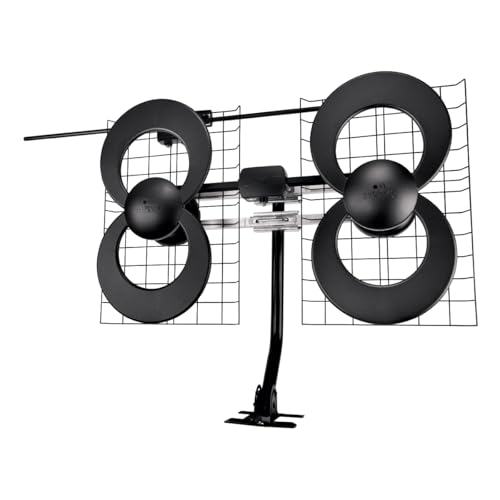
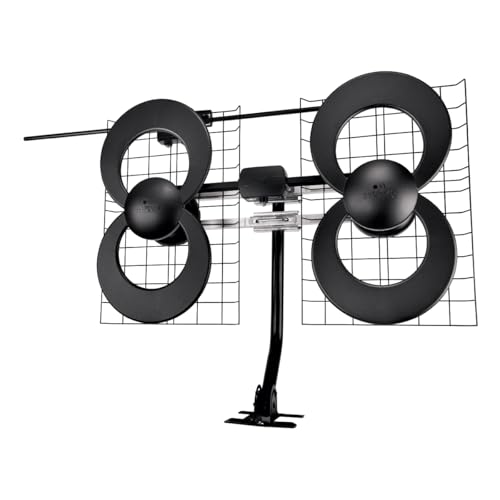
Antennas Direct ClearStream 4V: the suburban workhorse for strong VHF and UHF
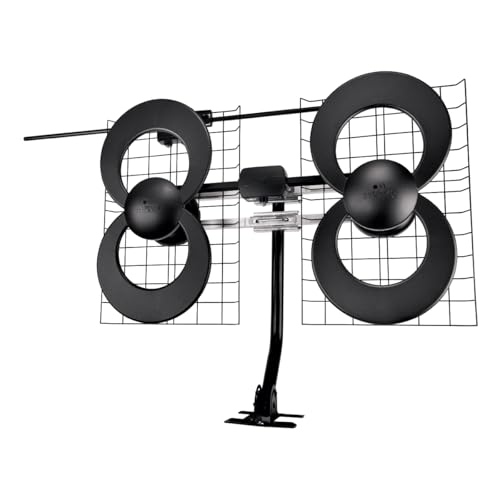
The ClearStream 4V is the antenna this guide would hand to a suburban homeowner who wants the local channels and does not want to think about antennas again for a decade. It is a compact four-bay bowtie design with a dedicated VHF dipole, which means it handles the two bands that actually matter in a modern broadcast market, and it does so from a package that is small enough to mount on a mast, a chimney, or an attic rafter without looking like a piece of Cold War infrastructure. It is rated for about seventy miles, which in practice means comfortable reception out to forty or fifty miles from a rooftop mount, and easy reception of everything inside thirty miles.
What makes the 4V stand out for local channels is its balance. The four bowtie elements give it strong UHF gain, while the dipole gives it real high-VHF performance, which is exactly the combination that catches the network affiliates that moved to VHF during the repack. Many compact antennas claim dual-band coverage but are weak on VHF in practice; the 4V is not one of them. In market after market, the station that viewers struggle with is the VHF affiliate, and this is the antenna that most reliably brings it in. It is also genuinely weatherproof, with a sealed balun and powder-coated elements, so it will survive years on a roof without the corrosion that kills cheaper outdoor models.
Strengths: Strong gain on both VHF and UHF, so repacked VHF affiliates come in reliably. Compact size for an outdoor antenna, which makes mounting and aiming much easier than a full-size yagi. Durable weatherproof construction with a sealed balun. Works well in an attic for viewers who cannot or do not want to mount outside, with only a modest signal penalty. Wide enough beam that towers spread across a moderate arc are all covered without a rotator.
Trade-offs: It is not the longest-range antenna in this guide, and viewers beyond fifty miles with weak signals may need something bigger. It has no built-in amplifier, so a separate preamplifier is needed if your cable run is very long or you split to several televisions. It costs more than the indoor panels in this guide, which is fair for an outdoor antenna but worth knowing before you buy. The included mounting hardware is functional rather than generous, and a proper mast and mount may need to be bought separately depending on your roof.
Who it suits: Suburban homeowners fifteen to fifty miles from their towers who want every local channel, including the VHF affiliates, from a single durable outdoor or attic antenna. It is the right pick for the viewer who has tried an indoor panel, found the picture breaking up on one or two stations, and wants the problem solved properly. If your towers are all in roughly the same direction and you have a place to mount it eight or more feet off the ground, this is the antenna to buy first. To see the current listing for the configuration that fits your mounting plan, check price on Amazon.

Mohu Blade Premium: the amplified blade for viewers who may end up mounting outside
Most indoor antennas make a promise they cannot keep outdoors, and most outdoor antennas are miserable things to live with in a front room. The Mohu Blade Premium is unusual because its specification covers both lives honestly. It is an amplified antenna in a blade form, twenty-four inches wide, rated by Mohu for sixty miles, receiving UHF and VHF across a multi-directional pattern, and supplied with sixteen feet of cable, a USB power adapter, and mounting hardware for tabletop or wall use, indoors or outside. For a suburban viewer who suspects the eventual answer is an exterior wall but wants to begin in the living room, that is a rare and practical combination.
Consider how a typical search for the locals unfolds. The antenna starts near the set, the scan finds most stations, and one network affiliate keeps breaking up. With a panel, the next step is a new purchase. With the Blade Premium, the next step is a move: up to a higher wall, then, if the house still argues, onto the outside wall on the tower side, using the hardware already in the box. The amplifier travels with it, powered over USB. Its 4K-ready billing also matches where local broadcasting is heading.
Strengths: One purchase covers the indoor experiment and the outdoor solution, which removes the costliest mistake in antenna buying. Multi-directional UHF and VHF reception means no careful compass work for most suburban tower layouts. The sixteen-foot cable and included mounting hardware make both the tabletop start and the wall finish realistic without extra shopping. USB power for the amplifier keeps the installation tidy behind a modern television.
Trade-offs: The blade is twenty-four inches wide, and it looks like hardware wherever it sits; viewers who want an antenna that vanishes behind the set should choose a flat panel instead. Sixty miles is a best-case rating, and terrain, trees, and building materials will shorten it in every real suburb. Amplification can overload a tuner close to strong transmitters, so very near the towers an unamplified model may behave better. An outdoor wall position still needs a sound fixing and a sensible cable entry into the house.
Who it suits: Suburban viewers roughly fifteen to forty miles from their towers who want to start indoors and keep the outdoor option open, renters whose lease allows a removable wall mount but not a roof installation, and households whose stations arrive from more than one direction. It is the right pick when the honest answer to “indoor or outdoor?” is “not yet sure.” For today’s listing of the twenty-four-inch amplified blade, check price on Amazon.
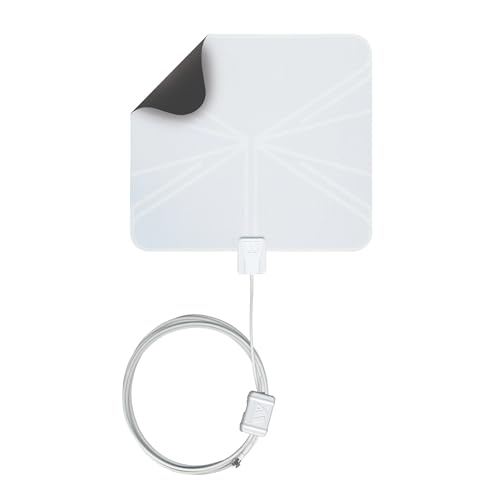
Winegard FlatWave Amped FL5500A: the window-mount specialist for weak indoor signals
The Winegard FlatWave Amped is the indoor antenna for the viewer whose first indoor antenna did not quite work. It is a flat panel, but with a more capable amplifier and a design that is specifically meant to be mounted on a window, where the glass is the thinnest barrier between the antenna and the broadcast towers. Winegard has been building antennas for decades, and that experience shows in the details: the amplifier is clean and low-noise, the panel is well tuned, and the whole package is designed around the reality that indoor reception is a fight against building materials.
The window mount is the key insight. A wall, even a drywall partition, costs you signal; a window costs you far less, unless it is low-emissivity glass, which is worth checking. The FlatWave’s suction-cup and adhesive mounting options make it easy to put the panel on the window facing your towers, and in that position it regularly outperforms larger indoor antennas stuck to an interior wall. The built-in amplifier is designed to compensate for the remaining losses, and the included cable is long enough to reach the television from the best window in the room.
Strengths: Window mounting gives the best possible indoor signal path, and the design is built around it. Low-noise amplifier that genuinely helps weak signals without the overload problems of cheaper amplified panels. Dual-band design with better VHF handling than most flat panels, so repacked VHF affiliates are more likely to come in. Solid build quality and a company with a long history in the antenna business. Easy to move and reposition while you search for the best spot.
Trade-offs: It costs more than the simplest flat panels, and the difference is only worth it if your signals are marginal. It still cannot beat an outdoor antenna, and viewers beyond thirty miles should not expect it to. Low-emissivity windows can block signals almost as effectively as a wall, so the window advantage disappears in some modern homes. The amplifier is always on, which can be a problem very close to the towers.
Who it suits: Viewers fifteen to thirty miles from their towers who cannot mount outdoors but have a window facing the right direction. It is the right second try for the household that bought a basic flat panel, got most channels, and is missing one or two that matter. If your house has ordinary glass windows and a clear view toward the broadcast towers, this is the indoor antenna most likely to close the gap. To confirm the current window-mount kit and amplifier details, check price on Amazon.

Antennas Direct DB8e: the long-range 8-bay bowtie for fringe suburban reception
The Antennas Direct DB8e is the antenna for the viewer at the edge of the map. It is a large eight-element bowtie antenna — two four-bay panels on one frame — designed for extreme-range UHF reception, with mounting hardware included. It is bigger and more conspicuous than anything else in this guide, and that is precisely the point: when you are forty or fifty miles from the towers, with trees and terrain in the way, aperture and gain are what matter, and an eight-bay bowtie gathers more UHF signal than any indoor panel or compact outdoor model.
The two-panel design is its party trick: the panels can be aimed together as one antenna or turned to face different directions, which suits suburbs where the local stations arrive from two tower sites at an angle to each other. Aimed as one, it concentrates its gain into a narrower, longer-reaching beam; split, it trades some peak gain for coverage of both markets without a rotor. It is a UHF design, so the high-VHF stations that matter after the repack are not its strength — households with a must-have VHF affiliate should pair it with a dedicated VHF solution or choose a dual-band pick from this guide instead. Built for outdoor mounting, it is a common sight on rooftops in the outer suburbs and the exurbs, where it has been pulling in local channels for years.
Strengths: Among the highest UHF gain in this guide, which makes the difference at forty-plus miles and in difficult terrain. Panels turn independently, so two tower directions can be covered from one mast. Multi-directional flexibility without a rotor or moving parts. Solid outdoor construction with mounting hardware in the box. Excellent choice when paired with a quality preamplifier for the longest cable runs.
Trade-offs: It is large and visible, which matters for homeowners’ associations and for anyone who cares about the look of their roof. It is UHF-only in character, so high-VHF affiliates need separate provision. It is heavier than compact antennas and needs a solid mast and mount. It has no built-in amplifier, so a preamplifier is an additional purchase for the longest runs. Installation is a real job that may need a second person and a ladder.
Who it suits: Suburban and exurban viewers thirty-five to seventy miles from their UHF towers, or closer viewers whose signal path is blocked by hills, dense trees, or a valley — especially where stations arrive from two directions. It is the right pick when smaller antennas have been tried and the picture still breaks up, and when the viewer is willing to mount a serious antenna properly and aim it carefully. For current availability and the right mounting accessories for your roof, check price on Amazon.

RCA ANT751E: the compact outdoor antenna that fits an attic or a small mast
The RCA ANT751E is the answer to a common suburban problem: you need an outdoor antenna, but you do not want a large one, and you do not want to put a ten-foot mast on your roof. It is a compact yagi-style antenna, about three feet long, designed to be mounted on a short mast, a chimney, or a rafter in the attic. It covers both VHF and UHF, it is rated for about seventy miles, and in practice it delivers solid reception out to forty or fifty miles from a rooftop mount, and somewhat less from an attic. For the size and the price, it is one of the best values in outdoor antennas.
Its compact size is also its strategic advantage. A small antenna is easier to mount, easier to aim, less visible, and less affected by wind. It fits in an attic where a full-size yagi would not, and an attic installation, while it costs some signal to the roof, is often acceptable when the towers are within thirty miles and the roof is not metal. The ANT751E has been a steady seller for years precisely because it hits this sweet spot: serious enough to be a real outdoor antenna, small enough to be a weekend project rather than a construction job.
Strengths: Compact size makes mounting and aiming easy, and it fits in most attics. Genuine dual-band coverage, so VHF affiliates are included. Very good value for an outdoor-capable antenna. Light enough for a short mast or a chimney mount without heavy hardware. Reliable performance out to forty miles from a roof, which covers most suburban situations.
Trade-offs: It has less gain than the larger antennas in this guide, so it is not the choice for fringe reception beyond fifty miles. It has no amplifier, so a preamplifier may be needed for long cable runs or multiple televisions. Attic mounting costs signal, and a metal roof will defeat it almost completely. The included hardware is basic, and a proper mount may need to be bought separately. It is directional, so towers in very different directions may need a compromise in aiming.
Who it suits: Homeowners who need an outdoor antenna but want a compact, affordable one, and viewers who plan to mount in an attic rather than on the roof. It is the right pick for the suburban house twenty to forty miles from the towers, with a clear roof or attic space and a willingness to spend an afternoon on installation. If you want the reliability of an outdoor antenna without the size and cost of a full long-range model, this is the one to try. To see which mounting hardware is included with the current listing, check price on Amazon.

GE UltraPro Optima 81870: the weatherproof outdoor antenna for attic and roof-edge mounting
The GE UltraPro Optima, model 81870, closes this guide with a different kind of value: not the cheapest way to sample over-the-air television, but an outdoor HD antenna from a familiar electrical brand, built to live in the weather and to stay there. Its listing describes a weatherproof antenna for attic or outdoor mounting, ready for 4K and 8K Ultra HD broadcasts and NEXTGEN TV, aimed at exactly the promise this guide cares about — free local channels without a monthly bill. For the suburban house where indoor reception has already shown its ceiling, the Optima is the step outside without the largest long-range array in the guide.
Mounting choice is where this antenna earns its place. In an attic, protected from storms and invisible from the street, it suits viewers whose roof is ordinary shingles and timber rather than metal, and whose towers sit at a moderate suburban distance. On an outdoor mount, clear of the walls that defeat indoor models, it gets the open signal path that local reception rewards most. Either way, weatherproof construction matters: an antenna that lives outside or in a hot attic has to shrug off seasons without corroding at the connections, because the classic failure of an outdoor installation is slow decay, not drama.
Strengths: Weatherproof build designed for permanent attic or outdoor duty, from a brand most households already know. Current-standard readiness, with 4K and 8K Ultra HD and NEXTGEN TV called out on the listing. Outdoor placement delivers the clean signal path indoor antennas cannot match, the single biggest upgrade available to a suburban viewer. Attic mounting keeps it hidden and sheltered where a roof installation is impractical.
Trade-offs: This is an installation, not a ten-minute experiment: it needs a mount, a cable run, and patience to aim and rescan. It carries no built-in amplifier in its listing, so a very long cable run or a split to several televisions may call for a separate preamplifier chosen deliberately. An attic under a metal roof or radiant barrier will still block it, as it blocks every antenna. And for a viewer only a few miles from the towers, it may be more hardware than the address requires.
Who it suits: Suburban homeowners who have established that indoor reception is not enough, who want a weatherproof antenna sized for an attic or an outdoor mount rather than a full long-range rig, and who plan to keep the installation for years. It is the right pick for the house at a moderate distance from the towers with a clear mounting position on the tower side. For the current listing of the Optima outdoor model 81870, check price on Amazon.
Indoor versus outdoor: where to mount for local channels
The mounting decision deserves a section of its own, because it is where most reception problems are actually solved or created. The rule is simple and almost never wrong: the higher and the more open the antenna, the better the reception. An outdoor antenna on a rooftop mast is the gold standard. An attic antenna is the next best thing, losing perhaps a third of the signal to the roof, unless the roof is metal, in which case it loses almost everything. An indoor antenna on a top-floor window is next, and an indoor antenna on a ground-floor shelf behind the television is the hardest position of all. Every step down that ladder costs you channels, or at least costs you signal margin on the channels you do get.
That ladder also explains why two neighbours with the same antenna can have completely different results. One lives in a timber-framed house with asphalt shingles and a clear view toward the towers; the other lives in a house with a metal roof, foil-backed insulation, and a brick fireplace between the antenna and the signal. The antenna is not the difference. The building is. Before you blame a model, try moving it. A few feet of height, a different window, or the other side of the room can change a marginal signal into a solid one, and the cost of the experiment is ten minutes.
For outdoor mounting, height is the single most effective improvement you can make, and it is free once the mast is up. Raising an antenna from the eaves to the chimney top, a gain of perhaps eight feet, can be the difference between a picture that breaks up during a storm and one that holds steady. The roof peak is usually the best spot, with a clear line in the direction of the towers. Avoid mounting behind the chimney or a large metal vent, which will shadow the signal, and keep the antenna clear of power lines by a wide margin, both for safety and for interference. A proper ground for an outdoor mast is not optional: it protects the house and the equipment from lightning, and it is required by electrical codes in most areas.
Attic mounting is the compromise that many suburban homeowners choose, and it is often a good one. The antenna is protected from weather, it is invisible from the street, and installation is a comfortable indoor job rather than a roof climb. The cost is the roof itself: asphalt shingles and plywood cost you some signal, while a metal roof, radiant barrier, or foil insulation can cost you almost all of it. If your attic has a radiant barrier, test the antenna in the attic before you commit to the installation, because that foil layer is effectively a mirror for television signals. In a standard timber attic, a compact outdoor antenna like the RCA ANT751E will usually work well out to thirty miles.
For indoor antennas, the window facing the towers is almost always the best spot. Glass is the most transparent common building material for television signals, with the exception of low-emissivity glass, which has a metallic coating that reflects signals. If your home has low-E windows and an indoor antenna is struggling, that coating may be the reason, and the solution is an outdoor or attic antenna rather than a different indoor model. A high window on the top floor is better than a ground-floor window, and a window with a clear view, not one shaded by a large tree or a neighbouring house, is better still. Experiment with placement before you give up on an indoor antenna: move it, rescan, and keep notes on which position gave the most channels.
The FCC repack and why some channels moved
If you have not used an antenna in several years, the broadcast landscape has changed in an important way. The FCC repack, completed in 2020, moved hundreds of stations to new frequencies to free up spectrum for mobile services. Many stations that had broadcast on UHF for decades moved to high-VHF, and some VHF stations moved to UHF. The result is that an antenna that worked perfectly in 2015 can miss stations in 2026, not because the antenna has failed, but because the station it used to receive has moved to a band the antenna does not cover well.
The practical consequence is that you should never trust an old channel list or an old antenna recommendation. Check your signal report for the current real channels of your local stations, and buy an antenna that covers both bands unless your report shows that every station you care about is on UHF. This is also why the VHF performance of an antenna matters so much in this guide: the repack made VHF relevant again, and the viewers who get everything except one network affiliate are usually the ones whose antenna is weak on VHF.
The repack also changed the relationship between channel numbers and frequencies. The number you see on your television, the virtual channel, is not the frequency the station broadcasts on. Your local NBC might display as channel 4 but broadcast on real channel 11, which is VHF. The signal report lists both numbers, and the real channel is the one that matters for antenna selection. It is a small detail that causes a large amount of confusion, and it is worth understanding before you shop.
One more consequence of the repack is that some stations now share transmitters, which means two stations that used to come from different directions may now come from the same tower. That is good news for directional antennas, because it makes the market more compact. It also means that a rescan after a station move can sometimes find channels that were previously unreachable, because the new transmitter location is more favourable. If you have not rescanned your television in a year or more, do it before you buy anything: you may already have more channels than you think.
Suburban reception: distance, terrain, and trees
Suburban reception is defined by a handful of obstacles that city and rural viewers face less often. The first is distance: most suburbs sit fifteen to forty miles from the broadcast towers, which is the zone where an indoor antenna starts to struggle and an outdoor antenna starts to earn its keep. The second is terrain: suburbs are often built on rolling ground, and a house in a hollow or behind a ridge can be in a signal shadow even when the towers are not far away. The third is trees. A mature oak in full leaf is a meaningful obstacle to a television signal, particularly in summer, and reception that is perfect in February can degrade in June when the canopy fills in. If your reception changes with the seasons, trees are almost certainly the cause.
The fourth obstacle is the suburb itself. Neighbouring houses, especially two-storey homes and those with metal roofs, reflect and block signals. A house surrounded by taller homes can suffer from multipath, where the same signal arrives by several paths at slightly different times, confusing the tuner. Directional antennas with reflector screens help with multipath by favouring the direct signal and rejecting the reflections, which is one reason the larger outdoor models in this guide perform so well in the suburbs. An omnidirectional antenna, by contrast, receives the reflections as happily as the direct signal, and can actually perform worse in a multipath environment.
The fifth obstacle is interference from the home itself. LED bulbs, cheap phone chargers, and some household electronics can generate radio noise that interferes with television reception, particularly on VHF. If a station breaks up only when a particular light is on, or only in the evening when the house is full of running electronics, interference may be the cause rather than weak signal, and switching suspect devices off one at a time will show whether that is the case.
None of these obstacles is a reason to give up on over-the-air television. They are reasons to choose the right antenna and to mount it well. The suburban viewer who succeeds is usually the one who checks the signal report, picks a dual-band antenna with enough gain for the distance, mounts it as high as possible, and aims it carefully. The viewer who fails is usually the one who bought the cheapest indoor panel, put it behind the television on the ground floor, and concluded that antennas do not work. The difference is not luck. It is method.
Setting up and aiming your antenna
Setup is a process of small experiments, and the most important tool is your television’s channel scan, run after every change you make. Start with the signal report: note the compass bearing of your main towers, and the real channels of the stations you want. If you are mounting outdoors, use a compass or a compass app to aim the antenna at that bearing, then run a scan. If the scan finds everything, you are done. If it misses a station, rotate the antenna a few degrees at a time and rescan after each move. A few degrees can make a surprising difference, because the signal beam of a directional antenna is narrow, and the peak of the signal is a small target.
For indoor antennas, the process is the same but the moves are smaller: try a different window, a higher shelf, or the other side of the room, and rescan after each change. Keep a simple note of how many channels each position found, and which stations were missing, so you can compare positions honestly rather than by memory. It is also worth running the scan at different times of day, because atmospheric conditions change, and a station that is marginal in the afternoon may be solid in the evening. Do not judge an antenna by a single scan at a bad moment.
Cable quality matters more than most people expect. A long run of cheap, thin coaxial cable loses signal, and a damaged or corroded connector loses more. Use good-quality RG6 cable, keep the run as short as practical, and check that every connector is tight and clean. If you are splitting the signal to more than one television, use a proper splitter and consider an amplifier or a distribution amplifier to make up the splitting loss.
Finally, rescan regularly. Stations move, new subchannels launch, and a rescan is free. Many viewers who complain that a channel has disappeared simply have not rescanned since the station moved or since a new subchannel launched. Make it a habit after any reception change, and after any major weather event that might have moved an outdoor antenna. A few minutes of rescanning is the cheapest maintenance in television.
best speakers for home dj setup
Frequently asked questions
Do I need a different antenna for each local station?
No. A single well-chosen antenna receives all the stations that reach your location, because they are all broadcast in the same two frequency bands. The antenna does not care which network a station carries; it only cares about the frequency and the strength of the signal. If you can receive one station on a given band, you can generally receive the others on the same band from the same direction. The exception is when stations come from very different directions, in which case a wide-beam antenna or a rotator may be needed, but one antenna is still the answer for most viewers.
Why do I get some local channels but not others?
The usual reasons are frequency and direction. The missing station may broadcast on VHF while your antenna is UHF-only, which is the most common cause after the FCC repack. It may come from a different tower in a different direction, which a directional antenna aimed elsewhere will miss. It may be weaker than the others because its transmitter is farther away or lower powered. Or it may be blocked by terrain or a building that does not block the others. Check the signal report for the missing station’s real channel, distance, and bearing, and the answer is usually obvious.
Will an amplifier fix my weak channels?
An amplifier helps when the signal is weak but clean, and when the cable run is long or the signal is split to several televisions. It does not help when the signal is already strong, when the problem is interference or multipath, or when the antenna is pointed the wrong way. In strong-signal areas an amplifier can make things worse by overloading the tuner. If your towers are more than twenty miles away, an amplifier is probably worth having; if they are close, try the antenna without one first, and choose a model with a switchable amplifier if you can.
Can I use an antenna in an apartment or a rented house?
Yes, and this is exactly what indoor flat-panel antennas are for. A panel on a window, with no drilling and no outdoor work, is the standard solution for renters and apartment dwellers. If your building has a metal roof or foil insulation, indoor reception may be difficult, in which case a window on the tower side of the building is your best chance, or a small antenna on a balcony if your lease allows it. Federal rules in the United States protect the right to install a small antenna in an area under your exclusive control, such as a balcony, even in many rental situations, though the details depend on your lease and your local rules.
How many channels should I expect to receive?
It depends entirely on your market and your distance from the towers. A viewer close to a major market can receive fifty or more channels, including the subchannels, while a viewer in a smaller market or farther out might receive twenty. The number that matters is not the total but whether the channels you actually watch are among them. A signal report will tell you how many stations are predicted to reach your address, and that is a realistic target. If the report predicts thirty stations and you receive twelve, something in your setup needs attention; if it predicts fifteen and you receive fourteen, you are doing well.
The bottom line
Local channels are free, they are broadcast in excellent quality, and they carry the programming most households actually watch every day, from the evening news to the Sunday game. The right antenna is the one matched to your distance, your terrain, and your building, and for most suburban viewers that means a dual-band model mounted as high as practical and aimed with a little patience. Buy the antenna your signal report says you need, not the one with the biggest number on the box, and the local lineup will be waiting for you the next time you turn on the television.