Learning how to choose a tv starts with your room, your seating distance and what you actually watch, not with the longest spec sheet. Two televisions with the same screen size can look completely different in a bright living room versus a dim bedroom, and features that matter for a film lover may be wasted on someone who mostly watches news and sport. This guide walks through each decision in the order that matters, so you can narrow a huge market down to a short list with confidence.
Work through the steps below before you look at individual models. Decide the size that fits your viewing distance, pick the panel technology that suits your room lighting, confirm the ports and smart platform you need, and only then compare picture settings and extras. Readers who start with a budget tier in mind and a clear primary use, such as streaming films, console gaming or daytime sports, almost always end up happier than readers who chase a single headline feature.
Disclosure: As an Amazon Associate, kajuandouglas.com earns from qualifying purchases. Links to Amazon on this page are affiliate links; they cost you nothing extra. Listing details such as price and availability change often, so check the current Amazon listing before you buy.
Quick answer: In short: measure your seating distance first, choose a size that fills roughly a third of your field of view, pick OLED for dark-room contrast or a bright LED or Mini LED set for sunlit rooms, insist on at least three HDMI ports with eARC if you use a soundbar, and treat motion processing and smart apps as tie-breakers rather than the main event.
What You Need
- A tape measure: Viewing distance drives screen size more than any other factor, so measure from the main seat to the wall or stand position before you shop.
- Your room lighting notes: Count windows facing the screen and note whether you watch mostly in daylight or after dark, because brightness and reflections change the right panel choice.
- A list of your sources: Write down everything that will plug in: consoles, a streaming stick, a Blu-ray player, a soundbar and an antenna, so you can count the ports you truly need.
- Your stand or wall dimensions: A larger screen also means a wider stand footprint or a wall area that must be clear, so measure furniture width and wall space as well.
In this guide
How to Choose a TV: Step by Step
Step 1: Set the size from your seating distance
Sit where you normally watch and measure the distance to the screen position in inches. A practical rule for mixed viewing is to choose a diagonal size so the screen fills about thirty to forty degrees of your view, which for most living rooms lands on a mid to large size rather than the biggest panel in the store. Sitting very close to an oversized screen makes low resolution cable channels look soft, while a small screen at a long distance makes subtitles and sports scores hard to read.
Step 2: Match panel type to your room light
OLED panels switch each pixel off individually, giving perfect blacks and superb contrast that flatter films in a dark room. LED and QLED style LCD panels get brighter and resist reflections better, which suits open plan rooms with big windows. Mini LED sits between the two, using many small backlight zones for strong contrast with high brightness. Decide based on when and where you watch most, not on which technology sounds newest.
Step 3: Check resolution and HDR support honestly
For almost every household, a 4K panel is the sensible default because streaming services, consoles and broadcasters all target it. Look for support for the main high dynamic range formats your services use, and remember that real HDR impact depends on panel brightness and local dimming, not just a logo on the box. A modest set that handles HDR tone mapping gracefully will look better than a brighter set that clips highlights into white blobs.
Step 4: Count ports and confirm eARC
List every device you own and add one spare input for the future. Gamers should confirm which ports support the full bandwidth their console needs and whether the set offers a dedicated game mode with low input lag. If a soundbar is part of the plan, an HDMI port with eARC lets the television send full quality audio to the bar while the bar remote stays in a drawer, because volume is controlled through the television remote.
Step 5: Choose the smart platform you will enjoy daily
Every major platform streams the big services, so choose based on the remote, the home screen layout and voice search you prefer. If you already own a streaming stick or box you love, the built in platform matters far less, and you can judge the television purely on picture quality. Check that the platform still receives updates and that the apps you need, including any regional catch up services, are present before you commit.
Step 6: Plan the sound from day one
Television speakers have improved, yet a slim panel still cannot move much air, so dialogue can sound thin at low volume. Decide now whether a soundbar will join the setup, and leave shelf space and a power socket for it. Even a compact bar transforms film dialogue and sports commentary, and planning the space avoids a tangle of cables added as an afterthought later.
Step 7: Compare in person with your own content if possible
Store demo loops are designed to flatter every screen with slow, saturated footage. If you can, view a familiar film scene, a football match and a dark drama episode on your shortlisted sets. Look at skin tones, shadow detail and motion in fast pans rather than peak brightness alone. The set that looks natural with ordinary content will please you far longer than the set that wins a showroom brightness contest.
How to Choose a TV Without Overpaying for Features You Will Not Use
Manufacturers bundle features to justify higher tiers, so separate the upgrades that change everyday viewing from those you will notice once. A higher native refresh rate, more local dimming zones and better reflection handling change what you see every evening. Fancy ambient modes, built in cameras and exotic audio formats rarely do. Put your money into panel quality and brightness headroom first, because those are the parts you cannot upgrade later, whereas a streaming device or soundbar can be added at any time.
It also helps to think in tiers. Entry tier sets suit bedrooms, kitchens and casual viewing, with perfectly watchable pictures and basic smart platforms. Mid tier sets add brightness, better motion handling and wider colour, which is where most households get the best balance. Premium tier sets maximise contrast, viewing angles and gaming features for dedicated film and game rooms. None of these tiers is wrong; the mistake is paying for a premium tier to watch daytime news, or buying an entry tier set as the centrepiece of a dark home cinema.
Viewing Angles, Reflections and the Details People Forget
If your seating spreads wide across a room, viewing angle matters as much as headline contrast. Some LCD panels lose colour and contrast quickly when viewed from the side, while OLED and certain wide angle LCD designs hold their picture far better off axis. Walk to the side of a display in store and watch a dark scene; if faces wash out from your armchair position at home, that panel will disappoint no matter how good it looks head on.
Reflections are the other silent spoiler. A glossy screen in front of a bright window can mirror lamps and daylight into every scene. Look for effective anti reflection coatings if your room is bright, position the screen so windows sit to the side rather than opposite, and remember that curtains or blinds are often a cheaper picture upgrade than a brighter television. Finally, check the stand width against your furniture, because many modern sets place feet near the edges.
Common Mistakes
- Buying the biggest screen for the room: An oversized panel forces your eyes to scan during sport and makes standard definition channels look rough. Size to your closest regular seat, not to the wall.
- Judging by the store demo loop: Demo footage hides motion flaws, poor upscaling and weak blacks. Always judge with ordinary broadcasts, streaming drama and a fast sports clip.
- Ignoring port locations: Side facing ports are far easier to reach after wall mounting than rear facing ones. Check the layout before the set goes on the wall.
- Forgetting the sound plan: A great picture with thin, quiet dialogue leads to constant volume riding. Budget space and a socket for a soundbar from the start.
Pro Tips
If two finalists look equal, choose the one with the better remote and menu speed, because you will feel that difference every single day.
Photograph the back panel layout in store so you can plan cable runs and wall mount positions at home without guessing.
Keep the box and packaging until you have lived with the set for a few weeks, in case a panel defect only shows up in dark scenes at home.
Worked Example: A Family Living Room, Decided Step by Step
Consider a family room where the sofa sits about nine feet from the wall, with windows on the left side and viewing split between evening films, weekend sport and weekday news. The distance method points to a mid large size. Because daylight enters from the side rather than behind the viewers, reflections are manageable, but a bright LED class panel still suits the room better than a dim one. The family counts a console, a streaming box and a soundbar, so four HDMI ports with eARC go on the checklist, and the accurate picture mode will be set on day one.
Notice what did not happen in that example: nobody started with a brand, a headline feature or a store promotion. Room, distance, light, sources and sound produced a specification, and only then did models get compared against it. Two finalists remained, and the tie was broken by viewing a dark drama scene and a football match on both. That is the method of this guide compressed into one purchase, and it transfers unchanged to bedrooms, flats and dedicated cinema rooms, because the questions never change, only the answers.
Worked Example: A Bedroom Set and a Gaming Den
A bedroom set is chosen differently: the viewing distance is the bed length, the light is low, and the content is series and films before sleep. A mid size panel with good viewing angles for a propped up viewing position, modest brightness that will not blast a dark room, and a simple, fast smart platform matter more than flagship contrast. Many bedroom buyers also value a sleep timer and a remote that is easy in the dark over every picture feature in the catalogue.
A gaming den inverts several priorities again. The seat is closer, so a smaller size fills the same field of view. High refresh input support, variable refresh and low input lag in game mode outrank almost everything, and a panel with fast response keeps fast games clean. Sound might be headphones rather than a soundbar. Writing these two briefs side by side shows why there is no single best television: there is only the best match between a room, a viewer and a set of honest priorities.
Real-World Scenarios and Examples
Abstract advice lands differently in real rooms. These scenarios apply the guidance above to the situations readers describe most often.
- The bright open plan room: Daylight on three sides and all day viewing. Prioritise a bright LED or Mini LED panel, an effective anti reflection finish, and a size from the relaxed end of your distance window so broadcasts stay clean.
- The film lover basement: Controlled darkness and two seats facing the screen. An OLED panel at the cinematic end of the size window, accurate mode calibration and a planned soundbar give the full cinema effect.
- The shared student flat: Mixed content, mixed distances, tight tier. A mid size mainstream 4K set with four HDMI ports and a durable smart platform serves everyone without any single feature being wasted.
- The sports household: Weekend matches with friends spread across wide seating. Viewing angle performance and motion handling matter as much as size; check the panel from the side seats before buying.
- The bedroom upgrade: Series before sleep at bed distance. Choose angles and a gentle accurate mode over peak brightness, and confirm the stand fits the dresser or the wall position works above it.
Gear for This Guide
These verified examples show the shapes a short list often takes: a mainstream 4K set, a brighter Mini LED option for demanding rooms, and the soundbar many buyers add alongside.

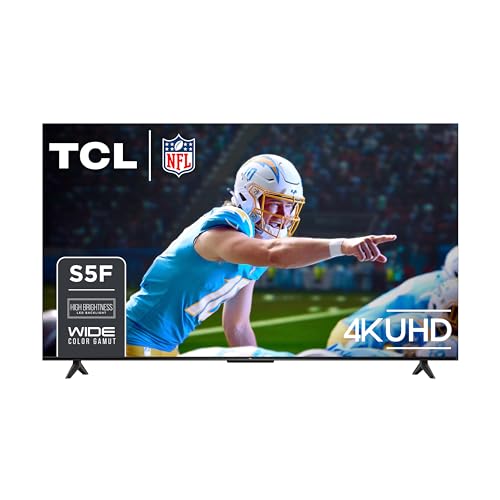
TCL 55-Inch Class S5 UHD 4K LED Smart TV with Fire TV (55S551F, 2024 Model), Dolby Vision, HDR PRO+, Dolby Atmos, Alexa Built-in with Voice Remote, Apple AirPlay 2 Compatibility, Streaming Television — A large 4K LED set with Dolby Vision and Dolby Atmos support that illustrates what a well rounded mainstream living room television looks like on paper. Check price on Amazon.

Hisense 55″ Class U6 Series Mini-LED 4K UHD Smart Fire TV (55U65QF, 2025 Model) – QLED, Native 144Hz, HDR10+, Dolby Vision IQ, Dolby Atmos, Game Mode Pro, ALLM, Alexa Built in, Black — A Mini LED example with a high native refresh rate, useful as a reference point when you compare bright room performance and gaming features. Check price on Amazon.

Bose TV Speaker – Soundbar for TV with Bluetooth and HDMI-ARC Connectivity, All-in-One Compact Soundbar, Includes Remote Control, Black — A compact soundbar that shows how a planned audio upgrade pairs with a new television through HDMI ARC. Check price on Amazon.
Room First: Light, Distance, and the Seats You Actually Have
Measuring the room like it matters, because it does
- Before any model is shortlisted, measure three things: the distance from the main seats to the wall or stand, the width of the furniture or wall space available, and the room’s light across the day, including where lamps sit at night. Screen size recommendations assume you will sit at a consistent distance, but real rooms have a favourite chair closer than the sofa and a seat at an angle that nobody admits is theirs. Choose a size that serves the main seats generously without overwhelming the closest one, and check the television’s width in centimetres against your furniture, because diagonal inches conceal width and returns departments know it.
- Light deserves a full day’s observation. A room that is gentle in the morning can be a hall of mirrors at sunset, and a screen chosen under shop lighting meets its real test at your golden hour. Note where reflections will fall: windows behind the viewers reflect in the screen, while windows behind the screen merely brighten the room. If reflections are unavoidable, panel choice and screen finish rise in importance, and a slightly smaller, less reflective screen can beat a larger mirror at every hour that matters.
Sound’s place in the room plan
- Televisions have grown thinner and their speakers have paid for it. Decide during selection, not after the first film, how the television will sound: its own speakers for simplicity, a soundbar for most living rooms, or a full system for dedicated viewing. That decision feeds back into the television choice itself: a soundbar needs a place to sit and an eARC connection to behave, a full system needs the right outputs, and a television whose own sound must suffice should be auditioned with dialogue at low volume, where thin speakers confess immediately.
- Measure for the soundbar when you measure for the screen. The classic disappointment is a beautiful television whose new soundbar covers its remote sensor or sits awkwardly above the stand’s height. Plan the ensemble as one object, screen, sound, and the furniture beneath both, and the installation day becomes an unveiling rather than a negotiation.
Panel Technologies Without the Tribalism
What you are really choosing between
- Behind the acronyms, panel choice is a choice about light control. Technologies that light each pixel individually produce perfect blacks and superb contrast in dark rooms, at higher prices and with brightness limits in sunlit spaces. Backlit technologies divide the screen into zones that brighten and dim, reaching higher brightness for daytime and sport, with some haloing around bright objects on dark backgrounds as their compromise. Neither is a moral position; each is an engineering trade that matches some rooms and betrays others, and your room’s light, measured honestly, is the arbiter.
- In the shop, judge panels with the content you actually watch, in a viewing mode resembling the one you will use at home rather than the retailer’s vivid demonstration setting. Dark scenes reveal contrast and haloing; sport reveals motion handling; faces reveal colour honesty. A panel that flatters a nature documentary may smear a football match, and the only opinion that matters is the one formed by your content in your conditions, which is why home trials and generous returns policies are worth more than any specification war.
Refresh, motion, and the gaming question
- Motion handling matters if sport and games fill your screen. Higher native refresh rates and good processing keep fast movement legible, while gaming adds its own requirements: low input lag, the right HDMI capabilities for your console, and variable refresh support to keep motion smooth. Check the exact ports on the exact model, because capabilities often live on only some of a television’s inputs, and the console will inevitably be plugged into the wrong one on the first evening unless you plan the connections now.
- For film lovers, the processing question inverts: the television should respect the film’s own motion rather than smoothing it into video-like glide. Every modern set offers controls for this, buried at different depths. When you shortlist, check that the model lets you reach a faithful picture mode easily and keep it, because a television that must be argued with at every source change will eventually win the argument by exhausting you.
- Measure seating distance, furniture width, and the room’s light across a full day before shortlisting.
- Decide the sound plan, television speakers, soundbar, or system, as part of the television choice.
- Judge panels with your own content: dark scenes for contrast, sport for motion, faces for colour.
- Check gaming features on the exact ports of the exact model, not the range’s brochure.
The Smart Platform and the Ten-Year Remote
Living with the interface daily
- You will interact with the television’s software far more than with its panel technology: every power-on, every app switch, every search. Platforms differ in speed, advertising presence, app availability, and how gracefully they accept an external streaming box if you later prefer one. If your household already lives in a streaming ecosystem, a television that embraces it, or at least does not fight it, will feel quicker than its processor. Check that your essential apps exist on the platform natively, and how updates have treated owners of the maker’s previous models, because a television is a decade-long software relationship.
- Remotes deserve their own audition. You will hold it thousands of times, in the dark, half asleep. Buttons should be findable by touch, the voice search should understand your household, and the remote should control your soundbar or system without a second remote joining it on the sofa. A television with a superb panel and a miserable remote is a daily small friction, and small frictions, multiplied by years, are how good televisions end up disliked.
Connections: counting for the household you will become
- Count today’s devices, then add the ones your household reliably acquires: a console becomes two, a streaming box joins, a soundbar arrives, a camera or computer wants the big screen occasionally. Ports fill faster than expected, and the television with one more input than you need today is the one that does not require a switcher and a compromise in three years. Confirm eARC for sound, confirm which ports carry the full gaming features, and think about where cables will run, because a wall-mounted television with unreachable ports turns every new device into a mountaineering exercise.
- Wireless deserves a check too: the television’s Wi-Fi should match your router’s modern standards, and if the television will live far from the router, plan for a wired connection if the room allows it, because a flagship screen fed by a faltering stream is a sports car on a dirt road. The picture you paid for is only ever as good as the connection delivering it.
Buying Well: Timing, Tiers, and Total Cost
Where the tiers actually differ
- Within a maker’s range, tiers buy brightness, processing, panel quality, and design, in roughly that order of visibility. The step from entry to mid-range is usually the largest visible improvement; the steps above it refine rather than transform, and they refine most for viewers with dark rooms, large screens, and critical eyes. Match the tier to your room and your seating distance: at modest sizes and distances in a bright room, mid-range televisions are extraordinarily good, and the flagship money may serve you better spent on sound, seating, or blackout curtains that transform the same room for every device in it.
- Last year’s models, sold as the new range arrives, remain the market’s standing bargain, with the caveat that software support counts from the model’s launch. Check the update horizon as you would for a tablet, keep the receipt and serial records with your household documents, and confirm the returns terms before delivery day, because a television is the household purchase least suited to discovering, after the van is gone, that the size argues with the wall.
Installation day, planned in advance
- Decide before delivery whether the television stands or mounts, who will lift it, because large screens are a two-person lift with awkward grips and no forgiveness, and what happens to the old set: another room, a relative, a recycler. Have the cables, the soundbar, and the wall fixings ready, and photograph the back of the old setup before disconnecting anything if the wiring is complex. A planned installation takes an hour and ends with a film; an improvised one takes a day and ends with a cable draped over a door.
- Finish the day with the unglamorous essentials from our related guides: run the updates, sign into your services, set the faithful picture mode, calibrate the basics, and verify the sound path with dialogue at evening volume. A television set up completely on its first day tends to stay set up; one left half-configured accretes compromises until nobody remembers what it was supposed to look like.
After the Purchase: The First Fortnight of Ownership
Settling the picture and the sound
- Live with the television for a fortnight before final judgement, because eyes adapt and rooms reveal themselves across weather and evenings. In that period, do the calibration basics from our companion guide, confirm the soundbar or system behaves with every source, and check the picture in the room’s worst light as well as its best. Small adjustments made in this window, a seating shift, a lamp moved, a picture mode refined, complete the purchase in a way no shop decision can, because they fit the television to the room it actually lives in.
- If something genuinely disappoints after that honest fortnight, use the returns window while it exists rather than beginning a decade of grievance. Retailers expect a proportion of size and panel exchanges in this category, because rooms cannot be auditioned. The fortnight’s discipline, live with it fully, judge it fairly, act decisively, is what separates owners who love their televisions from owners who merely keep them.
Registering, recording, and protecting the purchase
- Register the warranty, record the model and serial numbers with your household documents, and keep the delivery paperwork until the returns window closes and beyond. Set up the television’s own software updates to install automatically if you trust them, or calendar a quarterly check if you prefer control. If the screen will live where sunlight strikes it daily or small hands patrol, revisit placement and consider the cleaning and protection habits in our related guides now, while they are intentions, rather than after the first incident, when they become regrets.
- Finally, resist the immediate upgrade itch that comparison sites cultivate. A well-chosen television, correctly set up in its real room, should disappear into years of films, matches, and family evenings. That disappearance is the purchase succeeding, and it is worth more than the marginal specification you did not buy.
Household Scenarios: The Choice in Four Living Rooms
The young family’s first big television
- A family buying its first substantial television is really buying the room’s new hearth: cartoons at dawn, sport at weekends, films after bedtime, and games consoles arriving by birthday. Their priorities should run durability of decision over finesse: a size that suits the room as the children grow into it, a platform whose parental controls and profiles are set up on day one, enough ports for the consoles that are certainly coming, and sound that keeps dialogue clear at the low evening volumes family life imposes. Mid-range models serve this household superbly, and the money saved against flagships is better spent on the soundbar and the blackout curtains that will serve every one of those viewing occasions.
- They should also think about the screen’s physical life: a stand that is stable against small climbers or a wall mount installed properly from the start, screen protection habits taught early, and a remote that will survive being lost in sofas weekly. The family’s television will be judged not by its finest film night but by its thousandth ordinary morning, and choosing for endurance, of software support, of ports, of the household’s patience, is how that morning stays pleasant.
The film lover’s dedicated room
- Where a room is given over to viewing, the calculus inverts: darkness is achievable, seating is fixed and square, and the television can be chosen as a cinema instrument. Size and panel quality take the budget’s lead, sound graduates to a real system, and the smart platform matters less because a dedicated player may feed the screen. This buyer should audition in darkness with their hardest scenes, calibrate with the companion guide’s full rigour, and treat light control, seating, and speaker placement as parts of the television purchase, because in a dedicated room they are.
- The dedicated room also justifies patience in timing: buying the outgoing flagship as its successor launches can fund the room’s other needs, the seating and the sound, from the difference. A cinema is a system, and the screen, however dominant, is one component. The film lover who budgets the room rather than the badge ends with the better cinema, a truth that every comparison in this series keeps circling back to from a different door.
The downsizer and the second television
- A smaller home or a second room changes the virtues: compact sizes with excellent viewing angles, a platform that matches the main television’s so the household learns one interface, and sound that is clear without a soundbar’s footprint. Bedroom and kitchen televisions live at angles and distances the main set never meets, and they are watched in fragments, news with breakfast, a film’s last half hour, so instant wake, a simple remote, and a screen that reads well in daylight outrank cinematic depth. Buy the second television for its fragments, not as a miniature of the first.
- Households should also resist handing the main room’s rejects downward without thought: an old, slow, dim television in the kitchen teaches the household that second screens are disappointing, while a modest new one designed for the role becomes a small daily pleasure. Match each room’s television to its actual hours, and the whole house’s viewing improves for less than one flagship’s price.
Accessibility and Ease of Use: The Television Everyone Can Operate
Features that decide independence
- For viewers with low vision, hearing loss, or limited dexterity, the right television is the one whose accessibility features are excellent and easy to reach: screen magnification and high-contrast interfaces, a voice remote that genuinely understands the household, caption quality and customisation, audio description support, and remotes with buttons that can be found and pressed by touch. These features vary more between models than picture quality does at most prices, and they decide whether a viewer operates their own television or negotiates for help. Buyers choosing for a relative should audition the accessibility menu in the shop with the same seriousness as the panel, because independence is a specification.
- Households should also value simplicity as an accessibility feature in its own right: a home screen that can be pared to the essential apps, a remote without a thicket of sponsored buttons, and a television that returns to the last input rather than a marketing page. The best television for an older viewer is frequently a mid-range model whose interface respects them, set up by a relative who removed everything unnecessary and wrote the three essential operations on a card by the remote. That card, unglamorous as it is, outperforms any feature list in the daily referendum of use.
The ten-year test, applied to the whole purchase
- Close the decision with the projection this series favours: imagine the television in its tenth year. Its panel will still show a fine picture if the room suited it; its software will still be safe if the maker’s support was long; its ports will still serve if you counted generously; its sound will still satisfy if you planned it rather than accepting it. Every element of that tenth year is being decided today, in measurements, update policies, port counts, and sound plans that take an afternoon to assemble. The household that spends that afternoon buys a decade; the one that buys on a Saturday impulse rents its evenings from chance. Measure, count, audition, record: the method is unglamorous, and it is the entire secret.
A Word on Regret: The Three Mistakes This Guide Exists to Prevent
Size, light, and sound, in that order
- Television regret has a short catalogue. The screen that is too small for the room’s distance, forgiven nightly and never forgotten. The screen whose panel fights the room’s light, a fine television in the wrong physics. And the screen whose sound was never planned, so that every film is a negotiation with the volume control. Every other disappointment, a missing app, a slow menu, a port short, is survivable or fixable; those three are structural, and they are all decided before the purchase by the measurements and audits this guide prescribes. Take the measurements, observe the light for a day, plan the sound as part of the budget, and the catalogue of regret closes for you, leaving only the ordinary, pleasant work of choosing between good televisions, which is the position this entire article exists to put you in.
Buying for Someone Else: Parents, Relatives, and Gifts
The television as a gift that keeps its manners
- Choosing a television for a parent or relative reverses the usual priorities: their room, their eyes, their remote habits, and their support network, which is probably you, outrank your own tastes entirely. Favour the platform they can operate or that you can talk them through by phone, the size their room’s distance honestly wants, and sound that keeps dialogue clear without a soundbar’s second remote unless you will be there to marry them properly. Set it up completely when you deliver it, pared to their services, with the essential operations written on a card, because a television given configured is a gift and the same television given raw is a project you have assigned to someone who did not volunteer.
- Record its details in your own notes as well as theirs, since you are the support department now, and choose the model whose menus you can navigate from memory during a phone call. That unglamorous criterion, your fluency in its interface, will be worth more across the years than a tier of picture quality, and it is the honest final word on choosing for someone else: buy the television you can love at a distance and support from an armchair, in their room, at their pace.
Related Guides
- best tvs under 1000
- best tvs under 500
- best tvs for ps5
- best 4k tvs for gaming
- best tvs for bright rooms
- how to clean a tv
- how to mount a tv
Frequently Asked Questions
What size TV is right for a typical living room?
Measure from your main seat to the screen. For mixed films, sport and streaming, most households land on a mid to large diagonal that fills roughly a third of their field of view. If you sit closer than you expected, step one size down rather than up, because an oversized screen makes lower quality channels look soft and forces constant eye movement during fast action. Always confirm the stand width fits your furniture before ordering.
Is OLED or LED better for a bright room?
A bright LED or Mini LED set usually wins in a sunlit room because it can push more light through reflections and holds up at midday. OLED wins after dark, where its perfect blacks and contrast make films look richer. If most of your serious viewing happens in the evening with lamps low, OLED is hard to beat. If the television is on all day in an open plan space, prioritise brightness and anti reflection performance instead.
Do I need a soundbar with a new TV?
You do not need one, but most viewers benefit. Slim televisions have small speakers that fire down or backwards, so dialogue can sound muffled, especially at low volume in a large room. A compact soundbar connected through HDMI ARC or eARC clears up voices and gives films proper weight, while still being controlled by the television remote. Plan the shelf space and power socket when you choose the television, even if you buy the bar later.
How many HDMI ports should a TV have?
Three is a workable minimum for many homes and four is comfortable. Count a console, a streaming device, a Blu-ray player and a soundbar on eARC, then add one spare for a future purchase. Gamers should also check which specific ports support the full bandwidth and high refresh features of their console, because on some sets only one or two ports offer the complete feature set while the others are more basic.
Should I pay extra for 8K when choosing a TV?
For almost everyone, no. There is very little native 8K content to watch, streaming services and consoles target 4K, and at normal seating distances the extra pixels are hard to see. The money is better spent on a higher quality 4K panel with better contrast, brightness and motion handling. Choose 8K only for very large screens viewed unusually closely, or if you specifically want a flagship set and accept that most content will be upscaled.
When is the best time to buy a TV?
New models arrive in spring, and the previous range is often cleared as the new range lands, while major shopping events bring further reductions across the year. Because listing details change often, the practical approach is to decide your size, panel type and short list first, then watch your chosen models and buy when one of them is offered on terms you are happy with, rather than rushing at the first promotion you see.
How far should I sit from my television?
Sit close enough that the screen fills a comfortable portion of your view without forcing your eyes to travel constantly, which for modern high-resolution televisions is closer than older rules suggested. Use your main seats’ actual distance to size the screen, test in a shop by standing at your measured distance, and remember that the closest regular seat sets the limit: a screen that overwhelms the nearest viewer will not be forgiven by the farthest one.
Is it worth paying for a flagship television?
It is worth it if your room and habits can reveal what the flagship buys: a dark viewing room, a large screen, critical film watching, or serious gaming. In a bright room at a modest size, mid-range models are so capable that the extra money often serves better in sound, seating, or light control. Judge with your own content in conditions like your room’s, and let the visible difference, not the tier name, make the case.
Should I buy an extended warranty for a television?
Weigh the premium and excess against the model’s repair costs and your household’s history, as with any cover. Televisions are generally reliable and stationary, which weakens the case for cover for careful households, while very large screens, whose repair or replacement logistics are expensive, can strengthen it. Accidental damage cover is a separate question, most relevant where children, pets, and flying game controllers share the room.