kajuandouglas.com is reader-supported. When you buy through links on our site, we may earn an affiliate commission.
Where to Buy Telephoto Cameras, and Why Reach Is a System, Not a Number
Photographers searching for the best cameras for long distance shots usually carry a picture in their heads: a heron lifting off a far bank, a striker at the opposite end of the pitch, the moon’s craters over a rooftop. Every one of those pictures is a negotiation between focal length, sensor size, resolution and steadiness, and the camera body is only one negotiator. This guide treats reach as a system and judges each body by the distant photographs it actually helps you bring home.
Where to buy: each linked name below points to that camera’s Amazon listing, where the current body and kit configurations can be compared before ordering. Reserve serious money for the lens side of the equation — a long-distance kit is a body plus a telephoto, and the photographers who reverse that budget order spend the following year wondering why their expensive sensor produces such ordinary birds.
Three different strategies compete in these pages. Crop-sensor bodies stretch every lens further for free. That is why the Canon EOS R10 and Nikon Z50 II anchor the value end. High-resolution full-frame bodies take the opposite road: capture everything, then crop the middle of the frame in editing and still keep a printable file, the Fujifilm X-T5 and Canon EOS R6 Mark II approach. And the Sony RX100 VII argues that a real zoom in a pocket beats a system left at home.
Stabilisation runs through the whole subject like a spine. At effective focal lengths of 400mm and beyond, the world through the viewfinder swims; in-body stabilisation, lens stabilisation and the photographer’s stance all conspire to decide whether the distant subject lands as detail or as impressionism. Each review below states how its pick behaves handheld at long reach, because that is where long-distance photography is actually practised — on riverbanks and touchlines, not on laboratory benches.
Weather gets a mention in every verdict too. Distant subjects live outdoors, often at dawn, frequently in drizzle. A body that must be babied changes what its owner attempts, and the long-distance photographer who stays home on grey mornings misses the mist, the migration and the empty stadium light that make the genre worth its heavy bag.
A distinction the rest of the guide leans on: reach for looking and reach for photographing are different purchases. A spotting scope or a phone’s digital zoom can show you the eagle; a camera must gather enough real detail, steadily, in the light that exists, to make the eagle a photograph. Every pick below was judged on the second standard, so pocket convenience and professional sensitivity both appear without apology — they serve different photographers’ definitions of a successful distant frame.
Key Takeaways
The reach briefing, condensed for the impatient:
- Focal length is bought with lenses; bodies multiply it — crop sensors stretch, resolution lets you crop later.
- The Canon EOS R10 is the reach-per-budget champion with fast bursts for wildlife moments.
- Nikon’s Z50 II pairs a crop stretch with subject detection that finds birds and eyes at distance.
- The Fujifilm X-T5 turns its huge resolution into a second, invisible telephoto in the edit.
- Canon’s R6 Mark II steadies long lenses superbly and sees in near-darkness on the touchline.
- The RX100 VII is the distant shot you actually have with you — a genuine zoom in a coat pocket.
In this guide
Quick Picks
Six routes to a faraway subject, from crop-sensor value to a pocket zoom that embarrasses phones.
| Camera | Badge | Why it earns its place here |
|---|---|---|
| Canon EOS R10 | Best Reach for the Money | A fast crop body that stretches telephoto lenses and fires bursts when wildlife moves. |
| Nikon Z50 II | Best Compact Bird and Sport Body | Subject detection and Nikon colour in a body that walks all day to the hide. |
| Fujifilm X-T5 | Best Crop-After-the-Shot Resolution | Enormous detail that survives aggressive cropping, with film colour for the keeper frame. |
| Canon EOS R6 Mark II | Best Low-Light Telephoto Body | Full-frame sensitivity and stabilisation for evening matches and dawn hides. |
| OM SYSTEM OM-5 Mark II | Best Weatherproof Reach Outfit | A compact system whose lenses double their reach and shrug off bad weather. |
| Sony RX100 VII | Best Pocket Zoom for Distance | A 200mm-equivalent zoom and flagship-bred focus in a camera that is always present. |
How Did We Judge the Best Cameras for Long Distance Shots?
Reach arithmetic came first. We weighed each body’s crop factor — the multiplier it applies to a lens’s field of view — alongside the resolution left after cropping, because a distant photograph is always one of those two trades. A smaller sensor stretches; a denser sensor crops; the honest question is which trade suits the lenses a photographer owns or can afford.
Autofocus at distance was the second test, and it is harsher than autofocus across a room. The subject occupies a sliver of the frame, moves erratically, and competes with branches, posts and crowd clutter that all beg the camera to focus on them instead. Subject-detection systems that recognise birds, animals and athletes earned their prominence in these reviews honestly.
Third, steadiness: in-body stabilisation quality, viewfinder stability at long effective lengths, and burst behaviour when the moment arrives in a half-second flurry. Long-distance subjects rarely pose twice. The camera that fires a confident burst and keeps the sequence sharp turns luck into a selection of frames to choose from.
Carry weight closed the judging, because reach photography is walking photography. A body-and-lens combination that its owner leaves in the car photographs nothing at all. Two picks below exist largely because they keep total kit weight inside what a person will cheerfully carry up a coastal path for the third consecutive morning.
We paid unusual attention to viewfinders and screens, because distance work is aimed work. A finder that stays clear and calm at long effective lengths lets a photographer hold a small subject in frame through a gust of wind or a long wait; a laggy or dim one loses birds that the sensor could easily have captured. Two picks earned their places partly on this unglamorous interface between eye and subject.
Crop Factor or Crop Later? The Two Honest Roads to Reach
A crop-sensor camera like the R10 or Z50 II sees a narrower slice of the scene through any lens, so a 300mm lens frames like a much longer one. The stretch costs nothing, weighs nothing and applies to every frame in the field — but the sensor gathers less light than a full-frame chip, and the very darkest conditions expose that difference. For daylight wildlife, school sport and travel, the trade is close to free money.
Cropping later, on a high-resolution body, reverses the bargain: shoot wider with more light and more context, then take the middle of the frame home. The X-T5 and its high pixel count exist for this workflow, and it shines when the subject’s exact position is unpredictable — a bird that may erupt from any reed bed. The cost is discipline in editing and files that demand respect in storage. Neither road is superior; they suit different temperaments, and this guide keeps both open.
Why Do Distant Photographs Go Soft Even With Good Lenses?
Atmosphere is the unlisted component in every telephoto kit. Heat shimmer over a pitch at noon, haze across a valley, dust above a safari track — the air itself smears detail long before the lens’s limits arrive. That is why experienced reach photographers shoot early, shoot late, and get physically closer whenever the subject allows. No body in this guide defeats physics; the best ones simply stop adding their own softness to the air’s.
Technique is the other half. At long effective lengths, a shutter speed that felt generous at 50mm becomes a rumour; stabilisation helps the photographer, not the subject, and a moving bird still needs speed. Rest the lens, brace against the hide, exhale before the burst — the rituals are old because the physics is older. Cameras below are judged partly on how gracefully they support those rituals rather than replace them.
Which Bodies Bring Far Subjects Closer? The Six Picks in Detail
Judged on reach strategy, focus at distance and the weight of the whole outfit on a real walk.

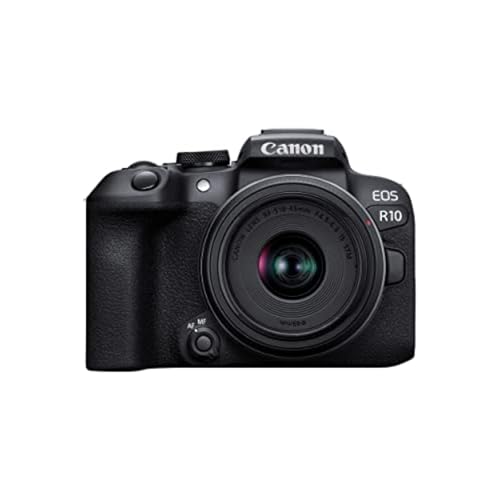
Canon EOS R10 — Best Reach for the Money
The R10 is the body that turns a modest telephoto zoom into a serious wildlife instrument. Its APS-C sensor crops every lens’s view by roughly one-and-a-half times, so the affordable long zooms most beginners actually buy suddenly frame like professional glass, and its burst rate — rapid-fire shooting inherited from Canon’s sport bodies — means the heron’s takeoff exists as a sequence to choose from rather than a single hopeful frame.
Autofocus is the second half of its reach argument. Canon’s subject detection recognises animals and birds and holds them through the messy backgrounds that defeat lesser systems: reeds, branches, the far fence of the nature reserve. At distance, where the subject fills a thumbnail’s worth of sensor, that recognition is not a luxury feature. It is the difference between a sharp eye and a sharp twig.
In the hand it stays beginner-honest. The body is light, the controls will be familiar to anyone arriving from a phone or an older Canon, and the files — while not the deepest in this guide for heavy cropping — are rich enough for the prints and publications its owners actually produce. Pair it with a long zoom and the whole outfit still undercuts a single professional telephoto lens.
Its boundaries are the crop format’s usual ones: the darkest hides and floodlit winter fixtures will push its sensitivity harder than the full-frame picks below, and the lens mount’s telephoto cupboard, while growing, rewards a little patience. As a first serious reach camera — the one that teaches a photographer the genre — the R10 has no equal at its level in these pages.
Sports parents should hear the R10’s case in their own language: the far end of a youth pitch is a long way from the opposite touchline, and this body’s crop view plus its burst rate turn that geography into a workable assignment. Shoot the warm-up to learn the light, position at the end your child attacks in the second half, and the R10 will return frames that make the season’s slideshow. Its video is a respectable sideline bonus for the family archive, though stills are plainly its first language and the reason it leads this guide.
A note on growth: the R10’s controls and menus teach Canon’s way of thinking so thoroughly that its owners graduate to bodies like the R6 Mark II below feeling fluent rather than retrained — same dial logic, same colour instincts, same lens mount waiting with the glass already owned. That continuity is an economic feature disguised as familiarity. Buy the R10 as a first reach camera and the second camera, years later, costs only the difference in ambition, because nothing in the bag becomes obsolete when the body does.
- Type: APS-C mirrorless system
- Reach strategy: sensor crop stretch
- Shooting: fast bursts for action
- Focus: animal and bird detection
- Role: the attainable wildlife starter
Strengths
- Long lenses frame dramatically longer.
- Bursts catch the unrepeatable moment.
- Light enough for all-day hides.
Trade-offs
- Dark conditions favour full-frame.
- Files crop less deeply than rivals.
- Telephoto lens range still growing.
Best for: new wildlife and sports photographers building a first telephoto kit.
Not suited for: floodlit professional sport in midwinter.

Nikon Z50 II — Best Compact Bird and Sport Body
Nikon’s Z50 II approaches distance from the walker’s direction: small body, crop stretch, and a view of the world coloured the way Nikon loyalists insist the world actually looks. On a coastal path with a compact telephoto mounted, the whole kit rides in a small shoulder bag, and that portability quietly produces more distant photographs than a heavier, theoretically superior system resting at home.
Its subject detection deserves the headline. The Z50 II recognises birds, animals, people and vehicles, and for the long-distance shooter that recognition does practical work: a wader at sixty metres is a speck to a contrast-detection system of the old school, but a known shape to this one. Focus lands on the bird rather than the glittering water behind it, which is where distant frames are usually lost.
Colour and file character suit the genre’s subjects. Nikon’s greens separate reed from reed and feather tones stay natural in the flat light of an overcast estuary, while the files tolerate the exposure rescue that backlit distant subjects so often need. Bird photographers working at dawn will also appreciate a body whose controls remain findable with cold fingers and gloves half-on.
The system’s honest caveat is in-body stabilisation: there is none, so the steadiness burden falls on stabilised lenses and the photographer’s technique. Nikon’s own telephoto zooms carry that stabilisation well, making the caveat a purchasing note rather than a flaw. Bought with its lenses in mind, the Z50 II is the connoisseur’s compact reach kit — the one experienced photographers choose when they downsize on purpose.
Landscape shooters overlook the Z50 II at their loss, and its telephoto landscapes — compressed ridge lines, a lighthouse isolated against weather, church spires stacked by haze — carry Nikon’s colour in a way that needs almost no editing to feel finished. The small body rides in the same bag as a wide lens without negotiation, making it the natural second body for photographers whose main camera wears the landscape glass. Downsizers from Nikon’s DSLR years will also find its menus a homecoming rather than a re-education, which shortens the road to the first keeper considerably.
Video deserves its honest sentence: the Z50 II films capable footage for the family archive and the club’s social pages, and birders increasingly record behaviour clips alongside their stills. It will not out-spec the hybrid specialists, and it does not need to — its stills-first clarity is why it walks so light. Owners who do film at distance should know the crop view helps here too, framing a wader’s courtship at ranges where a full-frame body would be reaching for a longer, heavier lens and a second mortgage.
- Type: APS-C mirrorless system
- Reach strategy: sensor crop stretch
- Focus: bird, animal and vehicle detection
- Stabilisation: in stabilised lenses
- Role: the walker’s considered reach kit
Strengths
- Detection finds specks at distance.
- Colour flatters feathers and fields.
- Kit stays genuinely portable.
Trade-offs
- No in-body stabilisation.
- Relies on lens stabilisation quality.
- Smaller buffer than pro bodies.
Best for: birders and travelling photographers who value the walk as much as the frame.
Not suited for: shooters wanting stabilisation in the body for unstabilised primes.

Fujifilm X-T5 — Best Crop-After-the-Shot Resolution
The X-T5’s distance trick is arithmetic performed in the edit. Its sensor packs resolution far beyond its APS-C size class, so a frame shot at a moderate focal length contains a second, tighter photograph hiding in the middle: crop to half the frame and a printable, detailed image remains. For subjects whose position refuses prediction — the deer that may step from any gap in the treeline — that insurance is a working method, not a gimmick.
Layered on the arithmetic is Fujifilm’s colour. Distant landscapes, the layered ridges and hazy valleys that telephoto compression stacks so beautifully, take film-simulation palettes like they were designed for each other, because in a sense they were. The X-T5’s owners develop a recognisable look for their far-off work that no amount of editing quite replicates from a neutral file.
Handling supports deliberate distance work: dedicated dials keep shutter and aperture under the fingers, the viewfinder is crisp enough to confirm focus on a far subject, and the body is weather-resistant for the exposed hillside the genre calls an office. Its autofocus, while much improved across the X line, asks slightly more of the photographer on erratic birds than the Canon and Nikon detection systems above — a fair trade stated plainly.
Think of the X-T5 as the landscape-and-travel reach camera that also does wildlife, rather than the reverse. Photographers whose distant subjects are mountains, architecture, compressed city layers and the occasional cooperative eagle will find its resolution and colour a daily pleasure. Pure bird specialists should weigh the R10 and Z50 II first; everyone else should handle an X-T5 before deciding the question is settled.
A technique this body rewards specifically: expose for the distant subject, not the scene. Its metering is honest, but a far bird against a bright sky will always be rendered a silhouette by any camera thinking about the whole frame — the X-T5’s dials put exposure compensation under a thumb, making the correction a reflex rather than a menu visit. Owners shooting compressed city layers at dusk will likewise appreciate how its film palettes hold a consistent mood across a sequence shot over an hour of changing light, turning individual frames into a series that hangs together.
Print discipline is where the X-T5’s owners cash their resolution honestly. A cropped frame from this sensor, printed at the sizes homes and clubs actually display, holds together with a confidence that ends the format argument at the only tribunal that matters — the wall. Photographers coming from phones, whose distant shots dissolved under exactly this test, describe the first big X-T5 print as the moment the hobby became real. If your distant subjects are destined for frames rather than feeds, weigh that moment heavily in this body’s favour.
- Type: high-resolution APS-C mirrorless
- Reach strategy: crop the huge file later
- Colour: film simulations with character
- Build: dials and weather resistance
- Role: the deliberate, printable reach camera
Strengths
- Cropping keeps real detail.
- Colour gives distance a signature.
- Dials reward careful technique.
Trade-offs
- Bird focus trails the specialists.
- Huge files fill cards quickly.
- High resolution punishes camera shake.
Best for: landscape, travel and architecture shooters who crop with intent.
Not suited for: burst-first bird photographers chasing erratic flight.

Canon EOS R6 Mark II — Best Low-Light Telephoto Body
When the light goes, the R6 Mark II keeps shooting distances other bodies surrender. Its full-frame sensor holds clean, colour-true files at the sensitivities a floodlit pitch or a dusk hide demands, and that sensitivity is a form of reach in itself: the telephoto photograph that exists beats the sharper one that noise destroyed. Evening sport is this camera’s home fixture.
Stabilisation is the co-headline. Canon’s in-body system works with stabilised RF telephotos to produce a combined steadiness that changes handheld long-lens behaviour — the viewfinder calms, the frame holds, and shutter speeds once reserved for monopods become working speeds on a touchline. Photographers covering a full match handheld will feel the difference in their shoulders by half-time and in their hit rate by full-time.
Autofocus completes the professional picture: deep subject detection, eye tracking that persists at distance, and burst speeds that turn a striker’s volley into a strip of decisive frames. This is the body in the guide most at home being aimed across a stadium by someone whose editor expects the moment, not an apology about the light.
Costs are the format’s costs — the body is a serious purchase and Canon’s long RF glass asks serious money — and its resolution, while ample, crops less luxuriously than the X-T5’s mountain of pixels. Judge it as the low-light and action specialist it is: for the photographer whose distant subjects move, in the dark, for money or for love, the R6 Mark II is the end of the argument.
Wildlife tour leaders quietly favour this Canon for a social reason: it is the body they can hand to a client. Its automatic modes are trustworthy enough that a guest, given ten minutes of instruction, returns from the hide with sharp, well-exposed frames of the day’s bird, while the same body in a professional’s hands runs fully manual with dual dials and custom controls. That dual citizenship — forgiving at noon, exacting at dusk — is rarer than any specification on its box, and it is why the R6 Mark II anchors so many mixed-ability expeditions.
A word about its stills resolution, since the cropping crowd may hesitate: twenty-four megapixels sounds modest beside the X-T5, yet it prints superbly at serious sizes and its files are kinder to cards, drives and ageing laptops across a long season. Professional sports shooters chose this class of resolution deliberately for decades of deadlines. The R6 Mark II’s real specification is throughput — focus, frames, files, delivered — and for the distance photographer working to a fixture list rather than a gallery, throughput is the specification that pays.
- Type: full-frame mirrorless system
- Reach strategy: sensitivity plus long glass
- Stabilisation: body and lens combined
- Focus: deep detection, fast bursts
- Role: the evening and professional pick
Strengths
- Clean files when light dies.
- Steadiest handheld telephoto here.
- Bursts built for decisive moments.
Trade-offs
- Resolution crops less than X-T5.
- Long RF lenses are costly.
- Heavier kit over a long day.
Best for: sports, evening wildlife and event photographers at distance.
Not suited for: budget-first beginners or resolution-led landscape work.

OM SYSTEM OM-5 Mark II — Best Weatherproof Reach Outfit
Micro Four Thirds has always made the boldest reach argument in photography: a sensor half the linear size of full-frame doubles every lens’s effective framing, so a telephoto that a full-frame shooter would need a wheelbarrow for becomes a lens an OM-5 owner carries in a jacket-adjacent bag. The OM-5 Mark II is that argument’s most outdoorsy current expression — compact, sealed against weather, and stabilised like it means it.
Weather sealing is not a footnote in this genre; it is the schedule. Migration mornings are wet. Sea watches are horizontal rain with birds in it. The OM-5’s sealing, matched by sealed lenses in its system, lets its owner stay on the headland while bigger kits retreat to cars, and the best distant photograph of the day is routinely the one taken in the weather everyone else waited out.
Computational helpers sweeten the fieldcraft: the system is known for tricks like in-camera neutral-density simulation for long exposures and focus aids that suit patient telephoto work. Stabilisation is a traditional OM strength, steadying those doubled focal lengths to a degree that makes handheld 800mm-equivalent framing a practical technique rather than a party trick.
The format’s physics set its ceiling: the smallest sensor here gathers the least light, so the darkest conditions belong to the R6 Mark II, and ultimate print size belongs to the high-resolution picks. But weigh what the OM-5 offers in exchange — the lightest genuine reach outfit in this guide, weatherproof, steady, and priced like a hobby rather than a mortgage — and its constituency of walkers, sailors and mountain photographers makes complete sense.
Sailors and sea-anglers give the OM-5 a constituency landlocked reviewers miss: on a boat, everything is distance — the seal colony on the skerry, the lighthouse bearing, the racing mark rounding — and everything is also wet, moving and short of storage space. A sealed, stabilised body with doubled lens reach, small enough for a dry bag’s spare corner, fits boat life as no larger system does. Its stabilisation earns double pay on a deck, where the platform itself never stops moving and a steady frame is a collaboration between the camera and the photographer’s sea legs.
Second-hand explorers should know the OM system’s secret wealth: decades of excellent Micro Four Thirds lenses circulate used at prices that make a two-lens reach kit attainable on a student’s budget, and the OM-5 Mark II’s modern sensor and stabilisation flatter every one of them. A used telephoto on this body is perhaps the cheapest honest route in the entire guide to serious distant photographs. Check a used lens’s sealing if the weather work matters, buy from a seller who accepts returns, and the system’s long history becomes your subsidy.
- Type: Micro Four Thirds mirrorless
- Reach strategy: two-times crop factor
- Build: serious weather sealing
- Stabilisation: a system hallmark
- Role: the all-weather walker’s telephoto
Strengths
- Longest reach per gram here.
- Sealed for genuine bad weather.
- Stabilisation steadies huge framing.
Trade-offs
- Smallest sensor, darkest ceiling.
- Prints top out sooner than rivals.
- Lens choice matters for sealing.
Best for: hikers, sailors, sea-watchers and travellers who shoot in weather.
Not suited for: the darkest venues or the largest gallery prints.

Sony RX100 VII — Best Pocket Zoom for Distance
The RX100 VII reframes the distance question entirely: what reach does the camera in your coat pocket have? Its zoom extends to a 200mm equivalent — genuine telephoto territory — behind a one-inch sensor far larger than a phone’s, with autofocus descended from Sony’s flagship sports bodies. The distant shot it takes on a city break, a school match or a mountain walk exists, which is more than can be said for the superior system back at the hotel.
Speed is its hidden telephoto virtue. That flagship-bred focus and rapid burst shooting suit exactly the subjects distance shooters meet opportunistically: the heron that flushes as you round the bend, the grandchild’s goal at the far end of the pitch. A pocket camera with a sports camera’s reflexes converts walks into photographic outings without a bag, a plan or a aching shoulder announcing the hobby to the whole family.
Files respect the format’s limits and surprise within them. At the long end in good light, detail is crisp and colour is Sony-clean; as light falls, the small sensor’s ceiling approaches faster than the system cameras’, and the zoom’s aperture narrows the way all compact zooms’ do. The honest summary: superb reach for daylight and travel, a capable guest at dusk, and no pretence of being a hide camera.
For system owners, it is also the perfect second body — the camera for the days the big kit stays home, bought once and carried for years. For everyone else, it may simply be the distance camera, full stop: the one whose 200mm view of the lighthouse, the striker and the moonrise is actually in the album, because the camera was in the pocket when the moment happened.
Parents of teenagers discover a diplomatic virtue in the RX100 VII: it photographs the school play, the climbing final and the far end of the sports hall without the social weight of a big camera announcing a Serious Photographer in row nine. Its quiet operation and small profile keep the photographer a parent rather than a presence. The same discretion serves street and travel photographers working at moderate distances in places where large glass changes how strangers behave — the pocket Sony observes the square; it does not interrupt it.
Longevity is the RX100 VII’s closing argument. Pocket cameras ask so little — no lens changes, no sensor cleaning, no system decisions — that owners keep them for the better part of a decade, and a camera kept is a camera whose quirks are known by heart. Its distant photographs improve across those years not because the hardware changes but because the photographer’s eye for the far subject sharpens. In a guide full of systems that invite upgrading, the little Sony’s invitation is different and rarer: stay, practise, and let the pocket camera grow old with your seeing.
- Type: premium pocket compact
- Zoom: to 200mm equivalent
- Focus: flagship-bred tracking
- Carry: coat pocket, always
- Role: the ever-present distance camera
Strengths
- Real telephoto, zero bag.
- Focus speed embarrasses compacts.
- Present for unplanned moments.
Trade-offs
- Small sensor, early dusk ceiling.
- Zoom slows as it lengthens.
- No lens changes, ever.
Best for: travellers, parents and system owners wanting a pocket second body.
Not suited for: dedicated hide or stadium professionals.
How Do the Six Reach Their Subjects?
Two stretch, one crops, one out-sees the dark, one doubles, one fits in a pocket — choose your arithmetic.
| Camera | Connection route | Standout trait | Watch out for |
|---|---|---|---|
| Canon EOS R10 | Crop stretch plus bursts | Fast detection for wildlife | Low light is its limit |
| Nikon Z50 II | Crop stretch, compact kit | Bird recognition at range | Stabilisation lives in lenses |
| Fujifilm X-T5 | Crop the file afterwards | Resolution as insurance | Focus asks more technique |
| Canon EOS R6 Mark II | Sensitivity and long glass | Evening sport and dusk hides | Cost and carry weight |
| OM SYSTEM OM-5 Mark II | Two-times crop factor | Weatherproof light outfit | Smallest sensor ceiling |
| Sony RX100 VII | 200mm pocket zoom | Always-carried distance shots | Dusk arrives early |
How Does Telephoto Compression Change What a Landscape Says?
Long lenses do not merely magnify; they stack. A 300mm view of a valley flattens its ridges into layered bands, pulls a distant church into the same plane as the foreground wall, and makes a setting sun loom behind a skyline at a size no naked eye ever witnessed. Photographers buy reach for wildlife and stay for this graphic compression, which turns ordinary viewpoints — a layby, a bridge, a hotel balcony — into compositions.
Working with compression is mostly working with viewpoint and air. Height helps layers separate; clear, cool air keeps the far layers legible; and the X-T5’s resolution or the OM-5’s doubled reach both serve the style well. Shoot the same valley across a day and the lesson lands permanently: the lens did not change, the distance did not change, and yet the light and atmosphere rewrote the photograph four times.
What Should a Safari or Wildlife-Trip Kit Weigh?
Less than the airline’s goodwill and your own, in that order of discovery. A crop body like the R10 or Z50 II with a mid-range telephoto zoom covers the great majority of vehicle-based wildlife at a weight a traveller can hand-carry through three airports without resentment, and resentment is a real photographic variable by day nine of a trip. Add the OM-5 as a weather-sealed backup and the kit still trails a full-frame professional pairing by kilos.
Spend the saved weight on access instead: the beanbag for the vehicle window, the better hide day, the extra dawn drive. Distance photography’s scarcest resource was never focal length — it is proximity, light and patience, all purchasable with the money and energy a lighter kit leaves in your hands. Every guide says buy the lens; the photographers who return with the pictures bought the mornings.
How Do You Focus on a Bird in Flight Without Losing Your Mind?
Start wider than pride suggests. Acquire the bird at a shorter focal length where it is findable, track it smoothly, and zoom in as the range closes — the picks with subject detection, the R10, Z50 II and R6 Mark II especially, reward this rhythm by locking on once the bird is properly in frame. Pan from the hips, keep both eyes open if you can learn it, and fire short bursts at the moments of predictable geometry: the turn into the wind, the flare before landing.
Accept the apprenticeship’s arithmetic. A first season’s keeper rate on flight shots is small for every photographer who has ever lived; the skill compounds quietly, outing by outing, until the camera’s handling disappears from consciousness. Choose the body whose controls your hands stop noticing soonest — for many that is the Nikon’s familiarity or the Canon’s speed — because in flight photography the photographer’s smoothness is the real autofocus system.
How Do You Read a Distant Scene Before Raising the Camera?
Experienced reach photographers look twice: once with naked eyes for the story, once through the lens for the frame. The naked-eye pass finds the subject’s behaviour — where the heron habitually lands, which gap the deer use, when the striker drifts to the far post — and behaviour, not optics, is what positions the photographer. Raise the camera after the scene has explained itself and the long lens becomes a tool for confirming a prediction instead of a telescope for searching in hope.
Light direction belongs to that first look. A distant subject lit from behind the photographer reads with full colour and detail; the same subject against the light becomes silhouette and rim, beautiful for mood and useless for identification. Knowing which photograph you are making before the shutter fires — record or artwork — decides exposure, position and whether the frame is worth the walk at all. The bodies in this guide serve both intentions; the photographer’s first look is what chooses between them.
How Should You Choose a First Telephoto Lens for These Bodies?
Buy the lens for the subject’s distance, not the catalogue’s maximum. Bird photographers on crop bodies typically live at the long end of a 100-400mm-class zoom; sports parents often find a faster, shorter telephoto more useful under floodlights, where aperture buys shutter speed. The body decisions in this guide all assume a zoom first and a prime later, because a zoom teaches you which focal length your subjects actually demand before you spend prime money answering the question.
Handle the combination before committing, if a shop allows: balance matters at length, with a front-heavy pairing tiring the arms and drifting off the subject. And budget for the support — a monopod for sport, a beanbag for hides and car windows — because the finest telephoto in the world photographs like a mid-range one when it is waving in the wind.
How Do You Practise Distance Technique Before the Big Trip?
Rehearse on unglamorous subjects: gulls at the harbour, the neighbour’s chimney pots, aircraft on approach paths. Practise acquiring the subject at a wide framing, then zooming to it — the beginner’s lost seconds are spent hunting through a long lens at full extension, sweeping the sky for a bird the naked eye can see perfectly well. Every body in this guide rewards the zoom-out, find, zoom-in rhythm.
Review your practice frames at full size without mercy. Softness at distance has causes — shutter speed, focus point placement, atmosphere, support — and each cause has a different cure. A month of honest practice outings will improve your keeper rate more than any upgrade in these pages, which is precisely why the guide can say so without undermining a single pick.
Which Errors Shrink Distant Subjects to Disappointments?
Chasing focal length while starving shutter speed is the beginner’s classic. A longer lens magnifies the subject and the shake equally, and a slow shutter at 600mm equivalent produces a beautifully framed blur. Raise the sensitivity sooner than pride suggests, brace the lens on anything solid, and remember that a sharp frame at a shorter length beats a smeared one at a longer length in every album ever printed.
Judging reach by the box’s biggest number is the shopper’s version of the same error. Digital zoom figures and heroic equivalent claims collapse under one question: how much real detail lands on the sensor? The picks here were chosen because their reach is optical, arithmetic or resolution-based — real detail, honestly come by — rather than an interpolation wearing a telephoto costume.
Ignoring the air ruins more safari and mountain frames than any equipment fault. Midday heat shimmer turns a distant elephant into a watercolour; valley haze eats the ridge you drove an hour to compress. Shoot the long shots in the first and last hours, close the distance whenever ethics and safety allow, and let the midday hours belong to the wide scenes that heat cannot hurt.
Finally, photographers forget that distance kit must be carried to the distance. A body abandoned at the trailhead for weight has a reach of zero. Two picks in this guide — the OM-5 outfit and the pocket Sony — exist as standing rebukes to the assumption that more capability always means more camera. The best long-distance photograph is the one your shoulders agreed to attend.
Over-sharpening the rescue is the editing-room error that pairs with all the field errors above. A distant frame cropped hard and sharpened harder develops crunchy edges and haloed feathers that announce their desperation at arm’s length. Edit distance work gently: crop for composition, lift exposure with restraint, and let a slightly soft, honest frame be a memory rather than forging it into evidence. The photographers whose albums age best are the ones who knew which frames to leave alone.
How Do You Choose Between Two Bodies That Both Fit?
Ties happen constantly in this category — the R10 and Z50 II both serve a beginning birder, the X-T5 and OM-5 both serve a travelling landscaper — and ties are not broken by another specification comparison. They are broken by the lens you already own, the menu system your hands prefer, the weight your shoulder votes for after an hour in a shop, and the subjects you photographed most in the last year rather than the ones in the brochure of your ambitions.
Rent or borrow before the expensive tie-break if your area allows it; a weekend with each body teaches more than a month of reviews, including this one. Photographers consistently discover their preference in the first hour — a dial that falls where a finger expects, a viewfinder their eye relaxes into — and that preference is data, not weakness. The camera you enjoy holding at dawn is the camera whose distant photographs you will actually take.
If the tie survives handling, buy for the system you would rather grow old in: the lens catalogue you’d browse for pleasure, the used market you’d trust, the community whose fieldcraft advice you’d read. Bodies are replaced; systems are lived in. Every pick in this guide sits inside a system worth living in, which is the real reason the choice between them can safely be left to your hands, your shoulder and your last year of photographs.
Final Recommendation
Match the arithmetic to your subjects. Daylight wildlife on a sane budget starts with the R10; birding walkers should handle the Z50 II; deliberate landscapers who crop with intent belong with the X-T5. Evening and professional action points to the R6 Mark II, weather-beaten walkers to the OM-5, and everyone — everyone — should consider whether the RX100 VII’s pocket reach would quietly out-produce the system they keep leaving behind.
Whichever body you choose, spend the following month on technique before judging it: brace, breathe, shoot early, review honestly. Distance photography is a craft wearing a shopping problem as a disguise, and the six cameras here are the ones that stop being the problem soonest, leaving the craft — the interesting part — to you.
One encouragement to end on: every photographer in this genre has a drawer of near-misses — the eagle as a smudge, the striker as a ghost — and the drawer is not a verdict, it is tuition. The bodies above shorten the course, each in its own arithmetic, but the graduation is the same for everyone: a morning when the light, the distance and the subject briefly agree, and your hands, practised and unhurried, are ready. That morning is what the shopping is for.
Related guides
Frequently Asked Questions
How much zoom do I need for birds?
On a crop body like the R10 or Z50 II, a lens reaching 400mm is the classic birding answer, framing small birds at hide distances with room to crop. Full-frame shooters typically want more lens or more resolution. Technique closes much of the remaining gap: a well-hidden photographer at twenty metres with 300mm out-shoots a visible one at forty metres with twice the glass.
Is a bigger sensor always better for distant subjects?
No — it is better in low light and for ultimate print size, but a crop sensor’s narrower view stretches every lens, and a high-resolution sensor of any size funds cropping later. The R10’s crop, the X-T5’s resolution and the R6 Mark II’s sensitivity are three different answers to the same question. That is why this guide refuses to crown a format and instead matches bodies to subjects.
Why are my long-distance photos hazy even in sunshine?
Usually the air, not the camera. Heat rising off ground, water or tarmac bends light and smears fine detail, worst at midday and over long flat distances. Shoot in cooler hours, shorten the air path by moving closer, and use a lens hood against stray light. A polariser can deepen a hazy sky in landscape work, at the cost of light your shutter speed may miss.
Can I use these cameras for the moon and astrophotography?
The moon is a bright, distant subject that flatters telephoto reach — the system picks here with long lenses, or the RX100 VII at full zoom, will produce satisfying lunar frames with careful exposure. Deep astrophotography is a different specialism of tracking mounts and long exposures; treat any of these bodies as a gateway rather than the destination for that hobby.
What is the cheapest real improvement to my distance shots?
Support and shutter discipline, both nearly free. A monopod, beanbag or even a fence post removes the shake that long lenses magnify, and choosing a faster shutter speed — funded by higher sensitivity — freezes the subject movement that stabilisation cannot. Photographers routinely gain more keeper frames from a beanbag than from a body upgrade, which is the genre’s favourite uncomfortable truth.
Are these cameras suitable for photographing aircraft and airshows?
Yes — airshows are distance photography in its purest public form, and the same virtues apply: the R10 and Z50 II’s crop reach and detection, the R6 Mark II’s bursts for fast passes, the OM-5’s steadiness for long handheld panning. Practise panning on ordinary approach traffic first, keep shutter speeds high enough to freeze a propeller’s blur to taste, and remember that crowd-line distance means your longest lens is the right lens.
Do I need a tripod for long-distance photography?
For static subjects — a perched bird, a lighthouse, a moonrise — a tripod or solid rest is the cheapest sharpness you will ever buy, and the stabilised picks here still benefit from it. For moving subjects, a monopod or beanbag usually serves better, freeing the pan while carrying the weight. Handheld technique has improved enormously with modern stabilisation, and much of this guide assumes it, but the honest hierarchy remains: the steadier the platform, the slower the shutter you may dare, and the more of the sensor’s detail survives to the print.
Related Guides
Continue the long-lens education with telephoto technique for beginners: hides, stalking and fieldcraft, compare glass in choosing between telephoto zooms for wildlife on a budget, and steady your whole practice with supports and monopods for long-lens photographers.