The best portable TV antennas for digital TV pull in free local channels without a cable bill, and they work anywhere you can point them at a broadcast tower — at home, in an RV, at a campsite or at a tailgate. This guide compares six portable antennas, from the GE Portable HD and the RCA ANT1360E to the Winegard FlatWave and the Channel Master FLATenna, so you can pick the range and the design that fit your home and your travels.
A portable antenna is judged by range, by how easy it is to set up, and by whether it handles both VHF and UHF channels, since local stations broadcast on both. Amplified antennas reach further but need power, while passive antennas are simpler and work anywhere. This guide covers both kinds, and the buying advice explains how to check which channels you can receive before you buy.
In this guide
Quick picks: best portable tv antennas digital tv
| # | Product | Where to buy |
|---|---|---|
| 1 | GE Portable HD Antenna | Check on Amazon |
| 2 | RCA ANT1360E | Check on Amazon |
| 3 | Philips Rabbit Ears SDV8201B | Check on Amazon |
| 4 | Winegard FlatWave FL5500A | Check on Amazon |
| 5 | Channel Master FLATenna | Check on Amazon |
| 6 | GE Modern Loop 33675 | Check on Amazon |
How the picks were chosen
Range honestly: we quote the range each maker states — 40 miles for the RCA, 60 miles for the Winegard FlatWave — and we note that real range depends on terrain, buildings and tower distance.
VHF and UHF: every pick handles both bands, since local channels use both, and we note the designs — flat panels, rabbit ears and loops — that catch each band best.
Portability: magnetic bases, compact flat designs and tabletop rabbit ears are favored, since a portable antenna must pack small and set up fast in an RV or at a campsite.
Amplified or passive: amplified antennas suit distant towers and weak signals, passive antennas suit strong signals and simple setups, and this guide includes both so you can match the antenna to your signal.
Exact model codes: antennas with similar names differ in range and features, so each pick quotes its model code, such as ANT1360E, FL5500A or SDV8201B/27.
We also checked cable length and connectors: a longer coaxial cable gives placement freedom, and a standard F-connector fits every modern TV, so no adapter is needed for any pick in this guide.
We also checked the connector type, since every pick here uses a standard F-connector that fits any modern TV, and the cable length is noted because it decides where you can place the antenna relative to the television.
We also checked the cable length and the connector type, since a longer coaxial cable gives placement freedom and a standard F-connector fits every modern TV without an adapter, which removes two common setup headaches.
Quick comparison
| Product | Key detail | Best for |
|---|---|---|
| GE Portable HD Antenna | Portable, magnetic base, VHF/UHF | RV, camping and tailgating trips. |
| RCA ANT1360E | Amplified flat, 40-mile range | suburban homes that need an amplified flat antenna. |
| Philips Rabbit Ears SDV8201B | Rabbit ears, dipole + loop, 5-ft cable | strong-signal areas and VHF-heavy channel lists. |
| Winegard FlatWave FL5500A | Amplified, 60-mile range, NextGen TV | homes far from towers that need maximum indoor range. |
| Channel Master FLATenna | Flat, 12-ft cable, NextGen TV | cord-cutters who want a simple flat antenna with a long cable. |
| GE Modern Loop 33675 | Loop + dipoles, 15-inch, 4-ft cable | living rooms that need a good-looking VHF-capable antenna. |

GE Portable HD TV Antenna
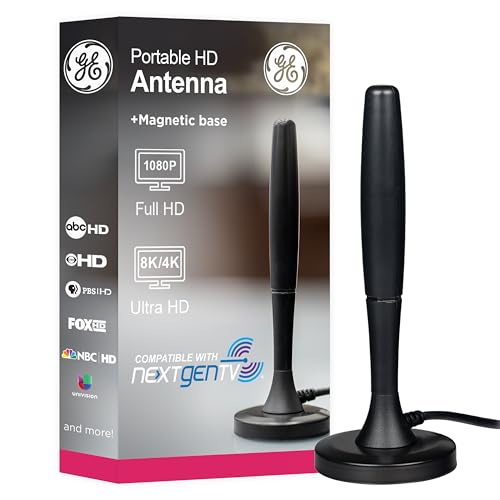
The GE Portable HD TV Antenna, model 81843, is an indoor digital antenna for 1080p, 4K and 8K signals, with VHF and UHF channels, a magnetic base and a compact travel design for RV, camping and tailgating. It is the most portable pick in this guide, built to move with you rather than to live on a wall.
The GE Portable antenna's magnetic base sticks to a car roof as well as a fridge, so you can mount it high outside an RV for a better signal, and the compact size means it fits in a glove box. The GE Portable antenna's compact size means it fits in a backpack alongside a small TV or a laptop, and the magnetic base sticks to a car roof, a fridge or a metal shelf, so you can place it high and out of the way in seconds. For an RV owner, that combination of portability and easy placement is exactly what a travel antenna needs to be. The GE Portable antenna's magnetic base sticks to a car roof or a fridge, so you can place it high and out of the way in seconds, and the compact size means it packs into a bag without a second thought for RV trips and camping.
For RV use, place the GE Portable antenna as high as possible and away from metal roofs that block signals, and re-scan for channels at each new site, since the available stations change with location. For RV use, the GE Portable antenna should be placed as high as possible and away from metal roofs that block signals, and you should re-scan for channels at each new site, since the available stations change with location. A quick scan on arrival takes two minutes and saves an evening of frustration.
Key specs: GE Portable HD TV Antenna, model 81843; indoor digital antenna for 1080p, 4K and 8K; VHF and UHF channels; magnetic base; compact travel design for RV, camping and tailgating; black.
Strengths:
- Magnetic base sticks to metal surfaces for quick, high placement
- Compact travel design packs easily for RV and camping
- Handles 1080p, 4K and 8K signals on VHF and UHF
Trade-offs:
- No range figure stated on the listing, so range is unproven
- Indoor design, so it is not built for permanent outdoor mounting
- Magnetic base needs a metal surface to work best
This antenna fits RV owners, campers and tailgaters who want a small antenna that sets up in seconds and packs away just as fast.
Best for: RV, camping and tailgating trips.
Not suited for: permanent home installation, or areas far from broadcast towers.
Check price on Amazon: GE Portable HD Antenna

RCA Amplified Indoor Flat HDTV Antenna
The RCA Amplified Indoor Flat HDTV Antenna, model ANT1360E, is a multi-directional flat antenna with VHF and UHF reception, 4K and 8K support, 1080p compatibility and a 40-mile range, with an amplifier built in to strengthen weak signals. It is the amplified flat pick in this guide, designed to sit on a wall or a window and pull in channels from up to 40 miles away.
The RCA ANT1360E's flat design can be painted to match a wall, so it disappears into a living room, and the amplifier's power adapter is small enough to hide behind the TV. The RCA ANT1360E's amplifier is powered by a small adapter that plugs into a wall socket, and the flat panel can be mounted on a wall or a window with adhesive strips, so installation takes minutes and leaves no holes. The multi-directional design means you do not need to aim it at the tower, which removes the most fiddly part of setting up an antenna. The RCA ANT1360E's amplifier boosts weak signals from distant towers, and the multi-directional flat design means you do not need to aim it precisely, which removes the fiddliest part of setting up an antenna.
The RCA antenna's amplifier can be switched off if your signals are strong, which avoids overloading the tuner, and that flexibility makes it useful in both weak and strong signal areas. The RCA antenna's amplifier can be switched off if your signals are strong, which avoids overloading the tuner and causing pixelation, and that flexibility makes it useful in both weak and strong signal areas. If the picture breaks up with the amplifier on, try it off before blaming the antenna.
Key specs: RCA Amplified Indoor Flat HDTV Antenna, model ANT1360E; multi-directional VHF and UHF reception; 4K, 8K and 1080p; 40-mile range; amplified.
Strengths:
- Built-in amplifier boosts weak signals up to 40 miles
- Multi-directional design needs no precise aiming
- Flat shape hides on a wall or window
Trade-offs:
- Needs power for the amplifier, so it is less portable
- 40-mile range is modest for rural areas
- Flat antennas can struggle with VHF channels in some areas
This antenna fits suburban homes within 40 miles of broadcast towers, where a discreet flat antenna with an amplifier pulls in channels cleanly.
Best for: suburban homes that need an amplified flat antenna.
Not suited for: rural areas far from towers, or off-grid use without power.
Check price on Amazon: RCA ANT1360E

Philips Rabbit Ears Black Indoor TV Antenna
The Philips Rabbit Ears indoor TV antenna, model SDV8201B/27, is a classic dipole and circular loop tabletop antenna for digital and smart TVs, with 4K and 1080p support on VHF and UHF and a 5-foot coaxial cable. It is the traditional pick in this guide, and the one that handles VHF channels best.
The Philips rabbit ears' dipoles extend to 15 inches or more, which helps with VHF channels that flat antennas struggle with, and the loop can be rotated to find the best angle for UHF. The Philips rabbit ears' extendable dipoles adjust from short to long, which lets you tune them for the VHF channels in your area, and the circular loop rotates independently for UHF, so each band can be optimized separately. That adjustability is why rabbit ears still work well decades after they were invented. The Philips rabbit ears' dipole and loop design catches VHF and UHF channels well, and the 5-foot cable gives room to place the antenna where the signal is strongest, near a window or on a high shelf.
The Philips antenna works best near a window, since glass blocks less signal than a wall, and the 5-foot cable gives enough slack to reach a windowsill from most TV stands. The Philips antenna works best near a window, since glass blocks less signal than a wall, and the 5-foot cable gives enough slack to reach a windowsill from most TV stands. If a channel is missing, try rotating the loop and adjusting the dipoles before moving the whole antenna.
Key specs: Philips Rabbit Ears indoor TV antenna, model SDV8201B/27; dipole and circular loop; tabletop antenna; digital and smart TV compatible; 4K and 1080p, VHF and UHF; 5-foot coaxial cable; black.
Strengths:
- Dipole and loop design catches VHF and UHF well
- No power needed and no mounting required
- 5-foot cable allows placement where the signal is strongest
Trade-offs:
- Tabletop design takes up space and looks old-fashioned
- Needs manual adjustment when you change channels
- No amplifier, so it suits strong-signal areas best
This antenna fits buyers in strong-signal areas who want a simple, no-power antenna that handles VHF well, and who do not mind adjusting the ears now and then.
Best for: strong-signal areas and VHF-heavy channel lists.
Not suited for: weak-signal areas, or buyers who want a hidden antenna.
Check price on Amazon: Philips Rabbit Ears SDV8201B
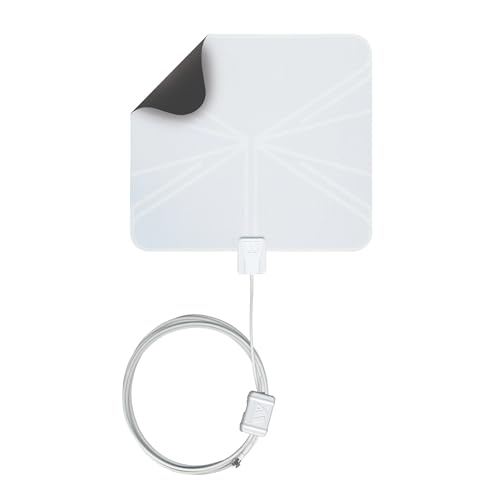
Winegard FlatWave FL5500A Amplified Indoor TV Antenna
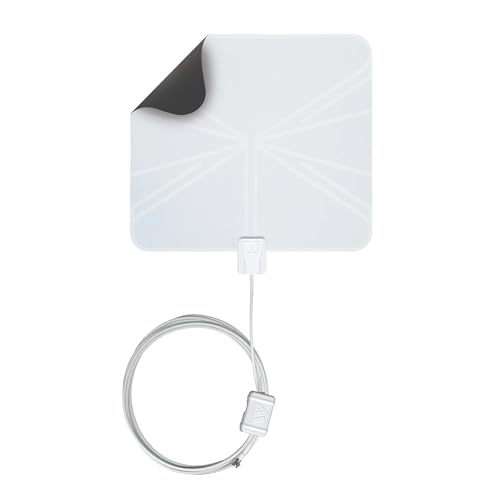
The Winegard FlatWave FL5500A is an amplified multidirectional indoor TV antenna with a 60-mile range, an ultra-thin dual-color design, indoor rating for metro and suburban areas, and 4K Ultra-HD and NextGen TV support. It is the longest-range indoor pick in this guide, built for homes that sit far from broadcast towers.
The FlatWave FL5500A's dual-color design means one side is black and the other white, so you can face the side that matches your wall, and the ultra-thin panel can sit behind a picture frame. The FlatWave FL5500A's amplifier is built into the panel, so there is no separate box to hide, and the ultra-thin design means it can be painted to match the wall or placed behind a picture frame. The 60-mile range is the longest indoor range in this guide, and it is achieved through the combination of the amplifier and the large panel area. The FlatWave FL5500A's 60-mile range is the longest indoor range in this guide, and its ultra-thin panel can be painted or placed behind a picture to disappear into the room, with NextGen TV support for the future.
The Winegard FL5500A supports NextGen TV, which is the newest broadcast standard, so it will keep working as local stations upgrade their broadcasts over the coming years. The Winegard FL5500A's NextGen TV support means it is ready for the newest broadcast standard, which offers 4K video and better sound, and local stations are upgrading to it over the coming years. Buying a NextGen-ready antenna now means you will not need to replace it when your local stations switch.
Key specs: Winegard FlatWave FL5500A; amplified multidirectional indoor TV antenna; 60-mile range; ultra-thin, dual-color; indoor rated, metro and suburban areas; 4K Ultra-HD, NextGen TV.
Strengths:
- Longest indoor range in this guide at 60 miles
- Amplified multidirectional design needs no aiming
- Ultra-thin panel hides easily and supports NextGen TV
Trade-offs:
- Needs power for the amplifier
- Indoor rated, so it is not for permanent outdoor use
- Premium price for the longest range
This antenna fits suburban and metro homes that sit far from towers, or homes with weak signals that need an amplifier to get a clean picture.
Best for: homes far from towers that need maximum indoor range.
Not suited for: off-grid use, or buyers in strong-signal areas who do not need amplification.
Check price on Amazon: Winegard FlatWave FL5500A
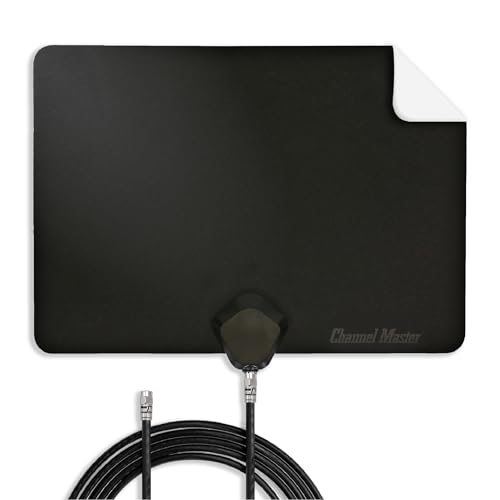
Channel Master FLATenna Indoor Digital HDTV Antenna
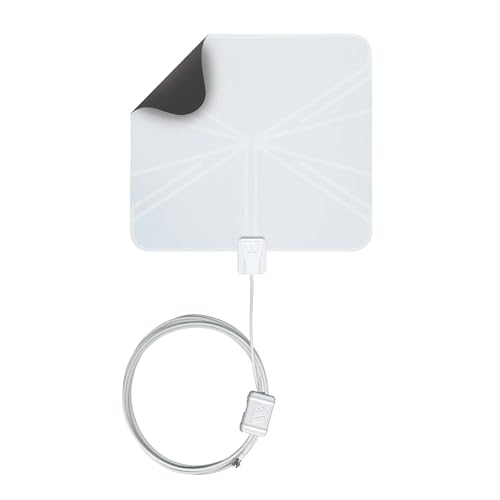
The Channel Master FLATenna is an indoor digital HDTV antenna with a 12-foot coaxial cable, superior reception range and signal reliability, support for 4K smart TVs, over-the-air broadcast and NextGen TV, and easy installation. It is the simple flat pick in this guide, with a long cable that gives you freedom to place it where the signal is best.
The FLATenna's flat panel is light enough to hang with adhesive strips, so no drilling is needed, and the 12-foot cable reaches a window even when the TV is on the opposite wall. The FLATenna's 12-foot cable is the longest in this guide, and it gives real freedom: the antenna can sit on a window across the room from the TV, where the signal is strongest, without moving the television. The flat panel is light enough to hang with adhesive strips, so no drilling is needed, and it can be moved easily if you rearrange the room. The FLATenna's 12-foot cable is the longest in this guide, letting you place the antenna on a window far from the TV, and its passive design needs no power, so it works anywhere, including during a power cut.
The Channel Master FLATenna's reputation comes from its consistent performance: it is not the longest-range antenna, but it pulls in channels reliably in the areas it covers, which is what most buyers need. The Channel Master FLATenna's reputation comes from consistent performance rather than headline range: it pulls in channels reliably in the areas it covers, and its build quality means it lasts for years without degrading. For a cord-cutter who wants a set-and-forget antenna, that reliability is the point.
Key specs: Channel Master FLATenna; indoor digital HDTV antenna; 12-foot coaxial cable; superior reception range and signal reliability; supports 4K smart TVs, OTA broadcast and NextGen TV; easy install.
Strengths:
- Long 12-foot cable allows placement where the signal is strongest
- No power needed, so it works anywhere
- NextGen TV ready with a reputation for reliability
Trade-offs:
- No amplifier, so it suits moderate-signal areas best
- Flat design can struggle with some VHF channels
- No range figure stated on the listing
This antenna fits cord-cutters who want a simple, reliable flat antenna with the cable length to place it well, and who live within a moderate distance of broadcast towers.
Best for: cord-cutters who want a simple flat antenna with a long cable.
Not suited for: very weak-signal areas, or buyers who need an amplifier.
Check price on Amazon: Channel Master FLATenna
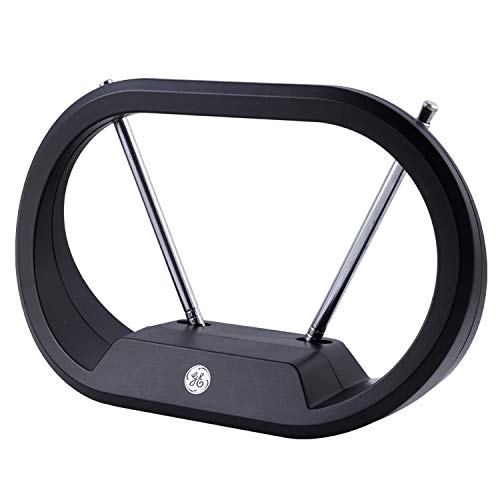
GE Modern Loop Rabbit Ears Indoor TV Antenna
The GE Modern Loop Rabbit Ears indoor TV antenna, model 33675, has 15-inch extendable dipoles, 4K and 1080p support on VHF and UHF, a tabletop design and a 4-foot coaxial cable, in black. It is the modern-looking rabbit-ears pick in this guide, with a loop design that suits a living room better than a classic antenna.
The GE Modern Loop's loop design is a modern take on rabbit ears, and its 15-inch dipoles give it the VHF performance that flat antennas lack, while still looking tidy on a stand. The GE Modern Loop's 15-inch dipoles extend further than most rabbit ears, which helps with VHF channels that flat antennas struggle with, and the loop design handles UHF cleanly. The modern styling means it looks at home on a TV stand rather than hidden behind it, which matters in a living room where the antenna is visible. The GE Modern Loop's 15-inch extendable dipoles catch VHF channels that flat antennas miss, while the loop handles UHF, and the modern styling looks tidy on a TV stand rather than hidden away.
The GE Modern Loop's tabletop design means it can be moved easily when you rearrange the room, and its modern styling suits a living room better than a classic rabbit-ears antenna. The GE Modern Loop's tabletop design means it can be moved easily when you rearrange the room, and its 4-foot cable gives enough slack to place it on a shelf or a windowsill. Like all passive antennas it needs no power, so it works during a power cut if your TV has a battery or a generator.
Key specs: GE Modern Loop Rabbit Ears indoor TV antenna, model 33675; 15-inch extendable dipoles; 4K and 1080p, VHF and UHF; tabletop antenna; digital HDTV antenna; smart TV compatible; 4-foot coaxial cable; black.
Strengths:
- 15-inch dipoles catch VHF well, loop handles UHF
- Modern styling suits a living-room TV stand
- No power needed, with a 4-foot cable for placement
Trade-offs:
- Tabletop design takes up space
- Needs occasional adjustment for different channels
- No amplifier for weak signals
This antenna fits living-room buyers who want a rabbit-ears antenna that looks modern, handles VHF well and needs no power or mounting.
Best for: living rooms that need a good-looking VHF-capable antenna.
Not suited for: weak-signal areas, or buyers who want a hidden flat antenna.
Check price on Amazon: GE Modern Loop 33675
Best portable TV antennas for digital TV: what matters most
Range is a claim, not a guarantee: makers state range in ideal conditions, and hills, buildings and trees cut it. Check your distance to the nearest broadcast tower before trusting a range figure.
VHF versus UHF: local stations broadcast on both bands, and rabbit ears and dipoles catch VHF better while flat panels and loops favor UHF. An antenna that handles both is essential.
Amplified or passive: amplification helps weak signals and long cable runs, but it can overload a strong signal and cause pixelation. If you live close to towers, a passive antenna is often cleaner.
Indoor or outdoor: indoor antennas suit flats and homes with good signals, while outdoor antennas suit rural areas and weak signals. A portable indoor antenna can also be used outdoors temporarily, but it is not weatherproof.
Height matters more than power: an antenna placed high and near a window will outperform a more powerful antenna placed low and behind the TV, so always try the highest, clearest spot first.
Buying guide: choosing portable TV antennas for digital TV
Check your channels first: free online tools show which stations broadcast near you, on which band and how far away. Buy the antenna that covers your weakest needed station, not the one with the biggest number on the box.
Think about placement before you buy: a window-facing wall, a high shelf or a magnetic base on a metal surface all beat a spot behind the TV. The cable length matters — the Channel Master FLATenna's 12-foot cable is a real advantage.
Match the antenna to the use: a portable magnetic antenna for the RV, an amplified flat panel for a suburban home far from towers, and rabbit ears for a strong-signal room where VHF matters.
Check whether your TV has a built-in tuner: most modern TVs do, but some displays and monitors do not, and they need a separate tuner box to use an antenna at all.
Check the return policy before you buy: antenna performance depends on your location, so a retailer with a good return policy lets you test the antenna at home and swap it if it does not pull in your channels.
Using and caring for your portable TV antennas for digital TV
Keep the antenna away from metal objects and electronics that cause interference, and re-scan for channels after moving it, since a small move can change which stations come in clearly.
Dust the antenna occasionally and check the coaxial connection for corrosion, especially in an RV or a damp room, since a loose or corroded connector is the most common cause of a suddenly weak signal.
Keep the coaxial cable free of kinks and tight bends, since a damaged cable loses signal, and replace the cable if the picture degrades suddenly after moving the antenna.
Check the coaxial cable annually for wear, especially in an RV where it is moved often, since a kinked or corroded cable loses signal gradually and is easy to overlook as the cause of a weak picture.
Common mistakes to avoid
Buying on range alone: a 60-mile antenna in a valley will underperform a 40-mile antenna on a hill. Terrain and tower direction matter more than the number on the box.
Skipping the channel scan: a TV needs to scan for channels after you connect an antenna, and again after you move it. Many 'broken' antennas are simply TVs that were never re-scanned.
Placing the antenna behind the TV: the TV itself blocks and reflects signals, so the antenna should be beside, above or away from the set, ideally near a window or on a high shelf.
Aiming an indoor antenna like an outdoor one: indoor antennas are often multi-directional and work best when placed high and clear, not when pointed precisely at a tower. Try several positions and re-scan each time.
Budget and value
Expect to pay least for a simple passive antenna such as the Philips rabbit ears or the GE Modern Loop, more for a flat panel with a long cable, and most for an amplified long-range antenna such as the Winegard FlatWave FL5500A. For most homes, a mid-range flat or rabbit-ears antenna is enough.
If the budget is tight, start with a passive antenna and test it: if it pulls in your channels cleanly, you have saved the cost of an amplifier, and if it does not, you will know the amplifier is worth paying for.
Start with a passive antenna and test it before buying an amplified one: if the passive antenna works, you have saved money, and if it does not, you will know exactly what the amplifier needs to fix.
A signal meter app on your phone can help you find the best antenna position without guesswork, and it costs nothing. Use it to compare positions before fixing the antenna in place.
Portable TV antennas for digital TV: RV, camping and home use
For an RV or a campsite, the GE Portable HD antenna is the pick: its magnetic base sticks to the vehicle, its compact size packs away, and it needs no power. For a tailgate, the same portability applies, with the added benefit that it sets up in seconds.
For home use, choose by distance: rabbit ears or a flat panel for strong signals, an amplified antenna such as the RCA ANT1360E or the Winegard FL5500A for weak ones. And remember that a portable antenna can also serve as a backup at home when the cable goes out.
Portable TV antennas: cutting the cord
Cutting the cord with an antenna means free local channels — news, sport and network shows — without a monthly bill, and the savings add up quickly: a one-time antenna purchase can pay for itself in a month or two of cancelled cable.
Pair the antenna with a streaming service for the shows it does not cover, and a DVR for recording: the antenna handles live local TV, the streamer handles on-demand shows, and together they cover most viewing for far less than cable.
Portable TV antennas: what channels can you get
The channels you receive depend on your distance from broadcast towers, the terrain between you and them, and the height of your antenna. In a city you may receive dozens of free channels, including major networks, local news and classic TV, while in a rural area you may receive only a handful.
Free online coverage tools show which stations broadcast near your address, on which band and how strong the signal is, so check them before buying. They will tell you whether you need an amplified antenna or whether a simple passive one will do.
Final recommendation
If you travel, the GE Portable HD antenna is the pick for its magnetic base and compact size. If you live in a suburban home, the RCA ANT1360E or the Winegard FlatWave FL5500A will pull in distant channels, with the Winegard winning on range. And if your signals are strong, the Philips rabbit ears or the GE Modern Loop will do the job simply and cheaply, with the Channel Master FLATenna as the discreet flat alternative.
Whichever you choose, check your local channels and tower distance first, place the antenna high and near a window, and re-scan your TV — those three steps decide whether the antenna works on the first try.
Test before you commit to a spot: move the antenna, re-scan, and note which position pulls in the most channels, then fix it there. A good antenna in the wrong spot is a bad antenna.
Buy the antenna for your weakest needed station, place it high and near a window, and re-scan after every move. Those three steps decide whether the antenna works.
Frequently asked questions
Do I need an amplified antenna?
Only if your signals are weak or your towers are distant: amplification boosts weak signals but can overload strong ones. If you live close to towers, a passive antenna is often cleaner.
What is the difference between VHF and UHF?
They are two broadcast bands: VHF carries some local stations and is best caught by dipoles and rabbit ears, while UHF carries most digital stations and suits flat panels and loops. A good antenna handles both.
How far can a portable TV antenna reach?
Indoor antennas in this guide claim 40 to 60 miles in ideal conditions, but hills, buildings and trees reduce real range. Check your tower distance before buying.
Can I use a TV antenna in an RV?
Yes — the GE Portable HD antenna in this guide is built for RV, camping and tailgating, with a magnetic base and a compact design that packs easily.
Why does my antenna get some channels but not others?
Different stations broadcast on different bands and from different towers, so an antenna that favors UHF may miss a VHF station. Repositioning the antenna and re-scanning often fixes it.
What is NextGen TV?
It is the newest over-the-air broadcast standard, offering 4K video and better sound. Antennas such as the Winegard FlatWave and the Channel Master FLATenna support it, so they are ready as stations upgrade.
How many channels can I get with an antenna?
It depends on your location: cities can offer dozens of free channels, while rural areas may offer only a handful. Check a coverage tool for your address before buying.
Do I need internet for a TV antenna?
No — an antenna receives free over-the-air broadcasts with no internet needed. Internet is only needed for the streaming apps on a smart TV.
Can I split one antenna to two TVs?
Yes, with a splitter, though each split halves the signal, so an amplified antenna or a distribution amplifier helps when feeding more than one TV from a single antenna.
Why do some channels break up in bad weather?
Heavy rain and storms can weaken broadcast signals, especially for distant stations. A higher antenna placement and an amplifier help, but some breakup in severe weather is normal.
Can I use an indoor antenna in an attic?
Yes — an attic is often a good spot, since it is high and clear of obstructions, though heat in summer can affect the antenna and the cable, so check the temperature rating if the attic gets very hot.
How do I find the best spot for my antenna?
Place it high and near a window, run a channel scan, then try a different spot and scan again. Note which position pulls in the most channels, and fix the antenna there.
Can I use an outdoor antenna indoors?
Yes, though it is larger and needs a mount. An outdoor antenna indoors can work well in a loft or attic, where its height gives it an advantage over a small indoor panel.
Do I need a different antenna for 4K channels?
No — any digital TV antenna that handles UHF and VHF will receive 4K broadcasts, since the antenna carries the signal and the TV decodes it. The picks in this guide all support 4K signals.