The best antennas for flat screen TV turn a modern television into a free source of local channels, with no monthly bill attached. A flat-screen TV already has a digital tuner built in, so the only missing piece is an antenna that can pull in the broadcast signals around you. This guide rounds up six antennas that do that job well, from a discreet indoor flat panel to a heavy-duty outdoor Yagi.
Over-the-air television has quietly become good again. Local stations now broadcast in high definition, and many carry extra subchannels with movies, classic shows and sports. A good antenna delivers those channels in full broadcast quality, which often looks better than the same channel streamed over the internet, because the signal is not compressed as heavily.
Choosing an antenna is mostly about distance and obstacles. A viewer a few miles from the broadcast towers can get away with a small indoor antenna, while a viewer in a rural area or behind hills needs a larger outdoor model with more gain. The picks below cover the whole range, so there is an option for apartments, suburbs and countryside alike.
Use the comparison table to narrow the field quickly, then read the full section for any antenna that fits your situation. Every pick links to the exact model listed, and the buying guide explains how to check which channels reach your address before you order.
One note before you start: no antenna can create channels that do not reach your home. A quick check of a broadcast coverage map for your address will tell you which stations are realistic, and the buying guide at the end of this article explains how to do that check in a few minutes.
The six antennas below are ordered from the most flexible all-rounder to the most specialised, but the right order for you depends on your address. A city viewer should start at the indoor end of the list, while a rural viewer should start at the outdoor end. The comparison table makes it easy to jump to the models that match your distance.
In this guide
Quick picks: best antennas for flat screen tv
| # | Product | Where to buy |
|---|---|---|
| 1 | Antennas Direct ClearStream 4 | Check on Amazon |
| 2 | Televes DAT BOSS Mix LR 148383 | Check on Amazon |
| 3 | Winegard HD8200U Platinum | Check on Amazon |
| 4 | Five Star Outdoor Antenna | Check on Amazon |
| 5 | Channel Master FLATenna | Check on Amazon |
| 6 | ClearStream 4V | Check on Amazon |
How the picks were chosen
Every antenna in this roundup had to clear the same bar. First, the listing had to describe a genuine TV antenna with the brand and model spelled out in full. Amplifiers, mounts, cables and other accessories were left out, as were listings that only mentioned an antenna in passing.
Second, the antenna had to be a complete, usable product for a flat-screen TV. That meant a standard coaxial connection, a design suited to indoor or outdoor mounting as stated, and a range figure that matched its size and type. An antenna that looked impressive but lacked the gain to match its claims would not earn a place here.
Third, the picks had to cover real living situations. The list runs from a flat indoor antenna for apartments to a heavy-duty outdoor Yagi for rural homes, so a buyer in a city flat and a buyer on a farm both have options, and a buyer in the suburbs has several.
Fourth, variety mattered. The six antennas come from five different brands and span indoor, attic and roof mounting, amplified and non-amplified designs, and directional and multi-directional reception. If one pick does not suit your home, another one probably will.
Finally, each antenna had to offer something distinct. There is no point comparing six near-identical indoor panels, so the list includes a motorised rotating antenna, a flat indoor antenna, a long-range outdoor Yagi and a full-band amplified model. The differences between them are the point of the roundup.
Build quality was weighed alongside reception. An outdoor antenna lives on a roof through wind, rain and summer heat, so flimsy elements and weak brackets were treated as real faults, not cosmetic ones. The outdoor picks here all come from manufacturers with a long record of antennas that survive years of weather.
Quick comparison
| Product | Standout feature | Best for |
|---|---|---|
| Antennas Direct ClearStream 4 | 70+ mile range, indoor or outdoor use | Suburban homes that want flexibility |
| Televes DAT BOSS Mix LR 148383 | Full-band amplified long-range reception | Rural and fringe-area homes |
| Winegard HD8200U Platinum | 65+ mile heavy-duty outdoor Yagi | Homes 40 to 65 miles from towers |
| Five Star Outdoor Antenna | Motorised 360-degree rotation, long range | Homes with towers in many directions |
| Channel Master FLATenna | Flat indoor antenna with 12-foot cable | Apartments close to the towers |
| ClearStream 4V | Extreme-range indoor-outdoor antenna | Edge-of-coverage homes |

Antennas Direct ClearStream 4 (70+ Mile Range, Indoor/Outdoor)
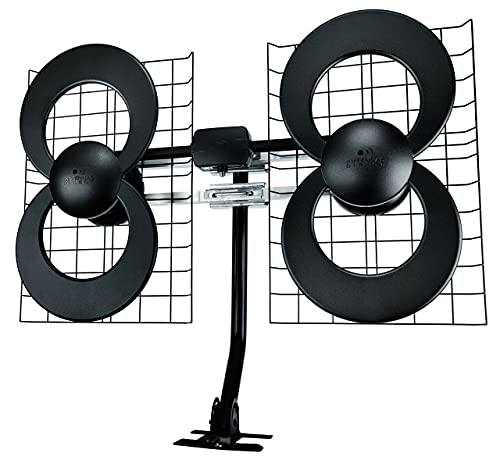
The ClearStream 4 is the most versatile antenna in this roundup. It is a UHF indoor-outdoor model with a stated range of more than 70 miles, multi-directional reception, and support for 4K, 8K and NEXTGEN TV broadcasts. It works mounted on a wall indoors, in an attic, or outside on a mast, which makes it the easiest recommendation for buyers who are not sure which mounting option suits their home.
Key specifications: UHF reception; indoor/outdoor use; multi-directional; 70+ mile range; 4K, 8K UHD and NEXTGEN TV support.
The ClearStream 4 suits suburban homes within 70 miles of the broadcast towers. Its multi-directional design picks up signals from several directions at once, which helps in areas where stations broadcast from different towers. Mount it high, point it toward the strongest cluster of towers, and run a channel scan on the TV to see what it finds.
Choose a mounting spot as high as practical, indoors or outdoors, and attach the antenna to a wall, mast or attic joist. Connect the coaxial cable to the antenna input on the TV, then run a channel scan from the TV menu. If some channels are missing, try a different height or angle before buying anything else.
Strengths
- Works indoors, in an attic or outdoors, so one model covers most homes.
- Multi-directional reception handles towers in different directions.
- 70+ mile range with 4K, 8K and NEXTGEN TV support.
Trade-offs
- UHF-focused design may miss some low-VHF stations in certain areas.
- Larger than a flat indoor antenna, so it needs a real mounting spot.
- No built-in amplifier, so very weak signals may need a separate preamp.
This antenna fits suburban buyers who want one flexible model that works in several mounting positions. It suits homeowners who would rather mount once and be done, and it works well as a first outdoor antenna for anyone new to over-the-air TV.
Best for: Suburban homes that want a flexible indoor-outdoor antenna with strong range. / Not suited for: Rural homes far from towers or areas where low-VHF channels matter most.
Check price on Amazon: Antennas Direct ClearStream 4

Televes DAT BOSS Mix LR 148383 (Full-Band, Long-Range, Amplified)
The Televes DAT BOSS Mix LR 148383 is the most technically advanced antenna in this guide. It is a full-band HDTV antenna covering low VHF, high VHF and UHF, built for long-range reception and fitted with a TForce BOSS amplifier that adjusts its own gain. It is aimed at viewers who are far from the towers or who struggle with weak, inconsistent signals.
Key specifications: Model 148383; full-band reception: low VHF, high VHF and UHF; long-range design; built-in TForce BOSS amplifier.
The DAT BOSS Mix LR suits rural and fringe-area homes where signals arrive weak and from one main direction. The built-in amplifier boosts the signal without the noise that a cheap separate amplifier can add, and the full-band design means low-VHF stations are not left behind. Mounted outdoors on a mast, it is the strongest performer in this roundup for difficult locations.
Mount the antenna outdoors on a mast as high as practical, pointing toward the broadcast towers. Connect the coaxial cable and power the amplifier through its power supply unit, then run a channel scan. Take time over aiming: a few degrees can make the difference between a stable channel and a broken one.
Strengths
- Full-band coverage includes low VHF, high VHF and UHF stations.
- Built-in TForce amplifier boosts weak signals cleanly.
- Long-range design suits rural and fringe reception areas.
Trade-offs
- A large outdoor antenna that needs a mast and careful aiming.
- Amplified design can overload if you live very close to the towers.
- Installation is more involved than a flat indoor antenna.
This antenna fits rural buyers and anyone in a fringe area who has tried a smaller antenna without success. It suits homeowners comfortable with a roof or mast installation, and it works well as the final step when indoor antennas have failed.
Best for: Rural and fringe-area homes that need long-range, full-band reception. / Not suited for: City apartments or homes very close to the broadcast towers.
Check price on Amazon: Televes DAT BOSS Mix LR 148383

Winegard HD8200U Platinum (Heavy-Duty Outdoor Yagi, 65+ Mile Range)
The Winegard HD8200U Platinum is a classic heavy-duty outdoor Yagi, built for viewers who need serious range and are willing to mount a large antenna to get it. Its stated range is more than 65 miles, and its directional design concentrates reception in one direction for maximum gain. It is the workhorse pick in this guide: big, sturdy and proven over many years.
Key specifications: Heavy-duty outdoor Yagi design; 65+ mile range; directional; non-amplified; weather-resistant build.
The HD8200U suits homes 40 to 65 miles from the towers, especially where the stations broadcast from roughly the same direction. Its large elements pull in weak signals that smaller antennas miss, and its sturdy construction stands up to wind and weather year after year. Because it is directional, it rewards careful aiming with a stable, clean picture.
Mount the antenna on a roof mast or tower, pointing toward the broadcast cluster, and run the coaxial cable to the TV. Use a compass and a coverage map to aim it, then run a channel scan and fine-tune the direction in small steps. Ground the mast properly, and check local rules about outdoor antennas before installing.
Strengths
- Proven heavy-duty Yagi design with strong long-range gain.
- 65+ mile range suits homes well outside the city.
- Sturdy, weather-resistant build made for permanent outdoor use.
Trade-offs
- Directional design needs careful aiming and suits one tower cluster.
- Large and visible, so it is not for every home or neighbourhood.
- Non-amplified, so very weak signals may need a separate preamp.
This antenna fits rural and suburban homeowners who want a permanent, high-gain outdoor installation. It suits buyers who have the roof space and the patience to aim it properly, and it works well as a long-term solution rather than a quick experiment.
Best for: Homes 40 to 65 miles from the towers that want a proven outdoor Yagi. / Not suited for: Apartments, renters, or homes where towers sit in many directions.
Check price on Amazon: Winegard HD8200U Platinum
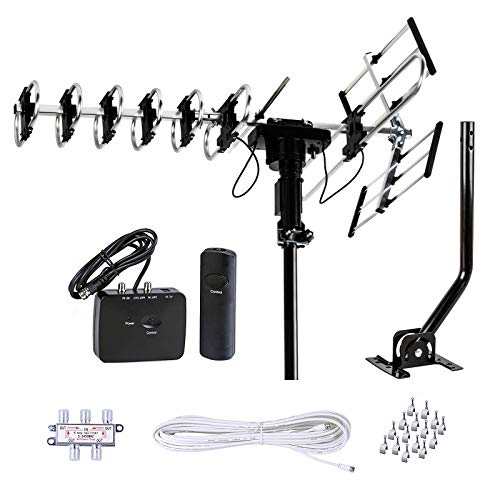
Five Star Outdoor Antenna (200-Mile Range, Motorised 360-Degree Rotation)
The Five Star outdoor antenna is the most flexible outdoor pick in this guide, thanks to its motorised 360-degree rotation. With a stated range of up to 200 miles, UHF and VHF reception, FM radio, and an infrared remote control for the rotator, it lets you aim the antenna from the sofa instead of climbing onto the roof. It is the pick for homes where stations broadcast from several directions.
Key specifications: Up to 200-mile range; motorised 360-degree rotation; UHF, VHF and FM reception; infrared remote control included.
The Five Star suits homes where broadcast towers sit in different directions, or where the best aim changes with the weather. Point it at one cluster for the evening news, then rotate it toward another cluster for a different set of channels, all without leaving the room. The long stated range also makes it worth considering for deep rural locations, though real-world results depend on terrain.
Mount the antenna outdoors on a mast, connect the coaxial cable and the rotator control cable, and place the remote receiver near the TV. Run a channel scan with the antenna in one position, then rotate and scan again to find the best aim for each group of channels. Note the best positions for future use.
Strengths
- Motorised rotation lets you aim at different tower clusters remotely.
- Long stated range with UHF, VHF and FM reception.
- Remote control makes fine-tuning easy without climbing up.
Trade-offs
- Stated 200-mile range depends heavily on terrain and conditions.
- Moving parts add a point of failure compared with a fixed antenna.
- Installation is more complex than a fixed indoor model.
This antenna fits homes with towers in several directions, and rural buyers who want to experiment with aiming. It suits viewers who enjoy fine-tuning their setup, and it works well where a fixed antenna forces a compromise between channel groups.
Best for: Homes with towers in different directions that want remote aiming. / Not suited for: Buyers who want a simple set-and-forget antenna with no moving parts.
Check price on Amazon: Five Star Outdoor Antenna
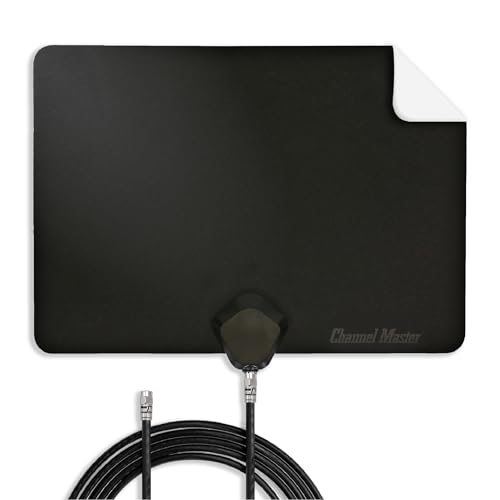
Channel Master FLATenna (Indoor Digital HDTV Antenna)
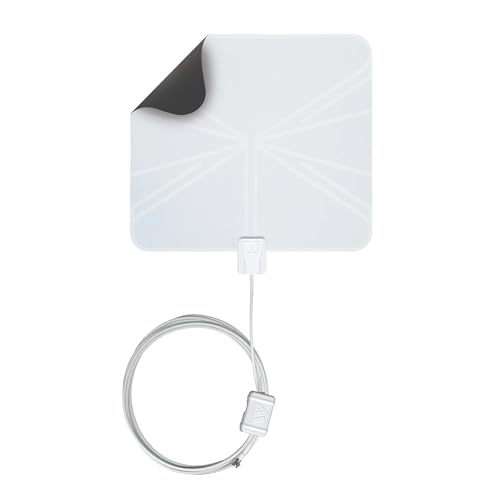
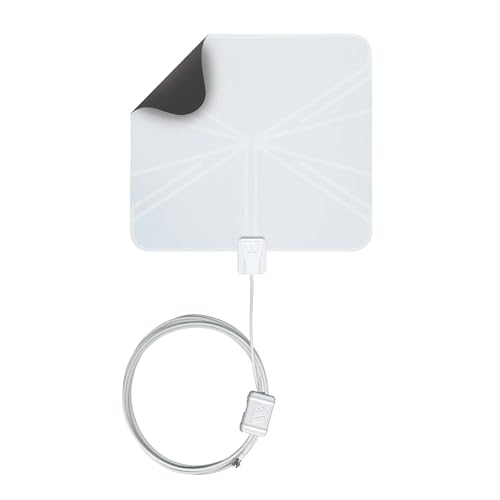
The Channel Master FLATenna is the simplest antenna in this guide, and sometimes simple is exactly right. It is a flat indoor digital HDTV antenna that comes with a 12-foot coaxial cable, designed to stick to a wall or window near the TV. For viewers close to the towers, it is all the antenna they will ever need, and it disappears into the room when installed.
Key specifications: Indoor digital HDTV antenna; flat design; 12-foot coaxial cable included.
The FLATenna suits apartments and city homes within a few miles of the broadcast towers. Hang it on a wall or window facing the towers, plug it into the TV, and scan for channels. It is ideal for renters, for second TVs in bedrooms, and for anyone who wants free local channels without drilling holes or climbing onto a roof.
Stick or hang the antenna on a wall or window as high as practical, facing the broadcast towers. Connect the included 12-foot cable to the TV, then run a channel scan. If reception is poor, try a different wall or a window, since even a few feet can change the result indoors.
Strengths
- Discreet flat design that suits apartments and renters.
- Simple setup with a 12-foot cable included in the box.
- No outdoor mounting, drilling or aiming hardware needed.
Trade-offs
- Short range suits only homes close to the towers.
- Indoor placement is sensitive to walls, metal and interference.
- No amplifier, so weak signals will not improve.
The FLATenna fits city and suburban viewers who live near the towers and want the simplest possible setup. It suits renters, bedrooms and kitchens, and it works well as a first antenna to test what over-the-air TV offers in your area.
Best for: Apartments and city homes close to the towers that want a discreet indoor antenna. / Not suited for: Rural homes or anyone more than a few miles from the towers.
Check price on Amazon: Channel Master FLATenna

ClearStream 4V (Extreme Range, Indoor/Outdoor HDTV Antenna)
The ClearStream 4V is the long-range sibling of the ClearStream 4, built for viewers who need more reach. It is an extreme-range indoor-outdoor HDTV antenna from Antennas Direct, designed to pull in distant stations while still working in an attic or on a wall. If the ClearStream 4 is the flexible all-rounder, the 4V is the step up for homes on the edge of coverage.
Key specifications: Extreme-range design; indoor/outdoor use; HDTV antenna; UHF and VHF reception.
The 4V suits suburban and rural homes at the edge of broadcast coverage, where a standard indoor antenna finds nothing and a full outdoor Yagi feels like overkill. Mount it in an attic or outdoors, aim it toward the towers, and it will often pick up stations that smaller antennas miss. Its indoor-outdoor flexibility means you can start in the attic and move it outside if needed.
Mount the antenna in an attic or outdoors on a mast, as high as practical and facing the towers. Connect the coaxial cable to the TV and run a channel scan. Try the attic first if you prefer a hidden installation, and move outdoors only if the scan misses channels you expect to receive.
Strengths
- Extreme-range design reaches stations smaller antennas miss.
- Works in an attic or outdoors, so installation stays flexible.
- Strong all-round performer for edge-of-coverage homes.
Trade-offs
- Larger than a flat indoor antenna and needs a real mounting spot.
- May still need a preamp for the weakest fringe signals.
- Aiming matters, so take time to find the best direction.
The 4V fits buyers on the edge of coverage who want more reach without a full-size Yagi. It suits suburban and rural homeowners, attic installations, and anyone whose indoor antenna came up short.
Best for: Edge-of-coverage homes that need more range than a basic indoor antenna. / Not suited for: City apartments close to the towers, where a flat antenna is enough.
Check price on Amazon: ClearStream 4V
What matters when choosing a TV antenna
Distance is the first thing to check. Broadcast coverage maps show how far you are from each tower and how strong the signal should be at your address. Under 10 miles, almost any indoor antenna works. From 10 to 40 miles, a good indoor-outdoor model is the right choice. Beyond 40 miles, you need a large outdoor antenna, and beyond 60 miles you need height, gain and patience.
Direction matters as much as distance. If all your local stations broadcast from one tower cluster, a directional antenna aimed at that cluster gives the best result. If stations come from several directions, a multi-directional antenna or a rotator is the better choice. A coverage map shows the bearing to each tower, so you can see the pattern before you buy.
Frequency bands are the detail most buyers miss. Television broadcasts use low VHF, high VHF and UHF frequencies, and an antenna that only covers UHF will miss low-VHF stations entirely. The Televes and Five Star models in this guide cover all three bands, while UHF-focused models suit areas where the local stations broadcast on UHF.
Amplifiers help only in the right situation. A built-in amplifier boosts a weak signal, but it also amplifies noise, and it can overload if you live close to the towers. If your signals are weak because of distance, an amplifier helps. If they are weak because of interference or multipath, an amplifier will not fix the problem, and moving the antenna is the better answer.
Finally, remember that the antenna is only half the system. The coaxial cable, the connections and the TV tuner all affect the result. Keep cable runs short, use good-quality connectors, and run a fresh channel scan whenever you move the antenna. A small change in position can make a large difference in reception.
Multipath interference deserves a mention, because it confuses many buyers. Signals can bounce off buildings and hills and arrive at the antenna twice, slightly out of step, which breaks up the picture even when the signal is strong. A directional antenna aimed carefully at the direct signal usually handles multipath better than a wide, omnidirectional one.
Buying guide: choosing best antennas for flat screen tv
Start with a coverage check. Enter your address into a broadcast coverage tool and note which stations should reach you, how far away they are, and which direction they broadcast from. This single check tells you whether you need an indoor flat antenna or a large outdoor Yagi, and it stops you buying more antenna than you need.
Next, decide where the antenna will live. Renters and apartment dwellers should start indoors, since a flat antenna on a window often works well in the city. Homeowners with roof access should consider an attic or outdoor mount, which is higher, clearer of obstacles, and almost always performs better than any indoor position.
Think about the channels you actually want. Local news, major networks and sports usually come from the main tower cluster, while extra subchannels may come from elsewhere. If the channels you care about most broadcast from one direction, a directional antenna aimed there is the best choice. If they come from several directions, look at a multi-directional model or a rotator.
Check the listing carefully before you buy. Confirm the exact model name and range figure, confirm whether the antenna is amplified, and confirm what is included: cable, mount and power supply are not always in the box. Listings for the same model can differ in what they include, so read the full description rather than the thumbnail.
Finally, plan the installation. A roof mount needs a mast, brackets and a safe way to reach it, plus proper grounding for lightning protection. An attic mount is easier and protects the antenna from weather, but the roof itself blocks some signal. If you are not comfortable on a roof, budget for a professional installer rather than risking a fall.
Think about future channels as well as today's. Broadcasters occasionally add subchannels or move to new frequencies, and an antenna with a little more range and bandwidth than you need today will still work well when the lineup changes. Buying slightly more antenna than the minimum is cheap insurance against a rescan that comes up short.
Using and caring for your best antennas for flat screen tv
Indoor antennas need almost no care. Dust the flat panel occasionally, check the cable connection if channels start breaking up, and re-run a channel scan after any nearby construction or after a station changes frequency. If reception worsens suddenly, check that the antenna has not been moved or covered by new furniture.
Outdoor antennas need a yearly check. Look at the mounting hardware for rust or looseness, check the coaxial cable for cracks or water damage, and make sure the antenna is still pointing the way you aimed it. Wind can shift a mast over time, and a few degrees of drift can cost you a channel.
Protect the cable and connections from water. Use weatherproof connectors outdoors, seal any entry point into the house, and route the cable so water drips away from the connection rather than into it. A corroded connector is the most common cause of a gradual loss of signal.
Keep the amplifier powered if your antenna has one. An unpowered amplifier blocks the signal rather than passing it through, so a dead power supply looks exactly like a dead antenna. If channels vanish overnight, check the amplifier power before assuming the antenna has failed.
After a storm, give the antenna a quick visual check from the ground. Look for bent elements, a tilted mast or a cable hanging loose, and check that channels still scan cleanly. Most storm damage is visible from the ground, and catching a bent element early stops it from stressing the mount further.
Common mistakes to avoid
The most common mistake is buying the biggest antenna for a city apartment. A large amplified outdoor antenna close to the towers can overload the TV tuner and make reception worse, not better. Match the antenna to your distance: small and simple near the towers, large and amplified far from them.
Another frequent error is mounting the antenna low and behind obstacles. An antenna in a basement or behind a metal roof will struggle no matter how good it is. Height and a clear line toward the towers matter more than the brand on the box, so mount as high as practical and keep metal objects out of the way.
Buyers also forget to re-scan for channels. Televisions only find channels when you run a scan, and they will not notice a new station or a changed frequency on their own. Run a fresh scan after installing the antenna, after moving it, and every few months to catch changes.
Finally, many people blame the antenna when the cable is the problem. A long, cheap or damaged coaxial cable loses signal along its length, and a loose connector can cost you every channel at once. Check the cable and connections first when reception drops, before replacing the antenna.
A final common mistake is placing the antenna next to a source of interference. LED lights, chargers and some appliances can radiate noise that weakens reception, especially on VHF. If channels break up only when a particular light or device is on, try moving the antenna or the device, and use a shielded cable for the run to the TV.
Budget and value
At the affordable end, the Channel Master FLATenna gives you free local channels for the least money in this guide. It is the right choice if you live close to the towers and want to try over-the-air TV without committing to an installation.
The middle of the range is where most buyers should look. The ClearStream 4 and ClearStream 4V cover suburban and edge-of-coverage homes with flexible indoor-outdoor mounting, and the Five Star adds motorised aiming for homes with towers in several directions. Most buyers will be happiest here.
At the top, the Televes DAT BOSS Mix LR and the Winegard HD8200U are for rural buyers who need maximum range and are willing to mount a large outdoor antenna properly. Their performance justifies the outlay if you live far from the towers, but they are more antenna than a city home needs.
Whatever your budget, remember that the antenna is a one-time purchase with no monthly cost. Even the most expensive model in this guide pays for itself quickly compared with a streaming subscription, and a well-installed outdoor antenna can last a decade or more with only basic care.
Final recommendation
If one antenna had to win this roundup, the ClearStream 4 takes it for most buyers: flexible indoor-outdoor mounting, a 70+ mile range, and multi-directional reception that handles towers in different directions. It is the easiest recommendation in the group, because it suits the widest range of homes.
Buyers who live far from the towers should look at the Televes DAT BOSS Mix LR for amplified full-band reception, or the Winegard HD8200U for a proven heavy-duty Yagi. Homes with towers in several directions should consider the Five Star with its motorised rotation, edge-of-coverage homes should look at the ClearStream 4V, and city apartments should start with the FLATenna.
Whichever antenna you choose, check your coverage first, mount it as high as practical, and run a fresh channel scan. Do those three things and any of these six antennas will bring free local channels to your flat-screen TV for years.
One last note: buy the antenna for the channels you actually watch, not for the longest range figure on the box. A modest antenna mounted high and aimed well will outperform a large one mounted low and pointed the wrong way. The six models above all earn their places, and any of them will serve you well when installed with care.
Frequently asked questions
Do I need an antenna if my flat-screen TV has a tuner?
Yes, if you want free over-the-air channels. The tuner in your TV can decode broadcast signals, but it needs an antenna to receive them. Without an antenna the tuner has nothing to work with, so even a simple indoor model makes a large difference.
How do I know which channels I can receive?
Enter your address into a broadcast coverage tool to see which stations should reach you, how far away they are, and which direction they broadcast from. The tool will also tell you which frequency band each station uses, which helps you choose between a UHF-only antenna and a full-band model.
Is an amplified antenna always better?
No. An amplifier helps when signals are weak because of distance, but it can overload your tuner if you live close to the towers, and it cannot fix interference or a blocked signal. If you live within a few miles of the towers, a non-amplified antenna usually works better.
Can I use one antenna for several TVs?
Yes, with a splitter, though each split reduces the signal slightly. A distribution amplifier can compensate for the loss if you feed three or more TVs. Keep cable runs short and use good-quality splitters to avoid degrading the picture.
Why do some channels break up while others are fine?
Different channels broadcast from different towers, on different frequencies and at different power levels, so one can be strong while another is weak. Aiming, height and obstacles affect each channel differently. Try adjusting the antenna direction and re-scanning, and check whether the weak channel is on low VHF, which some antennas handle poorly.
Do I need to rescan for channels often?
Run a fresh scan after installing or moving the antenna, and every few months afterwards. Stations occasionally change frequencies or add subchannels, and your TV will not notice until you scan. A rescan takes a few minutes and often recovers channels that seemed to have vanished.
Can an antenna work in an attic?
Yes, an attic antenna often works well, especially if the roof is made of wood or asphalt shingles. Metal roofing, foil insulation and solar panels can block the signal, so an attic installation may perform poorly in those homes. Try the attic first if you prefer a hidden installation, and move the antenna outdoors only if the scan misses channels you expect.
More guides from KajuanDouglas
Best TV Antennas for Rural Areas Best 4K Indoor TV Antennas Best Antennas for Local Channels