kajuandouglas.com is reader-supported. When you buy through links on our site, we may earn an affiliate commission.
Where to Buy
A quick note on the words that brought you here: the best digital video cameras for raing is how this search is often typed, thumbs cold or hurried, but the subject is rain — filming in it, through it, and because of it. Rain is cinema’s oldest special effect and its least cooperative. It soaks microphones, fogs lenses from the inside, turns touchscreens into ouija boards, and sends ordinary cameras into bags at exactly the moment the light turns to silver and the streets begin to shine. This guide is for the filmmakers, anglers, riders, storm watchers, and wedding videographers who have decided the weather will not be the editor of their footage.
The six picks divide by how they meet the water. Two are action cameras sealed at the factory and stabilised for movement; one is a 360-degree camera that drinks in a whole storm at once; one is a genuinely waterproof compact built like expedition equipment; one is a weather-sealed interchangeable-lens body for filmmakers who want real lenses under real clouds; and one is a budget action camera whose low price changes the risk arithmetic of filming near waterfalls, surf, and boat spray. Each of the six linked models was taken from the site’s verified pool, and every verdict is honest about the difference between waterproof, weather-sealed, and merely hopeful — three words the marketing departments blur and this guide will not.
Rain filming also punishes the unprepared in small, practical ways that have nothing to do with ingress ratings: droplets on the front element, audio drowned by drumming on a housing, batteries changed with wet hands at the worst moment. The later sections collect those crafts — lens discipline, sound strategy, drying rituals — because the camera is only half of filming in rain. The other half is a set of habits this guide treats as part of the purchase.
Key Takeaways
- The DJI Osmo Action 5 Pro is the strongest all-round rain camera here, sealed and low-light capable.
- GoPro’s HERO13 Black remains the mounting and lens-mod champion for vehicles and helmets.
- The Insta360 X4 records the entire storm and chooses its framing afterwards.
- OM SYSTEM’s Tough TG-7 is the truly waterproof stills-and-video compact for expeditions.
- The OM-5 Mark II brings interchangeable lenses and serious sealing for filmmakers.
- AKASO’s Brave 7 LE makes risky, splash-heavy angles financially painless.
In this guide
Quick Picks
| Badge | Pick | Why it stands out |
|---|---|---|
| Rain Filming All-Rounder | DJI Osmo Action 5 Pro | Factory-sealed, strong after dark, and steady in a downpour. |
| Mounting Champion | GoPro HERO13 Black | Lens mods and magnetic mounts for bikes, boats, and helmets. |
| Whole-Storm Capture | Insta360 X4 | 360-degree recording that reframes the weather later. |
| Expedition Waterproof Compact | OM SYSTEM Tough TG-7 | Built to be submerged, dropped, frozen, and rained on for years. |
| Real Lenses, Real Weather | OM SYSTEM OM-5 Mark II | Sealed interchangeable-lens body for cinematic rain work. |
| Risk-It Budget Angle | AKASO Brave 7 LE | Waterproof case included and a price that forgives bold placements. |
The table’s hidden lesson is that rain filming has two budgets: the camera’s price, and the cost of the footage you lose protecting it. Several picks below exist to shrink the second number to nearly nothing.
How Did We Judge Cameras for Filming in the Rain?
Water protection came first, and it was graded in plain language. A camera that can be submerged and keep filming is waterproof; a body that shrugs off rain and spray when its seals and lens are matched is weather-sealed; a camera that needs its included case to survive a splash is case-dependent, and the case changes its sound and handling. Each pick below is labelled by which of those citizens it is, because a buyer filming from a kayak and a buyer filming a rainy wedding need different promises wearing similar adjectives.
Image behaviour in rain’s peculiar light came second. Storm footage lives in low, flat, silvery illumination where lesser sensors turn to mush and lesser stabilisation turns every droplet strike into a wobble. We valued low-light competence, colour that survives grey days, and dynamic range that holds a bright wet street and a dark doorway in one frame. Third came control under duress: physical buttons that work with numb fingers, screens that can be locked against raindrop false-touches, voice commands for the moments hands are occupied holding on.
Finally, the ecosystem of survival: how the camera mounts when everything is slippery, whether its batteries swap without exposing its insides to the sky, and how gracefully it dries, charges, and returns tomorrow. Rain filming is a multi-day sport on any real trip, and the camera that wins day one but fogs by day three has told only half its story.
What Is the Real Difference Between Waterproof and Weather-Sealed?
Waterproof is a promise about immersion. The action cameras and the Tough compact in this guide carry depth ratings earned with sealed doors and membranes, and they can film a riverbed, a reef, or a child’s first underwater somersault without a housing. That promise has conditions — doors closed properly, seals free of grit and hair, depth respected — but within them the camera simply does not care about water, and that indifference transforms what a filmmaker dares to attempt.
Weather sealing is a promise about weather, not swimming. Gaskets at the dials, doors, and lens mount of a body like the OM-5 Mark II keep rain, spray, and dust from reaching the electronics during ordinary filming in bad conditions, provided the mounted lens is sealed to the same standard. It is the right promise for a wedding videographer in a squall or a landscape filmmaker above a waterfall’s mist — and the wrong promise to test in a river, where immersion pressure finds paths that falling rain never would.
Case-dependent cameras split the difference with a condition attached: inside their housings they can be impressively waterproof, while outside them they are fair-weather devices, and the housing muffles sound and adds a layer of droplet-prone plastic in front of the lens. None of these categories is a fraud; each is a contract. The buyer’s job — and this guide’s, in every verdict — is matching the contract to the wettest day the camera will genuinely face, rather than the wettest day in the brochure’s imagination.

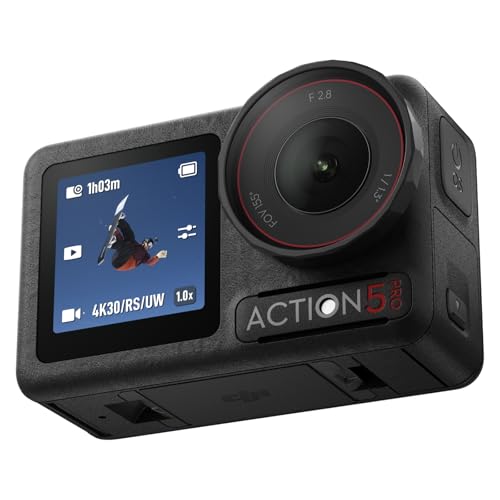
DJI Osmo Action 5 Pro — Rain Filming All-Rounder
The Action 5 Pro takes the top badge by treating bad weather as its home fixture rather than an edge case. It is waterproof from the factory to a depth that covers every rain, river, and surf scenario short of deliberate diving, its sensor is the strongest low-light performer among this guide’s action cameras — a decisive virtue when storms steal the sun at noon — and its stabilisation keeps walking footage composed while the operator is being rained on, blown about, and distracted by survival. Filming in rain is filming while uncomfortable, and this camera’s competence under distraction is its deepest feature.
Practical touches compound the case. Battery endurance stretches across a wet day’s shooting without the constant swapping that exposes doors to the sky; the screens can be managed so raindrops do not conduct a phantom interface; and DJI’s wireless microphone pairing gives storm filmmakers a route to intelligible voice that the camera’s own rain-drummed microphones cannot. Colour profiles exist for footage destined to sit beside larger cameras, so the Action 5 Pro can serve as a production’s weather unit rather than a toy kept for holidays.
Its compromises are the action format’s own. A fixed wide lens sets the framing, the sensor — however good — is not a full-frame low-light miracle, and the mounting ecosystem, while strong, plays second to GoPro’s sheer ubiquity in rental drawers and borrowed accessories. For the filmmaker whose brief is simply to come home from the storm with the footage, those are acceptable trades, and this is the camera this guide would hand them at the door.
- Sealing: waterproof from the factory, no housing needed
- Sensor: strongest low-light behaviour among these action picks
- Endurance: long battery life for full wet shooting days
- Audio: wireless microphone pairing for storm narration
- Control: screens and buttons manageable with cold hands
Strengths
- Storm light and storm motion handled together
- Long takes and long days without door-opening anxiety
- Footage grades respectably beside larger cameras
Trade-offs
- Fixed wide lens limits distant subjects
- Accessory world smaller than GoPro’s rental ubiquity
- Onboard sound still loses to heavy rain on the body
Best for: storm chasers, riders, anglers, and travel filmmakers in wet climates. Not suited for: telephoto wildlife or formal interview anchoring.

GoPro HERO13 Black — Mounting Champion
Rain filming often begins with a mounting problem: the camera must cling to a wet helmet, a vibrating handlebar, a boat rail slick with spray, and the HERO13 Black is the most mountable object in this guide. Its magnetic latch system, the vast inherited continent of GoPro fittings, and a family of interchangeable lens mods — including ultra-wide and macro options — let a crew rig a shot in minutes in conditions where improvisation with tape and hope is the alternative. It is waterproof without a housing, and its stabilisation remains a benchmark for smoothing a rider’s or runner’s storm.
The tall sensor earns its keep in weather work specifically. One mounting can serve the widescreen film and the vertical clip a sponsor or a feed demands, which matters when re-rigging in rain to shoot a second orientation is nobody’s idea of a good afternoon. Voice control lets a kayaker or climber start recording with occupied, freezing hands, and the camera’s time-lapse modes compress a storm’s whole biography — approach, fury, clearing — from a single patient placement on a fence post.
The familiar GoPro cautions apply with weather seasoning. Battery appetite grows in the cold that accompanies serious rain, so spares warmed in an inside pocket are part of the system; the onboard microphones hear the rain on the body as a drum solo; and its footage, while excellent, asks for the front element to be wiped constantly, because one droplet sits on a wide lens like a moon. None of this dethrones it as the rigging department’s favourite — it merely defines the crew habits that let its mounting genius translate into finished storm footage.
- Sealing: waterproof without a housing for rain and surf
- Mounting: magnetic latch plus the deepest accessory world
- Lenses: interchangeable mods for ultra-wide and macro
- Sensor: tall format feeding wide and vertical edits
- Control: voice commands for occupied, gloved hands
Strengths
- Rigs onto anything the weather can wet
- Stabilisation that forgives vehicles and weather alike
- One placement serves multiple deliverable shapes
Trade-offs
- Cold rain shortens battery intervals noticeably
- Droplets dominate a wide front element quickly
- Rain noise overwhelms onboard microphones
Best for: bikes, boats, helmets, vehicles, and mounted storm work. Not suited for: dialogue-led filming in heavy rain without external sound.

Insta360 X4 — Whole-Storm Capture
The X4 answers rain’s chaos with a philosophy: record everything, decide later. Its twin lenses capture a full sphere of video, so the lightning strike behind you, the wave that arrived from the side, and the rainbow forming over your shoulder all exist in the same file, waiting for the edit to point the audience’s eye. For storm filming — a genre whose best moments refuse direction — that reframing freedom is not a gimmick but a survival strategy, and the camera is waterproof in its own right for rain, spray, and shallow immersion.
The invisible-stick trick adds a documentary superpower: mounted on its pole, the camera appears to float through the scene, following a hiker through a downpour or circling a surfer’s preparation on a grey beach, with no operator visible to break the spell. Stabilisation is computational and serene, and single-lens mode serves conventional action framing when the sphere is more than the story needs. Battery and handling suit a day bag; the editing software, while a commitment, has matured into a genuinely creative reframing studio.
Weather extracts its specific tolls here. Two exposed fisheye domes mean two surfaces for droplets to colonise, and a single bead on either lens smears a whole hemisphere of the sphere, so the wipe cloth becomes this camera’s closest companion. Resolution spread across a sphere also means reframed crops are softer than a dedicated camera’s native frame, and stitching in rain — where droplets differ between lenses — can wobble at the seams. Used for the moments only it can catch, those costs buy footage no other pick in this guide can even attempt.
- Capture: full 360-degree recording, reframed in editing
- Sealing: waterproof for rain, spray, and shallow dips
- Signature: invisible-stick floating camera effect
- Stabilisation: computational smoothness in rough motion
- Modes: single-lens action framing when needed
Strengths
- Never misses the moment behind the camera
- Storms, surf, and travel become reframable worlds
- Floating shots without a drone or a crew
Trade-offs
- Droplets on twin domes demand constant wiping
- Reframed crops softer than native-frame rivals
- Editing workflow is a real time commitment
Best for: storms, surf, travel, and unpredictable action in wet places. Not suited for: filmmakers who need finished framing straight from the camera.

OM SYSTEM Tough TG-7 — Expedition Waterproof Compact
The TG-7 is not an action camera and does not pretend to be one; it is a compact camera built to expedition standards, waterproof to genuine depths, shockproof against drops onto rock, freezeproof for winter work, and crushproof in the bottom of a pack. For the rain filmmaker, its significance is that it shoots like a camera — real zoom, real macro, raw stills for the production’s photographs — while surviving weather and water that would retire every interchangeable-lens body in this guide. Field scientists, fishing guides, and expedition documenters have built a literature on this family’s indifference to abuse.
Video is a strong supporting craft rather than the headline: it records detailed footage including high-frame-rate options for slowing rain, spray, and leaping fish, and its microscope-grade macro modes film the storm’s small theatre — droplets beading on a leaf, insects sheltering under a cap — with a clarity no action camera approaches. GPS and environmental sensors log where and in what conditions footage was gathered, a gift to documentary and scientific work where provenance is part of the evidence.
The honest limits are a small sensor’s low-light ceiling and a fixed lens whose reach suits scenes rather than distant subjects. In bright storm light, on rivers, reefs, and ridgelines, those limits rarely bind; in a dark forest downpour, the DJI pick sees further. The TG-7’s kingdom is the expedition where the camera must simply never be the thing that fails — and in that kingdom, across years of weather, it has no serious rival at anything like its size.
- Build: waterproof, shockproof, freezeproof, crushproof
- Lens: real zoom with exceptional macro modes
- Video: detailed recording with high-frame-rate options
- Sensors: GPS and environmental logging for field work
- Stills: raw capture for production photography
Strengths
- Survival credentials no other pick here approaches
- Macro filming of the wet world’s small details
- A photographer’s camera, not a toy, in any weather
Trade-offs
- Low-light video trails the DJI action pick
- Fixed lens limits distant storm subjects
- Menus reward study before the expedition
Best for: expeditions, field science, fishing, and reef-to-ridge travel. Not suited for: night storms or distant subjects as the main brief.

OM SYSTEM OM-5 Mark II — Real Lenses, Real Weather
Every other pick in this guide accepts a fixed lens as the price of survival. The OM-5 Mark II refuses the bargain: it is a proper interchangeable-lens camera whose body and matched lenses carry serious weather sealing, so a filmmaker can shoot a rainy wedding, a misty waterfall, or a storm-lit street with fast primes and real depth of field while the water beads and runs off the equipment. Its sealing rating is among the most credible in its class, and its compact Micro Four Thirds system keeps the whole wet kit light enough for a day on foot in the hills that generate the weather.
The video craft is grown-up: stabilisation that steadies handheld rain walks, colour and log options for graded storm footage, and computational features inherited from its maker’s flagship line, including live composite tricks for lightning and long-exposure weather theatre. For the filmmaker whose rain work is cinematic rather than documentary-by-accident — music videos in downpours, narrative shorts that need a storm to look expensive — this is the only body here that speaks that language fluently.
The contract must be read carefully, as this guide promised. Sealing is not immersion: this camera films in rain, not underwater, and only when the mounted lens is itself sealed, with the mount’s gasket completing the circuit. Battery doors and ports demand the usual discipline, and the smaller sensor concedes some low-light purity to full-frame rivals that would never dare this weather. Within its contract, though, it is magnificent — the rain camera for filmmakers, full stop.
- Sealing: high-grade weather sealing with sealed lenses
- Lenses: full Micro Four Thirds interchangeable system
- Stabilisation: strong in-body system for handheld rain work
- Video: log and computational modes for cinematic storms
- Size: light system for foot-powered weather chasing
Strengths
- Real lens choice in genuinely bad weather
- Cinematic control no fixed-lens pick can offer
- Light enough to carry toward the storm, not from it
Trade-offs
- Sealed against rain, never for immersion
- Only sealed lenses complete the protection
- Low-light ceiling below full-frame fair-weather rivals
Best for: wedding, narrative, and landscape filmmakers working in weather. Not suited for: underwater filming or careless lens swapping mid-downpour.

AKASO Brave 7 LE — Risk-It Budget Angle
The Brave 7 LE’s argument is arithmetic. Rain filming’s boldest angles — the camera lashed where the wave breaks, taped low on a mudguard, mounted on the dog’s harness for a stormy beach run — carry a real chance of loss, and a camera priced as this one is changes that calculation from recklessness to strategy. It arrives with a waterproof case that extends its world underwater, dual screens that help framing from odd positions, and stabilised recording that is honestly serviceable for the web-first footage most risky angles become.
Expectations must be set by the same honesty. The image is the softest in this guide, low-light rain footage strains it hardest, and the case that grants its waterproofing also veils its microphones and adds a droplet-catching window before the lens. Battery life and build invite treating it as a consumable member of the crew — the camera you send where the DJI and GoPro should not be risked, on the understanding that its footage is a bonus harvested from danger rather than the production’s foundation.
Used with that clarity, it earns a genuine place in serious kits. Productions have always understood the sacrificial camera — the one inside the fireworks barge, under the waterfall, on the bumper in the hailstorm — and the Brave 7 LE is simply that tradition at its most affordable. Buy two, rig them without fear, and let the expensive bodies film the storm from the positions where their survival is a reasonable bet.
- Protection: waterproof case included in the box
- Screens: front and rear displays for awkward angles
- Recording: stabilised video suited to web delivery
- Role: sacrificial and secondary angles in wet danger
- Value: priced so loss is a budget line, not a disaster
Strengths
- Enables angles no sane owner risks a flagship on
- Complete starter kit with case and mounts included
- Fine for social and behind-the-scenes storm footage
Trade-offs
- Softest image and weakest low light in this guide
- Case muffles sound and catches droplets
- Build invites replacement rather than repair
Best for: risky angles, spare cameras, and beginners testing wet filming. Not suited for: anchoring a production’s principal photography.
Comparison Table
| Pick | Water promise | Image character | Choose it when |
|---|---|---|---|
| DJI Osmo Action 5 Pro | Waterproof, factory sealed | Strongest low-light action footage | One camera for every storm job |
| GoPro HERO13 Black | Waterproof, factory sealed | Tall-sensor, mount-anywhere footage | The rigging is the hard part |
| Insta360 X4 | Waterproof, twin domes | Whole-sphere, reframed later | The moment will not pose for you |
| OM SYSTEM Tough TG-7 | Waterproof expedition build | Zoom and macro in any weather | Survival outranks everything |
| OM SYSTEM OM-5 Mark II | Weather-sealed, not submersible | Cinematic, interchangeable lenses | Rain footage must look like film |
| AKASO Brave 7 LE | Waterproof inside its case | Serviceable web footage | The angle is worth more than the camera |
Which Lens and Droplet Habits Decide Whether Rain Footage Is Usable?
The front element is where rain footage lives or dies. A single droplet on a wide lens occupies a shocking share of the frame, and a smeared wipe is worse than the droplet, so the craft is specific: a hydrophobic cloth or chamois kept in a sealed pocket, a lens hood or shield that intercepts falling water before it lands, and the discipline to check the glass before every take rather than discovering the moon-sized bead in the edit. Some filmmakers angle the camera a few degrees downward, letting gravity clear the element; others keep a small blower for the droplets that wiping would only spread.
Fogging is the quieter assassin. A camera carried from an air-conditioned car into warm rain mists from the inside of its own housing or behind its lens, and the cure is patience — letting the equipment acclimatise in a sealed bag before exposure to the wet air, and keeping silica gel in every case as a matter of religion. The sealed action cameras resist most of this by design, yet their doors and membranes still reward the same rituals. Rain filming rewards the unhurried in a genre that feels like it should reward the brave.
How Do You Record Understandable Sound When the Sky Is Drumming?
Accept first that a camera’s own microphones in heavy rain record the rain’s opinion of the camera. The working solutions move the microphone under shelter: a wireless transmitter clipped inside a subject’s jacket with its capsule near the collar, a recorder tucked in a dry pocket narrating the day for later sync, or the discipline of filming the storm mute and building its sound in the edit from separately recorded rain, wind, and location atmosphere gathered under an umbrella’s protection. Documentary and travel filmmakers have used all three for decades, because weather sound is a design material, not a by-product.
Wind is rain’s accomplice and deserves its own sentence. A foam cover alone will not save a microphone in a storm; proper furry wind protection, sized to the capsule and kept dry in rotation, is the difference between narration and noise. Where the story allows, lean into the weather’s voice deliberately — a subject raising their voice against a downpour, water hammering a tent fly inches from the lens — because audiences read effort in sound as authenticity. The storm that cannot be defeated can always be cast.
What Should Happen to Every Camera in the Hour After a Wet Shoot?
Drying is a ritual with an order. Rinse salt and grit from waterproof bodies in fresh water before opening anything, because the door seal’s worst enemy is the crystal and sand it closes upon. Wipe every surface, extend every zoom and screen to its working position so hidden moisture meets air, and let the kit rest in moving air — never sealed into the bag it travelled home in, which is a terrarium for fungus. Batteries come out, cards come out, and both dry separately while the footage begins its backup journey.
The inspection that follows is the professional’s habit: seals examined for hair and grit, threads and mounts wiped, a test recording made before the camera is needed again. Silica gel packs regenerate in a low oven and return to the cases, so the system is ready for tomorrow’s weather rather than merely recovered from today’s. Filmmakers who treat the hour after as part of the shoot own cameras that survive seasons of storms; those who toss wet kit into a corner are shopping again by spring, and this guide would rather sell them habits than replacements.
Final Recommendation
Hand most rain filmmakers the DJI Osmo Action 5 Pro and the recommendation will age well: it is sealed, steady, strong after dark, and honest about its sound options. Choose the HERO13 Black when the film’s life is lived on mounts and vehicles, the X4 when the storm’s best moment might happen behind you, and the Tough TG-7 when the expedition’s first requirement is that the camera simply cannot be killed by weather. The OM-5 Mark II serves the filmmaker who wants rain to look like cinema, and the Brave 7 LE belongs in every kit as the brave, expendable eye sent where the others must not go.
Whatever you carry into the weather, carry the cloth, the gel packs, and the patience with it, because rain filming is a craft of small disciplines performed while wet. The reward is the footage fair-weather filmmakers never own: streets turned to mirrors, forests dripping silver, a subject laughing in a downpour because the story mattered more than the sky — the scenes audiences remember precisely because every other camera on the street had gone home.
How Do You Keep Filming When Your Hands Stop Working Properly?
Cold, wet hands are rain filming’s hidden exposure problem. Numb fingers drop cameras, fumble battery doors open at the wrong moment, and stab at touchscreens that rain is already conducting like a mischievous second operator. The equipment answers are woven through this guide’s verdicts — voice control on the GoPro, lockable screens and physical buttons on the DJI, glove-friendly dials on the OM bodies — but the human system matters as much: thin liner gloves that preserve grip and some dexterity, a lanyard or tether on every camera working over water, and the discipline to make adjustments in two deliberate stages rather than one hurried one.
Plan the shoot so the hardest operations happen in shelter. Batteries, cards, and lens changes belong to the car, the tent, or the café between squalls, leaving the exposed minutes for pointing, starting, and stopping. Filmmakers who storyboard their weather work this way return with more footage and all of their cameras, while those who improvise every adjustment in the downpour star in the cautionary tales told at camera clubs. Rain rewards the choreographed and taxes the spontaneous, which is precisely backwards from most filming and worth knowing before the sky opens.
Why Does Rain Make Ordinary Streets Look Expensive on Camera?
Water is a lighting department that works for free. A wet street doubles every sign and headlight, turning an ordinary road into a mirrored stage; rain in backlight becomes visible atmosphere, each droplet a tiny lens catching the glow; and the storm’s grey ceiling wraps subjects in soft, directionless light that flatters faces and deepens colours in clothing, foliage, and brick. Productions pay fortunes to wet down streets on dry nights for exactly this richness, which is why the filmmaker willing to shoot in actual rain owns a look the fair-weather schedule cannot buy.
Composition harvests the gift deliberately. Shoot toward the light to make the rain visible against darker backgrounds; drop the camera low so reflections carry the frame’s lower half; let a subject’s umbrella, a shop awning, or a bus shelter create a dry foreground island inside the wet world. The sealed cameras here free the operator to stand in the weather for those angles rather than shooting through a window’s distortion, and the OM-5’s lenses give the reflections the rendering they deserve. Rain, framed with intent, is not an obstacle to beauty. It is a subsidy.
What Should a Wedding Videographer Do When the Forecast Turns?
First, reframe the day rather than mourning it. Rain gives a wedding a story — guests laughing under umbrellas, light like pewter, a couple whose portraits glow against wet stone — and the videographer who arrives with sealed equipment and a plan becomes the calmest person at the venue. The OM-5 Mark II anchors the formal work, an action camera rides along for the dash between church and car, and every doorway and covered walkway on the route is scouted in the morning as a portrait location in waiting.
The practical liturgy matters as much as the art. Clear communication with the couple about which outdoor moments will be shortened or moved, a towel and a dry bag staged at every transition, spare batteries kept warm, and a second pair of hands assigned to umbrella duty over the equipment during the exposed minutes. Couples remember a rainy wedding by how it felt, and a videographer whose gear never faltered and whose manner never flustered is a large part of why the film of that day plays like romance rather than weather report.
How Does Salt Water Change the Rules for Sealed Cameras?
The sea is rain with an agenda. Salt corrodes, crystallises in seals as it dries, and turns spray into an abrasive film on every surface, so coastal filming demands the rinse ritual this guide described, performed the same day rather than the same week. A waterproof body fresh from surf work should bathe in clean water with its doors closed, soak briefly if the maker allows, and dry with its seals inspected, because the crystal that forms in a gasket overnight is the leak that arrives next season.
Mounts and accessories suffer faster than cameras. Metal fittings pit, straps stiffen with salt, and a mount that was trustworthy in June can be a rumour by September, so coastal crews treat hardware as consumable and inspect it like climbing gear. The reward for the discipline is access to filming’s most dramatic weather theatre — surf, spray, working harbours, storm coasts — with equipment whose survival is a system rather than a hope. The TG-7 and the action picks were chosen with exactly those coastlines in their biographies.
When Is the Right Call to Stop Filming and Protect the Kit?
Judgement is a specification no box prints. Lightning overhead, rising water, wind strong enough to move the operator, or cold that has taken the feeling from both hands — each is a legitimate full stop regardless of what the camera could survive, because the footage is never the most valuable thing at a storm location. Sealed equipment can create a dangerous confidence, as if the kit’s rating were a rating for its owner, and the experienced weather filmmakers in every genre share the same unimpressive secret: they have all walked away from shots, and that is why they are still filming.
The professional habit is deciding the limits before the weather decides them for you. Set the thresholds at the planning stage — the wind speed, the lightning distance, the hour by which the river path becomes a river — and let the plan, written in calm, overrule the enthusiasm of the moment. A camera preserved films tomorrow’s storm as well; a filmmaker preserved films for decades. This guide’s picks will handle more weather than their owners should, and knowing where the human rating ends is the final skill the rain asks its filmmakers to learn.
How Do You Film Wildlife and Gardens in Rain Without Disturbing Either?
Rain transforms familiar living subjects. Birds bathe and shake in it, frogs announce it, gardens darken into saturated colour, and the patient filmmaker with a sealed camera inherits scenes that sunny hours never stage. The craft is concealment plus endurance: a hide, a porch, or a vehicle as the blind, the camera settled and recording before the subject arrives, and the operator’s movements slowed to the weather’s own tempo. The Tough TG-7’s zoom and macro serve the small end of that world, while the OM-5 with a longer lens holds the respectful distance wildlife etiquette demands.
Sound, gathered under shelter at the garden’s edge, completes the record — rain on leaves is a soundscape audiences recognise in their bones. Filming in a garden downpour also teaches the home-scale version of every discipline in this guide: cloth at hand, doors opened only under cover, kit dried before it is stored. A single wet season spent filming one’s own garden produces a rain filmmaker faster than any expedition, because the repetitions are daily and the cost of every lesson is a walk back indoors.
What Does Rain Do to Batteries, Cards, and the Footage Itself?
Cold rides in on rain’s coat-tails, and lithium batteries surrender capacity as temperatures fall, so a storm kit carries spares against the body and rotates them like a relay team. Memory cards care less about temperature than about the moment of exchange — a card swapped with wet hands over wet ground is a card auditioning for loss — which returns the planning to its recurring theme: capacities chosen so that swaps happen in shelter, and cards treated as the film itself until the evening’s double backup is done.
The footage, meanwhile, gains a fragility of its own in the edit. Rain scenes expose compression mercilessly, because every droplet is detail the codec must describe, so recording at the healthier data rates these cameras offer — and resisting the temptation to economise on card space mid-storm — protects the finished film’s quality. A storm is the most expensive weather to compress and the cheapest to overshoot; fill the cards, within the shelter discipline, and let the edit decide what the rain meant.
How Should Beginners Practise Rain Filming Before It Matters?
Deliberately, cheaply, and close to home. The first wet session should be a garden, a street, a football match of no consequence — anywhere failure costs nothing — with the Brave 7 LE or whichever pick the budget chose, and a notebook for the lessons the weather teaches in order: how fast the front element beads, how the touchscreen misbehaves, which pocket keeps the cloth dry, how long the battery truly lasts in the cold. An hour of that rehearsal is worth a season of product research.
Graduate by assignment rather than by storm size. Film rain on windows, then rain on a river, then a person working in rain, then an event where the footage matters to someone else. Each step adds one pressure at a time, and the habits — wiping rhythm, shelter discipline, drying ritual — harden into reflexes before the day they protect something irreplaceable. The filmmakers whose storm footage fills this genre’s highlight reels are not braver than beginners. They are simply further along the same wet curriculum, and the first page of it is a rainy afternoon within sight of home.
How Do You Plan a Travel Shoot Around a Wet Season?
Whole regions keep their beauty behind a rainy season, and the traveller who goes then — for the empty temples, the green deserts, the waterfalls at full voice — plans differently from the fair-weather tourist. The kit shrinks to what one person can keep dry: a sealed action camera as the daily witness, one larger body for the ceremonies and portraits, and a dry bag whose quality matters more than any lens in it. Redundancy moves from bodies to basics — two ways to charge, two places footage sleeps each night, two cloths because the first will be damp by noon.
The schedule bends to the weather’s rhythm rather than fighting it. In many wet seasons the rain keeps appointments, arriving in the afternoon and clearing by morning, so the plan shoots exteriors early, shelters for the interviews and interiors during the daily downpour, and treats the hour after the rain — when the world is washed and the light turns gold — as the production’s prime time. Filmmakers who build that rhythm into the itinerary return with footage that looks like a larger crew spent a longer season, because they stopped experiencing the rain as interruption and started scheduling it as a colleague.
Why Do Some Rain Films Feel Alive While Others Feel Merely Wet?
The difference is almost never the camera. Living rain footage contains people responding to the weather — working in it, laughing in it, sheltering from it with the improvisation weather demands — while merely wet footage contains weather responding to nothing. Every pick in this guide can record rain beautifully; the filmmaker’s job is ensuring something in the frame has a relationship with it. A fisherman mending nets under a tarp in a downpour is a film. The same downpour on an empty harbour is a screensaver with excellent dynamic range.
Duration plays its part too. Audiences need time inside a storm to feel its mood settle, and the endurance praised throughout this guide exists to buy those unhurried minutes — the long take of a street emptying as the rain arrives, the patient observation of a campsite reorganising itself around the weather. Cut too quickly and rain becomes noise; hold, and it becomes the film’s narrator. The cameras that stay awake, sealed, and steady the longest are, in that sense, the most expressive ones here.
How Do You Choose a Rain Camera for Someone Else?
Buying weatherproof filming gear as a gift — for the angler, the rider, the storm-loving teenager — succeeds by matching the water in their actual life rather than the water in a catalogue. Ask where their current footage dies: if the answer is the boat, the pool, or the trail in November, the sealed action picks and the Tough compact are the honest shortlist. If the answer is a wedding business or a film course, the sealed interchangeable-lens body is the gift that respects their ambitions instead of merely their hobbies.
Include the unglamorous companions in the wrapping. A second battery, a card, a proper cloth and a dry pouch turn a camera gift into a working rain kit, and they signal that the giver understood the craft rather than the advertisement. Weather filming is a system of small survivals; the recipient who unwraps the whole system starts their first storm a season ahead of the one who unwraps a camera alone.
What Does a Minimal Rain Kit Weigh, and Why Does It Matter?
Weather filming is usually walking filming — toward the coast path, up the harbour wall, around the ground’s perimeter — and every gram argues with the rain for the operator’s endurance. The action picks built this guide’s light end deliberately: a camera, two batteries, a mount, and a cloth can disappear into a jacket, which means they are present for storms a full rig would have watched from the car park. The OM-5 system, heavier and dearer, justifies its carry by the footage only it can make, and the honest planner chooses per assignment rather than by loyalty.
The rule that emerges is to pack for the film, not the forecast. A day of harbour weather needs the light kit and dry discipline; a commissioned rainy wedding earns the sealed lenses and their bag. Rain punishes the over-packed with fatigue and the under-packed with missed scenes in roughly equal measure, and the photographers who thrive in weather are the ones whose kit list is a decision made the night before, in the dry, rather than a hope assembled at the door.
Frequently Asked Questions
Can I film in rain with a normal camera inside a plastic bag?
Generations of filmmakers have, in light rain, with care — a bag or rain cover shields the body while the lens peers out under a hood — but it is a compromise that fogs, fumbles, and fails exactly when the weather turns serious. For occasional drizzle over a valuable camera it is a reasonable field expedient. For a project whose premise is weather, a genuinely sealed pick from this guide is cheaper than the first repair bill.
Does a higher depth rating mean better rain protection?
Not in any way that matters for rain. Depth ratings describe immersion pressure, while rain tests seals against driven water, temperature change, and hours of exposure. A modestly rated waterproof camera shrugs off any storm; a deeply rated one adds diving headroom. Buy depth for the underwater work you will actually do, and judge rain fitness by sealing design, door discipline, and the maker’s weather reputation.
Why does my rain footage look flat and grey?
Because storm light is flat and grey — the sky becomes one enormous softbox with the contrast wrung out of it. The cures are compositional and editorial: seek the wet surfaces that reflect what light exists, place subjects against darker backgrounds, protect the highlights on shining streets, and grade with a firmer hand than a sunny day requires. The low-light-strong picks in this guide hold the most gradeable material in those conditions.
How do I stop raindrops ruining every shot?
Shield, wipe, check, repeat. A hood or improvised shield keeps falling water off the element, a hydrophobic cloth kept dry in a sealed pocket clears what lands, and a glance at the front glass before every take catches the bead that would otherwise star in the footage. Slight downward angles shed water naturally. There is no permanent fix — there is a rhythm, and rain filmmakers build it into their hands within one wet afternoon.
Is it safe to change batteries or cards during rain?
It is the riskiest routine moment of a wet shoot, because every open door invites the sky inside. Work under any shelter available — a jacket, a vehicle, an umbrella held by a companion — with hands dried first and the camera angled so its openings face down. Better still, plan capacities so changes happen at chosen shelters rather than forced ones; the endurance of the DJI pick is praised in this guide partly because it postpones that moment.
Can these cameras film lightning safely and well?
The cameras can; the filmmaker must supply the judgement about where to stand, keeping clear of isolated high points, water’s edge during strikes overhead, and metal structures, and following local safety guidance without exception. Technically, long exposures, interval modes, and the OM-5’s composite tricks render lightning beautifully, and the sealed bodies remove the equipment anxiety from the equation. No photograph is worth the risk that sensible storm watchers refuse — film the storm from shelter, and let the sky do the travelling.
Related Guides
Weather-minded filmmakers should continue with our best action cameras for water sports for the fully submerged half of the craft, the best digital cameras for travel in harsh climates for deserts and winters beyond the rain, and the best video cameras for storm and nature documentaries when the weather becomes the subject itself.


