kajuandouglas.com is reader-supported. When you buy through links on our site, we may earn an affiliate commission.
Where to Buy
Searching for the best compact digital cameras under 200 dollars means walking into the most honest conversation in this entire category, so let us have it in the first paragraph. The dedicated compact camera nearly died when phones absorbed casual photography, and the survivors retreated upmarket: the compacts reviewers celebrate now cost several times this budget. What remains under the line is a strange, mixed shelf — a rugged little action camera, two instant cameras that print their pictures, a couple of genuinely cheap point-and-shoots living on borrowed time, and a crowd of no-name cameras whose specifications dissolve under scrutiny. This guide sorts that shelf without pretending it is something else.
That sorting matters because the under-200 buyer is usually buying for a reason a phone cannot serve. Sometimes it is a child who needs a camera that is theirs alone, without a messaging app attached. Sometimes it is a traveller who wants a device that can be lost, soaked, or lent without grief. Sometimes it is the deliberate charm of a printed photograph handed across a table. And sometimes it is a parent equipping a school project or a grandparent who wants buttons, not gestures. Each of those jobs has a right answer on this shelf — and each wrong answer is a camera bought for a fantasy of what two hundred dollars used to buy.
So the picks below are organised by job, not by specification theatre. Three are linked because they sit honestly within reach of the budget. One linked pick is flagged, in its badge and throughout its review, as a step-up: the camera this budget wishes it could buy, included so you can judge the gap with your eyes open. Two picks are prose-only references — a classic cheap zoom compact and a discontinued favourite — included because any honest map of this price territory must show where the old road ran, even where it no longer leads anywhere you can purchase with confidence.
A word about the no-name crowd, because it dominates the search results for this exact phrase. Dozens of cameras promise absurd megapixel counts and video resolutions at prices that should trigger suspicion, and independent testing keeps finding the same story: tiny sensors, interpolated numbers, lenses that smear, and video that is a slideshow wearing a costume. This guide excludes them on principle. Every pick below is a real camera from a maker who answers for it — which, at this budget, is the single most valuable specification of all.
Key Takeaways
- The AKASO Brave 7 LE is the most capable true digital camera honestly near this budget: weather-sealed, stabilised video, and a screen front and back.
- The Fujifilm Instax Mini 12 and Polaroid Go Generation 2 sell a different pleasure — instant prints — and are the safest gifts on this list.
- The Canon PowerShot G7 X Mark III appears as a clearly labelled step-up: it is what the budget aspires to, not what it buys new.
- Prose-only references to the Kodak PIXPRO FZ55 and Canon PowerShot ELPH 360 HS map the classic cheap-zoom territory and its compromises.
- At this price, buy the job — gift, adventure, prints, or first camera — never the megapixel count printed on the box.
Read the badges as budgets with personalities. “Best Real Camera Under the Line” means stills and video you can actually use. “Best Gift” means the pleasure is immediate and social. “Step-Up” means exactly what it says, priced honestly in words rather than hidden in fine print.
In this guide
Quick Picks
| Badge | Pick | Why it stands out |
|---|---|---|
| Best Real Camera Under the Line | AKASO Brave 7 LE | A weather-sealed action camera that shoots stabilised video and honest stills for travel, kids, and water. |
| Best Gift and Party Camera | Fujifilm Instax Mini 12 | Instant prints, automatic exposure, and a selfie mirror — joy in ninety seconds, no settings required. |
| Best Pocket-Sized Instant | Polaroid Go Generation 2 | The smallest instant camera in its family, with credit-card prints that live in wallets and on fridges. |
| Step-Up: The Aspirational Compact | Canon PowerShot G7 X Mark III | A one-inch sensor and a fast lens — the compact this budget dreams about, labelled honestly as costing more. |
| Best Cheap Zoom (Prose Reference) | Kodak PIXPRO FZ55 | A simple long-zoom point-and-shoot that shows what the classic budget compact still offers and where it strains. |
| Best Discontinued Favourite (Prose Reference) | Canon PowerShot ELPH 360 HS | The slim pocket zoom a generation carried; a used-market reference for what this class once did well. |
Six picks, three philosophies. The AKASO is a tool. The two instants are toys in the honourable sense — instruments of fun. The Canon step-up is a temptation, presented as one. And the two prose references are history lessons with practical value: they explain what the missing middle of this market used to look like, which is the knowledge you need before a marketplace listing or a relative’s drawer offers you one.
How We Chose These Picks
The first filter was existence with accountability. Each candidate had to be a current or clearly identified product from a manufacturer with real support, real film or accessory supply where relevant, and a track record owners could verify. That single rule removed most of what a search for this keyword returns, and removing it was the point: a buying guide that cannot distinguish a camera from a costume is not a guide.
The second filter was the job test. Every surviving camera was asked what it is for, in one sentence, without the word “and” doing heavy lifting. The AKASO passed as the adventure-and-family video camera. The instants passed as print machines. The cheap zooms passed, more weakly, as daylight snapshot cameras. Candidates that answered with a blur of inflated claims failed, because a camera that promises everything at this price is confessing it does nothing well.
Image quality was judged at the size these photographs will actually live: phone screens, social posts, small prints, and the fridge door. That standard is not a lowering of the bar; it is the bar, honestly placed. A sensor that delights at those sizes and disappoints in pixel-peeping has done its job, and this guide says so — while also naming, for each pick, the moment the bar rises and the camera cannot follow: the dark restaurant, the fast toddler, the distant stage.
Running costs were counted as part of the purchase, because at this budget they dominate it. Instant cameras spend their lives buying film; the review of each instant pick treats film supply as a core specification. The action camera wants a memory card and eventually a spare battery. The cheap zooms sip power and ask almost nothing. A two-hundred-dollar camera that costs another hundred a year to feed is a different purchase from one that does not, and the picks are judged with their appetites showing.
Durability was weighed as a feature, not a footnote, because this budget’s cameras lead rough lives. A camera bought for a child, a boat, or a festival is a camera that will be dropped, splashed, and left in hot cars; the picks were ranked partly on how gracefully they meet that reality. The action camera’s sealing is a headline specification for exactly this reason, and the instants’ simple construction — few moving parts, nothing delicate protruding — counts quietly in their favour. The step-up Canon, by contrast, is a precision instrument, and its review prices that fragility into the recommendation.
Giftability received its own pass through the shortlist, because a large share of this keyword’s searches are someone shopping for someone else. A gift camera must delight within minutes of unwrapping, forgive a total beginner, and carry its running costs visibly rather than as a surprise. That test is why the instants rank as high as they do here despite their photographic modesty — and why every gift recommendation in this guide is paired with the film or card that makes the first month free of errands.
Finally, the step-up pick was chosen by a strict rule: it had to be the camera a buyer would most plausibly stretch for, and the stretch had to be confessed everywhere it appears — badge, review, comparison table, and verdict. A guide earns trust at exactly the point where it would be easiest to blur a price boundary. This one does not blur it.
What Should You Expect From the Best Compact Digital Cameras Under 200 Dollars?
Begin with what the money cannot do, because the category’s marketing will not tell you. It cannot buy a large sensor in a general-purpose compact; the one-inch and larger sensors that make modern compacts sing live in cameras costing multiples of this budget. It cannot buy reliable low-light photography, fast and certain autofocus, or video you would choose over a recent phone’s. Any listing implying otherwise is selling the shape of a camera rather than the substance, and the substance is what takes the picture.
What the money can buy is specialisation. An action camera spends the whole budget on one rugged, stabilised trick and performs it genuinely well. An instant camera spends it on a printer with a lens attached and delivers a physical object no phone can hand you. A cheap zoom spends it on reach — an optical zoom that frames a distant subject properly instead of cropping a phone’s file into mush — and accepts mediocrity elsewhere. Specialists survive at this price; generalists do not. That single insight organises the entire list below.
There is also the secondhand truth, which this guide respects without depending on. Yesterday’s mid-range compacts circulate used at prices near this budget, and a carefully bought one can out-shoot everything new on this page. But used buying is a skill — shutter counts, lens fungus, battery health, seller honesty — and a guide that quietly assumes that skill serves its readers badly. The prose-only ELPH below is included precisely to arm that route: if you go used, go knowing what the good ones were.
It can also buy freedom from the phone, which sounds soft and is not. A separate camera has no notifications colonising the moment, no battery shared with maps and messages, no thousand-dollar slab risked over the side of a kayak. Parents buy that separation for children; travellers buy it for peace of mind; some adults buy it simply to be unreachable while they photograph. Those are not photographic specifications, but they are among the most honest reasons this keyword gets searched, and a guide that ignored them would misunderstand its own readers.
And there is the phone in your pocket, the comparison nobody at this budget escapes. A recent phone out-shoots every new camera here on pure image quality in most conditions. The reasons to buy anyway are real but specific: a separate device for a child, a camera that can be dropped in a lake, a print that exists in the world, a zoom that reaches, a screen-free simplicity for someone who hates phones. If none of those reasons is yours, the honest advice of this guide is to keep the money. A buying guide willing to say that has earned the right to be believed about the rest.

AKASO Brave 7 LE — Best Real Camera Under the Line
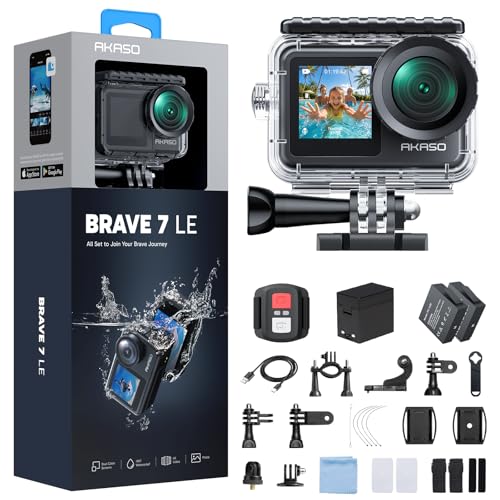
The Brave 7 LE is an action camera, and it leads this guide because an action camera is the one genuinely capable digital camera this budget can still buy new. Weather-sealed out of the box, it shrugs off the rain, splashes, and sandy hands that would retire a conventional compact, and its electronic stabilisation turns walking, cycling, and boat footage from nauseating to watchable. Dual screens — one facing the world, one facing you — make it a legitimate little vlogging and family-video tool rather than a helmet ornament.
For stills, honesty is required: the small sensor and fixed ultra-wide lens produce cheerful daylight photographs and struggle after dark, and there is no optical zoom, so distant subjects stay distant. But judge it by its actual jobs — the holiday video, the pool day, the child’s first camera that can survive being a child’s camera — and it delivers more real capability per dollar than anything else in this article. Its remote control and app support add a polish the no-name crowd only imitates in bullet points.
The deeper reason it belongs here is philosophical. Every other honest pick on this page is a specialist too, and the AKASO is simply the specialist whose speciality — rugged video — overlaps most with what people imagine a “real camera” doing. If your two hundred dollars must produce video you will keep and stills you will share, this is where they work hardest.
- Body: weather-sealed action camera, ready for water and weather
- Video: stabilised recording with front and rear screens
- Lens: fixed ultra-wide — frames scenes, not distant subjects
- Extras: remote control and app support included in the experience
- Character: the budget’s one genuinely capable all-weather tool
Strengths
- Survives the conditions that kill ordinary compacts
- Stabilised video that families actually rewatch
- Front screen makes self-filming simple
Trade-offs
- Low-light stills are weak, as the small sensor dictates
- No optical zoom for distant subjects
- Ultra-wide view distorts close faces at the edges
Best for: travel video, water and sport days, kids who drop things, first-camera gifts that must survive. Not suited for: portraits, concerts from the back row, or anyone whose main subject is across a field.

Fujifilm Instax Mini 12 — Best Gift and Party Camera
The Instax Mini 12 does not compete with the cameras above it on image quality, and it does not care, because it is selling something none of them can offer: a photograph you can hold before the moment has cooled. Press the button at a party, a wedding table, a school trip, and ninety seconds later a small print exists — handed over, pinned up, written on, kept. In a decade of photography dissolving into feeds, that physical trick has made the Instax line the budget camera people actually remember owning.
The Mini 12 is the friendliest version yet. Exposure is automatic and forgiving, a selfie mirror and close-up mode handle the shots its owners actually take, and the design is soft, bright, and unmistakably a pleasure object rather than an instrument. There are no menus to learn and no files to manage; the learning curve is the time it takes to load a film pack.
The running cost is the review’s necessary cold water. Film is a per-photograph expense forever, and a trigger-happy party can consume packs at a rate that reframes the camera’s cheapness. Buy it as what it is — an experience machine whose film is the ticket price — and it delights. Buy it expecting a cheap way to take hundreds of photographs, and the arithmetic will correct you within a month.
- Output: instant prints that develop in about ninety seconds
- Exposure: fully automatic, forgiving of beginners
- Selfies: mirror and close-up mode for arm’s-length shots
- Operation: essentially none — load film, press button
- Running cost: film packs are a permanent per-shot expense
Strengths
- Produces a keepsake no phone can hand someone
- Zero learning curve for any age of photographer
- The gift that gets used at the event itself
Trade-offs
- Film cost accumulates quickly at parties
- Small prints with soft detail by design
- No digital file unless you scan the print
Best for: parties, weddings, school trips, gifts for tweens and grandparents. Not suited for: high-volume shooting, archival quality, or anyone who wants files rather than prints.

Polaroid Go Generation 2 — Best Pocket-Sized Instant
The Polaroid Go Generation 2 shrinks the instant idea until it genuinely fits a pocket, and that shrinkage is its whole argument. Its prints are credit-card small — wallet photographs, locker photographs, the picture taped inside a notebook — and the camera itself is the one instant model here you might actually carry daily rather than deploy on occasions. A rechargeable battery, a selfie mirror, and a double-exposure mode give it more creative range than its toy-like silhouette suggests.
Set against its Fujifilm rival, the trade is characterful. The Go’s film look leans moodier and less predictable, which its fans call soul and its critics call inconsistency; both are describing the same chemistry. Its prints are smaller than the Instax Mini’s, and its film ecosystem is the narrower of the two. Choosing between them is choosing between the reliable party machine and the pocketable mood piece — a real choice, honestly framed, with no loser.
As a second camera for someone who already photographs seriously, the Go has a quiet charm the bigger instants lack: it asks nothing, weighs nothing, and produces a physical token of days that would otherwise live only in a camera roll. That is a legitimate photographic purpose, and at this budget it may be the most defensible one on the page.
- Size: the smallest instant camera in its family
- Prints: credit-card format for wallets and notebooks
- Battery: rechargeable, no disposable cells to buy
- Creative modes: double exposure and a self-timer
- Character: moodier, less predictable film rendering
Strengths
- Small enough to be carried every day
- Prints sized for wallets and journals
- Rechargeable battery keeps running costs to film alone
Trade-offs
- Prints are the smallest here — detail is impressionistic
- Film look varies more than the Instax’s consistency
- Narrower film ecosystem than its Fujifilm rival
Best for: everyday carry, journals and wallets, gifts with a design sensibility. Not suited for: party hosts printing for a crowd, or anyone wanting the most consistent instant results.

Canon PowerShot G7 X Mark III — Step-Up: The Aspirational Compact
This pick carries its warning in its badge: the G7 X Mark III costs more than this guide’s budget when bought new, and it appears here so you can see exactly what the extra money buys. The answer is a one-inch sensor and a fast zoom lens — the combination that produces the low-light photographs, the soft backgrounds, and the clean video that no honest under-200 camera can match. This is the compact the whole category is measured against, the one creators built channels on, and the one your budget is quietly dreaming about.
Its virtues are the category’s virtues at full strength. The lens is bright enough for restaurants and evenings; the sensor is large enough for backgrounds to melt politely; the video is stabilised, detailed, and friendly to anyone filming themselves, with a screen that flips up and a microphone input for proper sound. Where every other pick in this guide apologises for something fundamental, the Canon merely asks for money.
So the honest guidance is a fork. If your budget is truly fixed, close this tab of your mind and buy the AKASO or an instant with a clear conscience — they serve their jobs well. If your budget is a preference rather than a wall, and what you actually want is a real compact camera for years, this is the correct direction to stretch, and stretching once beats buying cheaply twice. What you must not do is buy a no-name camera that wears this Canon’s silhouette and promises its performance at a third of its price. That camera does not exist; only its box does.
- Sensor: one-inch class — the real divide in this guide
- Lens: fast zoom, bright enough for evenings indoors
- Video: stabilised, creator-friendly, microphone input included
- Screen: tilts up for self-filming
- Status: STEP-UP — priced above this guide’s budget when new
Strengths
- Image quality nothing else here approaches
- Low-light and background-blur ability the budget cannot buy
- A camera that stays satisfying for years
Trade-offs
- Costs more than the budget — that is the entire trade-off, stated plainly
- Too valuable to hand a small child or drop in a lake
- Its excellence makes the cheaper picks feel like compromises, because they are
Best for: buyers whose budget can stretch for a genuine compact that lasts. Not suited for: fixed budgets, loss-prone travel, or children — buy it only with open eyes and a flexible wallet.
Kodak PIXPRO FZ55 — Best Cheap Zoom (Prose Reference)
The FZ55 represents the classic budget compact in its surviving form: a slim point-and-shoot with a proper optical zoom, a rechargeable battery, and a price that keeps it honestly inside this guide’s territory. Its zoom is the argument — birthdays across a room, a child on a stage, a bird on a fence — subjects a phone frames by cropping and an action camera cannot reach at all. In daylight, at modest sizes, its photographs are pleasant and its operation is simplicity itself.
The compromises are the class’s compromises, and this guide names them rather than letting a listing imply otherwise. The small sensor fades quickly as light falls; autofocus is patient rather than quick; video is a courtesy feature rather than a strength. Owners who understand they have bought a daylight zoom for snapshots are content. Owners who expected the box’s biggest numbers to describe reality are not, and the gap between those two owners is exactly what reviews are for.
It appears without a link, as a prose reference, because the honest role of this class in 2026 is narrow and best entered deliberately. If a simple zoom for daylight and school events is your exact job, cameras of this type remain a rational, inexpensive answer. If your job is anything dimmer, faster, or more ambitious, this page has already shown you the two honest exits: the rugged specialist, or the step-up.
- Zoom: genuine optical reach for distant subjects
- Sensor: small — daylight is its home territory
- Battery: rechargeable, sips power
- Operation: true point-and-shoot simplicity
- Character: the surviving form of the classic budget compact
Strengths
- Optical zoom reaches what phones crop into mush
- Simple enough for any family member
- Honestly priced for what it is
Trade-offs
- Image quality fades fast as light falls
- Autofocus too patient for sport or toddlers
- Video is a courtesy, not a capability
Best for: daylight snapshots, school events, and stage-from-the-seats photographs. Not suited for: evenings, action, or anyone expecting phone-beating quality.
Canon PowerShot ELPH 360 HS — Best Discontinued Favourite (Prose Reference)
The ELPH 360 HS is this guide’s ghost: a slim, handsome pocket zoom from the years when the budget compact was a mature product rather than a survivor. It slipped into a jacket pocket, reached across a room with its zoom, connected to a phone without a fight, and took the kind of bright, dependable snapshots that filled a decade of family archives. A generation of travellers carried one as their only camera and came home happy.
It is discontinued, and that single fact organises its role here. New stock, where it lingers, is often priced by nostalgia rather than value; the sensible route is the used market, where a clean example can be a genuinely good buy for a careful shopper. Careful is the operative word: check the lens for marks, the zoom for smooth travel, the battery for swelling, and the seller for a returns policy. A used camera bought with those checks is a bargain; bought without them, it is a lottery ticket shaped like a camera.
Why devote a pick to a ghost at all? Because searches for this keyword are full of its descendants-by-listing — sellers invoking the ELPH era’s goodwill for cameras that share none of its engineering. Knowing what the real thing was, and what it honestly did and did not do, is the reader’s armour. The ELPH’s photographs were good snapshots, never miracles; any listing promising miracles in its image is selling the costume again.
- Status: discontinued — a used-market reference, not a new purchase
- Form: genuinely slim pocket zoom from the class’s mature years
- Zoom: optical reach in a jacket-pocket body
- Connectivity: phone transfer that worked without drama
- Buying note: inspect lens, zoom, and battery before paying
Strengths
- The pocketable form the whole class once perfected
- Dependable daylight snapshots with real zoom reach
- Used examples can be excellent value when inspected
Trade-offs
- No new warranty or manufacturer freshness
- Used condition varies — inspection is mandatory
- Even at its best, a small-sensor camera of its era
Best for: used-market shoppers who will inspect before buying, and readers calibrating what this class once was. Not suited for: anyone wanting a new camera with a warranty today.
What Happened to the Ordinary Two-Hundred-Dollar Compact?
A short history explains the strange shelf this guide surveys. Fifteen years ago, this budget bought the centre of the camera market: slim, competent point-and-shoots from a dozen famous makers, each year’s model a little better than the last, sold in every electronics shop on earth. Those cameras were genuinely good at their job, and the ELPH pick above is their memorial — proof that the class was once mature, refined, and honestly priced.
The phone ended that world in about five years. Casual photography did not merely move to phones; it discovered it preferred them — the sharing, the screen, the computational tricks no small sensor could match. Compact sales collapsed, and the makers who survived retreated to the two territories phones could not take: the premium compact, sold on sensor size and craft to enthusiasts, and the specialist, sold on a trick. Everything between those territories — including this guide’s entire price band — became a borderland.
Borderlands fill with opportunists, which is the other half of the story. As the famous names withdrew, listings multiplied for cameras wearing famous shapes and invented specifications, manufactured cheaply and marketed by the largest number on the box. The modern under-200 searcher therefore faces a shelf that is part genuine specialists, part honest survivors, and part theatre. Learning to tell those apart is the real skill this keyword demands, and it is learnable in one rule: a camera is real when its maker is accountable, its specifications are modest enough to be true, and its reviews describe the same product its listing does.
None of this makes the budget foolish. The specialists that inherited the territory are, at their specific jobs, better than the old generalists ever were — the action camera is tougher, the instants are more joyful, and the step-up premium compacts are more capable by an order of magnitude. What vanished is only the comfortable middle: one camera, modest price, everything adequate. Buyers who mourn it should aim at the used market with the ELPH as their map; buyers who accept the new map will find, as this guide has tried to show, that every territory on it has something genuinely worth owning.
Which of These Cameras Survives a Family Holiday Intact?
Imagine the same week given to all six: a beach house, two children, one rainy day, a boat trip, and a birthday dinner at a restaurant with lighting designed by someone who hates photographers. The week is a better reviewer than any laboratory, because holidays are where budget cameras earn or lose their existence — nobody packs a camera they expect to leave in the suitcase.
The AKASO owns the wet days outright. It goes on the boat, into the pool’s splash zone, and onto the beach towel without a protective thought, and its stabilised video of the boat trip is the footage the family will actually rewatch at Christmas. Its weakness arrives at the birthday dinner, where the small sensor and the candlelight conspire toward grain — the photographs are atmospheric rather than clean, and some families will call that charm while others reach for a phone.
The instants own the social days. The Instax Mini 12 at the beach house produces the week’s most treasured objects: prints stuck to the fridge with a magnet before dinner, a row of them documenting the holiday in a way no shared album achieves. The Polaroid Go travels lightest and prints smallest, the diary-keeper’s version of the same joy. Both fall silent as serious cameras on the rainy day indoors, where their flashes flatten and their film costs discourage experimentation — and both are forgiven, because that was never their shift.
The cheap zoom and the ghost divide the remaining territory. The Kodak-class camera is the one that frames the distant lighthouse and the child on the far side of the pool properly, in daylight, while the others crop or give up. The used ELPH, if bought well, does the same with more grace and a slimmer pocket profile. And the Canon step-up — if the family stretched — quietly takes the birthday dinner, the rainy-day portraits, and the evening walk, and reminds everyone at the table what the extra money was for. Six cameras, one week, no single winner: that is not indecision, it is the shape of this budget, and it is why the badges in this guide name jobs instead of crowns.
Why Does Light Matter More Than Megapixels at This Price?
Every camera on this page is, in the end, a bucket for light, and the buckets differ more than the numbers suggest. A sensor gathers light across its surface; a larger surface gathers more, and more light means cleaner photographs when the sun leaves, less grain in the shadows, and gentler transitions between bright and dark. This is why the step-up Canon’s one-inch sensor transforms evening photography while a budget camera’s enormous megapixel count — spread across a sensor the size of a fingernail clipping — transforms nothing except the file size.
Megapixels at this tier are mostly a printing specification for prints nobody makes. The photographs from these cameras will live on screens and in small frames, sizes at which even modest resolutions are generous. What those photographs cannot survive is darkness: the restaurant, the winter afternoon, the indoor party. There, the honest hierarchy of this guide asserts itself — the step-up first, daylight specialists next, and everything else relying on flash, with the flattening that flash brings.
The practical lesson is to shop by your light, not by the box. A buyer whose life is beaches, parks, and midday will be delighted by cameras that a buyer of candlelit dinners would call broken. Neither is wrong; they are shopping for different physics. This guide has tried, pick by pick, to say which light each camera was born for — because at two hundred dollars, matching the camera to your light is worth more than any feature list printed in larger type.
How Do the Six Picks Compare Side by Side?
| Pick | Type | Strongest at | Weakest at | Budget status |
|---|---|---|---|---|
| AKASO Brave 7 LE | Action camera | Stabilised video in any weather | Low light and distant subjects | Within reach |
| Fujifilm Instax Mini 12 | Instant | Party prints with zero learning curve | Cost per photograph, forever | Within reach |
| Polaroid Go Generation 2 | Instant | Pocketable everyday prints | Print size and consistency | Within reach |
| Canon PowerShot G7 X Mark III | One-inch compact | Everything photographic | Price | Step-up — above budget |
| Kodak PIXPRO FZ55 | Budget zoom | Daylight reach for snapshots | Dim light and speed | Within reach |
| Canon PowerShot ELPH 360 HS | Pocket zoom (discontinued) | Slim form, dependable snapshots | Availability and used condition | Used market only |
One column deserves a second look: budget status. Three picks sit comfortably within reach, one lives there only in its maker’s simplest form, one is a used-market proposition, and one is confessed as beyond the line. That spread is not a failure of this guide’s discipline; it is the territory’s true shape, and any rival guide showing six interchangeable “budget compacts” without these distinctions is drawing a map of a place that no longer exists. The distinctions are the information. A reader who finishes this table knowing which kind of two hundred dollars they have — strict, flexible, or patient — has learned the most useful thing this page teaches.
Read the table as a map of specialisations. No row wins more than two columns, and the row that comes closest — the Canon step-up — wins them by leaving the budget behind. That is the territory exactly as it is, and a buyer who reads the map this way will choose well: pick the row whose strongest column matches your most common day, and whose weakest column describes a day you rarely have.
How Should You Spend a Small Camera Budget Without Regret?
Start by writing down the camera’s three most likely days. Not its dream day — its ordinary ones. If those days are wet, sandy, or handled by a nine-year-old, the action camera wins before image quality is even discussed. If they are birthdays and gatherings, the instants enter, and the question becomes print size and film budget. If they are school stages and zoo fences in daylight, the cheap zoom’s reach is the whole argument. The camera that matches your ordinary days will be loved; the one bought for a fantasy day will be resold.
Second, count the second purchase hiding inside the first. Film for the instants, a memory card and spare battery for the action camera, a case for anything you travel with. At this budget the accessories are a meaningful fraction of the total, and the camera whose ecosystem you can afford to feed is the camera you will still be using in a year. A gift buyer should include the first film packs or the card in the box; the unwrapping should begin the hobby, not a shopping list.
Third, decide your relationship with the phone honestly. If this camera is a phone replacement, only the step-up truly qualifies, and the budget conversation must change. If it is a phone complement — the device for the lake, the child, the print, the pocket that a phone should not occupy — then every pick here has a defensible case, and the choice is taste among specialisations. Regret at this budget almost always comes from confusing those two purchases.
How Can You Get Better Photographs From a Cheap Camera?
Technique is the one upgrade this budget cannot sell you, and it closes more of the gap than buyers expect. The first technique is simply proximity: budget zooms and fixed lenses forgive little, so walk toward the subject until the frame fills. A cheap camera used close, in decent light, produces photographs that embarrass an expensive camera used lazily from across the room — the history of family albums proves it on every page.
The second is chasing light instead of settings. Move the birthday singer two steps toward the window. Take the portrait in the doorway’s shade rather than the garden’s glare. Shoot the beach at breakfast or in the last hour rather than at noon, when every camera here squints. Budget cameras have narrow comfort zones; the skill is arranging your moments inside them, and it costs nothing but attention.
The third is steadiness. Brace elbows on a table, hold the camera in two hands, exhale before pressing — the unglamorous liturgy that separates the keeper from the blur, especially for the cheap zooms whose patience in dim light turns any wobble into fog. For the action camera, the equivalent is mounting rather than hand-holding whenever the scene allows; its stabilisation is good, and a fixed viewpoint makes it look gifted.
Finally, edit with mercy. A slight crop, a straightened horizon, and the discipline to delete the near-duplicates will lift a budget camera’s output more than any accessory. The photographers whose cheap cameras seem to punch above their price are, without exception, ruthless editors of their own work. The camera takes a hundred frames; the photographer chooses six. That ratio is the real specification, and it is free.
What Mistakes Do Buyers Make at This Price?
The first mistake is believing the biggest number on the box. Inflated megapixel and video-resolution claims are this price tier’s native language, and they describe interpolation — software inventing detail — rather than capture. A real camera from a real maker with modest numbers will out-photograph a fantasy specification every day of the week, which is why this guide’s shortlist is built from makers who answer for their products.
The second mistake is buying a generalist. Under this budget there are none; there are only specialists and costumes. The buyer who needs “a bit of everything” and buys the camera claiming to provide it ends with a device that does nothing well enough to be carried. Choose the speciality that matches your days and let the other abilities go — the carried camera beats the capable one left in a drawer.
The third mistake is forgetting the film. Instant cameras are bought in a flush of charm and shelved when the second month of film purchases arrives. The charm is real, and so is the arithmetic; buy the instant because you value the prints at their true per-print cost, and the relationship lasts. The fourth mistake is its mirror: stretching for the step-up camera and then being afraid to use it anywhere interesting. A camera too precious for your life is the wrong camera for your life, whatever its sensor size.
Who Should Buy Which Pick, in One Honest Pass?
The grandparent buying for a grandchild should buy the Instax Mini 12 and a generous stack of film, and be remembered at every family gathering for a year. The parent equipping a roaming, filming, accident-prone child should buy the AKASO, a memory card, and nothing else — the kit is complete and the camera will outlast the childhood phases thrown at it. The diarist, the scrapbooker, the friend whose gifts always land should buy the Polaroid Go, the only pick here that functions as stationery.
The daylight snapshotter — school concerts, zoo trips, garden birds — should look hardest at the cheap-zoom class the Kodak represents, eyes open about evenings. The patient bargain hunter should take the ELPH’s lesson to the used market and inspect before paying. And the reader who has felt a small pang at every apology in this guide — who wants the dinner photographs clean and the backgrounds soft — has already self-identified: the step-up Canon is their camera, and the correct move is to save toward it rather than spend this budget twice.
Notice what that pass never recommends: the camera bought vaguely, for “photography in general,” at this price. General photography at two hundred dollars is the one purchase this market no longer supports, and every regret story in the category begins there. Specificity is the whole game — a named job, a named light, a named owner — and a buyer who can name those three things will find this strange, shrunken, specialist shelf suddenly generous.
Final Recommendation
Two hundred dollars used to buy the middle of photography; now it buys the edges — and the edges, chosen knowingly, are more interesting than the middle ever was. Buy the specialist that matches your days, feed it what it eats, and let it be excellent at one thing rather than sorry at everything.
For most buyers who reached this page, the AKASO Brave 7 LE is the recommendation: the one genuinely capable new camera this budget buys, rugged enough for the days that justify owning a separate camera at all. For gifts and gatherings, the Fujifilm Instax Mini 12 is the surest delight, with the Polaroid Go as the pocketable, moodier alternative. The Kodak-class cheap zoom serves daylight reach honestly, and the ELPH remains the used shopper’s reference point. And the Canon G7 X Mark III stands where this guide placed it — above the line, labelled as such — for the buyer who discovers, reading all of this, that what they truly want is a real compact and the budget was negotiable after all.
Related guides
Frequently Asked Questions
What accessories should the budget include from the start?
A memory card for the digital picks, the first film packs for the instants, and a simple case for anything that travels. None is glamorous, and each prevents the classic budget-camera tragedy: a camera that sits unused because its one missing accessory never got bought. Gift buyers in particular should treat the accessory as part of the gift, not an errand left behind.
Is a sub-200 compact better than a phone camera?
On raw image quality, usually not — a recent phone is a formidable camera. The reasons to buy here are the ones this guide is built on: ruggedness, a device of one’s own for a child, real optical zoom, or a physical print. Buy for those reasons and the camera earns its place; buy expecting to out-shoot a good phone and you will be disappointed.
Why are there so few true compacts at this price now?
Because phones absorbed the casual market, manufacturers withdrew to the premium end where a dedicated camera still justifies itself. The budget shelf refilled with specialists — action and instant cameras — plus no-name generalists whose claims do not survive testing. This guide’s shape simply reflects that reality.
Should I buy a used premium compact instead?
It can be the best photographic value at this budget, provided you buy carefully: inspected lens and zoom, healthy battery, a seller who accepts returns. The ELPH reference above describes the class to look for. If inspection and risk do not appeal, the new picks here are the safer route.
How much does instant film really add over a year?
Enough to plan for. Every photograph costs film, so a camera used weekly at gatherings consumes packs steadily. Treat film as the hobby’s subscription: budget for it when you buy the camera, include starter packs with gifts, and the cost becomes a known pleasure rather than a surprise.
Are the very cheap cameras in search results ever worth it?
Almost never as cameras, whatever their listings claim. The pattern is consistent: invented resolution numbers, tiny sensors, smeared lenses, and video that stutters. The picks in this guide cost what honesty costs at this tier; a listing promising the same abilities for a fraction of that is describing a product that does not exist. If the budget is truly minimal, a maker’s simplest real model beats a fantasy specification at any discount.
What should a first camera for a child be?
The one that survives childhood: the weather-sealed AKASO for a child who films and roams, or an instant for a child who loves objects and sharing. Both forgive drops and impatience, and both produce something the child can show — which is what makes a first camera a beginning rather than a drawer item.
Related Guides
Keep exploring with our guides to the best compact cameras for travel, the best action cameras for families, and the best instant cameras for parties and gifts.


