kajuandouglas.com is reader-supported. When you buy through links on our site, we may earn an affiliate commission.
Where to Buy
Nostalgia is a rendering decision before it is a purchase. The best cameras for vintage looking photos are not simply old cameras, and they are not simply new cameras with a sepia filter bolted on; they are the instruments — digital, instant, and genuinely film — that produce softened contrast, forgiving highlights, grain with character, and colours that lean toward memory rather than measurement. This guide gathers six of them across three different technologies, because the vintage look is not one look at all. It is a family of related moods, and choosing well means deciding which member of that family you actually love.
Consider what your eye is really responding to in an old photograph. Partly it is colour: the faded teals and warm skin tones of aged prints, the green shadows of certain film stocks, the way highlights bloom instead of clipping to white. Partly it is texture — grain that sits in the shadows like dust in afternoon light. And partly it is imperfection distributed honestly: a little softness at the edges, a little vignetting, light behaving as though the lens were simpler than it is. Modern cameras are engineered to eliminate every one of those traits, which is why the vintage photographer shops against the grain of progress.
Three honest roads lead to the look. The first is digital simulation done properly, where a camera’s colour science — Fujifilm’s film simulations above all — renders the photograph in-camera with the restraint of a stock rather than the enthusiasm of an Instagram filter. The second is instant film, where chemistry does the ageing for you and every frame is a physical object with soft edges and unpredictable colour. The third is real film in a real old camera, the slowest and most expensive road per frame, and the only one that produces an actual negative. This list walks all three roads and tells you plainly where each one ends.
A word about honesty in a guide like this. Two of our six picks are film cameras that sit outside our verified retail pool, so they appear as prose-only recommendations with no purchase link — we would rather describe a classic camera accurately than invent a listing for it. The four linked picks are current, buyable instruments. Between them, every budget and every patience level finds a home: the photographer who wants vintage tones in a file they can post tonight, and the photographer who wants to load a roll on Saturday and develop it the following weekend, are both served here.
Set your expectations about sharpness before you spend anything. Vintage rendering trades micro-contrast for mood. Photographs from these cameras will not win pixel-peeping contests against a modern flagship, and they are not meant to. What they win is feeling — the sense that a birthday, a street corner, or a grandmother’s kitchen was remembered rather than recorded. If that trade sounds like a loss to you, this entire category will disappoint you no matter which badge you buy. If it sounds like the whole point, read on.
Key Takeaways
- Fujifilm’s film simulations are the most convincing digital route to vintage colour, and the X100VI wears them best.
- Instant cameras age a photograph chemically, in your hand, in about ninety seconds — no editing required or possible.
- A real 35mm film camera delivers the genuine article, at real per-frame cost and with real waiting involved.
- The X-T5 is the vintage-styled digital body to grow into, with dials that slow you down in the right ways.
- Digital simulation is repeatable and free per frame; film is neither, and that difference should drive the decision.
- Whichever road you take, shoot the look in-camera — heavy filters applied afterward rarely fool anyone.
In this guide
Quick Picks
| Badge | Pick | Why it stands out |
|---|---|---|
| Best Vintage Look, Digital | Fujifilm X100VI | Film simulations and a leaf-shutter fixed lens in a body styled like the classics it imitates. |
| Best Instant for Parties | Fujifilm Instax Mini 12 | Cheerful, automatic instant prints with soft colour that flatters everyone at the table. |
| Best Pocket Instant | Polaroid Go Generation 2 | The smallest Polaroid, producing tiny square prints with the brand’s dreamy, unpredictable palette. |
| Best Vintage-Styled System | Fujifilm X-T5 | Dedicated analogue dials and the full simulation library on an interchangeable-lens body. |
| Best True Film Experience | Canon AE-1 Program (prose-only) | The classic student SLR: manual ritual, real grain, and a vast lens ecosystem on the used market. |
| Best Toy-Camera Chaos | Holga 120N (prose-only) | A plastic medium-format toy whose flaws — leaks, vignettes, softness — are the entire aesthetic. |
How We Chose These Picks
Judging vintage character requires different tests from judging a modern camera. We shot the same subjects — a face in window light, a red car, a green garden, a dim interior — across every candidate and compared not sharpness but temperament: how highlights rolled off, how shadows coloured, how much editing the file demanded before it felt old in the right way. Cameras whose look required an hour of software penance scored below cameras whose look arrived in the frame itself.
We also weighed the ritual, because ritual is half the product in this category. A vintage-styled camera should make its owner shoot like a film photographer even when no film is involved: deliberate framing, fewer frames, attention before the shutter rather than curation after it. Dedicated dials, fixed lenses, and viewfinders you raise to your eye all scored as features here, not nostalgia decoration.
Finally, we priced the whole habit, not the body. Film, developing, instant packs, and scanning turn cheap cameras into expensive hobbies, while a digital simulation body costs nothing per frame after purchase. Each pick below states its true running cost in plain language, because the vintage look is a subscription you pay either to a film lab or to nobody.
What Actually Makes a Photograph Look Vintage?
Begin with highlights. Film compresses bright tones gradually — a window, a forehead, a white shirt glows and blooms rather than slamming into featureless white — and the eye reads that gentleness as age. Digital sensors clip abruptly by default, which is why so many “vintage” filters look like modern photos wearing a costume: the costume is colour, but the bones are still digital. Cameras and stocks that protect highlights, or soften their edges, convince at a level colour grading alone cannot reach.
Colour comes second. Aged colour is not merely desaturated colour; it is shifted colour. Shadows lean green or blue, skin leans warm, reds deepen toward brick, and the overall palette narrows the way a printed photograph’s dyes fade unevenly over decades. Fujifilm’s simulations encode decades of exactly this research — several are modelled on real stocks the company manufactured — which is why they survive scrutiny that collapses lesser filters.
Texture is third, and the most abused. Real grain is random, clumps in shadows, and lives inside the image; digital noise overlays sit on top of it like dust on a lens. Instant film adds its own signature — chemical unevenness, soft borders, the occasional light leak — while toy cameras contribute vignetting and edge softness from lenses that were never corrected in the first place. The picks below each supply at least two of these three ingredients natively, which is the minimum for a convincing result.
There is a fourth ingredient nobody lists: restraint in the photographer. Vintage photographs look the way they do partly because film cost money, so photographers composed once and meant it. Subjects are centred more often, horizons are considered, and the frame contains what the moment offered rather than what cropping later salvaged. Any camera on this list will reward that discipline, and the film and instant picks will enforce it whether you cooperate or not.
Should You Choose Digital Simulation, Instant Film, or Real Film?
Digital simulation suits the photographer who loves the look but lives a modern life: hundreds of frames on a trip, files shared the same evening, zero running cost, and the freedom to shoot a simulation and a clean version side by side. Its weakness is philosophical — you can always re-shoot, re-edit, and perfect, and perfection is the enemy of the patina you are chasing. The discipline must come from you.
Instant film suits the social photographer. Its vintage character is inseparable from the object: a small print, passed hand to hand, pinned to a fridge, fading very slightly from the day it was made. The cost per frame is real but modest, the cameras are simple to the point of comedy, and the look — soft, warm, slightly unpredictable — cannot be faked by software because it is not an effect. It is chemistry finishing in your palm.
Real film suits the pilgrim. Loading a roll, metering by judgment, waiting a week, and opening an envelope of prints is a complete aesthetic experience that the photograph only partly captures. The images themselves carry the deepest vintage authority — actual grain, actual halation, actual stocks designed in another century’s colour taste. The price is money per frame, days per result, and a learning curve with no undo. Our prose-only film picks are here for readers who know that price sounds like value.
Many photographers, sensibly, end up owning two roads: a simulation body for travel and family duty, and a film or instant camera for weekends and occasions. The categories complement rather than compete, because they answer different hungers — the look, the object, and the ritual. Decide which hunger is loudest today and buy for that one first.
Which of the Best Cameras for Vintage Looking Photos Fits Your Temperament?

Fujifilm X100VI — Best Vintage Look, Digital
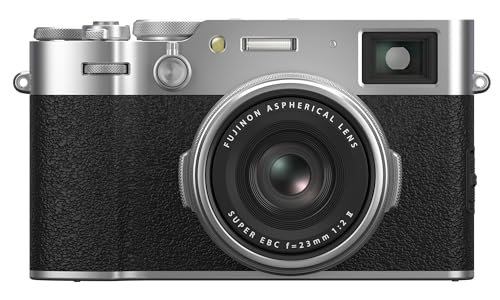
The X100VI is the camera that turned film simulation from a feature into a movement, and holding it explains why. The body is styled after the rangefinders of the last century — silver top plate, knurled dials, a viewfinder you can switch between optical and electronic — yet the vintage effect runs deeper than the costume. Its simulation library renders colour the way stocks did: Nostalgic Neg softens contrast and warms the palette into something that looks remembered, Classic Chrome mutes and deepens like an old magazine page, and the black-and-white modes carry grain structures modelled on real emulsions.
The fixed lens is a philosophical position. You cannot zoom, so you walk; you cannot swap, so you learn one focal length until it becomes the way you see. That constraint, more than any dial, reproduces the film-era shooting experience, and the photographs benefit — composed with feet and intention rather than assembled afterward. The leaf shutter adds a near-silent, vibration-free exposure that suits candid work, and it syncs flash at speeds mechanical shutters cannot, for those who chase the direct-flash look of old party snapshots.
Its second analysis angle is social: this camera changes how subjects behave. People relax in front of it because it reads as an heirloom rather than a professional instrument, and relaxed subjects are the raw material of photographs that feel like memories. Street photographers and family documentarians both exploit the same effect. Add the in-camera grain control and highlight-tone adjustments, and a patient owner can build a personal “stock” — a saved recipe that renders every frame like the same roll of an imaginary film only they shoot.
Honesty requires noting the friction: demand for this camera has chronically outrun supply, its fixed lens genuinely cannot do everything, and its menu depth rewards study. But as a single instrument for producing vintage-looking photographs digitally — convincingly, repeatably, at no cost per frame — nothing else in this guide or beyond it makes the case as completely.
- Lens: fixed wide-normal, leaf shutter
- Colour: full film-simulation library with grain control
- Viewfinder: hybrid optical and electronic
- Body: analogue-styled dials, compact rangefinder shape
- Flash: syncs at leaf-shutter speeds for snapshot looks
Strengths
- Most convincing in-camera vintage colour available
- Fixed lens enforces film-era shooting discipline
- Subjects relax in front of its heirloom styling
Trade-offs
- Chronically hard to find in stock
- One focal length, forever, by design
- Recipe-tweaking can become its own hobby
Best for: digital shooters who want authentic vintage colour with zero per-frame cost. Not suited for: photographers who need zoom range or interchangeable lenses daily.

Fujifilm Instax Mini 12 — Best Instant for Parties
The Instax Mini 12 produces vintage-looking photographs by the oldest method in this guide: it makes actual instant prints, small and glossy, with the soft contrast and kind colour that chemistry gives skin at a party. There is no simulation to evaluate because nothing is simulated. The print that ejects, whirring, into a friend’s hand is already an artefact — slightly imperfect, warmly toned, and physically incapable of being edited, which is precisely its vintage authority.
Operation is a study in removal. Twist the lens to switch on, point, press; automatic exposure and a selfie mirror handle the rest, and the close-up mode corrects the parallax that ruined a generation of instant close portraits. That simplicity is the feature. At a wedding table or a birthday, the camera passes between people who have never read its manual — there is barely a manual to read — and every one of them produces a keepsake. Vintage photography was always a social technology before it was an art form, and this camera remembers that.
Count the film before you celebrate the camera’s price. The body is the cheapest linked pick here by a wide margin, but the film is the subscription: Mini packs price each print at a real, countable cost, and a lively party consumes packs the way it consumes ice. Budget for the film, not the camera, and treat each frame’s cost as the discipline that makes people pose properly instead of spraying. The small print size suits wallets, mirrors, and fridge doors — the places vintage photographs actually lived.
What it will not do is equally clear. The prints are small, the detail is gentle, low light leans on a flash that flattens, and there is no digital file unless you scan the print later. Photographers wanting large, detailed vintage images should look at the Fujifilm digital picks. Photographers wanting a roomful of people to go home with a photograph in a pocket — a genuinely old-fashioned outcome — should buy film in bulk and start here.
- Format: Instax Mini instant prints
- Exposure: fully automatic with close-up mode
- Extras: selfie mirror beside the lens
- Running cost: per-print film packs
- File: physical print only, scan to digitise
Strengths
- Real instant prints with natural vintage colour
- Anyone can use it within ten seconds
- The print itself becomes the gift and the memory
Trade-offs
- Small prints with gentle detail
- Film cost accumulates at lively events
- Flash look dominates in dark rooms
Best for: parties, weddings, and anyone who wants vintage prints as physical objects. Not suited for: large prints, detailed landscapes, or a digital-first workflow.

Polaroid Go Generation 2 — Best Pocket Instant
The Polaroid Go is the smallest camera carrying the most famous name in instant photography, and its photographs look vintage in the specific Polaroid dialect: square-ish frames with deep, slightly moody colour, highlights that dream a little, and a chemical unpredictability that means two frames of the same scene are cousins rather than twins. Where Instax renders the past as cheerful, Polaroid renders it as wistful, and many photographers find the wistful dialect the more convincing one.
Size is its opening argument. The Go disappears into a jacket pocket or a small bag in a way no other pick here attempts, which means it is present for the unplanned moments — the roadside stop, the kitchen laugh, the dog in unexpected light — that become the photographs people keep. A vintage look depends heavily on subject matter, and subject matter depends on the camera actually being there. The best vintage camera is the one in your pocket when the light turns golden over an ordinary street.
The second generation refined the practicalities: a more reliable exposure system, a self-timer, a selfie mirror, and double-exposure capability for the experimentally inclined. Battery life arrives over USB charging rather than disposable cells. The film, a miniature of the classic Polaroid format, costs meaningfully per frame — more than Instax Mini — and the smaller print trades presence for portability. Handle frames gently while they develop and shield them from light during the first minutes; Polaroid chemistry rewards a little ceremony.
Choose the Go when the Polaroid palette is the point and the pocket is the constraint. It is not a precision instrument and will frustrate anyone metering exposures in their head; it is a mood instrument, tuned at the factory, that produces small square memories with an authenticity no filter subscription can invoice you for monthly.
- Format: miniature Polaroid instant film
- Size: genuinely pocketable body
- Features: self-timer, selfie mirror, double exposure
- Palette: moody, dream-leaning Polaroid colour
- Power: rechargeable over USB
Strengths
- The classic Polaroid look in a pocket camera
- Present for unplanned moments other cameras miss
- Double exposures invite playful experimentation
Trade-offs
- Film costs more per frame than Instax Mini
- Tiny prints reward closeness, not detail
- Chemistry varies frame to frame by nature
Best for: everyday carry and lovers of the moody Polaroid palette. Not suited for: high-volume events or photographers who need consistent, repeatable results.

Fujifilm X-T5 — Best Vintage-Styled System
Where the X100VI commits to one lens and one vision, the X-T5 offers the full vintage-styled system: the same beloved simulation library, the same philosophy of dedicated dials for shutter, ISO, and exposure compensation, but on an interchangeable-lens body with resolution to spare. Photographers who shoot vintage-looking portraits on Monday and sharp commercial work on Friday — and want one camera fluent in both centuries — start their deliberation here.
The dials deserve their reputation as more than styling. Setting exposure by touch, before raising the camera, changes the tempo of a session the way a film camera’s did; you think in whole stops and intentions rather than in menu pages. Paired with Fujifilm’s aperture-ring lenses, the X-T5 is the digital camera that most often gets mistaken, in the hand and in the results, for the film bodies it honours. Its simulations include the same nostalgic and chrome renderings as the X100 line, applied to a sensor with cropping room the fixed-lens camera cannot offer.
The second angle is longevity. A system body grows: a fast prime for candlelit portraits with vintage glow, a small pancake for street work, an adapted vintage lens — and here the X-T5 performs a lovely trick, because genuinely old glass on a modern sensor produces genuinely old rendering, halation and all, with focus aids the original cameras never had. The vintage look stops being a simulation at that point and becomes optics.
Its costs are size, price, and the temptation of the lens catalogue. It is a serious camera that asks to be learned, and its video and autofocus capabilities, while strong, are not why it is in this guide. Buy it as the centre of a vintage-styled practice you intend to keep for years, and it will not embarrass that intention.
- Mount: interchangeable Fujifilm X lenses
- Controls: dedicated shutter, ISO, and compensation dials
- Colour: full simulation library, high-resolution sensor
- Adaptability: welcomes vintage glass with focus aids
- Role: the system camera for a long vintage practice
Strengths
- Analogue handling with a modern, capable sensor
- Lens choice widens the vintage vocabulary
- Adapts real vintage lenses beautifully
Trade-offs
- A real investment before the first lens
- Larger than the fixed-lens Fujifilm
- Capability far beyond the vintage brief
Best for: committed photographers building a vintage-styled system for years. Not suited for: casual shooters who want the look without the learning curve.
Canon AE-1 Program (prose-only) — Best True Film Experience
This pick carries no purchase link, and the reason is the recommendation itself: the AE-1 Program is a film SLR from the early 1980s, bought used, and any honest guide sends you to a reputable used dealer or a serviced listing rather than pretending a tidy retail box exists. What you get for that inconvenience is the genuine article — a camera that does not simulate vintage photographs but simply takes them, on 35mm film, exactly as it did when new, because nothing about its process has changed.
The ritual is the curriculum. You load the roll, set the ISO dial to the film’s speed, choose a shutter or let the Program mode choose, focus through a bright split-image screen, and feel a mechanical shutter do its work. Thirty-six exposures might last a weekend or a month, and every one of them costs money, which reorganises a photographer’s brain in ways no digital constraint can imitate. Then the envelope comes back from the lab, and the photographs have grain because grain is what film is.
Glass, not the body, is where an AE-1 Program keeps paying you back. Canon’s FD mount hosts decades of excellent, now-inexpensive glass — fast primes with the gentle contrast and occasional flare that modern coatings engineered away. A serviced AE-1 Program with a standard fast prime is, totalled honestly, still one of the cheapest entries into serious film photography, provided you budget for the two consumables that never stop: film and developing, plus scanning if you want files as well as negatives.
Buy with your eyes open. Any forty-year-old camera may need light seals, a battery, and a service; factor a check-up into the price and buy from sellers who describe honestly. The reward for that diligence is the reference standard against which every simulation in this guide is quietly judged.
- Format: 35mm film, Canon FD lenses
- Exposure: Program automatic plus manual control
- Focus: manual, split-image viewfinder screen
- Running cost: film, developing, optional scanning
- Source: used market; buy serviced where possible
Strengths
- Actual film grain and colour, not a rendering
- Vast, affordable classic lens ecosystem
- The full deliberate ritual of film photography
Trade-offs
- Every frame costs money and days
- Used condition varies; service may be needed
- No preview, no undo, no exceptions
Best for: photographers who want the real film process and its real results. Not suited for: anyone who needs images today or shoots in high volume.
Holga 120N (prose-only) — Best Toy-Camera Chaos
The Holga is a plastic box that shoots medium-format film through a plastic lens, leaks light through seams its designers never sealed, vignettes every frame into a tunnel of attention, and produces — when the chaos aligns — photographs of a dreamlike vintage character that no careful camera can manufacture. It is the second prose-only pick in this guide, sold cheaply through specialty and used channels rather than our verified pool, and described here because a vintage guide without a toy camera is a menu without the chef’s strangest dish.
Understand what you are buying: unpredictability as a medium. Focus is a guess between pictogram settings, exposure is a choice between two apertures and hope, and the film advance is a knob you must remember to wind, which you will not, producing double exposures the surrealists would envy. Photographers raised on computational perfection either bounce off the Holga within a roll or fall for it permanently. There is very little middle ground, and the entry price — camera cheap, film and developing the same as any medium format — makes the experiment survivable.
Forget specifications for a moment and look at what a Holga does to a scene. The Holga’s flaws impose a style so strong that the photographer’s remaining job is pure seeing: find the subject that deserves a dream. Portraits soften into reverie, landscapes into memory, and ordinary streets into evidence from a half-remembered decade. Entire respected bodies of work exist in this dialect. Shooting a roll through a Holga once a season is also, veterans report, a palate cleanser that improves their careful photography by contrast.
Tape the seams if you want fewer leaks, leave them if you want more, and label your rolls, because the lab will return images you do not remember taking and could not take again. That irreproducibility is either the Holga’s disqualification or its entire point, and by now you know which reader you are.
- Format: 120 medium-format film
- Lens: fixed plastic, soft by constitution
- Exposure: two apertures, one shutter speed, hope
- Character: vignetting, leaks, dream softness
- Source: specialty and used channels, prose-only here
Strengths
- Unrepeatable vintage character no filter replicates
- Medium-format negatives at a toy’s entry price
- Forces pure seeing over technical fussing
Trade-offs
- Results genuinely unpredictable roll to roll
- Film and developing costs are full price
- Some frames will simply be lost to the chaos
Best for: experimental photographers who court accident and dream-logic images. Not suited for: any assignment where the photograph must come back as planned.
Three Roads to the Past: The Comparison
| Pick | Road | Cost per frame | Defining virtue |
|---|---|---|---|
| Fujifilm X100VI | Digital simulation | None after purchase | Convincing colour, film-era discipline |
| Fujifilm Instax Mini 12 | Instant film | Modest, per print | A physical keepsake in ninety seconds |
| Polaroid Go Generation 2 | Instant film | Higher, per print | Moody Polaroid palette, pocket size |
| Fujifilm X-T5 | Digital system | None after purchase | Dials, lenses, and room to grow |
| Canon AE-1 Program | 35mm film | Film plus developing | The genuine article, ritual included |
| Holga 120N | Toy medium format | Film plus developing | Chaos as an artistic medium |
Read the table by its middle column and the category explains itself: you pay for vintage character either once, in a digital body, or forever, in film. Neither answer is the frugal one in the abstract. A wedding season of Instax can outspend an X100VI; a decade of simulation shooting costs nothing beyond the body. Match the payment rhythm to your shooting rhythm — volume shooters belong on the digital road, occasion shooters can afford the chemical ones.
The other honest reading is about certainty. The digital picks deliver their look on demand, frame after frame, which suits work other people are counting on. The film and instant picks deliver their look statistically — most frames lovely, some frames lost, a few frames transcendent in ways nobody ordered. Choose certainty for obligations and chance for joy, and you will rarely regret a purchase in this category.
How Do You Shoot Vintage-Style Digital Without It Looking Fake?
Start in the camera, not the editor. Choose one simulation and live with it for a whole outing rather than auditioning six per photograph; real film photographers never had the option, and the consistency across a set is half of what makes a set feel like a roll. Soften the camera’s sharpening, let highlights keep their glow by exposing slightly for them, and resist the clarity slider’s modern insistence that every pore testify.
Then shoot vintage subjects with vintage grammar. Old photographs centre their subjects, include the environment, and accept the light the day provided. A simulation applied to a aggressively modern composition — extreme angles, heavy HDR habits, subjects cropped like advertisements — produces the costume effect this guide warned about. Slow down, square up, and let the scene be ordinary; ordinariness, rendered in nostalgic colour, is the whole aesthetic.
Finally, print something. A vintage-looking file on a phone screen is a rumour; the same image as a matte print on a table is a photograph. Printing also audits your settings mercilessly — overdone grain and crushed shadows confess on paper. Many simulation shooters find that printing a monthly handful disciplines their recipes better than any tutorial.
How Do You Match a Stock, Simulation, or Chemistry to a Subject?
Portraits want kindness. The renderings that flatter skin are the ones with softened contrast, warm mid-tones, and highlights that glow rather than glare — which is why the nostalgic simulations, the instant chemistries, and the classic portrait film stocks all share that recipe despite arriving by different roads. For faces, also mind your distance: the wide fixed lenses on several picks here will distort a close portrait the way old snapshot cameras did, which reads as period charm on a candid and as an insult on a formal sitting. Step back, include the room, and let the era’s grammar work.
Landscapes want the opposite emphasis. Aged landscape photographs are remembered for their skies — cyan-leaning, gently blown at the horizon — and for greens that slide toward olive and gold. Chrome-style simulations and the moodier instant chemistry deliver that palette natively, while toy cameras add the vignette that turns a field into a memory of a field. Shoot landscapes in the soft hours and the rendering has less work to do; midday contrast fights every vintage process ever invented.
Street and everyday scenes want speed and forgiveness. The vintage street archive was shot on whatever the photographer carried, often zone-focused, often a half-stop wrong, and its energy comes from that imperfection. This is the Holga’s home turf and the X100VI’s quiet triumph: both let you pre-set, raise, and fire without a menu intervening between the moment and the frame. If your vintage ambition is documentary, choose the camera that disappears fastest.
Interiors and evening scenes are the stress test. Every vintage process is hungry for light in its own way — instant film reaches for its flash, film stocks push grain into the shadows, simulations lean on the sensor’s high-ISO manners. Decide in advance which compromise is your aesthetic: the direct-flash snapshot look is authentically period, the grainy available-darkness look is authentically period, and the clean modern low-light look is not period at all. All three are available in this list; confusion only arrives when a photographer wants the third while claiming the first two.
How Should You Build a Vintage Shooting Habit That Lasts?
Give the look a project, because projects survive motivation. A year of photographing one street, one market, one grandparent’s house, or one child’s growth on a single camera and a single rendering produces a body of work whose consistency is itself vintage — archives look the way they do because one person, one camera, and one process stayed together. The photographers who churn through simulations weekly produce experiments; the ones who commit produce a style other people can recognise across a room.
Keep a small notebook, physical if you can bear it. Film photographers wrote settings on envelope backs; instant photographers write dates on print borders; simulation shooters should log recipes and the light they were shot in. The notebook is partly practical — it makes your best results repeatable — and partly ceremonial, an analogue habit that slows the digital half of this hobby back toward the tempo the aesthetic came from.
Share prints, not only posts. The vintage photograph completed its life on paper, in hands, on walls, and a practice that ends at a screen keeps only the costume of the thing. A monthly handful of prints — from the instant cameras directly, from the digital and film picks through any decent lab — will teach you more about your own rendering choices than a season of zooming into corners. Paper is the strictest editor this genre has.
Finally, protect the originals like an archivist, because you are building the thing future nostalgia will be made of. Negatives in sleeves, instant prints out of sunlight, digital files in two places with the recipe recorded beside them. The vintage look began as an accident of survival — the photographs that lasted were the ones somebody stored kindly. Shoot yours kindly from the start.
How Do You Care for Older Cameras, Prints, and Negatives?
Used film cameras ask for modest, regular kindness. Store them dry and out of heat, exercise the shutter occasionally through its speeds, and replace spongy light seals before they shed foam into the film chamber — a cheap, unglamorous service that prevents the one flaw, stray light fogging, that even vintage romantics do not forgive. Lenses live capped, and a camera that has sat for a decade deserves one professional inspection before it is trusted with an unrepeatable occasion like a wedding.
Instant prints ask for gentleness in their first minutes and darkness thereafter. Let a fresh print develop face-down or in a pocket, away from bright light; then file it in an album or a box rather than leaving it on a sunlit sill. The chemistry has finished its work, but its dyes remain more light-sensitive than conventional prints, and the fridge-door display, while traditional, should rotate its exhibits.
Negatives and files are the deep archive. Sleeve negatives without touching the image area, store them cool and dry, and scan at a resolution that honours the medium-format and 35mm detail you paid film prices to capture. For digital simulation work, archive the recipe with the file — a future re-edit from a clean version is only possible if you kept one, and the photographers who shoot simulation-only JPEGs should at least keep the recipe card that made them.
None of this care is expensive, and all of it compounds. The vintage aesthetic is, at bottom, a love letter to photographs that survived; treating your own output as future survivors is the most authentic vintage practice available to a modern photographer, more authentic than any grain overlay ever rendered.
What Mistakes Do Vintage-Style Photographers Make?
Stacking effects leads the list: a simulation, plus a grain overlay, plus a faded filter, plus a vignette, until the photograph looks less like 1974 and more like a themed restaurant. Real aged photographs are usually one process deep. Pick your process — one simulation, one film stock, one instant chemistry — and let it speak at natural volume.
Neglecting running costs is the financial classic, already flagged but worth its own paragraph because it ends hobbies. Count the full price of a film year — rolls, developing, scanning, postage — before romanticising the cheap used body, and count instant packs before the party, not after. The photographers still shooting film happily in year three are the ones who budgeted year one honestly.
Buying the look before the seeing is the quietest mistake. A vintage camera cannot supply the patience, framing, and subject sense that make old photographs moving; it can only render your seeing in an older accent. Spend a month shooting your current camera slowly and deliberately, and if the discipline delights you, every pick in this guide will multiply that delight. If it bores you, no simulation will save the purchase.
How Do Lenses Change the Vintage Character of a Photograph?
Ask a room of film photographers what makes an old photograph look old and the chemists will argue for grain while the opticians argue for glass — and the opticians have the quieter, stronger case. Older lenses render with lower contrast, gentler coatings that flare when light strikes them, and edges that soften because correction was expensive. A modern sensor behind genuinely old glass, as the X-T5 allows through adapters, inherits all of that behaviour physically. No simulation menu models your specific lens’s flare at f/2 on a November afternoon; the glass simply does it.
Flare deserves its own sentence because it is the vintage signature most often faked badly. Real flare veils a region of the frame, lifting shadows toward the light’s colour, and it follows the geometry of the scene — brightest near the source, fading with distance. Software veils uniformly, which the eye detects as a filter rather than as light. Shooting a slightly uncoated or older lens toward windows and low sun produces the true effect for free, and learning to place it — half in frame, at the edge of a portrait — is a craft skill this category quietly teaches.
Sharpness distribution matters as much as sharpness itself. Vintage lenses are typically honest in the centre and dreamy at the corners, a pattern the Holga exaggerates into theatre and classic portrait lenses refine into flattery. Modern digital vintage styles imitate this with vignette and blur tools, but the optical version interacts with depth — the corner softness grows as you open the aperture — in ways that reward a photographer’s judgment rather than a slider’s position.
The practical consequence for buyers: if you choose the system route, budget for one characterful lens before a second body, and consider adapted classics alongside native glass. If you choose a fixed-lens pick, you are choosing its lens’s character as your house style — which is why the fixed picks in this guide were judged as much on their optics’ temperament as on their sensors or simulations. In vintage photography, the lens is not an accessory to the look. Arguably, it is the look, and everything else is storage.
What Should a Year of Vintage Shooting Honestly Cost?
Run the three roads as budgets and the category’s economics sharpen. The digital road concentrates everything into the purchase: a simulation body, a card, perhaps one extra lens, and then a year of heavy shooting costs nothing but electricity. For a photographer making thousands of frames, this is unbeatably cheap per photograph, and it is why professionals who love the look — wedding photographers delivering nostalgic galleries at volume — almost all work digitally beneath the aesthetic.
The instant road spreads its cost across every occasion. A party might consume several packs; a year of gatherings, holidays, and weekends accumulates into a sum that surprises people who only priced the camera. The honest way to hold it is as an entertainment and gifting budget rather than a photography budget: each print is an object somebody keeps, and priced against printed party favours or a round of drinks, the film usually wins the comparison it actually belongs in.
The film road is the subscription with the highest rate and the deepest return. Rolls, developing, and scanning multiply by every thirty-six frames, and a devoted film photographer should expect the annual consumables to rival a mid-range digital body over a few years. What the subscription buys is the archive itself — negatives that will outlive every file format in this guide — plus the discipline this article keeps praising. Photographers who know the number and pay it gladly tend to stay; photographers who discover it by accident tend to leave, which is why this guide insists on printing the number early.
There is also a resale asymmetry worth knowing. Quality film bodies and characterful old lenses have held or grown their value for years, and the sought-after digital simulation bodies depreciate unusually slowly, while toy cameras and instant bodies are consumable-priced from the start. Vintage photography, unusually among hobbies, lets its pilgrims recover much of their stake — provided they bought the instruments, rather than the filters, in the first place.
Final Recommendation
For most readers, the Fujifilm X100VI is the answer: the most convincing vintage rendering in digital form, wrapped in a body that teaches film-era habits, at zero cost per frame. Choose the Fujifilm X-T5 instead when your vintage practice needs lenses, resolution, or a second life as a modern system camera.
Let the occasion photographers take the instant road without a moment’s guilt — the Instax Mini 12 for generous, cheerful prints at gatherings, the Polaroid Go for the moody palette in a pocketable form. And let the pilgrims walk the film road knowingly: the Canon AE-1 Program for the true and teachable classic experience, the Holga for glorious, unrepeatable chaos. The past is a big country; these six are its most reliable border crossings.
Related guides
- Best Digital Cameras for Dummies: Great Photos With Zero Learning
- Best Cameras to Use for Tintype: The Honest Guide to Real Wet Plate and Digital Homage
Frequently Asked Questions
Can a filter make any modern camera look vintage?
A filter can imitate colour, but vintage character also lives in highlight behaviour, grain structure, and lens rendering, which filters approximate unevenly. The convincing results in this guide come from cameras whose colour science, chemistry, or optics produce the look natively. Filters are a fine experiment and a poor foundation.
Which film simulation looks most like real film?
Photographers most often cite the nostalgic and chrome-style simulations for print-like softness and shifted colour, and the monochrome modes for grain with believable structure. The honest answer is that each simulation resembles a family of stocks rather than one emulsion — shoot the same scene across several and keep the one that matches the past you personally remember.
Is shooting real film worth the cost in 2026?
For the photographs alone, digital simulation is cheaper and nearly as convincing. For the process — the discipline, the wait, the envelope of prints, the negative in a sleeve — film offers something simulation structurally cannot. Photographers who value the ritual call the cost tuition; photographers who do not should save their money without apology.
Why are two picks in this guide not linked for purchase?
The Canon AE-1 Program and the Holga 120N live on the used and specialty markets, where condition and provenance matter more than a tidy listing. We describe them honestly as prose-only recommendations and suggest serviced, reputable sellers rather than inventing a retail link that would not serve you.
Do instant prints fade over time?
Instant prints are more delicate than conventional photographs: keep them out of prolonged direct sunlight, away from heat and humidity, and they will hold their colour well for years. Many owners scan their favourites as insurance, keeping the object for its charm and the file for its permanence.
Should I shoot vintage colour or vintage black and white?
Black and white is the more forgiving entry and, for many subjects, the more convincing one: grain structure, highlight bloom, and tonal softness carry the entire period effect without colour shifts to argue about, and both Fujifilm bodies here offer monochrome renderings modelled on real emulsions. Portraits, street scenes, and architecture all thrive in it. Colour is the richer prize and the harder one — its shifts must feel like a specific stock rather than a general fade — so many photographers spend a season in monochrome learning the discipline, then graduate to colour with a steadier hand.
What is the cheapest way to start shooting vintage-style?
An instant camera with a modest stack of film is the lowest total entry, and it teaches the core discipline — few frames, meant fully — from the first pack. If you already own a camera with strong colour profiles, a month of deliberate, simulation-only shooting costs nothing at all and will tell you whether the aesthetic is a phase or a practice. Treat that month as an audition for the whole category: one rendering, no filters, prints at the end, and an honest verdict from the person whose eye you trust most.
Related Guides
Keep exploring the older accent with our companion reading: best cameras for vacations for travel frames with a timeless feel, best cameras for video art for moving images with texture, and best cameras for vlogging and video for the modern counterpoint to everything above.


