kajuandouglas.com is reader-supported. When you buy through links on our site, we may earn an affiliate commission.
Where to Buy
The best compact digital cameras for beach days are chosen by an environment that is actively hostile to electronics. A beach is water, sand, salt, glare, and heat arranged into a holiday: spray rides the wind further than anyone expects, sand migrates into every seam and pocket, the sun turns screens into mirrors, and the light — glorious, hard, reflective — exposes every weakness in a camera’s metering. An ordinary compact taken to the beach is a camera being slowly unmade; the picks in this guide are the ones designed, sealed, or priced to thrive there.
Two philosophies divide the shortlist. The first is armour: cameras waterproof as they come, shockproof against the drop onto boardwalk and rock, with lenses that shrug off the wipe of a sandy thumb. The second is expendability with talent: action cameras inexpensive enough to ride the bodyboard and the beach game’s chaos without the owner’s pulse rising. Between them sits one deliberate exception — a tiny instant camera included because beach memories have a social life that files cannot match, with its risks stated plainly.
Beach photography also has a look, and it is not the look of other genres. The light is enormous and overhead at midday, tender at the day’s edges; the subjects are wet, moving, laughing, and half in the water; the photographer’s hands are sandy and their attention is divided between the camera and the swimmer they are nominally supervising. Cameras for this work need controls that operate by feel, screens that fight glare, and autofocus that finds faces among splashes — practical virtues this guide weights above specification-sheet glamour.
One honesty note before the picks: “waterproof” in this guide means the camera as sold, used within the maker’s stated limits, with its seals clean and its doors properly closed. Every waterproof pick below carries that discipline in its review, because the sea respects ratings only when owners respect seals. Read those lines as part of the product, not as fine print.
Key Takeaways
- The OM SYSTEM Tough TG-7 is the beach stills champion: waterproof, shockproof, and a real photographer’s compact underneath the armour.
- The GoPro HERO13 Black films the surf, the swim, and the ride with stabilisation that laughs at waves.
- The DJI Osmo Action 5 Pro is the long-day action pick — strong battery manners and excellent screens for glare.
- The Insta360 X4 captures the whole beach at once, so the photographer can be in the scene instead of behind it.
- The AKASO Brave 7 LE is the risk-it budget pick for bodyboards, beach games, and children’s hands.
- The Polaroid Go Generation 2 prints the beach day on the spot — kept dry, it is the holiday’s social star.
The shortlist’s logic in one line: the TG-7 photographs the beach, the action trio film it from inside, the Brave risks it cheaply, and the Polaroid remembers it physically.
In this guide
Quick Picks
| Badge | Pick | Why it stands out |
|---|---|---|
| Best Beach Camera Overall | OM SYSTEM Tough TG-7 | Waterproof, shockproof compact with real photographic control and macro talent. |
| Best for Surf and Swim Video | GoPro HERO13 Black | Mounts anywhere, stabilises everything, and lives in the water. |
| Best for Long Beach Days | DJI Osmo Action 5 Pro | Endurance, bright dual screens, and superb stabilisation for all-day filming. |
| Best for Whole-Scene Capture | Insta360 X4 | Records the entire beach sphere; frame the moment afterwards. |
| Best Budget Risk-Taker | AKASO Brave 7 LE | Case-protected action filming cheap enough for kids and bodyboards. |
| Best for Instant Beach Prints | Polaroid Go Generation 2 | Tiny prints for the beach bag — with a strict keep-it-dry discipline. |
Every pick except the Polaroid is at home in the water; every pick including the Polaroid is at home in the social weather of a beach day. Choose first by where the camera will spend its hours — in the surf, on the towel, or in a child’s fist — and the table resolves itself.
How We Chose These Picks
Testing took the shortlist to the shore for full days, not demonstrations: swimming sessions, a bodyboard morning, beach games with children, a windy afternoon when the spray reached the promenade, and the long glare of a cloudless midday. Cameras were used with wet hands, sandy hands, and sunscreened hands — the beach’s three operating conditions — and controls that failed any of the three were marked down without sympathy.
Water discipline was tested as owners will actually practise it: doors checked, seals inspected for the sand grains that defeat them, cameras rinsed under the beach tap at day’s end as the manuals prescribe. The guide reports the ownership ritual alongside each waterproof pick because the rating on the box is a partnership, and the owner’s half is thirty seconds of care per day.
Screens were judged at noon, facing the water — the worst glare geometry in photography — and again at golden hour, when beach photography becomes everyone’s favourite. Autofocus was tested on swimmers, runners, and one extremely uncooperative beach dog. Battery claims were measured against real days that mixed filming, standby in the heat, and the long sunset session, because a beach camera that dies before the light gets good has failed at the exact moment it was bought for.
Stills and video were weighted by each camera’s honest calling rather than a single yardstick: the TG-7 was judged as a photographer’s camera, the action trio as film tools, the Brave as a risk instrument, and the Polaroid as a social one. A beach kit, like a beach day, is allowed its specialists.
What Must the Best Compact Digital Cameras for Beach Days Actually Survive?
Water first, in its three beach forms: immersion for the swimmers and snorkellers, spray for everyone within fifty metres of the surf, and the wet hand, which is how most “dry” beach cameras actually meet the sea. The waterproof picks here are rated for genuine immersion within their makers’ limits; the guide’s discipline sections explain the seal care that keeps those ratings true across a season rather than a weekend.
Sand second, because sand is the beach’s quiet assassin. It abrades screens, jams lens mechanisms, infiltrates charging ports, and — most dangerously — lodges in waterproof door seals, where a single grain can hold the sea’s door open. Cameras with fixed lenses, sealed bodies, and minimal moving exterior parts survive sand by design; the owner’s half is the rinse, the soft brush, and the refusal to change batteries or cards on the towel. Every pick here was assessed on that design honesty.
Glare and heat third. A beach screen must be readable with the sun behind the photographer and the sea in front — the brightest natural scene on earth — and a beach battery must hold its charge in a hot bag between sessions. The picks divide honestly here too: the action cameras’ bright little screens and the TG-7’s considered display cope; all of them prefer the shade of the beach bag to the dashboard of a parked car, and the guide’s care section treats heat as the third element of the beach’s assault.

OM SYSTEM Tough TG-7 — Best Beach Camera Overall
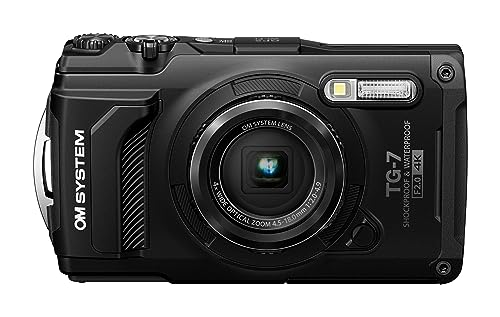
The TG-7 is the answer for the beachgoer who is, before anything else, a photographer. Beneath its armour — waterproof to serious depths, shockproof against the drops that boardwalks and rocks administer, sealed against the sand that kills ordinary compacts — sits a real camera: a bright zoom lens, proper photographic controls, RAW capture for those who edit, and a macro system so good that the rock pool becomes a studio. It photographs the beach the way a photographer’s camera should, then goes swimming without changing its clothes.
Its beach intelligence is specific. The lens’s brightness serves the day’s edges — the dawn swim, the sunset game — where lesser compacts reach for flash. Underwater modes balance the colour the sea steals, so snorkelling photographs come back with their reds remembered. The macro modes, with their microscope-like close focus, turn shells, crabs, and wet sand patterns into the day’s most original photographs, the ones no phone at the beach can imitate. GPS and environmental logging ride along for the travellers who map their coasts.
Ownership discipline is the price of the armour: seals inspected and kept sand-free, doors closed with intention, a fresh-water rinse after salt days. Its video is competent rather than class-leading — the action picks below are the film specialists — and its small sensor shares the compact class’s low-light limits once the beach empties and the bars light up. As the stills camera of the shoreline, nothing else in this guide is close.
- Protection: waterproof, shockproof, dustproof as sold
- Lens: bright zoom with exceptional macro modes
- Modes: underwater colour correction built in
- Files: RAW available for editors
- Care: seal checks and fresh-water rinses after salt
Strengths
- A real photographer’s compact that swims
- Macro work turns rock pools into studios
- Armour ends beach anxiety entirely
Trade-offs
- Video is competent, not class-leading
- Seal discipline is a daily ritual
- Low light after dark is compact-class ordinary
Best for: photographers who swim, snorkel, and explore rock pools. Not suited for: video-first creators or the seal-careless.

GoPro HERO13 Black — Best for Surf and Swim Video
The HERO13 treats the ocean as its native studio. Waterproof without a case, it mounts to the board, the paddle, the chest, and the snorkel mask, and its stabilisation performs its party trick precisely where the beach needs it: footage from inside breaking waves and off the back of a jet ski arrives calm enough to seem staged. For the beach’s moving life — the surf lesson, the kayak morning, the children’s wave-jumping — it is simply the correct instrument.
Beach practicality runs through its details. Voice control starts and stops recording when hands are wet and holding something more important. The tall framing captures the vertical clip and the wide scene from the same take, so one swim produces both the family archive and the social post. Lens options and the mount ecosystem let the same camera ride a bike to the beach, film the ride, and then go swimming — a full holiday day in one small, unkillable package.
Its manners are the action camera’s known ones. Faces filmed close wear the ultra-wide distortion; dusk turns its footage grainy as the beach bars take over the storytelling; and its stills are serviceable grabs rather than photographs. Keep it for the water and the motion, pair it with the TG-7 or a phone for the portraits and the sunset, and the beach kit is complete at two devices.
- Build: waterproof without housing, mount-ready
- Stabilisation: elite smoothing in surf and motion
- Control: voice commands for wet, occupied hands
- Framing: tall sensor serves vertical and wide together
- Ecosystem: mounts for boards, bikes, and boats
Strengths
- Films from inside the water’s action
- Surf footage smoothed to an uncanny calm
- One camera covers the whole active day
Trade-offs
- Ultra-wide look distorts close faces
- Grainy as the light fails
- Stills are grabs, not photographs
Best for: surfers, swimmers, and active beach families. Not suited for: portraits or evening scenes.

DJI Osmo Action 5 Pro — Best for Long Beach Days
Beach days are long, and the Action 5 Pro is the action camera built like it knows. Its battery endurance is the class’s benchmark — the camera that films the morning swim, the midday games, and the sunset session with the fewest anxious glances at the gauge — and its dual screens, bright enough to argue with the noon glare, frame from either side: the mounted shot checked from behind, the self-filmed piece composed from the front. Waterproof as it comes, stabilised to a polish, it is the professional’s beach action camera.
Details reward the all-day brief. Its colour holds up in the hard, reflective light that bleaches lesser action footage, and its low-light behaviour is the strongest among the action picks here — the beach party and the pier at dusk stay watchable a stop longer than rivals manage. Subject tracking and the maker’s microphone ecosystem serve the creator filming a beach series; the mounting system is the standard quarter-inch-and-fingers world every beach rig already speaks.
It asks the usual action-camera acceptances: the wide fixed view, the small-sensor ceiling in true darkness, the care with lens and seals that salt water demands of everything. Within the genre, though, it is the pick for the beachgoer who films all day and edits all evening — the one whose holiday output is a series, not a souvenir.
- Endurance: class-leading battery for full beach days
- Screens: bright front and rear for glare conditions
- Build: waterproof as sold, standard mounts
- Light: strongest low-light manners among action picks
- Colour: holds up in hard, reflective beach light
Strengths
- Films the entire day without power anxiety
- Screens that fight noon glare successfully
- Dusk footage a class above its rivals
Trade-offs
- Fixed ultra-wide view, as the genre dictates
- True darkness still defeats it
- Seal and lens care after salt sessions
Best for: all-day filming and beach content series. Not suited for: stills photographers or pitch-dark scenes.

Insta360 X4 — Best for Whole-Scene Capture
The X4 solves the beach photographer’s oldest exclusion: someone has to hold the camera, and that someone is never in the picture. Recording the full sphere, it captures the whole scene — the swimmers and the watcher, the game and the audience, the sunset and the faces it lights — and the framing is chosen later, calmly, in the app. On its invisible selfie stick above the beach games, it produces the floating third-person view that makes bystanders ask which drone you brought.
Water is within its competence, with the discipline its design demands. The camera itself is waterproof within its stated limits for the swim and the snorkel, and dedicated dive cases extend its depths for the reef trip. The reframing workflow turns one snorkelling pass into several clips — the turtle, the coral, your own astonishment — which for holiday editing is a small miracle of economy: film the experience once, harvest it repeatedly.
Respect the twin lenses. They bulge, exposed, on both faces, and a beach bag is a hostile neighbourhood of sand, bottles, and dropped towels; the lens guards travel on, and the camera gets its own pouch, or the sphere acquires a scratch that appears in every direction at once. Reframing also means editing — every clip asks for decisions — and the per-view sharpness trails a dedicated camera’s. For the beachgoer who wants to be in their own holiday film, those are fair prices, gladly paid.
- Capture: full 360 degrees — decide framing later
- Stick: selfie stick vanishes for drone-like beach views
- Water: waterproof within limits; dive case extends depth
- Workflow: one pass over the reef becomes several clips
- Care: lens guards and a pouch are non-negotiable
Strengths
- The photographer finally appears in the beach film
- Missed moments are recoverable in the reframe
- Whole-scene capture of games and gatherings
Trade-offs
- Exposed lenses fear sand and drops
- Every clip requires reframing work
- Per-view sharpness trails dedicated cameras
Best for: group holidays and solo beach travellers. Not suited for: the careless bag or the edit-averse.

AKASO Brave 7 LE — Best Budget Risk-Taker
The Brave 7 LE is the beach camera as a liberating idea: inexpensive enough that the beach can have it. In its waterproof case it rides the bodyboard, straps to the child’s beach racer, and films the wave pool from inside — footage that no precious camera would be allowed to attempt. Its weather-sealed body handles the spray and the sandy hand between case sessions, and its stabilisation keeps the chaos watchable.
Family logistics are its home ground. The front screen frames the group’s self-filmed pieces on the promenade; the rear screen checks the mounted shot before the descent; the kit in the box — case, mounts, the works — means the camera bought on Friday is filming the sea on Saturday without an accessory expedition. For beach houses and club trips, it is also the natural shared camera: lent freely, mourned briefly if the sea wins, replaced without a family meeting.
Its ceilings are the budget’s usual: dusk grain, fine detail a class below the flagship action pair, an app that does its job without elegance. None of these matter at the sizes beach clips are watched, and all of them are the honest price of the freedom it buys. The Brave’s role in a beach kit is not to be the best camera present; it is to be the camera present at the moments the best one was protected from.
- Protection: weather-sealed body, waterproof case included
- Screens: front and rear for groups and mounts
- Kit: mounts and case in the box, ready by Saturday
- Role: the shared, risked, lent beach camera
- Value: flagship freedom at a fraction of flagship cost
Strengths
- Films the moments precious cameras are spared
- Complete kit with nothing essential to add
- The natural camera to lend to children
Trade-offs
- Dusk and low light turn grainy
- Detail trails the flagship action cameras
- App experience is basic
Best for: families, clubs, and bodyboard-mounted fun. Not suited for: evening filming or detail-critical work.

Polaroid Go Generation 2 — Best for Instant Beach Prints
The Polaroid Go is in this guide under a clearly posted warning, and the warning is the review’s first half: it is not waterproof, it does not love sand, and it must live in the dry bag and come out for its moments like a guest of honour. Observe that discipline and it becomes the beach day’s social centre — a palm-sized instant camera whose tiny prints turn a holiday afternoon into a trail of physical souvenirs: the group shot taped to the beach-house fridge before dinner, the print handed to the surf instructor, the card-sized sunset in a phone case.
Its size is its beach virtue. Where the armoured picks are instruments, the Go is a toy in the honourable sense — produced in seconds, passed hand to hand, operated by anyone including the youngest cousin, its flash-forward instant look flattering the bright, bold, sunlit styling of beach clothes and beach light. The double-exposure mode layers the portrait over the seascape; the selfie mirror handles the group frame; the prints develop while the swim continues.
The discipline, stated once more because the sea is unforgiving: dry hands, dry bag, no exceptions, and the camera returns to its shelter between scenes like the non-swimmer it is. Film costs money per frame, and the prints are keepsakes rather than archives. Within those borders, no other pick here produces the thing the Go produces — the holiday, printed, before the holiday ends.
- Output: tiny instant prints, made on the spot
- Size: palm-sized — produced and put away in seconds
- Features: selfie mirror and double-exposure play
- Discipline: strictly dry — dry bag, dry hands
- Running cost: film per frame
Strengths
- Physical souvenirs before the day ends
- Delights every age at the beach gathering
- Instant look flatters sunlit colour and styling
Trade-offs
- Not waterproof — one wave ends it
- Sand and spray are enemies, managed by shelter
- Prints are keepsakes, not archives
Best for: beach houses, gatherings, and print-givers. Not suited for: the water, the sand, or the careless.
How Do You Care for a Camera Through a Beach Season?
Make the rinse a ritual, not a remedy. Every waterproof pick here ends its salt day the same way: doors confirmed closed, a gentle soak or rinse in fresh water, a soft dry, and storage with the doors’ seals inspected in good light. Sand found on a seal is removed with a soft brush or a breath of air — never a sandy fingertip, which grinds the grain across the rubber it was about to defeat. Thirty seconds, daily, is the entire difference between a waterproof rating that lasts a season and one that lasted a weekend.
Between sessions, geography is care. Cameras live in the shaded bag, never on the hot towel in direct sun, never in the parked car whose interior becomes an oven by noon. Batteries and cards are changed indoors or in the car, not on the sand where a dropped card is a donation. Lens surfaces get the blower before the cloth, because wiping sand is sanding. The action picks’ lens protectors and the X4’s guards are replaced when scratched — they are the sacrificial layer doing its job.
At the season’s end, one deeper service: seals examined for nicks and flattening, the maker’s maintenance route used where offered, and the camera stored dry with its doors as the manual directs. Beach cameras die in drawers more often than in waves — stored damp, sealed with salt inside, opened next summer to corrosion. The dry, inspected, rested camera is the one that films next year’s holiday too.
Which Beach Light Should You Shoot In, and When?
The beach day has three lights, and the wise shooter plans around all of them. Morning light is the swimmer’s gift: low, warm, and directional, it flatters faces and gives the sea its green; the TG-7’s bright lens and the action cameras’ best behaviour all belong to this hour. Midday is the enemy wearing a crown — light like a flashbulb the size of the sky, squinting subjects, shadows under every brow. Shoot it in the water, where the ultra-wide action picks turn the glare into sparkle, or retreat to shade and let the sea be the bright backdrop rather than the light source on faces.
Golden hour is why beach cameras exist. The last ninety minutes forgive everything: skin glows, the sea turns metallic, the TG-7’s lens and the Pocket-class sensors would feast — and the action picks, weakest at dusk, should be worked earlier in the hour while the light is still generous. Position subjects with the sun to the side rather than behind the camera, and the flat holiday snap becomes a portrait with modelling and depth.
One technical habit serves all three lights: protect the highlights. Beach scenes are the brightest in ordinary photography, and a camera that keeps the white water and the pale sand textured has kept the picture; the blown, featureless glare that beginners accept as “beachy” is simply overexposure with good PR. A touch of exposure compensation downward, learned on your own camera in one morning, is the highest-value skill in this entire guide.
How Do You Film Swimmers and Surfers From Where You Stand?
From the shore, honestly: you mostly cannot, and the beach kit is designed around that truth. The action cameras solve it by going with the swimmer — mounted, worn, or on a float — while the shore camera’s job is the wide scene: the bay, the line of boards, the race’s start and finish. Attempts to zoom a compact across a hundred metres of glittering water produce heat-shimmered disappointment; the TG-7’s reach frames the near swimmers and the rock-pool world, and the guide recommends it for exactly that honest radius.
In the water, technique is proximity and anticipation. Film at the swimmer’s level, camera half in the element for the split view the action picks make famous; anticipate the wave set rather than reacting to it, because the best frames belong to the third wave, not the first surprise. Keep the horizon level — the sea provides the most unforgiving straight line in nature — and let the stabilisation of the GoPro and DJI earn its keep while you concentrate on staying oriented yourself.
Sound at the beach is wind wearing a disguise, so set expectations: the shore commentary belongs in the sheltered spots, recorded close, or added later as a voice note from the beach house. The water sequences will speak in splashes and laughter, which is the correct soundtrack anyway. Film the scene’s sound deliberately for ten seconds at each new spot — future edits use it to glue the day together.
How Do You Photograph People at the Beach Without the Squint and the Shadow?
Beach portraiture’s enemies are geometry: the sun overhead carves shadow into every eye socket, and its reflection off water and sand makes subjects squint like witnesses. The classic solutions cost nothing. Turn your subject so the sun strikes from the side and slightly behind, letting the bright sea become a backdrop rather than a lamp in their face; step them into the shade of the beach structure, the boat, or the cliff, where the light turns soft and the eyes open; or wait for the cloud, the hour, the evening — the beach’s light improves on a schedule, and the patient photographer’s portraits improve with it.
The cameras divide the labour by their natures. The TG-7 is the portraitist’s beach tool: a real zoom for the flattering compression of a step back and a longer focal length, fill flash that lifts the shadowed face without announcing itself, and face-aware metering that exposes for the person rather than the glittering acre behind them. The action cameras, with their fixed ultra-wide view, should be kept for the environmental portrait — the subject small in the great scene — where their distortion cannot reach the face. The Polaroid’s flash-forward style is its own portraiture: close, direct, joyful, and honest about being a party trick.
One courtesy governs all of it: the beach is where strangers are least dressed and least expecting a lens, so the asked-first ethic of this site’s street work applies double at the shoreline. Photograph your own party freely, the landscape generously, and other people’s children not at all. The cameras here make your own group’s portraits easy; let the rest of the beach enjoy its anonymity, and your conscience will match your files for quality.
What Should a Beach Camera Bag Actually Contain?
Less than the industry hopes. The working beach kit is a dry bag, a microfibre cloth in a sealed pouch of its own, a blower, spare cards in a hard case, and the charging cable the household already owns. Add a float strap for any camera that swims — a waterproof camera that sinks is merely a camera that drowns slowly — and a small soft brush for the evening seal inspection. That is the entire list, and it fits in the corner of the towel bag, which is where it must live if it is to be used at all.
The discipline is what stays out. No loose batteries in the sand, no card swaps outside a car or café, no camera resting on the towel where a kicked ball or a shaken blanket can bury it. Assign the kit a single home — the dry bag, by the door of the beach house, charged nightly — and the morning’s departure becomes a grab rather than a gathering. Beach photography rewards readiness disproportionately, because its subjects — the dolphin pod, the sudden storm light, the child’s first unaided swim — do not repeat themselves for the unprepared.
Include one luxury if the household films seriously: a second, charged action battery or the power bank, sealed in its own pouch against the spray. The golden hour session at the day’s end is the beach’s photographic dividend, and it is paid only to cameras still alive to collect it. Everything else in the famous accessory catalogues is weight, and weight at the beach is measured in the walks back up from the shore.
How Do You Keep Beach Footage Steady When the Wind Picks Up?
Wind is the beach camera’s second element, and it attacks twice: it shakes the camera and it fills the microphones. Against the shake, the hierarchy in this guide holds — the action cameras’ stabilisation was built for handlebars and helmets and treats a gusting promenade as a mild morning, while the hand-held stills approach is posture: elbows into the body, the camera braced against the railing or the beach shelter’s post, the shot taken in the lull the wind reliably provides between gusts. Filming from a lower position helps twice over, cutting the wind’s leverage and giving the sea-level drama that standing footage cannot.
Against the noise, shelter is the only honest cure, because wind across a microphone port is a physical event no processing fully forgives. Turn your back to the wind and let your body be the windshield for the to-camera piece; film the commentary from the lee of the beach hut, the car, the dune; fit the furry covers made for the action cameras’ microphones when the day demands recording in the open. The water and action sequences need no commentary — the sea provides its own — and the guide’s recurring advice applies: record the calm explanations where the air is calm, and let the wind own the scenes it is starring in.
Judge the day by its light as well as its weather and the windy afternoon redeems itself: wind clears haze, builds the surf, and sends the clouds travelling at timelapse speed. The mounted action camera on the promenade rail, filming the bay’s changing mood while the family shelters with ice cream, is the windy day’s dividend — collected, as always at the beach, by the camera that was ready and the owner who reframed the problem.
What Should You Film at the Beach Besides the Swimming?
The beach day is a documentary with a dozen subplots, and the cameras here are wasted if they only attend the water. The arrival deserves its frames: the first sight of the sea from the dunes, the race to the shoreline, the towel claimed and the camp established — the day’s establishing sequence, filmed in the morning’s kind light. The craft of the beach deserves its close-ups: the castle engineered, the kite assembled, the board waxed, the TG-7’s macro turning shells and rock-pool citizens into the day’s most original stills.
Food is a subplot with its own cinematography: the picnic’s spread, the café’s catch, the ice cream’s brief architecture before gravity. The games — volleyball’s rallies, the beach cricket’s appeals, the frisbee’s long arcs — are where the action cameras’ stabilisation and the X4’s whole-scene capture turn a family’s afternoon into a sports film. And the day’s end is the feature presentation: the pack-up in golden light, the last swimmer, the footprints being edited by the tide, filmed by whichever camera still has battery because its owner minded the gauge at noon.
Keep one slot in the day’s filming for the sound alone: two minutes of the shore at dawn or dusk, camera still, the waves and the gulls and the distant beach emptying. Editors call it atmosphere; families, years later, call it the most evocative file of the holiday. The beach gives it away free to anyone who thinks to ask, and asking is simply pressing record and standing, for once, completely still.
How Do You Get Children Filming the Beach Safely and Well?
The beach is where many children should meet their first camera, because it is where the subjects never stop moving and the light never stops helping. The kit logic of this guide hands them the Brave first: cased, mounted, inexpensive enough that its adventures can be genuinely theirs. Give the mission in pictures, not settings — film the waves from the water’s edge, interview the castle’s architect, follow the crab — and set the camera rolling in its simplest mode before the handover. Children’s beach footage has a native grammar adults cannot imitate: everything at knee height, everything approached at a run, the sea treated as a main character rather than a backdrop.
Safety at the shoreline is a briefing, not a worry. The camera goes in the water only in its case, the case’s door is an adult-checked ritual until the habit is proven, and no shot — however promising the angle — is worth a step beyond the agreed depth or away from the agreed stretch of sand. Cameras float or sink on straps chosen for the purpose, and the rinse at day’s end becomes the child’s own ceremony, the care habit forming at the age when habits form best. The TG-7, when it is eventually entrusted, graduates the young photographer to real controls with the same armour philosophy they already understand.
Review the day’s catch together at the beach house, on the biggest screen available, with the seriousness of a festival jury. Children who see their footage celebrated learn framing by applause — the steady shot praised, the close crab admired — and return the next morning as better filmmakers without a single lesson. The beach holiday is long, the light is free, and the camera is cheap: it is the finest film school a family will ever accidentally run.
What Should You Do When a Waterproof Camera Fogs or Floods?
Fogging first, because it is common and usually innocent: a camera sealed in humid air and taken into cold water will mist its lens from inside the temperature difference, not from a leak. The cure is patience and prevention — let the camera acclimatise in the water gradually, keep the desiccant habits the manuals suggest, and avoid opening doors in the steamy bathroom-to-beach transition where humid air gets invited in. Fog that clears as temperatures equalise was never a failure; fog accompanied by droplets inside the body is a different report, and it means stop, dry, and service.
Flooding is the emergency the rituals exist to prevent, and its first minutes matter. Out of the water, power off, do not open doors at the shore where sand waits to join the disaster; rinse the exterior gently in fresh water if salt is involved, then dry the outside completely before any door moves. Remove battery and card in the dry room, let the body air for a full day, and let the maker’s service judge what the owner should not guess. Cards, mercifully, often survive what bodies do not — retrieve the footage first and mourn in the correct order.
Prevention remains the whole game, and it is boring, which is why it works: seals inspected in good light, doors closed with two-handed intention, depth and time limits respected as physics rather than suggestions, and the fresh-water rinse treated as part of the swim. Every camera in this guide has survived seasons under that regime in testers’ hands. The sea is not malicious; it is merely thorough, and it rewards exactly the owners who are thorough back.
Comparison Table
| Pick | Water readiness | Best medium | Sand manners | Best beach role |
|---|---|---|---|---|
| OM SYSTEM Tough TG-7 | Waterproof, deep-rated | Stills and macro | Sealed against it | Photographer’s beach camera |
| GoPro HERO13 Black | Waterproof, no case | Action video | Fixed lens, shrugs it off | Surf and swim filming |
| DJI Osmo Action 5 Pro | Waterproof, no case | All-day video | Sealed, standard mounts | Long-day filming |
| Insta360 X4 | Waterproof within limits | 360 video | Lenses need guards | Whole-scene capture |
| AKASO Brave 7 LE | Case for submersion | Budget action video | Case keeps it out | Kids and risk moments |
| Polaroid Go Generation 2 | None — keep dry | Instant prints | Shelter between scenes | Social souvenirs |
Which Mistakes End Beach Cameras?
The first is the sandy seal: a waterproof door closed on a grain of sand, which holds it open by exactly the width the sea needs. Inspect in light, every time, without exception — this single habit is the difference between the rating and the wreck. The second is the battery change on the towel, where cards vanish into sand and ports collect it; walk to the car or the café, every time. The third is the hot car, which cooks batteries and warps seals while the owner swims innocently.
Fourth is trusting “water-resistant” language from lesser cameras not in this guide — splash marketing has drowned more compacts than any wave. Fifth is the unrinsed camera stored wet after the holiday, corroding quietly until next summer’s first swim becomes its last. And sixth, for the Polaroid’s owners, is the optimistic exception — just one shot near the water — which the guide mentions because the sea specialises in exactly that shot’s moment.
How Should You Build a Two-Camera Beach Kit?
Pair a shore camera with a water camera and the beach is covered. The TG-7 can play both roles for a stills-led day, but the classic pairing is one action camera for the wet and moving world plus whatever photographs the shore — the TG-7 for the serious, a phone or the Polaroid for the social. Add the Brave as the children’s and risk camera and the kit covers every temperament at the beach without a single anxious moment.
Pack the kit as one system: a dry bag that holds both cameras, a microfibre cloth, a blower, spare cards in a hard case, and the chargers that share the household’s cables. The kit lives by the door during the holiday, charged nightly like the phones. Beach photography rewards the ready — the sudden pod of dolphins does not wait for a camera assembled from three rooms — and the two-camera kit, honestly packed, is readiness itself.
Final Recommendation
For the beachgoer who photographs, the TG-7 stands alone: a real camera in armour, at home from the rock pool to the reef, and the only pick here whose stills justify a frame on the wall. For the beachgoer who films, choose your stamina and your scene — the HERO13 for the surf’s violence, the Action 5 Pro for the long day’s endurance, the X4 for the whole gathering at once. The Brave takes the risks, the Polaroid makes the memories physical, and the sea, respected through the seal checks and rinses this guide keeps repeating, lets all of them come home working. The best compact digital camera for the beach is the one still shooting at golden hour on the holiday’s last day — buy the pick whose discipline you will actually keep, and it will be.
One last encouragement before the FAQ: do not let the care rituals in this guide make the beach sound like a hazard course. They are thirty seconds of rinsing and a habit of shade — a small tithe the sea charges for letting its favourite cameras play in it. Generations of photographers have paid it gladly, and the holiday albums of the world are the receipt. Choose your pick, learn its one ritual, and then forget the machinery entirely and go back to the serious business of the shore: the swim, the game, the long light at the end of the day, and the camera that is simply there, working, when all three align.
And spare one thought for the beach camera’s off-season, because how it winters decides how it summers. Stored dry, seals rested, battery at a friendly partial charge and refreshed once in the cold months, the camera wakes in June as the instrument it was in September. Neglected in the damp beach bag, it wakes to corrosion and a seal that has quietly retired. The ritual takes ten minutes in autumn and ten in spring — the cheapest insurance in this entire guide, bought with attention instead of money.
Book the golden hour the way you would book a table: it is the beach day’s best seat, it fills with light rather than people, and it rewards the party that plans to still be there, cameras charged, when the day turns to gold.
Related guides
Frequently Asked Questions
Can I take a normal compact camera to the beach instead?
You can, inside a proper waterproof case or a quality dry housing, with strict discipline about sand and spray — and many photographers do exactly that for a favourite body. What you cannot do is treat an ordinary compact as beach-proof: spray, wet hands, and one gust of sand are enough to begin its decline. The picks here exist so the discipline can relax; if your compact is precious, the case route or a dedicated beach pick are the two honest options.
What does waterproof actually require from me?
Three habits: seals inspected and clean before every immersion, doors closed with deliberate care, and a fresh-water rinse after salt use. Ratings assume those habits and the maker’s stated depth and time limits. A camera drowned with a sandy seal was not betrayed by its rating; it was failed by its ritual — which is why this guide repeats the ritual in nearly every review.
Which pick is best for snorkelling?
The TG-7 for photographs — its underwater colour modes and macro talent were designed for the reef’s small wonders — and the HERO13 or Action 5 Pro for filming the swim itself, mounted or hand-held on a float. The X4 joins them for the whole-scene record of the reef, within its limits or in its dive case. All three ask for the seal ritual before the boat leaves.
How do I stop sand ruining my camera?
Keep it sealed, keep it bagged between scenes, change nothing on the towel, blow grit off before wiping, and rinse waterproof bodies in fresh water at day’s end. Sand damages by entering and by being wiped across surfaces; deny it both. The fixed-lens, sealed designs in this guide are chosen partly because they give sand the fewest doors to try.
Is the instant camera a sensible beach buy?
As a second device under dry discipline, yes — its prints are the beach day’s most loved artefacts. As a primary beach camera, no: it cannot swim, fears sand, and its film dislikes heat. The guide includes it for the beach-house and gathering role, with its warning stated as plainly as its charms, and owners who respect the border between the towel and the water will get seasons of joy from it.
Can these cameras handle a full snorkelling trip?
The TG-7 and the action pair can, within their makers’ stated depths and with the seal ritual performed before every session — for most holiday snorkelling, which happens in the first few metres, they are entirely in their element. The X4 joins them within its limits or in its dedicated dive case for deeper work. What none of them replaces is a true dive housing for scuba depths; the honest border is the rating on the box, respected. Rinse after every salt session, and a snorkelling week is well inside these cameras’ design brief.
Related Guides
Holiday filmmakers should compare the wider travel picture in our best compact cameras for travel video; budget-conscious beachgoers will find the Brave’s full context in the best compact cameras under 250; and riders heading from beach to road can continue to the best compact cameras for cycling.


