kajuandouglas.com is reader-supported. When you buy through links on our site, we may earn an affiliate commission.
Where to Buy a Camera for Hiking, Where Every Gram Is Audited by Your Shoulders
The best cameras for hiking — the word behind the search’s cheerful spelling of “hicking” — are chosen by a committee of shoulders, weather, and distance. A hiking camera must earn its weight at every kilometre: it will be carried up weather it cannot control, past views that justify it perhaps twice a day, by an owner whose water, food, and shelter compete for the same pack. The cameras that fail this audit are not bad cameras; they are cameras whose photographs cost more effort than the trail repays, and they get left at the trailhead by the third outing — the saddest fate in photography.
The hiker’s real questions are physical. What does the whole system weigh — body, lens, batteries, case — against the day’s water? What survives the rain shower, the river crossing’s spray, the dust of the high trail? What works with gloves, with cold fingers, at altitude, at dawn, on the fourth day when the charger is a memory? And what does it ask in return: a photographer’s rucksack, or a coat pocket?
Where to buy: each linked name below leads to that camera’s Amazon listing, and hikers should order like expedition quartermasters — the camera, the strap or clip that carries it outside the pack where it can actually be used, the spare battery whose weight is justified by the summit’s cold, and the dry bag that is the whole system’s insurance policy. A camera in the pack’s depths is a camera that photographs rest stops; a camera on the strap photographs the trail.
The six divide by hiking philosophy: a sealed system for the photographer-hiker who plans trips around light; a bombproof compact that swims rivers and shrugs off scree; a pocket zoom for the hiker who refuses to carry a camera bag at all; a fixed-lens classic for the walker-philosopher; an action camera for the scrambles and the weather’s worst; and a bright compact for the social trail — the group hike, the summit portrait, the bothy evening.
One principle governs the list: the best hiking camera is the heaviest one you will still be carrying, happily, on the last day of the longest trip you actually take. Buy for your real trails, not your aspirational ones, and let this guide’s six be graded against your own pack list.
Key Takeaways
The trail briefing, before the boots:
- Weight is audited by the whole system — body, lens, batteries, case — against the day’s water, not by the brochure’s body-only figure.
- The OM SYSTEM Tough TG-7 is the worry-free default: waterproof, droppable, and indifferent to the trail’s weather.
- Carry decides photographs: a camera on a strap or clip shoots the trail; a camera in the pack shoots rest stops.
- Weather sealing is the difference between photographing the mountain and photographing the walk to it.
- Buy for the longest trip you actually take, not the expedition you daydream about.
In this guide
Quick Picks
Six cameras for the trail, cast by the kind of hiker each one serves.
| Camera | Badge | Why it earns its place here |
|---|---|---|
| OM SYSTEM Tough TG-7 | Best Worry-Free Trail Camera | Waterproof, shockproof, and macro-capable — the camera the weather cannot cancel. |
| OM SYSTEM OM-5 Mark II | Best Sealed System for Photographer-Hikers | A weather-sealed system whose two-lens kit weighs less than the water it walks beside. |
| Sony RX100 VII | Best Pocket Hiking Camera | A serious zoom and sensor in a jacket pocket — the no-camera-bag hiker’s answer. |
| Fujifilm X100VI | Best for the Walking Philosopher | One lens, one camera, film-born colour — the trail diary of the deliberate walker. |
| GoPro HERO13 Black | Best for Scrambles and Storms | Hands-free, waterproof witness for ridges, rivers, and the days hands are for holding on. |
| Canon PowerShot G7 X Mark III | Best for Group Hikes | Bright lens and kind faces for summit portraits and bothy evenings. |
How Did We Choose the Best Cameras for Hiking?
Carry came first, measured as a system and judged against real pack lists: the multi-day hiker’s arithmetic, where a camera system competes with a day’s food, is merciless and correct. We weighed sealing next — rain, dust, spray, and the condensation of a cold camera meeting a warm bothy — because mountain weather is not an edge case but the medium itself.
Operation in the field was the third screen: controls that work with gloves or cold fingers, screens readable in summit glare, batteries whose stamina is quoted in days rather than frames, and startup fast enough for the ptarmigan that will not wait. Fourth, the photographs’ worth: a hiking camera’s files must justify its carriage on the wall and in the album, or the whole audit was theatre.
What we discounted: studio virtues, cinema specifications, and any system whose honest trail weight requires a photographer’s pack on a walker’s trip. The trail grades every claim, and this list was marked by it.
How Much Camera Can a Hiker Honestly Carry?
The arithmetic is personal but the structure is universal: list the trip’s non-negotiables — water, food, shelter, safety — then weigh what remains for joy, and let the camera system bid for that remainder like everything else. Day hikers are rich: a sealed system and two lenses is a rounding error beside a picnic. Multi-day walkers are misers: the camera competes with the third day’s dinner, and the pocket picks win arguments that quality alone would lose.
The subtler cost is access. A heavy camera rides in the pack, and a camera in the pack photographs what the hiker stops for — which, tired and weather-beaten, is less and less as the days accumulate. The strap, the chest clip, the belt pouch: these unglamorous accessories are worth more photographs than any lens upgrade, because they move the camera from luggage to clothing. Every pick here was assessed for how it carries, not merely what it weighs.
Be honest about the trip you take most. The photographer who walks the same beloved hills monthly needs a different answer from the trekker crossing a range yearly, and both are ill-served by buying for the other’s life. This list’s spread exists so that each can find their own arithmetic’s answer.
What Does Mountain Weather Do to Cameras, Exactly?
Rain is the obvious assailant, and sealing is the obvious defence — but the experienced trail photographer’s enemies are subtler. Condensation fogs a cold lens the moment it enters a warm tent or bothy, and the photograph of the evening is lost to a handkerchief’s slow work. Dust on high, dry trails infiltrates unsealed dials a grain at a time, announcing itself months later as a gritty ring. Cold taxes batteries precisely at the summit, where the light is best and the wind is worst, and a battery carried warm against the body is worth two carried cold in the pack.
Spray and crossings write the adventure cameras’ job description: the waterfall’s mist, the river waded rather than bridged, the sea cliff’s weather. A camera that must be hidden from all three photographs the hike’s intervals rather than the hike, and the sealed and waterproof picks exist to close exactly that gap.
The defence is a liturgy rather than a product: sealed where possible, bagged where not, warmed batteries, a cloth in a sealed pouch, and the discipline to wipe, dry, and air the kit each evening of a long trip. Cameras die on trails by accumulation, not by incident, and the liturgy is what accumulation fears.
Altitude’s sun deserves the defence’s final clause: mountain light is stronger than its valley equivalent in exactly the frequencies that fade screens and tire eyes, so the hood stays on, the screen’s brightness is budgeted like battery, and the exposure is checked against the frame’s highlights rather than the glare’s opinion. The photographs that survive noon at altitude are made by photographers who stopped trusting their eyes’ adaptation and started trusting the camera’s report.
Which Cameras Earn Their Pack Weight? The Six Picks in Detail

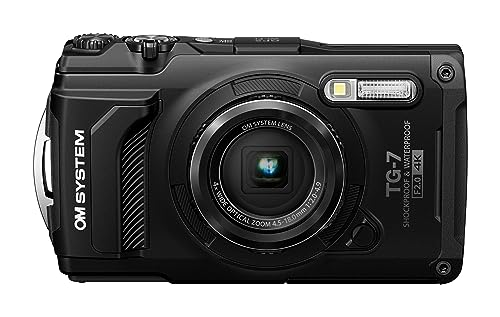
OM SYSTEM Tough TG-7 — Best Worry-Free Trail Camera
The TG-7 is the hiking camera that removes worry from the pack list entirely. It is waterproof to depths no hike will ask, rated for drops onto the surfaces trails are made of, sealed against the dust of high summer paths, and small enough for the hip-belt pocket where a hand goes without thinking. Rain becomes a photographic condition rather than a stop; the river crossing becomes a viewpoint; the scree slope’s stumble becomes a story the camera survives to illustrate.
Its close-focus gifts serve the trail’s small citizens: the alpine flower at boot height, the fossil in the streambed, the lichen’s map on the summit cairn. Its microscope-style macro and stacking turn the rest stop into a field studio, and hikers who learn it return with the trail’s miniature world documented as faithfully as its panoramas.
Day after day, it asks the least of any pick: rinse it, charge it like a phone, and it is ready before the boots are. For the hiker whose photography is a companion rather than a project — the walking club member, the trail runner with a camera habit, the parent on the family trek — it is the default that this list keeps returning to, because presence without anxiety is the trail’s first photographic virtue.
Its small sensor concedes the grand landscape’s ultimate print size and the dusk’s last light to the system picks. On the wall at home sizes and in the album, those concessions rarely appear; in the memory, what appears is that the camera was there, working, in all weathers — which is the whole argument.
- Type: rugged compact, waterproof
- Signature: worry deleted from the pack list
- Macro: the trail’s miniature world
- Carry: hip-belt pocket native
- Trail role: the default companion
Strengths
- Weather is a condition, not a stop.
- Survives the stumble and the stream.
- Macro documents the small trail.
Trade-offs
- Landscape prints trail the systems.
- Dusk light ends its day earliest.
- Fixed lens frames by footwork.
Best for: all-weather hikers, families, walking clubs.
Not suited for: poster landscapes or dusk specialists.

OM SYSTEM OM-5 Mark II — Best Sealed System for Photographer-Hikers
For the hiker who plans trips around light — the dawn ridge, the valley’s weather, the summit as a studio — the OM-5 Mark II is the system that respects the walk. Its body is weather-sealed, its lenses are famously small, and a two-lens trail kit — a wide zoom for the land, a telephoto for its citizens — rides at a weight that full-frame systems cannot approach without apology. Stabilisation stretches the dawn and dusk handheld, when the tripod stayed sensibly at home.
The system’s depth serves the mountains specifically: computational aids for the long-exposure stream and the stacked macro, sealing matched across its lens range, and files whose colour treats lichen, granite, and weather with a naturalist’s fidelity. Landscape photographers who walk far have quietly standardised on this class of kit for a decade’s worth of reasons, all of them measured in kilograms saved per viewpoint gained.
Choose it as the serious trail system: the photographer’s multi-day companion, the body whose lenses grow with the walker’s ambitions, from the first range crossed to the expedition that finally justifies the telephoto. It is a career camera that happens to be dressed for weather.
The costs are a system’s honest ones — lenses are further purchases, and the smaller sensor concedes the extreme low-light and print margins to larger formats that weigh accordingly more. On a mountain, that trade is usually the correct one, and the sealed body forgives the weather that makes the trade necessary.
- Type: weather-sealed mirrorless system
- Signature: system range at walking weight
- Lenses: small, sealed, mountain-bred
- Stabilisation: dawn and dusk handheld
- Trail role: the photographer-hiker’s system
Strengths
- Two-lens kit lighter than lunch.
- Sealing across body and glass.
- Computational aids serve the trail.
Trade-offs
- Lenses multiply the budget.
- Extremes of light concede to size.
- Menus reward the committed.
Best for: landscape walkers, multi-day treks, dawn patrols.
Not suited for: one-box buyers or pocket-only hikers.

Sony RX100 VII — Best Pocket Hiking Camera
The RX100 VII is the answer for the hiker who will not carry a camera bag and means it: a jacket-pocket body with a genuinely useful zoom — the far ridge, the ibex on the skyline, the valley’s detail — and a sensor whose files stand up in the album without excuses. It converts the hiker’s existing clothing into the camera system, which is the only conversion many walkers will ever accept.
Its trail virtues are access and speed: out of the pocket, framed, shot, and away in the time a system camera spends emerging from its pack, which is why its owners’ albums contain the trail’s unplanned citizens — the marmot, the break in the cloud, the companion’s unposed laugh — that staged photography misses. Its autofocus keeps up with all of them.
On long trips it sips its battery politely if the owner resists reviewing every frame on the big screen, and a spare battery weighs less than the trail snack it replaces in the hip pocket. Rain asks for the jacket’s inner pocket and a dry bag’s courtesy — its one honest vulnerability on this list.
Choose it when the walk is the point and the photographs are the walk’s diary, kept properly. Photographer-hikers will want the OM-5’s system; walker-photographers will find this the camera that finally matches their priorities, because it never once asks the hike to reorganise itself around the photography.
- Type: premium compact, real zoom
- Signature: the hike never reorganises
- Speed: pocket to photograph in seconds
- Zoom: ridges and skyline citizens
- Trail role: the walker’s diary, kept properly
Strengths
- No bag, no system, no debate.
- Catches the unplanned trail.
- Files honour the album.
Trade-offs
- Rain wants the inner pocket.
- Battery is a day-scale friend.
- Small controls, cold gloves, patience.
Best for: fast walkers, ultralight day hikes, diary keepers.
Not suited for: wet expeditions or system ambitions.

Fujifilm X100VI — Best for the Walking Philosopher
The X100VI is the trail camera as a philosophy: one fixed wide lens, a body that carries like a paperback, and colour descended from film that renders the walk as memory rather than as data. Its owners hike differently — fewer photographs, chosen like sentences — and return with trail diaries of a coherence that zoom-equipped abundance rarely achieves. The constraint is the curriculum, and the graduates swear by it.
The wide lens suits the trail’s own geometry: the path unwinding, the companion small against the land, the bothy window’s view. Its quiet, leaf-shuttered manners suit the trail’s society — no shutter slap in the dawn camp, no lens changes in the wind — and its build carries the weather of ordinary mountains with a shrug, though it asks for the bag in the worst of it like the civilised instrument it is.
Choose it for the beloved home hills, the pilgrimage route, the long trail walked as a single sentence over a season. It is also the second camera of system owners who want one honest frame-maker that never asks which lens, because the question itself is the weight they are escaping.
Its boundaries are the philosophy’s: the distant ibex stays distant, the macro flower stays a postcard, and the weather’s worst wants the TG-7’s indifference. Within the walking diary’s terms, those are not boundaries but the frame’s edge — and the frame, its owners insist, is the point.
- Type: fixed-lens premium compact
- Signature: one lens, chosen frames
- Colour: film-born trail diaries
- Manners: quiet, camp-friendly
- Trail role: the philosopher’s companion
Strengths
- Diaries with a single voice.
- Carries like a paperback.
- Colour flatters memory itself.
Trade-offs
- Distance stays distant.
- Storms want a hardier friend.
- Scarcity makes it deliberate.
Best for: home hills, pilgrimages, diary walkers.
Not suited for: wildlife reach or storm photography.

GoPro HERO13 Black — Best for Scrambles and Storms
Some trails demote the camera to a witness that must not need hands: the scramble where hands are for rock, the ridge in weather that argues, the river that is crossed rather than admired. The HERO13 Black is that witness perfected — waterproof without a housing, mountable on a chest strap or pack shoulder, stabilised against the body’s own negotiations with the terrain, and tough enough that a fall onto scree is its anecdote rather than its obituary.
Its record is the hike as experienced: the path unwinding at walking pace, the summit’s arrival filmed by the person arriving, the storm’s front crossing the valley in time-lapse while the party shelters. Stills serve as documents and frame-grabs; the video is the diary, and for many hikers it is the version of the trip that gets watched, shared, and believed.
It is also the bad-weather camera of mixed kits: when the sealed system stays bagged in the worst hour, the GoPro keeps the record, and the album gains the storm chapter that fair-weather photography always lacks. Expedition and winter walkers treat it as the insurance that photographs everything the insurance was for.
Its limits are the action camera’s constitution: a wide fixed view, stills that document rather than hang, and a small sensor’s dusk. As the trail’s witness rather than its portraitist, it is without rival on this page — and many hikes need a witness more than a portraitist.
- Type: waterproof action camera
- Signature: hands-free in hard country
- Mounting: chest, strap, helmet
- Record: the hike as experienced
- Trail role: scrambles, storms, crossings
Strengths
- Films while hands hold on.
- Weather’s worst is its element.
- Keeps the record in the storm hour.
Trade-offs
- Stills document; they do not hang.
- Wide view only, by design.
- Dusk is a small sensor’s limit.
Best for: scrambles, winter ridges, river trails.
Not suited for: considered landscape stills.

Canon PowerShot G7 X Mark III — Best for Group Hikes
The group hike is a social expedition wearing walking boots, and its photographs are portraits with scenery: the summit group, the bothy evening, the birthday on the hill. The G7 X Mark III is the social trail’s camera — a bright lens for the evening’s low light, face-friendly colour and focus for the portraits, and a tilting screen that frames the group shot with the photographer in it, which is where group photographers belong and so rarely are.
Its video serves the group’s second archive: the summit wind’s commentary, the song in the hut, the walk-out’s tired jokes — clips that groups watch for years after the stills have been framed. Its size keeps it in the leader’s pocket or the daypack’s top, present for the unplanned minute rather than staged for the planned one.
Choose it for walking clubs, family treks, and the friend-group expedition where the photographs’ job is the people’s memory of each other, with the mountains as honoured backdrop. Landscape purists will climb the list toward the OM-5; the group’s archivist will find this compact’s priorities exactly their own.
It asks the compact’s courtesies — a dry bag in real rain, a spare battery on the long day — and its zoom is a companion’s rather than a naturalist’s. Within the social trail’s distances, it lacks nothing its owners have ever written home about, except perhaps a second one for the other end of the group.
- Type: premium compact, bright lens
- Signature: people first, mountains honoured
- Screen: group shots with everyone in
- Video: the hut, the summit, the song
- Trail role: the group’s archivist
Strengths
- Faces in evening light stay kind.
- Everyone gets in the summit frame.
- Pocket presence, album files.
Trade-offs
- Rain asks for the dry bag.
- Zoom is a companion’s reach.
- Battery wants a spare on epics.
Best for: walking clubs, family treks, group expeditions.
Not suited for: solo landscape purists or storm duty.
How Do the Six Compare at a Glance?
Trails divide cameras by carry and courage, so the table casts each pick to its hiker and names the compromise.
| Camera | Form | Decisive edge | What you give up |
|---|---|---|---|
| OM SYSTEM Tough TG-7 | Rugged compact | Worry-free weather | Print extremes |
| OM SYSTEM OM-5 Mark II | Sealed system | Range at low weight | One-box simplicity |
| Sony RX100 VII | Pocket compact | Zoom in a pocket | Sealing |
| Fujifilm X100VI | Fixed-lens compact | Diary coherence | Reach |
| GoPro HERO13 Black | Action camera | Hands-free witness | Still portraiture |
| Canon PowerShot G7 X Mark III | Premium compact | People and evenings | Weather indifference |
How Do You Carry a Camera on the Trail So It Actually Gets Used?
The hierarchy of access is the trail photographer’s real equipment list. First class: the camera on the body — strap cross-body under the pack’s hip belt, chest clip on the shoulder strap, hip-belt pocket for the compacts — reachable in three seconds without breaking stride. Second class: the pack’s top lid or brain, reachable at a stop without unpacking. The pack’s main body is not a class at all; it is storage, and cameras stored there photograph trailheads and campsites exclusively.
Straps deserve the same engineering as boots: padded where the pack’s straps are not, quick to shorten at the scramble, and arranged so the camera cannot swing into rock at the exact moment both hands leave it. The rugged picks forgive the failures of this engineering; the civilised ones bill for them, and every trail photographer has paid once.
Build the carry at home, loaded, and walk the stairs with it. The arrangement that annoys in the hallway will mutiny on the mountain, and the arrangement that disappears at home will still be disappearing, photographically, at the summit.
What Are the Most Common Mistakes Hikers Make With Cameras?
The first is buying for the expedition and hiking with the day trip: the magnificent system that attends one trek a year while the weekly hills go unphotographed, though the weekly hills are the life. The second is the reverse snobbery — the phone-only walker who discovers, at the one unrepeatable dawn, what a real sensor was for. Both are cured by the same honesty: audit the last twelve months of actual walking, and buy for its median, with one eye on its best day.
The third is weather surrender — the camera bagged at the first shower though the mountain’s drama is weather-shaped — and the fourth is battery optimism at altitude, where cold and thin air conspire against the summit’s frames. The fifth is the unlabelled archive: four ranges, three countries, one card reader, and a winter evening spent asking the photographs where they have been. Label at the camp, nightly, in the notebook; the trail’s memory deserves the same discipline as its map work.
How Do You Photograph a Trail So the Folks at Home Feel the Walk?
Photograph the verbs: the path unwinding ahead, the boots at the ford, the hands on the scramble, the pack’s-eye view of the ridge — the walk as a sequence of doings rather than a gallery of views. Views are the trail’s posters, and they belong in the album; but the story lives in the connective frames, the ones that show how the viewpoint was earned. Future you, watching in winter, will thank the photographer for the mud as warmly as for the summit.
Include the scale the land deserves: the companion small against the corrie, the bothy under the hill, the path’s thread across the moor. Mountain photographs fail by grandeur’s absence more often than by technique — everything looks near and tame through a wide lens at noon — and the human figure, the known object, the weather arriving, are the currencies in which scale is paid.
And photograph the return: the valley in evening light, the boots off at the car, the map on the pub table. A trail album that ends at the summit tells half a walk; the descent is where the day becomes a story with an ending, and the hiker’s camera — still out, still working, because it was carried accessibly — is the only narrator the descent will get.
Sound, for the video-capable picks, completes the narration cheaply: ten seconds of the wind at the cairn, the stream at the crossing, the bothy’s kettle — clips the group will play for the room tone alone. The trail is an audible place, and the album that includes its voice is the one that makes the folks at home put their own boots on.
How Do You Photograph at Dawn and Dusk, When the Trail Is at Its Best?
The trail’s golden hours are bought with discomfort: the dawn start with the headtorch, the dusk descent finished by its beam. The camera’s part is to be ready before the light is — settings made at the camp or the car, the frame composed while the sky is still deciding — because mountain light at its best is a five-minute appointment that does not reschedule. Stabilisation is the dawn’s best friend, holding the slow shutter speeds that the tripod, left at home by every sane weight audit, would have owned.
Exposure at the day’s edges is a negotiation with contrast: the sky still bright, the land already dark, the photograph’s truth somewhere in the exposure that keeps the sky’s colour and lets the land be its evening self. The sealed system’s range and the compacts’ bright lenses each arbitrate that negotiation in their own dialect; the photographer’s part is to choose the frame’s priority — sky or land — and expose like they mean it.
And keep the camera out for the walk down. Some of the trail’s finest frames are made in the light after the light — the valley’s lamps, the bothy’s window, the headtorch’s small procession — by photographers whose cameras were still on their straps when the day closed. Accessibility, again, is the whole secret, wearing evening dress.
What Changes on Multi-Day Treks and Winter Trails?
Multi-day arithmetic turns every photographic decision into logistics: cards counted like meals, batteries budgeted like stove fuel, and the nightly ritual — download or duplicate where power allows, label in the notebook, dry the kit by the stove’s courtesy — promoted from habit to expedition discipline. The camera that serves a trek is the one whose needs the trek can meet without resentment, which is why the rugged and pocket picks punch so far above their specification weight at altitude.
Winter adds its own clauses: batteries sleeping in the bag’s warm heart, the camera acclimatised gradually to the bothy’s heat so condensation forms on the case rather than in the lens, and gloves thin enough for the dials — or dials honest enough for the gloves, which is the same negotiation from the other side. Screens dim in the cold’s economy; viewfinders, where the system offers them, earn their keep at the exact hour the compacts’ owners start composing by instinct.
None of this is hardship for its own sake; it is the price list of the finest photographic conditions the temperate world offers, and the trekkers who pay it cheerfully come home with the winter range, the empty trail, and the light that summer’s crowds never see.
How Do You Photograph Wildlife You Meet on the Trail, Honestly?
Trail wildlife is encountered, not pursued — the distinction is ethical before it is photographic, and the animals’ welfare outranks every frame. The zoom picks serve the encounter’s etiquette: photograph from where you stand, let the creature keep its distance and its business, and accept the frame the encounter offers rather than closing for a better one. A ptarmigan photographed at its ease is a portrait; a ptarmigan photographed at your approach is a documentary of a disturbance.
Readiness is the technique: the camera carried accessibly, its zoom at the long end during the habitat’s likely hours, its settings biased toward the quick frame — because encounters are measured in seconds and the camera that wakes slowly photographs rumps. The RX100’s zoom and the OM-5’s telephoto option are this section’s instruments, and both reward the hiker who walks quietly in the first place.
At home, crop with a conscience: the encounter’s honest frame, modestly tightened, tells the story the animal permitted. The trail’s wildlife archive grows slowly and means more for it — a shelf of meetings rather than a catalogue of pursuits.
How Should Trail Photographs Be Organised Across a Season?
By walk, not by month: one folder per route, named with the hill and the date, holding the day’s frames and a text file with the route’s notes — weather, companions, the light’s behaviour, the frame numbers of the keepers. A season filed this way becomes a walker’s gazetteer, consulted when planning the next season and priceless when writing the club’s journal or the family’s account of the year the hills were climbed properly.
Back the season up twice, in two buildings, before the cards are trusted to another year — trails lose cameras to rivers and packs to car boots, and the archive, duplicated, survives the equipment in the correct order of value. Keep the rejects until the season’s journal is written; the blurred frame of the crossing may be the only evidence of the river’s mood that day, and evidence outranks elegance in an archive.
Print the year’s dozen. A season of walking distilled to twelve frames on the wall is the audit that improves next year’s photography more than any lens: the gaps in the dozen — no dawn, no weather, no people — are the brief the next season’s camera work is written against.
Why Do Hikers Keep Photographing the Same Hills?
Because the hills are not the same: the home range in its seasons, its weathers, its lights, is a single subject with a hundred sittings, and the walker’s archive of it becomes, over years, a portrait of a place that no expedition to a famous range can match for intimacy. The camera that serves this devotion is not the most capable but the most carried — which returns the whole guide to its first principle, now with a decade’s evidence behind it.
The repeated hill also schools the photographer like no workshop: the same corrie in dawn and storm teaches what light does; the same path in snow and heather teaches what seasons do; and the photographer learns, frame by returning frame, to see the change rather than the view. That education is the trail camera’s deepest return on its pack weight, and it is available on the hill behind the house, free, in all weathers, to anyone whose camera is on their strap.
How Do You Keep a Trail Camera Working at Altitude and in the Cold?
Cold is a battery’s auditor and a screen’s critic, and altitude adds thin air’s indifference to both. The countermeasures are a liturgy the winter schools teach: batteries rotated from the body’s warmth to the camera, the camera itself kept under the shell layer during the halts, and exposures planned so the camera’s working minutes are spent photographing rather than warming up. LCDs slow and darken in real cold; the composed-by-instinct frame, practised at home, is the veteran’s answer, and the viewfinder systems smirk quietly at exactly this hour.
Breath is the lens’s weather: the photographer’s own exhalation, aimed carelessly, fogs the front element faster than any mist, and the summit portrait’s ritual — turn downwind, hold the breath, frame, shoot — sounds like superstition until the first fogged summit teaches it as physics. The cloth, kept in its sealed bag against the body’s warmth, restores what breath and weather take, and it must be grit-free: a cloth that has wiped a boot is a lens’s enemy wearing a friend’s clothes.
Descend gently. The warm bothy fogs a cold camera for an hour, so let it warm inside its bag with the desiccant of patience, and do the evening’s review from the card rather than the camera where the kit allows. Altitude and cold do not defeat cameras; impatience does, on a schedule so reliable it could set the expedition’s clock.
How Do You Choose Between This List and a Dedicated Landscape Camera?
By the proportion of the trip that is photography. When the walk exists for the frames — the dawn ridge planned for a month, the portfolio the destination — the landscape system, tripod and all, is the honest tool, and this list’s OM-5 is its lightest honest form. When the frames exist for the walk — the diary, the club journal, the family’s proof — the compacts and the rugged pick serve better, because they never tax the walking that is the trip’s actual purpose.
Most hikers live between the poles and migrate across a season: the big trip justifies the system, the weekly hills want the pocket. The two-camera household — system for the expeditions, Tough or RX100 for the Sundays — is not extravagance but the audit’s natural conclusion, and it is cheaper than the single magnificent camera that serves both masters at half their due.
How Do You Photograph People on the Trail Without Staging Them?
The trail portrait’s secret is that walkers photograph best while walking: the stride, the weather in the face, the pack worn like a biography. Ask the companion to keep moving and photograph from ahead — stepping off the path at the bend, letting them walk into the frame at their own pace — and the portrait keeps the day in it. The summit’s posed row has its place in the record, but the walking frames are the ones the subjects themselves choose for the wall.
Light on trails is found, not made: the open shade of the corrie’s wall, the bright overcast of the high plateau, the dawn’s side-light on the ridge. Position the walker in the found light rather than the found view when the two compete, because faces outrank scenery in every album ever kept. The bright-lens compacts and the face-holding systems each flatter this priority in their own way; the photographer’s part is the older craft of noticing where the light is kind.
Consent and humour complete the method: the trail’s society runs on good nature, and the photographer who shows the frame, laughs at the failures, and shares the files at the bothy will be welcomed back with the camera that a sneak is not. The group’s memory is a commons; tend it like one.
What Should a Beginner Hiker Buy First, and What Can Wait?
Buy the camera and the carry first — the strap or clip that puts it on the body, the dry bag that insures it, the spare battery that frees the summit from arithmetic. Those three accessories, together cheaper than any lens, decide whether the camera is used daily or monthly, and use is the only specification that compounds. The second lens, the tripod, the filter kit: all can wait for the season’s evidence, because the trail itself will name the limitation worth money, in the order it actually bites.
Beginners should also buy the notebook habit free of charge: route, weather, companions, frame numbers, one line per walk. It feels like homework for exactly two walks and like treasure by the second season, when the question of where that photograph was taken — the one on the wall — has an answer written by the only witness who was there.
How Do You Share Trail Photographs With the Group Without Becoming Its Secretary?
Agree the system at the trailhead, while goodwill is fresh: one shared album or folder, named for the walk, to which the day’s photographers contribute their keepers within the week — not the whole card, which is a data dump wearing generosity’s clothes, but the edited dozen each. The discipline of contributing few makes the album worth opening, and the week’s deadline makes it happen while the walk is still a shared memory rather than an archaeology.
Credit inside the album like professionals: the photographer’s name in the file or the caption, because groups dissolve and reform across decades of walks, and the future slide show deserves to know whose eye it is borrowing. The group’s archivist — often the G7 X’s owner, by temperament — keeps the master copy in two places, and the role rotates before it becomes a life sentence.
Final Recommendation
Take the OM SYSTEM Tough TG-7 as the worry-free default, the OM SYSTEM OM-5 Mark II for the photographer-hiker’s system, and the Sony RX100 VII when the bag itself is refused. Choose the Fujifilm X100VI for the diary, the GoPro HERO13 Black for the hard country, and the Canon PowerShot G7 X Mark III for the group’s memory.
Whichever camera earns its place in the pack, carry it where a hand can reach it, keep its battery warm and its lens cloth dry, and label the day’s photographs before sleep. The trail provides; the carried camera collects.
Related guides
Frequently Asked Questions
Is a phone not enough for hiking photographs?
For the diary of a fair-weather day hike, honestly close — until the rain, the zoom’s absence at the skyline, the battery shared with the map and the emergency call, or the dawn that deserved a real sensor. This list exists for the hikes where those margins matter, and its pocket picks close the gap without asking the hike to change.
How do I protect a camera that is not waterproof?
The dry bag is the whole doctrine: camera in the bag when the weather turns, out for the photograph, back before the next shower — plus a cloth in a sealed pouch and the discipline to dry the kit each evening. Generations of mountain photographs were made this way with cameras far more delicate than today’s; sealing is a convenience, not a permission slip.
What lens should a hiking system carry?
One wide-to-normal zoom covers most trails’ stories — the land, the path, the companions — and a light telephoto earns its place only when wildlife or distant detail is the trip’s actual purpose. Every additional lens must argue against the water it displaces, and on multi-day trails, most lose.
How many batteries does a multi-day hike need?
Count in days of your own shooting, discounted for cold: a modest photographer’s day per battery is a fair planning unit for the compacts, with the systems sipping more politely. Carry one more than the arithmetic says, keep it warm, and let the camera sleep rather than idle — the summit’s light is worth more than the rest stop’s review session.
Can I charge a camera on a long trail?
Several picks here charge from a power bank over the same cable as a phone, which collapses the charging problem into the one the hiker already solves. Solar panels serve base camps better than moving walkers. Plan the power as part of the pack list, with the same honesty as the food: grams in, photographs out.
How do I stop my lens fogging when I stop for a break?
Fog is a temperature meeting, not a malfunction: the cold lens meets your warm breath, the tent’s air, or the bothy’s stove-side. Keep the camera at the hill’s temperature during halts — outside the jacket, away from faces — and let it warm gradually in its bag when the day ends. A cloth kept warm and dry restores the occasional fogged frame; patience restores the rest, and both are cheaper than the photographs lost to wiping grit across a misted element.
What is the best hiking camera on a tight budget, in tier terms?
The Tough TG-7’s tier is the honest answer for most walkers: one purchase, no lenses, no case anxiety, weather included. Below that tier, a previous-generation rugged compact from the used market serves honourably — check its seals’ history as you would a tent’s, because waterproofing is a promise previous owners may have spent.
How do I keep grit out of everything on a dry, windy ridge?
Dust on a summit behaves like weather, arriving sideways and settling into every seam it can find. Keep the camera inside a sealed dry bag until the moment of shooting, face away from the gusts while changing a lens, and never set a body cap or rear cap down on rock, however clean it looks. A rocket blower used inside a sheltered jacket at the evening camp clears far more than frantic wiping on the ridge, which only drags particles across glass. Zip-lock bags weigh almost nothing, so carry spares for a dropped one, and treat a filter as the sacrificial surface you would rather scratch than the front element beneath it. Salt spray deserves equal suspicion on coastal paths, because it dries into a film that smears instead of lifting away. Rinse nothing under a tap on the hill; wait for shelter, use a barely damp cloth, and let the camera dry fully before sealing it into a bag overnight at the valley camp. Check zips, pockets and lens cloths at breakfast as well, since particles collected yesterday migrate overnight into exactly the places your fingers reach first when weather closes in suddenly.
What is the sensible shot sequence when the group grants you two minutes at a viewpoint?
Decide the order before the pack comes off. Take the wide establishing frame first, while everyone is still arriving and the scene is honest, then one tighter composition that excludes the clutter at the frame edges, and only then portraits against the drop. Chasing a clever angle first usually means the simple, printable record never happens at all. Keep settings prepared from the walk up, because a two-minute halt spent inside menus is a halt wasted. Finish by lowering the camera and actually looking at the place for the remaining seconds; the memory of standing there is part of what the photographs will be asked to carry home. If children or dogs belong to the party, place them early, while patience is fresh, and let the adults arrange themselves around that anchor instead of rebuilding the group three times. One honest frame of everybody present, slightly windswept and mid-laughter, will outlast a technically immaculate line-up that nobody enjoyed standing for, and it preserves goodwill for the next halt, the next scramble and the long descent still to come.
Related Guides
Trail neighbours in this series: best cameras for hiking with bluetooth best cameras for travel best cameras for nature photography


