kajuandouglas.com is reader-supported. When you buy through links on our site, we may earn an affiliate commission.
Where to Buy
The best compact cameras for backpacking are not judged on a desk. They are judged at mile nineteen, in rain, with cold fingers, when the light finally breaks over a col and you have perhaps forty seconds of willingness left to stop, unzip a hip-belt pocket, and take the photograph that justifies the whole walk. A backpacking camera lives or dies on grams, on packed volume, on whether it shrugs off weather that would send a delicate body back into a dry bag, and on whether it can sip power from the same USB battery bank that keeps your headlamp and phone alive on a five-day carry. Image quality matters — but only after those four tests are passed, because the finest sensor ever made takes no pictures at all from inside a pack it made too heavy to enjoy carrying.
This guide therefore ranks six compacts the way a backpacker actually experiences them: as weight on a hip belt, as bulk against food and insulation, as a tool that either tolerates a summit squall or demands to be babied through it. Every pick below can be charged over USB, which is the single most underappreciated backpacking specification of the modern era — it means one cable, one power bank, and no proprietary charger brick eating payload. Where a camera lacks weather sealing, the guide says so plainly and explains the carry discipline that compensates. Where a camera is genuinely sealed and armoured, that toughness is weighed against the optical compromises armour usually demands.
There is also a quiet psychological dividend to a dedicated trail camera that no specification captures. Knowing the camera is there — reachable, charged, weatherproof enough for the day — changes how a walker sees. You start noticing the light on the col an hour before you reach it, the way mist is organising itself in the valley, the small bright flower patch that deserves a stop. Photography at its best is attention with a souvenir attached, and the right compact, carried right, trains that attention trip after trip.
One more framing note before the picks. Backpacking splits into tribes: the ultralight walker counting every gram toward a base weight goal, the photographer who walks specifically to reach viewpoints and will carry a real camera gladly, and the thru-hiker whose camera must survive months of daily abuse rather than a weekend’s. The six picks below are assigned honestly among those tribes rather than pretending one body serves all three equally well.
Key Takeaways
- The OM SYSTEM Tough TG-7 is the only pick here you can drop in a creek, freeze on a winter ridge, and keep shooting — true sealing and armour at a modest weight.
- The Sony RX100 VII packs the longest zoom and the most complete stills package into a body that vanishes into a hip-belt pocket.
- The Canon PowerShot G7 X Mark III is the warm-light storyteller of the set: fast lens, lovely colour, but no sealing, so it rides in a dry pouch.
- The Fujifilm X100VI is the photographer’s backpacking camera — the heaviest pick here, carried deliberately for APS-C files worth printing large.
- The GoPro HERO13 Black is the storm camera and summit-video tool: tiny, waterproof, and content to be lashed outside the pack in any weather.
- The DJI Osmo Pocket 3 earns its place for walkers who film their routes: a stabilised gimbal camera lighter than most phones-plus-grip combinations.
Read the takeaways as a weight budget, not a league table. Add any one of these cameras to a carefully built ultralight kit and the pack still closes; add two and you are making choices about food and insulation that this guide will not make for you. The right question is never which camera is best, but which camera’s compromises match the walking you actually do.
In this guide
Quick Picks
| Badge | Pick | Why it stands out |
|---|---|---|
| Best for Bad Weather | OM SYSTEM Tough TG-7 | Waterproof, freezeproof, crushproof armour that treats a summit squall as a working condition, not an emergency. |
| Best All-Round Pocket Camera | Sony RX100 VII | A long zoom, a pop-up viewfinder, and serious autofocus in the smallest serious stills package here. |
| Best for Trail Storytelling | Canon PowerShot G7 X Mark III | A fast lens and forgiving colour for camp life, meals, and faces at the end of the day. |
| Best for Print-Worthy Files | Fujifilm X100VI | An APS-C sensor and a superb fixed lens for the walker who hikes to viewpoints on purpose. |
| Best Storm and Summit Camera | GoPro HERO13 Black | Waterproof, glove-simple, and happy lashed to a shoulder strap through weather that stops everything else. |
| Best for Filming the Route | DJI Osmo Pocket 3 | Gimbal-smooth walking footage from a device that slips into a chest pocket between shots. |
Notice the spread of intentions. Two of these cameras are sealed tools for weather; two are delicate instruments for beautiful light; two are primarily film machines that also take stills. A backpacker who reads the badges as jobs rather than ranks will choose correctly almost every time.
How We Chose These Picks
Each candidate was assessed the way it would actually be carried: in a hip-belt pocket, in a chest pack, and loose in a lid, across multi-day routes with real elevation, real rain, and the slow accumulation of trail fatigue that changes how a person handles small objects. Cameras were weighed with battery and card fitted, because that is the weight your hips learn about. Packed volume was judged against the spaces backpackers genuinely have — a hip-belt pocket already sharing room with snacks, a shoulder-strap pouch, the top lid beside a map.
Power discipline received its own testing block. On a long carry, electricity is a rationed resource shared between camera, phone, headlamp, and satellite communicator. Every pick here charges over USB, so each was run down and refilled from a typical trail power bank to learn how greedy it is, how warm it gets, and whether it can shoot while tethered to the bank for a long timelapse at camp. Cameras demanding a proprietary mains charger were excluded from this guide entirely, however fine their optics.
Weather tolerance was tested honestly rather than theatrically: shooting in steady rain, in wind-driven drizzle on an exposed ridge, and with condensation forming after a cold night in a tent. Sealed cameras were used bare-handed in the wet. Unsealed cameras were used the way their owners will actually use them — out for the shot, back into a pouch — and the guide reports how workable that rhythm is rather than pretending unsealed bodies belong in a downpour.
Durability was assessed across repeated trips rather than single outings, because trail damage is cumulative: the zip that grinds grit into a lens barrel over a season, the strap lug that frets, the battery door that loosens. Cameras were also handed to walking partners with no briefing, on the theory that a backpacking camera gets borrowed at summits and viewpoints, and a body that confuses a stranger into missing the group shot has failed a real trail test.
Finally, files were judged at the end of the pipeline: edited on a laptop after the trip, printed at modest sizes, and shared the way trip photographs are shared. A camera whose files collapse under gentle editing, or whose colours need rescue work after every walk, loses marks no specification sheet can restore.
What Actually Matters When a Camera Lives in a Pack?
Weight is the obvious currency, but volume is the sneakier one. A camera can be light yet shaped like a brick, and bricks fight the curved, soft geometry of a loaded pack. The flattest bodies here — the RX100 VII and the G7 X Mark III — slide into spaces that barely exist, against a hip belt or inside a chest pack’s phone sleeve. The X100VI is heavier and broader, and carrying it is a decision renewed each morning. The TG-7 and HERO13 are chunkier than their weight suggests but indifferent to where they ride, which is its own kind of compactness: a camera that can live in an outside mesh pocket, instantly reachable, effectively costs no organised space at all.
Reachability decides what gets photographed. Backpacking photography is mostly opportunistic — light on a ridge, a marmot on a boulder, weather building behind you — and opportunities expire while you are still unclipping a brain lid. Every pick here can be carried somewhere a hand reaches without removing the pack, and the detailed reviews note the carry that suits each body best. A camera that must live inside the main compartment is, for trail purposes, a camera you have decided not to use until camp.
Then there is the matter of cold. Lithium batteries sag in low temperatures, screens slow, and lubricants stiffen. The TG-7 is rated to keep working in freezing conditions that would have the others sleeping inside your jacket to stay alive — a real consideration for winter walkers and high alpine starts before dawn. For summer-only hikers this barely matters; for anyone who has watched a camera refuse to wake at a frosty sunrise, it can decide the whole purchase.
Sound deserves a sentence of its own, because trail films live or die by it. Wind is the default soundtrack of high places, and the cameras here handle it unequally: the HERO13 and Pocket 3, built for moving footage, tame gusts into something listenable, while the stills-first bodies record wind honestly and harshly unless you shelter the microphones with your body or a hat brim. If your archive is films of ridges, test your chosen camera’s wind behaviour on a blowy local hill before the big route — it is a five-minute experiment that can redirect a purchase.
Straps and attachment points close the practical survey. A camera carried on a capture clip or strap mount is a camera in use; the TG-7 and HERO13 accept that life natively, the flat compacts need a small case or clip solution, and the X100VI rides best on a proper strap under the pack’s shoulder harness, lens resting against the chest. None of these arrangements is wrong — but choose yours before the trip, because improvising carry systems at altitude with cold hands is how cameras meet granite.

OM SYSTEM Tough TG-7 — Best for Bad Weather
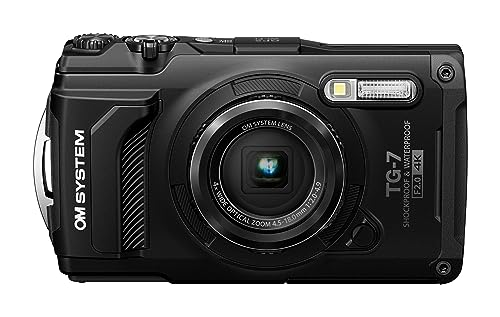
The TG-7 is the camera this guide would hand to a stranger without instructions or anxiety. It is waterproof well beyond rain — it can be submerged — shockproof against the drops that happen when numb fingers fumble, crushproof against the moment a loaded pack is set down on it, and freezeproof for winter ridges. On a backpacking trip, those ratings translate into a profound relaxation: the camera rides in a mesh side pocket or clipped to a strap, gets rained on for six hours, gets knocked against granite, and simply continues. No dry bag, no pouch ritual, no low-level worry humming under the walking.
That freedom changes what you photograph. Stream crossings become subjects instead of hazards. A storm clearing over a tarn can be shot from inside the weather rather than from the tent door. The TG-7 also focuses remarkably close — a gift on trails, where alpine flowers, frost patterns, and insects are half the visual diary — and its field-sensor system records GPS, altitude, and temperature data that turns a photo library into a genuine route log afterwards.
The compromises are optical and honest. The sensor is small, the zoom range modest, and in dim forest light the files are noticeably less clean than the one-inch cameras below. You are trading file finesse for the certainty of having a working camera on day four of a wet traverse. For many backpackers — especially those whose trips are defined by weather rather than viewpoints — that is the correct trade, and it is not close.
- Sensor class: small-sensor rugged compact with a moderate zoom
- Protection: waterproof, shockproof, crushproof, freezeproof sealed body
- Charging: USB-C, refills from a standard trail power bank
- Carry: outside mesh pocket, strap clip, or hip belt — no dry bag needed
- Extras: field sensors log GPS, altitude, and temperature to images
Strengths
- Genuinely sealed against water, dust, drops, and freezing cold
- Close-focusing ability turns trail details into a second photo diary
- Zero-protection carry frees organised pack space for food and layers
Trade-offs
- Small sensor shows its limits in dark forest and at dusk
- Zoom reach is short for wildlife across a valley
- Screen and controls feel utilitarian beside the premium picks
Best for: walkers whose routes are wet, cold, or rough, and thru-hikers who cannot afford a camera failure. Not suited for: photographers who print large or shoot mostly in low light.

Sony RX100 VII — Best All-Round Pocket Camera
If the TG-7 is armour, the RX100 VII is a scalpel. Its one-inch sensor and long zoom — stretching from wide trail vistas to a genuinely useful telephoto reach — cover more backpacking subjects than any other body in this guide, and the whole apparatus folds down into a slab that disappears into a hip-belt pocket. A pop-up electronic viewfinder matters more outdoors than newcomers expect: on a sun-blasted snowfield or a white limestone plateau, a rear screen washes out entirely, and the little finder becomes the difference between composing and guessing.
The autofocus is the other trail virtue. It locks onto walkers, dogs, and birds with a tenacity that suits a photographer shooting one-handed while the other hand holds a trekking pole. Burst shooting is deep and fast, which rescues wildlife encounters that last two seconds. At camp, the flip screen handles the group portrait on a rock-as-tripod with everyone in frame.
Delicacy is the price. The RX100 VII carries no weather sealing, and its sliding lens cover and pop-up mechanisms deserve respect around grit and drizzle. The working rhythm is simple — out of the pouch, shoot, back into the pouch — and on most routes that rhythm costs nothing. Its battery is also the smallest-feeling here, so multi-day walkers should budget a midday sip from the power bank, which the camera accepts happily over USB while it rests in the lid.
- Sensor class: one-inch sensor with a long-range zoom lens
- Viewfinder: pop-up electronic finder for glare and bright snow
- Charging: USB from a power bank; spare batteries are tiny and light
- Carry: hip-belt pocket or chest pack, inside a light dry pouch
- Focus: fast, confident subject tracking for wildlife and companions
Strengths
- Widest subject coverage here, from landscapes to distant wildlife
- Viewfinder keeps you shooting in glare that defeats rear screens
- Truly pocketable — the camera most likely to be within reach
Trade-offs
- No weather sealing; rain means pouch discipline
- Small battery asks for power-bank top-ups on long trips
- Menus reward setup at home rather than changes on the move
Best for: backpackers who want one small camera that answers almost every subject a trail offers. Not suited for: storm chasers or anyone careless with unsealed gear in wet climates.

Canon PowerShot G7 X Mark III — Best for Trail Storytelling
Every trip has two archives: the grand scenery and the human story — the freeze-dried meal that turned out brilliantly, the tent glowing at dusk, a walking partner laughing with rain still on her face. The G7 X Mark III is this guide’s storyteller. The lens stays fast as the light falls around camp, and its colour rendering flatters skin and food and firelight with minimal editing, and its flip-up screen makes the end-of-day video diary a one-take habit rather than a production.
The zoom range is shorter than the Sony’s, biased toward the wide and normal views that storytelling actually uses. Nobody films a camp kitchen on a long telephoto. What the Canon offers instead is speed of operation and a certain warmth in the files: photographs that look like the trip felt, straight from the camera, ready to send from the first town stop without an evening of editing penance.
Like the Sony, it is unsealed, and its natural home is a padded pouch in the lid or a chest pack. It charges over USB-C — the most convenient connector here — and sips power modestly. Walkers who shoot mostly in fair weather and care most about people, camps, and the texture of the journey will find this the most likeable camera in the guide; walkers headed into a week of Scottish rain should read the TG-7 section again.
- Sensor class: one-inch sensor with a fast, storytelling-biased zoom
- Screen: tilts up for diaries, camp portraits, and group shots
- Charging: USB-C from any trail power bank
- Carry: padded pouch in lid or chest pack; keep from drizzle
- Character: warm, forgiving colour that needs little editing
Strengths
- Fast lens keeps camp and evening photography alive
- Colour that flatters faces and firelight straight from the camera
- Simple, friendly handling when you are tired and gloved hands are off
Trade-offs
- No weather sealing at all — rain discipline is mandatory
- Shorter zoom reach limits wildlife ambitions
- Autofocus is a step behind the Sony for fast-moving subjects
Best for: fair-weather backpackers whose favourite frames are people, camps, and evenings. Not suited for: wet-climate traverses or telephoto wildlife hopes.

Fujifilm X100VI — Best for Print-Worthy Files
The X100VI is the deliberate camera, and it asks to be carried deliberately. It is the heaviest and broadest body in this guide, its lens does not zoom, and with the adapter ring and filter fitted for weather resistance it still prefers a pouch in serious rain. In exchange it offers an APS-C sensor with resolution to spare, in-body stabilisation, and a fixed lens of genuine excellence pointed at the focal length landscape photographers reach for most. The walker who hikes to a viewpoint — who plans the route around a dawn at a particular tarn — is carrying this camera on purpose, and the files justify the intention.
The hybrid viewfinder deserves special mention on the trail. The optical mode sips power and shows the world beyond the frame edges, so you see the walking partner about to enter your composition; the electronic mode previews exposure in brutal alpine glare. Battery life stretches accordingly when the optical finder leads. Film simulations, meanwhile, are not a gimmick on a long walk: choosing a look in the field and shooting finished JPEGs means the trip archive is presentable the evening you get home, and the RAW files remain for the frames worth printing.
Carrying it well is a solved problem: a small chest pack or a padded hip-belt holster keeps it reachable and protected, and its flat profile slides against a pack’s back panel better than its weight suggests. What it will not do is zoom to the eagle on the far crag or survive being dropped in a ford. It is a specialist’s instrument that happens to be compact, and backpackers who think of themselves as photographers first will accept every term of that bargain.
- Sensor class: APS-C high-resolution sensor, fixed wide-normal lens
- Viewfinder: hybrid optical/electronic, kind to batteries and glare
- Charging: USB-C; optical-finder shooting stretches a charge for days
- Carry: chest pack or padded holster; pouch needed in heavy rain
- Stabilisation: in-body, for dawn and dusk hand-held shooting
Strengths
- Files with the resolution and depth to print genuinely large
- Hybrid finder excels in glare and conserves power
- Fixed lens removes decisions when light is moving fast
Trade-offs
- Heaviest pick here — a real line item in a light pack
- No zoom; distant subjects stay distant
- Weather resistance needs the adapter and filter, and care besides
Best for: photographer-backpackers walking to viewpoints and printing the results. Not suited for: gram-counters or anyone wanting wildlife reach.

GoPro HERO13 Black — Best Storm and Summit Camera
There are moments on a mountain when every other camera in this guide is in a bag: the summit ridge in spindrift, the exposed scramble in rain, the river crossing where both hands belong on poles. The HERO13 exists for exactly those moments. It is waterproof without a housing, starts recording from a single press even with gloves on, and can be lashed to a shoulder strap or chest mount where it rides through weather as indifferent as the TG-7 while adding serious video stabilisation the TG cannot match.
As a stills camera it is a different philosophy: an ultra-wide lens, deep focus from near to far, and files that reward the dramatic foreground — boots on a summit cairn, a rope team against a drop. It will not give you a portrait or a distant peak detail, and it should not be asked to. Its genius is presence: because it can live outside the pack in any conditions, it is simply there for the wildest ten minutes of the trip, which are usually the minutes that define the story.
Power is its tax. Video drains it briskly, cold drains it faster, and the wise walker carries a spare battery or two — fortunately small and light — and treats the power bank as shared infrastructure. GPS and voice control sound like gimmicks until your hands are in mitts on a belay ledge; then they are the interface. For the backpacker whose trips are adventures first and photography second, this is the camera that comes home with the footage.
- Sensor class: action camera with ultra-wide lens and deep focus
- Protection: waterproof body, no housing required
- Charging: USB-C; carry spare batteries for cold and video
- Carry: shoulder-strap or chest mount, outside the pack in all weather
- Controls: one-press recording and voice control for gloved hands
Strengths
- Present and working in weather that benches every rival here
- Stabilised video of scrambles, ridges, and river crossings
- Glove-friendly operation when dexterity is gone
Trade-offs
- Ultra-wide stills only — no portraits, no telephoto, ever
- Battery life is short in cold and under video load
- Files need the action look accepted, not corrected away
Best for: mountaineering-leaning backpackers and anyone filming exposed terrain. Not suited for: stills photographers wanting focal-length choice.

DJI Osmo Pocket 3 — Best for Filming the Route
Walking footage is the hardest footage. A camera bouncing at hip height through a boulder field defeats ordinary stabilisation, and the resulting video is unwatchable within seconds. The Pocket 3 solves the problem mechanically: a three-axis gimbal holds its one-inch sensor level while you simply walk, and the result is the smooth, floating route film that makes friends at home understand what the trail actually felt like. It powers on with a flip of its rotating screen, tracks a walking partner automatically, and slips back into a chest pocket the moment the terrain demands attention.
For stills it is competent rather than inspiring — the sensor is capable, the lens fixed and moderately wide — and as a route-documentation tool it is superb: dawn departures, ridge traverses, and camp routines all emerge as clean, steady clips with good sound from its built-in microphones, better still with a small wireless mic on a collar.
The gimbal is also the vulnerability. This is a precision instrument with moving parts, not a sealed tool: rain means shelter, dust means care, and it rides in its protective cover inside a pocket rather than lashed outside. Battery life is respectable and it fast-charges over USB-C from the bank at lunch. Backpackers whose primary archive is moving — who make trip films, not photo albums — will find no lighter way to bring home footage this smooth.
- Sensor class: one-inch sensor on a three-axis mechanical gimbal
- Screen: rotating touchscreen that powers the camera as it flips
- Charging: USB-C fast charging from a power bank
- Carry: chest pocket in its cover; keep out of rain and grit
- Audio: capable built-in microphones, wireless mic pairing supported
Strengths
- Walking footage smoother than any non-gimbal camera achieves
- Starts in a second and tracks subjects while you walk
- Featherweight for the quality of film it returns
Trade-offs
- Moving gimbal parts demand shelter from rain and dust
- Stills are a side function, not its craft
- Fixed lens limits framing choices on foot
Best for: backpackers who document routes as films and vlogs. Not suited for: storm-exposed carry or stills-first photographers.
How Do Sensor Size, Zoom, and Armour Trade Against Each Other Outdoors?
The six picks divide along a triangle every backpacker should understand before choosing: file quality, focal-length reach, and physical toughness — pick two generously, compromise on the third. The X100VI takes quality and a measure of toughness-by-simplicity, surrendering reach entirely. The RX100 VII takes quality and reach, surrendering toughness. The TG-7 takes toughness and a working zoom, surrendering the fine grain of a big sensor. There is no design that wins all three corners in a pocketable body, and any review pretending otherwise is selling something.
What does the quality corner actually buy on a trail? Cleaner dusk and dawn files, gentler highlight roll-off in snow scenes, and crops that survive when the composition was hurried. The one-inch Sony and Canon sit one step down from the Fujifilm’s APS-C sensor and one large step above the TG-7’s small chip — a hierarchy you can see in a dim bothy or a shadowed gorge, and can mostly ignore in honest daylight, where all six produce files that honour the walk.
Reach buys the wildlife and the far detail: the ptarmigan on the ridge, the glacier’s crevasses picked out from the moraine, the village in the valley that explains the route. Only the RX100 VII truly offers it, which is why it anchors so many one-camera kits despite its delicacy. Armour buys certainty — the camera still working on the last day of a hard trip — and the freedom to shoot from inside the weather rather than about it. The mature backpacking choice is to decide which corner your trips can most afford to surrender, then buy the camera that surrenders exactly that.
One more trade hides inside the triangle: complexity. The HERO13 and Pocket 3 step outside the triangle by changing the question — they optimise for moving images, where stabilisation and presence outweigh sensor pedigree. Walkers should be honest about which archive they actually keep. If your trip reports are films, the triangle’s stills logic does not govern your choice at all.
Comparison Table
| Pick | Carry character | Weather stance | Charging | Trail role |
|---|---|---|---|---|
| OM SYSTEM Tough TG-7 | Chunky, rides anywhere | Fully sealed and armoured | USB-C | Wet, cold, rough routes |
| Sony RX100 VII | Flat slab, hip-belt pocket | Unsealed, pouch discipline | USB | All-round stills, wildlife reach |
| Canon PowerShot G7 X Mark III | Flat slab, lid or chest pouch | Unsealed, keep from drizzle | USB-C | Camp life and storytelling |
| Fujifilm X100VI | Heaviest, chest pack or holster | Resistant with adapter fitted | USB-C | Viewpoint photography, prints |
| GoPro HERO13 Black | Tiny, strap or chest mount | Waterproof, no housing | USB-C | Storms, summits, action film |
| DJI Osmo Pocket 3 | Slim, chest pocket in cover | Delicate gimbal, shelter it | USB-C | Smooth route films |
How Do Altitude, Dust, and River Crossings Change the Choice?
Altitude taxes everything quietly. Batteries deliver less in thin, cold air; screens can look dimmer against ferocious high-altitude glare; and the photographer’s own patience — the real exposure budget — shrinks with every thousand metres. Cameras that minimise fuss gain value as you climb: the TG-7 and HERO13, with their big simple controls and instant readiness, ask almost nothing of a hypoxic brain, while the X100VI’s aperture ring and shutter dial, operable by feel, reward the photographer who set the camera up before the hard breathing started. Menu-driven adjustments are the first casualty of altitude, and this guide quietly marked down any workflow that depends on them at height.
Dust is the desert and dry-trail equivalent of rain, and it is crueller to extending lenses than water is. Grit works into zoom barrels and sliding covers; a camera pumped in and out of a dusty pocket all day in canyon country is being slowly sanded. The sealed pair ignore dust entirely. The others want a zip bag in truly silty conditions and a blower at camp. Walkers headed for deserts, volcanic ash fields, or dry continental ranges should weight this as heavily as coastal walkers weight rain.
River crossings concentrate every risk into thirty seconds: water, impact, cold hands, and a pack worn high and loose. This is the moment tethers earn their negligible weight, and the moment the waterproof pair justify themselves absolutely — a camera already in hand, already recording the crossing, rather than sealed away in the pack’s driest corner. Photographers who shoot crossings, canyon narrows, and lakeshore camps as a matter of taste are not being reckless with the TG-7 or the HERO13; they are using the tools as designed.
None of this makes the delicate cameras bad choices — most backpacking happens in kind weather on kind trails, where the Sony’s reach and the Fujifilm’s files are pure profit. It means the environment is a specification, as real as sensor size, and the honest buyer reads the route map before reading the review scores.
Which Specifications Survive Contact with a Real Trail?
Specification sheets are written for studios. On a trail, half the numbers quietly stop mattering and a different half — rarely printed in bold — takes over. Resolution, for instance, matters far less at walking pace than stabilisation, because a large share of trail frames are taken slightly breathless, one-handed, in wind, at the ends of the day when light is beautiful and hands are tired. The X100VI’s in-body stabilisation and the Pocket 3’s gimbal earn their keep in exactly those minutes, while the smaller bodies lean on fast lenses and high-ISO composure instead. Judge a backpacking camera by the photographs it makes at your worst, not at its best.
Start-up time is another sleeper specification. Wildlife and weather do not wait for a lens to extend and a screen to wake. The HERO13 records from a single press almost instantly; the TG-7 is ready nearly as fast; the extending-lens compacts take a breath longer, which is why their owners learn to power up when the marmot’s head first appears rather than when it poses. None of this appears in marketing, and all of it decides real archives.
Screen visibility in hard sun, button size under gloves, the direction a lens cap can fall — these are trail specifications too. So is the humble wrist strap lug, and whether the battery door opens without removing a strap mount. This guide weighed those small frictions heavily, because on day four, with rain coming, small frictions are what separate the camera that gets used from the camera that gets carried.
Finally, consider repairability of routine: can you clean the lens with a shirt corner, dry the body with a bandana, swap the card with cold fingers on a col? The sealed pair shrug these questions off. The delicate four answer them well enough with a pouch and a cloth — but the questions should be asked before the route, not during it.
How Should You Pack and Power a Camera on a Multi-Day Route?
Build the carry before the trip, not at the trailhead. Decide the camera’s home — hip belt, chest pack, strap mount, or lid pouch — and then walk around the house with the loaded pack until drawing and stowing it is one fluid motion. On the trail, that fluency is the whole game: a camera that takes twenty seconds to reach photographs a tenth of what a five-second camera does. Keep the pouch’s zip pull large enough for the gloves you actually wear, and tether the camera with a light cord if your terrain includes drops, bridges, or boats; a tether weighs almost nothing and has saved more cameras than any insurance.
Power planning is arithmetic. Count your camera’s realistic shots or minutes per charge, multiply by your days, then size the power bank for the camera plus phone plus headlamp with a margin for cold, which steals capacity from everything. Charge the camera during lunch stops and inside the tent at night rather than in a cold pack pocket. Keep one battery — or the camera itself, for the small bodies — in a sleeping-bag-side pocket on frosty nights, and never leave the power bank in an outside pocket in winter; it is the heart of the whole electrical system.
Cards and backups deserve one firm rule: a card is not an archive. If the trip matters, copy each evening to a phone or a second card kept in a different part of the pack, so a lost pouch or a drowned bag cannot take the whole journey with it. The TG-7’s logged route data and the GoPro’s GPS make these backups richer, but the discipline matters more than the metadata.
How Do You Actually Shoot Well While Walking?
Trail photography rewards a rhythm more than a technique. Shoot while you walk — not instead of walking. The walkers who return with living archives develop micro-habits: the camera comes out at every natural pause, at water stops and gate crossings and the moment anyone says look at that. They photograph the route as it unfolds, including the unglamorous middle miles, because trips are remembered as journeys, not as a slideshow of summits.
Work the near ground. A compact’s great advantage over a big camera is how naturally it shoots close and low: boots in wildflowers, a stove flame at dusk, frost on a tent fly. The TG-7’s close focus and the G7 X’s fast lens both shine here, but any of the six will reward a photographer who kneels. Foreground interest is also the cure for flat mountain photographs — a ridge line alone is a postcard, while a ridge line behind your walking partner’s silhouette is a memory.
Manage light by schedule where you can. The finest trail photographs cluster around departures and arrivals: the first hour after a dawn start, the last hour into camp. Build walking days that put you somewhere worth photographing at those hours — a pass at sunrise rather than noon — and the camera you carried will suddenly seem twice as capable. At midday, shoot the details, the people, and the shade; save the panoramas for the golden edges of the day.
And keep the camera’s settings boring. Decide your defaults at home — auto ISO with a sane ceiling, a chosen colour look, focus mode matched to your subjects — so that on the trail the only decisions are where to stand and when to press. Every menu dive on a windy col is a small withdrawal from the same account of patience that the walking itself draws on.
Which Mistakes Ruin Backpacking Photographs?
The classic error is carrying the camera beautifully and photographing nothing, because it lives in the main compartment behind the tent. Reachability beats quality: the finest camera in the lid loses to the modest camera on the strap, every single day of a trip. The second error is weather optimism — taking an unsealed body out “for one quick shot” in drizzle, again and again, until the lens mists internally and the quick shots stop being possible at all.
Power mistakes run third: assuming a fresh battery lasts the trip, discovering video’s appetite on day two, or letting the power bank freeze. A subtler failure is charging everything the night before a trip and nothing during it — batteries self-discharge slowly, power banks lose a little to cold nights in the porch, and the walker who tops up at every lunch owns a margin the optimistic planner does not. Build the charging pause into the day’s rhythm, alongside water and food, and power anxiety simply never joins the party.
And the quietest mistake is shooting only the grand vistas. The photographs people return to are the camp, the companions, the small finds along the tread — which is why close focus, fast lenses, and flip screens appear so often in this guide’s judgements.
What Should a First-Time Trail Photographer Choose?
Beginners overthink the sensor and underthink the habit. The first backpacking camera should be the one whose operation disappears fastest, because a new trail photographer’s attention belongs on footing, weather, and the walk itself. On that measure the TG-7 is the kindest starter in this guide: it cannot be hurt by beginner mistakes, its automatic modes are honest, and its close focus opens the small world of the trail — flowers, insects, frost, fungi — where beginners find subjects at every rest stop without needing wildlife luck or landscape grandeur.
The RX100 VII is the better starter for a beginner who already knows they love photography and wants room to grow: its automatic modes carry you at first, and its zoom, viewfinder, and manual controls will still be teaching you things in three seasons’ time. The G7 X Mark III suits the beginner whose trips are social — group walks, hut tours, camp gatherings — where faces and evenings dominate the archive.
Whichever you choose, spend the first trip shooting more than feels reasonable. Review each evening in the tent, notice what you actually photographed rather than what you intended to, and let that evidence — not a specification sheet — steer any second purchase. Most backpackers discover their true camera only after one honest season with a good-enough one, and all six of these qualify as that honest starting point for someone.
Final Recommendation
One last piece of arithmetic before the verdicts: whatever you choose, weigh the whole photographic system, not the body alone. Pouch, tether, spare battery, cards, cloth, and a share of the power bank are all part of the camera’s true trail weight, and the honest totals narrow the gap between the lightest and heaviest picks considerably. Buy the system, carry the system, judge the system.
Match the camera to your weather and your archive. If your routes are wet, cold, or long, the TG-7’s armour and indifference make it the default backpacking compact, with the HERO13 as the storm-and-summit companion for film. If you walk in fairer conditions and want the most subjects answered by one pocketable body, the RX100 VII is the complete stills answer, while the G7 X Mark III tells the human story of a trip with more warmth and less fuss. Choose the X100VI when the photographs are the point of the walk, and the Pocket 3 when the film is. Any of the six will come home with a real archive — provided it rides where your hand can find it.
Frequently Asked Questions
Is a compact camera worth carrying when phones are so good?
For many walkers, yes — for reasons of battery as much as optics. A phone on a multi-day route is navigation, communication, and emergency infrastructure; spending its battery on photography creates a real risk. A compact also offers a zoom or a fast lens a phone cannot match, physical controls with gloves, and a battery you can swap or sip from the bank without touching the phone’s reserve.
How much camera weight is reasonable on an ultralight kit?
There is no universal figure, but the honest test is substitution: the camera should replace something in your reasoning, not merely add. The picks here span from genuinely tiny action bodies to the X100VI at roughly half a kilogram. Ultralight walkers usually land on the RX100 VII, G7 X Mark III, or HERO13; photographer-walkers accept the Fujifilm’s weight as their luxury item and trim elsewhere.
Can these cameras really charge from a power bank?
Yes — USB charging on the move is a defining feature of this selection. All six refill from a standard USB power bank, which is why none of them needs a proprietary mains charger in your pack. Charge during stops, keep the bank warm in cold weather, and remember that video and cold both increase how often you will reach for the cable.
What about rain with the unsealed cameras?
Discipline, not luck: shoot, then stow. A light dry pouch or even a sealed food bag keeps drizzle off the Sony, Canon, and Fujifilm between shots, and a microfibre cloth in the same pouch handles the lens. If your route promises sustained rain rather than showers, choose the TG-7 or the HERO13 and remove the worry entirely.
Do I need a viewfinder for trail photography?
Not always — but on snow, pale rock, or water glare, rear screens wash out badly, and squinting at a washed-out screen while standing on an exposed ridge is nobody’s idea of a good time. A finder also steadies the camera against your face, which quietly improves sharpness when you are breathing hard after a climb. The RX100 VII’s pop-up finder and the X100VI’s hybrid finder earn their keep precisely on the bright, high routes backpackers love. In forest and at camp, screens are perfectly workable, which is why the other picks manage without.
How do I protect a camera in a pack overnight?
Bring it into the tent, ideally in its pouch inside a dry bag with the rest of your electronics. Condensation is the overnight enemy: a cold camera meeting warm tent air fogs inside and out. Letting it warm gradually inside its pouch, rather than opening it cold to the tent’s humidity, prevents most of the problem.
Should I carry a small tripod as well?
For most backpackers, a mini tripod or a stuff-sack-and-rocks improvisation covers camp portraits and the occasional long exposure at a waterfall. The weight of a real tripod is hard to justify unless night skies or serious landscape work are the trip’s purpose — in which case the X100VI pairing makes the most sense. All six picks self-time happily for group shots on whatever support the terrain offers.
What capacity of memory card suits a week on trail?
Stills shooters fill cards more slowly than they fear; a single generous card, backed up nightly to a phone, serves most week-long trips. Video changes the arithmetic sharply — the HERO13 and Pocket 3 can consume a modest card in a day of enthusiastic filming — so film-makers should carry several cards and treat them as daily rolls, swapping and backing up each evening rather than trusting one huge card with the whole journey.
Related Guides
If your walking leans toward viewpoints and prints, our guide to the best compact cameras for landscapes goes deeper on dynamic range and tripod work, while riders heading out on two wheels should see the best compact cameras for cycling for one-handed, glove-friendly carry. And when the route turns into a film project, the best compact cameras for movies covers the longer-form video questions in full.


