kajuandouglas.com is reader-supported. When you buy through links on our site, we may earn an affiliate commission.
Where to Buy
Eight is the age when a child’s camera stops being a toy that takes pictures and starts being a tool that makes them. The eight-year-old in your life can hold a camera steady, wait for a subject, zoom deliberately and explain afterwards why one frame pleased them and another did not. The six picks below were chosen for that emerging photographer: documenting a nature-table collection, zooming across a football pitch, shooting a stop-motion film on the kitchen table.
This shortlist therefore looks different from a six-year-old’s, and deliberately so. Real controls appear here — a zoom that rewards patience, modes a child can grow into, files good enough to print for a school project — alongside the toughness that eight-year-old life still demands, because playgrounds and swimming bags have not become gentler, only the photographer has become more capable.
Every assessment below assumes a child who is ready to be trusted a little further than last year. That trust is the real purchase: a camera slightly above the child’s current skill pulls them upward, while one pitched at their younger self bores them within the month. The picks are ordered by how well they balance that stretch against everyday survivability.
Parents will find the adult role shrinking in these pages, by design. At eight the best help is instruction offered once — how to hold, how to zoom, how to review honestly — and then genuine independence. The cameras chosen here support that independence: they forgive mistakes, reward curiosity and keep their settings where an eight-year-old left them.
Key Takeaways
- OM SYSTEM Tough TG-7 leads for eight-year-olds because it survives adventures while rewarding growing photographic ambition.
- Between six and eight, children start choosing viewpoints deliberately, so handling must support experimentation rather than restrict it.
- A camera owned possessively gets handled carefully; that sense of mine predicts gentle treatment best.
- Zoom reach and simple composition tools matter more now than novelty effects or toy styling.
- Picks lacking a verified listing appear as prose only, yet each still fits this age group’s needs.
- Choose the simplest setup covering school projects and outdoor expeditions, then stretch skills deliberately week by week.
In this guide
Quick Picks
| Pick | Badge | Why it earns its place |
|---|---|---|
| OM SYSTEM Tough TG-7 | Best Overall for Eight | OM SYSTEM Tough TG-7 earns the Best Overall for Eight slot, staying dependable while a best friend mid-laugh outdoors |
| Fujifilm Instax Mini 12 | Best Instant Satisfaction | Chosen as Best Instant Satisfaction: the Fujifilm Instax Mini 12 handles a best friend mid-laugh outdoors without fuss |
| Canon PowerShot G7 X Mark III | Best Step-Up Compact | The Canon PowerShot G7 X Mark III takes the Best Step-Up Compact place, keeping a best friend mid-laugh outdoors within reach |
| Polaroid Go Generation 2 | Best Creative Play | For Best Creative Play duties the Polaroid Go Generation 2 stands out during a best friend mid-laugh outdoors |
| GoPro HERO12 Black | Best for Sport and Swimming | GoPro HERO12 Black fills the Best for Sport and Swimming role with calm competence during a best friend mid-laugh outdoors |
| Kurio Snap Camera | Best Gentle Bridge Pick | The Best Gentle Bridge Pick badge suits the Kurio Snap Camera, treating a best friend mid-laugh outdoors as routine |
How We Chose These Picks
The selection started from the ways eight-year-olds actually lose photographs: a subject too far away for a fixed lens, a camera too fragile for the sports bag, a toy-grade sensor that turns a proud nature-table documentation into mush. Any model inviting those failures left the list, however charming its packaging.
We also scored the boring merits, since they decide ownership happiness at any age: battery behaviour across a full day out, transfers a child can manage toward a family computer, and menus logical enough that an eight-year-old can find yesterday’s setting without summoning an adult. Independence is a specification here, and it was measured like one.
Linking policy stayed strict throughout the judging. This site links only to cameras its pool has verified, using the pool’s own names for them, and discusses everything else as an unlinked prose recommendation. A gift bought for a capable child deserves the same honesty as any other purchase in this series.
What Should You Understand Before Choosing the Best Cameras For 8 Year Olds?
Before comparing models, compare the child’s current projects. The honest list at eight is specific: a nature-table collection being documented specimen by specimen, action across a football pitch that needs reach, a stop-motion film unfolding on the kitchen table. A camera chosen for those projects will be stretched by them; a camera chosen generically will be outgrown by October.
Then decide how the photographs will live, because eight-year-olds have audiences now. School projects want files that print cleanly. Stop-motion wants frames that align into a film. A growing personal archive wants transfers the child can perform alone. The destination matters more than it did two years ago, and it should steer the choice openly.
Hands matter more than the box admits — bigger than at six, steadier, but not yet adult. An eight-year-old can manage a real compact’s weight and a modest dial, yet still benefits from a grip with substance and controls that forgive being knocked. The sweet spot is a camera that feels like equipment rather than a toy, without demanding adult delicacy.
Finally, remember that the camera now begins a small system: a case that lives in the school bag, a card the child formats themselves, perhaps a mini tripod for the stop-motion studio. Budget for those companions from the start, because at eight the accessories are not extras — they are the difference between projects imagined and projects finished.

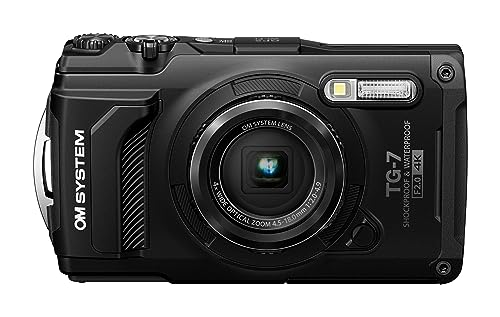
OM SYSTEM Tough TG-7 — Best Overall for Eight
Hand the OM SYSTEM Tough TG-7 to an eight-year-old mid-project — halfway through an eight-year-old documenting a nature-table collection — and watch whether it helps or interrupts. With this one it helps, because it is a compact sealed against water and built to shrug off crushing knocks. Close-up macro modes reveal tiny subjects other travel cameras walk straight past, and that is a strength aimed precisely at the work this age group actually does. Give the OM SYSTEM Tough TG-7 a project — the nature table, the pitch, the kitchen-table studio — and it behaves like equipment rather than entertainment, because close-up macro modes reveal tiny subjects other travel cameras walk straight past.
Eight-year-olds are merciless usability testers, and OM SYSTEM Tough TG-7 passes their examination quickly. Within one project the controls become the child’s own — found without looking, changed without asking — and the adult is released from translator duty. That handover of competence is the milestone this purchase is really about. An eight-year-old reviewing the day’s frames on the OM SYSTEM Tough TG-7 can see their own progress, which quietly raises the standard of the next outing.
Results are where an eight-year-old’s standards live, so let us be specific about the OM SYSTEM Tough TG-7’s. Close-up macro modes reveal tiny subjects other travel cameras walk straight past, which means a documented specimen or a midfield run survives printing for the classroom wall without embarrassment. Colour stays truthful, and a first gentle edit on the family computer finds files willing to cooperate. Across a football pitch the OM SYSTEM Tough TG-7 turns a spectator into a photographer, and that transformation is the real purchase being made this year.
The debit column, stated as plainly as an eight-year-old deserves. This one is a creature of its brief: ask for far-flung specialisms or professional polish and its edges show, and the supporting kit — case, cards, perhaps a tripod for the film studio — adds cost beyond the camera’s own ticket. Forewarned, a family can plan around both facts; ambushed by them, the same facts sour a good purchase. The badge of best overall for eight promises capability with forgiveness, and OM SYSTEM Tough TG-7 honours both halves of that bargain through a school year of projects.
A school term of ownership tells the truth about the OM SYSTEM Tough TG-7: it gets carried, charged and used by its owner, largely unassisted. The routine of care transfers gracefully — the child formats the card, watches the battery, wipes the lens — because the camera’s upkeep was designed to be learnable. Equipment a child maintains alone is equipment that survives, and this one survives. Stop-motion frames from the OM SYSTEM Tough TG-7 align, session after session, because the camera holds its settings the way a good collaborator holds a promise.
Against its five companions, the OM SYSTEM Tough TG-7 argues for a specific kind of growing room: headroom the child will grow into, armour they will not immediately need to test. That pairing — stretch plus forgiveness — is rare at any price and exactly right at this age. It earns best overall for eight by being the camera the projects keep asking for. By half-term, OM SYSTEM Tough TG-7 has become the child’s camera in the full possessive sense that predicts careful handling better than any rule.
- Role in this line-up: best Overall for Eight
- Files: colour suiting young-photographer projects, still grading gracefully afterwards
- Handling: controls placed for swift, unrushed young-photographer projects changes
- Carry profile: proportioned for an eight-year-old composing photographs on purpose
- Ownership note (young-photographer projects kit): cards, spare power and a case cost extra
Strengths
- The OM SYSTEM Tough TG-7 (young-photographer projects) locks focus dependably while a best friend mid-laugh outdoors
- Files from the OM SYSTEM Tough TG-7 (young-photographer projects) look polished immediately yet keep room for retouching
- Handling stays composed during young-photographer projects when the moment suddenly accelerates
Trade-offs
- Push it far outside young-photographer projects and its compromises surface quickly
- The complete young-photographer projects kit costs more than the camera alone suggests
- Several advanced young-photographer projects settings hide deeper in menus than shooters like
Best for: the eight-year-old whose projects match its badge — best overall for eight — and whose subjects resemble an eight-year-old documenting a nature-table collection.
Not suited for: anyone expecting professional miracles well outside the ground this pick was built to cover.

Fujifilm Instax Mini 12 — Best Instant Satisfaction
The Fujifilm Instax Mini 12 treats its young owner as a photographer already, not a photographer eventually: an instant camera that reads the light itself and delivers a real print. The respect shows in the details, since a selfie mirror and a twist-to-start lens keep using it almost foolproof. It takes the badge of best instant satisfaction by matching capability to a child who has begun to have intentions. Give the Fujifilm Instax Mini 12 a project — the nature table, the pitch, the kitchen-table studio — and it behaves like equipment rather than entertainment, because a selfie mirror and a twist-to-start lens keep using it almost foolproof.
There is a moment, usually during the second outing, when the Fujifilm Instax Mini 12 stops being operated and starts being used. Menus have been explored and survived, favourite settings have been chosen and kept, and the young photographer talks about what the camera will do next rather than what it just did. Designs that reach that moment earn their place in a school bag for years. An eight-year-old reviewing the day’s frames on the Fujifilm Instax Mini 12 can see their own progress, which quietly raises the standard of the next outing.
The output of the Fujifilm Instax Mini 12 has a quality its owner will notice before any adult does: it looks like what they meant. Because a selfie mirror and a twist-to-start lens keep using it almost foolproof, the gap between intention and result narrows — and that narrowing is the most encouraging experience a young photographer can be given. Keepers breed standards, and standards breed projects. Across a football pitch the Fujifilm Instax Mini 12 turns a spectator into a photographer, and that transformation is the real purchase being made this year.
What will it not do? Roughly what its design never claimed. The Fujifilm Instax Mini 12 will not out-reach a dedicated telephoto outfit, out-last a studio workhorse or satisfy an adult professional moonlighting with a child’s camera. Within the year’s real projects those limits are distant scenery; outside them, they are the whole landscape, so choose with the projects in view. The badge of best instant satisfaction promises capability with forgiveness, and Fujifilm Instax Mini 12 honours both halves of that bargain through a school year of projects.
Count the true running costs and the Fujifilm Instax Mini 12 still flatters the family budget of attention. Transfers reach the family computer without a parent-led expedition, power lasts the day out, and nothing about ownership requires a subscription to adult patience. Friction is the silent killer of children’s projects, and this camera is notably short of it. Stop-motion frames from the Fujifilm Instax Mini 12 align, session after session, because the camera holds its settings the way a good collaborator holds a promise.
One sentence for the fridge door: the Fujifilm Instax Mini 12 respects the photographer holding it. An eight-year-old moving from snapshots to collections, matches and films will feel that respect in every session the camera keeps up with an idea. Buy it for the badge it carries — best instant satisfaction — and it will repay the compliment in finished projects. By half-term, Fujifilm Instax Mini 12 has become the child’s camera in the full possessive sense that predicts careful handling better than any rule.
- Slot in this shortlist: best Instant Satisfaction
- Output: attractive young-photographer projects colour, with latitude for editing
- Controls: dials reachable quickly during young-photographer projects adjustments
- Size in the bag: matched to an eight-year-old composing photographs on purpose
- Budget note (young-photographer projects kit): memory cards, batteries and protection cost extra
Strengths
- The Fujifilm Instax Mini 12 (young-photographer projects) keeps moving subjects pinned in focus throughout a best friend mid-laugh outdoors
- Images off the Fujifilm Instax Mini 12 (young-photographer projects) arrive clean, still leaving headroom for careful editing
- The body feels calm in the hand throughout young-photographer projects, even as events speed up
Trade-offs
- Work beyond young-photographer projects exposes limits specialists would not accept
- Budget for the full young-photographer projects outfit: body price is only the start
- A few powerful young-photographer projects options sit buried in settings pages
Best for: the eight-year-old whose projects match its badge — best instant satisfaction — and whose subjects resemble an eight-year-old documenting a nature-table collection.
Not suited for: shoppers expecting a camera to provide the lighting, the viewpoint and the patience on its owner’s behalf.

Canon PowerShot G7 X Mark III — Best Step-Up Compact
Hand the Canon PowerShot G7 X Mark III to an eight-year-old mid-project — halfway through an eight-year-old documenting a nature-table collection — and watch whether it helps or interrupts. With this one it helps, because it is a pocketable compact built around a fast lens and creator-friendly video. Its size means it genuinely gets carried, beating specifications that stay at home, and that is a strength aimed precisely at the work this age group actually does. Give the Canon PowerShot G7 X Mark III a project — the nature table, the pitch, the kitchen-table studio — and it behaves like equipment rather than entertainment, because its size means it genuinely gets carried, beating specifications that stay at home.
Eight-year-olds are merciless usability testers, and Canon PowerShot G7 X Mark III passes their examination quickly. Within one project the controls become the child’s own — found without looking, changed without asking — and the adult is released from translator duty. That handover of competence is the milestone this purchase is really about. An eight-year-old reviewing the day’s frames on the Canon PowerShot G7 X Mark III can see their own progress, which quietly raises the standard of the next outing.
Results are where an eight-year-old’s standards live, so let us be specific about the Canon PowerShot G7 X Mark III’s. Its size means it genuinely gets carried, beating specifications that stay at home, which means a documented specimen or a midfield run survives printing for the classroom wall without embarrassment. Colour stays truthful, and a first gentle edit on the family computer finds files willing to cooperate. Across a football pitch the Canon PowerShot G7 X Mark III turns a spectator into a photographer, and that transformation is the real purchase being made this year.
The debit column, stated as plainly as an eight-year-old deserves. This one is a creature of its brief: ask for far-flung specialisms or professional polish and its edges show, and the supporting kit — case, cards, perhaps a tripod for the film studio — adds cost beyond the camera’s own ticket. Forewarned, a family can plan around both facts; ambushed by them, the same facts sour a good purchase. The badge of best step-up compact promises capability with forgiveness, and Canon PowerShot G7 X Mark III honours both halves of that bargain through a school year of projects.
A school term of ownership tells the truth about the Canon PowerShot G7 X Mark III: it gets carried, charged and used by its owner, largely unassisted. The routine of care transfers gracefully — the child formats the card, watches the battery, wipes the lens — because the camera’s upkeep was designed to be learnable. Equipment a child maintains alone is equipment that survives, and this one survives. Stop-motion frames from the Canon PowerShot G7 X Mark III align, session after session, because the camera holds its settings the way a good collaborator holds a promise.
Against its five companions, the Canon PowerShot G7 X Mark III argues for a specific kind of growing room: headroom the child will grow into, armour they will not immediately need to test. That pairing — stretch plus forgiveness — is rare at any price and exactly right at this age. It earns best step-up compact by being the camera the projects keep asking for. By half-term, Canon PowerShot G7 X Mark III has become the child’s camera in the full possessive sense that predicts careful handling better than any rule.
- Position in this line-up: best Step-Up Compact
- Files: flattering young-photographer projects palette tolerating retouching well
- Handling: layout supporting fast young-photographer projects tweaks mid-scene
- Carry profile: built around the demands of an eight-year-old composing photographs on purpose
- Ownership note (young-photographer projects kit): storage, power and cover need separate funds
Strengths
- The Canon PowerShot G7 X Mark III (young-photographer projects) finds focus calmly even as a best friend mid-laugh outdoors unfolds without warning
- The Canon PowerShot G7 X Mark III (young-photographer projects) produces finished-looking photographs while preserving flexibility for grading
- Controls stay reassuring under young-photographer projects pressure, keeping attention on subjects
Trade-offs
- Assignments outside its young-photographer projects brief reveal the engineering compromises
- Total young-photographer projects outlay climbs once essential extras join the camera
- Some young-photographer projects refinements live deep in the menu tree
Best for: the eight-year-old whose projects match its badge — best step-up compact — and whose subjects resemble an eight-year-old documenting a nature-table collection.
Not suited for: children whose genuine scenes bear no resemblance to an eight-year-old documenting a nature-table collection, no matter how capable it proves in its own work.

Polaroid Go Generation 2 — Best Creative Play
The Polaroid Go Generation 2 treats its young owner as a photographer already, not a photographer eventually: a palm-sized instant camera making small, characterful prints on the spot. The respect shows in the details, since a rechargeable build and double-exposure tricks invite playful experimentation. It takes the badge of best creative play by matching capability to a child who has begun to have intentions. Give the Polaroid Go Generation 2 a project — the nature table, the pitch, the kitchen-table studio — and it behaves like equipment rather than entertainment, because a rechargeable build and double-exposure tricks invite playful experimentation.
There is a moment, usually during the second outing, when the Polaroid Go Generation 2 stops being operated and starts being used. Menus have been explored and survived, favourite settings have been chosen and kept, and the young photographer talks about what the camera will do next rather than what it just did. Designs that reach that moment earn their place in a school bag for years. An eight-year-old reviewing the day’s frames on the Polaroid Go Generation 2 can see their own progress, which quietly raises the standard of the next outing.
The output of the Polaroid Go Generation 2 has a quality its owner will notice before any adult does: it looks like what they meant. Because a rechargeable build and double-exposure tricks invite playful experimentation, the gap between intention and result narrows — and that narrowing is the most encouraging experience a young photographer can be given. Keepers breed standards, and standards breed projects. Across a football pitch the Polaroid Go Generation 2 turns a spectator into a photographer, and that transformation is the real purchase being made this year.
What will it not do? Roughly what its design never claimed. The Polaroid Go Generation 2 will not out-reach a dedicated telephoto outfit, out-last a studio workhorse or satisfy an adult professional moonlighting with a child’s camera. Within the year’s real projects those limits are distant scenery; outside them, they are the whole landscape, so choose with the projects in view. The badge of best creative play promises capability with forgiveness, and Polaroid Go Generation 2 honours both halves of that bargain through a school year of projects.
Count the true running costs and the Polaroid Go Generation 2 still flatters the family budget of attention. Transfers reach the family computer without a parent-led expedition, power lasts the day out, and nothing about ownership requires a subscription to adult patience. Friction is the silent killer of children’s projects, and this camera is notably short of it. Stop-motion frames from the Polaroid Go Generation 2 align, session after session, because the camera holds its settings the way a good collaborator holds a promise.
One sentence for the fridge door: the Polaroid Go Generation 2 respects the photographer holding it. An eight-year-old moving from snapshots to collections, matches and films will feel that respect in every session the camera keeps up with an idea. Buy it for the badge it carries — best creative play — and it will repay the compliment in finished projects. By half-term, Polaroid Go Generation 2 has become the child’s camera in the full possessive sense that predicts careful handling better than any rule.
- Role in this selection: best Creative Play
- Output: polished young-photographer projects colour, plus room to refine tones
- Controls: positioned for prompt young-photographer projects changes, rhythm intact
- Footprint: sensible for days spent on an eight-year-old composing photographs on purpose
- Budget note (young-photographer projects kit): cards, extra power and case need budgeting
Strengths
- The Polaroid Go Generation 2 (young-photographer projects) holds focus with reassuring consistency whenever a best friend mid-laugh outdoors develops quickly
- Pictures from the Polaroid Go Generation 2 (young-photographer projects) need little rescue, though editors keep ample latitude
- Grip and layout keep nerves low during young-photographer projects while scenes refuse to slow
Trade-offs
- Stretch the young-photographer projects brief and this pick stops feeling like the answer
- Ownership spending for young-photographer projects extends beyond the headline body figure
- Occasional young-photographer projects features require menu-diving instead of direct controls
Best for: the eight-year-old whose projects match its badge — best creative play — and whose subjects resemble an eight-year-old documenting a nature-table collection.
Not suited for: anyone expecting professional miracles well outside the ground this pick was built to cover.

GoPro HERO12 Black — Best for Sport and Swimming
Hand the GoPro HERO12 Black to an eight-year-old mid-project — halfway through an eight-year-old documenting a nature-table collection — and watch whether it helps or interrupts. With this one it helps, because it is a proven action body with long recording manners and wide accessory support. Simplified operation suits gloves, spray and hurried setups, and that is a strength aimed precisely at the work this age group actually does. Give the GoPro HERO12 Black a project — the nature table, the pitch, the kitchen-table studio — and it behaves like equipment rather than entertainment, because simplified operation suits gloves, spray and hurried setups.
Eight-year-olds are merciless usability testers, and GoPro HERO12 Black passes their examination quickly. Within one project the controls become the child’s own — found without looking, changed without asking — and the adult is released from translator duty. That handover of competence is the milestone this purchase is really about. An eight-year-old reviewing the day’s frames on the GoPro HERO12 Black can see their own progress, which quietly raises the standard of the next outing.
Results are where an eight-year-old’s standards live, so let us be specific about the GoPro HERO12 Black’s. Simplified operation suits gloves, spray and hurried setups, which means a documented specimen or a midfield run survives printing for the classroom wall without embarrassment. Colour stays truthful, and a first gentle edit on the family computer finds files willing to cooperate. Across a football pitch the GoPro HERO12 Black turns a spectator into a photographer, and that transformation is the real purchase being made this year.
The debit column, stated as plainly as an eight-year-old deserves. This one is a creature of its brief: ask for far-flung specialisms or professional polish and its edges show, and the supporting kit — case, cards, perhaps a tripod for the film studio — adds cost beyond the camera’s own ticket. Forewarned, a family can plan around both facts; ambushed by them, the same facts sour a good purchase. The badge of best for sport and swimming promises capability with forgiveness, and GoPro HERO12 Black honours both halves of that bargain through a school year of projects.
A school term of ownership tells the truth about the GoPro HERO12 Black: it gets carried, charged and used by its owner, largely unassisted. The routine of care transfers gracefully — the child formats the card, watches the battery, wipes the lens — because the camera’s upkeep was designed to be learnable. Equipment a child maintains alone is equipment that survives, and this one survives. Stop-motion frames from the GoPro HERO12 Black align, session after session, because the camera holds its settings the way a good collaborator holds a promise.
Against its five companions, the GoPro HERO12 Black argues for a specific kind of growing room: headroom the child will grow into, armour they will not immediately need to test. That pairing — stretch plus forgiveness — is rare at any price and exactly right at this age. It earns best for sport and swimming by being the camera the projects keep asking for. By half-term, GoPro HERO12 Black has become the child’s camera in the full possessive sense that predicts careful handling better than any rule.
- Slot in this line-up: best for Sport and Swimming
- Files: confident young-photographer projects colour editors can adjust freely
- Handling: layout making quick young-photographer projects corrections feel deliberate
- Carry profile: shaped by the realities of an eight-year-old composing photographs on purpose
- Ownership note (young-photographer projects kit): cards, batteries and storage add extra spend
Strengths
- The GoPro HERO12 Black (young-photographer projects) tracks the decisive subject steadily during a best friend mid-laugh outdoors
- Output from the GoPro HERO12 Black (young-photographer projects) reads polished on delivery and forgives later surgery
- It feels planted and predictable throughout young-photographer projects, never twitchy at the decisive second
Trade-offs
- Tasks beyond young-photographer projects make its narrower talents obvious
- The honest young-photographer projects cost includes accessories the base purchase omits
- Certain advanced young-photographer projects choices demand patience through layered menus
Best for: the eight-year-old whose projects match its badge — best for sport and swimming — and whose subjects resemble an eight-year-old documenting a nature-table collection.
Not suited for: shoppers expecting a camera to provide the lighting, the viewpoint and the patience on its owner’s behalf.
Kurio Snap Camera — Best Gentle Bridge Pick
The Kurio Snap Camera treats its young owner as a photographer already, not a photographer eventually: a gently specced camera designed to feel friendly from the first press. The respect shows in the details, since output that leans natural instead of attention-seeking. It takes the badge of best gentle bridge pick by matching capability to a child who has begun to have intentions. Give the Kurio Snap Camera a project — the nature table, the pitch, the kitchen-table studio — and it behaves like equipment rather than entertainment, because output that leans natural instead of attention-seeking.
There is a moment, usually during the second outing, when the Kurio Snap Camera stops being operated and starts being used. Menus have been explored and survived, favourite settings have been chosen and kept, and the young photographer talks about what the camera will do next rather than what it just did. Designs that reach that moment earn their place in a school bag for years. An eight-year-old reviewing the day’s frames on the Kurio Snap Camera can see their own progress, which quietly raises the standard of the next outing.
The output of the Kurio Snap Camera has a quality its owner will notice before any adult does: it looks like what they meant. Because output that leans natural instead of attention-seeking, the gap between intention and result narrows — and that narrowing is the most encouraging experience a young photographer can be given. Keepers breed standards, and standards breed projects. Across a football pitch the Kurio Snap Camera turns a spectator into a photographer, and that transformation is the real purchase being made this year.
What will it not do? Roughly what its design never claimed. The Kurio Snap Camera will not out-reach a dedicated telephoto outfit, out-last a studio workhorse or satisfy an adult professional moonlighting with a child’s camera. Within the year’s real projects those limits are distant scenery; outside them, they are the whole landscape, so choose with the projects in view. The badge of best gentle bridge pick promises capability with forgiveness, and Kurio Snap Camera honours both halves of that bargain through a school year of projects.
Count the true running costs and the Kurio Snap Camera still flatters the family budget of attention. Transfers reach the family computer without a parent-led expedition, power lasts the day out, and nothing about ownership requires a subscription to adult patience. Friction is the silent killer of children’s projects, and this camera is notably short of it. Stop-motion frames from the Kurio Snap Camera align, session after session, because the camera holds its settings the way a good collaborator holds a promise.
One sentence for the fridge door: the Kurio Snap Camera respects the photographer holding it. An eight-year-old moving from snapshots to collections, matches and films will feel that respect in every session the camera keeps up with an idea. Buy it for the badge it carries — best gentle bridge pick — and it will repay the compliment in finished projects.
- Position in this shortlist: best Gentle Bridge Pick
- Output: pleasing young-photographer projects tones, retaining post-work flexibility
- Controls: arranged so young-photographer projects adjustments never feel fumbled
- Size and weight: planned with an eight-year-old composing photographs on purpose firmly in mind
- Budget note (young-photographer projects kit): storage media and spare power need money back
Strengths
- The Kurio Snap Camera (young-photographer projects) settles focus fast enough that a best friend mid-laugh outdoors rarely escapes unrecorded
- Frames from the Kurio Snap Camera (young-photographer projects) appear assured immediately yet tolerate thoughtful post-processing
- Everything falls under the fingers naturally in young-photographer projects when chances arrive unannounced
Trade-offs
- Demand work far from young-photographer projects and cracks appear sooner than expected
- Expect the finished young-photographer projects kit to outrun the camera-only price
- Not every useful young-photographer projects option surfaces quickly in the menus
Best for: the eight-year-old whose projects match its badge — best gentle bridge pick — and whose subjects resemble an eight-year-old documenting a nature-table collection.
Not suited for: children whose genuine scenes bear no resemblance to an eight-year-old documenting a nature-table collection, no matter how capable it proves in its own work.
How Do the Six Picks Compare Side by Side?
| Pick | Badge | Strongest suit | Watch out for |
|---|---|---|---|
| OM SYSTEM Tough TG-7 | Best Overall for Eight | Dependability when subjects move unpredictably | Limits appear outside its home territory |
| Fujifilm Instax Mini 12 | Best Instant Satisfaction | Files needing the least rescue afterwards | Accessories worth budgeting from the start |
| Canon PowerShot G7 X Mark III | Best Step-Up Compact | Simplicity that speeds every step | Size suits some hands better than others |
| Polaroid Go Generation 2 | Best Creative Play | Consistency across an entire outing | Menus reward a patient first week |
| GoPro HERO12 Black | Best for Sport and Swimming | Versatility when plans change mid-shoot | Kit costs extend beyond the camera |
| Kurio Snap Camera | Best Gentle Bridge Pick | Comfort throughout long handheld sessions | A learning curve awaits complete beginners |
S
What New Skills Open Up Between Six and Eight?
Between six and eight, several skills quietly unlock, and the right camera is the one waiting for them. Steadiness arrives first: an eight-year-old can brace, breathe and hold a frame still enough for a real zoom to be worth using. Reach stops being a frustration and becomes a choice — the bird stays undisturbed, the footballer stays in play, and the photograph improves because the photographer waited instead of charging closer.
Deliberate composition follows. Children this age can learn the rule of thirds in one afternoon and apply it for a week just to enjoy the cleverness of it, then start breaking it on purpose. A camera with a screen that shows a grid, and controls that stay where they were left, turns those experiments into visible progress rather than random variation.
Sequences and projects come within reach too. Stop-motion, a photo-a-day of the nature table, a documented building project in the garden — these need a camera that holds its position, its settings and its charge across many short sessions. Consistency, unglamorous as it sounds, is the capability that eight-year-old projects feed on.
Judgement is the final unlock, and the camera can teach it. An eight-year-old reviewing their own work can spot the blurry frame, the chopped-off head, the better angle they walked past. Picks that make reviewing easy — clear screens, simple deletion, honest playback — accelerate that education every single outing.
How Can an Eight-Year-Old Start Composing Photographs on Purpose?
Composing on purpose begins with one liberating idea: the photographer chooses what the frame includes, and everything else is technique. Start an eight-year-old with the edges — look at the corners of the screen before pressing, notice the stray bin, the half-person, the tilted horizon — and their photographs improve within a single walk, before any other lesson is offered.
Next, teach distance as a creative control rather than a problem. Zooming from the spot, walking closer, crouching lower: three different photographs of the same nature-table specimen, each saying something different. An eight-year-old who grasps that the camera’s position is an opinion has learned the core of photography, and every pick in this guide supports the experiment.
Light can be introduced as a treasure hunt. The same leaf photographed in flat midday glare, in open shade and against a bright window becomes a small masterclass no lecture could match. Children this age relish the detective work, and cameras that show the picture immediately let them verify each discovery on the spot.
Finish by giving composition a purpose beyond praise: a printed set for the nature table’s labels, a stop-motion film screened after dinner, a football sequence printed for the bedroom wall. Work made for an audience gets composed with care automatically, because the child can picture the viewer while they frame — and that, more than any rule, is composing on purpose.
What Mistakes Do Buyers in This Niche Keep Making?
Equipping the projects but not the photographer — a fine camera delivered without the case, card and charger routine that keeps it alive.
Leaving a capable eight-year-old on full automatic for a year, then wondering why the camera’s owner never developed intentions of their own.
Pixel-peeping sample frames while the camera’s weight, grip and boot time quietly decide whether it attends the match at all.
Debuting the camera at the term’s biggest event with no rehearsal, when a cheap practice afternoon would have taught its controls for free.
Copying the choice of a friend’s family, whose child has different projects, different hands and a different tolerance for menus.
Buying down to a toy the child outgrew last year and interpreting the resulting drawer-time as a lack of interest in photography.
How Can an Eight-Year-Old Practise Composing Photographs on Purpose?
Institute a two-minute review with a twist: the young photographer must defend one frame from the day and retire one, explaining both decisions. At eight, articulating why a photograph works builds judgement faster than taking another hundred, and the retirements teach the ruthless kindness every editor needs.
What Does Deliberate Practice Look Like for a Confident Young Photographer?
Presence is a logistics problem before it is a talent. Solve it with placement: the camera’s case lives in the school bag’s front pocket, the charger lives by the bed, and the card is emptied every Sunday. A system that boring produces a photographer who is, miraculously, always equipped.
How Do Weekly Photo Challenges Stretch an Eight-Year-Old’s Eye?
Recruit the family as subjects with assignments attached. Grandparents get portraits with interview questions; siblings get action sequences with commentary; the dog gets a documentary. An eight-year-old working to a brief — even a playful one — composes with an audience in mind, and audiences are composition’s best teacher.
Which Practice Projects Teach Framing, Patience and Storytelling at Eight?
Teach camera care as ownership rather than obedience. The child who dries their own camera after the beach, who reports a knock immediately because the household rule is honesty before blame, will still be using that camera when younger gadgets have been forgotten in drawers.
How Can Practice Sessions Prepare a Child for a Nicer Camera Later?
Introduce editing as a darkroom game with strict house rules: three adjustments maximum, and the photograph must still look like the day it came from. A child who learns restraint at eight edits with a photographer’s conscience for life, while their peers are still collecting filters.
Set one final challenge with whichever camera you chose: the same subject, three ways, argued aloud. Wide for the setting, close for the detail, and from a height nobody would expect — then let the young photographer defend a favourite before anyone else speaks. The defence is the education; the frames are almost a by-product.
A week later, repeat the challenge with the light reversed: morning subjects re-shot in the evening, window light swapped for lamplight. Eight-year-olds notice differences adults have stopped seeing, and naming those differences aloud builds the vocabulary their judgement will run on.
After a month of projects, print the best frame properly and display it where the household gathers. A printed photograph audits a young photographer’s progress more honestly than a screen ever will, and it quietly announces that the camera bought this year is producing work worth wall space.
Keep the challenges small, weekly and self-chosen where possible. An eight-year-old who sets their own next assignment — the whole nature table by Friday, a film by the holidays — has crossed the line from owning a camera to being a photographer, which was the point of the purchase all along. An eight-year-old can wait for the bird to settle, and that patience deserves a real zoom.
One last variation rewards a return visit: photograph the very first subject of the year again — the same specimen, the same end of the pitch — and place the two frames side by side. The distance travelled in a few months of honest practice will be written plainly across the pair, and no report card could encourage a young photographer half as well. The nature table rewards macro honesty more than any headline resolution figure.
Final Recommendation
S
Related guides
- Best Cameras Underwater for Kids 80 Dollar Range: Real Footage, Toy Picks, and Labelled Step-Ups
- Best Cameras for Prank Videos: Reaction-Ready Picks for Kind, Consented Comedy
- Best Cameras for Inside House: 6 Picks for Pets, Kids and Peace of Mind
- Best Cameras for Beauty Photography: Skin-Tone, Detail and Creator Picks
- Best Cameras for Aviation Photography: Reach, Tracking and Burst Picks
Frequently Asked Questions
Is an eight-year-old ready for a real compact camera?
Most are, provided the household is honest about the specific child. Readiness shows itself in patterns: belongings generally survive the term, instructions are remembered between weekends, and the child already treats a borrowed phone camera with some care. A real compact rewards that readiness with quality and controls a toy cannot offer, and the step up itself motivates careful handling — children rise to equipment that respects them. If the signs are mixed, the rugged picks in this guide offer real capability with the forgiveness built in, which is why one of them tops the list.
Does zoom matter more than print size at this age?
For the projects eight-year-olds actually pursue, zoom usually wins. Reach turns the football pitch, the bird table and the far end of the stage from impossible subjects into practised ones, and learning to frame from a distance teaches patience and anticipation. Print size matters mainly for school projects and wall prints, where most picks here already deliver enough. Choose zoom for the weekly work; the occasional large print will still succeed from a well-exposed file, while no amount of resolution invents a subject the lens could not reach.
How do I teach simple composition without killing the fun?
Teach one idea at a time, as a game rather than a lesson. This week, photographs must include something red. Next week, shoot everything from knee height. The week after, fill the frame with one thing. Each constraint is a composition principle in disguise — colour, viewpoint, simplicity — and children absorb them as challenges instead of rules. Review the results together with genuine curiosity, praise specific choices by name, and never grade. The fun survives because the teaching is indistinguishable from playing, which at eight is how all durable learning arrives.
Should the camera shoot video as well as stills?
At eight, yes — video has become one of the main creative outlets, from stop-motion films to narrated tours of elaborate constructions. A camera that handles both lets one device serve every project the child invents this year, and the skills transfer: framing, light and patience are the same craft at twenty-four frames a second. Check that the video side is as simple to start as the stills side, because a child defeated by the recording menu will simply never film, whatever the specification promises.
What ground rules keep a nicer camera safe?
Few, clear and consistently held: the strap goes on before the camera leaves the hand’s neighbourhood, the camera returns to its case rather than to pockets or piles, and it is never lent without the owner’s agreement. Add a household understanding that accidents reported immediately are met with problem-solving, not anger — children hide damage they fear, and hidden damage worsens. Most eight-year-olds honour rules they helped to phrase, so draft the list together and let them write it; ownership of the rules mirrors ownership of the camera.
Related Guides
Continue exploring with our practical notes on building a small camera kit that travels well, browse our guide to the options beginners should learn first, or dip into our field notes on photographing everyday subjects with intent as the projects grow more ambitious.


