kajuandouglas.com is reader-supported. When you buy through links on our site, we may earn an affiliate commission.
Where to Buy
A child, a swimming pool, and a camera that can go in the water with them: that is the whole dream behind the search for the best cameras underwater for kids 80 dollar range, and it deserves an honest map before any shopping begins. Eighty dollars, treated here purely as the budget frame your search named rather than as any product’s price, buys two very different families of device. At one end sit toy-grade waterproof cameras built for small hands, big buttons, and cheerful abuse. At the other end sit entry action cameras that happen to fall near the frame when bundled simply, plus a few clearly labelled step-up machines whose toughness explains why families stretch.
Start by deciding which family your child actually belongs to this summer. A six-year-old who wants to film a sibling’s cannonball and photograph a beetle at the pool’s edge needs forgiveness, floatability, and controls that work with wet fingers. A ten-year-old who snorkels, keeps a nature journal, and already protects a tablet like a librarian needs real image quality and a case that seals properly. Both children are shopping in the same search results, which is exactly why those results confuse everybody.
Waterproof claims need translating before money moves. Some cameras in this territory swim happily without any housing at all. Others are only splash-proof until they are clicked into the waterproof case in the box, and a case forgotten on the kitchen counter turns a pool day into a cautionary tale. Depth figures, meanwhile, describe survival in still test water, not a cannonball landing or a dive off the side. This guide reads every claim through a child’s actual behaviour, because children are the harshest testing laboratory any camera will ever meet.
Key Takeaways
- AKASO Brave 7 LE is the frame’s honest centre: a real action camera with a waterproof case, sized for family budgets.
- Toy-grade waterproof cameras suit the youngest swimmers best, provided an adult accepts their soft, cheerful image quality.
- GoPro HERO12 Black is the durable step-up for older children whose water time is measured in whole summers.
- OM SYSTEM Tough TG-7 is the labelled premium step-up: genuinely waterproof without a housing and built to be dropped.
- A floating strap and a rinse routine matter more to survival than any specification printed on a box.
- Buy for the depth your child truly reaches, which for most pool play is shallower than marketing suggests.
In this guide
Quick Picks
| Badge | Pick | Why it stands out |
|---|---|---|
| Best Inside the Frame | AKASO Brave 7 LE | Real action-camera footage, a proper waterproof case, and family-frame manners. |
| Best for the Youngest Swimmers | VTech Kidizoom Camera (waterproof case versions) | Oversized controls and a toy’s forgiveness for first underwater experiments. |
| Best Simple Pool Camera | Ourlife Kids Waterproof Camera | A cheerful, inexpensive route to underwater snaps without system thinking. |
| Step-Up: Best for Older Children | GoPro HERO12 Black | Step-up toughness, stabilisation, and an accessory shelf that grows with them. |
| Step-Up: Toughest Build | OM SYSTEM Tough TG-7 | Step-up waterproofing without a housing, plus macro modes for rock pools. |
| Best for Snorkel Trips | DJI Osmo Action 5 Pro | Step-up clarity and battery stamina for boat days and reef edges. |
How We Chose These Picks
Survival came first, image quality second, and that ordering is deliberate. A children’s underwater camera earns its keep by returning from the pool alive in September, so sealing design, case honesty, grip with wet hands, and the availability of a floating strap all outranked sensor bragging during selection. Cameras whose waterproofing depended on a flap a child could leave open were marked down, however pretty their sample photographs looked.
Age fit shaped the shortlist next. Every pick was assigned a realistic youngest owner, judged by button size, menu patience, weight in a small hand, and how much reading the setup demands. A brilliant camera that requires an adult to start every recording session fails the brief quietly, because the footage children value most is the footage they capture themselves, mid-game, without asking permission from the technology.
Position against the eighty-dollar frame was labelled last and labelled plainly. Two picks live honestly inside the frame’s spirit, one linked action camera anchors its centre, and three step-ups sit beyond it for families whose water use is heavy enough to justify the climb. Nothing in the tables below disguises which row is which, and the recommendation returns to that honesty before asking anyone to stretch.
What Does Waterproof Actually Mean When a Child Is Holding the Camera?
Manufacturers describe sealing in the language of depth and minutes: so far down, for so long, in laboratory water. Children operate in the language of impact, sunscreen, and surprise. A camera rated for a respectable depth can still flood through a battery door that was closed over a single grain of sand, and a modest depth rating with a simple, positive-locking case will outlive it across a whole summer. Read ratings as ceilings under perfect behaviour, then shop for designs that forgive imperfect behaviour.
Housings deserve their own paragraph because they change the daily ritual. A case-based camera must be inspected before every swim: seal wiped, latch fully home, a tissue test after the first dunk of the season. That ninety-second ceremony is nothing to an organised parent and everything to a rushed one, so families should choose the sealing style their real mornings can sustain. Built-in waterproofing removes the ceremony and replaces it with a simpler rule about rinsing and drying, which some households will honestly prefer.
Chlorine, salt, and sunscreen wage slow war on seals regardless of design. Chlorinated water dulls rubber over a season, salt crystals work into seams as they dry, and sunscreen softens some plastics while making every grip treacherous. The countermeasures are unglamorous and universal: fresh-water rinsing after swimming, air drying with doors open, and a fingertip check of every seal before the next outing. Cameras rarely die in the deep end; they die in the beach bag, un-rinsed, in August.
Screens and sound behave differently underwater too, and setting expectations early prevents disappointment. Touchscreens mostly stop responding when submerged, which is why physical buttons matter so much in this category. Microphones record a muffled, bubbling world that children find hilarious and adults find unusable, so families wanting narration should plan to add voices later, at the kitchen table, over the edited highlights.
How Much Camera Does a Child of Each Age Genuinely Need?
For the youngest swimmers, roughly the under-seven crowd, the camera is a toy that happens to record, and judging it as anything else guarantees frustration. They need a device that floats or wears a floating strap, survives being sat on, starts with one press, and produces bright, wobbly souvenirs of a day they experienced mostly as sensation. Sharpness rankings are irrelevant at this age; survival and immediacy are the entire specification sheet.
Middle childhood changes the brief completely. Somewhere around eight, children begin comparing their footage with what they see online, noticing blur, asking why the reef looks grey, and wanting to show a grandparent a clip that actually resembles the moment. Cameras for this band need honest stabilisation, a screen that can be read in sunshine, and files that survive being watched on a television. The linked action camera in this guide exists precisely at this crossing point.
Older children and young teenagers are, functionally, beginner photographers with wetter hobbies. They can manage a housing ritual, understand an exposure warning, and benefit from manual curiosity: macro modes for tide pools, slow motion for dive entries, time-lapse for a rock pool’s afternoon. Families shopping for this band should read the step-up rows seriously, because a camera bought a level above current skill gets grown into, while a toy bought a level below gets abandoned by October.
Siblings complicate every calculation, because a camera bought for the ten-year-old will be borrowed by the six-year-old at the exact moment supervision blinks. Households with wide age gaps should weight toughness and floatability higher than any single child’s wish list suggests, and should treat the floating strap not as an accessory but as the peace treaty that keeps one purchase serving the whole family.
Which of the Best Cameras Underwater for Kids in the 80 Dollar Range Fits Your Swimmer?

AKASO Brave 7 LE — Best Inside the Frame
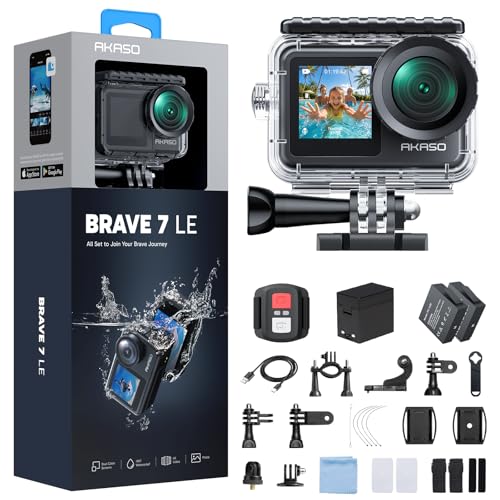
Here is the pick that makes the eighty-dollar frame feel honest rather than aspirational. The Brave 7 LE is a genuine action camera — stabilised video, a front-facing screen for a child narrating their own swim, voice-friendly controls, and a waterproof case in the box — offered at the modest end of its category. For a family that wants footage a television can do justice to, without entering flagship money, this is where the search sensibly ends.
Think about who operates it on a real pool afternoon. The case’s latch is positive and visible, so a parent can confirm sealing at a glance from the lounger. Buttons remain usable through the housing, which means the child keeps filming rather than ferrying the camera back for adult intervention. The dual-screen arrangement flatters the young presenter who wants to frame a poolside introduction before the underwater segment begins.
Weather sealing on the bare body adds a second layer of practicality that pure toy cameras never offer. Out of its case, the camera shrugs off splashes, rain on a boat ride, and the general damp of a beach bag, so it serves as the family’s everyday action camera across seasons rather than a single-purpose pool gadget. Versatility is what turns a summer purchase into a year-round resident of the kitchen drawer where useful things live.
Set expectations with the same clarity. Low light is handled willingly rather than beautifully, evenings belong to other cameras, and the case ritual — wipe the seal, check the latch — is non-negotiable homework before every swim. None of that dents the verdict for the frame’s typical buyer: a family with a confident swimmer between eight and twelve who wants real footage, real stabilisation, and a bill that respects the budget named in the search.
Ownership across a season follows a reassuring pattern with this class of camera. The first week produces chaos and delight in equal measure; by the third outing, the child has learned the case check, the parent has learned the rinse, and the footage has settled into watchable family record. Equipment that teaches its own care routine that quickly tends to survive, and survival, in this category, is the feature every other feature depends on.
- Form: compact action camera with waterproof case included
- Screens: front and rear, for framing and presenting
- Sealing: weather-resistant body, case for submersion
- Controls: physical buttons usable through the housing
- Position: the guide’s anchor inside the frame
Strengths
- Real stabilised footage at a family-frame position
- Front screen serves young presenters well
- Useful out of the water across all seasons
Trade-offs
- Underwater use depends on the case ritual
- Evening image quality is modest
- Small controls challenge the youngest hands
Best for: confident swimmers aged roughly eight to twelve wanting real footage. Not suited for: toddlers, or families unwilling to check a case seal.
VTech Kidizoom Camera (waterproof case versions) — Best for the Youngest Swimmers
Some cameras are instruments; this one is a companion, and for a five-year-old that distinction is the entire review. The Kidizoom line wraps simple photography and video in a chunky, grippable body with oversized controls, playful effects, and — in the versions sold with their waterproof case — permission to take the whole game into the shallow end. It is presented here without a purchase link, as a prose-only pick, because listings and bundles vary; shop by the case being included, not by the colour of the shell.
Judge its pictures by the standards of its owner. The images are soft, the video is cheerful rather than detailed, and the built-in games will consume as much holiday time as the photography does. A child who has just learned to swim does not experience any of that as deficiency. They experience a device that is theirs, that starts when they press the big button, and that shows them their own underwater face on the screen before the towel is even found.
Durability thinking differs from the action cameras in this guide. The Kidizoom’s protection is partly the case, partly the low stakes: it is light, it is designed to be dropped on tiles, and its replacement cost sits in birthday-present territory rather than family-electronics territory. Parents relax around it in a way they never relax around a flagship, and that relaxation is itself a feature, because a camera adults fear for gets left in the hotel room.
Know where its ceiling sits before a keen child finds it. There is no growth path, no meaningful manual control, and no footage that will satisfy the same child at nine. Buy it as a first chapter with a planned ending: two or three summers of shallow-end sovereignty, after which the household graduates to the action-camera rows of this guide with a young photographer already trained in framing, reviewing, and caring — mostly — for a device.
One practical ritual elevates even this toy’s survival odds. Teach the case check as a game the child performs aloud — seal, latch, shake, swim — and the habit will transfer intact to every more serious camera that follows. Families often discover that the cheapest camera in the guide taught the most expensive lesson in the whole category: waterproofing is a behaviour, not a purchase.
- Form: chunky toy camera, waterproof case on bundled versions
- Controls: oversized buttons for small, wet hands
- Extras: games and playful photo effects built in
- Files: cheerful souvenirs rather than detailed records
- Position: inside the frame, youngest-owner territory
Strengths
- Designed for small hands and hard knocks
- Ownership feels complete to a young child
- Low stakes keep parents relaxed
Trade-offs
- Image quality is toy-grade throughout
- No growth path as skills develop
- Bundles vary; verify the case is included
Best for: swimmers under seven taking their first underwater pictures. Not suited for: snorkelling detail or children already editing video.
Ourlife Kids Waterproof Camera — Best Simple Pool Camera
Between the toy shelf and the action-camera shelf sits a plain-spoken middle shelf, and this camera occupies it. Sold as a children’s waterproof camera with a case, a wrist strap, and a deliberately short feature list, it asks almost nothing of its owner: charge it, seal it, press the shutter, and accept bright, simple underwater photographs as the reward. It appears here as a prose-only pick, without a link, because seller bundles shift frequently; the shopping skill is checking that case, strap, and card arrangements are all in the box.
Simplicity at this level is a considered trade, not an accident. There is no stabilisation story to configure, no app pairing ceremony, no menu tree in which a child can lose the settings an adult arranged. Grandparents can operate it. Younger siblings can operate it. The camera’s whole personality is availability, and for pool parties, paddling pools, and the shallow end of a holiday hotel, availability beats sophistication every single afternoon.
Its photographs should be described honestly. In bright pool water, faces and swimsuits record with pleasing colour and enough detail for the family chat and the fridge door. In dimmer water, or at a reef’s shadowed edge, quality thins quickly, and video is best treated as a bonus rather than a purpose. Families whose ambitions stop at souvenirs will never feel the limits; families planning a snorkelling holiday should keep reading toward the action cameras.
What redeems the simplicity is how completely it sidesteps the category’s usual failure: the camera that stays home. Because nobody in the household feels protective of it, this one goes to the water park, the river picnic, and the rainy-day garden flood experiment. The archive of a childhood is built from cameras that were present, and presence is this pick’s entire, honourable argument.
Treat its case with more respect than its price suggests. The seal is the product, in a sense; a two-minute rinse-and-dry routine after swimming and a seal wiped free of sand before closing will decide whether it sees a second summer. Children can own that routine by the third outing, and usually take pride in performing it with unnecessary solemnity.
- Form: simple children’s camera with waterproof case
- Operation: near-zero setup, shutter-first design
- Files: bright pool souvenirs, modest video
- Bundles: vary by seller; check contents carefully
- Position: inside the frame, simplicity first
Strengths
- Anyone in the family can use it instantly
- Goes everywhere because nobody fears for it
- Honest pool photographs in bright water
Trade-offs
- Dim water defeats its small sensor quickly
- Video is a bonus, not a strength
- Bundle contents need checking before purchase
Best for: pool parties, paddling pools, and souvenir-first families. Not suited for: reef trips or young videographers with ambitions.

GoPro HERO12 Black — Step-Up: Best for Older Children
Step-up label first, because honesty about position matters more than enthusiasm: this camera sits beyond the eighty-dollar frame, and it earns its row by being the device the frame’s graduates eventually ask for by name. Waterproof without a housing to a depth that covers every pool and most snorkelling a family will attempt, stabilised so effectively that a child’s excited swimming still yields watchable footage, and supported by mounts for helmets, bikes, boards, and boats, it converts one summer’s hobby into several years of active filming.
Consider the child it truly suits. They already swim confidently, already watch their footage back with a critic’s eye, and already chafe at the toy camera’s softness. Hand that child this machine and the improvement is immediate and visible: dives hold together, underwater colours stay truer, and slow-motion entries off the board become the family’s most replayed clips. The step-up is not buying prestige; it is buying the removal of frustrations the child can already name.
Voice control deserves mention in a children’s guide for a practical reason: hands are busy. A swimmer holding a rail, a rider holding bars, a kayaker holding a paddle can start and stop recording by speaking, which keeps the camera a participant in the activity rather than an interruption to it. Parents of active children will recognise how much footage exists solely because starting it required no free hand.
Budget its companions with adult realism. A floating grip or strap is mandatory near deep water, spare batteries serve long boat days, and a protective case for travel keeps the lens that lives dangerously from collecting scars in transit. Counted whole, the step-up costs what it costs; this guide’s position is simply that for the right child — active, committed, past the toy stage — it is money spent once instead of twice.
Longevity completes the case. Mounts, batteries, and replacement parts for this line are stocked everywhere active families travel, so the camera bought for a ten-year-old’s snorkel trip can be re-purposed for the same child’s cycling phase and the family’s ski holiday without an accessory treasure hunt. Few purchases in this guide adapt to as many second acts.
- Sealing: waterproof without a housing for pool and reef use
- Stabilisation: strong smoothing for swimming and riding
- Control: voice commands for occupied hands
- Ecosystem: mounts and parts available everywhere
- Position: step-up beyond the frame, labelled as such
Strengths
- Footage quality a growing critic will respect
- No housing ritual for everyday swimming
- Adapts across sports and seasons
Trade-offs
- Sits beyond the eighty-dollar frame
- Overkill for shallow-end souvenir play
- Needs a floating strap near deep water
Best for: active older children filming swims, rides, and trips. Not suited for: first cameras for the under-sevens.

OM SYSTEM Tough TG-7 — Step-Up: Toughest Build
Another step-up, labelled as plainly as the last, and the guide’s choice for families whose water is wilder than a pool. The Tough TG-7 is a stills-first camera engineered around punishment: waterproof without any housing, resistant to drops, dust, and cold, and small enough to live in a beach bag’s side pocket for an entire holiday. Where the action cameras think in footage, this one thinks in photographs — rock-pool creatures, waterfall portraits, a child’s face surfacing through spray.
Macro is its party trick and the reason nature-minded children adore it. A microscope-style mode focuses astonishingly close, turning a tide pool into a safari: anemones, tiny crabs, the architecture of a shell. A child who leans toward collecting and identifying rather than filming and performing will produce, with this camera, the most interesting album in the whole guide — still images with genuine detail, taken in places no phone should ever go.
Field handling rewards the expedition mindset. The grip works with wet or gloved hands, controls stay findable by touch, and location logging can map where each discovery happened, which turns a coastal walk into a plotted expedition diary. Parents should note the honest corollary: menus run deeper than a toy’s, and a younger child will need an adult co-pilot for the first few outings before the camera becomes truly theirs.
Video exists and serves, without leading. Families whose memories move will prefer the action rows; families whose memories hang on walls and fill nature journals will not miss the trade. Inside a guide organised by an eighty-dollar frame, this pick’s role is to mark the quality ceiling of the genuinely-tough compact class, so that a family with a serious young naturalist knows exactly what the climb buys.
Durability claims here are structural rather than cosmetic, and that difference shows after a year. Seals are designed for repeated immersion, the body tolerates the drops that end lesser cameras, and the whole device asks only for rinsing and drying in return. Bought for the right child, it is the pick least likely in this guide to be replaced for any reason other than being outgrown artistically — which is the best reason there is.
- Build: waterproof, drop-resistant, dust- and cold-tolerant
- Macro: microscope-style close focus for tide pools
- Handling: controls usable with wet hands
- Logging: location records for expedition diaries
- Position: premium step-up beyond the frame
Strengths
- Genuine toughness without any housing
- Close-up modes delight nature collectors
- Stills quality leads this guide’s tough class
Trade-offs
- Well beyond the frame’s budget
- Menus need an adult co-pilot at first
- Video serves rather than stars
Best for: young naturalists photographing coasts, pools, and weather. Not suited for: video-led children or frame-firm budgets.

DJI Osmo Action 5 Pro — Best for Snorkel Trips
The final row belongs to the family’s biggest water days, and it too sits beyond the frame as a step-up. The Osmo Action 5 Pro is an action camera tuned for clarity and endurance: strong low-light behaviour for shaded reef edges and late-afternoon swims, long battery stamina for boat days that outlast a single charge elsewhere, and waterproofing without a housing for the depths recreational snorkelling actually reaches. For a family taking one significant snorkelling holiday, it is the camera that brings the reef home recognisably.
Colour underwater is where this class earns its money, and where children notice first. Water eats red light with depth, leaving cheap footage green and ghostly; better sensors and processing resist that drift longer, so the fish a child followed stays the colour the child remembers. Parents editing a holiday film will feel the difference in every clip, and grandparents watching it will simply see the trip as it was.
Endurance shapes the second half of the argument. Boat days are long, charging opportunities are fictional, and a camera that records through the morning reef, the beach lunch, and the sunset swim on disciplined battery use removes a whole category of holiday friction. Paired with a floating grip and a wrist lanyard, it becomes the single device a family passes hand to hand above the reef, each swimmer returning with their own chapter of the day.
Place it honestly against its GoPro neighbour before choosing. Both are excellent; the decision turns on whether the family’s water is bright and playful, where either delights, or shaded, deep, and long, where this pick’s clarity and stamina justify its position. Either way, both step-ups should be bought only when the child’s commitment is proven — a season of enthusiasm on a frame-priced camera is the evidence that unlocks this row.
Accessories follow the same discipline as everywhere in this guide: flotation first, power second, novelty last. A camera recovered from the surface by its floating grip has justified its entire accessory budget in one moment, and every family that has watched a non-floating camera descend slowly into blue water understands that sentence in their stomach rather than their head.
- Sealing: waterproof without a housing for snorkel depths
- Image: strong clarity in shaded and deeper water
- Stamina: long recording days on a boat schedule
- Handling: suited to hand-to-hand family sharing
- Position: step-up beyond the frame
Strengths
- Reef colour holds up better with depth
- Battery suits full holiday excursions
- No case ceremony before swimming
Trade-offs
- Beyond the frame, like all step-ups here
- More camera than pool play requires
- Floating grip remains an essential extra
Best for: snorkelling holidays and older children filming reefs. Not suited for: paddling pools or first-camera duty.


