The best 150 mile outdoor antennas exist for homes that sit far from the broadcast towers, where an indoor antenna gives up and a standard outdoor model still falls short. At this range, the antenna has to do real work: a long directional or rotating element, a low-noise amplifier, and a mount that holds steady through wind and weather. The six antennas below all carry a 150-mile range rating in their listings, and they were chosen to cover the main ways people actually use one — a motorized rotating model for scattered towers, a fixed Yagi-style build for a single distant market, and multi-TV models for feeding several rooms from one mast.
Range ratings are not promises, and that matters more at 150 miles than at any shorter distance. Hills, trees, buildings, and weather all eat into reception, and a tower that is 150 miles away on flat ground may be unreachable behind a ridge. What a good long-range antenna does is give you the best possible starting point: enough gain, a clean amplified signal, and the ability to aim at the towers that matter. The rest of this guide explains how to read those listings honestly, what to check before you climb a ladder, and which of the six picks fits each kind of home.
In this guide
Quick picks: best 150 mile outdoor antennas
| # | Product | Where to buy |
|---|---|---|
| 1 | Five Star Outdoor 150 Mile Motorized Antenna | Check on Amazon |
| 2 | McDuory Amplified Digital Outdoor Antenna 150 Miles | Check on Amazon |
| 3 | Five Star HDTV Antenna 150 Miles Range | Check on Amazon |
| 4 | McDuory Digital HDTV Outdoor Amplified Antenna 150 Miles | Check on Amazon |
| 5 | Mornixol TV Antenna Outdoor 150 Miles | Check on Amazon |
| 6 | YeCeny Digital Outdoor Amplified HD TV Antenna 150 Miles | Check on Amazon |
How the picks were chosen
We started with outdoor antennas whose listings state a 150-mile range, and kept only models that are clearly built for outdoor mounting with weather-resistant construction. An indoor-only antenna or a model rated for a shorter distance did not make the list, because the whole point of this guide is the far end of the range scale, where the wrong pick means no signal at all.
Each candidate was checked against the practical questions that decide whether a long-range antenna works in a real home: does it rotate, so it can aim at towers in different directions, or is it fixed and aimed once; does it include an amplifier and a long coaxial cable, so the signal survives the run from the roof to the TV; and how many TVs can it feed, since a single-TV model is a poor fit for a household with three sets. The six picks below answer those questions in different ways, which is why the list mixes motorized and fixed designs.
Finally, we weighed build and mounting. A 150-mile antenna is usually mounted on a roof, a mast, or a tall pole, so the mounting hardware and the cable length in the box matter as much as the range number. Every pick below includes mounting hardware or a mounting pole in its listing, and the sections below say plainly what each one includes and what you will still need to supply.
We also checked the antenna listings for what they do not say. A listing that states a range but never mentions the mounting hardware, the cable length, or the number of TVs it supports leaves the buyer guessing, and guessing is expensive when the antenna is already on the roof. The six picks below all state those details clearly, which is part of why they were chosen over the many listings that hide them.
We also favoured antennas whose listings state the cable type. RG6 coaxial cable is the standard for TV antenna runs, because it loses less signal over a long run than thinner cable, and every pick in this guide that states a cable length uses RG6. A listing that never mentions the cable type leaves the buyer to discover a weak link after the install.
Quick comparison
| Product | Key detail | Best for |
|---|---|---|
| Five Star Outdoor 150 Mile Motorized Antenna | Five Star Outdoor 150 Mile Motorized Antenna | Homes with scattered broadcast towers |
| McDuory Amplified Digital Outdoor Antenna 150 Miles | McDuory Amplified Digital Outdoor Antenna 150 Miles | Easy installs and rotating reception |
| Five Star HDTV Antenna 150 Miles Range | Five Star HDTV Antenna 150 Miles Range | Whole-house antenna setups |
| McDuory Digital HDTV Outdoor Amplified Antenna 150 Miles | McDuory Digital HDTV Outdoor Amplified Antenna 150 Miles | Single-direction tower setups |
| Mornixol TV Antenna Outdoor 150 Miles | Mornixol TV Antenna Outdoor 150 Miles | Roof-edge installs with a J-pole mount |
| YeCeny Digital Outdoor Amplified HD TV Antenna 150 Miles | YeCeny Digital Outdoor Amplified HD TV Antenna 150 Miles | Two-TV homes wanting motorized aiming |
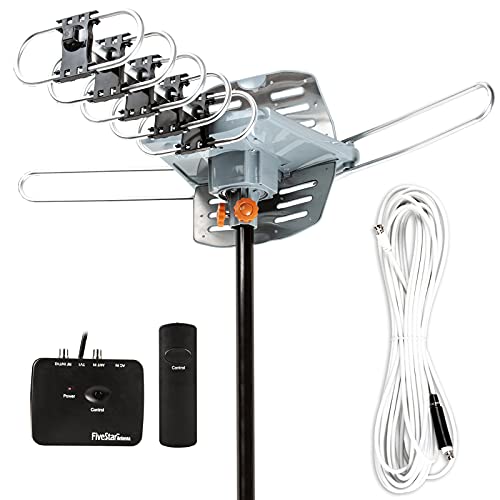
Five Star Outdoor 150 Mile Motorized 360 Degree Rotation Antenna
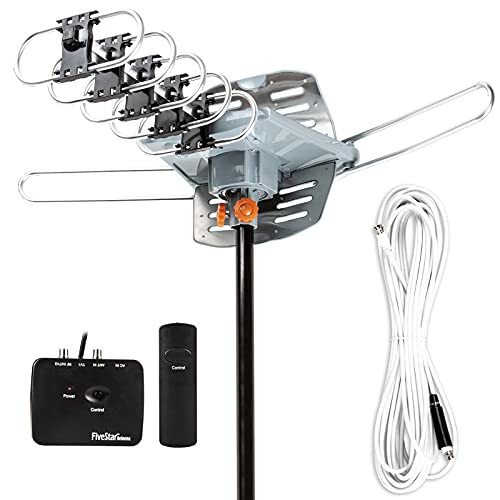
The Five Star motorized antenna is the most complete package in this guide: a 150-mile amplified outdoor antenna with 360-degree motorized rotation, a wireless remote control, and support for two TVs. The motorized rotation is the feature that matters most at long range, because broadcast towers are rarely all in one direction, and a rotating antenna can be aimed at each tower group without anyone climbing back onto the roof.
Its listing describes an OTA amplified design for UHF and VHF channels with 1080p reception, a 40-foot RG6 coaxial cable in the box, and a wireless remote that turns the antenna from inside the house. The two-TV support means a single antenna can feed a living room set and a bedroom set, which covers the most common household setup without a separate splitter purchase.
The motorized rotation also helps with seasonal changes. Trees leaf out in summer and lose their leaves in winter, which changes the signal path, and a rotating antenna can be re-aimed in seconds to find the strongest signal for the season. That flexibility is one reason motorized models are popular in rural areas, where the landscape itself changes through the year.
Key specs: Range: 150 miles. Rotation: 360-degree motorized with wireless remote control. Channels: UHF and VHF, 1080p. TVs supported: 2. Cable: 40-foot RG6 coaxial cable included. Amplified OTA design.
Strengths:
- Motorized 360-degree rotation aims at towers in any direction
- 150-mile amplified range with support for two TVs
- Wireless remote and 40-foot cable included in the box
Trade-offs:
- Motorized parts add a point of failure over a fixed antenna
- Two-TV support is modest for larger households
- Needs a clear outdoor mounting spot to reach its rated range
This is a good fit for rural homes with towers in more than one direction and two TVs to feed from a single antenna.
Best for: Homes with scattered broadcast towers
Not suited for: Single-direction tower setups where rotation is never used
Check price on Amazon: Five Star Outdoor 150 Mile Motorized Antenna
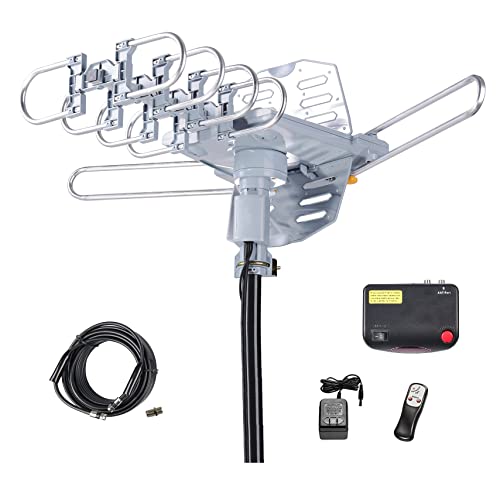
McDuory Amplified Digital Outdoor HDTV Antenna 150 Miles
The McDuory amplified outdoor antenna pairs a 150-mile range rating with 360-degree rotation controlled by infrared remote, and it is built around a simple idea: tools-free installation. For anyone who wants a long-range antenna without a complicated mount, the listing describes a design that goes up without special tools and still covers the full rotation circle.
Its listing covers digital outdoor HDTV reception with an amplified signal and infrared control for the rotation, plus support for two TVs. The tools-free angle matters because a 150-mile antenna is usually a roof or mast job, and anything that shortens the time on a ladder is a genuine advantage rather than a gimmick.
The infrared remote is worth a note for buyers who mount the antenna far from the house. Infrared needs a line of sight to its receiver, so the receiver should be placed where the remote can reach it, ideally near a window facing the antenna. If the receiver will sit behind a wall, a wireless remote model is the better choice.
Key specs: Range: 150 miles. Rotation: 360-degree with infrared remote control. Installation: tools-free. TVs supported: 2. Amplified digital outdoor HDTV antenna.
Strengths:
- Tools-free installation shortens the mounting job
- 360-degree rotation with infrared remote control
- 150-mile amplified range for distant towers
Trade-offs:
- Infrared control needs a line of sight to the receiver
- Two-TV support limits larger households
- Infrared remotes can be less convenient than wireless ones
This is a good fit for anyone who wants a rotating long-range antenna and would rather spend less time on the roof during installation.
Best for: Easy installs and rotating reception
Not suited for: Households needing to feed more than two TVs
Check price on Amazon: McDuory Amplified Digital Outdoor Antenna 150 Miles
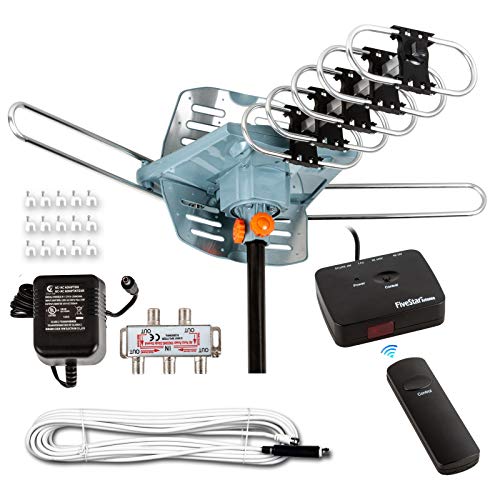
Five Star HDTV Antenna Amplified Digital Outdoor Antenna 150 Miles Range
The second Five Star pick in this guide is the multi-TV specialist: a 150-mile amplified outdoor antenna with 360-degree rotation, a wireless remote, and support for up to five TVs. If the first Five Star model is the standard two-TV package, this one is the version for a household where the antenna feeds the living room, two bedrooms, and a den from a single mast.
Its listing describes a 40-foot RG6 coaxial installation kit, which covers the cable run from a roof or mast mount down to a splitter, and the 360-degree rotation with wireless remote control. The five-TV support is the headline here, and it is the reason this pick exists: most long-range antennas feed one or two sets, and a five-TV capacity changes the maths for a whole house.
The five-TV capacity is also useful for future-proofing. A household with two TVs today may add a third in a bedroom or a den, and an antenna that already supports five sets means no new antenna when that happens. The extra capacity costs little at purchase and saves a second install later.
Key specs: Range: 150 miles. Rotation: 360-degree with wireless remote control. TVs supported: 5. Cable: 40-foot RG6 coaxial installation kit included. Amplified digital outdoor antenna.
Strengths:
- Feeds up to five TVs from one antenna
- 360-degree rotation with a wireless remote
- 40-foot RG6 installation kit included
Trade-offs:
- A five-TV setup still needs a splitter and extra cable runs
- Motorized rotation adds moving parts
- Overkill for a single-TV household
This is a good fit for larger households that want one antenna on the roof feeding every TV in the house.
Best for: Whole-house antenna setups
Not suited for: Single-TV homes that will never use the extra outputs
Check price on Amazon: Five Star HDTV Antenna 150 Miles Range

McDuory Digital HDTV Outdoor Amplified Antenna 150 Miles Range
The second McDuory pick is the fixed-installation workhorse of the list: a 150-mile amplified outdoor antenna that comes with a mounting pole and 40 feet of RG6 coaxial cable, and is tuned for UHF and VHF performance. There is no motorized rotation here, which is a deliberate trade-off — fewer moving parts, a simpler install, and a design that is aimed once and left alone.
Its listing describes tools-free installation, a mounting pole in the box, and optimized performance across UHF and VHF bands. For a home where all the wanted towers sit in roughly the same direction, a fixed antenna like this one is often the more reliable choice, because there is nothing to rotate, nothing to wear out, and nothing to re-aim after a storm.
The fixed design also means the antenna holds its aim through storms. A motorized antenna can drift slightly after high winds, and it needs a re-check after a storm, while a fixed antenna that is bolted down stays where it was aimed. For a home in a windy area, that steadiness is a real advantage.
Key specs: Range: 150 miles. Mounting pole included. Cable: 40 feet RG6 coaxial cable included. Bands: UHF and VHF. Installation: tools-free. Amplified outdoor antenna.
Strengths:
- Mounting pole and 40-foot cable included in the box
- Fixed design means no motor to wear out
- Tuned for UHF and VHF reception
Trade-offs:
- No rotation, so it suits one tower direction only
- Aiming it correctly matters more than with a rotating model
- Needs a clear line toward the towers
This is a good fit for homes where the broadcast towers cluster in one direction and a set-and-forget antenna is the goal.
Best for: Single-direction tower setups
Not suited for: Homes with towers spread across the compass
Check price on Amazon: McDuory Digital HDTV Outdoor Amplified Antenna 150 Miles
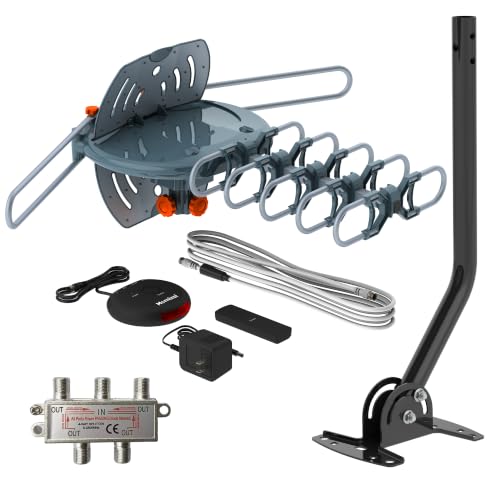
Mornixol TV Antenna Outdoor 360 Degree Motorized 150 Miles
The Mornixol outdoor antenna is a 150-mile motorized model that ships with a J-pole mount, an amplifier signal booster, and a remote control, all aimed at one job: pulling in distant 4K and 1080p channels from a single outdoor mount. The J-pole in the box is a practical detail, because it means the antenna can go straight onto a roof edge or wall bracket without a separate mast purchase.
Its listing describes 360-degree motorized rotation, a 150-mile long-range reception rating, an amplifier signal booster, and support for 4K and 1080p HDTVs, with easy setup. The combination of motorized aiming and a built-in booster is what a long-range setup needs most: the rotation finds the towers, and the booster keeps the signal strong enough to survive the cable run indoors.
The J-pole mount suits a roof edge, a gable end, or a sturdy wall bracket, and it keeps the antenna clear of the roof surface itself. That clearance matters for signal, because a metal roof close behind an antenna can reflect and distort reception, and a J-pole holds the elements out in clear air.
Key specs: Range: 150 miles. Rotation: 360-degree motorized with remote control. Mount: J-pole included. Amplifier: signal booster included. Reception: 4K and 1080p HDTVs.
Strengths:
- J-pole mount included, so no separate mast is needed
- Amplifier signal booster helps the signal survive long cable runs
- Motorized 360-degree rotation with remote control
Trade-offs:
- Motorized design has more parts that can wear over time
- A J-pole suits roof edges better than flat open ground
- Needs a clear view toward the towers to reach full range
This is a good fit for homes that need a complete motorized long-range kit with the mount included in the box.
Best for: Roof-edge installs with a J-pole mount
Not suited for: Ground-level installs with no elevated mounting point
Check price on Amazon: Mornixol TV Antenna Outdoor 150 Miles

YeCeny Digital Outdoor Amplified HD TV Antenna 150 Miles
The YeCeny digital outdoor antenna closes the list with a familiar formula done well: a 150-mile motorized antenna with 360-degree rotation, a wireless remote, and a 40-foot RG6 coaxial cable, supporting two TVs. It is the value entry among the motorized picks, offering the same core combination of long range, rotation, and amplification at a simpler package level.
Its listing describes UHF and VHF reception with 1080p and 4K support, a wireless remote control for the rotation, and a 40-foot RG6 cable. For a household that wants motorized aiming and a 150-mile rating without paying for multi-TV capacity it will not use, this is the straightforward pick.
The value angle of this model is its completeness. Motorized rotation, amplification, a wireless remote, and a 40-foot cable cover the whole install in one box, and the only extra purchase most buyers need is the mount itself. For a first long-range antenna, that simplicity is worth a lot.
Key specs: Range: 150 miles. Rotation: 360-degree motorized with wireless remote control. Cable: 40-foot RG6 coaxial cable. Reception: UHF and VHF, 1080p and 4K. TVs supported: 2.
Strengths:
- Motorized 360-degree rotation with wireless remote
- 150-mile range with 40-foot cable included
- Supports 4K and 1080p reception for two TVs
Trade-offs:
- Two-TV support is the limit for this model
- Motorized parts need occasional attention over the years
- Mounting hardware beyond the antenna itself may be needed
This is a good fit for a two-TV household that wants motorized long-range reception in a simple package.
Best for: Two-TV homes wanting motorized aiming
Not suited for: Whole-house setups feeding four or five TVs
Check price on Amazon: YeCeny Digital Outdoor Amplified HD TV Antenna 150 Miles
Best 150 mile outdoor antennas: what matters most
Range is the first number to read, and it should be read as a maximum under good conditions, not as a guarantee. A 150-mile rating means the antenna has the gain and amplification to reach that far when the path is clear, but hills, dense trees, and buildings all shorten the practical distance. Before buying, it helps to check where the nearest broadcast towers actually are and how far they sit from the house, because a home 40 miles from its towers does not need a 150-mile antenna at all, while a home 120 miles out does.
Rotation is the second decision, and it depends entirely on tower geography. If every channel you want comes from towers in one direction, a fixed antenna aimed once is simpler and more reliable. If the towers are spread across two or three directions, a motorized rotating antenna earns its place, because it can be turned toward each group without a trip to the roof. The remote control matters here too: a wireless remote works from the couch, while an infrared remote needs a clear path to its receiver.
Amplification and cable length are the third pair to check. An amplifier boosts a weak distant signal before it travels down the cable, which is exactly what a long-range setup needs, but it cannot create a signal that is not there. A long RG6 cable in the box saves a separate purchase and keeps the signal path short and clean, and the number of TVs the antenna supports decides whether one antenna can serve the whole house or only one room.
Mounting height is the fourth factor, and it is often the one that decides whether a 150-mile antenna works at all. A few extra feet of height can clear a treeline or a neighbouring roof, and that clearance can be the difference between a channel and no channel. If the roof is the highest point available, mount there; if a mast can add height, it is usually worth it, because height is the cheapest gain a long-range setup can buy.
The number of TVs is the fifth factor, and it should be counted before ordering rather than after. An antenna that supports two TVs cannot feed a third without a splitter, and a splitter divides the signal, so a household that grows will need the amplification to cope. The five-TV model in this guide exists for exactly that reason, and it is the right buy for a whole-house setup.
Buying guide: choosing 150 mile outdoor antennas
Start by finding the broadcast towers. A quick check of tower locations and distances tells you whether 150 miles is the right class at all, and which direction the antenna must face. If the towers cluster in one direction, a fixed antenna is the simpler buy; if they spread out, pay for motorized rotation. This one check prevents the most common long-range mistake, which is buying a powerful antenna and aiming it at empty sky.
Then match the antenna to the mounting spot. Roof mounts give the clearest path and the best range, mast mounts add height where a roof is not an option, and a J-pole suits a roof edge or a wall bracket. Check what mounting hardware is in the box before ordering, because a missing pole or bracket means a second purchase and a second trip up the ladder.
Finally, plan the cable run and the TV count. A 40-foot cable covers a typical roof-to-living-room run, but a longer run to a far bedroom needs extra cable, and every extra TV needs a splitter. Count the TVs first, then pick an antenna whose supported TV count covers them, and remember that a splitter divides the signal, so an amplified antenna matters more the moment a second TV joins the setup.
Also consider the weather where you live. An antenna that survives a mild climate may not survive a coastal storm or a heavy snow load, so check the listing for weather-resistant construction and a sturdy mount. In a high-wind area, a smaller fixed antenna with a strong mount often outlasts a larger motorized one, and the reliability is worth more than the rotation.
Also think about lightning and grounding. An outdoor antenna is the tallest metal object on many houses, and a proper ground wire from the mast to the house ground is a safety measure, not an optional extra. If the install is done by a professional, grounding should be part of the job; if it is a do-it-yourself install, the grounding step should not be skipped.
Using and caring for your 150 mile outdoor antennas
Check the mount twice a year, ideally before storm season and after it. Wind loosens brackets and guy wires over time, and a long-range antenna that has shifted a few degrees off its aim loses channels quietly, one at a time. A quick visual check and a re-tighten of the mounting bolts keeps the aim true.
Keep the amplifier and its power supply dry and ventilated. Most amplified antennas have an indoor power inserter that feeds power up the coaxial cable, and it should sit somewhere dry with airflow, not in a damp corner or behind a heat source. If channels start dropping, the power inserter and its connections are the first things to check.
Re-scan for channels after any change. Moving the antenna, replacing a cable, or even a seasonal change in tree cover can shift which channels come in cleanly. A fresh channel scan on the TV takes a few minutes and is the simplest way to confirm the antenna is still aimed at the right towers.
Inspect the coaxial cable where it enters the house, because that is where water finds its way in. A cable that dips and rises again can trap water, and a drip loop — a small U-shaped sag in the cable before it enters the wall — keeps rain running off instead of following the cable indoors. It is a five-minute job that prevents a slow leak.
Common mistakes to avoid
The most common mistake is treating the range number as a promise. A 150-mile antenna in a valley behind a ridge will not pull in a tower 150 miles away, because the ridge blocks the signal no matter how much gain the antenna has. Height and a clear path matter more than the number on the box, so mount high and aim carefully.
The second mistake is skipping the amplifier power check. An amplified antenna that is not powered behaves worse than a passive one, because the unpowered amplifier blocks the signal instead of boosting it. If a new amplified antenna performs badly, check that its power inserter is plugged in and connected before anything else.
The third mistake is aiming by guesswork. A few degrees off at 100 miles means missing the tower entirely, so use a tower map or a compass bearing rather than pointing the antenna at the nearest town and hoping. With a motorized model, sweep slowly through the rotation while a helper watches the signal meter, and note the best position for each channel group.
The fourth mistake is mounting the antenna indoors and expecting outdoor performance. An attic antenna loses signal to the roof itself, and a 150-mile rating measured outdoors does not apply inside. If an outdoor mount is genuinely impossible, a shorter-range indoor model is the honest buy, and the long-range antenna should stay on the shelf.
Budget and value
For most rural homes, a motorized 150-mile antenna with an amplifier and a 40-foot cable is the value sweet spot: it covers the range, the rotation, and the cable run in one box, and it feeds two TVs. Spending more mostly buys multi-TV capacity or a heavier-duty build, and each of those is worth paying for only if the household actually needs it.
The step up to a five-TV model makes sense the moment the antenna feeds more than two rooms, because a separate splitter and amplifier purchase often costs as much as the difference. Below that line, the extra capacity is unused; above it, a single whole-house antenna is simpler and tidier than a stack of add-ons.
150 mile antennas and rural TV reception
Rural reception is where these antennas earn their keep. In a town with towers nearby, almost any antenna works, but in a rural home the difference between a 60-mile model and a 150-mile model is the difference between a handful of channels and a full lineup. The extra gain and the amplifier are not luxury features out here; they are what makes the distant stations watchable at all.
That said, rural homes should also think about the ground between the house and the towers. A hill, a dense stand of trees, or a metal roof can all cut into reception, and no antenna fixes a blocked path. If the tower map shows a clear line, a 150-mile antenna is a sound buy; if it shows a ridge in the way, height is the answer, and a taller mast may matter more than a bigger antenna.
How far can a 150 mile antenna really reach
The honest answer is that it depends on the ground between the antenna and the tower. On flat open ground with a clear line of sight, a well-mounted 150-mile antenna can pull in stations at remarkable distances, and rural viewers regularly report channels from far beyond their nearest town. Behind a hill or a dense forest, the same antenna may reach only half its rated distance, because the signal is blocked before it ever arrives.
Height is the most reliable way to extend real-world range. Every extra foot of mounting height pushes the horizon further away and clears more obstacles, which is why a mast or a tall roof mount matters so much at this range. If the choice is between a bigger antenna at low height and a smaller one mounted high, the higher mount usually wins.
Weather plays a part too. Heavy rain and dense foliage in summer can weaken a distant signal, while cold dry winter air often carries it further. If a channel comes and goes with the seasons, the antenna is probably fine and the atmosphere is the variable, and a small adjustment in aim or height is the usual fix.
Installing a 150 mile outdoor antenna safely
Safety comes before signal. Working on a roof is the most dangerous part of an antenna install, and a fall from a roof can be serious, so the work should only be done in dry, calm weather, with a stable ladder, a helper on the ground, and proper footwear. If the roof is steep or high, hiring a professional installer is the sensible choice, and the cost is small next to the risk.
The install itself is straightforward once the mounting point is chosen. The antenna goes on the mast or the J-pole, the coaxial cable runs down to the house with a drip loop before it enters the wall, and the power inserter for the amplifier sits indoors near the TV. Aiming comes last: sweep the antenna slowly while watching the signal meter on the TV, and lock it down at the strongest position.
Final recommendation
For most homes, the Five Star Outdoor 150 Mile Motorized Antenna is the pick that covers the most situations: 150-mile range, motorized rotation, a wireless remote, and support for two TVs with a 40-foot cable in the box. If the antenna must feed a whole house, the five-TV Five Star model is the one to buy, and if the towers all sit in one direction, the fixed McDuory with its mounting pole is the simpler and more reliable choice.
Whichever you choose, check the tower locations first, mount the antenna high with a clear view, and re-scan for channels after the install. A long-range antenna rewards careful aiming more than any other purchase in the home, and a few minutes with a compass is worth more than a bigger range number.
One last check before ordering: confirm the TV has a digital tuner and the coaxial input is accessible, because an antenna without a tuner needs a separate converter box. Most modern TVs have the tuner built in, but an older set may not, and finding out after the install is a frustrating surprise.
Frequently asked questions
Do 150 mile outdoor antennas really reach 150 miles?
The rating is a maximum under good conditions, with a clear path and a clear line of sight to the towers. Hills, trees, and buildings shorten the practical distance, so a 150-mile antenna is best understood as a high-gain antenna for distant towers rather than a guarantee of reception at that exact distance.
Do I need a motorized rotating antenna?
It depends on where the towers are. If they all sit in one direction, a fixed antenna aimed once is simpler and more reliable. If they are spread across different directions, a motorized antenna lets you aim at each group from indoors, which is a real advantage at long range.
What does the amplifier in a long-range antenna do?
It boosts the weak signal from distant towers before it travels down the coaxial cable to the TV, which keeps the signal strong enough to survive a long cable run. The amplifier needs power to work, so its power inserter must be plugged in and connected.
How many TVs can one outdoor antenna feed?
It depends on the model. The antennas in this guide support two to five TVs, and feeding more sets than the listing supports needs a splitter, which divides the signal. An amplified antenna handles splitting better than a passive one.
Does a 150 mile antenna need a tall mast?
Not always, but height helps more than almost anything else at long range. A roof mount is usually enough, and a mast adds height where the roof is low or blocked. The goal is a clear line toward the towers, and height is the simplest way to get it.
Can one antenna feed TVs in different rooms?
Yes, if the antenna supports multiple TVs. The models in this guide support two to five TVs, and a splitter divides the signal between them. An amplified antenna handles splitting better, and each extra TV needs its own cable run from the splitter.
Will a 150 mile antenna work in a city?
It will, but it is more antenna than a city home needs, and a powerful amplified antenna close to strong transmitters can overload the tuner and make reception worse rather than better. In a city, a shorter-range antenna is usually the better buy.
Do I need a separate amplifier for a 150 mile antenna?
No. The antennas in this guide all have amplification built in, and the listings state it. A separate amplifier is only needed when the signal must be split to many TVs over very long cable runs.