kajuandouglas.com is reader-supported. When you buy through links on our site, we may earn an affiliate commission.
Where to Buy
The selfie is the most practised photographic genre on Earth and the least respectfully reviewed, which is a shame, because the best cameras for taking selfies solve a genuinely interesting problem: how to photograph a subject who is also the photographer, at arm’s length, in uncontrolled light, with nobody behind the camera to say ‘chin down, eyes here, the background is doing something odd’. Six cameras follow, each an answer to that problem — flip screens that compose honestly, lenses wide enough for a person and a place, autofocus that finds the eyes of somebody holding the camera in the same hand that’s supposed to be in the photograph, and rendering that flatters the way good light flatters rather than the way a filter lies.
Distance is the selfie’s secret specification, and it explains half the rankings that follow. A face photographed from thirty centimetres is distorted by geometry, not by character: the nose advances, the ears retreat, and the resulting stranger gets blamed on the camera. Add distance — a longer arm, a small tripod, a camera whose lens is wide enough to include the scene from farther back — and the same face becomes itself again. The picks here earn their places partly by how gracefully each one manufactures that distance, whether through lens width, stabilised walking room or a gimbal that floats the camera beyond the hand’s shake.
Light is the other half. Selfies happen in the world’s worst studios: overhead office tubes, car interiors at noon, restaurant pendants designed for romance rather than portraiture. Cameras cope through fast lenses, honest exposure for the face rather than the room, and screens bright enough to judge the result where it was taken. This guide scores those virtues in that order, because a selfie camera’s laboratory performance under perfect light is the least relevant number in its life.
There is also the question of what a selfie is for, and the list divides by the answers. The quick self-portrait for the family chat wants speed and kindness. The creator’s daily frame wants video fluency and a microphone future. The traveller’s proof-of-presence wants the scene in the frame and the camera back in a pocket before the moment cools. The keepsake wants paper. Each pick below owns one of those purposes outright, and the reviews resist pretending any camera owns them all.
A note on honesty, because this genre attracts the opposite: nothing in this guide promises to change a face. Lenses, light and distance change how a face is rendered, sometimes dramatically, and that craft is real and learnable. Filters that reshape features are a software argument this guide declines to have. The cameras here were chosen to render their owners truthfully and kindly — the way a good portraitist does — and the techniques sections teach the distance and light that do most of that work for free.
Finally, the social physics: a selfie camera gets carried, whipped out and used in company, so size, speed and a certain lack of embarrassment are specifications too. The camera that makes its owner feel conspicuous stays in the bag while the moment emigrates. Every pick below can be produced, used and pocketed inside the half-life of a joke, which in this genre is not a convenience. It is the entire ballgame.
Key Takeaways
- A good selfie camera is mostly a kind lens at a kind distance, with a screen that lets you compose without contortion.
- Sony ZV-1F leads for pure selfie simplicity, with a wide lens that fits the subject and the scene in one arm’s-length frame.
- Canon PowerShot G7 X Mark III brings the beauty-community’s favourite rendering and a proper selfie screen.
- DJI Osmo Pocket 3 films the walking selfie with a steadiness no handheld camera matches.
- Sony ZV-E10 II grows from selfies into a full creator system as ambitions widen.
- Insta360 X4 reframes the selfie after the fact, while Fujifilm Instax Mini 12 prints it for the wall of the room it was taken in.
In this guide
Quick Picks
| Badge | Pick | Why it stands out |
|---|---|---|
| Best Pure Selfie Camera | Sony ZV-1F | A wide fixed lens, true selfie screen and one-button simplicity for the daily self-portrait. |
| Best for Beauty and Lifestyle | Canon PowerShot G7 X Mark III | The lifestyle community’s favourite rendering, a selfie-ready screen and a fast lens. |
| Best for Walking Selfie Video | DJI Osmo Pocket 3 | A gimbal that floats the camera, making the moving self-portrait watchable at last. |
| Best to Grow Into | Sony ZV-E10 II | Interchangeable lenses and creator audio for the selfie-taker becoming a channel. |
| Best for Groups and Action | Insta360 X4 | Shoots the whole circle at once and lets the selfie be framed afterwards, at leisure. |
| Best for Instant Keepsakes | Fujifilm Instax Mini 12 | The selfie as a physical object, developed in the hand and pinned to the wall. |
How We Chose These Selfie Picks
Judging began at arm’s length, in bad light, one-handed — the genre’s native conditions rather than a reviewer’s bench. We scored how completely each screen lets the photographer compose (a true flip or vari-angle design outranks a tilt that still hides the frame’s edges), how reliably autofocus finds the photographer’s own eyes while the camera is also being held by the photographer’s own hand, and how the files render skin under the mixed, overhead, generally hostile light of real rooms, cars and cafés.
The second filter was the frame’s generosity. A selfie that amputates the location wastes the journey, so lens width and the composition it permits — person plus place, group plus landmark, cook plus kitchen — were weighed heavily, along with the stabilisation that lets a walking selfie stay watchable. Cameras that force a choice between the face and the scene were marked down against those that refuse the choice, because the selfie, at its best, is a portrait with its evidence attached.
The final filter was the upgrade path of the owner’s ambitions. Some buyers want a better selfie forever and nothing more; others are creators in embryo whose selfie camera must grow microphones, lenses and a streaming career. The list holds both kinds honestly — sealed, perfect compacts for the first, an interchangeable-lens door into the second — and the verdicts say which reader each camera is actually for, because buying a system for a pocket’s job is as wasteful as buying a pocket for a system’s.
Why Do Selfies Look Wrong When the Face Is Fine?
Perspective is the usual suspect, and it is innocent of malice: at very close range, the geometry of projection enlarges whatever is nearest the lens, which is the nose, and shrinks whatever is farthest, which is everything that makes a head look like a head. The cure is not a better face or a harsher filter but a longer throw — the camera farther away, on a mini tripod, a shelf, a friend’s hand, or a lens wide enough that distance does not exile the subject from the frame. Several picks below exist precisely to manufacture that throw inside an arm’s-length genre, and their owners’ photographs show the difference instantly.
Lens choice writes the second half of the effect. Very wide lenses at close range bend the frame’s edges, stretching a companion at the border into a rumour; moderate widths keep a group honest. This is why the selfie compacts cluster around a particular field of view — wide enough for the scene, disciplined enough for the faces at its edges — and why the Insta360’s reframing, which lets the photographer choose the honest crop afterwards, earns its place in a list otherwise built on getting it right in the moment.
The third culprit is light from directly above, the default of offices, trains and kitchens, which carves shadows into eye sockets and under chins with a cruelty no sensor can fully forgive. Turning the face toward a window, a doorway, any large soft source, transforms the same camera’s output more than an upgrade would. Selfie craft is mostly that turn — toward the light, away from the ceiling tube — and the cameras below were scored on how much they reward it: fast lenses and face-priority exposure that notice the turn and honour it.
How Do You Take a Selfie That Includes the Place?
Compose in layers, the way landscape photographers do, because a travel selfie is a landscape with a person reporting from inside it. Foreground: the photographer, close enough to be the story’s narrator. Middle: the companion, the table, the market stall, the life of the place. Background: the landmark, the coastline, the street doing its ordinary business. Cameras with genuinely wide lenses and screens that show the whole frame let a photographer arrange those layers one-handed, and the picks below were tested on exactly that arrangement — in markets, on ferries, at the windy end of famous bridges.
Height is the layer-arranger’s second tool. A camera held slightly high includes the ground plane and the scene’s geography; held at eye level it becomes a portrait with scenery; held low it turns heroic and strange, which has its uses and its limits. The flip screens across this list exist to make those heights composable without guesswork, and the Pocket 3’s gimbal adds the walking version — the selfie as a guided tour, the place unfolding behind a steady narrator.
Timing finishes the method. Places have rhythms — the market before the crowds, the landmark in the ten minutes after rain when the tour groups are in the café — and a selfie taken inside the rhythm carries the location’s real character rather than its queue. A camera that lives in a pocket and wakes instantly, as most of these do, collects those windows by simply being present for them. Presence, in travel selfies as in baby photography, keeps defeating specifications in this guide’s testing, and the verdicts reflect the upset.
What Makes a Selfie Camera Good for Video, Not Just Stills?
Movement is the first answer: the selfie video is usually filmed by somebody walking, gesturing or cooking, and stabilisation decides whether the result is watchable or a seasickness souvenir. The Pocket 3’s mechanical gimbal sets the standard the others are described against, while the compacts’ electronic and optical systems serve the seated and standing cases honourably. A buyer whose selfie life is mostly filmed should rank this section above every stills virtue in the guide, because their audience will.
Sound is the second answer and the one stills photographers forget until their first filming day. A selfie video’s voice competes with wind, cafés and traffic, and the camera’s microphone arrangement — plus the grace with which it accepts an external microphone when the channel grows serious — shapes the result more than resolution does. The ZV-E10 II’s creator ecosystem leads here, the compacts serve the casual clip, and the honest advice is to choose by how much talking the future holds.
The third answer is the face’s treatment over time: autofocus that holds eyes while the subject moves through light and shade, exposure that does not pump as clouds cross, colour that survives a whole walk without drifting. Video exposes every automation’s manners continuously, where a still forgives them in an instant. The detailed reviews score those manners explicitly, because a selfie camera in this decade is a video camera that also takes photographs, whatever the buyer’s original intention was.
How Should Groups and Families Handle the Selfie Problem?
The group selfie fails by arithmetic: arms are finite, groups are wide, and the person holding the camera gets the distortion while standing closest to the lens they own. The cures are the genre’s standard kindnesses — the camera passed to the longest arm or the steadiest tripod, the wide lens trusted to include everyone, the burst spent so that one frame in six has every pair of eyes open. The Insta360’s reframing solves the arithmetic most radically, capturing the whole circle and letting the crop be chosen when nobody is holding anything.
Inclusion is a photographer’s duty in group work, because the holder of the camera vanishes from the evidence exactly as parents do in family archives. Timers, remotes and the voice or gesture controls scattered across these picks exist to put the photographer back inside the frame, and groups that adopt the ten-second ritual — camera placed, everybody in, nobody operating — produce the photographs that get framed. The best group selfie in any collection is rarely the first one taken at arm’s length; it is the third, from the shelf, with the whole party present including its photographer.
Grandparents and children define the group’s technical floor, and the cameras that serve them — automatic, forgiving, quick — serve the group best. This is the Instax’s social genius and the compacts’ quiet one: nobody at the gathering needs a tutorial, so the photograph happens inside the party’s flow rather than in a seminar beside it. Choose the group camera for the least technical guest, and the archive of gatherings will double within a year.
Why Do Some Selfie Cameras Flatter and Others Accuse?
Rendering is a philosophy before it is a setting. Some processing pipelines pursue accuracy into cruelty, resolving every pore under overhead light; others smooth toward kindness at the cost of truth. The cameras in this guide were chosen from the honest middle: skin rendered as skin, with its texture respected and its temporary weather — the tired day, the travel flush — treated gently by good light gathering and face-aware exposure rather than by digital renovation. Owners look like themselves on a good day, which is the only flattery that survives being looked at for years.
Lens aperture carries part of that philosophy into physics. A fast lens in dim light lets sensitivity stay low and skin stay clean, and it softens the background’s clutter into a suggestion, which flatters any subject by removing the competition. The compacts’ fast lenses are their selfie argument in miniature: not speed for its own sake, but the specific kindness of a face lit softly against a room that has politely blurred itself out of the story.
The photographer’s half of flattery is distance and angle, and it is learnable in an afternoon: camera at or slightly above eye level, never below the chin’s ambitions; a step back wherever the frame allows; the face turned three-quarters toward the light rather than flat into it. Every pick here rewards that afternoon’s practice immediately, and the reader who invests it will outperform, with the cheapest camera in this list, the owner of the dearest who never did. Craft remains the genre’s great leveller.
How Do You Take a Better Selfie Tonight, With Any Camera?
Tonight’s masterclass fits in one paragraph of practice: find the largest soft light in the room — a window, a doorway, a lit wall — and turn your face three-quarters toward it. Raise the camera to just above eye level, step back until the frame forgives you, rest the holding hand against something stable, and take six frames while thinking about the person the photograph is for. Compare them honestly. The improvement over the overhead-light, arm’s-length, single-frame method will be larger than the difference between the cheapest and dearest cameras in this guide, which is the most useful sentence in it.
Then practise the second discipline: the placed camera. Every room has a shelf at the right height and every walk has a wall, a bench or a companion willing to hold the frame for ten seconds. The placed selfie — full scene, photographer included at a human distance, distortion abolished by geometry — is the genre’s grown-up form, and the timers and remotes across these picks exist to make it a habit rather than an event. Master the window and the shelf, and every camera you ever own becomes a better selfie camera by tonight.
How Do You Take Selfies With Children and Pets Honestly?
Children and animals share a photographer’s blessing: neither will perform on command, so the selfie that includes them must be built from opportunity rather than direction. The method is to set the stage and wait inside it — camera placed or held wide, the game already in progress, the burst ready for the half-second when the toddler’s joke lands or the dog’s dignity collapses. The wide lenses and reframing tricks in this guide earn their keep here specifically, because the frame must be generous enough to contain behaviour nobody scheduled.
Height and patience replace posing. A camera at the child’s eye level enters their world instead of documenting it from the weather system above, and the selfie taken down there — parent folded into the carpet’s geography, pet at full magnificence — carries a tenderness the standing portrait cannot counterfeit. The flip screens and gimbals in this list exist for exactly that descent: they let the photographer compose from the floor without performing yoga behind the lens.
Consent and comfort govern the whole enterprise, in forms appropriate to the subject. A child who is done is done, and the archive built on chased toddlers tastes of the chase forever; a pet’s session ends at the first sign that the game has stopped being one. The selfies that survive decades are the ones where everybody in the frame was having the time the photograph claims they were — which is why the honest method is always to build the good time first and let the camera, whichever of these six it is, merely testify.
Arm, Bag and Ambition: Which of the Best Cameras for Taking Selfies Fits Yours?

Sony ZV-1F — Best Pure Selfie Camera
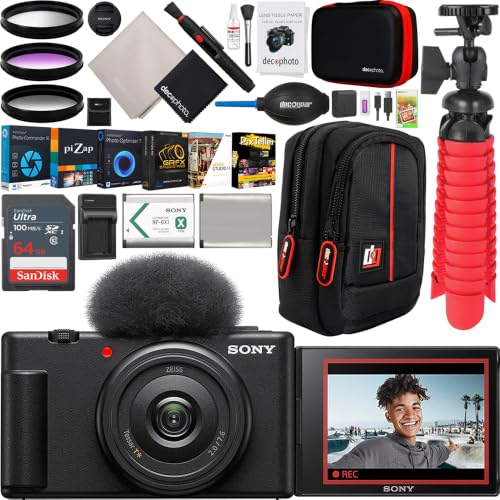
The ZV-1F was designed by people who studied the selfie as a behaviour rather than a specification, and it shows in every decision. The lens is wide — properly wide, wide enough that an arm’s-length frame contains a person and the place they are standing in, with the group at the edges still recognisable as themselves. The screen flips fully to face the photographer, the autofocus hunts eyes with a vlogger’s priorities, and the whole camera operates at the speed of the moment it serves: out of the pocket, framed, shot, pocketed, joke still warm.
Its video manners extend the brief without complicating it. Stabilisation tuned for the walking monologue, a microphone arrangement that respects the voice, and product-showcase habits inherited from its creator lineage make it the selfie camera of the daily poster — the cook narrating breakfast, the traveller filing from the platform, the friend whose family lives in another timezone and measures love in clips. Stills from its fixed lens carry the same wide honesty, and its rendering treats skin kindly under the mixed light of real days.
The fixed lens is the honest boundary, worn openly: there is no zoom to rescue a distant subject, and the camera’s world is the world within a few metres of its owner. For the selfie genre, that boundary is barely a limitation — the subject is definitionally present — but buyers whose camera must also cover a school stage or a safari should read the ZV-E10 II’s review as their door. For the self-portrait itself, in stills and clips, the ZV-1F is the most completely considered answer in this guide.
Owners develop a tell with the ZV-1F: they stop checking the result. The wide lens and the eye focus are trusted the way a favourite pen is trusted, and that trust returns the photographer’s attention to the moment the selfie was supposed to be about. A camera that can be forgotten mid-use is this genre’s highest achievement, and the little Sony achieves it more completely than bodies with ten times its specification.
- Role: fixed-lens compact built around the selfie
- Lens: wide field for person-plus-place framing
- Screen: fully flipping for honest composition
- Focus: eye priority for the holder’s own face
- Video: stabilised walking monologue manners
Strengths
- The frame includes the place, not just the face
- Operates at the speed of the moment
- Kind rendering in real rooms’ light
Trade-offs
- No zoom for distant duties
- A specialist in a generalist’s budget slot
- Serious audio still means an accessory
Best for: daily posters, travellers and anyone whose selfies carry a location with them. Not suited for: one-camera households needing stage and safari reach.

Canon PowerShot G7 X Mark III — Best for Beauty and Lifestyle
Ask the lifestyle internet which compact made its face, and this Canon is the answer with a decade of evidence behind it. Its rendering — warm, kind, faithful to skin under café light — became a genre’s house style, and its tilting screen and fast lens serve the selfie ritual as practised by people who have taken ten thousand of them: compose in the flipped screen, let the lens drink the window light, trust the colour. The G7 X Mark III’s selfie is not an engineering demonstration. It is a social instrument tuned by the largest focus group in photography.
Craft beneath the charm is real. The lens gathers dim restaurants without flash, the sensor keeps files respectable when the light is merely social, and the microphone input waits for the day the selfie becomes a series. Its size keeps it in the bag the lifestyle actually carries — the small one, with the lipstick and the keys — which this guide has repeatedly established as the first virtue of any camera whose subject is its owner’s own life.
Know the generation’s honest edges. The screen tilts rather than fully articulating, which the overhead and low-angle framings forgive and the strictest vlogging posture notices; autofocus is capable rather than clairvoyant beside the newest Sonys; and the fixed lens draws the usual boundary at the garden’s far end. None of it has dislodged the camera from its community, because its central promise — you, rendered kindly, in the light you actually live in — is kept daily. For the lifestyle selfie, that promise is the specification.
The G7 X Mark III’s community keeps a piece of evidence no review can replicate: a decade of birthdays, engagements, first apartments and last days of school, all rendered in its particular warmth. Selfie cameras are judged, finally, by the archives they accumulate, and this Canon’s archive is a generation’s visual diary. New buyers are not purchasing a compact; they are joining a look their whole social world already recognises as real life, well lit.
- Role: premium compact for lifestyle self-portraits
- Lens: fast aperture for cafés and evenings
- Screen: tilting, selfie-ready composition
- Colour: warm rendering loved by its community
- Audio: microphone input for growing creators
Strengths
- Skin rendered kindly in social light
- The bag size a lifestyle actually carries
- A decade of community-proven manners
Trade-offs
- Screen tilts rather than fully articulating
- Autofocus a step behind the newest rivals
- Fixed lens, familiar boundary
Best for: lifestyle creators, beauty communities and café-light self-portraitists. Not suited for: strict vlogging postures or zoom-dependent duties.

DJI Osmo Pocket 3 — Best for Walking Selfie Video
The Pocket 3 solves the selfie video’s oldest embarrassment — the shake — by removing the hand from the equation. Its three-axis gimbal floats the lens through walks, stairs, crowds and cooking demonstrations with a steadiness that reads as professional crew work, while the camera tracks its owner’s face through the frame like a devoted assistant. The screen rotates to face the narrator, the whole instrument is the size of a chocolate bar, and the result is the walking selfie transformed from a seasickness souvenir into a genre a person can build a channel, a family archive or a travel diary on.
Stills ride along more capably than the video-first design suggests, and the Pocket’s party trick — the selfie that pans, tilts and follows without a tripod — covers the group and location cases with a flair no fixed camera matches. Audio, the silent half of every filming verdict, is served by DJI’s microphone ecosystem with a simplicity that has converted many creators outright: the voice, clear, while the hands stay in the story.
Its boundaries are a gimbal’s boundaries. It is a filming instrument first, and the stills purist will feel the ordering; it asks to be charged, carried in its case and treated as the small machine it is rather than as a pebble; and its lens’s world, like the ZV-1F’s, is the few metres around its owner. For the moving self-portrait — the genre’s fastest-growing dialect — those are trivial tolls. The Pocket 3 is not the best camera in this list at the selfie. It is the best at the selfie in motion, which is where the genre now lives.
Pocket 3 owners tell the same story about other people’s reactions: strangers assume a crew. The floating lens and the tracked face read as production values far beyond a solo creator’s means, and that misreading is commercially and socially useful — the travel vlogger looks established, the family historian’s films look intentional. No other pick in this guide upgrades its owner’s perceived seriousness so cheaply, and perception, in the selfie economy, compounds like interest.
- Role: gimbal camera for moving self-portraits
- Stabilisation: three-axis mechanical float
- Tracking: face following for solo narrators
- Screen: rotating, faces the presenter
- Audio: microphone ecosystem for clear voice
Strengths
- Walking footage that looks crewed
- Face tracking like a devoted assistant
- Chocolate-bar size, pocketed instantly
Trade-offs
- Filming first, stills second by design
- A small machine that wants its case
- The near world is its whole world
Best for: walking tours, travel diaries, cooking channels and moving narrators of every kind. Not suited for: stills purists or the deliberately camera-careless.

Sony ZV-E10 II — Best to Grow Into
Every selfie habit contains a possible career, and the ZV-E10 II is the camera for the reader who suspects theirs might. It begins exactly where the compacts do — flip screen, eye autofocus, kind rendering for the daily self-portrait — and then refuses to end there: E-mount lenses widen the selfie into a production, microphones professionalise its voice, and the body’s streaming and filming fluency carries a hobby into a channel without a change of camera or a relearned menu. Buying it is buying the option on one’s own ambition, priced honestly.
The selfie itself benefits from the system immediately. A fast prime renders the evening self-portrait with a softness of background no fixed compact can imitate, a wider lens swallows the group and the landmark together, and the same body that framed the morning’s portrait films the afternoon’s event from the tenth row. Families and creators share this biography: the camera bought for selfies becomes the household’s or the channel’s general instrument, and the selfies improve as the system around them grows.
Size and intention are the tolls. With a lens mounted it is a camera to carry deliberately rather than a pocket’s afterthought, and its menus assume an owner willing to learn — gently, but learn. The pure selfie-taker who will never want a lens should save the difference and take the ZV-1F’s simplicity. The one who hears, in their own daily posting, the first notes of a larger project should buy this door and walk through it at their own pace.
The ZV-E10 II’s owners describe a graduation day: the first time the selfie lens comes off and a longer one goes on, and the camera bought for portraits of oneself becomes the camera of everything else. That day justifies the purchase retroactively and completely. Systems are bought for their second year, and this Sony’s second year is where its ranking is truly earned — the selfie was merely its friendly admissions tutor.
- Role: mirrorless creator body starting at the selfie
- Mount: E-mount lenses from selfie primes upward
- Screen: flip design with eye autofocus
- Audio: creator microphone ecosystem
- Growth: streaming and production fluency built in
Strengths
- The selfie that can become a channel
- Lens choices that transform the portrait
- One body for the household’s whole story
Trade-offs
- A deliberate carry, not a pocket afterthought
- Menus ask for a learner’s patience
- Over-specified for the selfie-only buyer
Best for: creators in embryo, growing channels and households wanting one system for everything. Not suited for: pocket-only minimalists who will never swap a lens.

Insta360 X4 — Best for Groups and Action
The X4 abolishes the selfie-taker’s oldest anxiety — was everyone in? — by photographing everything, in every direction, all the time. Mounted on its stick, which the software politely erases from the evidence, it captures the whole group, the whole summit, the whole ridiculous moment, and lets the framing be chosen later from a sphere of possibilities. The resulting selfie is a decision made calmly at home rather than a gamble taken at arm’s length, and for groups, sports and chaotic joyful occasions, that inversion is not a novelty. It is the answer.
Its action heritage serves the selfie in motion specifically: flow-state stabilisation, a build that shrugs at weather and water, and angles — the orbiting group shot, the impossible third-person view — that no conventional camera in this list can produce at any price. Travellers who move through the world actively, on bikes, boards and boats, will find its selfie is the only one that keeps up with the holiday they actually take.
The workflow is the toll, and it should be weighed with open eyes. Reframing is an extra step between the moment and the share, the files are hungry, and the stills purist’s single decisive frame becomes a selection process some photographers love and others experience as homework. For the group, the summit and the surf, the toll is trivially worth paying. For the quiet daily self-portrait, the compacts above remain the straighter path — which is why this guide ranks the X4 as the specialist it proudly is.
X4 owners keep a category of photograph nobody else in this guide owns: the selfie where the photographer forgot to perform. Because the sphere captures everything, the candid frames — the laugh before the pose, the group mid-argument about lunch — exist alongside the arranged ones, and they are invariably the keepers. A camera that records the moment around the moment turns out to be a documentary instrument wearing a party trick’s clothes.
- Role: 360 camera for groups, action and reframed selfies
- Capture: the whole sphere, framed afterwards
- Stabilisation: flow-state smoothness in motion
- Build: weather and water ready for active travel
- Stick: selfie stick rendered invisible in output
Strengths
- Nobody is ever out of the frame
- Angles no other pick can produce
- Built for the holiday that actually happens
Trade-offs
- Reframing adds a step before sharing
- Hungry files and a selection workflow
- Overkill for the quiet daily portrait
Best for: groups, athletes, travellers and anyone whose selfies happen at speed. Not suited for: one-tap minimalists who share in the moment or never.

Fujifilm Instax Mini 12 — Best for Instant Keepsakes
The Instax Mini 12 closes this list by questioning its premise: perhaps the selfie was never meant to be a file. Its portraits develop in the subject’s own palm, get passed around the table accruing fingerprints and affection, and end the evening on a fridge, a mirror, a dorm wall — places no cloud album has ever lived. Its automatic exposure and close-up manners handle the arm’s-length portrait without a single decision, and its rendering, soft and forgiving in the way of all beloved instant film, flatters the way memory flatters: generously, and with the truth still recognisable underneath.
Socially it is the strongest camera in this guide. Handed around a party, it manufactures photographs the way a Polaroid did for earlier generations — the group crowding in, the print claimed, the second print demanded — and it places the photographer inside the frame’s economy rather than behind a screen’s. For the selfie specifically, its mirror-assisted framing and arm’s-length focus were designed for exactly the portrait this article is about, decades before the genre had a name.
Film cost disciplines every frame, resolution belongs to memory rather than to laboratories, and the digital picks remain the archive of record for any life that needs one. But a life also needs objects, and the Instax is the only camera here whose selfie can be held by the person in it, tonight. As a second camera, a party camera, a keepsake engine beside the digital record, it earns its place in this list outright — and frequently becomes the one whose photographs are still on the wall when the others are in a folder.
The Instax’s owners measure its value in wall space. Years after the digital archives have migrated through three phones, the Mini prints from the flat-warming, the festival and the grandmother’s eightieth are still on their walls, faded exactly as much as the memories have and no more. Permanence was supposed to be digital’s advantage; in the selfie economy, paper keeps winning the long game on the evidence of every student corridor in the world.
- Role: instant camera for physical self-portraits
- Operation: automatic exposure, close-up mode
- Framing: selfie mirror for arm’s-length composition
- Output: prints that live on fridges and walls
- Audience: every guest operates it instantly
Strengths
- The portrait exists in the hand, tonight
- Parties organise themselves around it
- Forgiving rendering, memory’s own palette
Trade-offs
- Film makes each frame a small spend
- Detail is a keepsake’s, not an archive’s
- Digital picks remain the record of quality
Best for: parties, dorms, families and anyone whose selfies should be objects, not files. Not suited for: sole-record archivists or high-volume daily posters.
The Selfie Shelf Compared: Six Answers to One Arm’s-Length Problem
| Pick | Type | Standout trait | Watch out for |
|---|---|---|---|
| Sony ZV-1F | Fixed-lens compact | Wide, simple, trusted daily | No zoom, near world only |
| Canon PowerShot G7 X Mark III | Premium compact | Community-proven kind rendering | Tilting screen, older focus |
| DJI Osmo Pocket 3 | Gimbal camera | Motion steadiness and tracking | Filming first, cased carry |
| Sony ZV-E10 II | Mirrorless | Growth into a full system | Deliberate size, learner menus |
| Insta360 X4 | 360 camera | Everyone in, framed later | Reframing workflow, hungry files |
| Fujifilm Instax Mini 12 | Instant | The print in the hand | Film cost, keepsake detail |
The table divides by where the selfie goes next. Into the daily feed go the ZV-1F and the G7 X, one arguing width and trust, the other warmth and community. Into the moving story goes the Pocket 3, unopposed. Into a future channel goes the ZV-E10 II, into the group’s shared memory goes the X4, and onto the wall goes the Instax, which competes with nobody because it is playing a different sport on the same field. Most readers will recognise their destination instantly, and the recognition, not the ranking, is the buying decision.
Second-camera logic flourishes in this genre as in the others: the compact that lives in the bag pairs naturally with the Instax that lives at the party, and the creator body pairs with the Pocket for the walking pieces. Buy the first for the selfie you take daily, and let the second announce itself through the frames that keep failing — the shaky walk, the cropped-out friend, the moment that deserved paper.
A closing pattern from owners of several rows: the selfie camera is the most personally loved camera a household owns, because its subject is the household itself. Specifications fade from memory within a year; the rendering of a partner’s laugh in a Lisbon doorway does not. Choose the row whose rendering you want your life to have been recorded in, and the technical argument will have been settled by the only judge whose verdict ages well.
What Selfie Mistakes Do Even Good Cameras Keep Photographing?
The low angle leads the charge, carving the chin’s underside into the portrait’s foundation and shortening every neck it meets. It persists because it is the natural angle of a phone in a tired hand, which is exactly why it must be unlearned deliberately: camera up, at or above the eyes, every time, until the raised hand feels like the neutral one. Every pick in this guide rewards the correction instantly, and no filter ever written has subtracted what the low angle adds.
Overhead light runs second, hollowing eyes and inventing shadows the face does not own in life. The correction costs nothing — a quarter turn toward the window, a step into the doorway’s soft spill — and it outperforms every processing pipeline in this guide combined. Selfie-takers who learn the turn stop blaming their cameras within a day, which is why this guide teaches it three times in three sections and would teach it a fourth if the format allowed.
The final mistake is the single frame. Expressions arrive in families, eyes blink in shifts, and the keeper is statistically the third or fourth of a burst, not the heroic first attempt. Shoot the small burst, choose at leisure, delete without sentiment. The cameras above all support the habit; the archive it produces — one true frame per occasion, honestly chosen — is the difference between a selfie habit and a selfie practice.
Final Recommendation
Choose by the destination you named while reading: the daily feed, the moving story, the future channel, the group’s memory or the wall. The ZV-1F serves the first with the least friction ever engineered into the genre; the G7 X Mark III serves it with a beloved warmth; the Pocket 3 owns the moving story outright; the ZV-E10 II is the door into everything larger; the X4 guarantees the whole circle; and the Instax prints the evidence for the room. Each is the best camera in this guide for somebody, and the somebody is determined by the life, not the laboratory.
Then take tonight’s masterclass with you — window light, raised camera, placed frame, small burst — because it will improve your selfies more than the distance between any two rows of the comparison table. The cameras here are excellent. The craft is free. A reader who buys the first and learns the second will be unrecognisable, photographically, within a month — which is the only transformation this guide has ever promised, and it is entirely real.
One last thought for the photograph’s real audience: most selfies are taken for somebody specific — a parent, a partner, a friend on another continent, a future self. Photograph for that person rather than for the feed’s abstraction, and the frames change character immediately: kinder, funnier, more honest about the day. The cameras above will render whatever you bring them. Bring them the true day, and the archive will thank you for decades.
Related guides
Frequently Asked Questions
Why do I look different in selfies than in the mirror?
Mostly geometry: the mirror shows you at conversational distance, while a selfie lens at arm’s length exaggerates whatever is nearest it. The cure is distance — a placed camera, a longer effective throw, a wider lens used from farther back — plus the raised, window-lit posture this guide teaches. Every pick here was chosen partly for how gracefully it manufactures that distance, and the difference, once seen in your own frames, cannot be unseen.
Is a flip screen really necessary?
For composed selfies, it is the single most valuable feature in this guide, because it converts guessing into framing: the whole scene, the group’s edges and the background’s behaviour become visible before the frame is spent. Tilt screens serve most angles honourably; fully articulating and rotating screens serve them all. The X4 sidesteps the question by capturing everything, and the Instax answers it with a mirror — but for a conventional camera, buy the screen first and the sensor second.
Which camera is best for group selfies?
The Insta360 X4, by abolishing the problem: it captures the entire circle and lets the frame be chosen afterwards, so nobody is cropped, nobody is operating, and the candid frames come free. For a conventional answer, the wide compacts — ZV-1F first — include the most people at arm’s length, and the placed-camera ritual with any pick in this guide beats every arm ever grown. Groups are a geometry problem, and geometry has several honest solutions here.
Do I need a separate camera if my phone takes selfies?
A phone is the genre’s default and a fine one, but the dedicated picks earn their pockets through the year: wider and faster lenses for real rooms, screens and gimbals built for the purpose, rendering that flatters honestly, and — for the system and instant picks — growth paths and paper that no phone offers. The honest test is your own archive: if the phone’s selfies already delight you, spend nothing; if they keep disappointing in the same ways, this list is arranged by exactly those disappointments.
How do I stop my selfie videos shaking?
Stabilisation in layers: a gimbal where the genre justifies it — the Pocket 3 is this guide’s answer outright — or the compacts’ electronic systems for seated and standing work, plus the walker’s craft of a bent knee, a tucked elbow and a pace chosen for the camera. No stabilisation forgives running, and the honest creators shoot their walking pieces at walking speed, which audiences experience as calm rather than as limitation.
Are instant selfies worth the film cost?
For the occasions the Instax serves — gatherings, milestones, rooms full of people who will want the print — the cost buys something no file provides: the photograph as a gift, an object, a wall’s resident. As a daily volume habit it is an expensive diary; as a second camera for life’s gatherings it is, on the evidence of every fridge door in the world, one of the best-value instruments in this entire guide.
What is the kindest light for a selfie indoors?
A large window in daytime, with the face turned three-quarters toward it and the camera between the window and the subject, is the kindest light most homes own — soft, directional and honest. In the evening, a lamp bounced off a wall or ceiling imitates it respectably. What to avoid is the bare overhead bulb directly above, which no camera in this guide can fully forgive; move two steps toward softness and every pick here will appear to have been upgraded.
How many selfies should I take on a trip?
More than feels dignified at the landmark, fewer than the moment can spare. The working rhythm most travel photographers settle into is a small burst at each place that matters, one placed-camera frame with everybody in, and then the camera away while the place is experienced unmediated. Archives built that way contain both the evidence and the memory, which is the whole point of travelling with a camera at all.
Related Guides
Build the rest of the personal archive with our guides on best cameras for self potraits best compact cameras for selfies best cameras for social media and posting.


