kajuandouglas.com is reader-supported. When you buy through links on our site, we may earn an affiliate commission.
Where to Buy
The best compact cameras for selfies are judged by a test no laboratory runs: hold the camera at arm’s length, in imperfect light, with one hand, and see whether the person in the frame looks like themselves on a good day. That test is decided by four things. The screen must flip all the way around — a full 180 degrees — so you can see your framing while you are in it. The colour must treat skin kindly, because a selfie is a portrait and portraits are skin with a background attached. The autofocus must find your eyes and stay there, since at arm’s length you cannot check focus yourself. And the whole apparatus must be light and grippable enough that one hand holds it steady and unstrained through a dozen attempts, because the first attempt is never the keeper.
The six picks below divide by selfie philosophy. Some are precision instruments whose screens tilt up over the top — the selfie tradition of the one-inch compacts. Some were designed from the first sketch for the front-facing life, with fully articulating screens and faces as their first priority. One prints its selfies on the spot, which turns out to be a philosophy all of its own. And one famous photographer’s camera appears with its limitation stated in plain language, because its screen does not fully flip and a selfie guide that hid that would be lying to you.
It is worth pausing on how completely the selfie has inverted photography’s old geometry. For a century, the person holding the camera was the one person guaranteed absent from the archive; families own a thousand photographs of everyone except the parent who took them. The selfie ended that exile, and the cameras in this guide are the instruments of the reunion — which is why their quality matters out of proportion to their size. The photograph of you, taken by you, at the place, with the people, is the document the future will actually consult.
A note on honesty about beauty modes. Several of these cameras offer skin-smoothing and face-tuning effects. This guide treats them as seasoning, not substance: a light touch can flatter, a heavy hand produces the waxwork look that dates a photograph instantly. The rankings reward cameras whose unaided colour already flatters, because a selfie habit built on processing is a habit that collapses the first time the light gets difficult.
Key Takeaways
- The Canon PowerShot G7 X Mark III is the selfie connoisseur’s pick: a screen that flips up and over, a fast lens for dim rooms, and the kindest skin colour here.
- The Sony ZV-1F was designed for the front-facing life — fully articulating screen, face-first autofocus, and a wide lens that always fits the group.
- The Sony RX100 VII tilts its screen a full 180 degrees and adds eye autofocus and a viewfinder, the precision option for careful self-portraits.
- The Fujifilm Instax Mini 12 makes selfies physical: a selfie mirror, simple close framing, and a print in your hand a minute later.
- The Fujifilm X100VI produces the most beautiful self-portraits here when a friend or a tripod helps — but its screen only tilts, so solo framing is a compromise.
- The Canon PowerShot V10 (prose-only here) is the pocket selfie-video specialist, built to stand on its own and film you hands-free.
Read the list as a spectrum from spontaneity to craft. The Instax and the ZV-1F optimise for the selfie as it happens; the Canon and Sony one-inch cameras optimise for the selfie as a photograph; the X100VI optimises for the portrait and tolerates the selfie. Your own habit tells you where on that spectrum you live.
In this guide
Quick Picks
| Badge | Pick | Why it stands out |
|---|---|---|
| Best Overall for Selfies | Canon PowerShot G7 X Mark III | Flip-up screen, fast lens, and skin colour that needs no rescue. |
| Best Designed for Self-Filming | Sony ZV-1F | Fully articulating screen and face-first everything, in a featherweight body. |
| Best for Careful Self-Portraits | Sony RX100 VII | A 180-degree tilt screen, eye autofocus, and a real zoom for considered framing. |
| Best for Instant Prints | Fujifilm Instax Mini 12 | A selfie mirror and a physical photograph while the moment is still warm. |
| Best Portrait Quality | Fujifilm X100VI | Superb skin rendering and resolution — with a tilt-only screen caveat. |
| Best Hands-Free Selfie Video | Canon PowerShot V10 | Stands on its own kickstand and films you wide, no grip or tripod needed. |
The badges map to selfie occasions: the Canon owns the evening with friends, the ZV-1F owns the daily front-facing update, the Sony owns the considered portrait, the Instax owns the party, and the V10 owns the hands-free demonstration. Choose by your calendar, not by the spec sheet.
How We Chose These Picks
Selfie testing is unavoidably personal, so it was done by a panel rather than a person: different faces, different skin tones, different ages, glasses and none, in the lights selfies actually happen in — kitchen light, café windows, pub gloom, midday sun, and the blue hour outdoors. Each camera shot the same rounds of solo selfies, pairs, and groups, at arm’s length, one-handed, with the screen as the only viewfinder. The keepers were judged the way their subjects judge them: does this look like me, on a day I liked?
Skin rendering was assessed before any beauty mode was touched, then with each camera’s smoothing at its gentlest setting, to learn which cameras flatter by colour and which merely blur. Eye autofocus was scored on its behaviour as the subject moved, laughed, and looked away and back — the selfie is a small performance, and focus that quits mid-performance shows in the rejects. Screen mechanics were judged physically: how the flip or tilt behaves one-handed, whether it clears a microphone or a hand, and whether the camera can be held by the body without a finger straying over the lens.
Weight and grip were measured in the hand over a full round of attempts, because selfie fatigue is real: a camera that is charming for one frame and tiresome by the twelfth loses the keeper, which is usually frame nine. Battery and sharing were the final filters — a selfie camera that cannot get the photograph to a phone in under a minute has misunderstood its assignment, and every pick here passes that test in its own way, the Instax by abolishing it.
One more test ran quietly underneath the others: the second-day test. Each camera was picked up cold the next morning, by a panel member who had not used it the day before, and asked to produce a good selfie within a minute. Cameras that require recollection — a mode to find, a screen manoeuvre to remember — lose the reflex quality the genre runs on, and the rankings absorbed that lesson: the ZV-1F and the Instax pass the second-day test by design, the Canon by familiarity’s shortcut, and the Sony by the owner’s investment in learning it once.
Why Do the Screen, Skin, Eyes, and Grip Decide a Selfie?
The screen is the selfie camera’s viewfinder, mirror, and director in one. A screen that flips fully to face forward — whether by tilting up over the top, as the one-inch compacts do, or by articulating out and around, as the ZV-1F does — lets you compose the photograph you are inside of: the background arranged, the light checked on your own face, the friend’s eyes confirmed open. A screen that only tilts for low and high angles, like the X100VI’s, serves the portrait taken by someone else and leaves the solo shooter estimating. Estimation is not fatal — generations shot selfies blind — but it costs attempts, and attempts cost the spontaneity the selfie exists to capture.
Skin is the subject. Every selfie is ninety percent complexion by area and a hundred percent by attention, so a camera’s colour science — how it renders the reds and oranges of a face, how it handles the shine on a forehead, how gracefully it treats a face lit by a greenish office tube — is not a detail but the product. The cameras ranked highest here render skin as their first language. Eye autofocus is skin’s partner: at arm’s length the depth of field is workable but not infinite, and the difference between focus on the eyes and focus on the nose is the difference between a portrait and a snapshot. The grip, finally, is stamina: the selfie is taken by the weakest tripod in photography, a tired arm, and every gram and every awkward contour is paid for in shake and in keepers forgone.

Canon PowerShot G7 X Mark III — Best Overall for Selfies
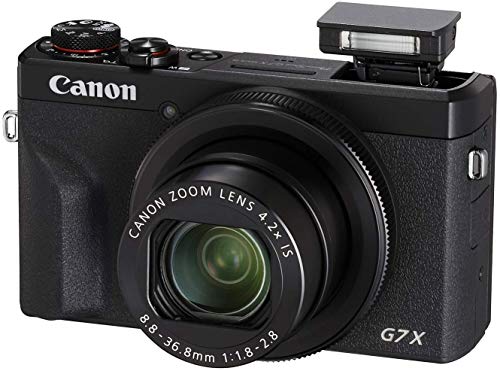
The G7 X Mark III has been the selfie camera of record for years, and using it for an evening explains why. The screen flips up and over the top of the body until it faces you squarely — a full 180-degree arrangement that keeps the camera’s profile slim and the lens centred, so your eyeline in the photograph meets the viewer naturally rather than drifting toward a side-hinged screen. The lens is fast, which in selfie terms means the pub, the restaurant, and the lamplit street stay available without the flash’s interrogation-room glare. And the colour is Canon’s: skin rendered warm and kind, the photograph looking like the evening felt.
Its autofocus finds faces readily and holds them through the small theatre of a group selfie — the leaning in, the laughing, the regrouping — and the body is light enough, with a shape a hand wraps properly, that a dozen attempts cost nothing. Touch operation on the flipped screen lets you place focus or fire the shutter with the holding hand’s thumb, a small mercy that becomes the whole workflow by the third round of attempts.
Its honest debits are a generation’s: no eye autofocus with the Sony’s tenacity, so a moving subject in dim light will lose the occasional frame, and no viewfinder for the bright-day framing the Sony offers. But as a complete selfie instrument — screen, lens, colour, weight, in balance — it remains the pick this guide would hand to a friend without a paragraph of caveats.
- Screen: flips up a full 180 degrees, centred above the lens
- Lens: fast, for flash-free selfies in evening light
- Colour: warm, forgiving skin rendering by default
- Grip: light body shaped for one-handed rounds of attempts
- Focus: reliable face detection for groups and pairs
Strengths
- The most flattering unaided skin colour here
- Screen arrangement keeps eyeline natural
- Fast lens owns the evening selfie
Trade-offs
- Eye autofocus less tenacious than Sony’s
- No viewfinder for glare-filled days
- Beauty effects are present but best kept gentle
Best for: social selfies, evenings out, and anyone who wants to look like themselves, kindly. Not suited for: precision self-portraiture in harsh sun.

Sony ZV-1F — Best Designed for Self-Filming
The ZV-1F began its design life with a question the other cameras never asked: what if the photographer is almost always in front of the lens? Its screen articulates fully to the front; its lens is fixed very wide, so an arm’s-length frame always contains you and a context; its autofocus is face-and-eye first in its priorities, with a defocus switch that softens the room behind you at a touch. Even its microphones point forward, at the person the camera exists to serve. As a selfie instrument it is less a camera with features than a single, considered answer.
For stills selfies the same design pays out. The wide lens forgives framing errors that a tighter lens punishes; the eye autofocus holds through movement and laughter; the body is so light that the holding arm forgets it, which shows in relaxed faces by the tenth attempt. Skin rendering is bright and clean, tuned for the front-facing life, and a gentle skin-smoothing option exists for those who want it, best used at its mildest.
The trades are the familiar ones from this camera’s other appearances: the fixed lens cannot tighten for a considered portrait, there is no external microphone input for those who film at distance, and the stills file is a one-inch-class file — good, not luxurious. As a dedicated selfie and self-filming machine, though, it asks the least of its owner of any pick here, and asking little is a photographic virtue when the photographer is also the subject, the director, and the audience.
- Screen: fully articulating to the front
- Lens: fixed ultra-wide, always fits you and the scene
- Focus: face and eye priority with a defocus switch
- Weight: the lightest serious selfie tool here
- Audio: forward-facing microphones for self-filming
Strengths
- Designed end-to-end for the front-facing life
- Eye autofocus that keeps up with a performance
- Featherweight for long selfie sessions
Trade-offs
- Fixed wide lens — no portrait compression
- No external microphone input
- Stills quality is good rather than rich
Best for: daily selfie and vlog habits, solo travellers, presenters. Not suited for: considered portrait sessions or distant subjects.

Sony RX100 VII — Best for Careful Self-Portraits
The RX100 VII’s screen performs the trick its slimmer shape seems to forbid: it tilts up a full 180 degrees, over the top of the body, so the careful self-portraitist gets the front-facing view with the camera’s full precision behind it. And precision is this pick’s selfie argument. Eye autofocus of genuine tenacity locks the near eye and holds it; the zoom lets you choose the portrait’s geometry — wider for the environmental selfie with the view behind you, tighter for the flattering compression that treats faces best; and the pop-up viewfinder, useless mid-selfie, serves the portrait’s other half when you hand the camera to a friend and step into the frame properly.
Its files are the richest of the true selfie cameras here, with the depth to survive the crop when the arm’s-length framing was imperfect — and arm’s-length framing is always imperfect, so cropping latitude is a selfie feature of the first rank. Burst shooting rescues the group selfie from the blink problem: hold the shutter through the laughter and choose the frame where every eye is open.
The debits are physical. It is the densest, least grippy body of the front-facing picks, and one-handed at arm’s length it asks for a wrist strap and a deliberate hand — the selfie camera most likely to be dropped by the careless. Its menus, set once, stay out of the way, but the first setup is a study session. Choose it when your selfies are portraits you intend to keep, and handle it like the instrument it is.
- Screen: tilts a full 180 degrees over the body
- Focus: eye autofocus with class-leading tenacity
- Lens: zoom for environmental or compressed portrait framing
- Files: rich enough to crop an imperfect arm’s-length frame
- Handling: dense and smooth — a wrist strap is mandatory
Strengths
- The sharpest, most deliberate solo portraits here
- Zoom chooses the portrait’s geometry properly
- Burst mode solves the group-blink problem
Trade-offs
- Slippery, dense body for one-handed work
- Setup menus reward patience
- Overqualified — and priced so — for casual snaps
Best for: careful self-portraitists and quality-first solo travellers. Not suited for: careless hands or party spontaneity.

Fujifilm Instax Mini 12 — Best for Instant Prints
The Instax Mini 12 answers the selfie question by changing what a selfie is for. Its little mirror beside the lens — the selfie mirror, a feature so simple it circles back to genius — lets you frame your face without any screen at all, and a minute after the shutter the photograph exists as an object: warm, slightly imperfect, and already being passed around the table. In a guide full of files, this camera makes artefacts, and at parties, weddings, and reunions the artefact wins every time.
Its close-up mode handles the arm’s-length distance natively, the exposure is automatic and forgiving, and the flash — which instant photography embraces rather than apologises for — gives its selfies a direct, celebratory look that has become a visual dialect of its own. There is no autofocus to discuss, no colour science to grade, no file to rescue: the discipline it teaches is commitment, one frame at a time, which is a healthier selfie education than a hundred deleted attempts.
The costs are literal and ongoing: film is a per-photograph expense, the prints are small and their quality is a charm rather than a fidelity, and there is no digital copy unless you photograph the print. It is not a camera for your portfolio. It is a camera for your friends, and on the evidence of every gathering it attends, that may be the higher calling.
- Framing: selfie mirror beside the lens, no screen needed
- Mode: close-up setting for arm’s-length distances
- Output: a physical print in about a minute
- Operation: automatic exposure, point and commit
- Character: the selfie as a gift rather than a file
Strengths
- Prints turn selfies into presents on the spot
- Zero learning curve, zero editing afterwards
- The mirror framing is fast and surprisingly accurate
Trade-offs
- Film cost per photograph, forever
- Small prints with a lo-fi character
- No digital file to share or reprint
Best for: parties, weddings, reunions, and guest books. Not suited for: portfolios, sharing online, or careful portraits.

Fujifilm X100VI — Best Portrait Quality
Here is the honesty this guide promised. The X100VI’s screen tilts for low and high angles but does not flip to face forward, so as a solo selfie camera it asks you to estimate your framing, use the self-timer with a mini tripod or a friend, or accept the phone-style guesswork its designers clearly considered beneath it. It is included — highly — because when the portrait is taken, by whatever arrangement, the result is the most beautiful in this guide: an APS-C sensor’s depth, a superb lens’s rendering, and film simulations that treat skin with a sophistication the smaller cameras admire.
Used as the self-portraitist’s instrument rather than the snapper’s, it has real methods. The self-timer and interval options, a phone remote over its app, and the tilting screen for a camera placed on a table facing you all produce composed, deliberate self-portraits of a quality the arm’s-length crowd cannot reach. Its eye autofocus, once you are in frame, is capable, and the files reward printing — the self-portrait as a photograph, not a post.
What it will never be is spontaneous. It is the heaviest pick here, the least one-handable, and the only one whose screen declines the front-facing duty entirely. Buy it for portraits, including your own, arranged with intent; buy anything else in this list for the selfie as a reflex.
- Screen: tilts only — no front-facing view
- Sensor: APS-C with the finest skin rendering here
- Methods: self-timer, app remote, table-top placement
- Colour: film simulations with portrait sophistication
- Character: the deliberate self-portraitist’s camera
Strengths
- Portrait quality beyond every other pick
- Simulations flatter skin with real subtlety
- Files that print beautifully
Trade-offs
- No flip screen — solo framing is estimation
- Heaviest and least one-handable here
- Spontaneity is not its language
Best for: deliberate self-portraits and portrait-first photographers. Not suited for: arm’s-length solo selfies or party snaps.
Canon PowerShot V10 — Best Hands-Free Selfie Video
The V10 is the odd one in this guide and knows it: a camera shaped like a small remote control, with a built-in kickstand that lets it stand on a café table and film you — wide, steady, and hands-free — while you cook, demonstrate, play, or simply talk with both hands available for the talking. Its screen flips up for framing, its lens is wide enough to hold a small scene, and its whole posture says that the selfie, for many creators, is not a held photograph but a performed piece that needs the performer free.
For stills selfies it serves the same hands-free philosophy: stand it, frame on the flipped screen, step back into the scene, and shoot by timer or remote — a full-length, full-context self-portrait that no arm’s-length camera can compose, because the arm is not in it. The wide lens’s distortion at the edges is the tax on that freedom, and the files are modest beside the one-inch picks.
It appears here as a prose-only reference pick. Its lesson for the buyer is taxonomic: if your selfies are mostly video, mostly hands-free, and mostly at home, a purpose-built oddity like this can serve you better than a famous all-rounder — and if they are not, its oddity will annoy you daily. Know your genre before admiring its cleverness.
- Stand: built-in kickstand for hands-free framing
- Screen: flips up to face the performer
- Lens: wide, for full-context scenes
- Stills: timer and remote self-portraits at distance
- Character: a performed-selfie specialist
Strengths
- Hands-free filming and portraits with no accessories
- Full-scene selfies an arm cannot compose
- Tiny enough to live where it is used
Trade-offs
- Wide-lens edge distortion to manage
- Modest stills files beside the one-inch picks
- Listed here as a reference pick without a link
Best for: hands-free creators, demonstrators, and home performers. Not suited for: arm’s-length purists or quality-first portraits.
What Changes With Glasses, Groups, and Growing Up?
Glasses are the selfie camera’s quiet examination. Eye autofocus must find the eye through a lens that reflects the room, and autofocus systems vary in their composure when the reflection competes with the eye behind it; the Sony pair handled the panel’s glasses-wearers with the least hesitation, and the practical technique — a slight downward tilt of the head or the glasses, moving the reflection out of the eye line — rescues the rest. Bright screens also reflect in glasses on the flipped view, so check your own preview for the white rectangle before the round of attempts, not after.
Groups change the mathematics of depth. At arm’s length, the front face and the back face live at meaningfully different distances, and a wide aperture’s shallow focus will privilege one row over the other. The selfie cameras’ automatic modes mostly manage this sensibly; the deliberate shooter stops down a touch or arranges the group in a shallow arc, faces at similar distances, which also happens to be how groups look best. The burst habit matters more with every added face, since the probability that someone is blinking rises with the company.
And faces change. The selfie habit of a teenager, a parent holding a toddler, and a grandparent at a reunion are three different photographic practices sharing a word. Cameras that flatter without erasing — the Canon’s colour, the Fujifilm’s simulations — age with their owners gracefully, because they record a face rather than negotiating with it. A guide that recommended only the smoothing modes would be recommending a camera you will outgrow; these picks were chosen to be kept.
How Do You Take a Better Selfie With Any of These Cameras?
Light first, because the selfie is a portrait and portraits are light wearing a face. Face a window, a lamp, or the open shade — never stand with the light behind you unless a silhouette is the intention — and raise the camera slightly above eye level, the angle every face prefers. The fast-lensed picks forgive dim rooms, but no lens forgives a face lit from below by a phone-torch or from directly above by a downlight; move two steps and the photograph changes more than any setting could achieve.
Distance is the second craft. A wide lens at very close range enlarges the nearest features — the nose-forward look that makes people hate their selfies is geometry, not vanity. Extend the arm fully, crop later from the richer file where the camera offers one, or step the zoom a fraction tighter on the Sony and Canon one-inch bodies, and faces return to their true proportions. The group selfie obeys the same law with the opposite solution: the wide ZV-1F or the Instax’s forgiving view gathers everyone without the back row shrinking into the distance.
Finally, shoot the burst and choose at leisure. The keeper rate of even practised selfie-takers is low, and the cameras here all offer the tools — bursts, self-timers with multiple frames, touch shutters that avoid the shake of a button press. Take six, keep one, and let no one see the arithmetic; that has always been the professional’s method, in selfies as in everything else.
How Does Solo Travel Change the Selfie Brief?
The solo traveller’s selfie has a job description the home selfie never faces: it must prove presence. You, recognisably, in front of the place, recognisably — with both halves of the frame sharp enough to testify. That argues for the wider lenses and the deeper focus of the ZV-1F and the Canon, for screens that let you verify the landmark is actually in the shot, and for the self-timer methods — camera on a wall, a bench, a mini tripod — that put you in the scene at a distance where the place gets its share of the frame.
Solo travel also argues for discretion and speed. A camera that frames and fires in seconds, one-handed, attracts less attention in a crowd and less negotiation with strangers than a production with a tripod; the light picks in this guide earn their keep at the famous viewpoint at noon. Against that, the deliberate traveller with the X100VI’s timer method comes home with fewer, better testimonies. Both are honourable travel styles; the camera should match the one you actually practise, not the one you admire in others.
One practical travel note belongs in every selfie guide and appears in few: back up the day’s photographs before the evening, because the camera that documents your presence is also, until the backup, the only copy of it. The phone-transfer habits these cameras make easy are not a convenience feature for the traveller; they are the archive’s insurance, and the Instax — whose print is its own backup, handed to a companion — is exempt by philosophy rather than by technology.
Comparison Table
| Pick | Screen | Eye AF | One-hand comfort | Selfie role |
|---|---|---|---|---|
| Canon PowerShot G7 X Mark III | Flips up 180 degrees | Face detection | Light and grippable | Evenings, groups, warm skin |
| Sony ZV-1F | Fully articulating | Yes, face-first | Featherweight | Daily front-facing habit |
| Sony RX100 VII | Tilts 180 degrees | Yes, tenacious | Dense — strap required | Careful self-portraits |
| Fujifilm Instax Mini 12 | Selfie mirror | Not applicable | Simple and light | Parties and instant prints |
| Fujifilm X100VI | Tilts only | Yes, in frame | Heaviest here | Deliberate portraits |
| Canon PowerShot V10 | Flips up, kickstand body | Face priority | Hands-free instead | Performed selfie video |
How Do You Pose Without Looking Posed?
The stiffness in most selfies is not the face but the freeze: the subject stops living for the duration of the photograph and the camera, honestly, records the interruption. The cure is motion in small doses. Talk through the round of attempts, laugh at the attempt itself, look away and back as the timer runs — the frames caught between expressions are the ones that look like a person. Burst modes and multi-frame timers exist in these cameras precisely to harvest those in-between frames, and the practised selfie-taker reviews for the unguarded one rather than the most arranged.
Hands and objects help more than angles do. A cup, a railing, a companion’s shoulder, the dog — something for the scene to be about besides being photographed — relaxes the face by giving the moment a subject. This is why the café-table selfies from the Canon and the party prints from the Instax so often beat the bathroom-mirror canon: the photograph is of an occasion, with you in it, rather than of a face, with an occasion behind it. Choose cameras and moments accordingly, and let the portrait-quality picks handle the occasions when the face truly is the whole subject.
A last, unfashionable counsel: keep some of the imperfect ones. The selfie archive that survives is not the most flattering sequence but the truest one, and the frame with the squint and the wind in it will be worth more in ten years than the porcelain perfect one beside it. The cameras in this guide were ranked partly on how truthfully they flatter — a paradox, but the right one.
How Should You Set Up a Selfie Camera Once, Properly?
Ten minutes at home converts every pick in this guide from a gadget into a habit. Set the self-timer’s multi-frame option so one press yields a small burst to choose from. Turn on face or eye detection and leave it on permanently — there is no selfie situation it harms. Choose your skin-smoothing level now, in honest daylight, at its gentlest or off, rather than discovering at a party that the default is porcelain. And set the touch shutter on the flipped screen, because firing with the holding thumb is steadier than reaching for a button.
Framing defaults deserve the same single sitting. Learn where your face sits in your camera’s wide view at full arm extension — every body here has a slightly different geometry, and the practised owner has internalised theirs so the first attempt is already close. Save the grid overlay if your camera offers one; the eyes-on-the-top-third composition it teaches becomes instinct within a week. Finally, pair the phone transfer before you need it, in the calm of the kitchen, because the first attempt at pairing always happens in the worst possible light with an audience forming.
Then practise the round: six frames, one location, reviewed honestly. The point of the exercise is not vanity but calibration — you are learning your camera’s kindnesses and its tells, the angle it prefers, the light it forgives. Every pick in this guide rewards the owner who has done this once; every one punishes, mildly and repeatedly, the owner who meets it for the first time at the event itself.
Which Mistakes Make Selfies Disappointing?
The first is the low arm: a camera below chin level photographs up the nose and doubles the chin, and no filter in any of these cameras can repeal the geometry. Raise it. The second is the bathroom light — overhead, greenish, and directly above — which carves shadows into every face; the same face two steps toward the window is a different, kinder photograph. Third is the stranglehold grip: a hand clenched around the body shakes the camera and creeps a finger toward the lens, which is why the light picks and the wrist strap recur throughout this guide.
Sixth is the background nobody checked: the photobombing stranger, the mirror showing the room’s least flattering corner, the bright window turning the face to silhouette. The flipped screen exists to prevent exactly this, which is why the panel’s most common note across all testing was how rarely the front-facing cameras produced a background surprise compared with blind shooting. Glance at the corners before the round, not at the face alone — the face is the one part of the frame that is definitely coming with you.
Fourth is the beauty mode at full strength, which produces the porcelain look that reads as false to every viewer including, eventually, the subject. And fifth is the single attempt: the selfie deleted in disappointment that was one frame away from the keeper. Shoot the round, choose in calm, and judge the camera — and the face — on the best of six, not the first of one.
How Do Children and Pets Rewrite the Selfie Rules?
A selfie with a toddler or a dog is a negotiation with a co-star who has not read the brief. The child will look at the screen — which is to say, at themselves, delightedly — rather than the lens, and the dog will look at whatever smells most interesting, which is never the camera. The cameras that serve this genre best are the ones whose screens entertain the small co-star while their autofocus minds the faces: the front-facing displays here double as the child’s mirror and the photographer’s viewfinder in one, a dual use no one designed and every parent exploits.
Speed replaces precision as the governing virtue. The keeper is the frame where the child’s expression and your own coincide for a fifth of a second, and it is found by volume — bursts, multi-frame timers, and the Instax’s cheerful commitment to whatever happened. Eye autofocus that extends to animals, a Sony strength in this list, turns the dog from a blur with ears into a portrait subject, and the wide lenses forgive the lunge, the lean, and the sudden exit that end most attempts.
There is a safety footnote the guide will not skip: a camera on a strap around a neck, at a child’s head height, is a pendulum. Hand the camera, sit down to their level — which is also the flattering angle for small faces — and let the session be a game the camera attends rather than an appointment it imposes. The selfies that result are the ones families frame, and they are taken at floor level, in available light, by the lightest camera in this guide more often than by the finest.
Why Does the Selfie Deserve a Real Camera at All?
Because the phone’s front camera, for all its convenience, is the weakest camera most people own: a tiny lens, aggressive processing, and a file that dissolves under cropping or printing. The selfie, meanwhile, has become the era’s dominant portrait form — the way families, friendships, and solo journeys are actually documented. The mismatch between the form’s importance and the tool’s quality is the entire market these six cameras serve. A dedicated selfie compact brings a real lens, a real sensor, and honest colour to the photographs you will be shown at your own milestone birthdays.
Presence matters too. A phone in the hand is a portal to everything else — messages, feeds, the next obligation — and a selfie taken with it is taken by a distracted instrument. A camera asks for the moment and nothing else, and subjects feel the difference: faces relax differently for a camera than for a phone, a small social fact every party photographer knows. The Instax radicalises the point by removing the screen altogether; the others merely civilise it.
None of this requires abandoning the phone, which remains the sharing device and the backup. The compact earns its place at the moment of capture — the light, the lens, the colour — and hands over to the phone for everything after. That division of labour, capture by the camera and distribution by the phone, is the working arrangement behind every pick in this guide.
Final Recommendation
For most people, the G7 X Mark III is the selfie camera to buy: the screen, the lens, the colour, and the weight in a balance nothing else here quite matches. It is also the pick least likely to be outgrown, because its selfie excellence sits inside a complete camera — the owner who arrives for the flipped screen stays for everything else it does, and a purchase that deepens rather than narrows a practice is the kind this guide exists to recommend. Choose the ZV-1F if your selfies are a daily front-facing practice and simplicity is your first requirement; the RX100 VII if they are portraits you keep and print; the Instax if they are gifts; the X100VI if they are art and you accept its terms; and consider the V10’s philosophy if your selfie is a performance that needs your hands. The best selfie camera is the one whose screen you can see yourself in — in every sense — and this list gives you six honest ways to do it.
Whichever of the six ends up in your hand, give it the home rehearsal this guide keeps prescribing: one ordinary evening, one ordinary room, a round of attempts reviewed without mercy. The selfie is the most practised photograph in the world and still the most improvable, and the camera that survives your rehearsal with its dignity intact is the one that will still be serving at the reunion, the summit, and the kitchen table years from now.
Frequently Asked Questions
Does a selfie screen really need to flip 180 degrees?
For solo framing, it is the difference between composing and estimating. A full flip — over the top or articulated around — shows you the frame, the light on your face, and your companions’ eyes before the shot. It also shows you the background, which blind selfies get wrong more often than they get the face wrong: the stranger mid-yawn, the cluttered counter, the exit sign growing from someone’s head. One glance at a flipped screen is a full editorial review conducted before the fact, and it is the cheapest quality upgrade in all of selfie photography. Tilt-only screens still serve placed-camera self-portraits with timers and remotes, as the X100VI section describes, but for the arm’s-length reflex selfie the front-facing screen is close to essential.
Why do I look distorted in wide-lens selfies?
Because a wide lens close to a face enlarges whatever is nearest — usually the nose — and shrinks the ears and jaw. It is perspective, not a defect. The same law, reversed, is the portrait photographer’s oldest trick: stand back with a longer lens and faces settle into their calmest proportions, which is why the considered self-portrait — camera placed, timer set, subject at a proper distance — flatters in a way no arm’s-length frame can, and why the X100VI and the zoomed Sony produce the guide’s most dignified faces despite their selfie inconveniences. Extend your arm fully, move the camera a little further and crop, or use a tighter focal length where the camera offers one; the RX100 VII zoomed partway is the classic cure among these picks.
Are beauty modes worth using?
At their gentlest, occasionally — they can soften harsh light’s effect on skin for a quick share. As a habit, no: they flatten the features that make a face itself, and the effect dates quickly. There is a simple self-test: apply the mode to a photograph of someone you love and notice whether your reaction is recognition or mild unease. The unease is the mode erasing the person in favour of the type, and it is why this guide’s rankings are built on colour science — which flatters by rendering — rather than on processing, which flatters by removing. The better investment is light and angle, which flatter without processing, and choosing a camera — the Canon above all — whose unaided colour is already kind.
Which pick should a group choose for its selfies?
The ZV-1F’s very wide lens gathers the largest group at arm’s length, and its eye autofocus minds the faces while you mind the gathering. Arrange the group in a shallow arc rather than a line — the arc equalises distances, flatters every face with similar focus, and fits more people into a wide frame than a straight row ever does — and fire the burst through the countdown’s end, because the frame after the pose relaxes is usually the keeper. The Instax is the group’s favourite at parties for the print that follows. For a considered group portrait, the RX100 VII on a mini tripod with its burst mode solves the everyone’s-eyes-open problem most reliably.
Can a selfie camera also be my main camera?
Several of these can. The G7 X Mark III and RX100 VII are complete compact cameras whose selfie talents are one department of a larger competence; the X100VI is a serious photographer’s camera with a selfie limitation. The deciding question is proportion: if four of your five photographic outings are front-facing, buy the specialist and borrow the rest; if selfies are one department of a varied practice, buy the all-rounder and let its selfie talents — considerable, in the Canon’s case — cover the department without a second body. The specialists — ZV-1F, Instax, V10 — are happiest as dedicated instruments alongside, or instead of, a general camera depending on how narrow your photography is.
How do I take a good selfie in bright sun?
Turn so the sun lights your face from the side or find open shade at the edge of the sunlight; squinting into direct sun defeats every camera here. A hat brim or a companion’s shadow can serve as portable shade for the face while the background stays bright — the classic holiday-selfie arrangement — and the fast lenses are unnecessary in this light, so spend the exposure on keeping both face and background honest rather than letting the sky blow out behind you. The RX100 VII’s viewfinder helps compose when screens wash out — for the portrait you then take of a companion — while for the selfie itself, a shaded background and your face in soft shade will flatter more than any setting.
What about short vertical selfie videos?
That is the ZV-1F’s and the Canon’s home ground: both frame vertically happily, keep a face tracked and exposed while it moves, and produce files the platforms accept without a wrestling match. Keep the takes short and the light in front of you, and remember that vertical video punishes the low arm even more than stills do — the camera at eye level, the chin un-doubled, is a habit worth building before the audience arrives. The V10’s hands-free stance serves the talking-to-camera format best of all. For anything longer or more produced — interviews, events, graded work — the companion guide to movie compacts linked below takes over from this one.
Is an instant camera’s selfie really comparable to a digital one?
As a photograph, it is a different species — small, warm, unrepeatable. As a social object, it is frequently the most successful selfie at the event, because it can be given away. Hosts who keep one by the door, with a guest book and a pen beside it, understand the instrument perfectly: the selfie as a ritual of arrival, printed before the coats are off, and kept long after the digital archives of the same evening have been scrolled past and forgotten. Judge the Instax by the gatherings it serves rather than by the files it does not produce, and it stops looking like a toy and starts looking like a specialist.
Related Guides
Selfie shooters who film themselves at length should read the best compact cameras for movies for the heat, sound, and profile questions this guide only touches, and anyone whose selfies happen on the trail will find the carry and weather answers in the best compact cameras for backpacking. For the small, held-up-close subjects of a seller’s selfie-style demonstrations, see the best compact cameras for close up photos.


