kajuandouglas.com is reader-supported. When you buy through links on our site, we may earn an affiliate commission.
Where to Buy When the House Lights Are About to Drop
Nobody shops for the best afordable cameras for concert photography in calm circumstances. You shop because last Friday you stood in a crowd with a phone, watched it smear the guitarist into a watercolour ghost, and swore the next show would be different. Or because your kid’s school ensemble performs in a hall lit like a cave, or because a local venue finally granted you a photo pass and your current camera focuses by candlelight the way a sleepwalker navigates stairs. Concerts are photography’s stress test: the light is dim, coloured, and changing; the subjects move; the good positions are crowded; and the moment refuses to repeat itself for anyone.
Where to buy: each camera named below links to its Amazon listing, and the listing deserves a careful read for a concert-specific reason. Bodies sell alone and in kits, and the kit lens bundled for birthdays and holidays is usually a slow zoom that will starve in a dark hall. For this genre the body is the purchase and the fast prime lens is the plan; if a listing bundles a bright prime instead of the standard zoom, that bundle is the concert-ready one even when its headline looks less generous. Also confirm the exact model generation, because concert-capable names have older siblings whose low-light manners are noticeably worse.
Permission deserves a paragraph before any product does. Many venues restrict interchangeable-lens cameras regardless of your intentions, and the finest body on this list is worthless in a bag checked at the door. The picks below therefore span a range of sizes, and the smaller ones are not consolation prizes — a compact-looking body that security waves through, in the hands of someone who knows the exposure triangle, out-photographs a flagship confiscated at the entrance. Know your venue’s published policy, shoot school and community events freely, and treat club rules as part of the craft.
Key Takeaways
- Low-light autofocus and clean high-sensitivity files decide concert results; megapixels and burst headlines do not.
- A fast prime lens matters as much as the body — budget for both or the dark will tax you nightly.
- Full-frame bodies lead when light collapses; crop bodies answer with reach from the back of the hall.
- Silent or near-silent shutters protect you during acoustic sets and school performances.
- Venue camera policies can veto any body, so size and discretion are genuine features here.
In this guide
Quick Picks
| Pick | Badge | Why it earns its place |
|---|---|---|
| Canon EOS R6 Mark II | Darkness Specialist | Focuses in light so low the audience is guessing, and keeps files clean while doing it. |
| Sony Alpha 7 IV | All-Round Headliner | The balanced hybrid for shooters who photograph the show and film the encore. |
| Panasonic LUMIX S5II | Filmer’s Favourite | Built for the person recording whole sets without the body overheating or giving up. |
| Fujifilm X-T5 | Colour Poet | Stage gels become gorgeous colour instead of a problem when its film looks lead. |
| Nikon Z50 II | Back-of-Hall Reach | Crop-sensor reach and subject detection for parents seated twelve rows from the stage. |
| Canon EOS R10 | First Photo Pass | The affordable apprenticeship: pro-grade focus instincts in a learner-priced body. |
What Did We Demand From a Camera Before Calling It Concert-Ready?
Three trials eliminated most candidates. The first was focus in gloom: a concert camera must acquire a singer’s eye under light that changes colour every four seconds, and it must do so through haze, microphone stands, and the raised arms of strangers. Bodies whose detection systems recognise people and hold their faces scored ahead of bodies with merely fast contrast systems, because at a concert the subject is always a person first and a focusing target second. The second trial was file quality at the sensitivities concerts impose. Every shooter in a hall lives at settings that daylight photographers visit only by accident, so sensors were judged on how gracefully their files hold colour and detail when pushed, and on whether skin survives stage magenta without turning to wax.
The third trial was endurance in the real sense: not battery statistics, but whether the camera keeps working through a two-hour set — heat in a packed room, a card filling at the headline moment, a photographer whose hands are tired and whose attention is on the music. Customisable controls scored heavily, because concert shooters reconfigure exposure compensation and sensitivity constantly and cannot menu-dive during a chorus. Shutter discretion counted too. A mechanical clack that is charming at a rock show becomes vandalism during a string quartet, so bodies with convincing silent modes earned credit that spec-sheet comparisons rarely award.
Video was judged as a supporting act. Most concert photographers film at least the encore, and parents film entire recitals, so each pick had to record respectably in the same miserable light without focus breathing theatrics or thermal surrender. But stills led the ranking; a camera that films beautifully and photographs hesitantly is a camcorder wearing a costume.
Why Do Concerts Defeat Cameras That Handle Everything Else?
Because concerts attack every assumption a camera makes. Auto exposure expects an averagely lit world; a stage is a black room containing one blinding human, and metering systems average that into grey soup unless the photographer intervenes. Auto white balance expects a dominant light source; a stage offers four, alternating, plus haze that scatters them into fog. Autofocus expects contrast; a vocalist backlit by a follow spot is a silhouette with a halo. Even the photographer’s body is compromised — standing, jostled, forbidden from using flash, often shooting one-handed around a barrier or a balcony rail.
Understanding the attack explains the equipment answer. You need sensitivity headroom because the light will not improve. You need detection autofocus because manual focus on a moving singer at a wide aperture is a lottery. You need exposure compensation under a thumb because the meter will lie to you song by song as the lighting designer changes mood. And you need a lens that gathers light greedily, which is why this guide repeats its central sermon: the fast prime is not an accessory to the concert camera, it is half of it. A moderate body behind a bright prime will humiliate an expensive body behind a slow kit zoom in every dark venue on earth.
There is also a social physics to concerts. Photographers who look professional get challenged; photographers who look like fans get tolerated. Small bodies, quiet shutters, and screens used sparingly keep you in the second category at fan-level events, while a photo pass at a formal venue reverses the logic and rewards looking deliberate. The shortlist spans both worlds deliberately.
Which Six Are the Best Afordable Cameras for Concert Photography?

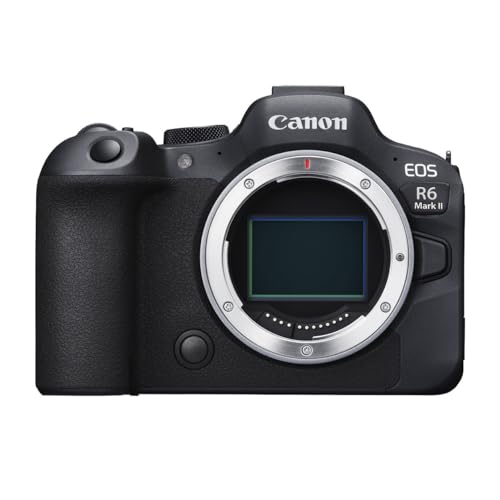
Canon EOS R6 Mark II — Darkness Specialist
Every concert photographer has a story about the shot that got away in the dark. The R6 Mark II exists to retire those stories. Its autofocus continues to find and hold faces at light levels where the photographer is working partly from memory, and that single talent reorganises a concert evening: instead of spraying frames and praying, you compose. When the lighting designer drops the stage to a single blue wash for the quiet song — the moment phones produce abstract art — this body keeps the singer’s eye in focus and lets you choose the instant the expression changes.
Its files share the talent. The full-frame sensor favours clean, gradation-rich images at the elevated sensitivities concerts impose, so skin under stage colour keeps its texture and the blacks of an unlit backdrop stay black instead of dissolving into coloured noise. In-body stabilisation steadies the slower shutter speeds that seated, barrier-free shooting sometimes forces, particularly with the longer primes used from the back of theatres. Canon’s colour under mixed stage light needs the least rescuing of any system here, a mercy at midnight when two hundred frames await editing.
Practical touches accumulate. The controls can be arranged so sensitivity, exposure compensation, and focus mode all live under fingers that never leave the grip. The electronic shutter is genuinely quiet for acoustic passages. Battery endurance covers a full evening of stills with room to spare, and the dual card slots matter to anyone shooting a paid or once-only event — a daughter’s solo, a band’s album launch — where a card failure would be a small tragedy. This is the pick when the concert is the point of the camera, not an occasional outing.
- Sensor format: full frame, tuned for clean files in poor light
- Autofocus: face and eye detection that persists in very low light
- Stabilisation: in-body, coordinating with RF lenses
- Shutter: quiet electronic option for acoustic and school settings
- Storage: dual card slots for once-only events
Strengths
- Low-light focusing confidence that changes how you shoot an entire set.
- Files that keep skin believable under aggressive stage colour.
- Stabilisation that rescues slow shutter speeds from the back rows.
Trade-offs
- The largest investment here once a fast prime joins the bag.
- Resolution is ample rather than lavish for heavy cropping.
- Its professional look can attract door-staff questions at fan events.
Best for: working concert shooters, photo-pass holders, and anyone whose defining gigs happen under stage light.
Not suited for: buyers whose venues ban interchangeable-lens cameras outright, where discretion must come first.
A working note from the pit: this body’s focus system rewards being set up before the house lights drop. Tell it to prioritise people, restrict its sensitivity ceiling to a value your prints tolerate, and assign exposure compensation to the dial your thumb naturally sweeps. Photographers who perform that two-minute ritual describe the camera as an extension of intention; those who fight factory settings mid-set describe the same camera as stubborn. The difference is preparation, and the pit is no place to discover it.

Sony Alpha 7 IV — All-Round Headliner
If the R6 Mark II is the specialist, the Alpha 7 IV is the headliner who plays every festival on the calendar. It photographs a rock set with the same assurance it films a wedding, records a podcast, or documents a holiday, and for concert work its particular blend is compelling: full-frame sensitivity headroom, autofocus that recognises eyes across people and animals, and a lens ecosystem so wide that the fast prime you need exists at several prices, from Sony’s own glass to third-party lenses that have become concert-bag staples.
That ecosystem deserves emphasis. Concert photography consumes lenses the way tours consume drumsticks — a bright standard prime for the pit, a fast short telephoto for seated venues, perhaps a wide zoom for the whole-stage establishing frame. Sony shooters can assemble that kit gradually, mixing new and used, own-brand and third-party, without adapters or compromises. The camera’s custom buttons and function menu let you park the concert trio — sensitivity, compensation, silent shutter — within thumb reach, and its focus system can be told to prioritise faces so completely that a drummer behind a forest of cymbals stops stealing focus from the vocalist.
Video is where this body quietly outflanks rivals for the modern concertgoer, who is often also the band’s social media volunteer. It records long, good-looking footage in the same light, tracks the singer while doing it, and its files grade gracefully when stage colour needs taming. Heat management during video is respectable rather than heroic; a full set filmed continuously in a hot club is the Panasonic’s party trick below. For mixed evenings of stills plus clips, few cameras anywhere balance the ledger this evenly.
- Sensor format: full frame, balanced resolution and sensitivity
- Autofocus: eye detection for people and animals, deep customisation
- Mount: Sony E, the widest fast-prime selection at every budget
- Video: strong hybrid recording with reliable subject tracking
- Controls: extensive custom buttons and a quick function menu
Strengths
- The deepest lens ecosystem for building a concert kit in stages.
- Hybrid stills and video quality that covers the whole evening.
- Focus customisation that keeps vocalists ahead of drummers.
Trade-offs
- Menus take longer to master than Canon’s friendlier arrangement.
- Long continuous video in hot rooms is good, not class-leading.
- The body feels utilitarian beside the Fujifilm’s styled dials.
Best for: hybrid shooters who photograph the set, film the encore, and want one ecosystem for everything else too.
Not suited for: minimalists who want the camera’s decisions made by dials rather than menus.
Band teams quietly love this camera for a reason beyond image quality: its files move fast. The same body that shot the set can hand the manager a dozen frames before the crowd reaches the car park, because its connectivity and in-camera cropping suit the social deadline that now governs live music. A generation ago the photograph mattered next week; tonight it matters before the encore’s echo fades, and the Alpha’s whole workflow is built for that clock.

Panasonic LUMIX S5II — Filmer’s Favourite
Some concertgoers are not photographing the show; they are the show’s memory. The parent recording an entire recital, the fan archivist filming a beloved band’s club set, the videographer hired to capture a worship service or a school musical — these shooters need a camera that records for hours in warm, dark rooms without a thermal warning ending the story at the climax. The S5II was designed with an internal fan for exactly this endurance, and it pairs that stamina with phase-detection autofocus that follows performers instead of hunting through the haze every time a strobe fires.
Its stills credentials are genuine rather than honorary. The full-frame sensor delivers the low-light files this genre requires, in-body stabilisation is among the most effective here for handheld work at slow shutter speeds, and the colour science renders stage light with a cinematic restraint that flatters skin. Photographers who split their evening — stills during the support act, film for the headliner — will find the mode switching painless and the results consistent across both crafts, which matters when the same event must look like one story.
The L-mount alliance supplies the glass, including fast primes from several makers, and the used market grows friendlier each year. Where the Panasonic concedes ground is burst-shooting glamour and the sheer breadth of its rivals’ lens shelves; neither matters much at a concert, where the decisive skills are focus, exposure judgement, and being awake for the encore. If your concert memories move and sing, this is the body built to keep them.
- Sensor format: full frame, strong low-light stills and video
- Cooling: internal fan for long continuous recording
- Autofocus: phase detection that tracks performers through haze
- Stabilisation: in-body, excellent for handheld slow speeds
- Mount: L-mount, shared across alliance manufacturers
Strengths
- Records whole sets in warm venues without thermal surrender.
- Stabilisation that steadies handheld filming and stills alike.
- Consistent colour across its stills and video for one-event stories.
Trade-offs
- Lens shelf is narrower than Sony’s or Canon’s, though growing.
- Stills burst performance is adequate rather than thrilling.
- The fan’s existence is inaudible in clubs but worth knowing in silent halls.
Best for: recital parents, band archivists, and videographers who also need honest stills from the same body.
Not suited for: pure stills shooters who would trade its video stamina for faster bursts.
Recital parents should know one practical grace: the camera’s recording limits are effectively the length of the performance and the size of your card, so a winter concert, a full school musical, even a three-act community production can live on a single take. Set it on a small tripod at the aisle seat, frame wider than feels brave, and be a parent for the evening instead of a camera operator. The footage will still be there in twenty years, which is the entire point.

Fujifilm X-T5 — Colour Poet
Stage lighting designers think in colour; the X-T5 is the camera that thinks back. Its film simulation modes, derived from decades of Fujifilm emulsions, interpret saturated stage gels as richness rather than error, and photographers who shoot for the joy of the image — the fan with a photo pass at a beloved band’s show, the student documenting the local scene — often find its straight-from-camera files need almost no editing. In a genre where a night’s shooting can produce a thousand frames, files that arrive finished are a form of mercy.
The body itself courts the concertgoer. It is smaller than the full-frame picks, styled like a classic film camera, and at fan-level events it reads as an enthusiast’s toy rather than a professional’s tool, which can soften door conversations — though rules are rules, and a ban is a ban. The top-plate dials put shutter speed and sensitivity under your fingers between songs, the tilting screen serves overhead crowd shots and low barrier angles, and the APS-C sensor’s crop stretches compact primes into useful stage reach from mid-hall seats.
Honesty about limits: at the very top of its sensitivity range, its smaller sensor concedes texture to the full-frame bodies, and its autofocus, while much improved, is not the low-light bloodhound the Canon is. Compensations exist. Fujifilm’s fast primes are small, bright, and priced kindly, and the crop factor means a modest telephoto prime reaches like a longer lens. For jazz clubs, folk venues, theatre, and any stage where colour is the story, this camera’s voice is the most distinctive here.
- Sensor format: APS-C, high resolution with celebrated colour modes
- Controls: dedicated dials for shutter, sensitivity, compensation
- Size: the most discreet interchangeable-lens body in this guide
- Mount: Fujifilm X, with small bright primes suited to halls
- Screen: three-way tilt for crowd and barrier angles
Strengths
- Stage colour rendered as beauty straight from the camera.
- Discreet, classic styling that draws less attention at fan events.
- Dial-led exposure control between songs without menu diving.
Trade-offs
- Extreme-sensitivity files trail the full-frame picks in texture.
- Low-light autofocus is capable rather than class-leading.
- No fully articulating screen for self-filmed commentary.
Best for: colour lovers, jazz and theatre shooters, and fans whose photography is about the feeling of the night.
Not suited for: shooters who regularly work the very darkest metal clubs at the highest sensitivities.
Jazz musicians, incidentally, tend to like this camera. It looks like the film bodies in the old club photographs on the wall, it makes no sound worth mentioning on its silent setting, and its files carry the room’s amber and indigo the way the audience remembers them. Photography at intimate venues is partly a social contract, and equipment that honours the room’s atmosphere gets waved closer to the bandstand than equipment that announces itself.

Nikon Z50 II — Back-of-Hall Reach
Picture the actual seat. Row twelve of a school auditorium, a clarinet-playing daughter somewhere inside a black-clad ensemble, light the colour of weak tea. This is where most concert photography in the world happens, and it is the Z50 II’s home fixture. Its crop sensor multiplies the reach of affordable telephoto lenses, so a modest zoom frames the clarinet section instead of the whole stage; its subject detection finds your child’s face among forty similar faces and holds it through the piece; and its files at school-hall sensitivities are clean enough for the family album and the grandparents’ framed print.
Nikon’s handling suits the seated photographer. The grip is secure one-handed, the menus speak plainly, and the camera can be told to shoot silently so the shutter never intrudes on a quiet passage or a neighbour’s enjoyment. Video for the full performance is respectable, and the body’s modest appetite for batteries still counsels carrying a spare for a long programme. The same talents translate upward: at club shows, the crop reach plus a fast prime covers stages from the back wall, and the small body travels in a coat pocket rather than a camera bag, which changes whether it comes along at all.
Where it concedes: no in-body stabilisation, so longer lenses should bring their own, and the smaller sensor asks more of your exposure discipline in the very darkest venues. Within its brief — family concerts, school stages, community theatre, and club nights with reasonable light — it is arguably the most photograph per pound spent in this guide, and its Nikon colour flatters the skin tones of young performers under unflattering hall lighting.
- Sensor format: APS-C, multiplying lens reach from distant seats
- Autofocus: subject detection that finds faces inside ensembles
- Shutter: silent shooting for quiet passages
- Mount: Nikon Z, with compact zooms and fast primes
- Body: small, secure grip, plain-spoken menus
Strengths
- Reach that turns row twelve into a workable photo position.
- Detection focus that picks one performer out of an ensemble.
- Size and price that suit family documentation perfectly.
Trade-offs
- No in-body stabilisation; choose stabilised lenses for long reach.
- Darkest-venue files trail the full-frame bodies.
- Battery life asks for a spare on long programmes.
Best for: parents, community theatre photographers, and club shooters seated far from the stage.
Not suited for: professionals shooting paid gigs who need dual slots and full-frame headroom.
One setup tip from ensemble veterans: teach the detection system faces during the warm-up if the hall allows it, and use the camera’s ability to register specific people when your performer is one face among forty. Even without registration, narrowing the focus area to the section of the stage where your child sits prevents the system from falling in love with the conductor, whose waving arms are the most charismatic movement in its world.

Canon EOS R10 — First Photo Pass
Every concert photographer starts somewhere, and the R10 is the wisest somewhere in this guide. It inherits the autofocus instincts of Canon’s professional bodies — the same eagerness to find an eye and stay with it — and wraps them in a camera priced for apprenticeship. A young shooter covering local bands for a student paper, or a fan who has just been handed a first photo pass, needs exactly this: a body whose focus they can trust while they learn exposure, positioning, and the etiquette of the pit, which are quite enough lessons for one season.
The crop sensor works for the beginner’s budget twice over. It stretches affordable lenses toward the stage, and Canon’s RF catalogue plus the adapted EF back catalogue mean the fast prime that transforms the kit — the purchase this guide keeps preaching — exists at genuinely kind prices, new and used. The articulating screen helps in crush barriers and balcony rails, the body is light enough for a full festival day, and Canon’s menus remain the friendliest classroom in photography.
Limits are the honest tuition kind. Without in-body stabilisation, slow shutter discipline matters; at the highest sensitivities the full-frame bodies pull ahead; a single card slot means the R10 is a learning and passion tool rather than a wedding-grade insurance policy. None of that diminishes its role. Concert photography is learned by shooting concerts, and this body removes the equipment excuses faster than any rival at its level, then grows with the shooter into the RF system when the apprenticeship ends.
- Sensor format: APS-C, Canon RF mount
- Autofocus: professional-lineage eye detection at an entry price
- Adaptability: EF lenses via adapter, including affordable fast primes
- Screen: fully articulating for barriers and balconies
- Body: light enough for festival-length days
Strengths
- Focus performance that lets beginners learn everything else.
- The cheapest credible route into bright prime lenses, new or used.
- Friendly menus and light weight for long learning curves.
Trade-offs
- No in-body stabilisation to forgive slow shutter speeds.
- Single card slot limits its paid-work credentials.
- High-sensitivity texture trails the full-frame picks.
Best for: students, first photo passes, local-scene documenters, and fans upgrading from a phone for good.
Not suited for: paid headliner work where dual slots and maximum headroom are contractual.
Apprentices should exploit this body’s honesty. It will not rescue a slow lens or a timid position, and that is its gift: every weakness in your first season’s gallery is a lesson with your name on it rather than the camera’s. Keep a notebook after each show — what the light did, where you stood, which setting betrayed you — and the R10 becomes a curriculum. Photographers who skip the notebook buy the full-frame body later and repeat the same season at higher cost.
How Does Haze Change Everything You Planned?
Modern stages breathe fog, and fog is autofocus’s natural predator. Haze scatters the beams your camera uses to judge distance, softens contrast across the whole frame, and turns follow spots into glowing cones that expose every metering error. Experienced concert shooters treat the first haze-heavy song as a focusing audit: if the body hunts, they narrow the focus area to the performer, switch to the detection mode the camera trusts most, and accept a slightly slower shutter in exchange for frames that are actually sharp. The bodies in this guide differ here more than in daylight, and the Canon and Sony systems’ determination to hold a face through atmosphere is a large part of why they lead the shortlist.
Haze also writes the picture’s mood, and fighting it entirely is a beginner’s error. The cone of light around a singer, the silhouetted heads in the foreground, the way a beam ends in darkness above the drum kit — these are the visual grammar of live music, and they exist because fog gives light a body. Expose for the performer inside the beam, let the haze glow where it wants, and your frames will look like the night felt. Photographers who curse the fog machine all evening return with technically cleaner, emotionally emptier pictures than the fan beside them who simply leaned into it.
One practical mercy: haze is cyclical. Machines fire, the air thickens, the room’s movement thins it again. The choruses you cannot focus through are followed by verses you can, and learning that rhythm — shoot the verses hard, breathe during the fog — turns an enemy into a metronome. By the third show of a tour, regulars can set their watches by the fog cues, and their galleries show it.
What Should a Beginner’s First Three Shows Teach?
Show one is for exposure. Shoot the whole night on one lens, one metering pattern, one sensitivity ceiling, and afterwards study which frames survived. You are not collecting keepers yet; you are collecting evidence about how your camera behaves in the wild. Show two is for position. Arrive early, choose a spot with intention — the corner where the guitarist plays to the crowd, the balcony edge above the drummer — and work only that geography, learning how a fixed vantage disciplines composition. Show three is for people: watch the performers instead of the camera, learn the singer’s habits, and feel the half-second before the chorus lands when every great concert photograph is actually taken.
After three shows, review the galleries together and name your recurring failure honestly. If it is focus, your next money goes to technique sessions and perhaps a brighter lens. If it is light, the answer is exposure discipline, not a new sensor. If it is access, the answer is etiquette and persistence at one venue rather than new equipment anywhere. Beginners who run this audit stop buying cameras to solve problems cameras do not cause, and they improve at a speed that embarrasses gear-first shooters with three times their budget.
Keep the galleries. In a year, when a newer body tempts you, those three shows will show you what actually changed — and it will mostly be you. That knowledge is the real graduation from this guide: the moment the equipment conversation goes quiet because the photographer has become the variable that matters.
How Do the Six Compare When the Lights Go Down?
| Pick | Sensor | Concert superpower | Video stamina | Best seat in the house |
|---|---|---|---|---|
| Canon EOS R6 Mark II | Full frame | Focus and clean files in near-darkness | Strong for clips and songs | The photo pit |
| Sony Alpha 7 IV | Full frame | Ecosystem depth and tracking | Strong hybrid all-rounder | Anywhere, all night |
| Panasonic LUMIX S5II | Full frame | Cool-headed long recording | Best for whole sets | Tripod at the mixing desk |
| Fujifilm X-T5 | APS-C | Stage colour straight from camera | Capable shorter-form | Jazz club table |
| Nikon Z50 II | APS-C | Reach plus ensemble face detection | Good for full school pieces | Row twelve, aisle seat |
| Canon EOS R10 | APS-C | Pro focus instincts, learner price | Good for songs and sets | First night in the pit |
How Should You Expose a Show Without Chimping Every Chorus?
Arrive during the support act and treat it as your rehearsal, because it is one: same stage, same lighting rig, less emotional cost for experiments. Set the camera to manual exposure with auto sensitivity as your safety net, capped at a ceiling you have tested at home and found acceptable in print. Choose a shutter speed that freezes your subject’s actual motion — singers sway slower than drummers’ hands, and a speed that holds the vocalist may still bless the drummer with artistic blur, which audiences read as energy. Open the lens near its widest and let the sensitivity float; a sharp, slightly grainy frame defeats a clean, blurred one every time the band’s manager chooses images.
Metering needs supervision. Spot or highlight-weighted metering aimed at the performer’s face prevents the black backdrop from persuading the camera to overexpose, and a glance at the histogram after the first song tells you whether faces are clipping under the follow spot. Then stop chimping. Concerts reward photographers who watch the stage, anticipate the leap, the harmony lean-in, the guitarist’s step to the lip of the stage — and those moments announce themselves a breath before they happen. Photographers staring at their screens miss the announcement. Shoot the chorus, review during the guitar solo’s long notes, and trust the settings the support act taught you.
White balance deserves one decision per venue. Auto handles many modern LED rigs surprisingly well, but a fixed setting chosen during the opener gives a consistent set that edits as one story instead of forty unrelated colour accidents. Shoot raw regardless; stage magenta has humbled every in-camera setting ever made, and raw files let you rescue skin at midnight without rebuilding the photograph.
What Etiquette Separates Welcome Photographers From Banned Ones?
The pit has commandments. Shoot the agreed songs — often the first three — then leave without negotiation. Never use flash unless the band’s own team requests it; a strobe in a vocalist’s eyes is both rude and, mid-performance, genuinely disruptive. Keep screens dimmed and tilted down in seated venues, because your glowing rectangle is part of your neighbour’s show whether you intend it or not. In school and community halls, position yourself before the performance begins, commit to the spot, and let the audience forget you exist; wandering the aisles for angles is how photographers become the story parents tell instead of the recital.
Sharing completes the etiquette. Local bands live on images, and the photographer who sends the venue and the support act a handful of strong frames within days becomes the photographer invited back with fewer restrictions. Credit agreements vary, but generosity early in a scene compounds like interest. The camera earns the access; the manners keep it.
Which Mistakes End Concert Nights Early?
The classic is arriving with a slow kit zoom and discovering, as the houselights drop, that mathematics is merciless: at the long end of that zoom the camera demands shutter speeds no standing human can hold. The second is trusting auto exposure against a black stage and returning home with two hundred grey, washed frames. The third is shooting the entire night at the widest aperture without learning that a half-stop down often sharpens a fast prime noticeably while costing almost nothing.
Storage and power end more nights than optics do. A single small card fills during the headline set’s third song; a battery nursed from last month fades during the encore everyone waited for. Two cards, two batteries, both charged the night before, is the cheapest professionalism in this guide. And the quietest mistake: never checking the venue’s camera policy until the door. Read it the day you buy the ticket, choose the body that complies, and let other photographers have the argument at security.
How Should You Build the Rest of the Concert Bag?
The body is the beginning of the kit, not the kit. After the fast prime this guide keeps preaching, the most valuable concert accessory is a second battery, followed closely by a card large enough that storage never enters your thoughts mid-set. A compact monopod earns its place at seated venues where tripods are banned but a single leg reads as a walking aid for your lens; it steadies long glass from row twelve and folds into a coat pocket afterwards. Ear protection belongs in the bag with the same seriousness as the lenses — photographers stand closer to speaker stacks than anyone except the crew, and hearing, once spent at a hundred shows, does not return for the hundred and first.
Carrying style matters at doors and in crowds. A sling that keeps the camera at your hip, under a jacket’s edge, draws less security attention than a chest harness bristling with intent, and in a crush it protects the lens better than a neck strap swinging at elbow height. Inside the venue, a microfibre cloth in a breast pocket handles the condensation that forms when a cold camera meets a hot, humid room; give the body ten minutes in the room’s air before the first set and the fogged front element that ruined someone else’s opener will not ruin yours.
Finally, insure the irreplaceable by habit rather than policy: the moment you reach the car, one card stays on your person and its twin stays in the bag. Cards are small, venues are chaotic, and the only copy of a once-only performance should never ride home in a single pocket of a single bag. These are unglamorous disciplines, but concert photography at every level is a pyramid — manners at the base, habits in the middle, and only at the very top, the camera.
Why Do School Concerts Deserve the Same Respect as Arena Shows?
Because the photographs matter more, not less. An arena band will be photographed by a hundred professionals tonight and forgotten by the tour’s end; a school ensemble will be photographed by you, once, and the prints will sit on grandparents’ shelves for thirty years. That asymmetry should shape your preparation. Arrive for the warm-up and photograph it too — the tuning, the nervous laughter, the conductor’s last instructions — because those unguarded frames often outlive the performance shots in family affection. Learn the programme so you know which piece features your performer, and during the others, lower the camera and simply be present; the family archive needs a witness as well as a photographer.
Technically, school halls punish complacency in specific ways. Their lighting is often fluorescent or cheap LED, which flickers at frequencies that stripe electronic-shutter photographs with bands; the mechanical shutter, or the camera’s flicker-reduction setting, is the safer choice there even though it clicks. Their acoustics make that click audible, so time your bursts for loud passages the way pit photographers time theirs for choruses. Their stages are wide and shallow, which favours sitting slightly off-centre: from an angle, the ensemble gains depth, music stands stop forming a single black wall, and your performer separates from the row behind. None of this needs a more expensive camera. It needs the cameras above used with the same seriousness a professional brings to a stadium, scaled to a hall that smells of polish and programmes.
And share generously here too. The ensemble photograph that includes everyone’s child, sent to the school for its newsletter, buys more goodwill — and more access at the next concert — than any equipment upgrade. Community photography runs on that currency.
How Do You Edit a Night’s Shooting Without Spending a Week on It?
The morning after a concert, discipline matters more than taste. Import everything, back it up before touching a slider, then make a ruthless first pass deleting only the hopeless — the missed focus, the blink at the wrong second, the frame where a stranger’s phone occupies the centre. Concert galleries die of generosity; a band needs twelve unforgettable frames, not two hundred adequate ones, and your reputation with venues is built on the twelve. Cull to the strongest few dozen, edit those properly, and archive the rest unedited against a future request.
Editing stage photographs has a grammar of its own. Correct white balance on skin, not on the backdrop, because audiences forgive a strange background and never forgive a green vocalist. Lift shadows cautiously — the blacks of an unlit hall are supposed to be black, and raising them reveals the noise and the empty seats the darkness was kindly hiding. Keep some grain; a perfectly smoothed concert frame looks like a waxwork, and the texture of a high-sensitivity file is part of the night’s truth. The Fujifilm files need least of this, the raw files from the full-frame bodies tolerate most of it, and every camera here rewards an editor who stops one slider earlier than instinct suggests.
Deliver fast while the night is still news, in two sizes: full resolution for the band’s archive and a web set for immediate sharing. Name files with the band, venue, and date rather than camera gibberish, because in two years nobody searches by serial numbers. The photographer’s name travels with good files, and in the small economy of live music, that travelling name is worth more than any single night’s fee.
Final Recommendation
Match the body to your seat and your role. If concerts are your craft or your obsession, the Canon EOS R6 Mark II is the darkness tool, full stop. If the camera must also run the rest of your visual life, the Sony Alpha 7 IV balances everything best, while the Panasonic LUMIX S5II belongs to those whose memories must move for hours at a time. Choose the Fujifilm X-T5 when colour is the souvenir you actually want, the Nikon Z50 II when your stage is a school hall viewed from row twelve, and the Canon EOS R10 when this season is your apprenticeship. Whichever name wins, reserve the next money for a fast prime lens — in the dark, glass is destiny.
One closing habit separates the photographers venues remember fondly: leave the spot cleaner than you found it and the staff thanked by name where you can. The lighting tech who ran the haze, the teacher who held the hall, the door person who waved your small camera through — these people are the venue’s memory, and next season’s access is decided by it. Cameras open the conversation. Character, in the end, always finishes it properly.
Related guides
- Best Cameras for Ages 7–10: First Cameras That Survive Childhood and Teach Real Photography
- Best Cameras for Amateur Filmmaking: Bodies That Grow With Your Films
Frequently Asked Questions
Can I photograph a concert with the kit zoom while I save for a prime?
Yes, at the wide end, in the better-lit half of the room, with realistic expectations. Shoot the support act, favour stationary performers, accept slower shutter speeds and stabilisation’s help, and let sensitivity climb. The results will teach you exactly why the prime matters, which makes the saving period an education rather than a delay.
Why do my stage photographs turn magenta no matter what I set?
Because modern LED rigs genuinely light faces with saturated colour, and skin has no defence in a JPEG. Shooting raw lets you pull individual colour channels back toward believable skin afterwards. Some photographers also embrace the truth of it — the Fujifilm pick above built its following partly on making saturated stage colour look intentional rather than accidental.
Is a silent shutter really necessary?
At amplified rock shows, no. At acoustic sets, classical recitals, school performances, and theatre, absolutely — a mechanical shutter is audible across a quiet hall and marks you instantly. Every pick here offers a silent electronic mode; learn its one caution, which is banding under certain flickering lights, and test during the opener rather than the solo.
How close to the stage should I try to get?
As close as your ticket and the venue’s rules allow, because proximity buys light, angle, and connection at once. From the back of a hall, even the reach of the crop-sensor picks yields documentary frames rather than portraits. When closeness is impossible, photograph the event instead: silhouetted crowds, hands, the lighting rig’s architecture — the story of the night rather than the faces in it.
What should I photograph during songs I am not allowed to shoot?
Nothing with the camera raised, if the agreement says so — access survives on trust. Use those songs to watch, learn the set’s rhythm, note where the light peaks and which performer owns which moment, so the permitted songs find you prepared. The best concert frames are usually anticipated, not reacted to.
Should I rent before I buy for one big show?
If the show is genuinely once-only — a reunion tour, a graduation performance, a band you may never see again — renting a full-frame body and a fast prime for the weekend is rational and comparatively cheap insurance. Rehearse with the rental the night before on any dim room in the house, because an unfamiliar camera in a dark hall is a liability dressed as an upgrade. Many photographers discover through one rental exactly which shortlist body feels like theirs, which is the other honest way to shop.
Related Guides
Carry the night further with our companion pieces: choosing your first fast prime lens for live music, how to earn and keep a photo pass at local venues, and editing stage colour in raw files without plastic skin.