Disclosure: As an Amazon Associate, kajuandouglas.com earns from qualifying purchases. Links on this page are affiliate links; they cost you nothing extra. Prices and availability change often, so check the current Amazon listing before you buy.
Every switch buyer meets this fork in the road, so let us walk it properly: cherry mx vs gateron switches which is better is not a question with a trophy at the end, because the two brands are not trying to be each other. Cherry is the originator — the German maker whose MX pattern became the world’s standard, whose colour recipes the whole market speaks, and whose current MX2A generation sells consistency and permanence. Gateron is the challenger that grew up in Cherry’s shadow and then out-innovated it in public: smoother factory strokes, a beloved milky housing, whole sub-lines for sound chasers, at divisions of price by count that Cherry does not attempt to match. This comparison puts verified switches from both camps on the table — Cherry’s MX2A Red and Brown kits against Gateron’s Milky Yellow Pro, G Pro 3.0 Red, and G Pro 3.0 Brown — and scores the brands where they actually differ.
Cherry Mx Vs Gateron Switches Which Is Better: The Quick Verdict
Choose Cherry if you value the reference standard: tight consistency from switch to switch, a colour system that means the same thing in every decade, and the confidence that the recipe you buy today will be buyable, matchable, and understood in ten years. Choose Gateron if you value the stroke itself: a smoother, often deeper-voiced keystroke out of the box, more variety within each switch type, and a budget-friendlier path to a full board. Neither verdict insults the other brand. Cherry sells certainty; Gateron sells feel-per-money. The criterion sections below show where each claim is earned, and the pick reviews show the specific switches doing the earning.
In this guide
The contenders

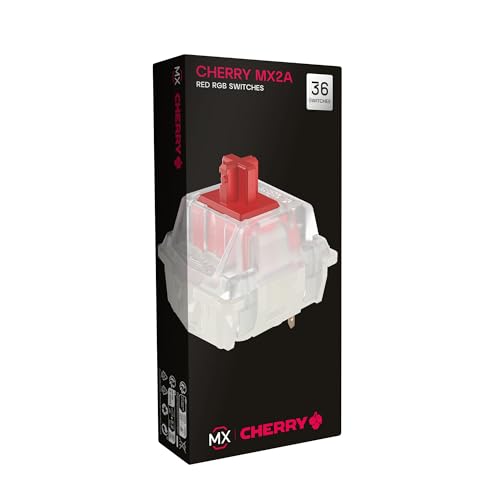
CHERRY MX2A Red — Cherry’s case in one switch
Badge: The reference light linear, in its current generation.
- Type: linear, smooth and direct, light spring class
- Kit: 36 switches, RGB housing version
- Generation: MX2A, with the line’s updated housing and factory lubrication
- Character: neutral, consistent, and utterly predictable — meant as praise
Everything Cherry stands for is audible in a board of these: no single key calls attention to itself, the stroke is clean, and the whole set behaves like one switch repeated a hundred times. The MX2A revision narrowed the smoothness gap that Gateron used to win by default, which makes the modern comparison closer than the folklore suggests. What the Red will not give you is character — a voice, a signature, a reason to write home. It gives you a standard, kept.
Strengths
- Set-to-set consistency that makes a whole board feel uniform
- The recipe is permanent: matchable and replaceable for years
- MX2A smoothness has closed much of the old gap to Gateron
Trade-offs
- A neutral voice that sound chasers find plain
- Kit counts and pricing sit above Gateron’s bulk logic
- Less variety within the linear type than Gateron’s catalogue
Best for: long-term boards, purists, and buyers who value the standard. Not suited for: sound-first builders on a strict budget.

CHERRY MX2A Brown — the tactile of the establishment
Badge: The gentle tactile that offices run on.
- Type: tactile, no click, light spring class
- Kit: 36 switches, RGB housing version
- Character: a modest bump, focused and noticeable
- Role: Cherry’s answer for feel-typists in shared rooms
The Brown is the switch the working world types on, and its virtues are the brand’s virtues in miniature: a predictable, gentle bump, delivered identically by every switch in the set, at a volume no office has ever complained about. Gateron’s tactiles, including the Brown in this guide, chase a rounder and sometimes fuller feel; the Cherry chases uniformity. Which matters more depends on whether your board is an instrument you tune or an appliance you trust.
Strengths
- Uniform, gentle tactility across the whole set
- Office-safe sound with real finger feedback
- The most documented, understood tactile in the hobby
Trade-offs
- The bump is subtle beside modern enthusiast tactiles
- Less sonic and tactile character than Gateron’s offerings
- Kit size suits compact boards better than full-size ones
Best for: office professionals and feel-typists who value consistency. Not suited for: bump hunters who want a pronounced tactile event.

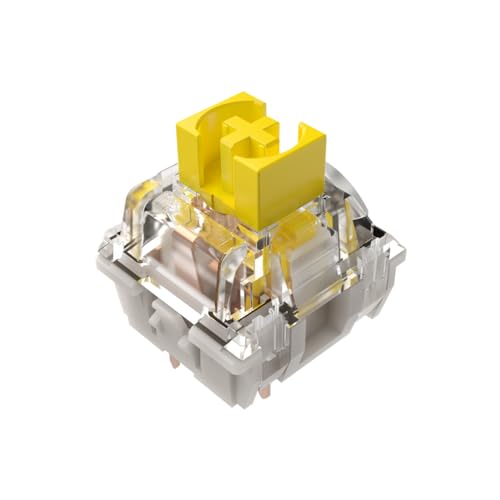
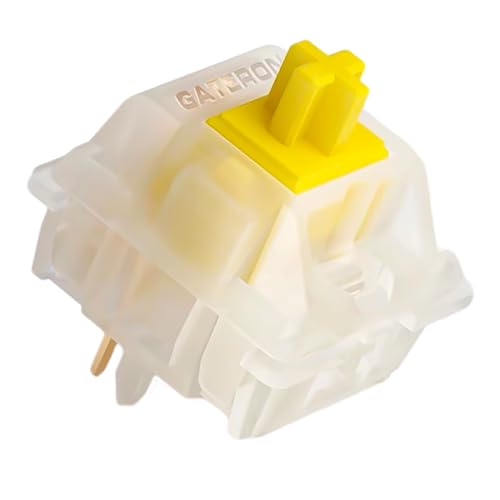
Gateron Milky Yellow Pro V2 — Gateron’s case in one switch
Badge: The smooth, deep-voiced linear that converted a generation.
- Type: linear, pre-lubed, 5-pin, 50 gf class
- Pack: 72 switches
- Housing: milky, lending a deep and soft sound signature
- Character: the budget-tier price with an enthusiast’s manners
If one switch explains Gateron’s rise, it is this one. The Milky Yellow Pro delivers the two things Cherry’s Red historically did not — a factory stroke smooth enough to silence the lubricant debate for most users, and a voice with genuine depth — at a pack logic that makes a full board an easy decision. Enthusiasts with expensive boards keep returning to it, which is the strongest testimony any switch can earn. Against the Cherry it trades a measure of set-to-set austerity for feel and sound that most hands and ears prefer on first contact.
Strengths
- Deep, pleasant sound that flatters almost any case
- Factory lubrication good enough for most users, permanently
- Bulk pack makes full-board builds simple and economical in spirit
Trade-offs
- Milky housing diffuses backlighting
- Consistency, while good, is a shade looser than Cherry’s standard
- Its soft voice will not suit a bright, clacky build brief
Best for: sound-focused builders and full-board conversions. Not suited for: shine-through RGB showcases or absolutists about uniformity.

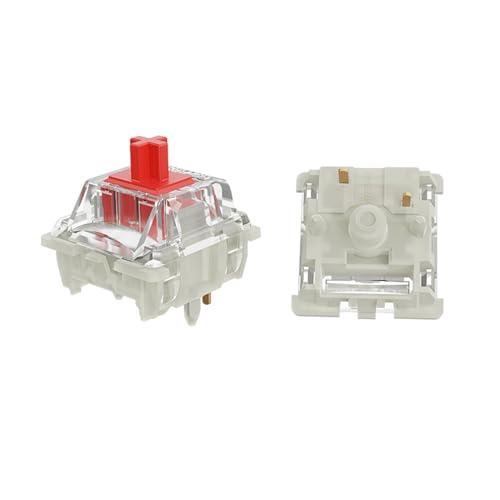
Gateron G Pro 3.0 Red — the direct answer to Cherry’s Red
Badge: The like-for-like challenger: a light linear with modern polish.
- Type: linear, pre-lubed, 5-pin, RGB-friendly housing
- Pack: 35 switches
- Generation: G Pro 3.0, the line’s current moulds and lubrication standard
- Character: bright, smooth, and eager
This is the comparison’s cleanest experiment: the same recipe — light linear — from the challenger brand’s current line. The G Pro 3.0 Red feels a touch slipperier out of the box than the Cherry, sounds a shade brighter, and treats backlighting better than its milky sibling. The Cherry answers with uniformity and permanence. Typed side by side in the same case, most users can tell them apart blind; fewer can tell you which is “better” without first deciding whether they are judging the stroke or the system around it. That is the whole brand comparison in one pair of switches.
Strengths
- Smooth, modern stroke with backlight-friendly housing
- Current-generation consistency from Gateron’s main line
- A livelier character than the Cherry’s neutrality
Trade-offs
- Small pack size rewards compact layouts most
- Brighter voice than the Milky Yellow’s depth
- The line evolves faster than Cherry’s, so today’s recipe may be revised sooner
Best for: backlit gaming builds and stroke-first buyers. Not suited for: buyers who want a recipe guaranteed unchanged for a decade.

Gateron G Pro 3.0 Brown — the challenger’s tactile
Badge: A rounder tactile bump for feel-typists who want more event.
- Type: tactile, pre-lubed, pin-enhanced, 55 gf class
- Pack: 108 switches, 3-pin
- Character: a fuller bump than Cherry’s Brown, at a slightly firmer weight
- Role: the tactile half of the like-for-like test
Set against the Cherry Brown, Gateron’s Brown makes the brands’ philosophies tactile. The bump is rounder and more present, the spring a touch firmer, the whole event more noticeable — a switch designed by a company competing on feel. The Cherry’s defenders will note, correctly, that its gentler bump disappears more completely during fast typing and that its uniformity across a hundred switches is the stricter achievement. Both claims are true, and the typist’s preference between a bump that announces itself and a bump that merely informs is a genuine fork in taste, not a quality gradient.
Strengths
- A fuller, rounder bump that feel-typists can type by
- Large pack covers any layout in one purchase
- Firmer weight resists accidental presses better than Cherry’s Brown
Trade-offs
- The more present bump can intrude during fast, flowing typing
- 3-pin format only in this listing
- Less austere uniformity than the Cherry reference
Best for: tactile typists who want the bump to matter. Not suited for: purists who want feedback that never interrupts flow.
Criterion by criterion
Smoothness out of the box
Gateron’s modern lines made their name here, and the Milky Yellow and G Pro 3.0 switches in this guide still hold the edge: their factory lubrication and moulds deliver a stroke that needs nothing. Cherry’s MX2A generation has closed most of the historical gap — a fresh MX2A Red is a genuinely smooth switch — but “most” is the operative word. Verdict: Gateron, by a narrowing margin.
Consistency and quality control
Cherry’s home ground. A hundred MX2A switches behave like a hundred copies of one switch; a hundred Gaterons behave like a close family — excellent, with slightly more individual variation in spring feel and lubricant. For a board’s owner the difference shows up as the occasional outlier in a Gateron set and almost never in a Cherry one. Verdict: Cherry.
Sound
Gateron, and it is the criterion sound chasers weight most. The milky housing’s depth, the line’s variety of voices, and a design culture that treats acoustics as a feature give Gateron boards a character Cherry’s neutrality does not attempt. Cherry’s defenders reply that a neutral switch lets the case compose the sound; true, and beside the point for buyers who want the switch itself to sing. Verdict: Gateron.
Variety and specialisation
Gateron again. Within linears alone, this guide’s Gateron picks span a deep-voiced milky switch and a bright backlit one, and the wider Gateron catalogue — mapped in gateron switches complete guide — adds silent, heavy, and exotic-material lines at a pace Cherry’s deliberate catalogue does not match. Cherry’s range is a canon; Gateron’s is a menu. Verdict: Gateron.
Value, in the qualitative sense
Gateron’s pack logic — more switches per box, friendlier divisions at the listing — makes full-board builds easier to justify, and the budget roundup in this cluster is full of its switches for that reason. Cherry’s value is of a different kind: permanence, resale, and a recipe that will not be revised out from under your spares. Verdict: Gateron for the purchase, Cherry for the decade.
Longevity and ecosystem
Both switches will outlast their boards, and both fit the same sockets and caps. The difference is institutional: Cherry is the standard’s owner, with the longest track record and the most conservative product policy in the industry. A board built on Cherry is the easiest board in the world to maintain, match, and explain to its next owner. Verdict: Cherry.
Who should buy which brand
Buy Cherry if the board is a fixture — the desk’s permanent keyboard, the one you intend to maintain rather than replace — or if your temperament runs to standards, references, and things that stay bought. Buy Gateron if the board is an instrument — tuned, listened to, rebuilt as your taste develops — or if the build’s budget must stretch across a full layout without surrendering the stroke. Buy both, across two boards or two zones, if you are the hobby’s commonest creature: the person whose work board is a Cherry appliance and whose project board is a Gateron experiment. The brands are not really competing for the same desk hour, and many households discover that the fork in the road was a junction with room for both directions. The foundations beneath both brands are laid out in keyboard switches explained for beginners, and Cherry’s own house is toured in cherry mx switches complete guide.
How to run the brand test yourself
Step 1: Compare like with like
Put the two Reds — or the two Browns — in the same board, in the same case, under the same keycaps. Brand comparisons conducted across different boards measure boards.
Step 2: Type blind where you can
Have someone swap two rows’ switches, or shuffle the layout yourself and type before looking. Brand loyalty is a powerful seasoning; remove it and the stroke speaks plainly.
Step 3: Listen from the listener’s chair
Record both halves from across the room. Gateron’s sound advantage is a room-scale phenomenon, and Cherry’s neutrality is one too; your own chair flatters whichever you already prefer.
Step 4: Live a week on the mixed board
Novelty inflates the challenger’s charms and familiarity inflates the incumbent’s. A week of real work and real games burns off both, and the preference that survives is the one to fund.
Step 5: Decide by the board’s job, not the afternoon’s winner
If the mixed board taught you that the strokes are close, let the system’s virtues decide — permanence for a fixture, variety and value for an instrument. That tie-break rule has settled more of these comparisons than any specification.
Common mistakes in the brand wars
The first is treating the brands as quality tiers — Cherry as the “real” switch and Gateron as the copy — a decade after the market stopped agreeing. The second is the mirror error: treating Cherry as a legacy tax, when its consistency and permanence are real engineering virtues that real users feel. The third is comparing a Cherry linear against a Gateron tactile and attributing the difference to the logos. The fourth is judging either brand by its cheapest or oldest line: Cherry’s current generation is MX2A, Gateron’s is the Pro 3.0 era, and folklore about either brand is usually two generations out of date.
Fifth: assuming the choice is permanent or total. The sockets do not care which brand sits in them, zoning across brands is routine, and a board can be Cherry where it works and Gateron where it plays. Sixth: buying on a sound test recorded through a flagship custom case and expecting the same voice from a hollow starter board — the case will have the last word over both brands, as it does over every switch in this cluster.
Final recommendation
If a single name must be printed: Gateron wins the stroke, the sound, and the shopping; Cherry wins the standard, the system, and the decade. Most readers should let the board’s job break the tie — Gateron for the instrument you will tune and enjoy, Cherry for the fixture you will trust and keep. And the reader who still cannot choose should take comfort in the comparison’s best-kept secret: at the level of these five switches, there is no losing outcome, only two different kinds of winning.
The history in one page: how the challenger caught up
Cherry’s MX switch defined the mechanical keyboard’s modern era and, for years, defined its ceiling: if you wanted the real thing, the German switch was the real thing. Gateron’s early reputation was built as the acceptable alternative — similar pattern, friendlier pricing, quality that varied enough to keep the hierarchy comfortable. The turning point was not a single product but a shift in what buyers could see. As the enthusiast community developed its instruments — force curves, sound tests, slow-motion stem photography, teardowns published within days of a launch — quality became legible at every price point, and Gateron’s investments in moulds, materials, and factory lubrication became visible, comparable, and saleable. The Milky line’s sound, the Pro generations’ polish, and a catalogue that answered community requests within a product cycle did the rest. Cherry’s response, the MX2A generation, is best read as the incumbent accepting the new terms: the standard, refined to compete on the challenger’s ground of stroke quality while keeping its own ground of consistency and permanence. The comparison in this article is close because both companies have spent a decade making it close, and buyers are the beneficiaries of the whole argument.
Manufacturing philosophies, translated
Underneath the marketing, the two brands run different factories in spirit. Cherry’s philosophy is the recipe kept: narrow tolerance bands, conservative materials, changes introduced at generational pace and documented like engineering revisions. The virtue is that a Cherry switch is a known quantity to a degree few manufactured goods achieve; the cost is that novelty arrives slowly and variety stays narrow. Gateron’s philosophy is the recipe iterated: more lines, more materials, more frequent revisions, each answering a visible community desire — a deeper voice, a longer spring, a new housing compound. The virtue is responsiveness and range; the cost is a catalogue that can confuse, and generations that turn over before their spares become heirlooms. Neither philosophy is a disguise for quality or its absence. They are two honest answers to the question of what a switch company is for, and the buyer is really choosing between them — the switches in this guide are just where the philosophies become touchable.
The sound argument, given its full weight
Because sound decides so many of these purchases, it deserves a fuller hearing than one criterion row. A switch’s voice is composed by its housing material, its stem fit, its spring, and its lubricant, then performed by the case. Gateron’s design culture treats that composition as a headline feature: the milky housing exists to deepen the voice, the line’s materials are chosen with acoustics in the brief, and its community judges each release by ear as much as by finger. Cherry’s culture treats sound as an outcome to be kept neutral and consistent, leaving composition to the builder’s case, caps, and foam. Neither is the correct philosophy — but they produce audibly different boards from the same desk, and a buyer who cares about sound should weight this section heavily, while a buyer who types in a treated custom case may find the difference narrows to taste. The recording test in the how-to section is the honest arbiter: microphones do not have brand loyalty, even if their owners do.
What about tactility as a brand signature?
The tactile comparison in this guide — Brown against Brown — generalises into a brand truth worth stating. Cherry’s tactile philosophy is restraint: a bump that informs without interrupting, sized for eight-hour days and fast, flowing typing, delivered with strict uniformity. Gateron’s tactile philosophy is presence: rounder, fuller bumps that a feel-typist can lean on, in more weights and flavours, accepting a little more variation as the price of character. Enthusiasts who chase tactility as a hobby in itself tend to migrate past both brands toward the boutique makers — the subject of this cluster’s boutique guide — but for the working typist the choice between restraint and presence is the real decision, and it is a decision about one’s own typing rhythm rather than about either company’s competence. Try both Browns in one board for one week; your fingers’ preference will be embarrassingly clear, and it will predict your brand allegiance better than any argument in this article.
The prebuilt dimension: the brands inside other people’s keyboards
Most typists meet these brands first as the switches inside a prebuilt board, and that meeting shapes loyalties in ways worth examining. Cherry’s prebuilt presence runs through the established keyboard brands, where its name on a specification sheet is a selling point aimed at buyers who know the colour language. Gateron’s presence runs through the enthusiast and value ends of the prebuilt market, where its switches are often the best thing about the board they arrive in — and more than one buyer’s brand journey began with pulling a switch from an inexpensive Gateron-equipped board and discovering the housing’s name with surprise. The practical lesson is that you may already own data in this comparison: if a board you have typed on happily carries one of these brands, that happiness is evidence, and it outweighs a stranger’s review — including the reviews in this guide, which is why they keep prescribing trials on your own desk.
Resale, spares, and the ten-year drawer
A switch purchase is partly a purchase of future options, and the brands differ there too. Cherry spares are the hobby’s blue-chip: any kit you shelve will match boards and buyers for a decade, because the recipes do not drift. Gateron spares are more liquid in the short term — the lines are popular, the community trades them constantly — with the caveat that a line revised next year makes this year’s spares a slightly more specific asset. Neither consideration should lead the decision, but for the builder who maintains several boards, the drawer test is real: in ten years, which box of spares will you be glad you kept? The honest answer splits by temperament, like everything else in this comparison, and knowing your own temperament is once again the actual skill being purchased.
Two build stories
Consider a writer assembling a board meant to last a decade at one desk. She chooses Cherry — Browns for the letters, a Silent Red where the household listens — not because a sound test crowned them, but because the board’s job is permanence and the brand’s whole philosophy is permanence. Five years on, the board has needed one replacement switch, sourced in minutes, identical to its hundred siblings. The purchase looks wiser with every year, which is exactly the curve Cherry sells. Consider, in the next room of the same house, her partner assembling a board as a hobby object: Gateron Milky Yellows in a foam-filled case, chosen by ear, rebuilt twice as taste evolved, its switches traded and re-traded through the community. That purchase also looks wiser with every year, because the board’s job was never permanence — it was pleasure, iterated. The brands did not compete in that household. They specialised, and the household is the comparison’s truest verdict: the question was never which brand is better, but which job is yours.
Myths that survive every forum thread
Four claims about these brands refuse to die, and a complete comparison should bury them. The first says Cherry switches are scratchy — true of some older production, untrue of the MX2A kits in this guide, and a decade stale as a general claim. The second says Gateron switches are inconsistent — true of the brand’s earliest years, untrue of its current Pro lines at any fair standard, though Cherry’s band remains the narrower. The third says the brands’ switches are interchangeable in feel because they share a pattern — the pattern is a socket standard, not a feel standard, as one afternoon with both Reds will prove. The fourth says one brand is “for gamers” and the other “for typists” — both brands sell linears that game beautifully and tactiles that type beautifully, and the gaming variable that actually matters, actuation geometry, lives inside specific models rather than inside logos. Buyers who clear these four myths away find the real comparison underneath, which is the one this article has been conducting: philosophy, stroke, sound, system.
The modding verdict
Modders — the owners who open switches, swap springs, and tune housings — divide over these brands in an instructive way. Cherry switches are the traditional modding substrate: their tolerances reward precision work, their parts interchange across decades of production, and a tuned Cherry is a known destination. Gateron switches increasingly arrive pre-tuned, which splits the modding community into those who find the factory work a convenience and those who find it a spoiler — half the hobby is the tuning, and a switch that needs nothing gives the tuner nothing to do. If you mod for the result, Gateron’s current lines shorten the road. If you mod for the practice, Cherry’s line is the richer workshop. Either way, the spring-swap trick belongs to both brands equally: a mid-weight spring turns either maker’s light linear into the middle switch neither catalogue quite sells, and it remains the highest-value evening in the hobby.
What the comparison looks like at the extremes
Stress-test the verdict at the market’s edges and it holds. At the strictest budget, Gateron’s lines dominate this cluster’s budget roundup, because its divisions and pack sizes were designed for exactly that buyer; Cherry does not contest the tier and should not be forced into it. At the longest horizon — the board as heirloom — Cherry’s permanence is unchallenged, because no rival can point to its recipes’ multi-decade stability. At the sound extreme, Gateron’s milky and specialty lines are the mainstream’s deepest voices; at the consistency extreme, a Cherry set is the metrology reference. A comparison that names different winners at different extremes is not being evasive. It is reporting that the brands were built, deliberately, to be good at different things — and that the buyer’s task is to locate their own desk on the map those extremes define.
Frequently asked questions
Are Gateron switches just cheaper copies of Cherry?
That description is a generation out of date. Gateron began in the MX pattern’s long shadow, but its modern lines — the Milky Pro and G Pro 3.0 switches in this guide — are original engineering with their own materials, moulds, and sound signatures, and they beat Cherry on several axes enthusiasts care about. Cherry remains the standard’s owner; Gateron is a peer, not a photocopy.
Which brand is more durable?
Both are rated for long service and routinely outlast their keyboards. Cherry’s track record is longer because the brand is older, and its conservative engineering is part of its appeal; Gateron’s modern lines have accumulated their own years of uneventful service in millions of boards. Durability should not decide this comparison — neither brand gives you a reason to worry.
Which is better for gaming?
For most players, whichever light linear suits their board: Cherry’s Red is the reference gaming linear, and Gateron’s G Pro 3.0 Red and Milky Yellow Pro answer it with smoother factory strokes. Competitive specialists should look at actuation geometry — Cherry’s Speed Silver — rather than at brand, because geometry, not logo, is what changes input timing.
Can I mix Cherry and Gateron switches on one board?
Yes. Both brands build to the MX pattern, so they share sockets and keycaps, and mixed boards are common — Cherry tactiles for typing zones beside Gateron linears for gaming zones is a configuration many owners settle on. Keep zones clean and documented, since the two brands’ voices differ enough to notice across a boundary.
Which brand is quieter?
Neither brand is a silent specialist at the level of these picks, but Gateron’s milky housings produce a deeper, softer-edged sound that most listeners judge gentler, while Cherry’s standard switches are neutral. For genuine quiet, both brands sell silent lines — Cherry’s Silent Red is in this cluster’s complete Cherry guide — and the silent category matters more than the brand on the box.
Which brand would this guide’s authors put in a single shared office board?
Cherry Browns for the typing rows, for their uniformity and their gentle, documented manners, with Gateron’s linears shortlisted the moment the office becomes a private room and sound becomes a pleasure rather than a policy. Shared spaces reward the standard; private ones reward the instrument. The office board is a policy document before it is a preference, and Cherry writes policy fluently.
One last question: does the brand on my switches really matter this much?
Less than this article’s length suggests, and more than a specification sheet admits. The switches are the part of the keyboard your body actually touches, thousands of times a day, and small differences in their behaviour compound into the feel of your working life. But they are also the most replaceable part you own. Care about the choice, make it with evidence, and then stop caring — that sequence is the whole wisdom of the hobby, and both brands reward it equally.
Should I read the five-brand comparison as well?
If your shortlist is still forming, yes: the five-brand article in this cluster adds Kailh’s box designs, Outemu’s budget workhorses, and Razer’s gaming switches to the argument, and it reframes this two-brand verdict inside the whole mainstream market. Readers whose choice is truly only between Cherry and Gateron have everything they need here; readers shopping the category itself should widen the lens before spending.
What is the final tie-break rule?
When the strokes feel close in your own trial — and for many hands, with current-generation switches, they will — buy the system you want to live inside: Cherry’s permanence if the board is a fixture, Gateron’s variety and value if it is an instrument in progress. A tie on feel is not a failed comparison. It is the comparison telling you the decision has moved from your fingers to your intentions, which is where brand choice always belonged.
Is there a board type where the brand choice matters least?
Yes: the heavily treated custom board. When a case is foam-filled, gasket-mounted, and capped with thick keycaps, the build’s own engineering composes so much of the feel and sound that the two brands’ mainstream switches converge — both arrive smooth, both sound civilised, and the decision falls back to system virtues. The brand choice matters most in a plain, honest board, where the switch is the loudest voice in the room. Know which board you own before weighting this article’s criteria.
Which brand holds its value better second-hand?
Cherry kits are the steadier store of value, because their recipes are permanent and every buyer knows exactly what a colour promises. Gateron’s popular lines trade briskly but their value follows the catalogue’s evolution — a line’s revision can soften its predecessor’s price. Neither should be bought as an investment; switches are for typing. But the owner who keeps spares will find Cherry’s the easier to pass on at a fair return, years later, to a stranger.
Do both brands offer clicky and silent options?
Yes — the rivalry spans every switch type. Cherry’s Blue and Silent Red appear in this cluster’s complete Cherry guide; Gateron’s catalogue answers with its own clicky Pro line and its KS-9 silent line, both represented elsewhere in this cluster’s picks. A buyer committed to a type — clicky, silent, heavy, speed — will find both brands waiting there, which is why brand should usually be chosen after type, not before it.
What should I buy if my board is mostly for writing?
Start with the two Browns in a split-board trial: a week will tell you whether your rhythm prefers Cherry’s restraint or Gateron’s presence, and that preference — not the brands’ general reputations — is the answer for a writing board. Writers who discover they type by flow rather than by feel should repeat the trial with the two Reds. The method matters more than the outcome, because the outcome is only ever yours.
Which brand is the safer recommendation to give a stranger?
Cherry, by a nose — not because its switches are better for the stranger’s hands, which you cannot know, but because its recipes are the most predictable and the most documented, so the stranger can research, match, and maintain the result without you. Recommending Gateron to a stranger is recommending a catalogue; recommending Cherry is recommending a colour. Both kindnesses are real, and they are not the same kindness.
Do the brands feel different because of springs or housings?
Both, in proportions that vary by model: the spring sets the force story, the housing and stem set the friction and the voice, and the lubricant mediates between them. Gateron’s modern reputation rests mostly on the second and third of those — housings and factory lubrication — while Cherry’s rests on holding all three to a narrow, permanent specification. A buyer who understands that anatomy can predict a new model’s character from its description, whichever logo it carries.
What is the best way to spend a fixed switch budget across the two brands?
Put the majority where the hours are: if the board works all day, fund the typing zone with the brand your trial preferred and let the minority zone — the gaming cluster, the numpad — take the other brand’s value line. A fixed budget spent by hours-of-use beats the same budget spent by allegiance, and the mixed result usually outperforms a single-brand board bought to a price, because each zone got the philosophy that suits it.
Is one brand better for small hands or light typists?
The light linears of both brands serve light typists well, and the choice between them is the comparison in miniature: Cherry’s Red for its uniformity and permanence, Gateron’s light linears for their stroke and sound. Hand size itself matters less than typing style in this category — both brands’ mainstream weights were designed around the average hand, and outliers in either direction should shop weights first and brands second.
Which brand do keyboard manufacturers themselves choose?
Both, visibly: Cherry’s name anchors established brands’ specification sheets, while Gateron’s switches power a large share of the enthusiast and value boards that reviewers praise for their typing feel. The manufacturers’ split mirrors the consumers’ — the standard where permanence sells, the challenger where feel-per-money sells — and it is further evidence that the industry’s honest answer to this article’s question is a shelf with both names on it.
What happens if I choose wrong?
Very little, and that is the comparison’s kindest fact. The switches pull out, the other brand’s pull in, and the first set becomes spares, a second board’s heart, or a trade with the community. Brand choice in the MX ecosystem is one of the most reversible decisions in consumer electronics. Choose with the evidence you have, type for a month, and let the sockets arbitrate any remaining doubt — they were designed for exactly that.
How do I read the two brands’ product names?
Cherry’s names are the colour system: the stem colour is the recipe, with named variants for silence and speed. Gateron’s names are line-and-recipe pairs — the line (Milky, G Pro, Oil King and others) tells you the housing and design family, the colour or descriptor tells you the type and weight. A Gateron buyer shops a two-dimensional catalogue; a Cherry buyer shops a one-dimensional one. Neither is a flaw, but the Gateron shopper should budget an extra ten minutes for the catalogue’s breadth.
Which brand is better for a gift keyboard?
For a recipient whose taste you know, match the brand to it. For a recipient whose taste you are introducing, Gateron’s friendlier divisions make the generous version of the gift easier, and its switches’ out-of-box polish flatters a first impression. For a recipient who is already an enthusiast with a Cherry board’s spares drawer, a matching Cherry kit is the gift that respects their system. The brands divide gift duty the way they divide everything: by the job the board will do.
Do either brand’s switches need modification out of the box?
Neither needs it; the question is whether modification is your hobby or your chore. Gateron’s current lines arrive closest to the enthusiast ideal of a finished switch, which is why they dominate build guides that promise a no-mod path. Cherry’s MX2A kits are likewise ready to type on, with modification reserved for owners chasing a specific sound. In both houses, lube and films are now refinements rather than rescues — a sentence that would have surprised the hobby five years ago.
What is the strongest argument for each brand, in one sentence each?
For Cherry: no other switch is as certain to be the same switch, in the same recipe, maintained by the same ecosystem, for as long as you own keyboards. For Gateron: no other mainstream brand gives your fingers and ears as much, out of the box, for as little commitment per switch. Every section of this article is an expansion of those two sentences, and a buyer who knows which sentence sounds like their own priorities already has the verdict.
Which brand should a sound-focused builder start with?
Gateron, and specifically the Milky Yellow Pro in this guide: it is the mainstream’s reference for a deep, soft voice, it flatters ordinary cases, and its pack logic makes a full board the easy version of the experiment. Build one board on it, learn what your case does to its voice, and every later sound decision — including any future Cherry build — will be made with educated ears.
Are the brands’ spring weights comparable?
Roughly, with care: both brands quote operating forces in similar classes, and a light linear from either house feels like a light linear. The details — where in the stroke the force builds, how long the spring is, how the bottom-out feels — differ enough that cross-brand twins are cousins rather than clones. Treat the numbers as a neighbourhood, and the in-board trial as the address.
What if I like Cherry’s system but Gateron’s prices?
That is the hobby’s most common position, and it has a practical resolution: build the main board on Gateron’s current lines, where the stroke-per-money is strongest, and keep Cherry for the roles where its permanence pays — the board you will maintain for a decade, the gift that must be right, the spares drawer that must match everything. Brand allegiance is a hobby luxury; brand literacy is the actual asset, and it is portable across both catalogues.
Do Gateron switches fit Cherry-branded keyboards?
Yes, provided the board uses standard MX sockets, as Cherry’s own keyboards and nearly all mechanical boards do. The pattern is the pattern, whichever name is moulded on the housing. The reverse is equally true, which is the ecosystem’s founding convenience: a Cherry board is a Gateron board waiting for an evening and a switch puller.
Which brand is better for a quiet build that is not fully silent?
Gateron, on the evidence of these picks: the milky housing’s deep, soft-edged voice is the gentlest standard-switch sound in the comparison, and it asks nothing of the typist. Cherry’s standard switches are neutral rather than hushed. If the requirement hardens into true quiet — a microphone, a sleeping household — leave both standard lines and buy a silent switch, where Cherry’s Silent Red and Gateron’s silent lines compete on the category’s own terms.
How do the brands compare for heavy typists?
Heavy hands should look past the light linears that headline this guide: Cherry answers with the Black’s firm spring and its industrial heritage, Gateron with its heavier yellow and specialty lines. Between the five picks here, the firmer Gateron Brown is the heavy hand’s tactile, while Cherry’s firm linear lives in the complete Cherry guide. The brand lesson generalises: both houses serve heavy typists, but in different rooms of the catalogue.
Why do enthusiasts own both brands?
Because the brands answer different questions, and a household with more than one desk — or one desk with more than one mood — eventually asks all of them. The work board wants a standard kept; the project board wants a voice; the gift board wants a division that makes generosity easy. Owning both is not indecision. It is the mature state of a hobby whose two leading mainstream brands specialised instead of converging.
Is Cherry’s MX2A generation a real improvement?
Yes, in the specific way that matters to this comparison: the updated housing and factory lubrication narrowed the smoothness gap that Gateron used to win by default. The recipes’ characters are unchanged — a Red is still a Red — but a buyer comparing fresh kits today is comparing closer strokes than the folklore describes, which pushes the decision toward the system-level virtues where the brands genuinely differ.
Which brand has the better linear switches?
For the stroke and the sound, Gateron’s current linears — the Milky Yellow Pro above all — hold the mainstream’s affection, and this guide’s criterion sections score them ahead on both. For uniformity across a large set and for the recipe’s permanence, Cherry’s linears remain the reference. Most buyers are really asking about the first pair of virtues; professionals maintaining fleets of boards ask about the second. Know which question is yours.
Which brand has the better tactile switches?
It depends on the bump you want. Gateron’s Brown offers the fuller, rounder event that feel-typists can lean on; Cherry’s Brown offers the gentler, more uniform event that disappears into fast typing. Stronger tactility than either lives in the boutique category. Within this comparison, call it a draw decided by typing style — restraint against presence, with no quality gap underneath.
Do the two brands’ switches fit the same keyboards?
Yes. Both build to the MX pattern, so sockets, plates, and keycaps are shared, and a board can host either brand or a deliberate mixture of both. The only routine cautions are pin counts — match the switch’s legs to your board’s acceptance, trimming a 5-pin switch’s extra legs where a board requires it — and housing choice where backlighting matters.
What is the cheapest way to settle this comparison for myself?
A row of each, in your own board, for a week apiece — the trial format every guide in this cluster prescribes. The two brands’ entry linears are close enough in commitment that the experiment costs little, and it converts this article’s argument into your own evidence, which is the only form in which the verdict will ever really be yours.
Which should a beginner buy first?
A beginner who wants the reference experience should start with Cherry, because every future comparison will be described against it. A beginner who wants the most enjoyable stroke for a first build’s budget should start with Gateron. Either is a sound education; the beginner to pity is the one who starts with an unbranded switch and learns neither brand’s language.
Related reading: cherry mx vs gateron vs kailh vs outemu vs razer switches which is best · best budget linear switches under 30 cents · durock jwk tecsee boutique switches guide