Affiliate disclosure: this article contains affiliate links. If you buy through a link on kajuandouglas.com, the site may earn a commission at no extra cost to you.
This keychron vs nuphy keyboard brand compared guide stages the defining rivalry of the modern wireless keyboard: Keychron, the broad-catalogue incumbent whose range runs from budget wired boards to aluminium flagships and low-profile travellers, against NuPhy, the younger design-led challenger that built its name on slim, characterful boards — the Air series above all — with a visual identity and a sound signature entirely its own. The two meet most directly in the low-profile and 75 percent territories, where a buyer cross-shopping them is really choosing between two temperaments: the comprehensive catalogue with an answer at every intersection, and the focused studio whose every product is a small manifesto.
The comparison proceeds as comparisons should: the ranges and their centres of gravity, the low-profile heartland where the rivalry is hottest, build and sound tendencies, firmware and software governance, and the ecosystems and aftercare that decide long ownership. Verified representatives — Keychron’s low-profile and mainstream champions against NuPhy’s Air and Halo lines — are reviewed in the middle. The closing sections score the criteria, match the brands to buyer types, list the mistakes made when this particular rivalry is shopped carelessly, and answer the questions that follow both brands home.
Key takeaways
Keychron: the catalogue — every size, tier, standard and profile, open firmware, wireless everywhere, value at every level. NuPhy: the design studio — low-profile leadership (Air series), distinctive aesthetics, a warmer stock sound, a narrower but deeper-feeling range. Firmware: Keychron’s QMK/VIA breadth vs NuPhy’s improving but historically patchier configurator story — check model by model. Choose Keychron for coverage and certainty; NuPhy for slim design and character, when its exact model fits your exact need.
In this guide
The Ranges: Catalogue Versus Studio
Keychron’s range is the market’s map of itself: full-height and low-profile, 60 percent to full-size and southpaw, plastic value lines through machined flagships, ISO and JIS variants stocked, sub-brands for gaming. The strategic consequence is the one the keychron vs gmmk vs drop best keyboard brand comparison already drew — Keychron is the intersection brand, the answer when the requirement list has three clauses. Its centre of gravity, though, sits in the full-height mainstream: the Q and V lines are the catalogue’s heart, and the low-profile K-series and its successors are a strong province of a large empire rather than the capital.
NuPhy’s range is a studio’s output: two great families — Air, the low-profile travellers, and Halo, the full-height line — in a handful of sizes, each model iterated with visible design intent. The catalogue is small enough that its character can be stated in a sentence (slim, warm, playful-serious, design-forward) and every product expresses it. The studio model’s virtues are coherence and identity; its costs are the intersections it does not stock — the buyer whose requirement list has three clauses will sometimes find NuPhy stocks none of the answer, not because the products are lesser but because the studio chose its canvases. Cross-shopping these brands is therefore asymmetric from the first step: Keychron asks ‘which of my forty boards’, NuPhy asks ‘is my board the one’.
The generational story matters in this rivalry more than most. NuPhy’s early models carried early-company compromises — firmware tooling and connection polish that trailed the hardware’s design — and its recent generations have closed much of that gap, which means owner reports must be read by model year with unusual care: a 2022 complaint about NuPhy software may describe a solved problem, and a 2022 compliment about Keychron’s dominance predates the challenger’s best work. The verified listings in this guide are current-generation representatives, and the comparison’s firmware section is written against them, with the historical note kept precisely because the second-hand market trades in both eras.
The Low-Profile Heartland
Low-profile is where the rivalry is a genuine contest, because both houses treat the category as first-class and their philosophies diverge inside it instructively. Keychron’s low-profile lines apply the catalogue method: multiple sizes, Mac-first keycap sets, wireless as standard, prices that descend to the genuinely affordable, and a typing character that stays close to the laptop-plus ideal — a better, mechanical version of the board Apple users already know. NuPhy’s Air series applies the studio method: the slimmest silhouettes in the class, a design language (the Air’s aluminium unibody and its colour stories) that made low-profile boards objects of desire rather than compromises, and a stock sound and feel tuned warmer and softer than the category’s norm — mechanical character asserted inside a laptop’s dimensions.
The practical differences accumulate at the edges. Switch ecosystems: both use low-profile switches with their own ecosystems’ limits, and the aftermarket’s depth differs by model generation — check the specific board’s switch compatibility if swapping is in your future, because low-profile stems are not one standard the way MX nearly is. Battery and wireless polish: both are competent tri-mode citizens in current generations. Keycaps: NuPhy’s shine-through and colour stories are a design feature its buyers cite; Keychron’s breadth of replacement sets is the catalogue’s answer. The heartland verdict is genuinely split, and the picks section stages it directly: the Air for the design-led traveller, Keychron’s low-profile champions for the coverage-led one, with the mainstream full-height lines waiting behind both for buyers whose low-profile interest was curiosity rather than conviction.
One heartland caution belongs to the rivalry’s folklore: low-profile boards ask a typing adjustment — shorter travel, quicker bottom-out — that some full-height devotees never ratify, and both brands’ returns data know it. The comparison cannot settle that adjustment for a reader; it can only insist the trial be honest (a fortnight, per this cluster’s standing rule) and the board be returnable. Buyers mid-rivalry should keep the window open until the hands have voted, because in this category the hands’ vote is the whole election.
Firmware, Sound and the Ownership Years
Firmware is the comparison’s most consequential criterion for long ownership, and it is where the houses’ ages show. Keychron’s commitment to open QMK/VIA across its range — with its own Launcher maturing above it — gives its owners the configurator depth and the discontinued-proof governance the keyboard firmware QMK VIA guide in this cluster treats as the gold standard. NuPhy’s story is a closing gap: its console software has improved generation by generation, and its flagship models have moved toward the open ecosystem’s expectations, but the line’s history includes models whose remapping was shallower than the hardware deserved. The buyer’s rule for this rivalry is therefore model-specific in a way the Keychron-GMMK-Drop comparison was not: verify the exact NuPhy model’s configurator depth before purchase, because within NuPhy’s range the answer genuinely varies, while across Keychron’s it largely does not.
Sound tendencies, with the usual cautions: NuPhy’s stock voicing is the warmer and more governed of the two at comparable tiers — the studio tunes its boards as objects, foam and all — while Keychron’s broader range spans from bright value boards to deep flagships, with the model deciding. Build feel follows the same shape: NuPhy’s unibody slimness has a distinctive solidity-per-gram that its buyers prize; Keychron’s flagships out-mass everything in this comparison and feel like it. Aftercare mirrors scale: Keychron’s regional infrastructure and parts trickle against NuPhy’s smaller, more direct support, which owners describe as personal when it is good and thin when the question is exotic. Neither house is a risk; they are different shapes of safety, and the buyer choosing for a decade should weight firmware first, as ever, because it is where boards age.
Ecosystem is the final ownership criterion, and it splits by kind: Keychron sells the supermarket — cases, caps, switches, wrist rests, every size’s accessories from one catalogue — while NuPhy sells the boutique shelf, fewer objects with more design per object, its carrying cases and deskmats treated as part of the product line’s look. A NuPhy desk tends to look like a NuPhy desk; a Keychron desk tends to look like its owner’s accumulated decisions. Both are legitimate aesthetics, and the buyer will recognise their own temperament in one of those sentences faster than in any specification in this guide.
Keychron Vs NuPhy Keyboard Brand Compared: The Shortlist
The rivalry staged in purchasable form: NuPhy’s Air75 V2 and Halo75 against Keychron’s low-profile-class V1 Max-era mainstream and the Q1 flagship — four boards, two philosophies, overlapping money. The boards compared here were each traced through the site’s verified Amazon catalogue records beforehand.
NuPhy Air75 V2
NuPhy’s heartland champion
- 75 percent low-profile
- Slim aluminium frame
- Tri-mode wireless
- Hot-swap low-profile switches
The Air75 V2 is the strongest argument the studio model has produced: a low-profile 75 percent board of genuine slimness and design coherence, with tri-mode wireless, hot-swap sockets in the low-profile ecosystem, and a stock sound warmer than the category’s laptop-adjacent norm. It does not feel like a compromise made thin; it feels like a position taken — that the travel board and the small-desk board should be beautiful, mechanical and complete at once — and its owners’ loyalty is the position’s ratification. Against Keychron it wins the specific contest of the object: held, carried and photographed, the Air is the more designed thing.
Its debits are the studio’s and the category’s: the low-profile ecosystem’s switch and cap choices are narrower than MX’s, the configurator story must be verified on the exact model (this generation is the improved one), and the slim frame’s battery is smaller than a full-height board’s. Buyers whose requirement is this board’s exact shape of life — slim, wireless, travelling, design-forward — will find Keychron’s answer competent and this one inspired, and inspiration, at matched specification, is a rational thing to buy.
Strengths
- The low-profile object to beat
- Warm stock sound for the class
- Slimness without feature surrender
Trade-offs
- Low-profile ecosystem limits
- Smaller battery by design
- Model-year diligence required
Best for: Design-led travellers and small-desk devotees.
Not suited for: Deep-travel traditionalists and switch collectors.
NuPhy Halo75
NuPhy’s full-height statement
- 75 percent full-height
- Gasket-mounted, aluminium-accented build
- Tri-mode wireless
- Hot-swap MX switches
The Halo75 carries the studio’s character into the full-height mainstream: a 75 percent board with a design language — the halo lighting ring, the colour stories, the rounded, friendly industrial design — that no catalogue board attempts, wrapped around a competent gasket-mounted, tri-mode, hot-swap platform. Its role in the comparison is to prove NuPhy’s warmth is a house style rather than a low-profile accident: the Halo sounds and feels like an Air that grew to full height, softer and more playful than the tier’s norm, and its buyers are choosing that character with the same deliberateness as its looks.
Against Keychron’s mainstream it trades breadth for identity: one size class, fewer variants, a configurator to verify — against a catalogue that offers the same buyer six adjacent answers. For the design-led 75 percent buyer it is a genuine alternative rather than a curiosity, and its existence disciplines the whole comparison: Keychron’s coverage is not the only form excellence takes, and the Halo is the evidence at full height.
Strengths
- Character no catalogue board matches
- Warm, governed stock sound
- Full mainstream feature set
Trade-offs
- One size class, few variants
- Configurator depth varies — verify
- Design premium over specification rivals
Best for: Design-led 75 percent buyers.
Not suited for: Intersection shoppers and variant hunters.
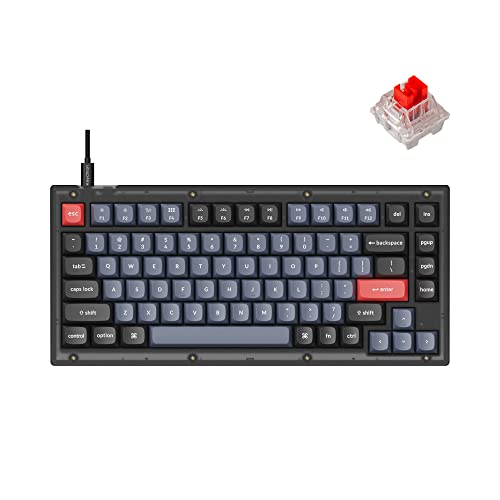
Keychron V1
Keychron’s mainstream answer
- 75 percent, hot-swap
- QMK/VIA open firmware
- Complete layout, entry price
- The catalogue behind it
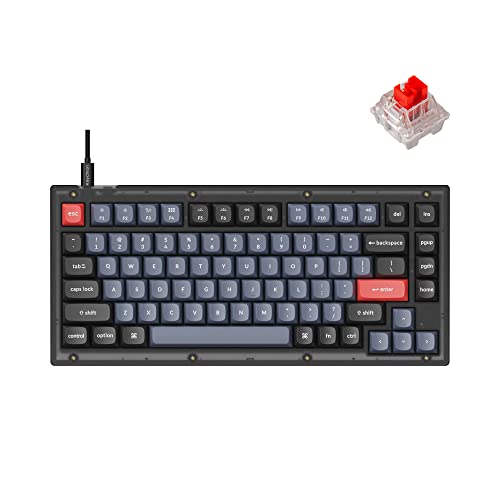
The V1 stands for Keychron in this ring not as its most glamorous board but as its most characteristic: the complete, open-firmware, hot-swap 75 percent at the price that reorganised the market’s expectations, backed by a catalogue that offers the same buyer a wireless sibling, a low-profile cousin, an aluminium flagship and an ISO variant without leaving the brand. Against NuPhy’s studio objects it is deliberately unglamorous — and its argument is that governance, coverage and price are the virtues that compound across ownership, while glamour is spent in the first month. Many buyers, reading both arguments honestly, discover which temperament is theirs by which paragraph annoyed them.
Its debits within this comparison are presence and warmth: the stock sound is unremarkable beside the Halo’s tuning, and the design is competence itself. Its credits are the catalogue’s: whatever the V1 teaches its owner about their preferences, Keychron sells the board that answers the lesson. That is a difficult argument to beat for a first serious purchase, and the comparison records it without embarrassment.
Strengths
- Open firmware and coverage, at entry price
- Every preference’s next board in the same catalogue
- The safest first serious purchase in the ring
Trade-offs
- Unglamorous beside the studio objects
- Stock sound is a starting point
- Wired focus in the base configuration
Best for: First serious buyers and coverage shoppers.
Not suited for: Design-first buyers — NuPhy is waiting.
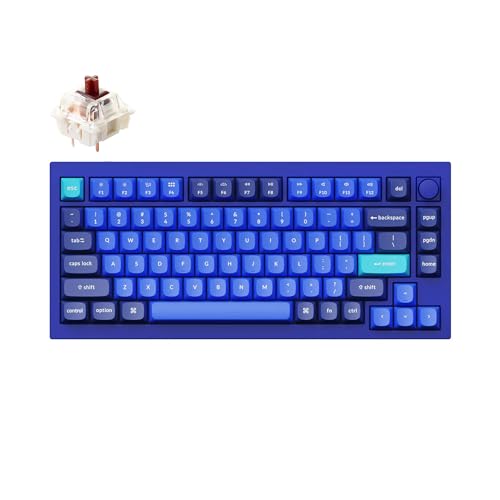
Keychron Q1
Keychron’s flagship ceiling
- 75 percent aluminium, gasket mount
- QMK/VIA + Launcher
- Hot-swap, knob versions
- Wireless generations
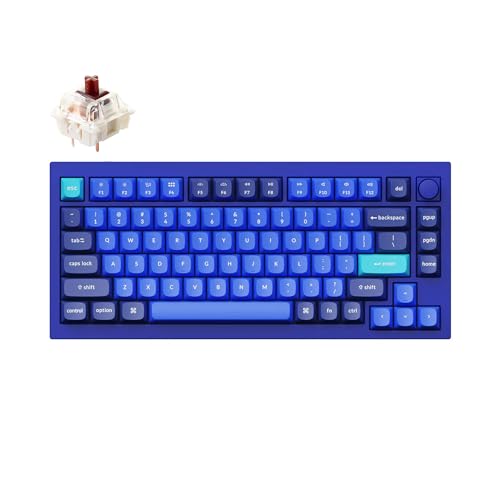
The Q1 is included to mark the catalogue’s ceiling in this rivalry: when the contest moves to flagship full-height boards, Keychron fields a machined, gasket-mounted, open-firmware platform with variant depth (knob, wireless generations, standards) that NuPhy’s narrower range does not attempt to match model-for-model. The Halo75 competes with it on character; on specification breadth and configurator certainty, the Q1 is the comparison’s high-water mark, and buyers whose 75 percent requirement list runs long will find their shortlist ending here by elimination.
Its debits are the flagship’s usual — weight, price, variant maze — and within this rivalry one more: it has no answer to the Air’s slimness, because the catalogue’s low-profile line, not the Q series, holds that province. The comparison’s structure thus resolves into territories, which is its honest conclusion: NuPhy holds the design-led low-profile heartland against all comers, Keychron holds everything else and contests the heartland competently, and the buyer’s temperament and requirement list — not a trophy — decide the purchase.
Strengths
- The specification ceiling of the comparison
- Variant and standard depth
- Open firmware at full maturity
Trade-offs
- Heavy and premium
- Variant maze
- No slim answer in this line
Best for: Long requirement lists at 75 percent.
Not suited for: Slim-board and design-first shoppers.
The Scorecard, Criterion by Criterion
Range: Keychron, by an order of magnitude. Low-profile design: NuPhy — the Air is the class’s object of desire, against Keychron’s competent breadth. Low-profile value: Keychron, whose slim lines descend to prices the studio does not chase. Full-height character: NuPhy, whose Halo sounds and looks like a position taken. Full-height specification ceiling: Keychron’s Q series. Firmware certainty: Keychron, line-wide, with NuPhy model-dependent and improving. Wireless: a genuine tie in current generations, both tri-mode competent. Ecosystem breadth: Keychron; ecosystem coherence: NuPhy. Support scale: Keychron; support personality: NuPhy, on owner reports. Resale and liquidity: Keychron’s volume makes its boards easier to move; NuPhy’s design following makes its best models hold value surprisingly well for their size.
Read as a whole, the scorecard describes two companies optimising different variables with unusual purity — coverage against character — and it predicts the decision guide without remainder: the buyer whose constraints are external (size, standard, budget, firmware) belongs to Keychron’s optimisation; the buyer whose constraints are internal (the object’s feel, look and sound as daily companions) belongs to NuPhy’s, provided the studio stocks their size. The rivalry’s heat comes from the overlap population — design-sensitive buyers with requirement lists — and for them the guide’s method below is the resolution.
The Decision Method for the Overlap Buyer
Start with the hard constraints, because they eliminate without appeal: if your size, standard or firmware requirement is stocked by only one house, the rivalry is over and the survivor’s best model is the purchase — no amount of design longing survives an unstocked ISO variant or an unverifiable configurator. If both houses survive the constraints, the decision moves to the trial: order the leading candidate from a seller with a genuine returns window and give it the fortnight — in this rivalry more than most, because low-profile adaptation and design affection are both fortnight-scale phenomena that no review can pre-feel for you. Judge on the third week’s ordinary Tuesday, not the first evening’s unboxing, and let the board that is still on the desk when the window closes be the verdict.
The overlap buyer’s final discipline is generational: verify the exact model’s year and configurator before paying, especially on the NuPhy side, where the range’s improvement curve makes old reviews unreliable witnesses, and on the Keychron side, where one name spans generations of connectivity. The rivalry rewards the current-model buyer and punishes the archive shopper — a fitting last word for a comparison between the catalogue that contains everything and the studio that means every word of its smaller catalogue.
Low-Profile, Taken Seriously: NuPhy’s Home Ground
NuPhy’s identity rests on low-profile done as a first-class citizen, and the comparison deepens when that phrase is unpacked. Low-profile is not one decision but a stack: shorter switches with their own stem and spring geometries, thinner keycaps whose profiles are a separate family from the standard shelf, a case whose front height drops toward the laptop’s territory, and a typing feel that is its own country — shorter travel, a snappier bottom-out, a sound in a higher, drier register. NuPhy’s contribution is to have engineered the whole stack as a system and then styled it, rather than shrinking a standard board and calling the result low-profile. Keychron’s low-profile lines, arriving from the standard side, are strongest exactly where the system view matters least — ecosystem, variants, price — and the head-to-head at the low-profile tier is therefore a genuine contest between a specialist’s system and a generalist’s scale, which the buyer should grade by how much of the stack they care about: the committed low-profile typist feels every layer of it; the traveller who wants a thinner bag item feels two.
The low-profile feel itself deserves a paragraph of honest description, because it is the comparison’s most subjective term and the one reviews handle worst. The travel is shorter, so the keystroke’s event is compressed in time; the bottom-out arrives sooner and speaks more clearly in the feel; the sound is quicker and drier. Typists formed on standard boards describe it, at first, as abrupt; typists formed on laptops describe it as home, with substance. Neither description is a quality judgement, and the how to choose first mechanical keyboard guide’s audition doctrine applies with doubled force: low-profile is a dialect, and dialects are learned by immersion or not at all. The buyer between the brands should audition the dialect itself before the badge, because the dialect will still be there when the badge’s novelty has become furniture.
And low-profile has a keycap consequence that compounds across ownership: the caps are a separate market — thinner, scarcer, with fewer profiles and legends — so the low-profile board’s owner shops a smaller shelf forever, exactly as the ISO buyer does in their dimension. NuPhy’s own cap ecosystem is the specialist’s answer; the generalist’s shelf is broader in boards and thinner in their caps. Price the shelf, not the board, if customisation is in your future; if the board will wear its factory caps for life, the shelf is a rumour and the specialist’s system can be bought on its feel alone.
Design Languages: Retro-Futurism Versus the Catalogue’s Sobriety
The two brands’ design languages are far enough apart to constitute a genuine choice, and the comparison should treat aesthetics as the durable property it is. NuPhy’s language is retro-futurism with discipline: colour used as structure, rounded forms, a playfulness that stops short of toy — objects designed to be looked at, by a company that understands its buyers photograph their desks. Keychron’s language is the catalogue’s sobriety: aluminium in considered colours, proportions that defer to the desk’s other citizens, a design whose ambition is to be appropriate everywhere. Neither language is a garnish on the other’s product; they are different theories of what a keyboard is for visually — a statement or a citizen — and the desk’s other objects usually reveal which theory the buyer already lives by. The board that matches the room’s theory will look right for a decade; the board that argues with it will look wrong by the second month, at any specification.
Design languages also age differently, and the ageing belongs in a comparison of decade-scale purchases. Playful design dates by fashion’s clock — the colourway that was the season’s signature becomes the season’s timestamp — while sober design dates by the slower clock of proportions, which is why the sober board’s tenth year looks like its first and the playful board’s tenth year looks like a memoir. Memoirs are not failures; owners who rotate boards treat the timestamp as the pleasure, and owners who keep boards treat it as the tax. The rotation-versus-keeping question, which the sound guide asks about registers, is the same question here wearing colours, and it should be answered from the buyer’s own history: look at the objects you have kept longest, and note whether they were the sober ones. They usually were, and the exceptions are instructive too.
And the languages signal their ecosystems: NuPhy’s design confidence extends to its packaging, its accessories, its whole object’s coherence — the specialist’s signature — while Keychron’s breadth dilutes its coherence in proportion to its catalogue, the generalist’s tax. A buyer who values the object’s total design will feel the specialist’s advantage daily and small; a buyer who values the platform will never notice it. Comparisons exist to price such feelings honestly — daily and small, across a decade, is not nothing; it is simply not everything, and it should be bought knowingly rather than discovered.
Wireless Implementations, Compared at the Radio
Both brands sell wireless heavily, and their implementations differ in ways the specification sheet compresses into identical bullet points — so this section expands the bullets. The radio’s quality shows in three places: the connection’s stability at distance and through obstruction (the desk’s real geography, not the laboratory’s), the wake behaviour (the board that reconnects instantly after sleep versus the board whose first keystroke is a sacrifice to the reconnection), and the multi-device manners (how gracefully the board moves among a computer, a tablet and a phone — Keychron’s historical home ground, where its three-device fluency is a mature product, against NuPhy’s improving but younger implementation). The bluetooth vs 2 4ghz keyboards tri mode explained guide’s connection physics grades both; this comparison adds only that the implementations’ maturity gap, where it exists, is felt in the week’s small frictions rather than in any benchmark, and small frictions are the currency of ownership satisfaction.
Battery behaviour is the radio’s second ledger. The low-profile board’s thinner case holds a smaller battery by geometry, and its endurance is therefore a design outcome before it is a specification: NuPhy’s boards live with the constraint their form imposes, and their owners charge on a traveller’s rhythm. Keychron’s standard boards carry larger cells and longer intervals, and its low-profile lines inherit the same geometry tax as NuPhy’s. The buyer comparing endurance across the brands must compare within the form factor, or the comparison grades physics and calls it engineering. And the charging manners — the port’s placement, the board’s usability while charging, the cable’s inclusion — are the ledger’s small print, read best in owner reports rather than in listings.
The wireless verdict, compressed: for the desk-bound multi-device worker, Keychron’s implementation maturity is a real and daily advantage; for the traveller, both brands’ dongle modes perform within the margin where the display and the game dominate, and the choice returns to form and feel. Wireless, in this comparison, is a reason to prefer Keychron at the margin and no reason to avoid NuPhy at all — which is the shape of most mature comparisons, and the buyer’s cue to let the other sections’ larger differences decide.
The Typing Feel, Brand by Brand
Comparisons of feel are usually horoscopes; this one confines itself to what the two brands’ engineering choices predict, and states its confidence accordingly. NuPhy’s low-profile switches — its own collaborations and the Gateron low-profile family’s better members — type with the dialect described above: quick, dry, decisive, with a bottom-out that speaks. Its standard-profile boards, the Halo line above all, pursue a cushioned, deep-leaning feel with heavy factory tuning — the specialist applying its system view to the standard stack, with results that reviewers consistently grade as among the most finished at their price. Keychron’s feel splits by line, as its catalogue does: the V line’s honest mid-tuning, the Q line’s governed gasket character, the K line’s lighter touch — a range whose breadth means ‘Keychron feel’ is a less coherent phrase than ‘NuPhy feel’, which is the specialist’s advantage stated in feel’s terms.
The keycaps contribute their share, and here the brands’ philosophies show again: NuPhy ships caps designed as part of the object’s system — its own profiles and legends, matched to its cases’ design language — while Keychron ships competent caps from the standard shelf, adequate everywhere and distinctive nowhere, expecting (correctly, for its ecosystem’s citizens) that the owner’s own set may replace them. The buyer who types on factory caps for life should weight NuPhy’s completeness; the buyer with a keycap collection should weight Keychron’s indifference as the neutrality it is. Feel, in the end, is a system’s output, and the brands differ less in any component than in how completely they have composed the system before selling it — the specialist’s whole thesis, which the typing largely confirms.
And the feel comparison’s honest limit should be stated, as this cluster states every instrument’s limit: hands differ more than brands do. The same Halo that one typist calls cushioned, another calls muted; the same Q that one calls governed, another calls firm. The audition — the borrowed board, the returns window’s honest month — outranks this section, the main guide and every review ever written, on the question of feel. Use the comparison to shortlist the two boards your hands will audition. That is the comparison’s job, and on feel it is the only job any comparison can do.
Ecosystems and Futures: The Bet Inside the Purchase
Every brand purchase is partly a bet on the brand’s future — its firmware’s maintenance, its parts shelf, its survival — and the two brands present different bet profiles that a comparison should price. Keychron is the scale bet: a large catalogue, a broad installed base, an ecosystem whose community documentation alone would keep its boards configurable for years even in the company’s absence, because the intelligence lives in open formats. NuPhy is the momentum bet: a younger, smaller company whose trajectory — from low-profile specialist to a fuller line — has been consistently upward, whose community is devoted out of proportion to its size, and whose boards also speak the open firmware languages, which caps the bet’s downside in the same way. The open-format point deserves emphasis because it equalises the futures more than brand partisans admit: a QMK/VIA board from a vanished maker is an orphan with its papers in order, and both brands sell such boards at their enthusiast tiers.
The parts and accessories shelves express the same profiles in miniature. Keychron’s shelf is a warehouse: cases, caps, cables, switches, boards’ spares across a decade of models — unevenly stocked, as warehouses are. NuPhy’s shelf is a boutique: fewer items, designed as its objects’ companions, stocked with a specialist’s coherence. The decade’s maintenance will shop one of these shelves; the buyer’s temperament — warehouse or boutique — is again a legitimate input, because the shelf’s experience is part of ownership’s texture. And the second-hand markets price the futures continuously: both brands’ boards hold value respectably, Keychron’s on liquidity, NuPhy’s on devotion, and either is a safer store of value than the category’s average — a fact worth the comparison’s notice, since resale is the purchase’s hedge.
The futures section’s verdict is therefore restrained by design: neither bet is reckless, and the difference between them is smaller than the difference either makes against the market’s true risks — the proprietary ecosystems, the vanished configurators, the boards whose intelligence dies with a company’s server. Both brands stand on the right side of that line. Choose between them on the present — form, feel, design, the desk’s census — and let the future, unusually in this industry, take care of itself.
The Decision, Run Once Cleanly
This comparison closes by running its own decision once, cleanly, as a model — for the reader whose desk resembles the common case: a worker who types all day, travels monthly, keeps boards for years, and is choosing a primary board between the brands’ best. The census first: typing dominates, so feel and the decade rule; travel is monthly, so a second, dedicated travel board is a legitimate line in the budget rather than a compromise demanded of the primary. Run that census and the comparison resolves itself by division of labour: the primary board is chosen on feel and ecosystem at the standard profile — where Keychron’s breadth and NuPhy’s Halo are the finalists, and the audition decides — while the travel board is chosen on the specialist’s ground, where NuPhy’s low-profile system is the market’s answer and Keychron’s K line is its value alternative. Most real decisions between these brands are not either-or; they are assignments, and the brands’ different geniuses make the assignments easy once the census has separated the jobs.
The model decision’s second lesson is what it did not consult: the brands’ marketing, their newest releases, their communities’ loudest arguments. It consulted a census, two auditions and a budget — the same instruments every guide in this cluster hands its readers — and it produced a decision that will survive the next product cycle because it was never based on the products’ novelty. The reader whose desk differs should run the same instruments on their own census and expect a different assignment, reached with the same confidence. That is the comparison’s final service: not its verdict, but the demonstration that a verdict can be reached cleanly, from evidence, in an afternoon — and then lived with, without revision, for the decade the boards will serve.
And if the audition crowns the other brand from the one this model chose — if your hands file for NuPhy’s system or Keychron’s catalogue against the model’s expectation — the model has still done its work, because the hands’ evidence outranks every model, including this one. That ranking is the cluster’s first and last principle, stated at the end of this comparison as at the end of so many of its guides: the instruments narrow, the evidence decides, and the hands — tenured, daily, incorruptible — have the final vote. Give it to them, and either of these brands will reward the trust.
The Travel Desk and the Home Desk Are Different Purchases
This comparison has treated the two brands as rivals for one board, and its final expansion corrects the frame: for a large class of buyers they are successive purchases for two desks, and the order of purchase matters. The home desk’s board is bought on the decade’s criteria — feel, ecosystem, the finish that survives ten thousand mornings. The travel board is bought on the journey’s criteria — the bag’s geometry, the café table’s shallowness, the battery’s forgiveness, the price at which a loss is an annoyance rather than a bereavement. NuPhy’s low-profile system was designed in the journey’s country and Keychron’s breadth covers both, which is why the two-brand household so often assembles itself without any brand disloyalty: the Q or the Halo at home, the Air in the bag, each the correct answer to a different census. The keyboard size guide‘s specialisation pattern is the doctrine; this comparison’s brands are simply its most available instruments.
The order matters because the home board teaches the hands what they own, and the travel board should be bought after that education, not before: the traveller who knows their switch weight, their size census and their layer habits can choose a travel board as a translation of a known instrument into a thinner dialect, while the traveller who buys both at once is guessing in stereo. Buy the home board, live the season, then translate. The translation will lose something — travel boards always do — but it will lose the things its owner has learned they can spare, which is the difference between a compromise and a decision.
And the two-desk frame dissolves the comparison’s last artificial tension: the question was never which brand deserves the desk, but which board deserves which desk, and brands are merely the shelves the boards sit on. The reader who leaves this article with two assignments and a sequence has been better served than the reader who leaves with a winner — because desks, unlike comparisons, are lived in one at a time, and each deserves its own right answer.
Cross-Shopping the Rivalry in Five Steps
For buyers whose shortlist holds one board from each house.
- Write the hard constraints — size, standard, connection, firmware depth, budget ceiling — and confirm each house’s candidate against the maker’s own specification page, not the retailer’s summary.
- Price the complete first year for each: board, the case or accessories you will actually buy, and (for low-profile) any switch or cap set the ecosystem will ask of you, at each house’s own shelf.
- Read long-term owner reports for the exact models and generations, weighting software and battery passages heavily — this rivalry’s differences compound there, not in the unboxings.
- Trial the leading candidate through a returns window for a full fortnight of real work. If trialling both is possible without abusing the policy, the desk-to-desk comparison in your own room outranks every paragraph in this guide, including this one.
- Decide by temperament ratified by evidence: the catalogue’s certainty or the studio’s character, as your fortnight actually felt — and record the verdict’s reasons, because this rivalry will be re-fought at your next board and the notes are the rematch’s head start.
Rivalry-Specific Shopping Mistakes
Judging NuPhy by its first generations.
The studio’s early software and polish compromises are documented history and current marketing ammunition — for a company whose recent models closed much of the gap. Archive reviews of this brand decay faster than almost any in the market. Verify the generation in front of you, and let 2022’s verdicts testify about 2022’s boards only.
Assuming Keychron’s breadth means its every model is safe.
A catalogue of forty boards contains its own weakest entries, and the badge does not distribute the flagships’ virtues downward automatically. The rivalry tempts buyers to shortlist ‘Keychron’ as if it were a model; it is a shelf. Research the specific board with the same rigour the studio’s single candidate receives.
Comparing a low-profile board against a full-height one on travel alone.
The Air and the Q1 are both ’75 percent wireless boards’ in a retailer’s filter and entirely different instruments in the hand — travel depth, ecosystem, sound and posture all differ. Cross-profile comparisons must be made consciously, as a category decision first and a brand decision second, or the buyer wins the rivalry and loses the category.
Ignoring the low-profile ecosystem’s switching costs.
Low-profile switches and caps are not the MX world’s commons: stems vary, sets are fewer, and a collector’s existing drawer may fit neither finalist. Price the ecosystem you are entering, not just the board — the rivalry’s hidden column — especially if switch experimentation is part of your pleasure.
Letting the design do the firmware’s job.
A beautiful board whose configurator cannot move the keys your software needs will be re-sold beautifully. In this rivalry the temptation has a specific address — the studio’s objects are genuinely lovely — and the defence is the constraint list: firmware depth verified, in writing, before the heart is consulted. The heart gets the final vote only among boards that pass.
Choosing the brand before the form factor.
Keychron and NuPhy overlap most where their catalogues are least distinctive and differ most where their identities live — low-profile, design, breadth. Buyers who pick a badge first and a form second routinely buy a brand’s weakest board for their brief instead of its rival’s strongest. Decide the form (low-profile or standard, size, wireless), then let the brands compete on that ground, where the comparison’s real differences are waiting.
Frequently asked questions
Is NuPhy better than Keychron?
At the things NuPhy optimises — low-profile design, stock warmth, object character — yes, measurably, model for model in its chosen territories. At coverage, firmware certainty and value breadth, Keychron is better by larger margins. The brands are not two attempts at the same product; they are two products sharing a category, and ‘better’ resolves the moment a buyer’s constraints and temperament are stated. This guide’s scorecard is the honest form of the answer.
Why are NuPhy keyboards so popular despite the smaller range?
Because the studio model concentrates force: a few models, each designed with visible intent, in the category (slim wireless boards) whose buyers care most about design. Popularity followed the Air’s demonstration that a travel keyboard could be an object of desire rather than a compromise — a lesson the whole market, Keychron included, has since absorbed. A narrow range with a hit in it outweighs a broad range without one, in attention if not in coverage.
Which brand is better for Mac users?
Both court Mac explicitly — Mac-first keycap sets and mode switches are table stakes in this rivalry — and the practical differences are at the edges: Keychron’s breadth gives Mac users more sizes and low-profile options at more prices; NuPhy’s design language sits comfortably in the Apple-adjacent aesthetic its buyers often already inhabit. Judge by model and size, as ever; the operating system will not decide this one.
Do NuPhy boards work with VIA?
It depends on the model and generation — which is precisely the diligence this comparison prescribes. Recent flagship NuPhy models have moved toward the open configurator ecosystem or deepened their own console substantially, while older models were shallower. Keychron’s VIA support is the line-wide constant against which NuPhy’s variance must be checked, model by model, on the maker’s current specification page.
Which brand’s keyboards sound better stock?
NuPhy’s, at comparable tiers, on the weight of owner consensus — the studio tunes its boards as finished objects, foam and voicing included. Keychron’s flagships close the gap and its value lines concede it. Sound is a model-level property wearing a brand tendency, so the verdict is a prior rather than a promise: audition the exact models, per the sound test guide’s protocol, before letting this criterion spend your money.
I’m torn between the Air75 and a Keychron. What breaks the tie?
The fortnight trial, honestly run — but if a prior is needed: choose the Air if the board travels, the desk is small, and the object’s design will be a daily pleasure you can already feel in the photographs; choose the Keychron if the requirement list is longer than the Air’s stock answers, if configurator depth is a working need, or if the budget must also cover the ecosystem around the board. The tie is real, which is why the rivalry is famous; it breaks on temperament ratified by trial, and both outcomes have satisfied owners by the thousand.
Is NuPhy better than Keychron for Mac users?
Both brands treat Mac as a first-class citizen — Mac legends, mode switches and function rows are standard on both — and the difference is one of depth: Keychron’s Mac support spans its whole catalogue and its multi-device wireless is the more mature implementation for a desk that moves among a Mac, an iPad and a phone all day. NuPhy’s Mac experience on its own boards is complete and well-designed. A Mac-only desk will be served fully by either; a multi-device Apple desk feels Keychron’s maturity in the small frictions, which is where such desks live.
Are NuPhy keyboards good for gaming?
The standard-profile line, with high polling on its gaming-specified models and competent switches, games perfectly well for the overwhelming majority of players; the low-profile line’s shorter travel suits some players’ taste and its wireless implementations are sound. The competitive margin — rapid trigger, the analog frontier — is territory neither brand’s heartland covers as fully as the gaming specialists, a point this cluster’s gaming guides make about both. For the player whose gaming is serious but not professional, either brand’s gaming-specified models are honest equipment; for the margin, shop the specialists.
Should I match my travel keyboard’s switches to my home board’s?
Where the market allows, yes — the hands’ education is the asset, and a travel board that speaks the same switch dialect lets the education travel with you. Exact matches are not always available across form factors (low-profile switches are their own family), so match the character — weight, tactility, sound register — as closely as the shelf permits, and accept the translation’s remainder as the journey’s tax. The how to choose a mechanical keyboard the buyers guide calls this the household standard, and households that keep it adapt between desks in minutes rather than days.
Keychron and NuPhy are the market’s breadth and its depth, wearing keyboard shapes: one house that answers every question with a catalogue, one that answers a few questions with objects worth framing. The comparison’s refusal to crown either is not diplomacy but accuracy — their optimisations genuinely differ, their territories genuinely overlap only in part, and the buyer’s constraints and temperament are the missing variables in every argument that treats the rivalry as a sport. State the variables, verify the generations, trial the finalist, and the rivalry resolves into what it always was underneath the threads: two good companies, one right answer per buyer.
Whichever house you choose, choose its current best work, in the exact variant your constraints name, through a seller whose window respects the fortnight your hands need. The board that survives that process — catalogue’s certainty or studio’s character — will not feel like a compromise won or lost. It will feel like the desk’s natural citizen, which is the only verdict either brand, at its best, has ever wanted from you.