Asking what size laptop backpack do you need sounds like one question and is actually two, tangled together in every product listing on the internet. Size one is the laptop compartment: does it fit your machine, in measured inches? Size two is the bag capacity in liters: does it fit your life — the charger, lunch, layer, and bottle that travel with the machine? A bag can pass one test and fail the other completely, which is why so many people own a backpack that fits their laptop beautifully and their day not at all.
This explainer untangles the two sizes, translates liters into real loads you can picture, explains why manufacturer numbers wobble, and gives you a sizing method based on your actual pile. By the end, you will shop with two numbers in hand and the confidence to ignore everything else on the tag.
Disclosure: As an Amazon Associate, kajuandouglas.com earns from qualifying purchases. Links to Amazon on this page are affiliate links; they cost you nothing extra. Listing details such as price and availability change often, so check the current Amazon listing before you buy.
Gear for This Guide
Reference points across the capacity bands — note how the sleeve class stays similar while the day-size changes.

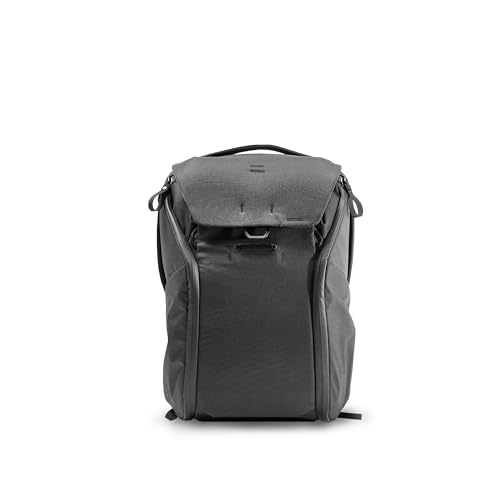
Peak Design Everyday Backpack 20L, Black, Fits 15″ Laptop — A 20-liter full-commuter example: laptop-plus-lunch-plus-layer territory, in a design that also offers a larger sibling for heavier patterns. Check price on Amazon.

Thule Paramount Backpack 24L, Black — A mid-20-liter do-everything profile — the gym-and-work, short-trip band where most one-bag lives are lived. Check price on Amazon.

Samsonite Xenon 3.0 Laptop Backpack, 1680D Ballistic Poly, Fits 15.6” Laptop, TSA Compatible, Air Mesh Back Padding, Tablet Pocket, Smart Sleeve, Quick Stash Pocket, Durable & Lightweight – Large — A business commuter in the organized mid-size class — proof that capacity and boardroom manners coexist when the sizing is deliberate. Check price on Amazon.
In this guide
What Size Laptop Backpack Do You Need?
The Two Sizes, Separated at Last. Compartment size is a fit question with a tape-measure answer. Your laptop has a width, depth, and thickness; the sleeve has internal dimensions; the first must be slightly smaller than the second in all three. Screen-size labels — fits 15-inch laptops — are approximations that fail at the edges of every generation, as our measuring guide details. Nothing about capacity in liters tells you anything about this fit. A cavernous bag can have a small sleeve; a slim bag can swallow a big machine and nothing else.
Capacity is a volume question answered in liters, and it describes the main carrying space — how much day the bag holds. This is the size that decides whether lunch fits, whether the gym kit comes along, whether the bag works as your airline personal item. The two sizes trade against each other inside a fixed outer silhouette, which is why the slim executive bag and the student hauler can share a sleeve size and nothing else. Every sound purchase checks both numbers independently, against two different references: your machine, and your pile.
Liters, Translated Into Actual Days
Because a liter is unhelpfully abstract, anchor it to loads. Around 12 to 16 liters is the slim commuter: laptop, charger, notebook, bottle, small items — the laptop-plus-essentials day, and nothing beyond it. Roughly 18 to 22 liters is the full commuter: add lunch, a layer, a book, and breathing room. The 24 to 30 liter band is the do-everything zone: work plus gym, work plus groceries, or two-to-three-day travel in one bag. Beyond 30 liters you are shopping travel and outdoor packs wearing commuter clothes, with laptop sleeves as a feature rather than the purpose.
Now the honest caveat: liters are not standardized. Makers measure volume by different methods — some fill the bag with pellets and measure honestly, others compute from optimistic dimensions — so a 22 from one brand can swallow what a 25 from another cannot. Treat liters as a neighborhood, not an address: shop within the band your load suggests, then verify with your pile during the return window. The bag that fits your Tuesday is the right size, whatever its tag claims in either direction.
Sizing by Person and Pattern
Your frame matters as much as your load. A tall carrier wears 28 liters invisibly; the same bag on a petite frame overwhelms, catches on turnstiles, and strains a shorter back. Bag height should roughly match torso length — the base near the waist, the top below the neck — and trying a loaded bag, or at minimum checking its height against your back, prevents the turtle-shell look and feel. There is no dignity requirement to suffer for capacity you use twice a year.
Pattern matters equally. The minimalist whose kit never changes should size close to the load — a fitted bag carries best and ages slowest. The variable carrier — gym days, market days, kid days — should size for the common heavy day, not the average one, because an under-sized bag fails completely on the days it fails, while an over-sized one merely flops a little on light days. And the traveler should size to the airline personal-item box first and the load second, because that metal sizer at the gate is the least forgiving measuring instrument in this entire article.
Common Misconceptions About Backpack Size
Misconception one: bigger is safer — buy the largest and never lack room. Oversized bags carry badly half-empty, invite load creep that punishes your shoulders, and fail personal-item sizers. Misconception two: the laptop class decides the bag size. As established, sleeve fit and capacity are separate axes; a 17-inch laptop in a slim bag is a valid product and a 13-inch laptop in a 30-liter hauler is too. Misconception three: liters are comparable across brands like-for-like — they are a guide band, not a standard, as the pellet problem shows.
Misconception four: one bag must serve every purpose. The two-bag answer — a slim daily carrier and a larger travel or heavy-day bag — beats the one compromise for many people, at a total cost often similar to one premium do-everything pack. Size, in other words, is partly a wardrobe question. Buy for your dominant pattern without guilt, and let the exceptional days borrow a second bag rather than taxing all the ordinary ones.
Sizing by Load Type: What You Carry Decides the Litres
The litre guidance in the main guide becomes much more useful when it is tied to named loads rather than abstract days. Work through the loads below, find the one closest to yours, and notice how quickly the required size separates itself from the size you might have guessed.
The minimalist professional load
Laptop, slim charger, phone cable, notebook, pen, wallet, keys, and perhaps a paperback: this load lives happily in a compact bag and, importantly, carries best there, because a small bag keeps slim contents settled rather than sliding. Owners with this load who buy large bags for reassurance usually regret the bulk within a month — the extra litres are not neutral, they are carried, swung, and stored every day. If this is your load, let it be small, and spend the money saved on better straps and a better laptop compartment instead of volume.
The full office day load
Add a lunch container, a water bottle, a jumper, and a book or tablet, and you have the classic commuter load that mid-size bags exist for. The lunch container is the item to plan around, because its rigid shape refuses to compress and it demands a stable, upright position away from the laptop. This is also the load where internal organisation starts paying rent: without pockets and a tech pouch, the mid-size bag becomes a deep well in which small items sink below the jumper and are excavated daily.
The gym-and-work load
Training kit changes the arithmetic completely. Shoes alone consume the volume of a small bag, and they need separation from everything clean. Work-and-gym carriers should size for the combined day, not the average day, because the combined day is the one that actually happens several times a week — but they should also consider the two-bag answer honestly: a mid-size backpack for work and a separate gym bag left at the office or gym can beat one enormous bag that is wrong for both jobs on the days they separate.
The student and the creator loads
Students carry dense, changing loads — textbooks one day, lab or art materials the next — and benefit from capacity headroom plus a structure that keeps heavy books against the back. Creators carry fragile, oddly shaped loads where raw litres matter less than padded, divisible space; a smaller bag with excellent internal padding and organisation can outperform a cavernous bag in which a lens and a charger are free to collide. In both cases, list the actual items and measure the bulkiest few before trusting any litre figure, because these loads defeat averages.
Body Size, Fit, and the Ergonomics of Bigger Bags
Capacity is only half of sizing. The other half is whether the bag’s dimensions suit your frame, because a large bag on a small torso is not merely inelegant — it changes how the weight is carried and how the day feels.
Torso length and where the bag sits
A backpack should sit with its base near the top of your hips and its top below the base of your neck, carried on straps adjusted so the load hugs your back. Very tall bags on shorter torsos hang low, pull backwards, and bounce; very small bags on tall frames perch and concentrate pressure on the shoulders. When trying sizes, judge the loaded bag in a mirror from the side: the profile should look like a natural extension of your back, not a shelf bolted to it. Hip belts on larger bags only help if they actually land on your hips, which is another torso-length question.
Width, crowds, and doorways
Wide bags catch on turnstiles, bus seats, and other passengers, and the wider the bag, the more its owner unconsciously twists and apologises through the day. If your commute is crowded, a taller, narrower profile of the same capacity is usually the kinder geometry. Depth matters too: a deep bag moves its load’s centre of gravity backwards, which your lower back pays for on longer walks. Two bags of identical litres with different shapes are different products, and the tape measure, used on the bag as well as the laptop, reveals which one your life actually wants.
When to size down deliberately
There is a respectable strategy in choosing slightly less capacity than your worst day needs: a constraining bag enforces carrying discipline, keeps weight honest, and handles beautifully on the ninety percent of days that are normal. The exceptional day is solved with a tote or a second carry. Owners prone to load creep — and most of us are — often find the smaller bag improves their back, their organisation, and their mornings simultaneously. The strategy fails only when the exceptional day is actually every day, which is a fact about your load list, not about your willpower.
Special Situations: Travel, Growth, and Changing Lives
Size decisions made for today’s life get tested by tomorrow’s. A few predictable changes are worth thinking through before you commit, because a bag bought with them in mind survives them gracefully.
Travel and the personal-item ceiling
If the bag will fly as a personal item, airline size limits become a hard ceiling that overrides your capacity wishes, and the right move is to size to the strictest airline you regularly use and then organise within it. Travel also adds temporary bulk — a change of clothes, a wash bag, headphones — that argues for a bag at the generous end of your commuter range, or for packing cubes that let a mid-size bag behave like a larger one for a weekend. Frequent travellers often end up owning the honest answer: a travel-sized bag and a smaller daily bag, each right for its job.
Students who become professionals, and other transitions
A bag bought for a heavy final school year faces a lighter professional life within months, and the reverse journey — a slim professional bag meeting a new course, a new hobby, or a new baby — is just as common. If a transition is visibly coming, either buy for the life after it and tolerate a season of excess or constraint, or buy an inexpensive bag for the current season and choose properly afterwards. What rarely works is pretending the transition is not happening and being surprised by it in bag form.
Sharing, lending, and household bags
A household spare bag, a bag a teenager borrows, or a bag shared between partners needs to fit the largest laptop and the largest load among its users, which usually means sizing up and accepting that smaller users carry some spare air. Adjustable straps and a structured shape help a shared bag serve different torsos acceptably. It will be nobody’s perfect bag, and that is fine — its job is to be everybody’s adequate bag, ready on the day someone’s main bag fails, gets soaked, or is simply in the wrong house.
The Cost of the Wrong Size, Counted Properly
Owners tend to think of the wrong size as a mild inconvenience. In practice it charges rent in several currencies at once, and adding them up explains why getting this decision right matters more than getting most bag features right.
Too big: the daily tax
An oversized bag weighs more empty, swings more when walking, invites load creep because the space is there, and stores worse at home and under desks. Its contents shift and arrive disorganised, its laptop compartment may let the machine slide if the bag is underfilled, and its owner develops the hunched, apologetic crowd manoeuvres of someone carrying furniture. None of these costs is dramatic; all of them are daily, which is worse. A bag that is too big is rarely returned, because each individual day is tolerable — the cost is paid in aggregate, invisibly, over years.
Too small: the acute tax
An undersized bag fails loudly instead: zips strained and eventually broken, items left behind on the days they mattered, a second bag carried awkwardly, and a laptop compartment distorted by pressure from an overfilled main section. The small bag’s costs are acute and visible, which paradoxically makes them easier to fix — owners replace too-small bags, while owners endure too-big ones. If you are between sizes and your load is stable, the smaller bag with a tote for exceptional days is usually the happier long-term answer; if your load is growing, be honest about it now.
The replacement-cycle tax
Every wrong-size purchase tends to be followed by a right-size purchase, making the wrong bag the most expensive kind: the kind bought twice. This is the financial argument for the measuring, listing, and loaded try-on discipline elsewhere in this guide. An hour of sizing work before purchase is cheaper than a second bag in every scenario, including the scenario where the first bag was bought on sale.
Capacity Myths That Distort Sizing Decisions
A few persistent claims send buyers toward the wrong size with great confidence. Each contains a grain of history and a bushel of error.
Myth: more litres always means more useful space
Volume locked in a tall, narrow top section or in a dozen tiny organiser pockets is not usable volume for real objects. A well-shaped smaller bag routinely swallows a lunch box, a jumper, and a book that a badly shaped larger bag rejects or buries. Judge by loading, not litres, whenever you can — and when you cannot, prefer the bag whose main compartment is one honest, accessible space over the bag whose litres are scattered across features.
Myth: you should size for your biggest imaginable day
Sizing for the extreme day means carrying the extreme bag through every ordinary day, and ordinary days outnumber extreme ones fifty to one. Size for your heavy normal day — the fullest day that happens weekly — and solve the genuinely exceptional days with a supplement. The exception is when the extreme day is also the important day: the photographer’s wedding, the student’s exam week, the traveller’s one-bag trip. Then size for it unapologetically, and accept the ordinary-day bulk as the price of the day that matters.
Myth: a growing teenager or student needs room to grow into
Bags do not work like shoes, and loads do not grow smoothly — they jump at transitions. An oversized bag carried for years in anticipation of a load that arrives, if ever, in the final term is years of bad carrying for a term of convenience. Buy for the load that exists, replace at the transition, and let the old bag become the household spare it was always destined to be.
Reading Your Own Week: A Practical Sizing Exercise
The most reliable sizing tool is not a chart but your own last seven days. This short exercise converts your actual life into a capacity decision, and it takes less time than returning a bag.
The seven-day load audit
For one ordinary week, note each evening what you carried, what you carried but never used, and what you wished you had with you. Most people discover the same three facts: their true daily load is smaller than their imagined load, one or two items account for most of the bulk, and the item they missed was small and specific. Size the bag for the load that the audit actually records — including its heaviest recurring day — and let the audit, not anxiety, choose the litres. If a bulky item appears daily but is used weekly, question the item before enlarging the bag around it.
Measuring your bulkiest items
Litres describe volume in the abstract; your lunch container, shoes, and books have actual dimensions. Measure the three bulkiest things you carry regularly and check candidate bags against those shapes as you did for the laptop. A bag whose main compartment cannot accept your lunch container upright is the wrong bag at any litre count, and a bag that swallows your shoes only by distorting its laptop compartment is equally wrong. Shape compatibility is the silent half of capacity, and it is entirely checkable in advance.
Planning for the item you are about to add
If a change is already scheduled — a bigger laptop, a gym habit starting next month, a course beginning next term — size for the announced future rather than the present, because the bag will meet that future within its first season. If the change is merely possible, ignore it. The distinction between scheduled and possible is the difference between foresight and the just-in-case thinking that fills cupboards with oversized bags bought for lives that never arrived.
Sizing for Two: Shared Bags, Family Life, and the School Run
Many bags serve more than one person or more than one role, and shared use changes the sizing logic in predictable ways worth stating plainly.
The family and household dimension
A bag that does school runs, weekend trips, and a parent’s workdays must fit the largest load among those roles, which usually means sizing up one step from any single role’s ideal. Choose structure and organisation that help different users keep order — a shared bag without fixed homes for things becomes a shared mess within a week. Accept that it will be nobody’s perfect fit, optimise for the role it serves most often, and make sure its straps adjust across the range of its users without tools or fuss.
Bags for younger carriers
Children and smaller teenagers are routinely given bags far too large for their frames, on the theory that they will grow into them while carrying loads that are already heavy relative to their body weight. The kinder and safer logic runs the other way: the bag should fit the child’s back now, sit high and close, and hold the actual school load without room for the extra weight that spare capacity invites. A correctly sized bag replaced at a growth spurt costs less than the posture complaints of the alternative, and the outgrown bag joins the household spares.
When the Answer Is Not a Bigger Backpack
Sometimes the sizing question dissolves once it is asked properly, because the real problem is not the bag’s volume but what the day is asking one bag to do.
Splitting the load intelligently
A laptop backpack plus a small separate carrier for gym kit, shopping, or instruments often beats any single bag, because each container is then right-shaped for its contents and the heavy, dense items stay in the bag designed around your back. Splitting also isolates wet, dirty, and smelly loads completely, which no internal divider fully achieves. The costs are a second thing to carry and a second thing to forget, and both are managed by routine: the second bag lives in one place and travels on predictable days.
Wheeled and hybrid alternatives
For genuinely heavy daily loads over smooth routes — the representative with samples, the student crossing a flat campus with a day of books — a wheeled bag removes the carrying question altogether, at the price of stairs, crowds, and rough ground. It is not a failure of backpack sizing to conclude that your load should roll; it is the sizing process working honestly. Judge your route’s surfaces as carefully as your load’s volume, and let the two answers together choose the tool.
The discipline of the right answer
Whatever the exercise concludes — a compact bag, a large one, two bags, or wheels — commit to it fully for a season. Size dissatisfaction is often just the friction of a new system, and owners who re-decide monthly never reach the state where the bag disappears from their attention, which is the true destination. The right size is the one you stop thinking about, and you can only discover whether you have found it by living with your decision long enough for it to become invisible.
Size and Appearance: Looking Right at the Size You Need
Owners sometimes choose against their measured size because they fear a correctly sized bag will look wrong — too big for the office, too small to seem serious. Appearance is a legitimate factor, but it should be handled by proportion and design rather than by carrying the wrong volume.
Proportion beats size
A bag looks right when its proportions suit its carrier and its setting, and a well-proportioned larger bag on a larger person reads as neat while a small bag overstuffed reads as chaotic at any size. What actually looks unprofessional is distortion: bulging pockets, strained zips, and a silhouette fighting its contents. A bag at its correct fill level, in a restrained colour, looks composed in either size. Choose the volume your load requires, then achieve the look you want through colour, structure, and keeping the fill honest.
Structured versus relaxed silhouettes
Structure holds a bag’s shape empty or full, which flatters larger sizes in formal settings and helps any bag stand upright and accessible. Relaxed designs carry more casually and compress when lightly loaded, which flatters smaller sizes in informal settings. If your correct size feels visually wrong, changing the silhouette usually fixes the impression without changing the litres — a far better solution than downsizing into strained zips or upsizing into a sail.
Putting a Number on It: A Worked Sizing Example From Start to Finish
Consider a representative carrier: a professional with a mid-size laptop, a charger, a lunch container, a water bottle, a paperback notebook, a light jumper, and gym kit on two evenings a week. Measured honestly, the laptop needs a standard compartment, the daily items form a moderate load, and the gym kit — shoes above all — is the volume event of the week.
The wrong way to size this life is to average it: the average day has half a gym kit, which exists on no actual day. The right way is to recognise two distinct days. If the gym kit travels in the same bag, the bag must be sized for the gym day, structured enough to keep shoes separate, and accepted as generous on ordinary days. If a locker or a second bag can hold the gym kit, the backpack sizes down to the elegant daily load and carries beautifully all week. Neither answer is wrong; what is wrong is refusing to see that the decision is about the gym kit, not about the laptop at all. Most sizing dilemmas, examined closely, contain one such item — find yours, decide its fate, and the bag’s size decides itself.
The same method for a student
A student with a laptop, two rotating textbooks, a lab coat or art materials on certain days, and a part-time job’s uniform faces the identical structure: one or two exceptional items drive the size. Timetables make the pattern predictable, so the student can size for the heavy recurring day — not the single heaviest day of term — and plan the exceptional days around a tote or a locker. The method transfers because it was never about the items; it is about refusing to let averages describe a life that is actually lived in distinct, nameable days.
After You Buy: Living With the Size and Adjusting the Load
The first fortnight with a new bag is a calibration period, and treating it as one prevents both premature returns and permanent dissatisfaction.
What to watch in the first two weeks
Notice whether the zips close without force on your heaviest regular day, whether the laptop sits still rather than sliding, and whether you have started leaving the bag’s top section empty while its base is a compressed archaeology of your week. The first two observations judge the size; the third judges your packing, and it is fixed by the reset habit rather than by a different bag. Also notice your shoulders at the end of the longest carrying day: they are reviewing the purchase more honestly than your eyes did in the shop.
Adjusting the load before replacing the bag
If the size feels wrong, audit the load before blaming the bag — in a surprising share of cases the bag is right and the carry has crept. Remove everything, rebuild from the audit list, and live a week with the disciplined version. If the bag still strains or still swims, you have clean evidence rather than a suspicion, and exchanging it is a decision rather than a guess. Retailers’ return windows reward exactly this prompt, honest testing, which is one more reason the first fortnight matters.
Quick Reference: Matching Common Lives to Sensible Sizes
Pulling the whole guide into a short reference: the slim professional with a laptop and little else belongs in a compact bag and should resist upselling with confidence. The standard commuter with lunch, bottle, and a layer belongs in the middle of the range, where organisation matters as much as volume. The combined work-and-gym carrier, the student with rotating heavy materials, and the one-bag weekend traveller belong at the generous end, sized by their fullest recurring day. The parent, the field worker, and the creator with fragile kit should size by shape and separation as much as by litres, because their loads punish a single undifferentiated space at any volume.
Notice what this reference does not do: it does not name a litre figure as an answer by itself, because the same life fits different numbers in different brands’ ranges. Use it to place yourself in a band, then use your laptop measurements, your bulkiest items, and a loaded try-on to land on the specific bag. Size is a conclusion, not a starting point — reached by that route, it tends to stay right for years, through load changes that would have defeated a guess.
The answer, in one sentence
You need the smallest backpack that comfortably holds your laptop, your honest heaviest recurring day, and nothing you carry only in your imagination — carried on a frame it fits, with its zips closing like a courtesy rather than a contest.
Sizing Mistakes Made by Confident Buyers
Experience does not immunise against sizing errors; it merely changes their flavour. The veteran traveller buys for the expedition they take yearly and suffers the bulk on the daily commute. The minimalist, proud of a tiny carry, buys so small that the weekly heavy day becomes a wrestling match they dread. The parent sizes the family bag for the eldest child’s load and wonders why the youngest is swallowed by it. The pattern beneath all three is identical: a vivid, memorable day outvoted the ordinary, recurring one. The defence is the same at every level of experience — write the loads down, count the days each load actually occurs, and let arithmetic overrule anecdote, including your own.
There is also the mistake of the perpetual size tourist: the owner who has owned compact, medium, and large in three years and been satisfied with none, because each purchase was a reaction against the last bag’s single worst day. Satisfaction lives in accepting which days your bag will handle slightly awkwardly. Choose which days those are — rare ones, ideally — and the bag you buy will finally be allowed to be good at everything else.
A Note for Readers Between Two Homes, Two Jobs, or Two Countries
Some lives are genuinely doubled: the worker who splits a week between two offices, the student between home and halls, the carer between two households. Doubled lives tempt doubled loads, because everything might be needed at the other place. Resist by duplicating the cheap, light consumables at both ends — cables, toiletries, a spare layer — rather than enlarging the bag to carry two lives at once. The bag then sizes to one life, carried well, and the duplication costs a little money once instead of costing your back a larger bag forever. It is the same principle as the second-bag answer, applied to geography instead of gym kit, and it is one of the most liberating sizing decisions a doubled life can make.
Size, in the end, is a promise you make to your future self: that the bag will meet your ordinary days without complaint and your heavy days without drama. Make the promise from evidence — measurements, load lists, counted days — and it is a promise the right bag can keep for years. Make it from a guess, a sale, or a single vivid memory, and you will be making it again, at the price of another bag, within a season or two.
If you take only one action from this entire guide, take this one: lay out tomorrow’s real load on a table tonight, look at it as a single honest pile, and let that pile — not a catalogue, not a fear, not a hope — tell you how much bag your life actually requires.
That pile has never once lied to anyone. Trust it, size to it, and then stop thinking about size altogether — which is, and always was, the entire point.
Related Guides
- best backpacks for camera
- best laptop backpacks for men
- best laptop backpacks for women
- best laptop backpacks for travel
- best laptop backpacks for business
- hard shell vs soft laptop backpack
- how to fix a broken backpack zipper
- how to choose a laptop backpack
Frequently Asked Questions
How many liters do I need for work and gym?
For most people, the mid-20s: roughly 24 to 28 liters swallows a laptop kit, a change of gym clothes and shoes in their own cube, lunch, and a bottle without zipper heroics. If your gym gear is minimal — no shoes, just clothes — the low 20s can work. Lay the actual pile out and remember shoes are the volume villain in this equation; our packing guide shows how the zones absorb them. When torn between two sizes for a dual life, take the larger: gym days forgive flop, but nothing forgives a bag that cannot close.
Is a 20-liter backpack big enough for a weekend trip?
For a practiced light packer in mild weather, yes — 20 liters with packing cubes handles two to three days: laptop, two changes, toiletries, chargers. It is the classic personal-item-only travel style, and it demands discipline: worn bulk on the plane, laundry tolerance, minimal extras. If your trips involve formal wear, winter layers, or souvenirs with volume, step to the high 20s and accept carry-on rather than personal-item status. Both are legitimate; know which traveler you are before the tag comes off.
My laptop is 17 inches. Does that force a huge bag?
It forces a large sleeve, not necessarily a huge bag — slim 17-inch-class carriers exist for the laptop-plus-essentials pattern. What it does eliminate is the small end of the market: sub-18-liter bags rarely house that sleeve. Measure your machine exactly (gaming 17-inch models are thick as well as wide), shortlist bags that publish a fitting compartment, and then choose capacity by your pile as usual. The machine sets the floor; your day sets the size.
How do I measure a backpack capacity I already own?
Roughly, by filling it with a known volume: line it with a bag and count liters of water for a true figure, or fill it with folded towels and compare against a bag of known capacity. Honestly, though, the useful measurement is behavioral: pack your heaviest normal day and judge the closure. If the zippers strain, the bag is too small for your life whatever its number; if it closes easily with shape to spare, it is right. Your pile is the only calibrated instrument that matters.
Should a smaller person avoid large backpacks?
Avoid mismatched ones: the issue is bag height against torso length and total load against body weight, not liters in the abstract. A compact-framed 26-liter designed with a shorter back panel can carry beautifully on a petite frame, while a tall 22-liter can fight it. Check the bag back length, load it, and walk. As a comfort guide, a total carried weight around a tenth of your body weight is sustainable all day; much beyond that, even perfect fit negotiates rather than wins.
What size is best for a student?
Students live the variable life — laptop, chargers, lunch, gym kit, library hauls, the occasional overnight — so the versatile band, roughly 22 to 28 liters, with a sleeve verified against their machine, serves best. It is also the population most tempted by the biggest bag on the shelf; resist beyond the high 20s, because campus days are long walks and the load-creep tax is paid in shoulders. A durable build matters more than an extra two liters: student bags work harder than almost any others.
Is it better to buy one large backpack or two smaller ones?
For most people with distinct day types — light office days and heavy gym or travel days — two right-sized bags outperform one large compromise, because the large bag is carried at its worst on the most common days. One bag wins on simplicity, cost, and never transferring items between bags. Decide by how different your days truly are: if your load barely changes, buy one; if it swings wildly, two bags sized to each life will feel like an upgrade every single morning.
How do I know if a backpack is too big for me personally?
Loaded with your normal carry, it should not extend far beyond your shoulders in width, hang below the top of your hips, or pull you backwards when you stand relaxed. If you catch it on doorways regularly, apologise for it in crowds, or find its contents always occupy only the bottom third while the top collapses, it is too big for you or for your load — and either way, a smaller bag will carry better.
My backpack is the right size but still feels uncomfortable. Is size really the problem?
Probably not — discomfort at the correct size usually comes from packing order or strap adjustment. Heavy items sitting away from your back, a load riding too low, or straps set unevenly will make a well-sized bag feel wrong. Repack with the weight high and close, adjust both straps evenly, and give it a week before concluding anything. If discomfort persists at sensible weights with good packing, the bag’s harness design, not its size, is the mismatch.