Disclosure: As an Amazon Associate, kajuandouglas.com earns from qualifying purchases. Links on this page are affiliate links; they cost you nothing extra. Prices and availability change often, so check the current Amazon listing before you buy.
A ttc switches complete guide has to begin with a confession about how this brand reaches buyers: TTC is one of the most respected switch manufacturers in the mechanical keyboard world — an engineering-led maker whose switches ship inside many brands’ keyboards — yet its own range reaches Amazon shoppers unevenly. Four TTC lines have dedicated, verified listings, and those four are reviewed and linked below with their official images: the Gold Pink V3, the Frozen Silent V2, the Speed Silver V2 and the Bluish White V2. The rest of the family — Flame Red, Honey, Wind, Heart, Silent Red and others — appears in our verification only inside multi-variant sampler listings whose titles name no single switch, so this guide covers them honestly in prose and never links a sampler as though it were a model. That distinction is the difference between a guide and a sales page, and it runs through everything that follows.
What unites the family is a design philosophy: TTC tunes for smoothness, consistency and a certain engineered precision that enthusiasts describe as “clean” — strokes without scratch, springs without surprises, housings that feel machined rather than moulded-and-hoped. Whether your interest is the lightest linear in the range, its silent flagship, its speed entry or its silent tactile, this guide maps each verified line to the hands it suits, explains the prose-only lines well enough that you can recognise them in the wild, and gives you the buying discipline to navigate a brand whose catalogue is wider than its storefront.
Key Takeaways
- Four TTC lines have dedicated verified listings: Gold Pink V3 (lightest linear), Frozen Silent V2 (silent linear), Speed Silver V2 (fast linear) and Bluish White V2 (silent tactile).
- Other TTC lines — Flame Red, Honey, Wind, Heart, Silent Red — are covered prose-only because they appear only inside multi-variant sampler listings; never buy a sampler expecting a named model.
- TTC’s house character is engineered smoothness and consistency across every line in this guide.
- The Gold Pink’s light spring is the family’s signature for stamina-focused and rhythm players; the Frozen is its quiet flagship in a generous 110-piece pack.
- All four linked lines arrive pre-lubed, so TTC ownership starts at a level of finish other brands reach after a modding session.
Who is TTC, and why do enthusiasts respect the name?
TTC built its reputation the slow way: as a manufacturer first. Its switches have shipped inside other companies’ keyboards for years, which means its engineering was judged by professionals buying in bulk before it was ever marketed to hobbyists. The enthusiast community’s respect followed from the product’s traits — tight tolerances, smooth strokes, well-behaved springs, and a willingness to pursue specific ideas (a genuinely light linear, a genuinely engineered silent switch) to a finished conclusion. When TTC’s own-branded lines reached wider retail, they arrived with that manufacturing credibility attached. The four verified lines below are the retail face of that reputation, and the prose-only lines behind them are why this guide is “complete” in coverage even where it cannot be complete in links.
That manufacturer-first history also explains the family’s retail quirks, which this guide treats as facts to navigate rather than faults to excuse. A maker accustomed to selling switches by the hundred thousand to board brands does not naturally build the variant-by-variant storefront that hobbyists browse elsewhere; its lines surface through distributors, in samplers, inside finished keyboards, and — for the four lines verified here — in dedicated packs through specialist sellers. The buyer who understands that landscape stops being frustrated by it and starts using it: samplers to audition, verified packs to convert, specialist retailers for the fringe lines, and this guide as the map that labels each route honestly.
In this guide
The verified TTC range at a glance
| Line | Type | Pack | Choose it for |
|---|---|---|---|
| Gold Pink V3 | Linear, lightest spring | 70 | Stamina, light-touch typing, rhythm play |
| Frozen Silent V2 | Silent linear | 110 | Full-board quiet conversions |
| Speed Silver V2 | Linear, speed-tuned | 90 | Fast registration in a smooth TTC stroke |
| Bluish White V2 | Silent tactile | 90 | Quiet typing with a gentle bump |

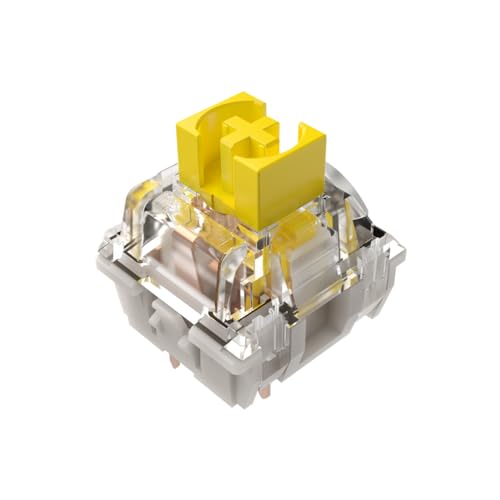
TTC Gold Pink V3 — the lightest touch in the family
Badge: Best TTC switch for light-touch players and typists.
- Type: linear, pre-lubed
- Positioning: the lightest spring option in the TTC range covered here
- Pack: 70 switches
- Seller: Metrickeys listing
- Character: feather-light, silky, effortless
The Gold Pink is the switch that made TTC’s name among players and light typists: a linear whose spring asks so little that long sessions — rhythm-game streams, marathon writing days, high-volume data work — stop being endurance events. Crucially, the lightness never feels cheap. The stroke is silky from its factory lubrication, the housing is tight, and the return is composed; this is a light switch engineered like a flagship, not a budget switch with a weak spring. Its role in the rhythm world is covered from the player’s side in the best switches for osu, where it anchors the stamina end of that guide.
The discipline it demands is the familiar one: fingers that rest heavily will register accidents, and the first week includes a few. Players and typists who adapt describe the same liberation — the keyboard stops resisting them — and for small or tiring hands the Gold Pink can be the difference between a board that is used and a board that is endured.
Strengths
- The lightest quality linear in this guide’s whole cluster
- Silky, pre-lubed stroke with flagship consistency
- 70-piece pack covers compact and tenkeyless boards
Trade-offs
- Accidental presses punish heavy resting fingers
- An adjustment week is nearly guaranteed
- Too light for deliberate, heavy-handed typists
Best for: stamina-focused players, light typists, smaller hands. Not suited for: heavy-handed users who rest on their keys.
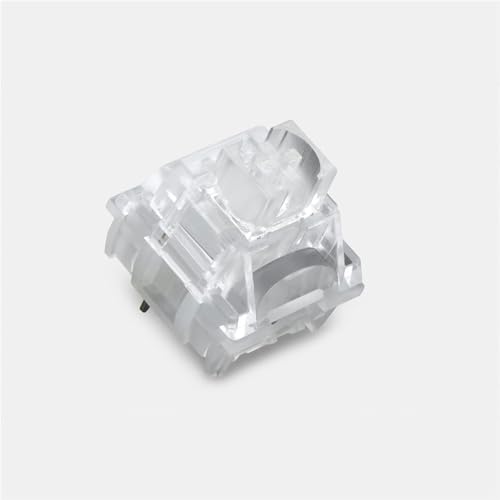
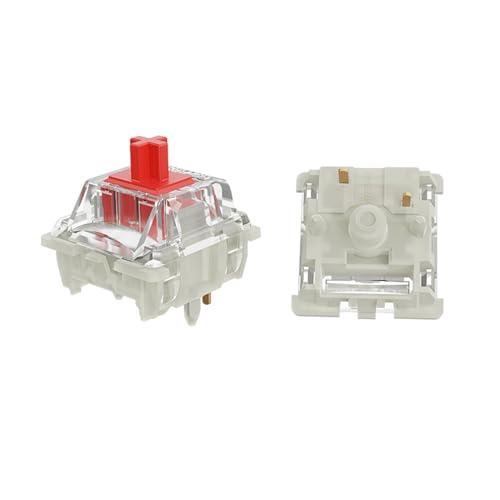
TTC Frozen Silent V2 — the quiet flagship
Badge: Best TTC switch for shared rooms and full conversions.
- Type: silent linear, pre-lubed
- Housing: transparent, RGB-friendly
- Pack: 110 switches
- Seller: Metrickeys listing
- Character: a cool, engineered hush over a smooth stroke
The Frozen Silent V2 is TTC’s answer to the question this site’s quiet rankings keep asking, and it answers with engineering rather than padding: a silent linear whose hush feels designed into the structure, over a stroke that remains smooth and precise rather than cushioned into vagueness. Its transparent housing keeps RGB boards honest, and its 110-piece pack is the most practical in the family — a full-size conversion in one purchase, with a rotation stock left over. In the quiet ranking elsewhere in this cluster it appears as the bonus pick most likely to be promoted; within its own family guide, it is simply the flagship for the way most people now live — in rooms other people are also in.
Strengths
- Engineered quiet that preserves a precise stroke
- 110-piece pack converts any board size once
- Transparent housing suits RGB builds
Trade-offs
- Premium tier within the family
- Cool, precise character will not charm fans of warm, thocky boards
- Large pack is overkill for a small trial
Best for: shared-room typists, full-size conversions, quiet seekers. Not suited for: small experimental purchases.
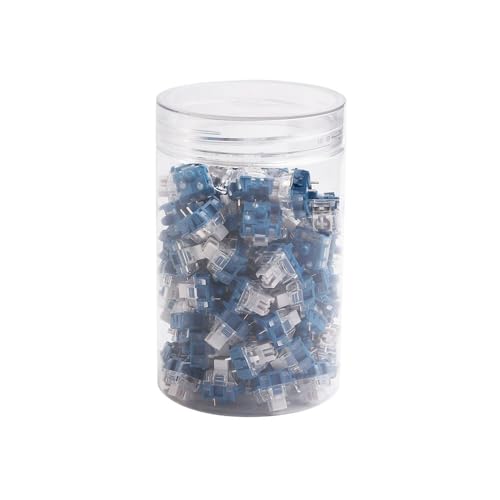
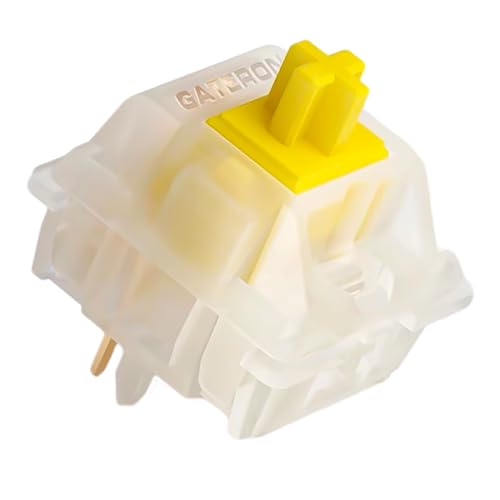
TTC Speed Silver V2 — the fast one
Badge: Best TTC switch for speed-focused gaming.
- Type: linear, speed-tuned
- Version: V2, lubed version as described in the listing
- Pack: 90 switches
- Seller: Metrickeys listing
- Character: brisk actuation inside TTC’s smooth stroke
Every family needs its sprinter, and TTC’s is the Speed Silver V2: a linear tuned for earlier registration, delivered with the smoothness that distinguishes the brand. Speed switches from lesser makers often feel like ordinary switches with an anxiety problem; TTC’s version keeps its composure — the stroke is clean, the spring behaves, and the speed arrives as a property of the design rather than a compromise of it. Ninety switches cover full-size boards or a compact board plus a deep bench of spares for the high-wear gaming cluster.
Choose it when your games reward early actuation and your hands have the discipline for it; choose the Gold Pink instead when effort, not timing, is your limiter. The two switches are the family’s twin answers to fast play, separated by which resource — milliseconds or stamina — your play style spends faster.
Strengths
- Speed tuning without losing TTC smoothness
- 90-piece pack is genuinely practical
- Lubed version arrives ready to install
Trade-offs
- Early actuation punishes sloppy, resting fingers
- Speed is wasted on slow, deliberate genres
- Less stamina-friendly than the Gold Pink for long sessions
Best for: competitive gamers with a controlled touch. Not suited for: heavy-handed players or pure typists.

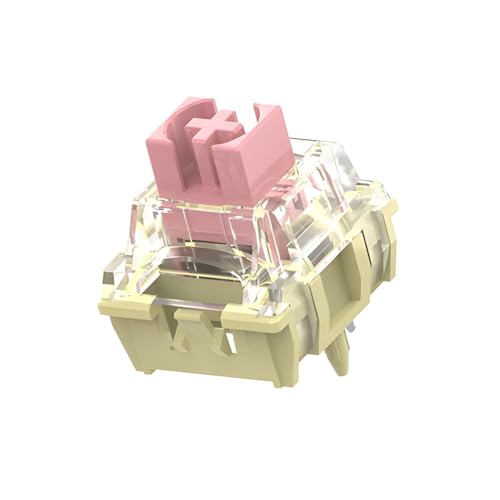
TTC Bluish White V2 — the quiet tactile
Badge: Best TTC switch for office typists.
- Type: silent tactile, pre-lubed
- Pack: 90 switches
- Seller: Metrickeys listing
- Character: a gentle bump in a hushed, smooth stroke
- Role: the family’s typing specialist
The Bluish White V2 completes the family’s logic: if the Frozen silences a linear, the Bluish White silences a tactile, giving office typists the bump their accuracy wants at a volume their colleagues can forgive. The bump is gentle — a confirmation, not a statement — and the surrounding stroke carries the family smoothness, pre-lubed and consistent across a generous 90-piece pack. It is the least showy switch in this guide and, for the largest number of working typists, very likely the most useful: the one that goes into the work board, in the shared office, and simply serves for years.
Strengths
- Quiet tactility for accurate office typing
- 90-piece pack covers full working boards
- Family smoothness and consistency throughout
Trade-offs
- Gentle bump will underwhelm strong-tactile fans
- Not a gaming switch in any serious sense
- Less distinctive than the family’s headline lines
Best for: office typists and shared-workspace professionals. Not suited for: bump maximalists or gamers.
The rest of the family: TTC lines covered in prose
TTC’s wider catalogue includes lines that long-time enthusiasts will meet in sampler packs, in other brands’ boards, and in community discussion, and a complete guide owes them accurate descriptions even where it cannot offer links. The Flame Red is the family’s conventional gaming linear — a standard-weight, smooth red in the classic mould, the line most often found inside prebuilt boards wearing TTC badges. The Honey line pursues a soft, quiet-leaning typing character, a gentle switch for gentle desks. The Wind line is TTC’s exploration of a lighter, airier stroke. The Heart line is known for a distinctive, softer bottom-out character that its fans describe in almost culinary terms. The Silent Red is the family’s earlier silent linear, the Frozen’s predecessor in spirit.
Why are they prose-only here? Because in our verification these lines surfaced only inside multi-variant sampler listings — boxes containing several TTC models under one listing whose title names no single switch. Linking such a listing under a line’s name would misrepresent what a buyer receives, and this guide’s rule — the rule of the whole cluster — is that a link must promise exactly what its title verifies. If you want one of these lines, buy it from a specialist retailer whose listing names the line, its variant and its pack count unambiguously, and use this guide’s descriptions to confirm you have found the right one. The sampler boxes themselves are legitimate as samplers: a reasonable way to audition the family’s breadth on a tester before committing to the verified lines above.
How do you choose between the TTC lines?
The family divides by two questions. First, must the board be quiet? If yes, the choice is the Frozen for gliding hands and the Bluish White for bumping ones — the same fork the whole silent category presents, executed here within one maker’s tuning. If no, the second question is what your speed costs you. Players limited by effort choose the Gold Pink’s lightness; players limited by timing choose the Speed Silver’s early registration; typists limited by neither should still choose the Gold Pink for long days or the Bluish White for shared ones, because most desks are shared and most days are long. Underneath every branch sits the family’s constant: whichever line you choose arrives smooth, consistent and pre-lubed, so the decision is about character, never about finish. Brand-loyal readers comparing across makers will find the same four-way fork — light, fast, quiet linear, quiet tactile — structuring silent switches guide and the gaming roundup alike; TTC’s distinction is offering all four corners inside one engineering philosophy.
How do you install and care for TTC switches?
Step 1: Respect the factory finish
Every linked line here arrives pre-lubed. Install a full zone and type for several days before deciding any switch needs your brush — with TTC, the factory application is part of the product, and adding lubricant to a satisfied switch is the beginner’s tax this family lets you skip.
Step 2: Convert in zones, as always
Alphas first, then modifiers, then the rest, typing real work after each zone. TTC’s consistency makes zone conversion unusually informative: any difference you feel is the line’s character, not unit variation, so your verdict will be about the right thing.
Step 3: Keep the spares by line
TTC lines look related and feel distinct; a spare Gold Pink in a Frozen board announces itself instantly. Label the bags by line when the packs are opened — a ten-second habit that protects every future repair.
Step 4: Maintain like any quality switch
Keep grit out, rotate high-wear positions annually if you play or type heavily, and re-lube only when a switch’s stroke tells you to. The family’s tight housings reward clean desks with years of unchanged feel.
What mistakes do TTC buyers make?
Buying a sampler expecting a model is the first, and this guide’s prose-only section exists to prevent it: read what a listing’s title actually names. The second is assuming all light switches are alike and ordering the Gold Pink for a heavy-handed typist, who will spend the board’s life apologising to it. The third is the mirror error — dismissing TTC as a niche name because its storefront is uneven, when its switches have been under professionals’ fingers inside other brands’ boards for years. The fourth is mixing lines casually across a board and then blaming the family for inconsistency that the buyer installed personally. And the fifth is skipping the Frozen’s pack arithmetic: 110 switches feels extravagant until the day a full-size board, a rotation stock and a spare set all come out of one box, at which point it feels like foresight.
Final recommendation
Within the verified range, the Gold Pink V3 is the family’s signature and the first TTC most buyers should meet — the lightest quality linear in this cluster, with a flagship’s finish. The Frozen Silent V2 is the quiet flagship and the full-conversion bargain. The Speed Silver V2 serves disciplined gamers; the Bluish White V2 serves the working typist in a shared room. Beyond the verified range, treat the prose-only lines as a map for specialist retailers rather than a shopping list, and never let a sampler wear a model’s name. TTC rewards the buyer who reads carefully — which, given that its switches reward the fingers that press carefully, seems exactly right.
If the budget stretches to only one experiment, make it a three-switch installation of the line your answers named, typed on for two honest days in your real work. TTC’s consistency means that small test carries the full information of a conversion — a courtesy few families extend — and its result will either crown the line or redirect you within the same small, legible tree, at the cost of an afternoon rather than a board. That is the complete guide’s final recommendation: test small, read exactly, and let an engineering-led family do what it has quietly done inside other people’s keyboards for years — disappear beneath your fingers, completely.
What do the V2 and V3 designations mean in TTC’s lines?
TTC iterates in public, and its version numbers are worth decoding because they appear throughout the verified range. A V2 or V3 is a generation: the same line’s idea, re-engineered — typically with revised moulds, updated materials, improved factory lubrication or a retuned spring — rather than a different switch wearing a similar name. The practical consequences for buyers are two. First, prefer the current generation when a listing offers both, because TTC’s iterations have consistently refined smoothness and consistency, the family’s core virtues. Second, read listings exactly: a Gold Pink and a Gold Pink V3 are related but not identical products, and a guide’s recommendation — like this one’s — attaches to the generation it names. The habit generalises across the whole cluster: in a hobby where names are colours and colours are shared, the generation marker is often the most honest word in the title.
How does TTC compare with Gateron and Cherry?
The three makers divide the mainstream switch world by temperament. Cherry is the establishment: the original designs, a deliberate feel, consistency as a creed. Gateron is the people’s enthusiast: smooth, characterful, endlessly varied, with a line for every taste and a community that documents all of them. TTC is the engineer: fewer lines, tighter tolerances, a house character of clean precision that runs from its lightest linear to its silent flagship. None of the three is the correct answer; they are three answers, and a buyer’s hands usually declare a preference within one testing session. Where TTC wins converts most decisively is among buyers who value uniformity above personality — the typist who wants every key to feel machined from the same drawing — and among light-switch seekers, where the Gold Pink’s execution has few peers at any address. Where it loses them is variety and lore: Gateron’s catalogue is a library, TTC’s is a shelf, and some hobbyists are library people. Know which reader you are.
Where will you meet TTC switches inside other keyboards?
Because TTC manufactures for the industry, many readers have already typed on its switches without knowing — inside prebuilt boards whose listings credit TTC in the small print, inside limited runs and collaborations, inside the sampler economy this guide has described. That hidden ubiquity cuts both ways for a buyer. It means the family’s reliability is field-tested at a scale few enthusiast brands match; it also means a “TTC board” and a “TTC switch pack” are different purchases with different tunings, since a board maker may specify its own spring or lubrication choices. When a prebuilt board’s TTC switches delight you, the verified packs in this guide are how you bring that delight to a board you already own — matching the line by name and generation, as the version section insists, rather than assuming every TTC linear is the Gold Pink in disguise.
What do the four verified lines sound like?
TTC’s house sound is best described as tidy. The Gold Pink speaks softly for a non-silent linear — a light, clean tap with little spring commentary, the sound of a switch with nothing loose in it. The Speed Silver is a fraction brighter, in keeping with its brisker design, still free of the ping that betrays lesser speed switches. The Frozen is the family’s hush executed properly: a murmur with the edges removed, uniform across the board in the way that makes a quiet conversion feel expensive. The Bluish White adds its gentle bump’s whisper to the same hush — present to the typist as information, absent to the room as noise. Across all four, the through-line is the absence of stray sounds: no scratch in the stroke, no ring in the spring, no rattle in the housing. Buyers chasing a deep, bassy thock as an end in itself may find TTC’s tidiness almost too polite; buyers who want their keyboard to sound like a well-made instrument will recognise the politeness as the point.
TTC’s spring philosophy, explained through its range
A switch family reveals its values in its springs, and TTC’s range is a small seminar. The Gold Pink’s spring is light and — the detail its fans cite — evenly wound, so the lightness feels controlled rather than flimsy; a cheap light spring surges and collapses, while TTC’s simply yields, uniformly, from first contact to bottom-out. The Speed Silver’s spring serves timing: a touch more presence, so the faster actuation still returns the key with authority for the next press. The Frozen and Bluish White carry springs chosen for composure, mid-weight and unhurried, because a quiet switch whose spring sings or hurries would betray its brief. Read across the four and the philosophy is consistent: the spring is not a commodity inside the switch but a tuned component, specified per line, and the family’s famous consistency is substantially the springs’ doing. Buyers who later explore spring-swapping as a modification will find TTC’s stock springs the hardest to improve on — which is, of course, the compliment the whole paragraph has been building toward.
How should you use a TTC sampler pack honestly?
Samplers deserve a defence, properly framed. As auditions, they are excellent: a single box that puts the family’s breadth under your fingers on a tester, teaching your hands the difference between the Gold Pink’s lightness and the Frozen’s hush before any full pack is ordered. As purchases of a named model, they are a category error — the error this guide’s linking rule exists to prevent — because a multi-variant box cannot promise which line, in which quantity, your money is really buying for a conversion. The honest workflow is therefore two-step: sampler first, on a tester, with notes; then the verified dedicated pack of the line your notes crown. Buyers who skip the first step buy on reputation; buyers who skip the second build a board from a tasting menu. TTC’s range rewards the full workflow more than most, because its lines differ in character more than their similar names suggest.
TTC for gaming, in more depth
Gamers meet TTC at two doors. The rhythm and stamina door is the famous one — the Gold Pink’s lightness under fast, repeated tapping, covered from the player’s side in the osu! guide — but the mainstream gaming door deserves its paragraph too. The Speed Silver V2 gives TTC a credible entry in the early-actuation contest that gaming roundups adjudicate, and it brings a smoothness many speed switches sacrifice. The Frozen, meanwhile, is the night-session switch: a gaming-capable linear whose hush keeps households asleep, a role the gaming guide’s shared-room logic keeps prescribing. What TTC does not offer gamers is ecosystem theatre — no proprietary analog line, no software-locked features — and for players who prefer their switches as universal components, that absence is a feature stated plainly. The family’s gaming case rests on execution: light done properly, speed done smoothly, quiet done by engineering.
Three TTC users, three doors into the family
The rhythm player arrived through the Gold Pink, as rhythm players do, and stayed for an unexpected reason: her typing board now wears the same line, because the lightness that saved her streams also ended her end-of-day finger fatigue on documents. One switch, two lives — the family’s most common conversion story. The engineering manager arrived through a prebuilt board at work, noticed the small print, and traced it to the Bluish White pack that now fills his home board; his door was the hidden-ubiquity route, and his loyalty is to the consistency he first met without a brand attached. The night-shift nurse games on the Frozen because her household sleeps while she plays, and her review of it, in full, is that nobody has ever mentioned her keyboard — the highest praise a quiet switch can earn, delivered by the audience it was engineered for. Three doors, one family, and a fourth waiting for the reader whose hands are about to have an opinion.
What makes a TTC housing feel different?
Run a fingernail along a cheap switch’s travel and you can feel the mould’s indifference; TTC’s housings are where its manufacturing-first history shows. The family’s stems run true in their channels with minimal wobble, which matters more than its specification suggests: wobble is not merely a feel flaw, it is a consistency flaw, because a stem that leans actuates fractionally differently from press to press and angle to angle. TTC’s tightness removes that variable, which is why its switches feel “clean” in the way the community means — the press you intend is the press that happens, identically, ten thousand times. The Frozen’s transparent housing adds the practical virtue of light transmission for RGB boards without surrendering that tightness, and the Bluish White’s housing carries its tactile mechanism with the same discipline. None of this photographs well or headlines a listing, which is precisely why a complete guide exists: to say that the family’s premium lives in tolerances, and tolerances are felt rather than seen.
How should you test a TTC switch before converting a board?
TTC’s consistency makes testing unusually decisive — one switch genuinely represents its line — and the test should exploit that. Install three: one under a letter your strongest finger owns, one under your weakest finger’s letter, and one under the spacebar’s neighbourhood if your board allows a quick swap there. Type for two full days, including your longest session of the week, because the Gold Pink’s virtue and vice both declare themselves at duration rather than at first touch. Game on the Speed Silver in your fastest title, not your favourite one. Then interrogate the experience with the family’s own questions: Was every press the same press? Did the spring ever surprise you? Did the stroke ever scratch, ping or wander? A line that passes those questions across three switches and two days will pass them across a board and two years, which is the closest thing to a guarantee this hobby honestly offers.
Where does TTC sit on value?
TTC’s verified lines sit in the quality tier, priced as engineered products rather than commodities, and the value case rests on three legs. The first is longevity of character: tolerances and springs that hold their feel across years amortise a pack the way a good tool amortises — daily, silently, completely. The second is the absence of a modding tax: pre-lubed to a standard many owners never improve, TTC switches do not invoice you for grease, films and an afternoon before they perform. The third is pack honesty: the Frozen’s 110 and the Bluish White’s and Speed Silver’s 90s are sized to finish jobs, and a purchase that finishes a job is cheaper than two that nearly do. Buyers counting switches per coin will find lighter arithmetic elsewhere; buyers counting years per board will find TTC’s arithmetic persuasive, and the family’s following suggests the second count is the one experienced hands eventually make.
The TTC family tree, summarised
Step back and the range arranges itself into a small, legible tree. The linear branch carries the family’s fame: Gold Pink at the light extreme, Flame Red at the conventional centre (prose-only in this guide), Speed Silver at the fast end. The silent branch mirrors it: Silent Red as the earlier expression, Frozen Silent V2 as the current flagship, Bluish White V2 as the branch’s tactile. The character lines — Honey’s softness, Wind’s airiness, Heart’s distinctive landing — form the family’s experimental fringe, the lines enthusiasts trade stories about and samplers exist to audition. Four of these carry verified dedicated listings and this guide’s links; the rest are mapped in prose with their natures described, awaiting the day their retail presentation earns the same treatment. A complete guide’s job is exactly that arrangement — the whole tree, honestly labelled, with the buyable branches distinguished from the merely knowable ones — and readers who keep the tree in mind will never mistake a sampler’s contents for a catalogue again.
TTC switches and typing speed
Do TTC switches make anyone type faster? The family’s contribution to speed is indirect and real: consistency removes the micro-corrections that uncertain switches impose, and the Gold Pink’s lightness reduces the effort budget a long session can spend, which is where personal speed records quietly come from — not a faster switch, but a typist whose hundredth minute resembles their tenth. The Bluish White contributes accuracy’s version of the same gift, its bump confirming presses early enough that errors are caught by feel rather than by proofreading. Set beside the pure gaming logic of the best switches for gaming, TTC’s speed case is the typist’s one: sustainable pace over a working day, which is the only speed most keyboards are ever asked for. Measure yours before and after a conversion with the same passage at the same hour, and let the family’s consistency make its own argument in the only laboratory that matters.
Building a keyboard around TTC switches
Readers planning a board from parts around a TTC line will find the family’s tidiness simplifies the brief: a well-made case and plate will not be asked to hide switch flaws, so budget can flow to the components that shape sound and feel at the board level. The Frozen and Gold Pink both reward a gasket-mounted build’s softness; the Speed Silver reads crisply through a firmer mount; the Bluish White asks only for a quiet room to appreciate it in. The full component picture — cases, plates, keycaps and the order of decisions — is laid out in custom mechanical keyboard building guide and building your first custom keyboard, and TTC’s lines slot into those plans at the switch step with fewer caveats than most: choose the line by the two questions this guide opened with, and the family handles the rest.
Reading TTC’s names without a decoder ring
TTC names its lines the way poets name perfumes — Gold Pink, Frozen, Bluish White, Honey, Wind, Heart — and the beginner is forgiven for finding the shelf opaque. The names do carry information once the family’s habits are known. Colours in TTC’s world are stem colours first and personalities second, and the experienced buyer reads them as addresses rather than descriptions: Gold Pink is that specific light linear, not any pinkish switch. Adjectives like Frozen and Speed are the honest words in their titles — the Frozen is the cold, quiet one; the Speed Silver is the fast one — while the evocative lines, Honey and Heart and Wind, signal the experimental fringe where character outranks category. The discipline this guide recommends is unglamorous and total: buy by the full line name plus generation, verify the listing’s title names exactly that, and let the poetry be a pleasure of ownership rather than a method of selection. Every error in the mistakes section above began as a name read too loosely.
How TTC switches age across years of use
The family’s tolerances buy a particular kind of longevity: not immortality, but predictability. A TTC board’s high-wear keys soften their springs on the same schedule as any quality switch, yet the housings’ tightness means the stroke’s character — its straightness, its cleanliness — survives long after looser switches have developed their wobble and scratch. The silent lines’ dampers compress on the universal schedule described in the quiet guides, ageing toward ordinary volume with a grace that gives owners years of warning rather than a sudden failure. Practical ownership follows the cluster’s standing advice: rotate fresh switches into the movement and home-row positions annually if your use is heavy, keep the spares labelled by line, and let the board’s own consistency tell you when a position has drifted — on a TTC board, drift is audible and palpable precisely because the baseline is so even. A family whose virtue is uniformity makes its own maintenance legible, which may be the most manufacturer-like compliment a switch can earn.
Is TTC a good family for a first switch purchase?
For a particular kind of beginner, TTC is the ideal first family: the buyer who wants the decision to be small and the product to be finished. Four verified lines, each answering a distinct need, all arriving pre-lubed and consistent, remove the two anxieties that complicate first purchases elsewhere — which of forty variants, and how much modding stands between the box and a good board. The beginner TTC does not serve is the explorer, for whom the hobby’s pleasure is the catalogue itself; that reader will outgrow a four-line shelf by curiosity, and the family’s role in their life will be a respected first chapter rather than the whole book. Everyone else — the light-fingered, the quiet-housed, the professional, the gamer with discipline — can start here and, in the experience this guide reports, simply stay. A first purchase that remains the right purchase years later is the rarest outcome in any hobby’s marketplace, and it is the outcome TTC’s engineering-first approach is quietly optimised to produce.
What “complete” means in this guide
A word about the title’s promise, because this guide makes it differently from most. Completeness here is not a link under every name — the verification discipline forbids that, and the prose-only section explains why at the length the subject deserves. Completeness is coverage with honest labelling: every significant line in the family described accurately enough to recognise, choose and discuss; the buyable lines linked to listings whose titles verify them; the unbuyable-here lines flagged with the reason and the route to them. A guide that linked everything would be more convenient and less true, and its readers would learn the difference at the checkout, which is the most expensive classroom in the hobby. TTC’s own philosophy — engineering first, marketing second — is the standard this guide has tried to keep, and if the family’s switches reward careful readers, its guide should too. That symmetry is the completeness on offer, and the four verified lines are where it becomes a purchase.
A note on TTC collaborations and limited runs
TTC’s manufacturing role produces a penumbra of collaborations — switches made by TTC to another brand’s specification, limited runs with tuned springs or housings, board-exclusive variants that never reach a switch pack at all. Collectors prize them; this guide’s advice to everyone else is calm. A collaboration switch should be judged by its own verified listing and its own described specification, never by borrowed family glory, because a tuned variant can differ from its parent line in exactly the spring or stem that made the parent famous. When a collaboration’s listing is exact — naming maker, model and variant — it can be bought on its merits with the same confidence as the four lines above. When it trades on atmosphere instead, the prose-only discipline applies: admire it accurately, buy it knowingly, and let the verified range remain the recommendation this guide stands behind. The family’s centre is strong enough that its edges can be enjoyed without being exaggerated.
Reading a TTC datasheet like an engineer
A complete guide should leave its readers able to judge the next TTC switch without it, and the datasheet is where that independence lives. Read it in the order the mechanism cares about: operating force and its tolerance first, because that tolerance band is the consistency you will feel across a board; then the travel figures — pre-travel to the actuation point, total travel to the bottom — because their ratio is the switch’s tempo; then the electrical and mechanical life ratings, which for TTC are a point of house pride and a fair predictor of the switch’s old age. Treat marketing adjectives as unproven until the numbers second them, and treat a missing figure as information too — a house that publishes its tolerances, as TTC does, is telling you how it expects to be judged. Bring that literacy to any brand’s shelf and the guides you need get shorter every year, which is the proper ambition of this one.
Frequently asked questions
Are TTC switches good quality?
Yes — TTC is a manufacturer-led brand whose switches have shipped inside other companies’ keyboards for years, and the verified lines in this guide show the traits that built the reputation: smooth strokes, consistent units, tight housings and factory lubrication applied properly.
What is the lightest TTC switch?
Of the verified lines, the Gold Pink V3 — its light spring is the family’s signature and the reason stamina-focused players and rhythm gamers seek the brand out. Handle it with the respect lightness demands: it rewards controlled fingers and exposes heavy resting ones. If you are unsure whether your touch qualifies as controlled, the three-switch test described in this guide will tell you within two days, and the answer — whichever way it falls — will organise your TTC choice and probably your whole switch future.
Why are some TTC switches not linked in this guide?
Because verification found them only inside multi-variant sampler listings whose titles name no single model. Linking a sampler under a model’s name would mislead buyers about what they would receive, so those lines — Flame Red, Honey, Wind, Heart, Silent Red — are described in prose and left to specialist retailers to sell properly.
Which TTC switch is best for an office?
The Bluish White V2 for typists who want a bump, the Frozen Silent V2 for those who prefer to glide. Both are quiet, both arrive pre-lubed in practical pack sizes, and both carry the family’s consistency into the shared room where it matters most. Between the two, let your error rate arbitrate: the typist whose documents fill with corrections gains more from the Bluish White’s confirmation, while the accurate glider gains the Frozen’s extra degree of hush — and either choice leaves the office quieter than it was, which colleagues will register as the family’s real office feature.
Do TTC switches fit standard keyboards?
The verified lines use the standard MX-style stem and mainstream formats, fitting hot-swap boards built for them. As with every switch purchase, confirm your board’s pin and socket specification before ordering, and remember that a soldered board turns any swap into a desoldering project. Owners of boards that shipped with TTC switches inside have the easiest path of all: the line is often named in the board’s documentation, and the matching verified pack in this guide is then a like-for-like refresh rather than a change of character.
How long do TTC switches last?
They are built and rated as long-life components, and their real-world longevity follows the pattern this guide’s ageing section describes: springs tire gradually at high-wear positions, housings hold their tolerances for years, and the family’s consistency makes any single tired switch easy to identify and replace from your labelled spares. Treated as the precision components they are — kept clean, rotated at the hard-worked positions — a TTC board’s switches are among the last parts of the setup you will ever think about replacing.
Can I mix TTC lines on one keyboard?
You can, and the family’s shared engineering makes TTC the safest brand within which to mix — a Frozen board with a Bluish White alpha cluster for typing, for instance, keeps one maker’s consistency across two characters. Keep zones coherent, label your spares by line, and remember that the Gold Pink’s lightness beside any other line’s weight is the mix most likely to feel like a mistake rather than a design.
Where can I buy the TTC lines that are not linked here?
Through specialist keyboard retailers whose listings name the exact line, generation and pack count. Use this guide’s prose descriptions to recognise the line you want, treat any multi-variant sampler as an audition tool rather than a model purchase, and apply the same title-reading discipline the verified links in this guide were chosen by.
Are TTC switches pre-lubed?
All four verified lines in this guide are listed as pre-lubed, and the factory application is good enough that the guide’s advice is to live with a line for several days before considering any additional lubrication. Most owners never add any.