Disclosure: As an Amazon Associate, kajuandouglas.com earns from qualifying purchases. Links on this page are affiliate links; they cost you nothing extra. Prices and availability change often, so check the current Amazon listing before you buy.
This epomaker keyboards guide maps one of the new wave’s most prolific houses. Epomaker’s catalogue is a festival of the current era’s favourite ingredients — gasket mounts, tri-mode wireless, hot-swap everything, screens, knobs, retro styling, aluminium shells and switch names like poems — organised into families (RT, TH, Galaxy, EK) that span every size from 65 percent to full-size. The brand collaborates widely (its Aula F75 partnership produced one of the era’s defining budget boards), iterates quickly, and prices aggressively. This guide explains the families and the house style, then reviews five verified listings across the range, so a buyer can navigate the festival without getting lost in it.
Key takeaways: RT is the retro line — screens, knobs, typewriter-adjacent charm with modern internals. TH is the mainstream performance line, sized by number (TH80, TH99, TH108). Galaxy is the aluminium QMK/VIA line for the custom-adjacent. EK is the compact gaming line. Everything is hot-swap and tri-mode or better; sound is creamy by design; verify the exact variant, because the catalogue iterates fast and names repeat across generations.
Epomaker Keyboards Guide: The Families: RT, TH, Galaxy, EK
Epomaker’s naming is a map once its logic is stated. RT boards are the retro flagships — the RT100 made the house famous with its detachable mini screen, typewriter-evoking design and full modern specification (gasket mount, tri-mode, hot-swap), and the line continues in Pro generations with bigger screens and batteries. TH boards are the mainstream line, their numbers approximating their sizes: TH80 in the 75–80 percent class, TH99 in the 96–98 percent class, TH108 at full size — gasket-mounted, tri-mode, screen-and-knob equipped in the current Pro generations, and priced to contest the whole market. Galaxy is the aluminium line, built around QMK/VIA openness for buyers who want custom-world firmware in a finished board. EK is the compact line, 65–68 percent gaming-leaning boards with knobs and hot-swap. Across all four families the house style is constant: creamy stock sound from layered padding, pre-lubed switches with evocative names, PBT keycaps, and feature lists that read like the era’s wish list. The reviews below take one representative from each major family, plus the full-size flagship.
In this guide
Five Listings Across the House
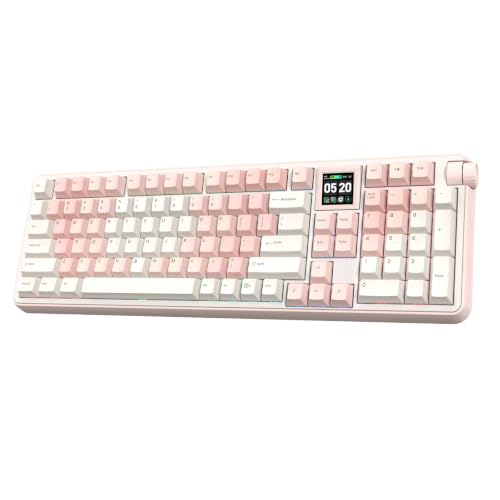
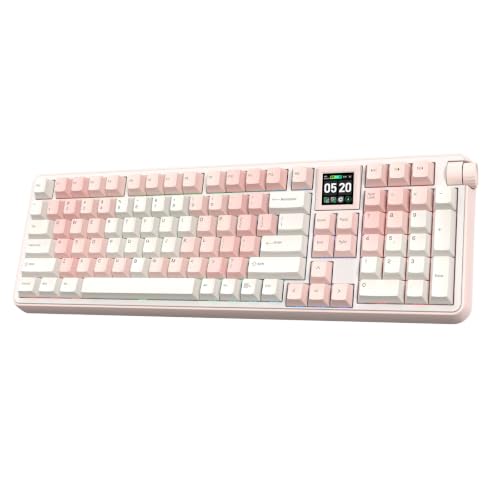
EPOMAKER RT100 Pro — the retro flagship
Badge: Best Epomaker for character
- Layout: 96–100 percent class, retro design
- Features: 1.54-inch screen and knob
- Connection: 2.4 GHz, Bluetooth, USB-C
- Switches: hot-swap, Sea Salt Silent (listing)
- Battery: 5,000 mAh (listing)
The RT100 Pro is the house’s signature object: a retro-styled board whose screen and knob headline a specification that is entirely modern — tri-mode wireless, hot-swap switches, PBT caps and a gasket-cushioned creamy voice. The verified listing’s Sea Salt Silent switches make it the quiet configuration of a characterful board, a combination the retro niche rarely offers. Buyers who want their keyboard to be a desk event and a competent instrument in the same object are this board’s constituency, and it serves them with unusual completeness.
- Strengths: unmatched retro character
- Strengths: full modern specification
- Strengths: silent variant available
- Trade-offs: retro size is desk-filling
- Trade-offs: screen is charm, not utility, for most
- Trade-offs: variant jungle requires care
Best for: retro desks and character seekers. Not suited for: minimalists.

EPOMAKER Galaxy100 — the aluminium QMK board
Badge: Best Epomaker for customisers
- Layout: 96–100 percent class
- Case: aluminium shell
- Firmware: QMK/VIA
- Connection: Bluetooth, 2.4 GHz, USB-C
- Switches: pre-lubed hot-swap linears (listing)
The Galaxy100 is Epomaker’s answer to the custom world: an aluminium shell, QMK/VIA firmware with its open keymap depth, tri-mode connection and pre-lubed hot-swap switches in a near-full-size layout that keeps the numpad within a compacted frame. It is the house’s most serious board — the one a builder buys when they want the platform without the group-buy calendar — and it anchors the guide’s recommendation for customisers who shop finished boards.
- Strengths: aluminium build and QMK depth
- Strengths: numpad in a compacted frame
- Strengths: tri-mode and hot-swap
- Trade-offs: compacted numpad layout takes adjustment
- Trade-offs: heavier than plastic siblings
- Trade-offs: premium within the house
Best for: customisers and numpad users. Not suited for: travellers.

EPOMAKER TH80 V2 Pro — the mainstream 75 percent
Badge: Best Epomaker for most buyers
- Layout: 75–80 percent class
- Features: screen and knob
- Connection: 2.4 GHz, Bluetooth, USB-C
- Switches: hot-swap, Creamy Jade (listing)
- Battery: 10,000 mAh (listing)
The TH80 V2 Pro is the house’s centre of gravity: the popular compact-with-F-row size, a screen and knob, an enormous battery by the listing’s specification, tri-mode connection and the creamy gasket voice the line is known for. It competes with the entire market’s favourite boards and does so on specification breadth at the house’s aggressive pricing. For a buyer who wants one Epomaker that does everything the era does, this is the guide’s default answer.
- Strengths: the era’s full feature set
- Strengths: huge battery capacity
- Strengths: creamy stock sound
- Trade-offs: screen features divide buyers
- Trade-offs: software is the house’s own driver
- Trade-offs: generations iterate quickly
Best for: mainstream feature seekers. Not suited for: open-firmware purists.

EPOMAKER TH108 V2 Pro — the full-size flagship
Badge: Best Epomaker at full size
- Layout: full-size
- Features: screen and knob, Mac modifier PBT keycaps
- Connection: Bluetooth, 2.4 GHz, USB-C
- Mount: gasket
- Battery: 10,000 mAh (listing)
The TH108 V2 Pro carries the house formula to full size: gasket mount, screen and knob, tri-mode, a large battery and — a professional touch — Mac modifier keycaps in the box, acknowledging the full-size board’s working constituency. It is the Epomaker for the numpad-bound buyer who wants the modern feature set without surrendering a single key, and its existence completes the TH line’s size ladder.
- Strengths: full size with full features
- Strengths: Mac modifiers included
- Strengths: gasket creamy sound
- Trade-offs: largest desk footprint
- Trade-offs: battery serves a mostly desk-bound board
- Trade-offs: feature breadth to learn
Best for: full-size modernists. Not suited for: compact desks.

EPOMAKER EK68 — the compact with a knob
Badge: Best compact Epomaker
- Layout: 65 percent, 68 keys
- Features: knob, south-facing LEDs
- Mount: gasket
- Connection: 2.4 GHz, Bluetooth 5.0, USB-C
- Switches: Gateron Pro Yellow (listing)
The EK68 is the house in miniature: a 65 percent gasket board with a knob, tri-mode connection, NKRO and hot-swap sockets, wearing Gateron Pro Yellow linears in the verified listing. It demonstrates that the house style survives compression — the creamy sound, the feature generosity, the aggressive price — and it is the Epomaker this guide recommends to the compact desk that games and types in equal measure.
- Strengths: full house style at 65 percent
- Strengths: knob and tri-mode included
- Strengths: quality stock linears
- Trade-offs: function row is layered
- Trade-offs: smaller battery than TH line
- Trade-offs: compact layout apprenticeship
Best for: compact mixed-use desks. Not suited for: F-row dependents.
The House Style: Creamy Sound, Poetic Switches, Fast Iteration
Three traits define Epomaker ownership across the families. The first is the sound: layered internal padding and gasket mounting tuned for the deep, creamy voice the era prizes, delivered stock — the house’s boards arrive sounding like boards other brands’ owners mod toward. The second is the switch programme: pre-lubed switches with evocative names (Sea Salt, Creamy Jade, Wisteria, Marble) that are genuine quality units beneath the poetry, hot-swappable everywhere, so the named switch is a starting point rather than a sentence. The third is iteration speed: generations refresh quickly, Pro and V2 suffixes multiply, and the catalogue’s breadth is both the house’s glory and the buyer’s homework — the exact variant, generation and switch must be verified in the listing, because last season’s board wears a nearly identical name. Buyers who embrace the homework get the era’s features at the era’s friendliest prices; the Aula keyboards guide covers the house’s most famous collaboration from the partner’s side.
Screens and Knobs: The Theatre, Audited
Epomaker’s signature furniture deserves an honest audit, because the house fits screens to boards the way the era fits them to everything. The knob is the easy verdict: volume and media control under a fingertip is a daily-use feature whose convenience survives every novelty audit, and its presence across the families is the house’s most defensible indulgence. The screen is subtler. Its genuine utilities are real — connection mode, battery, time, a custom image that makes the desk personal — and its honest classification is charm with utility garnish. The audit that matters is the price one: in this house’s pricing, the screen’s premium is modest, the board beneath it is fully specified either way, and a buyer is therefore free to choose by delight rather than by guilt. That freedom is the house’s design philosophy in miniature — theatre is allowed when it does not tax the fundamentals — and it is why the RT line’s screens read as character while a lesser board’s would read as compensation. The Epomaker RT100 deep dive in this cluster takes the flagship’s options one by one.
The Switch Poetry, Translated
Epomaker’s switch names are the catalogue’s most charming obstacle, and a translation table in prose will save buyers real time. The names describe families of feel rather than single switches, and they recur across boards and generations with variations. Sea Salt switches are the house’s quiet line — the Silent variant in the RT100 listing is a dampened linear for shared rooms. Creamy Jade is a smooth, medium linear of the creamy-sound school, the TH listings’ current favourite. Wisteria linears are light and smooth, the Galaxy line’s frequent stock. Marble White is another smooth linear dialect in the same family. The translation rule is that the poetry is consistent about character (quiet, creamy, light) even as the exact units evolve, and the specification block always names the switch a given listing actually ships. A buyer who learns the four names above can read most of the catalogue’s switch lines at sight — and the hot-swap sockets forgive any remaining misreading within a half hour of the board’s arrival.
Epomaker Against Its Own Generation
The house does not compete in a vacuum, and its position among the new wave’s majors deserves a scored paragraph. Against Keychron, Epomaker trades blows: Keychron’s software and aluminium lines are more polished, its catalogue more disciplined — and Epomaker’s feature-per-price arithmetic and retro imagination are bolder, its sound stock-creamy where Keychron’s is merely good. Against Royal Kludge and the budget wave, Epomaker is the step up: better padding, better switches, screens and shells the budget cannot reach, at prices that stay in sight of it. Against the gaming majors, it wins every typing category and loses the esports frontier, a trade its buyers make knowingly. The house’s real signature in the field is velocity — it ships the era’s ideas first and cheapest, from screens to giant batteries to retro flagships — and velocity’s known cost is the catalogue discipline this guide keeps prescribing homework for. Buyers who value the frontier’s arrival over the archive’s tidiness are Epomaker’s natural citizens, and there are, on the evidence of its sales, a great many of them.
The Verification Drill: Epomaker Edition
No house in this cluster needs its drill more, because no house iterates faster. Generation: Pro, V2 and plain variants of the same model name are different boards — confirm the suffix in the title and the specification block agree. Switch: the named switch in the listing is the one that ships; the same board wears several, and the photographs do not say which. Size class: the TH numbers approximate — confirm the key count and the numpad’s presence in the specification, especially between TH99 and TH108. Screen and knob: confirm both are present on the variant, since some generations split the furniture across trims. Firmware: VIA or the house driver, per the model, confirmed before purchase if your workflow depends on it. Five checks against a catalogue that rewards them disproportionately — because the board you verified is an excellent board, and the board you assumed is a lottery ticket in very attractive packaging.
Sound: The Creamy Programme, Assessed
The house’s sound deserves its own assessment because it is the specification buyers cite most and understand least. “Creamy” in Epomaker’s execution is an engineering stack — gasket mounting to soften the landing, layered case foams and films to absorb the harsh frequencies, pre-lubed switches to remove scratch, and PBT caps of decent thickness to keep the voice low — and the stack is applied across the families with a consistency the budget wave does not match. The result is a stock voice that sits recognisably in the modern school: deep, soft, composed, and — the honest caveat — somewhat uniform across the range, so that the buyer chasing a distinctive acoustic personality will still mod, as the custom mechanical keyboard building guide teaches. For the majority who want the modern voice without the workbench, the programme is the house’s core value: the sound arrives finished. Judge it, as always, by recordings of the exact variant, because switch choice moves the voice more than any other single variable in the stack.
Epomaker at Work, at Play, on Camera
The house’s boards lead the era’s typical triple life, and the guide should certify each shift. At work, the tri-mode boards are the hybrid desk’s natural citizens — dongle in the dock, Bluetooth for the laptop’s travels, cable for the BIOS moments — with the TH108’s Mac modifiers and the Galaxy’s VIA depth serving the professional ends of the range. At play, the boards bring hot-swap linears, NKRO and 2.4 GHz links that satisfy all but the frontier’s specialists, while the house’s Hall-effect experiments elsewhere in the catalogue court the competitive crowd directly. On camera — the shift the other houses ignore — Epomaker is the segment’s set designer: the RT line’s retro theatre and the TH line’s screens photograph like props because they were designed by people who understand that a modern desk is also a broadcast. A buyer whose desk works all three shifts is the house’s exact target, and the catalogue’s breadth means the same brand can furnish the whole rotation without a voice change between boards.
Batteries, Radios and the Wireless Reality
The house’s wireless specification is generous on paper — tri-mode everywhere, batteries up to the TH listings’ five-figure capacities — and the ownership reality deserves the cluster’s standard translation. Battery life in this class is measured in weeks of real use with lighting moderated, and in days with the RGB at festival brightness and a screen awake; the giant batteries buy genuine freedom for the disciplined and a longer leash for the theatrical. The 2.4 GHz links are the performance mode and the battery-hungriest; Bluetooth is the longevity mode and the multi-device citizen; the cable remains the zero-latency, zero-anxiety fallback the tri-mode philosophy keeps in the bag. Dongle storage, mode indication and wake behaviour vary by model and generation — three more reasons the drill insists on the exact variant’s documentation. None of this is a criticism of the house; it is the physics of the category, stated so that the specification’s poetry does not write cheques the battery cannot cash. The Bluetooth vs 2.4GHz and tri-mode explainer gives the full physics for buyers speccing a wireless-first desk.
Software: The House Driver and the VIA Island
Software is the house’s honest weak shore, and the guide should chart it precisely rather than wave at it. Most Epomaker boards configure through the house’s own driver — remapping, macros, lighting, screen content — which is capable in scope and variable in polish across generations, with the newest boards’ web-based tooling improving the picture. The Galaxy line’s QMK/VIA support is the island of open-firmware excellence in the catalogue, and buyers whose workflows depend on VIA’s depth should simply live on the island. The practical guidance is to match the software to the ambition: a buyer who remaps once and types for years will never feel the driver’s limits on any model; a buyer who lives in their configurator should buy Galaxy or shop the rival whose software is its crown. Firmware updates, when they come, arrive per model, and the drill’s generation check doubles as the software check — the variant you verified is the variant whose driver you will actually use.
Longevity in a Fast Catalogue: The Ownership Wager
The thoughtful buyer’s one hesitation with a fast-iterating house is support longevity — will this model exist, in parts and firmware, in three years? The honest assessment runs in the house’s favour more than its velocity suggests. The boards are built from the ecosystem’s standard parts — MX switches and caps, standard cables, commodity radios — so their maintenance never depends on the house’s inventory. The hot-swap architecture turns the most common ageing event into a switch purchase from anyone. The community around the popular models is large and documents itself. The genuine risk concentrates in the proprietary layer — a screen’s firmware, a driver’s download page — and the mitigation is the standard one: archive the driver and firmware at purchase, and prefer the high-volume models whose communities are self-sustaining. Priced against that modest risk is the house’s value, which is not modest at all. The wager, stated plainly, is a small archival chore against a large specification-per-price advantage — and on the evidence of the house’s installed base, it is a wager its owners keep winning.
Three Desks Furnished by One House
The guide in people, as this cluster’s guides conclude best. The streaming creator whose desk is a set and whose board must perform on camera and off: the RT100 Pro, in the colourway the set’s palette dictates, its screen carrying the channel’s mark and its silent switches sparing the microphone. The hybrid professional whose week splits between the office dock and the home desk, whose numpad use is real but occasional: the TH99 class or the Galaxy100, dongle in the dock, VIA or driver keymaps carrying the workflow’s macros. The compact gamer-typist whose single board must do the ranked evenings and the essay deadlines: the EK68 or the TH80, hot-swap linears for the season, the knob earning its keep in both shifts. Three desks, one house, no compromises that matter — the catalogue’s breadth, which the drill treats as a hazard, is from the owner’s side a genuine convenience: a single brand’s voice across a whole life of desks.
Ergonomics and Desk Fit Across the Range
The house’s sizes span the full ergonomic map, and the bodily arithmetic follows the cluster’s standing rules with two house-specific notes. The compact EK68 and TH80 pull the mouse hand in with the usual dividend, their gasket softness adding a landing comfort that long sessions register in the fingers rather than the posture. The near-full TH99 and Galaxy100 compress the numpad into the frame — a posture middle path whose tighter right-hand geography some typists love and some find crowded, decidable only by a week’s trial. The full TH108 is the traditional wide stance for the numpad professions. The house-specific notes: the retro RT boards sit taller and more upright than the low modern decks, suiting a wrist-rest pairing; and the gasket boards’ softer landing is a genuine, if modest, comfort asset for heavy daily volume — not an ergonomic intervention, but a kindness the joints notice by Friday. Buyers with structural comfort needs belong in the dedicated ergonomic guides; buyers with ordinary needs will find a size and a softness in this catalogue that fits.
The Collaboration Culture: Aula and Beyond
Epomaker’s catalogue cannot be fully understood without its collaboration habit, because some of its most important boards carry two names. The Aula partnership produced the F75 line — the board that taught the budget market what gasket sound was — and the collaboration continues in Max generations with screens added. The pattern generalises: the house treats partnerships as a research programme, absorbing partners’ strengths (Aula’s value engineering, switch makers’ latest units) into boards that carry the joint credit honestly on the box. For the buyer, the practical rules are two: a collaboration board is bought by the same drill as a solo one, with both names’ reputations standing behind it; and the collaboration lines often represent the house’s best value, because two companies’ margins have been negotiated down before the price was set. The F75’s shadow falls across this whole guide — it is the proof, cited by every rival’s pricing, that the house’s formula works — and its own story is told in the Aula guide linked earlier.
Price Architecture: Where the Money Goes
The house’s pricing rewards a buyer’s literacy, because its ladder is legible once the cost drivers are named. The base of the ladder buys the formula — gasket, tri-mode, hot-swap, PBT, creamy sound — at prices that undercut the disciplined majors. The middle rungs buy furniture and capacity: screens, bigger batteries, finer switches. The top rungs buy materials and openness: aluminium shells, VIA firmware, the Galaxy line’s custom-adjacent construction. A buyer can therefore shop the ladder by naming what they are paying for, and the house’s honesty is that each rung’s premium corresponds to a visible asset rather than to a badge. The ladder’s one trap is generational: a discounted last-generation board may undercut its successor while sharing its name, and the drill’s generation check is the difference between a bargain and a booby trap. Read the ladder, run the drill, and Epomaker’s pricing becomes what its owners say it is — the era’s features at the era’s fairest exchange rate.
Troubleshooting and the Owner’s First Aid
The house’s fault list is the tri-mode era’s standard one, and the guide records the first aid. A board that will not pair yields to the mode discipline: confirm the physical mode, clear the slot, re-pair, and test wired to separate radio from board. A key that misbehaves is a hot-swap gift — reseat or swap the switch in a minute and let the fault declare itself. Screen or driver oddities resolve through the model’s own software reset, with the archived installer the longevity section advised keeping. A battery that drains theatrically is almost always a lighting and screen audit rather than a failure. The deeper method, for anything beyond first aid, is this cluster’s fix keyboard not working troubleshooting guide, whose wired-wireless decision tree was written for exactly these boards. The house’s boards fail rarely and forgive quickly — the hot-swap, tri-mode architecture sees to that — and the owner’s first aid is mostly a matter of knowing which of the board’s three connections to interrogate first.
Who Should Not Buy Epomaker
The refusals, as plainly as the recommendations. The open-firmware absolutist should confine themselves to the Galaxy island or shop elsewhere, because most of the catalogue runs the house driver. The catalogue minimalist — the buyer who wants three models and a decade of stability — will find the house’s velocity a standing irritation and belongs with the traditionalists in this cluster. The support-conservative enterprise buyer, whose procurement values a single long-lived SKU above specification, should buy the disciplined majors. And the theatre sceptic who reads every screen as a gimmick-tax should choose the house’s plainer trims or a rival’s plainer line, because much of this catalogue’s charm is deliberately theatrical. Everyone else — the feature hunter, the creamy-sound seeker, the retro romantic, the value engineer, the creator whose desk is a set — is in the house’s intended and very large congregation.
The Guide’s Verdict in One Breath
Epomaker, condensed to a single paragraph: the TH80 V2 Pro is the house’s centre and the mainstream default; the RT100 Pro is the character flagship; the Galaxy100 is the customiser’s aluminium VIA board; the TH108 V2 Pro completes the full-size brief; and the EK68 carries the style into 65 percent. Family by character, model by size, variant by the specification block — and the driver archived on day one. That is the whole Epomaker method, and it converts the catalogue’s famous breadth from a hazard into what it was designed to be: a size, a style and a price for every desk the era types on, from one house, in one creamy voice.
A First Month With the House Style
Ownership texture, compressed into the month that decides whether a board stays. Week one belongs to the sound — the creamy stock voice is the house’s handshake, and it lands in the first hour. Week two belongs to the connections, as the tri-mode map settles into habit: dongle at the desk, Bluetooth on the couch, cable for the firmware session. Week three belongs to the furniture — the knob absorbed into the hand’s reflexes, the screen either personalised into a small daily pleasure or dimmed into irrelevance, both legitimate outcomes. Week four belongs to the judgement: the board has been typed on, gamed on, carried and charged, and the owner’s verdict forms around the fundamentals the theatre was bought on top of. The house’s boards pass that month at a rate their sales figures keep confirming, because the fundamentals — switches, caps, sound, radios — were never the compromise. The theatre was the bonus. Buyers who understand that ordering will be happy here; buyers who bought the theatre and hoped for fundamentals should read the specification block next time, in this house or any other.
The Resale and Rotation Economy
Epomaker boards circulate in the second-hand market with a velocity that matches their first-hand sales, and the rotation economy has its own rules worth a buyer’s minute. Popular models in current generations hold value respectably, because the installed base is large and the boards are standard-parts machines whose condition is easy to verify. Superseded generations discount quickly — the flip side of the house’s iteration speed — which makes them the used market’s bargains for buyers who run the drill in reverse: last season’s TH at a discount is often the smartest money in the whole catalogue. Sellers should keep boxes and dongles, because tri-mode boards missing their receiver sell as dual-mode boards whatever the listing claims. And rotators — the owners who cycle boards seasonally — find the house’s range ideal: one voice, many forms, and a market liquid enough to fund the habit. The economy’s lesson for the new buyer is reassuring: an Epomaker is easy to leave, which paradoxically makes it easy to commit to.
What Epomaker Teaches the Market
The guide’s last analysis concerns the house’s effect on everyone else’s prices, because Epomaker’s deepest product is pressure. By shipping gasket sound, tri-mode radios, hot-swap sockets and PBT at its price points — and then adding screens, aluminium and retro flagships without leaving the value register — the house reset the market’s expectation of what a given sum buys, and every rival’s current catalogue is partly a reply. The disciplined majors answered with polish; the budget wave answered by adopting the formula; the traditionalists answered by pointing at the decades. Buyers benefit from all three answers, which is why this cluster’s guides can recommend across the whole field with a straight face. Epomaker’s own lesson to its buyers is the mirror image: when a house competes this hard for you, the correct response is literacy — the drill, the variant check, the archived driver — because the value is real precisely where the buyer verifies it. Velocity plus literacy is the era’s keyboard market in one phrase, and no house embodies the first half, or rewards the second, like this one.
The Thirty-Second Epomaker Method
The guide compressed for the impatient: character first — retro (RT), mainstream (TH), aluminium-open (Galaxy), compact (EK). Size second — the number approximates it, the specification confirms it, the numpad question decides between the 80, 99 and 108 classes. Switch third — read the poetry by the translation table, and remember the sockets forgive. Firmware fourth — VIA means Galaxy; the driver means everything else, archived on day one. Generation always — the suffix is part of the name. Five checks, thirty seconds, and the festival becomes a map. The reader who runs them joins the house’s owners in the only initiation it requires; the reader who skips them joins its returns statistics, which are the same catalogue viewed from the other side.
Postscript: On Liking Things
A closing confession of method, because this guide has praised a theatrical house in measured language and the measurement deserves a footnote. Keyboard writing defaults to the measurable — polling, grams, decibels — because the measurable is defensible. Epomaker’s catalogue is a standing reminder that the unmeasurable is also real: a retro board’s charm at 8 a.m., a screen’s small greeting, a switch named like a dessert that makes a buyer smile at a specification table. Those pleasures are not the opposite of quality; in this house they are quality’s travelling companions, priced honestly and built on fundamentals that survive their novelty. The guide’s verdicts stand on the fundamentals, as they should. But a buyer who chooses the RT100 because it delights them, having verified that it also types, connects and sounds as it should, has made the most rational purchase in this entire guide — because delight, verified, is a specification too.
The Beginner’s Door and the Veteran’s Door
The catalogue serves two opposite buyers through two different doors, and naming them closes the guide’s map. The beginner’s door is the TH80 class: the era’s complete feature set at the size most desks want, forgiving in every direction — hot-swap for the switch education, tri-mode for the connection education, a knob and screen for the delight that keeps a beginner engaged while the fundamentals settle. The veteran’s door is the Galaxy100: aluminium, VIA, a numpad in a serious frame — the board for the buyer who has already owned the education and wants the platform’s depth without the kit calendar. Between the doors, the RT line serves the romantic and the EK line the minimalist, and the TH108 serves the professional full-size desk. A house that can furnish both the first board and the fifth, in one voice, has solved the catalogue problem that defeats most of its rivals — which is why, beneath the theatre and the poetry, Epomaker’s guide keeps returning to a sober conclusion: this is one of the era’s essential keyboard companies, and its boards belong on any modern shortlist that the drill has verified.
And Finally, the Sound of the Whole Catalogue
One image to close the analysis, because it captures what the specification tables cannot. Put the five reviewed boards on one table and type across them: the EK68’s compact creaminess, the TH80’s mainstream depth, the Galaxy’s aluminium resonance under the same switch family, the TH108’s full-size breadth, the RT100’s retro hush in its silent configuration. The voice is recognisably one house’s — the padding philosophy, the lube, the cap thickness all conspire to it — wearing five sizes and three materials. That coherence across a catalogue this broad is an engineering achievement disguised as a house style, and it is the practical reason the brand’s owners rotate within the range so comfortably: the hands learn one voice and keep it, whatever the desk’s size or the season’s form factor. A catalogue with a voice is a catalogue with a thesis. This one’s thesis is that the modern keyboard should sound finished the day it arrives — and across five boards and four families, the thesis holds.
A Buyer’s Last Cross-Check
Before the questions, the standing cross-check that protects an Epomaker purchase against its nearest alternatives. If the shortlist holds a Keychron of the same size, the decision is polish versus theatre at a price difference — choose by which your desk values, with the fundamentals honestly tied. If it holds a budget-wave board, the decision is the padding, switches and furniture the step up buys — audible and visible, and worth it to most ears. If it holds a traditionalist, the decision is the era itself: this house is the modern feature set’s fullest expression, and the traditionalist is its deliberate refusal, and no specification table can make that choice for a temperament. Run the cross-check, run the drill, and the purchase that survives both is the right one — in this house’s catalogue, as in every other in this cluster, the two filters together have never yet produced a regret that better reading would not have prevented.
The Gift Angle, Briefly
One buying situation recurs in this house’s sales that the analysis has not priced: the gift. An Epomaker is among the safest technology gifts in the category, because its delight is front-loaded — the unboxing, the sound, the screen’s first greeting — while its fundamentals protect the giver’s judgement over the following years. The giver’s drill is shortened to three: the recipient’s desk size, their operating system, and their colourway taste, all knowable without spoiling the surprise. The TH80 class is the default gift board for the same reason it is the default recommendation; the RT100 is the gift for the recipient whose desk is already a personality. Few products in this cluster can be given as confidently, and the house’s design instinct — that a keyboard may be a pleasure before it is a tool — is never more vindicated than in the giving.
Closing Note: The Festival, Organised
This guide opened by calling the catalogue a festival, and it should close by honouring what festivals are for. A keyboard is typed on for thousands of hours; the case for buying the one that also makes its owner happy — in the hand, in the ear, in the eye at the desk’s odd hours — is not frivolity but arithmetic over those hours. Epomaker’s catalogue, organised by the families and the drill, is the era’s fullest attempt to sell that happiness without taxing the typing. Navigate it with the literacy this guide has tried to teach, and the festival resolves into a shortlist, the shortlist into a board, and the board into the daily, creamy, quietly theatrical pleasure its owners describe. That resolution — from abundance to one right board — is all any guide can promise, and this catalogue, uniquely, makes the promise enjoyable to keep.
The Last Word on Choosing Well Here
Every guide in this cluster ends by returning the decision to the reader’s desk, and this one is no different — but the desk it imagines is specific: modern, multi-device, aesthetically awake, and budget-conscious without being cheap. That desk is the era’s median desk, which is why this house’s catalogue maps onto it so completely. The buyer who recognises their desk in that description should simply run the method — family, size, switch, firmware, generation — and buy with the confidence that the fundamentals beneath the theatre are the genuine article. The buyer whose desk is a monastery or a museum should buy the traditionalists instead, and this guide will consider that a success too: its purpose was never to sell a house but to make a house legible. Epomaker, legible, is formidable — and that is the review.
The Catalogue’s Next Chapter, and How to Read It
A house this prolific refreshes its line faster than any guide can freeze it, so the durable skill this article can leave behind is the reading method rather than the roster: sort any new Epomaker arrival by the pattern keys the five exhibits taught — format and layout first, then the generation letter and suffix code, then the switch family’s name, then the screen question — and the newcomer classifies itself in under a minute. Pro suffixes promise the tuned build; V-numbered generations outrank their elders; the screen appears where the line’s experimenters are playing. A reader armed with the method needs no updated guide, which is the compliment a brand guide should aim to pay its subject: Epomaker’s catalogue is a language, and languages outlast their phrasebooks. The exhibits above remain the recommended entry points; the method is the recommended luggage for everything after.
And the method’s last refinement: when two arrivals differ by a single suffix, the suffix is the product — the difference between a plain board and its Pro sibling is the factory tuning, and between generations it is the whole acoustic recipe. Read the small print of the name first, and the catalogue stops being a crowd and becomes a shelf, each item findable by the logic of its label.
The shelf, in the end, is the compliment the brand has earned from its own chaos: five exhibits, five different arguments for what a keyboard at these prices may attempt — and a method for reading the sixth when it arrives, as it shortly will.
To the questions, then — the catalogue’s sprawl in its most compressed and answerable form.
Frequently Asked Questions
Are Epomaker keyboards good?
At their prices, they are the new wave’s value benchmark: gasket mounts, tri-mode wireless, hot-swap switches, quality stock sound and PBT keycaps, in boards whose feature lists match rivals costing considerably more. The honest caveats are software polish — the house’s own drivers are functional rather than beloved — and a catalogue that iterates fast enough to demand careful variant checking. The hardware value is not in dispute.
What do the Epomaker family names mean?
RT is the retro line with screens and typewriter charm; TH is the mainstream line sized by number (TH80 compact, TH99 near-full, TH108 full-size); Galaxy is the aluminium QMK/VIA line; EK is the compact gaming-leaning line. Pro and V2 suffixes mark refreshed generations. The families share the house style — creamy gasket sound, hot-swap, tri-mode — so the family choice is mostly about size and character.
Does Epomaker use VIA or its own software?
Both, by line: the Galaxy family is built on open QMK/VIA, while most RT and TH boards use the house’s own driver for remapping, macros and screen content. Buyers for whom open firmware is a requirement should shop Galaxy; buyers content with a capable proprietary driver can shop the whole catalogue.
Are Epomaker keyboards good for Mac?
Yes — the house designs for Win/Mac across its lines, and the TH108 V2 Pro in this guide includes Mac modifier keycaps in the box. Tri-mode boards pair with Macs over Bluetooth or dongle, and the retro RT line’s listings state Mac compatibility explicitly. Verify the specific model’s keycap provision if Mac legends matter to you.
What is the difference between Epomaker and Aula?
They are distinct brands that collaborate: the Epomaker x Aula F75 is a joint product that became one of the era’s defining budget boards. Aula’s own line is covered in its dedicated guide in this cluster. Epomaker’s solo catalogue — RT, TH, Galaxy, EK — is broader and more feature-led; the collaboration boards carry both names and both houses’ DNA.
How do I choose between the TH80 and TH99?
By the numpad. The TH80 class surrenders it for compactness; the TH99 class keeps it in a compressed 96–98 percent frame at the cost of tighter key spacing around the numpad cluster. Both share the line’s screens, knobs, batteries and sound. Spreadsheet-heavy buyers take the 99; everyone else usually prefers the 80’s breathing room.
One house, four families, every size the era types on: choose the family by character, the model by size, and the variant by the specification block. Then enjoy the part the specifications were always in service of — a board that sounds finished, connects to everything, changes its switches on a whim, and makes the desk a slightly happier place to sit down at. That combination, at these prices, is the house’s whole argument, and after five boards and four families this guide finds the argument convincing. Verify the generation, name the switch, archive the driver, and let the board’s first creamy hour make the argument the rest of this guide has been making in prose — that in the current market, a keyboard can be a festival and an instrument at once, and that Epomaker is the house that proved it at scale. Do that, and Epomaker will give you the modern feature set — creamy, wireless, hot-swappable, theatrical where you want it — at prices that keep the whole market honest.
One last piece of housekeeping for the new owner, offered because the house’s pace makes it valuable: on the day the board arrives, download and archive its driver and firmware, photograph the box’s label with the exact model and generation, and keep the dongle’s home slot sacred. Those three five-minute acts convert the catalogue’s velocity from a support risk into a non-event, and they are the entire difference between the owners who describe this house as effortless and the minority who describe it as a maze. The maze was never in the boards. It was in the filing — and now it is filed.