Disclosure: As an Amazon Associate, kajuandouglas.com earns from qualifying purchases. Links on this page are affiliate links; they cost you nothing extra. Prices and availability change often, so check the current Amazon listing before you buy.
The search for the best linear switches is a search for an absence: no bump, no click, no scratch, no spring noise, nothing between your finger and the bottom of the stroke except smoothness itself. That purity is harder to manufacture than it sounds, which is why the linear market spans scratchy bargains and flagship glides that feel like they were machined from a single thought. This guide’s seven picks cover that whole honest range, from the budget legend that taught a generation what smooth could cost, to the premium reference linears, to the heritage kit and the light, modern full-POM design, every one a verified listing with its official image, and every one chosen for a distinct job on a distinct kind of desk.
Read the roundup the way linear buyers actually shop. The quick picks assign each switch its role, the full reviews give each one strengths, trade-offs and a verdict, and the buying guide afterwards teaches the criteria, smoothness, spring behaviour, housing material, weight and sound, that let you judge any linear the market invents next. Prices stay where they belong, on the live Amazon listings, and this guide speaks in tiers instead. By the end you will know not just which of these seven belongs on your board, but why, and what you would be giving up with each of the other six.
In this guide
Best Linear Switches: The Quick Picks
- Gateron Milky Yellow Pro V2: the value legend, pre-lubed, deep-voiced, the default linear recommendation.
- Gateron Oil King: the smoothness flagship of the Gateron line, quiet and slick in a big 108 pack.
- Tealio V2: Zeal’s premium linear, the typist’s reference glide.
- Durock L7 Smokey: the boutique linear, 62g, pre-lubed, for builders who tune.
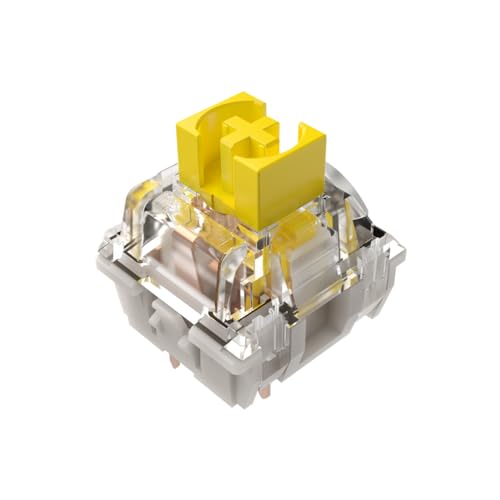
- Akko V3 Creamy Yellow Pro: the modern all-rounder, dustproof stem, 50gf class, 45 pieces.
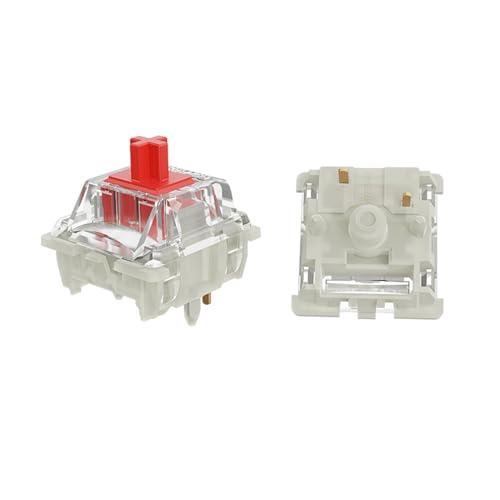
- CHERRY MX2A Red kit: the original linear bloodline in its modern generation, a 36-switch kit.
- Gateron Smoothie: the light, full-POM modern design, dual-stage spring, 40gf class.
Key Takeaways
- Smoothness is the whole product in a linear; every pick here clears a bar that bargain linears fail.
- The Milky Yellow Pro V2 remains the value benchmark against which all other linears are priced in spirit.
- Premium linears such as the Oil King and Tealio sell refinement: spring manners, tolerance density and voice.
- Weight divides the field from the Smoothie’s light 40gf class to the Tealio’s firmer typist tunings.
- Factory pre-lubrication is now standard across the serious linear tier, making stock installation respectable.
How were these linear switches chosen?
Only verified listings were eligible, and from those the guide filtered for the qualities that define a linear in daily use: a stroke free of perceptible scratch, a spring that returns the key without ping or crunch, tolerances that keep the stem composed under tall keycaps, and a factory state a buyer can live with. The seven survivors were then assigned roles rather than ranked into a single ladder, because linear preference is unusually personal: the gamer’s ideal weight insults the typist, the typist’s ideal voice bores the sound chaser, and the budget legend outsells the flagships for reasons that are rational rather than sentimental. Match the role to your desk and the ranking takes care of itself.

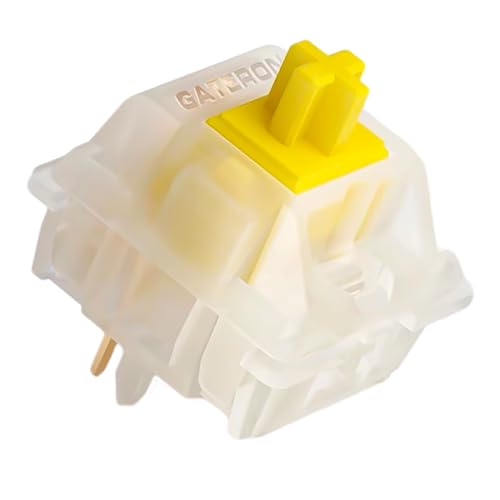
Gateron Milky Yellow Pro V2 — the value legend
Badge: Best linear for most buyers, at any level of experience.
- Type: linear, pre-lubed, 5-pin
- Weight: 50gf class operating force
- Housing character: milky, deep and soft-voiced
- Pack: 72 pieces
Some switches become famous and some become furniture, the default object a whole category arranges itself around, and the Milky Yellow Pro V2 is furniture. Its milky housing lends the stroke a deep, cushioned voice, its factory lubrication is generous and even, and its weight sits in the crossover pocket where typing and gaming shake hands. The V2 revision tightened the tolerances that the original was gently teased for, and the result is a switch that embarrasses products several tiers above it in blind tests. If this guide could keep only one linear, the argument for keeping this one would take about ten seconds, and most of those seconds would be spent acknowledging that the hobby’s worst-kept secret is also its best value.
Strengths
- Deep, pleasant sound that flatters almost any case
- Factory lubrication most owners never feel the need to redo
- Versatile mid weight for mixed typing and gaming desks
Trade-offs
- Milky housing softens backlighting instead of showcasing it
- Popularity means popular counts occasionally sell through
- Its soft voice will not satisfy builders chasing a sharp clack
Best for: nearly everyone, especially first custom builds and sound-led budget boards. Not suited for: shine-through RGB showcases or clack purists.

Gateron Oil King — the smoothness flagship
Badge: Best for buyers who want Gateron’s slickest factory stroke.
- Type: linear, pre-lubed
- Weight: 55g class
- Character: quiet and smooth per the listing
- Pack: 108 pieces
The Oil King is what Gateron builds when the brief is glide above all. The name promises lubrication as a worldview, and the delivered stroke honours it: dense, slick and quiet, with a bottom-out that lands like a book closing in another room. The slightly firmer class than the Milky Yellow gives the return a composed authority that typists notice across long documents, and the big pack treats full-size boards as first-class citizens. Where the Milky Yellow is the people’s champion, the Oil King is the connoisseur’s Gateron, the one bought by owners who have already owned the champion and want to know what the flagship feels like. The answer, it turns out, is this: the same ideas, polished until they shine.
Strengths
- Exceptionally slick, quiet factory stroke
- Firmer weight gives typing a composed, deliberate rhythm
- Large pack suits full-size boards in one purchase
Trade-offs
- Dark, muted character will not voice a bright, clacky build
- Sits above the value tier its sibling owns
- Smoothness this complete can feel anonymous to character-seekers
Best for: smoothness maximalists, full-size typists and quiet-desk builders. Not suited for: bright-sound builds or strict value shoppers.

Tealio V2 — the premium typist’s linear
Badge: Best linear for typing-first endgame boards.
- Type: linear, 5-pin, MX stem
- Weights on the listing: 62g and 67g variants
- Colourway: cyan-teal, SMD RGB compatible
- Lineage: ZealPC design, Gateron-manufactured, KPREPUBLIC listing
- Pack: 70 pieces, 67g shown
The Tealio carries Zeal’s design philosophy into the linear world: feel as a discipline, tolerances as a promise, and a price that assumes the buyer can tell the difference. Its stroke is polished in the specific way typists mean, free of scratch and spring complaint, with a weight ladder aimed at people who write for a living. At 62g it crosses into gaming competently; at 67g it becomes one of the great typing linears, the return firm enough to pace fast fingers, the descent clean enough to disappear under thought. It does not chase the lightest actuation or the loudest voice, because its buyers are purchasing composure, and composure is what it delivers for years without drift.
Strengths
- Reference-grade smoothness with impeccable spring manners
- Typist-tuned weights, including a superb 67g
- Long-documented consistency across packs and years
Trade-offs
- Premium pricing across a full board adds up quickly
- No featherweight option for speed-first players
- Understated character rewards typists more than sound chasers
Best for: writers, programmers and endgame typing builds. Not suited for: ultra-light gaming setups or value-first full-size boards.
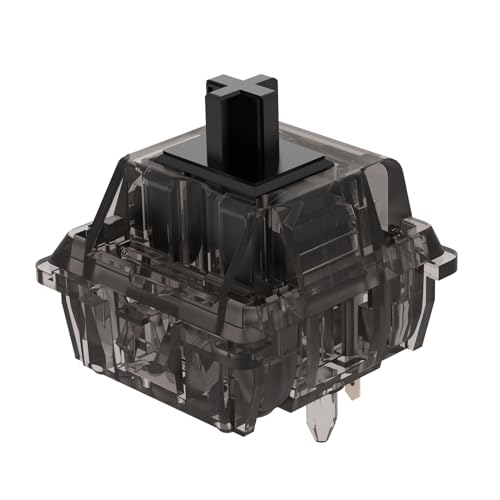
Durock L7 Smokey — the boutique tuner’s linear
Badge: Best for builders who treat a switch as a starting point.
- Type: linear, pre-lubed, 5-pin
- Variant: L7 Smokey, 62g class
- Series: Durock L Series smooth linears
- Pack: 90 pieces
Durock’s L Series speaks to the hobby’s tuning culture, and the L7 Smokey is its smoky-housed representative here: a smooth linear from the factory that nonetheless invites the owner’s hand, filming, spring choices and lubricant preferences all finding purchase in a design built to be finished by its buyer. The 62g class places it in the typist-friendly middle, the factory lubrication gives it a respectable stock voice, and the 90-count pack respects full-size ambitions. Where the Gaterons arrive as answers, the Durock arrives as an excellent question, and builders who enjoy the ritual of tuning will get more from it than its specification suggests.
Strengths
- Smooth factory stroke with deep modding headroom
- Balanced 62g class suits typing-led boards
- Generous pack count for larger layouts
Trade-offs
- Full potential asks for owner tuning time
- Smokey housing dims backlighting by design
- Less universally stocked than the Gateron headliners
Best for: tuners, hobbyist builders and typing boards with personality. Not suited for: install-and-forget buyers or RGB showcases.

Akko V3 Creamy Yellow Pro — the modern all-rounder
Badge: Best polished all-rounder for compact and mid-size boards.
- Type: linear, 5-pin, dustproof stem design
- Weight: 50gf class
- Pack: 45 pieces
- Character: creamy naming, smooth reality
Akko’s V3 Pro platform modernised the company’s switches in one generation, and the Creamy Yellow Pro is its linear standard-bearer. The dustproof boxed stem is the engineering headline, steadying the stroke and slowing the grit that ages linears, while the factory state delivers the smooth, slightly creamy descent the name advertises. At its 50gf class it sits beside the Milky Yellow in the crossover pocket, and the honest comparison between them is a personality contest: Gateron’s deep milky voice against Akko’s tidy modern polish. Either wins depending on the desk, and the fact that a buyer can choose between two such complete linears without leaving the sensible tiers is the modern market in miniature.
Strengths
- Dustproof stem steadies the stroke and extends its life
- Polished factory feel with no immediate modding required
- Crossover weight serves typing and gaming equally
Trade-offs
- 45-piece pack means full-size boards need two
- Character is modern and clean rather than deep-voiced
- Shares its weight pocket with a legendary rival
Best for: compact and tenkeyless builds that want modern polish. Not suited for: one-pack full-size budgets or deep-thock chasers.

CHERRY MX2A Red kit — the original linear, modernised
Badge: Best for purists, samplers and compact builds.
- Type: linear, no click, MX2A generation
- Character per the listing: smooth and direct
- Format: 36-switch kit, RGB variant
- Use: DIY, hot-swap, custom and gaming boards
The red switch is the linear archetype, the design that defined what a smooth, direct keystroke meant for decades of gaming boards, and the MX2A generation is that archetype with its internals brought up to date. The kit format makes it this roundup’s sampler and small-board solution: thirty-six switches complete a compact build or teach a newcomer exactly what the reference linear feels like before they chase boutique variants. Its character is honest and unadorned, lighter in spirit than the typist-tuned picks, quicker in feel than the deep-voiced Gaterons, and historically important in a way that still shows in the typing. Buy it for the education, keep it for the board it suits.
Strengths
- The reference linear lineage with modern-generation refinement
- Kit size suits compact boards and honest sampling
- Direct, unadorned feel that gamers have trusted for years
Trade-offs
- Full-size boards require multiple kits
- Less factory polish theatre than the boutique rivals
- Voice is plain beside the deep Gateron housings
Best for: purists, compact gaming boards and first samplers. Not suited for: one-purchase full-size builds or sound-first typists.

Gateron Smoothie — the light, full-POM modern linear
Badge: Best for light-touch typists and players who want a featherweight glide.
- Type: linear, 5-pin, full POM construction
- Weight: 40gf class operating force
- Spring: 22mm dual-stage, factory pre-lubed
- Pack: 105 pieces
The Smoothie is the roundup’s modernist: full POM construction, a material chosen for its self-lubricating smoothness, a long dual-stage spring that makes the light 40gf class feel controlled rather than flimsy, and a factory pre-lube that lets the materials speak. Light linears live or die by their springs, because a weak spring at low force turns a keyboard into a trampoline of accidental presses, and the dual-stage design is this switch’s answer, a return with shape to it. For players who want speed without mush and typists whose hands prefer the lightest credible touch, the Smoothie is the contemporary answer, packaged in a count that finishes big boards without a second thought.
Strengths
- Full POM smoothness with a genuinely light touch
- Dual-stage spring keeps the light weight controlled
- Large pack covers full-size boards completely
Trade-offs
- Light force invites accidental presses from heavy resting hands
- Bright, modern voice will not satisfy deep-sound builders
- Lightness is a specialism; mid-weight loyalists will find it insubstantial
Best for: light-touch typists, speed-leaning players and full-size modern builds. Not suited for: heavy-handed typists or thock-first sound design.
How to choose a linear switch: smoothness, spring, weight, voice
Four criteria decide a linear, and this guide ranks them in the order your fingers will. Smoothness first, because it is the product: run a slow press and any scratch you feel is a flaw that ten thousand fast presses will not forgive. Spring behaviour second, because the spring writes the return half of every keystroke and its voice, ping, crunch, silence, is the sound your room actually hears most. Weight third, matched to your hands and your games rather than to fashion: light for speed and gentle hands, mid for the crossover majority, firm for typists who like authority. Voice fourth, not because it matters least but because it is the most board-dependent, deepened by milky and smoky housings, brightened by clear ones, and always hostage to the case the switch lands in. A linear that wins the first two criteria for your hands is your linear; the rest is tuning.
zealpc switches deep dive guide
How to install linears and keep them smooth
Installation follows the discipline this site preaches everywhere: inspect pins, seat by the housing, test the first row, keep spares labelled. Linears add one commandment of their own: protect the smoothness you bought. Work on a clean surface, because a single grain of grit inside a linear housing is a scratch you will feel for months. If you lubricate, use a light, even film and keep it off the contact leaves; linears forgive lubricant generosity better than tactiles do, but a drowned switch still feels drowned. And give a new set a week before judging its voice, since springs and factory lubricant settle into their working character across the first days of real typing.
Common linear mistakes
Chasing the lightest weight as a proxy for quality is the first, and the accidental-press frustration it causes has filled many forum threads. Buying a deep-voiced switch for a hollow case and blaming the switch is the second. Over-lubricating until a crisp linear turns viscous is the third. Ignoring the spring’s voice in favour of the bottom-out’s is the fourth, an error of attention rather than of money. And assuming all reds, yellows and clears feel alike because their colours match across brands is the fifth; colour is a dialect, not a standard, and this roundup’s two yellows prove it by feeling nothing alike.
Final recommendation
Start with the Milky Yellow Pro V2 unless your desk gives you a reason not to: it is the linear the most people will love for the longest time. Step up to the Oil King for Gateron smoothness at flagship polish, or to the Tealio for the typist’s endgame. Tune with the Durock, modernise with the Akko, learn the reference with the CHERRY kit, and lighten everything with the Smoothie. Seven switches, seven honest jobs, and not a scratch among them.
cherry mx brown vs red switch compared
The seven picks compared: a field guide
Laid side by side, the roundup resolves into families of intent. The Gateron trio spans the brand’s whole argument: the Milky Yellow as the people’s default, the Oil King as its smoothness flagship, and the Smoothie as its materials experiment, three different answers from one factory that between them cover the majority of desks. The Tealio stands apart as the designer-led premium, priced and tuned for typists. The Durock represents the tuning culture, the Akko the modern platform play with its dustproof stem, and the CHERRY kit the heritage reference that explains where all of them came from. A buyer who understands those seven intents can shop the entire linear market, because every other linear on sale is a variation on one of these themes, a new material here, a new spring there, a new colour over an old idea.
On voice alone the field sorts into the deep camp, Milky Yellow and Oil King, the composed middle, Tealio, Durock and Akko, and the brighter moderns, CHERRY Red and Smoothie. On weight it sorts into the Smoothie’s light class, the crowded crossover middle where the Milky Yellow, Akko and CHERRY live, and the firmer typist territory of the Oil King, Durock and Tealio. Cross those two sortings and your shortlist writes itself: a deep-voiced crossover buyer has exactly one name to sample first, and it is the name this guide has been circling since the introduction.
Linears for gaming: what actually matters in play
Gaming strips a linear down to three working properties: how quickly and consistently it actuates under frantic, imperfect presses, how cleanly it resets for the next input, and how little it asks of the fingers across a long session. By those measures the roundup’s gaming citizens are the Smoothie, whose light class and shaped dual-stage return were practically designed in a lab for rapid play, the CHERRY Red, whose direct character raised generations of players, and the crossover pair, Milky Yellow and Akko, for the majority whose gaming desk is also their everything desk. The typist-tuned picks game perfectly well in ordinary hands; what they decline to do is specialise, and the player whose rank genuinely turns on actuation speed should also be reading about rapid-trigger magnetic boards, a different technology that this mechanical roundup honestly acknowledges as the speed category’s current frontier.
One gaming myth deserves burial inside a linear guide: the idea that a switch can be too smooth to control. Control in play comes from the spring’s return and the keycap’s shape far more than from friction in the stroke, and the players who swear by scratchy switches are usually swearing by a spring they like inside a housing they have not separated from it. Buy the spring behaviour you want, in the smoothest housing that offers it, and the combination will out-play the myth every evening of the week.
Linears for typing: the long-document test
Typing judges linears by a crueller standard than gaming does, because the document is longer than the match and the errors compound in silence. Across eight hours, the properties that matter are return consistency, which paces rhythm, bottom-out manners, which decide whether the desk sounds like rain or like typing, and the absence of any single recurring annoyance, a faint scratch on one letter, a spring’s voice on the spacebar’s neighbours, because repetition turns pinpricks into grievances. That is the test the Tealio was built to pass and the test the Oil King’s composed firmness passes almost as impressively. It is also the test that justifies this guide’s insistence on a sample week: no audition of ninety seconds has ever predicted hour six, and linears, having no bump to hide behind, are the switch type where that truth bites hardest.
Housing materials and the modern linear arms race
The Smoothie’s full-POM construction is a window into where linear design is heading. Housing and stem materials have become the category’s research frontier, because with the basic geometry settled decades ago, friction is now a materials problem: POM’s self-lubricating character, the various nylons’ sound signatures, polycarbonate’s light manners, and proprietary blends each promise a glide with a different accent. Milky housings earned their fame by sounding deep, smoky housings by muting glare and brightness together, and clear housings by serving the backlighting above all. The shopper’s takeaway is refreshingly simple: material claims are audible and feel-able claims, not decoration, and a switch that names its materials plainly, as the Smoothie does, is telling you its design priorities in its first sentence. Sample by material family as much as by brand and your linear education will accelerate noticeably.
Longevity and the linear ageing curve
Linears age more gracefully than any other switch family because they have the fewest events to wear out: no bump leaf to fatigue the feel, no click mechanism to change its mind. What ages a linear is contamination and spring settling, both manageable. Dustproof and boxed stem designs slow the first, quality springs minimise the second, and a board kept reasonably clean will deliver a stroke in year four that its owner would struggle to distinguish from month one. That stability flatters the premium picks’ economics and the budget legend’s alike: a linear purchase is close to a permanent one, which is why this guide treats the sample week as an investment rather than a delay. The switches you choose here are likely to be the switches on the desk when the computer around them has been replaced twice.
Three desks, three linear answers, worked through
Desk one belongs to a student who games at night and writes essays at dawn, on a tenkeyless board that has to do both jobs without complaint. Her shortlist from this guide is the crossover pocket, and her sample week pits the Milky Yellow Pro V2 against the Akko Creamy Yellow Pro on alternate halves of the same board. What decides it is not the slow press, where both feel superb, but the essay hour: the Gateron’s deeper voice keeps the dawn shift pleasant in a quiet house, while the Akko’s tidier polish wins the gaming evening by a nose. She chooses the Milky Yellow for the board and keeps the Akko pack for the macropad she builds next semester, a verdict this guide recognises as the most common real-world outcome of the comparison, because at this level of quality the loser of a sample week is rarely sold, merely reassigned.
Desk two belongs to a software engineer whose output is measured in keystrokes per year and whose wrists have begun submitting formal complaints. His deliberation starts with weight and return rather than with brand, which is why his sample pairs the Tealio at 67g against the Oil King, two firm, composed linears with impeccable springs. The Tealio wins his home row by the quality engineers call boring and typists call perfect: nothing to notice, hour after hour. The Oil King, however, wins the second board in his office, where its quieter landing respects the room. His story carries the guide’s favourite moral about linears, that the flagship tier’s real product is the absence of grievance, and that absence is worth money precisely to the people whose keyboards never rest.
Desk three belongs to a competitive player furnishing a dedicated gaming setup, separate from the family computer, where every component is allowed to be a specialist. Her sample is the Smoothie against the CHERRY Red kit, lightness against lineage, and the dual-stage spring settles it: the Smoothie’s return has a shape that makes rapid repeated inputs feel metered rather than mushy, and its full-size pack finishes her board in one purchase. The CHERRY kit retires to the family board, where its honest directness upgrades a membrane-era desk beyond recognition. Three desks, three different winners, and not one of them the switch a generic ranking would have crowned, which is why this guide organises linears by job instead of by throne.
How to run a linear sample week that actually decides
Sampling linears is a discipline because their differences hide in repetition. Install each finalist under the keys your fingers know best, home row, WASD cluster and the spacebar’s neighbours, because a linear judged only on the letter Q has not been judged at all. Type the same long document on consecutive days rather than improvising, so the comparison holds the work constant and lets the switch vary. Play your most demanding game once on each candidate, noting resets and accidental presses rather than impressions. Record three numbers each day if numbers help you: errors, accidental activations, and the hour at which you first noticed your hands. The candidate that wins the third day usually wins the year, because linears reveal themselves by accumulation, and the buyer who respects that accumulation will never again purchase a full board on the evidence of a thirty-second press in a quiet room.
Keep the losing candidate. A linear pack that loses a sample week becomes the second board’s upgrade, the travel board’s salvation, or the gift that converts a friend, and at the prices this category spans, that afterlife is part of the value. The only genuinely wasted linear purchase is the one made without a sample at full-board scale, which is the purchase this entire guide exists to prevent.
Troubleshooting a linear build that disappoints
Linear disappointment has a short fault tree, and working it in order saves both money and morale. If one key feels scratchy while its neighbours glide, the cause is one contaminated or outlier switch; swap it from the pack’s spares before touching anything else, because a linear’s uniformity makes single-unit faults feel like system failures. If the whole board sounds higher and thinner than the sample promised, the case and keycaps are the story, and foam, a desk mat and thicker caps will recover the voice you auditioned. If accidental presses plague a light build, the honest fix is technique for a week, since light linears expose resting-finger habits that heavier switches concealed, and only if the problem survives the week is a firmer spring the answer. If a spring voice emerges on a few keys, a drop of spring lubricant, applied by owners comfortable opening switches, settles it without a new pack. Genuine batch-wide defects are rare among the makers in this guide, and they should be the last hypothesis standing, not the first one funded.
Linears and the rest of the instrument
A linear switch is the most honest component in a keyboard, which means it exposes everything around it. Stabilisers that a tactile’s bump might have masked will announce themselves on a linear board, keycaps with thin walls will brighten a deep switch past recognition, and a hollow case will turn a flagship glide into a drum recital. This is not an argument against linears; it is the reason linear owners become good builders. The switch teaches you to hear the whole instrument, and the fixes it demands, tuned stabilisers, honest caps, a damped case, pay rent on every future board you assemble. Buy your linear with a small reserve of attention budgeted for its supporting cast, and the combination will outperform a costlier switch dropped into an indifferent build, a result this guide has now asserted often enough that regular readers can recite it, because it remains the most reliably true sentence in switch shopping.
The linear market’s direction, and what it means for this purchase
Linears are the category where the hobby’s engineering energy currently concentrates, and a buyer benefits from knowing the weather. Materials research, as the Smoothie’s full-POM design shows, is producing genuinely new glides rather than new colours for old ones. Spring design has become a discipline of its own, with dual-stage and long springs selling return character as a feature in its own right. Factory lubrication has industrialised to the point where the hand-lubing ritual, once the linear owner’s initiation, is now an optional refinement for most buyers. And at the category’s edge, magnetic rapid-trigger designs are absorbing the pure-speed conversation, which paradoxically clarifies the mechanical linear’s identity: it is the feel-first, sound-aware, decades-proven technology, bought for the quality of the stroke rather than the nanoseconds of the actuation. Every pick in this guide sits comfortably inside that identity, which is why none of them will feel obsolete next season; the category is refining, not replacing, and refinement is a tide that lifts the switches already on your desk.
Matching a linear to your keycaps and plate
Two pairings decide how a chosen linear actually lands. Keycaps first: tall profiles lengthen the stem’s lever and make any linear feel marginally weightier and sound marginally deeper, while low profiles quicken the event and brighten the voice, so a Smoothie under tall caps and a Smoothie under low caps are cousins rather than twins. Thick walls deepen every switch in this guide, thin walls brighten every one, and a buyer auditioning on stock caps should know the audition is provisional until their real caps arrive. Plate material second: soft plates, plastic and polycarbonate, add a give that flatters linears by cushioning the bottom-out, while stiff metal plates keep the stroke exact and the voice crisp. None of these combinations rescues a poor switch or ruins a great one, but across seven picks this good, the pairings are where the final personality is set, and they are cheaper to change than the switches themselves.
What a linear teaches you about your own typing
There is a diagnostic gift hidden in every linear board: with no bump to lean on, your technique is exposed. Typists discover whether they bottom out every stroke or float, whether their accuracy came from their eyes or their fingers, and whether their speed was ever really theirs or partly the tactile’s confirmation carrying them. The first week on a linear can feel like a small demotion for exactly this reason, and the guide’s counsel is to let the week finish before sentencing the switch. Most typists emerge from it faster and quieter in their hands, because the linear forced the skill into the fingers where it belongs. Those who genuinely miss feedback after an honest month have learned something equally valuable, that they are tactile typists at the level of identity, and the roundup’s sibling guides exist to serve that discovery. Either way, a season on linears is an education no switch collection is complete without, and the seven picks above are its most reliable teachers at every tier.
Keeping linears at their best across the years
Stewardship of a linear board is mostly a matter of defending smoothness from the environment. A cover or a weekly blast of air keeps grit out of the housings, and grit is the one adversary that can genuinely rewrite a glide. Keep liquids at the distance every keyboard deserves, and treat any spill as an immediate power-off and drying exercise rather than a wait-and-see. If a single switch’s character drifts, swap it from the spares before investigating the board, and store those spares sealed and labelled by name and weight, because linear families multiply quietly across a hobbyist’s drawer and their colours will not identify them for you in two years’ time. Attended that lightly, the picks in this guide will deliver their purchase-day stroke for the working life of the desk itself, which is the final economic argument for buying the linear you actually want the first time: in this category more than any other, you are going to be living with the decision for a very long while.
The one-paragraph version for the reader in a hurry
Milky Yellow Pro V2 if you want the default answer that has never embarrassed anyone. Oil King if you want Gateron’s glide at flagship polish on a full-size board. Tealio V2 if you type for a living and want the reference. Durock L7 if you enjoy finishing a switch yourself. Akko Creamy Yellow Pro if you want modern polish on a compact board. CHERRY MX2A Red if you want the original, in kit form, for a small build or an education. Smoothie if your hands and your games both vote for light. That is the roundup, and the longer way of saying it fills the pages above because the differences, while real, live in exactly the details those pages describe.
Why this guide refuses to crown a single winner
Rankings sell certainty, and linear switches punish it. The stroke a writer calls perfect composure, a player calls delay; the voice a builder calls deep, a roommate calls present. A guide that forced these seven into a single podium would be answering a question nobody’s hands actually asked. What the guide offers instead is a map with the territories honestly drawn, the value legend here, the typist’s reference there, the light modernist in the corner, and the confidence that any of them, matched to the right desk, becomes the correct answer so completely that its owner will argue for it online. That argument, multiplied across thousands of desks, is how each of these switches earned its place in this roundup, and it is the most trustworthy ranking the category supports.
A final word on springs, the linear’s hidden half
If this guide leaves you with one technical habit, let it be spring literacy. Read every future linear listing for its spring story first: single or dual-stage, long or standard, the class of its force and the reputation of its return. The stem and housing get the photographs, but the spring writes half of every keystroke you will ever make on the switch, governs the reset your games depend on, and sings the note your room hears most often. The seven picks above were chosen partly because their springs behave like adults, no ping, no crunch, no surprises at hour six, and a shopper who learns to audition springs before housings will find that the entire linear market suddenly sorts itself into switches that respect the return and switches that merely survive it. Buy from the first group, whichever badge it wears, and your board will feel considered every time your fingers come home.
And when the sample week ends and the full pack is in the board, give the finished keyboard one honest evening before you write its review anywhere, including in your own head. Linears settle, springs relax into their working voice, factory lubricant finds its final distribution, and the board on day eight is the board you actually bought. The seven switches in this guide were all chosen to still be pleasing you on day eight hundred, which is the only day count that separates a recommendation from a first impression.
Linears on the road: travel and second-desk duty
One deployment this guide has not yet priced in is the travelling board, and linears own it. A linear board in a laptop bag offends no train carriage, survives the knocks of transit with the fewest mechanisms to disturb, and asks nothing of an unfamiliar desk beyond a cable. The crossover picks travel best, since the same board must game in the evening and type in the morning, and their mid weights read as correct in both countries. Owners who travel with the Tealio or the Oil King report the small luxury of a flagship stroke in temporary places, while the Milky Yellow’s replaceable-everywhere status makes it the road warrior’s insurance policy. Whichever pick travels with you, a hard case is the accessory that protects the investment, because a linear’s smoothness is a precision surface and precision surfaces deserve luggage that respects them.
Trust the process the guide has laid out and the category becomes simple: shortlist by job, sample by week, judge by accumulation, and keep the runner-up for the second board it was always destined for. The best linear switches are not the ones with the loudest claims; they are the ones still gliding, unnoticed and unresented, under the ten-thousandth sentence of the year, and every pick on this page has the record to promise exactly that.
What about mixing linears on one board?
Mixed boards deserve a defence in a guide that has mostly preached single-family purity. A firmer linear under the spacebar and thumbs, a lighter set under the pinkies, a crossover weight everywhere else: hands are not uniform, and a board tuned by finger is not indecision but ergonomics with the courage of its convictions. The roundup’s weight spread makes such tuning practical within two or three packs, and the shared design languages inside each maker’s range keep a mixed board coherent in voice. The discipline is to mix by plan, heavier where the hand is stronger and lighter where it is weakest, rather than by whatever the drawer happens to hold, and to live with the plan for a month before revising it. Many endgame boards are mixed boards whose owners stopped apologising for them years ago.
So the guide ends where it began, with an absence that turns out to be a presence: the best linear switch is the one whose nothing, no bump, no scratch, no complaint, you can build a whole typing life on top of. Seven ways of achieving that nothing are documented above, at seven combinations of price, weight and voice, and the desk in front of you already knows which one it wants. Sample it, confirm it, and then enjoy the peculiar pleasure of a component so well chosen that you stop thinking about it entirely.
One practical promise to close: whichever of the seven you choose, buy it from the verified listing linked in its review, confirm the variant and count on the page before checkout, and keep the pack’s spares somewhere you will remember in three years. Those three small habits protect the purchase completely, and they are the difference between a switch that arrives as researched and a switch that arrives as a surprise.
The linear shelf will keep moving after this guide is published, new materials, new springs, new names over familiar ideas, and the criteria in these pages are built to outlast the catalogue they currently describe. Judge the next arrival by its stroke, its spring, its weight honesty and its voice, sample it by the week, and it will have to earn its place against the seven benchmarks above rather than against a headline. That is all any guide can honestly offer: not a permanent winner, but a permanent method, and a starting seven that the method itself keeps re-electing.
Now go and press some switches slowly, the way this guide taught you, and listen to the springs. The right one is on this page, and your fingers, given a fair week, will point straight at it.
Remember, too, that a linear board is the easiest keyboard in the world to lend, gift and recommend, because its virtues need no acquired taste to appreciate. Friends who would bounce off a heavy tactile or a loud clicky understand a good linear in one sentence typed on it, which makes the packs in this guide the hobby’s most reliable ambassadors. Choose yours well and it will recruit for the hobby every time someone else sits down at your desk, long after your own deliberation has faded into the simple pleasure of typing on the thing.
That is the whole of it: seven verified linears, four criteria, one sample week, and a board that disappears under your work for years. The guide is long because the decision deserves better than a podium, and the decision, made this way, is one you will not need to remake when the next season’s colours arrive.
One closing thought for the undecided: smoothness is the easiest quality to undervalue in a showroom and the hardest to give up at a desk. If the linear idea appeals at all, give it the honest fortnight this page recommends, on a board that lets you change your mind switch by switch, and let the second week cast the vote the first week is too noisy to hear.
Frequently asked questions
Are linear switches better for gaming than tactiles?
For speed-focused play, generally yes: nothing interrupts the stroke, and repeated presses feel uniform. For mixed desks the advantage narrows, and many players happily game on tactiles. This roundup’s crossover picks, the Milky Yellow and the Akko, exist for exactly that mixed reality.
Which linear switch is the smoothest?
The Oil King and the Tealio contest that title at the flagship end, with the Smoothie’s full-POM construction making a materials-based case of its own. The Milky Yellow Pro V2 remains the smoothness benchmark once value enters the sentence.
What weight linear should a typist choose?
Most typists settle in the mid-to-firm classes represented here by the Oil King and the Tealio’s 67g, where the return paces fast fingers. Light classes like the Smoothie’s suit gentle hands and speed play but punish heavy resting fingers with accidental presses.
Do linear switches need lubrication?
Every pick in this guide arrives pre-lubed or factory-finished to a standard most owners keep. Lubrication becomes a tuning choice rather than a necessity, and the standing advice is a week of stock typing before any switch is opened.
Why do two yellow switches in this guide feel different?
Because switch colours are each maker’s internal language, not an industry standard. The Milky Yellow Pro and the Creamy Yellow Pro share a colour family and a weight pocket but differ in housing, stem design and voice. Always shop by the full product name and its verified listing, never by colour alone.
Can linear switches work for an office?
Yes, linears without any click mechanism are among the more presentable switch types, and the quieter picks here, the Oil King above all, suit shared spaces well. Truly silent requirements call for dedicated silent linears, which are a separate category from this roundup’s seven.