Disclosure: As an Amazon Associate, kajuandouglas.com earns from qualifying purchases. Links to Amazon on this page are affiliate links; they cost you nothing extra. Listing details such as price and availability change often, so check the current Amazon listing before you buy.
Where to buy
If you are shopping for best indoor tv antenna for multiple tvs, start here: every linked pick in this guide is sold on Amazon, where you can check the current price, stock status, delivery window and return terms on the listing itself before you commit. Prices and availability for antenna models move constantly — especially around sale events — so treat the Amazon listing as the source of truth at the moment you order, and complete your purchase there so the order, warranty registration and returns all sit in one place. This site may earn a commission on qualifying purchases made through these links, at no extra cost to you.
- Mohu Leaf Ultimate Amplified Indoor Antenna — the Leaf with a signal meter to guide placement
- Winegard FlatWave FL5500A Amplified Indoor Antenna — the amplified flat antenna for metro and suburban homes
- Antennas Direct ClearStream Eclipse Indoor Antenna — the reversible flat antenna that grips to a window
- Channel Master FLATenna Indoor Antenna — Channel Master’s honest, unamplified flat antenna
- GE Flat Panel Indoor HD Antenna (33681) — flat panel plus rabbit ears — the VHF-friendly indoor design
- Antennas Direct ClearStream JUICE4 Distribution Amplifier — clean four-way distribution without splitter loss
Read the full guide ↓
Finding the best indoor tv antenna for multiple tvs is less about chasing the longest spec sheet and more about matching the product to the job you actually have. Indoor antennas and multiple TVs are natural enemies — splitting an already modest indoor signal divides it further — so this guide is honest about what works: a strong indoor antenna, the shortest possible runs, and amplification chosen carefully. This guide narrows the field to six picks that each do a distinct job, so instead of one winner forced onto every reader, you get the right answer for feeding multiple TVs from an indoor antenna — and honest notes on where each option gives something up.
The trap with best indoor tv antenna for multiple tvs is that headline claims hide the compromises. Marketing leads with the one number that looks best in a comparison chart, while the details that decide daily satisfaction — build quality, software support, the accessories in the box, how the thing behaves on an ordinary Tuesday — get buried. The picks below were chosen on the factors that survive contact with real use, and every linked model had its key specifications cross-checked against its Amazon listing and the manufacturer’s own pages.
Who is this for? Renters and apartment dwellers who cannot mount anything outside who want a decision they do not have to revisit. If your priority sits outside that brief, the Related Guides at the end point to the neighbouring shortlists. Otherwise, read the Quick Picks table, jump to the one or two reviews that match your situation, and use the buying guide sections to sanity-check the choice before you order.
Key Takeaways
- Indoor multi-TV works best in strong-signal areas; be honest about your distance from towers.
- A signal indicator is worth real money indoors — placement is everything.
- Splitting indoors demands a distribution amplifier, not a passive splitter.
- Sometimes the right answer is one antenna per TV; this guide flags where.
- VHF channels are the indoor weak point — dipole designs help.
In this guide
Quick Picks
If you only have a minute, this table is the whole guide in miniature: six picks for best indoor tv antenna for multiple tvs, each with a distinct job, ordered the same way they are reviewed in depth below. Start with the badge that matches your situation, read that one review closely, and use the others as cross-checks.
| Badge | Pick | Why it stands out | Link |
|---|---|---|---|
| Best Overall | Mohu Leaf Ultimate Amplified Indoor Antenna | the Leaf with a signal meter to guide placement | Check price on Amazon |
| Best Amplified | Winegard FlatWave FL5500A Amplified Indoor Antenna | the amplified flat antenna for metro and suburban homes | Check price on Amazon |
| Best for Windows | Antennas Direct ClearStream Eclipse Indoor Antenna | the reversible flat antenna that grips to a window | Check price on Amazon |
| Best Unamplified | Channel Master FLATenna Indoor Antenna | Channel Master’s honest, unamplified flat antenna | Check price on Amazon |
| Best for VHF | GE Flat Panel Indoor HD Antenna (33681) | flat panel plus rabbit ears — the VHF-friendly indoor design | Check price on Amazon |
| Best for Splitting | Antennas Direct ClearStream JUICE4 Distribution Amplifier | clean four-way distribution without splitter loss | Check price on Amazon |
How These Picks Were Chosen
Shortlisting for best indoor tv antenna for multiple tvs started from the full field of options a buyer would realistically consider, then applied the filters below in order. Manufacturer specifications were cross-checked against retailer listings for every linked model, and any product whose key claims could not be verified was either dropped or kept as a clearly labelled prose-only pick with no link. Because prices change constantly, no pick was chosen or rejected on a price seen on any single day; value judgements here are about what the hardware and software deliver relative to their tier, and you should confirm the current figure on Amazon before ordering.
- Reception type matched to your towers: VHF versus UHF band coverage checked against the channels you actually need.
- Rated range treated as a best-case figure and discounted — terrain, roofing material and trees matter more than the box claim.
- Amplification judged carefully: an amplifier helps long cable runs and splits, but over-amplifying strong signals causes dropouts.
- Multi-TV readiness assessed on the whole chain — antenna, amplifier, splitter and coax — not the antenna alone.
- Mounting and weatherproofing verified for attic and outdoor models, including the hardware actually included in the box.
- Connector and cable quality checked; a corroded F-connector undoes an expensive antenna.
One more note on method: badges are assigned per article, not per product. The same model can be a Best Overall pick in one guide and a Runner-Up in another, because the right answer depends on the angle — and the angle here is feeding multiple TVs from an indoor antenna, for renters and apartment dwellers who cannot mount anything outside.
The Best Indoor TV Antenna for Multiple TVs
Six picks follow, in the same order as the Quick Picks table. Each review covers who the pick suits, the verified specifications that matter, three genuine strengths, three honest trade-offs, and a blunt choose-it/skip-it verdict, so you can stop reading the moment you find the one that matches your brief.

Mohu Leaf Ultimate Amplified Indoor Antenna
Badge: Best Overall
| Type | Indoor flat, amplified |
| Bands | UHF + VHF |
| Pattern | Multi-directional |
| Cable | 12 ft included |
| Feature | Signal indicator |
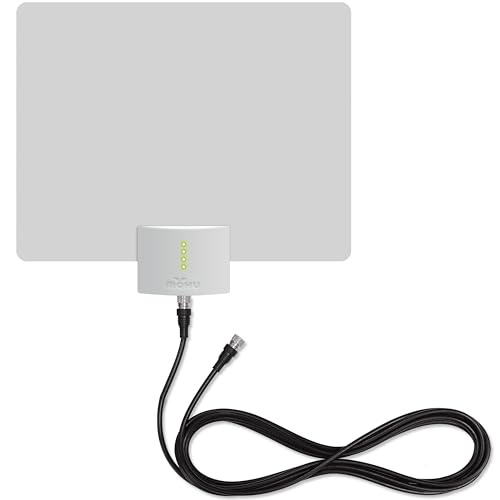
The Leaf Ultimate adds a signal indicator to Mohu’s famous paper-thin design, so you can watch reception change as you move the antenna — the feature indoor antennas always needed. It sits at the middle of the range, where most buyers get the best balance of capability and cost. The verified specification reads: Type: Indoor flat, amplified; Bands: UHF + VHF; Pattern: Multi-directional; Cable: 12 ft included. None of those numbers exists in isolation — together they describe a product built around a clear idea of its user, and the review below tests that idea against the brief of this guide rather than against products twice its price.
Living with the Mohu Leaf Ultimate Amplified Indoor Antenna means living with a clear set of priorities. It was not designed to win every comparison row; it was designed to be right for a particular user, and within that design brief it is thorough. The strengths below are the reasons it earned its badge in a guide about best indoor tv antenna for multiple tvs; the trade-offs are stated just as plainly, because a pick that suits your neighbour’s brief may be wrong for yours.
Judged strictly against best indoor tv antenna for multiple tvs, the Mohu Leaf Ultimate Amplified Indoor Antenna makes its case through consistency: type of Indoor flat, amplified, bands of UHF + VHF, pattern of Multi-directional. Nothing about it is a party trick, and that is the point — feeding multiple TVs from an indoor antenna rewards equipment that disappears into the routine. Readers who value predictable, repeatable results over novelty will find this an easy model to live with, and an easy one to recommend to someone with the same brief.
Strengths
- Signal indicator makes placement methodical
- Amplified for suburban reach
- 12 ft cable gives placement freedom
Trade-offs
- Amplifier can overload near towers
- Indicator is a guide, not a measurement instrument
- Costs more than basic flat antennas
Choose it if indoor users who struggle to find the sweet spot — and if the trade-offs above read like things you can live with rather than things you would fight daily. Skip it if roof or attic installations; the guide’s other picks cover that ground better, and forcing this one into the wrong brief helps nobody.
Best for: indoor users who struggle to find the sweet spot / Not suited for: roof or attic installations
Winegard FlatWave FL5500A Amplified Indoor Antenna
Badge: Best Amplified
| Type | Indoor flat, amplified |
| Bands | UHF + VHF |
| Pattern | Multi-directional |
| Rated range | 60 miles (best case) |
| Finish | Dual-colour reversible |
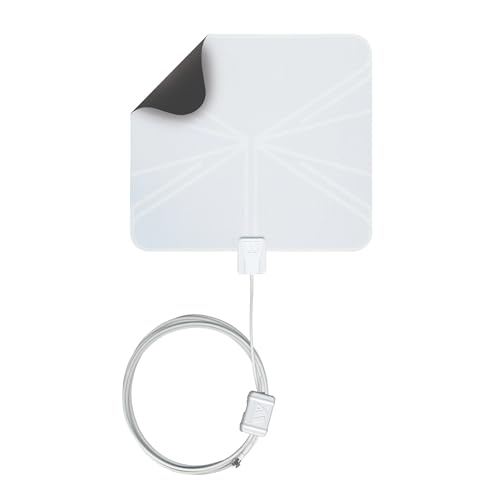
The FlatWave FL5500A is Winegard’s amplified indoor flat antenna — thin, reversible, and tuned for metro and suburban reception where a little gain helps. This is a product at the accessible end of the range, where the design brief is value first and the compromises are chosen carefully, and its verified specification — Type: Indoor flat, amplified; Bands: UHF + VHF; Pattern: Multi-directional; Rated range: 60 miles (best case) — shows a manufacturer spending money on the things its target user touches daily. Whether that targeting matches your brief is the question this review answers, in strengths, trade-offs and a plain verdict.
In everyday use, the pattern that emerges is consistency. The Winegard FlatWave FL5500A Amplified Indoor Antenna does not rely on one spectacular feature to excuse ordinary performance elsewhere; the basics are executed at the same level as the highlights, which is rarer than it should be. Owners coming from an older or cheaper alternative will notice the difference most in the tasks they repeat daily — the ones that never make it into a headline but decide whether a product gets recommended or replaced.
The Winegard FlatWave FL5500A Amplified Indoor Antenna answers the best indoor tv antenna for multiple tvs question with a specification that reads like it was written for the brief: type of Indoor flat, amplified, bands of UHF + VHF, pattern of Multi-directional. In practice that means fewer workarounds, fewer settings to babysit, and fewer moments where the product reminds you it was a compromise. If feeding multiple TVs from an indoor antenna is genuinely your priority — rather than a nice-to-have — this is one of the shortest paths to getting it right the first time.
Strengths
- Built-in amplifier helps marginal indoor signals
- Reversible finish blends with walls
- Established design with broad retail support
Trade-offs
- Amplification can overload near-tower homes
- Indoor placement still caps VHF results
- Flat antennas are placement-sensitive
The short version: choose it if apartments and suburban rooms without attic access. Skip it if homes very close to transmitters — in that case, one of the other five picks in this guide was quite literally shortlisted for you instead.
Best for: apartments and suburban rooms without attic access / Not suited for: homes very close to transmitters

Antennas Direct ClearStream Eclipse Indoor Antenna
Badge: Best for Windows
| Type | Indoor flat |
| Bands | UHF |
| Pattern | Multi-directional |
| Cable | 12 ft included |
| Rated range | 35+ miles (best case) |
The Eclipse is a reversible black/white flat UHF antenna that sticks to walls and windows, with a 12-foot cable for placement freedom. Positioned at the accessible end of the range, where the design brief is value first and the compromises are chosen carefully, it is specified as follows: Type: Indoor flat; Bands: UHF; Pattern: Multi-directional; Cable: 12 ft included. Read as a whole, that sheet tells you exactly who this was designed for, and the sections below judge it on that basis — what it does for renters and apartment dwellers who cannot mount anything outside, where it leads its rivals, and where it honestly gives ground.
What distinguishes the Antennas Direct ClearStream Eclipse Indoor Antenna in daily life is how little managing it needs. Setup is a one-time job rather than a recurring chore, the controls and defaults are sensible, and the product recedes into the routine it was bought for. That quality is hard to capture in a specification table, but it is exactly what separates the picks in this guide from the longer list of alternatives that were considered and set aside.
The Antennas Direct ClearStream Eclipse Indoor Antenna answers the best indoor tv antenna for multiple tvs question with a specification that reads like it was written for the brief: type of Indoor flat, bands of UHF, pattern of Multi-directional. In practice that means fewer workarounds, fewer settings to babysit, and fewer moments where the product reminds you it was a compromise. If feeding multiple TVs from an indoor antenna is genuinely your priority — rather than a nice-to-have — this is one of the shortest paths to getting it right the first time.
Strengths
- Window placement often beats a wall behind the TV
- Reversible colours blend with decor
- Long included cable
Trade-offs
- UHF only — VHF channels may be missed
- Range figure assumes ideal conditions
- Adhesive mounting is not renter-proof on all paints
Choose it if apartments with a window facing the towers — and if the trade-offs above read like things you can live with rather than things you would fight daily. Skip it if homes needing VHF network channels; the guide’s other picks cover that ground better, and forcing this one into the wrong brief helps nobody.
Best for: apartments with a window facing the towers / Not suited for: homes needing VHF network channels
Channel Master FLATenna Indoor Antenna
Badge: Best Unamplified
| Type | Indoor flat |
| Bands | UHF + VHF |
| Pattern | Multi-directional |
| Cable | 12′ included |
| Tuner | ATSC / NextGen TV |
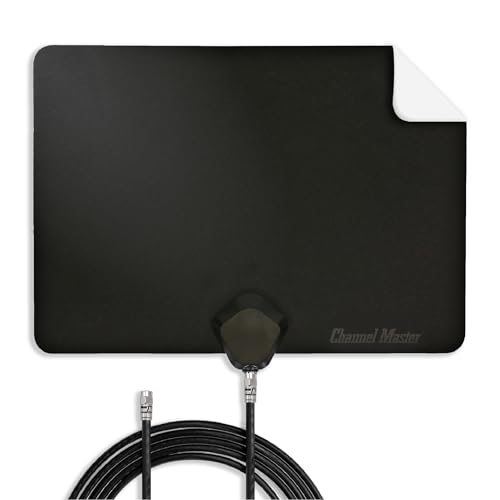
The FLATenna is Channel Master’s indoor flat antenna — a conservatively rated, well-made panel from a brand that publishes honest specifications. This is a product at the accessible end of the range, where the design brief is value first and the compromises are chosen carefully, and its verified specification — Type: Indoor flat; Bands: UHF + VHF; Pattern: Multi-directional; Cable: 12′ included — shows a manufacturer spending money on the things its target user touches daily. Whether that targeting matches your brief is the question this review answers, in strengths, trade-offs and a plain verdict.
Living with the Channel Master FLATenna Indoor Antenna means living with a clear set of priorities. It was not designed to win every comparison row; it was designed to be right for a particular user, and within that design brief it is thorough. The strengths below are the reasons it earned its badge in a guide about best indoor tv antenna for multiple tvs; the trade-offs are stated just as plainly, because a pick that suits your neighbour’s brief may be wrong for yours.
Where the Channel Master FLATenna Indoor Antenna fits the best indoor tv antenna for multiple tvs brief is in the details you feel every day: type of Indoor flat, bands of UHF + VHF, pattern of Multi-directional. Shoppers comparing options for feeding multiple TVs from an indoor antenna often fixate on one spec and miss how the whole package behaves together; here the package is coherent, with no single weak link that undermines the rest. For renters and apartment dwellers who cannot mount anything outside, that balance is usually worth more than a longer feature list on a rival that cuts corners somewhere less visible.
Strengths
- Honest range figures from a heritage broadcast brand
- Long 12-foot cable included
- Works with NextGen TV tuners
Trade-offs
- Unamplified — not for weak signals
- Flat-panel placement rules apply
- Design is plain
The short version: choose it if metro homes wanting a quality basic indoor antenna. Skip it if fringe reception — in that case, one of the other five picks in this guide was quite literally shortlisted for you instead.
Best for: metro homes wanting a quality basic indoor antenna / Not suited for: fringe reception
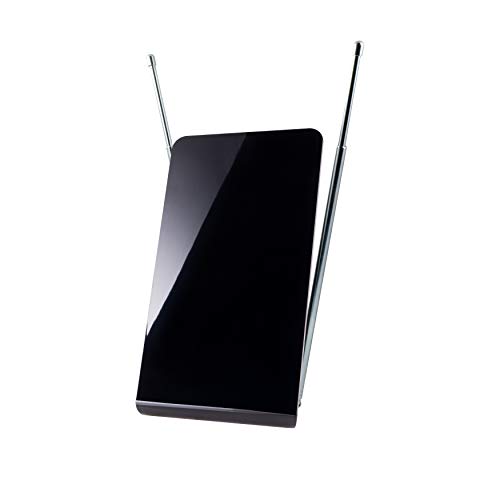
GE Flat Panel Indoor HD Antenna (33681)
Badge: Best for VHF
| Type | Indoor panel + dipoles |
| Bands | UHF + VHF |
| Extras | Extendable dipole rabbit ears |
| Cable | 5 ft included |
| Stand | Adjustable included |
GE’s flat panel adds extendable dipole rabbit ears to the modern flat design, giving VHF channels the element length that pure flat panels lack. It sits at the accessible end of the range, where the design brief is value first and the compromises are chosen carefully. The verified specification reads: Type: Indoor panel + dipoles; Bands: UHF + VHF; Extras: Extendable dipole rabbit ears; Cable: 5 ft included. None of those numbers exists in isolation — together they describe a product built around a clear idea of its user, and the review below tests that idea against the brief of this guide rather than against products twice its price.
What distinguishes the GE Flat Panel Indoor HD Antenna (33681) in daily life is how little managing it needs. Setup is a one-time job rather than a recurring chore, the controls and defaults are sensible, and the product recedes into the routine it was bought for. That quality is hard to capture in a specification table, but it is exactly what separates the picks in this guide from the longer list of alternatives that were considered and set aside.
Judged strictly against best indoor tv antenna for multiple tvs, the GE Flat Panel Indoor HD Antenna (33681) makes its case through consistency: type of Indoor panel + dipoles, bands of UHF + VHF, extras of Extendable dipole rabbit ears. Nothing about it is a party trick, and that is the point — feeding multiple TVs from an indoor antenna rewards equipment that disappears into the routine. Readers who value predictable, repeatable results over novelty will find this an easy model to live with, and an easy one to recommend to someone with the same brief.
Strengths
- Rabbit ears genuinely help VHF indoors
- Stand included for shelf placement
- Familiar big-brand availability
Trade-offs
- Short 5 ft cable limits placement
- Dipoles are visually old-school
- Indoor limits remain indoor limits
Choose it if indoor viewers whose missing channels are on VHF — and if the trade-offs above read like things you can live with rather than things you would fight daily. Skip it if minimalist living rooms; the guide’s other picks cover that ground better, and forcing this one into the wrong brief helps nobody.
Best for: indoor viewers whose missing channels are on VHF / Not suited for: minimalist living rooms

Antennas Direct ClearStream JUICE4 Distribution Amplifier
Badge: Best for Splitting
| Type | Distribution amplifier |
| Outputs | 4 TVs |
| Power | 12V DC adapter included |
| Cable | RG6 jumper included |
| Tuner | NEXTGEN TV ready |
The JUICE4 replaces a passive splitter with powered distribution to four televisions, compensating for split losses so every TV sees a healthy signal. It sits at the middle of the range, where most buyers get the best balance of capability and cost. The verified specification reads: Type: Distribution amplifier; Outputs: 4 TVs; Power: 12V DC adapter included; Cable: RG6 jumper included. None of those numbers exists in isolation — together they describe a product built around a clear idea of its user, and the review below tests that idea against the brief of this guide rather than against products twice its price.
What distinguishes the Antennas Direct ClearStream JUICE4 Distribution Amplifier in daily life is how little managing it needs. Setup is a one-time job rather than a recurring chore, the controls and defaults are sensible, and the product recedes into the routine it was bought for. That quality is hard to capture in a specification table, but it is exactly what separates the picks in this guide from the longer list of alternatives that were considered and set aside.
Judged strictly against best indoor tv antenna for multiple tvs, the Antennas Direct ClearStream JUICE4 Distribution Amplifier makes its case through consistency: type of Distribution amplifier, outputs of 4 TVs, power of 12V DC adapter included. Nothing about it is a party trick, and that is the point — feeding multiple TVs from an indoor antenna rewards equipment that disappears into the routine. Readers who value predictable, repeatable results over novelty will find this an easy model to live with, and an easy one to recommend to someone with the same brief.
Strengths
- Four outputs with gain rather than loss
- Purpose-built for antenna distribution
- Includes power adapter and jumper cable
Trade-offs
- Four outputs is the ceiling
- Needs mains power at the distribution point
- Will not fix a weak antenna signal by itself
Choose it if homes feeding three or four TVs from one antenna — and if the trade-offs above read like things you can live with rather than things you would fight daily. Skip it if single-TV setups; the guide’s other picks cover that ground better, and forcing this one into the wrong brief helps nobody.
Best for: homes feeding three or four TVs from one antenna / Not suited for: single-TV setups
Comparison Table
Badges tell you the job each pick does; this table lines up the verified specifications side by side so you can spot the differences that actually separate them. Where a cell shows a dash, that specification does not apply to the pick or could not be verified — another reason to read the full review rather than buying from a table alone.
| Pick | Type | Bands | Pattern | Cable |
|---|---|---|---|---|
| Mohu Leaf Ultimate Amplified Indoor Antenna | Indoor flat, amplified | UHF + VHF | Multi-directional | 12 ft included |
| Winegard FlatWave FL5500A Amplified Indoor Antenna | Indoor flat, amplified | UHF + VHF | Multi-directional | — |
| Antennas Direct ClearStream Eclipse Indoor Antenna | Indoor flat | UHF | Multi-directional | 12 ft included |
| Channel Master FLATenna Indoor Antenna | Indoor flat | UHF + VHF | Multi-directional | 12′ included |
| GE Flat Panel Indoor HD Antenna (33681) | Indoor panel + dipoles | UHF + VHF | — | 5 ft included |
| Antennas Direct ClearStream JUICE4 Distribution Amplifier | Distribution amplifier | — | — | RG6 jumper included |
Buying Guide: How to Choose a TV for feeding multiple TVs from an indoor antenna
Start with the room, not the catalogue. Measure the distance from the main seat to the screen wall, note which windows face the screen at viewing hours, and check the width of the furniture the set will sit on or the wall space it will occupy. Indoors, placement is the specification: a window facing the towers can outperform a bigger antenna in the wrong corner. Those three measurements eliminate half the market immediately and turn the search for the best indoor tv antenna for multiple tvs from a spec contest into a fitting exercise — which is what it should be, because a television is furniture you stare at for a decade.
Panel technology is the next decision, and it is a genuine fork rather than a ladder. OLED gives perfect blacks and per-pixel control that flatter films and prestige TV, but caps out lower on sustained full-screen brightness. Mini-LED LCD goes much brighter, shrugs off sunny rooms and static logos, and is usually cheaper per inch, at the cost of some blooming around bright objects on dark backgrounds. Plain LED with no local dimming is the budget tier: fine for news and casual viewing, visibly greyer with anything cinematic. Decide which weakness you can live with; every TV at every price has one.
Finally, be honest about the budget. Spend on the antenna with the best placement options and one good distribution amplifier; two cheap antennas in two rooms often beat one split signal. Within a fixed ceiling, money spent on panel quality keeps paying you back every night, while money spent on exotic audio modes or designer stands does not — a soundbar can be added later, but you cannot retrofit local dimming. Check the current price of your shortlist on Amazon on the day you buy, because television pricing swings harder than almost any other category.
The Specifications That Actually Matter
Native refresh rate is the first number to verify, because it is the most abused. A panel described with a large ‘motion rate’ or ‘effective rate’ is often a 60Hz panel with processing on top; the manufacturer’s own spec sheet lists the native figure. For sport and gaming, native 120Hz is the meaningful step up. For films and general viewing, a good 60Hz panel with clean processing beats a poor 120Hz one, so do not let this single number veto an otherwise better set.
HDR is a format war you need to referee before buying. HDR10 is universal, Dolby Vision appears on most premium streaming content, HDR10+ is Samsung’s rival, and HLG is what broadcasters use. Few TVs carry all four. Match the set to your sources: if your streaming life runs through services that favour Dolby Vision, a set without it will play those titles in a lesser format, and no setting fixes that after purchase.
Ports decide more purchases than picture modes do. Count the HDMI inputs your life needs — streamer, console, soundbar, Blu-ray player, PC — then check which ports are full-bandwidth and which one carries eARC for audio return. A TV with four inputs where only two handle 4K at 120Hz is a four-input TV for some households and a two-input TV for a gamer. The spec sheet’s port diagram, not the marketing summary, is the document to trust.
Mistakes Renters and apartment dwellers who cannot mount anything outside Make With This Purchase
The commonest error is buying the screen size for the room you wish you had. A panel that overwhelms the seating distance makes sport fatiguing and exposes every flaw in compressed streams; a panel that is too small makes subtitles and split-screen gaming a squint. Use the viewing-distance guidance in the how-to section, and when you land between two sizes, remember that almost nobody returns a TV for being slightly too big once it is on the wall — but plenty regret a cramped stand or a blocked doorway swing.
The second error is judging picture quality from a showroom or a single demo clip. Stores run sets in vivid modes with boosted brightness that nobody uses at home. Judge instead on the content you watch most, in the picture mode you will actually use, and weight the reviews and measurements taken in those modes. The third error is forgetting the system around the TV: the stand depth, the soundbar that will block the infrared receiver, the console that needs the one full-bandwidth port. The television is the easy part; the integration is where purchases quietly fail.
How Do You Set Up a TV Antenna for Multiple TVs?
A multi-TV antenna system is a chain — antenna, amplifier, splitter, coax — and it works only as well as its weakest link. Set it up in this order.
- Survey first: use a signal-mapping site or app to find your tower directions and distances before choosing where the antenna lives.
- Mount the antenna as high and as clear of obstructions as practical — attic before living room, roof before attic, for anything beyond strong-signal areas.
- Run one clean coax line from the antenna to a central distribution point; avoid daisy-chaining splitters room to room.
- Fit the preamplifier at the antenna if the run is long, and the distribution amplifier at the central point if you split to three or more TVs.
- Terminate every unused splitter output — open ports leak signal and invite interference.
- Scan for channels on one TV and note the count and the weak stations before connecting the rest.
- Connect the remaining TVs, rescan on each, and re-aim the antenna in small steps if a network is missing — then tighten everything down.
Re-scan after any change: broadcasters move channels between frequencies more often than most households realise, and a missing network is often a rescan, not a fault.
Troubleshooting
Problem: one TV gets fewer channels than the others → the longest or oldest coax run is losing signal. Swap that TV to the distribution point temporarily to prove it, then replace the run or add amplification at the source, not at the TV.
Problem: channels pixelate on windy or rainy days → the antenna is moving or the signal was marginal to begin with. Check the mount is rigid, then consider more height or a higher-gain antenna rather than more amplification.
Problem: a strong local channel breaks up while weak ones are fine → the signal is too strong, not too weak — an amplifier is overloading the tuner. Remove the amplifier or add an attenuator.
Problem: all TVs lost the same channel at once → the broadcaster has likely moved frequency or is doing tower work. Rescan before touching any hardware.
Common Buying Mistakes
Most returns and regrets around best indoor tv antenna for multiple tvs trace back to a handful of avoidable errors. None of them require expertise to dodge — just a few minutes of checking before you order instead of after.
- Judging by the showroom picture. Retail floors run televisions in vivid modes at maximum brightness under fluorescent light — conditions nothing like your room at night. A set that wins on the wall can look washed out or harsh at home. Judge on measurements and reviews taken in accurate modes, and on the content you watch most.
- Ignoring the stand footprint. Wide-set feet are now common, and a stand narrower than the foot span is a wobble or a non-starter. Measure the furniture, check the foot width in the spec sheet, and price a universal stand or wall mount into the purchase if they do not fit.
- Counting HDMI ports instead of reading them. Four ports where only two carry full bandwidth is a two-port TV for a household with a console and a PC. The port diagram in the manual — which ports, which bandwidth, which one is eARC — is the document that decides whether your system connects without a switcher.
- Forgetting the sound plan. Thin panels make thin sound, and a soundbar placed in front of the TV can block its remote sensor or sit below the screen’s bottom edge. Decide where external audio goes and how it connects before the TV arrives, not while it balances on the sofa.
- Buying last year’s flagship at this year’s price. Television ranges refresh annually and prices slide all year. A superseded model can be the smartest buy in the category — or a trap if a retailer prices it against its successor. Compare the panel and ports, not the badge, and check the current listing price on the day you order.
- Skipping the return-window check. A TV is the hardest common purchase to return — size, packaging and courier rules all work against you. Confirm the return terms on the listing before ordering, and keep the box until the panel has survived its first week of evenings.
Aiming, Amplifying and Scanning: The Details That Decide Reception
Antenna work rewards patience in one specific order: position first, aim second, amplify last. Move the antenna in small steps — a metre sideways or half a metre up can matter more than any specification — and rescan after every move, noting which position holds the weakest channel you care about rather than the strongest. Towers in different directions may force a compromise aim, and a rotor or a second antenna joined properly is the honest fix when they do not.
Amplifiers fix cable losses, not weak signals. A preamp at the antenna helps when a long cable run or a splitter tree follows it; the same amplifier indoors behind a short cable mostly amplifies noise. If a channel pixelates only at certain times, suspect LED lighting, cheap USB chargers and other household interference before blaming the antenna — switching the offending device off is a free diagnostic.
Keep a written channel log: which channels, which antenna position, which weather. Reception has seasons — foliage, temperature inversions and construction all move it — and the log turns a frustrating evening of guesswork into a five-minute adjustment.
Cord-Cutting the Rest of the Setup
An antenna covers broadcast television; the complete cord-cutting setup pairs it with a DVR or a network tuner so recordings and other rooms are covered, plus one streaming service rotated monthly rather than five subscribed forever. The antenna in this guide is the permanent, zero-monthly-cost foundation of that stack — the part that keeps working when subscriptions lapse and internet connections fail.
Distribute deliberately: a network tuner near the antenna with Ethernet to the router beats long coax runs to every room, and apps on each TV or stick make the antenna feel like a built-in service. However you distribute, label the coax runs and photograph the setup; the person troubleshooting it in three years is you, and you will be grateful.
Final Recommendation
The Mohu Leaf Ultimate earns the lead because its signal indicator turns placement from superstition into measurement, and its amplifier feeds a small split credibly. The Winegard FlatWave Amplified is the alternative for suburban reach.
If your missing channels are on VHF, the GE panel with its dipole ears is the indoor design that takes VHF seriously. And when you do split, split with the JUICE4’s powered distribution rather than a passive divider.
Set expectations honestly: in a strong-signal flat, this works beautifully; in a fringe suburb, an attic antenna is the real answer, and the related guides cover it.
Related Guides
- best indoor tv antennas for multiple tvs
- best outdoor tv antenna for multiple tvs
- best digital tv antenna for multiple tvs
- best hdtv antenna for multiple tvs
- best attic tv antenna
Frequently Asked Questions
What size screen should I choose when shopping for the best indoor tv antenna for multiple tvs?
Work from your seating distance rather than from the deals page. As a working rule, a screen width of roughly a third to a half of the viewing distance feels immersive without overwhelming — for most living rooms that lands on an antenna-fed. Measure the furniture or wall space as well: the best size on paper is useless if the stand feet overhang or the panel blocks a doorway swing.
Is a more expensive panel worth it within the best indoor tv antenna for multiple tvs?
Up to a point, yes — the jump buys backlight control, and backlight control is what separates a picture that merely shows a film from one that renders its shadows. Beyond that point the returns shrink quickly: you pay for slimmer bezels, exotic materials and audio modes most owners replace with a soundbar. Spend first on the panel and the ports, and let everything else compete for what is left of the budget.
How long should a TV bought today realistically last?
The panel itself commonly outlasts the smart platform wrapped around it. Expect the hardware to serve for many years, but plan on the built-in apps feeling dated sooner — which is why a cheap streaming device is the standard life-extension for a good panel. Buying a set with a healthy port count and eARC today keeps that upgrade path open when the interface starts to age.
Do I need a soundbar, or are built-in speakers enough?
For news, sport commentary and casual viewing, modern built-in speakers are serviceable. For films, the honest answer is that no thin panel produces real bass or clear dialogue at low volume the way even a modest soundbar does. If the budget forces a choice, buy the better panel now and add the soundbar later — audio can be upgraded in an afternoon, picture quality cannot.
Should I wait for a sale when buying the best indoor tv antenna for multiple tvs?
Television prices move more than almost any other category, and the multi-room framing of this guide assumes you will check the live listing rather than a remembered price. If your current set still works, patience around the big sale events is usually rewarded; if it has failed, the picks above were chosen to make sense at ordinary prices, so you are not forced to wait with a blank wall.
What should I check on the Amazon listing before I order?
Confirm the exact model number — television ranges reuse similar names across years and regions — then check the panel size, the port list, the stand width against your furniture, and the return terms for a large item. Finally, verify which accessories are in the box; remote controls, stands and cables vary by region, and a missing stand discovered on delivery day is a miserable surprise.