kajuandouglas.com is reader-supported. When you buy through links on our site, we may earn an affiliate commission.
Where to Buy
The best digital cameras for shooting on sunny days are not simply the cameras with the most megapixels, because hard midday light defeats photographers in ways a spec sheet never mentions. The sun washes out rear screens until framing becomes guesswork, blows white shirts and pale sand into featureless glare, and turns every shadow under a hat brim or a tree into a black hole the sensor struggles to fill. A camera that shines at noon therefore needs a viewfinder you can actually see through, exposure tools that protect highlights, and handling that stays calm when the photographer is squinting, sweating, and working fast.
This guide ranks cameras by their behaviour between ten in the morning and three in the afternoon, the hours most buying advice quietly avoids. Beach holidays, desert road trips, summer weddings, school sports days, market streets in white-walled towns — these are the assignments considered here, and they share one trait: the light is abundant, directional, and completely unwilling to negotiate. The winning cameras treat that abundance as raw material rather than as an enemy.
Three qualities separate the picks below from ordinary good cameras. First, a genuine electronic or optical viewfinder, because composing through a sun-struck LCD is like reading a phone through a shop window. Second, highlight discipline — metering that can be trusted not to sacrifice the sky, the dress, or the breaking wave to a blinking warning. Third, a screen and body that remain usable with sunglasses on, sunscreen on your fingers, and heat rising off the pavement. Cameras that failed any one of those tests, however celebrated their sensors, did not make this list.
Key Takeaways
- The Sony RX100 VII is the pocket answer to glare — a pop-up viewfinder appears exactly when the rear screen surrenders to the sun.
- The Fujifilm X100VI brings a hybrid viewfinder that lets you frame in bright light without draining the battery or the mood.
- The OM SYSTEM OM-5 Mark II pairs a clear electronic viewfinder with weather sealing for dusty, dazzling days outdoors.
- The Canon PowerShot G7 X Mark III tilts its screen for shaded, low-angle compositions when overhead light turns harsh.
- The OM SYSTEM Tough TG-7 shoots happily at the waterline, where reflected glare defeats almost every other camera here.
- The Nikon Z50 II is the grow-into-it mirrorless choice, with a bright finder and lenses that tame contrasty summer scenes.
One honest warning before the table: no camera makes noon light gentle. What these six do is keep the photographer in control — able to see, able to meter, able to choose — while the sun does its worst. The technique sections later in this guide matter as much as the hardware, because on a bright day the difference between a keeper and a deletion is usually a half-step sideways into better angle, not a more expensive body.
In this guide
Quick Picks
| Badge | Pick | Why it stands out |
|---|---|---|
| Pocket Glare Fighter | Sony RX100 VII | A pop-up viewfinder rescues framing when the beach light blinds the rear display. |
| Hybrid Finder Classic | Fujifilm X100VI | Switch between optical and electronic framing while the midday sun blazes overhead. |
| Trail-Ready Mirrorless | OM SYSTEM OM-5 Mark II | Sealed against dust and spray, with a finder that stays legible on exposed ridgelines. |
| Tilting-Screen Compact | Canon PowerShot G7 X Mark III | Angles its display away from direct glare for waist-level and overhead compositions. |
| Waterline Specialist | OM SYSTEM Tough TG-7 | Waterproof construction shrugs off the reflected sparkle of pools, reefs, and wet sand. |
| Grow-Into-It Kit | Nikon Z50 II | A bright electronic finder and deep lens bench for summers of learning ahead. |
Notice the pattern running through the table: five of the six offer an eye-level finder of some kind, and the sixth tilts its screen like a periscope to escape the worst reflections. That is not a coincidence or a fashion. Bright-day photography is a visibility problem before it is an image-quality problem, and every ranking decision in this guide flows from that single observation.
How We Chose These Picks
Evaluation happened where sunny-day cameras actually work: a shadeless harbour wall at midday, a white-sand beach in early afternoon, a high-altitude viewpoint where the air itself seemed to amplify the light, and a long summer festival day that ran from harsh noon through golden evening. At each location the same subjects were photographed with every candidate — pale clothing against dark doorways, backlit faces under awnings, sparkling water, deep shade beneath trees — and the results were judged on highlight survival, shadow detail, and how confidently the photographer could see what they were doing.
Screen performance was tested unsentimentally. Displays were checked wearing polarised sunglasses, with the sun directly behind the photographer’s shoulder, and after an hour of heat had warmed the bodies. Several well-regarded cameras produced lovely files yet forced their owners into a hunched, hand-shading crouch for every frame; those cameras were marked down hard, because a tool that fights you at noon will simply be left in the hotel room by day three of a holiday.
Exposure behaviour received equal weight. We watched how each metering system handled the classic bright-day traps: the white dress against the dark church door, the swimmer’s face surrounded by glittering water, the black dog on sunlit grass. Cameras that offered fast, tactile exposure compensation — a dial a thumb finds without lowering the camera — earned their places, because sunny-day mastery is mostly a series of small, quick corrections made while the moment is still standing in front of you.
Finally, heat and stamina were logged rather than assumed. Bodies that grew uncomfortably warm in the hand, batteries that faded by mid-afternoon, and screens that dimmed themselves to save power all counted against their makers. A sunny-day camera must last exactly as long as the sunshine does.
Why Does Bright Sunlight Break So Many Photographs?
Because the contrast range of a summer noon exceeds what any sensor records comfortably. The lit side of a face may be ten or more stops brighter than the shade beneath the same person’s chin, and the camera must choose which end of that range to honour. Expose for the shadows and the sky becomes white paper; expose for the sky and the faces sink into silhouette. Understanding that this is a choice — one the photographer, not the camera, should be making — is the first skill of bright-day work, and the picks here are chosen to put that choice under your thumb.
Colour suffers in the same hours. Hard light desaturates by glare: a thin veil of scattered brightness lies over everything, the way dust lies over a windscreen, and reds go brickish while blues bleach toward grey. This is why midday photographs so often look harsher than the day felt. Cameras with pleasing colour science and honest metering narrow the gap, and the technique of turning your subject even slightly — so the light rakes across rather than blasting flat — closes most of what remains.
There is also a human factor nobody lists in reviews. Photographers squint, rush, and shade the screen with a cupped hand that then cannot reach the controls. They stop composing carefully because looking at the scene hurts. A viewfinder is, among other things, an eye-shade: it restores the dark little room in which photographers have always done their best seeing, and on a bright day that restoration is worth more than another increment of sensor size.
Which Exposure Habits Protect Highlights at Noon?
Start by deciding what must survive. In most sunny-day frames the answer is the brightest meaningful surface — a face’s lit cheek, a white sail, foam on a wave — and everything else can be allowed to fall where it may. Meter for that surface, or dial in a touch of negative compensation when the camera’s evaluative metering is being dazzled by a large bright background such as sand or sky. The highlight warnings in the viewfinder, often called zebras or blinkies, are not scoldings; they are a map of exactly where detail is dying, and bright-day photographers learn to glance at them the way drivers glance at mirrors.
Shoot raw when the day is at its most contrasty, not because raw is a religion but because noon files need the extra highlight headroom when you open them later. The difference between a recoverable sky and a permanently white one is often sitting in that headroom. Pair the habit with a low base sensitivity setting, which keeps shutter speeds manageable and files clean, and resist the beginner’s reflex of raising sensitivity the moment a cloud of shade appears — on a sunny day there is almost always light enough; the challenge is distribution, not quantity.
Watch the direction of light as deliberately as its amount. A subject turned three-quarters away from the sun gains modelling instead of squinting; a step so the sun falls over your shoulder onto a shaded face can rescue a portrait entirely. Backlight, handled with compensation and a finder that shows you the exposure honestly, produces the rim-lit hair and glowing edges that make summer photographs sing. The cameras below were all tested in each of these geometries, because a sunny-day pick that only performs with the sun politely behind the photographer is no pick at all.

Sony RX100 VII — Pocket Glare Fighter
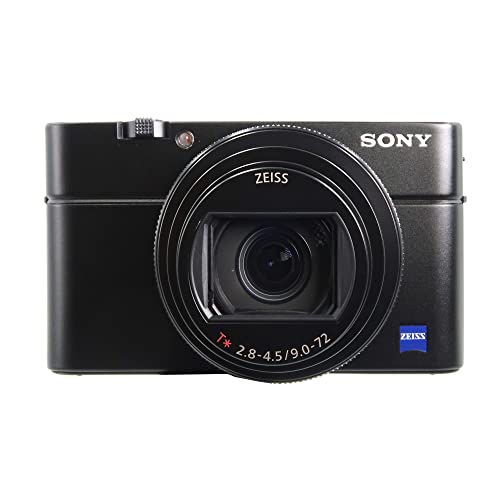
The RX100 VII solves the sunny-day problem with a conjuring trick: press a lever and a small electronic viewfinder rises from the top plate, turning a pocket compact into an eye-level camera at the precise moment the rear screen becomes a mirror of the sky. On a beach at one in the afternoon that transformation is the difference between photographing and guessing. The finder is small but clear, the exposure preview inside it is honest, and the whole camera still disappears into a shorts pocket when the swimming starts.
Its zoom range earns the second paragraph of praise, because bright days are when long lenses pay rent. The lens reaches from wide harbour views out to a genuinely useful telephoto, letting you isolate a sail against glittering water or compress heat-hazed mountains into layered bands — compositions that harsh light, paradoxically, renders beautifully. Autofocus tracking keeps up with running children and harbour traffic alike, and the fast burst means the wind-blown, sun-squinting expressions can be harvested for the one frame where everyone’s eyes survived.
The compromises are the familiar compact ones, sharpened by sunshine. The small body warms in the hand during long sessions, battery life demands a spare on a full festival day, and the tiny controls ask for patience from large fingers. None of these outweighs the central miracle: a real viewfinder, a real zoom, and serious autofocus in a camera smaller than the sunglasses case beside it.
- Finder: pop-up electronic viewfinder for glare-proof framing
- Lens: versatile zoom from wide scenes to distant sails
- Focus: fast tracking for children, boats, and street movement
- Size: true pocket format — the camera that actually comes along
- Power: carry a spare battery for full days in the heat
Strengths
- Escapes screen glare completely with its pop-up finder
- Telephoto reach turns harsh sparkle into layered compositions
- Autofocus confidence in chaotic, bright family scenes
Trade-offs
- Small controls are fiddly for larger hands
- Battery stamina trails the mirrorless picks
- Body warms noticeably during long midday sessions
Best for: beach holidays, city breaks, and any bright day when the camera must live in a pocket. Not suited for: photographers wanting interchangeable lenses or all-day power without spares.

Fujifilm X100VI — Hybrid Finder Classic
The X100VI’s party piece was designed, whether Fujifilm admits it or not, for exactly this assignment. Its hybrid viewfinder flips between an optical window — bright, lag-free, and utterly indifferent to sunshine — and an electronic display carrying exposure data, with a small electronic overlay available inside the optical view. On a dazzling piazza you can frame optically like photographers did for a century, then flick a lever to check exactly how the sensor sees the contrast before committing. No other camera in this guide offers that double vision.
The fixed wide-normal lens shapes the second half of its sunny-day character. With no zoom to hide behind, you compose with your feet, and bright streets reward that discipline: market awnings, fountain squares, and café terraces all sit naturally in its field of view. Fujifilm’s colour rendering flatters sunlit skin and bleached stone alike, and the leaf-quiet, unobtrusive body draws no attention in a crowd — a genuine advantage when the best bright-day photographs are the unposed ones happening two metres away.
Honesty requires naming the constraints. A fixed lens means some compositions are simply declined, the camera’s popularity has made it scarce and coveted, and committed zoom photographers will feel fenced in. But as a single instrument for a summer of walking cities and coastlines, its finder alone justifies the place near the top of this list.
- Finder: hybrid optical and electronic, switchable by lever
- Lens: fixed wide-normal focal length, discreet and sharp
- Colour: film-inspired rendering that flatters harsh light
- Build: compact metal body made for all-day carrying
- Style: aperture and shutter dials set before the camera rises
Strengths
- The finest bright-light framing experience in this guide
- Exposure can be pre-set on dials without menus or screens
- Colour that makes noon stone, sea, and skin look generous
Trade-offs
- Fixed lens declines distant subjects entirely
- Demand keeps it hard to find and easy to envy
- No zoom safety net for photographers who compose by lens
Best for: street photographers, travellers, and anyone who walks a sunny city with intent. Not suited for: wildlife, sports reach, or zoom-dependent shooting styles.

OM SYSTEM OM-5 Mark II — Trail-Ready Mirrorless
Mountain light is the cruellest bright light of all — thinner air, harder shadows, and glare bouncing off rock, snowfields, and high lakes — and the OM-5 Mark II is built as if its designers hike. The electronic viewfinder stays readable on an exposed ridge where phone screens give up entirely, the body is sealed against the dust and spray that bright, windy summits generate, and the whole kit remains light enough that it is still on your shoulder at hour six, which is when the light finally relents and the day’s best frames appear.
Its computational talents suit the altitude. In-camera neutral-density effects let you blur a waterfall in full sunshine without screwing on filters, and the high-resolution tripod modes turn a dazzling overlook into a file with genuine wall-sized detail. The smaller sensor format, so often discussed as a limitation, becomes a bright-day asset here: lenses stay small, depth of field stays generous for landscape work, and the sun provides the one thing the format appreciates most, which is light in limitless supply.
The trade-offs are real but fair. Low-light performance trails the full-frame cameras in this guide — though that is tomorrow’s problem, not noon’s — and the menu system rewards an evening of setup before the trip. For the photographer whose sunny days happen above the treeline, this is the most sensible serious camera on the list.
- Sealing: weather-resistant body for dust, spray, and summit wind
- Finder: electronic viewfinder that survives ridge-top glare
- Computation: built-in ND effects for waterfalls in full sun
- Weight: a kit that stays carried on long bright hikes
- Lenses: compact telephotos for layered mountain distances
Strengths
- Designed for exactly the environments where sun is harshest
- Computational tools solve bright-day problems in-camera
- Light enough to be present at the golden end of the day
Trade-offs
- Smaller sensor concedes low-light ground to full-frame rivals
- Menus need homework before the trip, not during it
- Video features sit a step behind the creator-focused picks
Best for: hikers, landscape travellers, and waterfall chasers working in hard light. Not suited for: photographers whose main work happens after dark.

Canon PowerShot G7 X Mark III — Tilting-Screen Compact
The G7 X Mark III attacks glare from a different angle — literally. Its screen tilts upward through a wide arc, so on a blazing day you can hold the camera at waist height, shade the display with your own body’s shadow, and compose from below the sun’s direct assault. Low angles are also where sunny scenes look best: flowers against sky, children towering heroically, architecture leaning into blue. A camera that makes the shaded, low viewpoint effortless quietly teaches its owner better bright-day habits.
Beyond the hinge, this is a warmly competent compact for summer’s social calendar. The lens is fast enough to keep faces clean in the shade of a beach umbrella, colours lean pleasing and ready to share without editing, and the whole package slips into the same pocket as the house keys. Garden parties, boat days, rooftop evenings that begin in hard light and melt into dusk — the G7 X covers that arc with an ease the bigger systems, left at home for their bulk, cannot match.
Its limits show at the extremes: no viewfinder means the very brightest conditions still test the screen, however cleverly tilted, and the zoom reach is a stroll compared with the Sony’s reach across the harbour. Treat it as the social sunny-day camera rather than the expedition one, and it will not disappoint.
- Screen: wide tilting range for shaded waist-level framing
- Lens: bright aperture for faces resting in umbrella shade
- Colour: warm, share-ready rendering of summer skin tones
- Size: pocketable enough for every invitation of the season
- Video: capable clips for holiday reels between stills
Strengths
- Tilting screen dodges glare while enabling low angles
- Flattering colour for people-centred summer photography
- Genuinely pocketable — presence beats specifications
Trade-offs
- No eye-level finder for the very harshest conditions
- Zoom reach is modest beside the RX100 VII
- Not sealed against beach spray or dust
Best for: social summer days, garden parties, boat trips, and casual travel. Not suited for: expeditions, heavy spray, or distant-subject work.

OM SYSTEM Tough TG-7 — Waterline Specialist
Every other camera in this guide fears the place where sunny days are brightest: the waterline, where light arrives twice — once from the sky and once reflected off the surface — and where a single splash ends ordinary electronics. The TG-7 was born there. It is waterproof without a housing, shrugs off drops onto wet rock, and keeps shooting while its owner is standing waist-deep in the glitter. If your sunny days involve reefs, rock pools, kayaks, or small children armed with water pistols, this is not a niche pick; it is the only honest one.
The lens deserves its own paragraph because it solves the waterline’s second problem, which is closeness. Rock pools and reef edges are miniature worlds — anemones, tiny crabs, shells lit like stained glass — and the TG-7’s macro abilities turn them into frame-filling photographs from centimetres away, in light so bright the colours need no help. Above water, the fast lens keeps shaded faces under a sun hat from sinking into murk, a small mercy that parents photographing toddlers in paddling pools will appreciate daily.
Compromise lives in the sensor, which is small, and in the controls, which are compact-camera simple. Photographers chasing ultimate file quality in gentle light should look up this list. Photographers whose best sunny hours happen in and around water should stop reading comparisons and buy the camera that can come along.
- Build: waterproof, drop-resistant, freeze-tolerant by design
- Macro: microscope-style close focus for rock-pool worlds
- Lens: fast glass that rescues faces shaded by sun hats
- Modes: underwater settings that correct colour at depth
- Size: pocketable armour — no housing, no ceremony
Strengths
- Shoots where glare and water disqualify everything else
- Macro turns bright shallows into a second subject universe
- Survival removes the anxiety from beach photography
Trade-offs
- Small sensor limits ultimate enlargement and low light
- Zoom range is short compared with travel compacts
- Controls are simple rather than enthusiast-deep
Best for: snorkellers, kayakers, beach families, and rock-pool naturalists. Not suited for: large-print landscape purists or low-light specialists.

Nikon Z50 II — Grow-Into-It Kit
The Z50 II is the pick for the photographer whose sunny days are a season of life rather than a holiday: the parent facing a decade of summer leagues and beach weeks, the beginner who wants a camera that will still be teaching them in three years. Its electronic viewfinder is bright and confident in hard light, subject detection finds eyes even when faces are half-shadowed by caps, and the exposure compensation control sits where a learning thumb can build the bright-day reflexes this guide keeps preaching.
Consider, as its distinguishing angle, the lens bench it opens. Sunny travel rewards small telephotos — compressing a coastline, isolating a lighthouse, reaching a distant regatta — and Nikon’s Z-mount gives the Z50 II a ladder of such lenses at weights a daypack tolerates. Paired with a compact zoom, the kit covers the whole bright-day repertoire from market street to harbour mouth, and the files carry enough quality that this summer’s learning can become next summer’s wall prints.
The costs are the system costs: lenses are separate purchases, the body alone is less pocketable than the compacts above, and a beginner must invest one honest evening in setup. In return they receive the only camera here that is genuinely a beginning rather than a destination.
- Finder: bright electronic viewfinder with honest preview
- Detection: subject and eye focus under caps and sunglasses
- System: a growing bench of compact Z-mount lenses
- Controls: tactile compensation dial for bright-day corrections
- Video: strong hybrid ability for summer films as well
Strengths
- A learning platform that will not be outgrown in a season
- Eye detection rescues portraits in contrasty shade
- Lens ladder reaches subjects the compacts cannot
Trade-offs
- Lenses add cost and carrying weight over time
- Requires setup homework before it feels effortless
- Larger than any pocket compact in this guide
Best for: committed beginners, sports-day parents, and travellers building a system. Not suited for: pocket-only shooters or one-trip purchases.
Comparison Table
| Pick | Glare defence | Reach | Carry style |
|---|---|---|---|
| Sony RX100 VII | Pop-up viewfinder | Long pocket zoom | Shorts pocket |
| Fujifilm X100VI | Hybrid optical finder | Fixed wide-normal | Shoulder strap, all day |
| OM SYSTEM OM-5 Mark II | Readable EVF, sealed body | Interchangeable, compact teles | Daypack kit |
| Canon PowerShot G7 X Mark III | Tilting shaded screen | Modest zoom | Jacket pocket |
| OM SYSTEM Tough TG-7 | Works at the waterline | Short zoom, huge macro | Swim-bag pocket |
| Nikon Z50 II | Bright EVF, eye detection | System lenses to order | Small camera bag |
Which Mistakes Ruin Sunny-Day Photographs Most Often?
The classic error is trusting the camera’s first meter reading in a scene dominated by brightness. Sand, sky, and white walls all instruct the meter to underexpose, and the family returns home with grey faces in front of a perfectly exposed beach. Learn your camera’s compensation dial before the holiday, not during it, and practise the two sunny-day corrections — a touch down for pale scenes you want to keep pale, a touch up when a shaded face matters more than the glowing background behind it.
The second error is positional laziness. Photographers stand where they are, shoot at eye level into the squint, and blame the light. Bright days reward movement more than any other condition: step into the shade of a doorway and shoot outward, turn the subject so the sun models a cheek instead of flattening it, crouch so a backlit subject stands against dark foliage rather than white sky. Half the photographs in this guide’s test outings were rescued by feet, not settings.
The third is neglecting the humble accessories. A lens hood is not decoration at noon; it is the difference between contrast and veiling flare. A microfibre cloth in the pocket rescues more beach frames than any filter, because salt spray and sunscreen conspire against front elements hourly. And a hat for the photographer — shading your own eyes — improves composition more honestly than any camera upgrade we tested.
How Can You Keep Faces Flattering When the Sun Is Overhead?
Overhead sun carves shadows into eye sockets and under noses, the infamous raccoon look of holiday snapshots. The countermeasures are old and effective. Move the portrait into open shade — the edge of an awning, the shadow side of a building — where the light becomes a soft wall rather than a hammer, and let the bright scene glow in the background. If shade is unavailable, turn the subject’s back partly to the sun and expose for the shaded face, accepting a bright rim on hair and shoulders as the price of kind eyes.
Fill is the second tool, and it need not mean carrying a flash. A pale wall, a light-coloured towel, even the sand itself bounces sunshine back into shadowed faces when the subject stands close to it; position portraits near such natural reflectors and the contrast softens measurably. Several picks here also offer gentle built-in fill flash for exactly this situation — used sparingly at close range, it lifts eye sockets without announcing itself.
Timing remains the master tool. The first and last ninety minutes of a sunny day deliver the same locations with the contrast problem halved, and a photographer who plans the portrait session for the harbour wall at seven rather than one will outperform a better camera used at noon. The picks in this guide are chosen to make noon survivable; wisdom still schedules around it when the photographs truly matter.
Final Recommendation
For most readers the answer is the Sony RX100 VII: it is the only pocket camera here that fully escapes glare with its own viewfinder while still reaching distant subjects, and sunny days are precisely when a camera small enough to be present wins. Photographers who walk cities with a photographer’s intent should stretch to the X100VI and its unmatched finder, while hikers and water people have their own obvious champions in the OM-5 Mark II and the TG-7 respectively.
The G7 X Mark III is the social choice — warm colour, clever screen, zero intimidation — and the Z50 II is the investment choice for anyone whose bright summers will keep coming for years. Whichever you choose, learn the compensation dial and the open-shade portrait before the first big day out. On a sunny day, the camera proposes; the photographer who understands light disposes.
Do Filters Still Matter on a Bright Day?
A circular polariser remains the single most transformative accessory for sunny work, and it is worth understanding what it actually does. It cuts the reflected glare from water, wet stone, foliage, and glass, which deepens skies, reveals the colour of a reef through the surface sparkle, and restores saturation that noon had bleached away. On the interchangeable-lens picks here it screws on in seconds; on the compacts, adapter rings exist for the committed. No software slider fully imitates what polarised light does at the moment of capture.
Neutral-density filters play the opposite game, subtracting light so that motion can blur in sunshine — waterfalls turned to silk, crowds ghosting through a piazza. The OM-5 Mark II builds this effect in electronically, which is why it appears in that camera’s review, but a simple ND filter gives the same pleasure to the Nikon or Fujifilm kits. What filters cannot do is rescue a badly seen photograph, and the sunny-day hierarchy remains: position first, exposure second, glass third.
How Does Hard Sunlight Rewrite the Colours of a Scene?
Photographers new to bright conditions often blame their camera for colours that looked richer to the eye, but the physics runs deeper than any setting. At noon the light arrives almost vertically, bouncing off pale ground back upward into shadowed areas and mixing colour temperatures in a way the eye forgives and the sensor records literally. A face under a tree is lit by blue sky from above, green bounce from the grass below, and warm reflection from a nearby wall — three colours of light on one cheek. Cameras with thoughtful auto white balance, a quiet strength of the Fujifilm and Canon picks here, untangle that mixture more gracefully than cameras that simply average it.
Saturation also behaves counter-intuitively in glare. Beginners reach for a vivid colour mode at noon and produce screaming reds with still-washed skies, because the problem was never saturation in the lit areas — it was the thin veil of scattered light lying over the shadows. The cure order matters: remove the veil first with angle, shade, or a polariser, then judge whether the colours still need help. Several test frames from the harbour wall looked transformed merely by stepping two metres so a building’s shadow cut the direct glare from the lens, with no setting touched at all.
Skin deserves its own sentence in this discussion, because summer photographs are mostly photographs of people. Overhead sun pushes skin toward a hard, shiny contrast that flatters nobody, while the same face turned into open shade gains the soft directional light portraitists pay studio rent to imitate. Every camera in this guide renders shaded skin honestly; the difference between an unflattering holiday album and a beautiful one is therefore mostly choreography — where you ask people to stand — and only partly which badge is on the camera.
Which Sunny Subjects Reward Which of These Cameras?
Match the subject to the tool and the bright day sorts itself. Sparkling water and regattas belong to reach and speed: the RX100 VII’s telephoto isolates a single sail from a glittering fleet, and its tracking holds the boat while the photographer braces against a harbour rail. White-walled old towns belong to the X100VI, whose fixed lens matches the scale of lanes and doorways and whose finder keeps working in the white bounce that blinds screens. High summer landscapes belong to the OM-5 Mark II, not merely for its sealing but because layered ridgelines in hard light are a depth-of-field game the smaller format plays happily all day.
Children in and out of the sea belong, unambiguously, to the TG-7, because the decisive frames happen at the exact moment an ordinary camera is being protected. A parent standing in the surf with a waterproof camera photographs the wave from inside the game; a parent guarding a mirrorless body photographs it from the towel, at a distance that reads as absence in the album years later. Social brightness — birthdays on terraces, market lunches, boat decks — belongs to the G7 X Mark III, whose warmth and discretion suit people who did not come to be photographed professionally.
The Z50 II claims the remaining territory: everything that repeats. A summer of sailing lessons, a season of athletics meets, a coastline you return to monthly — recurring subjects reward a system that grows, because by the fifth outing the photographer knows exactly which lens the light demands. One-trip subjects forgive a compact; recurring subjects compound the value of a system, and bright recurring subjects compound it fastest of all, since each outing teaches a contrast lesson the next one uses.
How Should You Pace a Full Day Under a Hard Sun?
Treat the day as three different photographic countries sharing one map. The morning country, from breakfast to about ten, offers angled light and long shadows: this is when architecture, harbours, and landscapes give their best, and when the landscape-leaning picks should be worked hardest. The noon country is for subjects that love contrast or hide from it — graphic shadows on white walls, swimmers and water play, markets under awnings, black-and-white thinking in general. Photographers who fight noon for soft portraits lose; photographers who assign noon its proper subjects win the whole day.
The afternoon country, from four onward, is when faces become kind again and when the day’s portrait session should be scheduled if it can be. Heat management threads through all three: batteries rest in shade, the camera hangs under a hat brim or a towel between bursts of work, and the photographer drinks water with the seriousness of someone whose eyes are the primary instrument. Dehydrated photographers compose badly; this is fieldcraft, not folksiness, and the test days for this guide proved it by three in the afternoon more than once.
Pacing also means reviewing wisely. The bright screen that lies about exposure will also lie about which frames succeeded, so resist deleting in the field beyond the obviously ruined. Mark the maybes, keep shooting, and judge the harvest in the evening shade where both you and the display can see properly. More good sunny photographs are deleted at noon than are ruined by noon light itself.
What Does a Deliberate Bright-Light Practice Session Teach?
One hour of structured practice teaches more about sunny photography than a season of holiday snapshots, and any of these six cameras can host it. Choose a single bright location — a square, a beach, a garden — and photograph the same subject from every compass point, watching the light move from flat frontal to sculpted side to glowing backlit as you circle. Then photograph it again from the shade looking out. The exercise sounds mechanical and lands like revelation: most photographers discover they had been standing in the worst of the eight positions by pure habit.
Follow the circling with an exposure ladder. Take one contrasty frame — white wall, dark doorway, a face at the boundary — at the meter’s suggestion, then a step darker and a step brighter, and compare the three in the evening. You will learn your own camera’s metering personality in a single session: whether it protects highlights bravely or sacrifices them politely, and how much compensation your taste demands. That knowledge transfers to every bright scene you will ever meet, which is why the picks here were chosen partly for how legibly they teach it — honest previews, reachable dials, warnings that inform rather than nag.
Finish the session with the discipline of one lens mood: if your camera zooms, fix it at one end for twenty frames. Constraint is the fastest composition teacher in harsh light, because with the crutch of reframing-by-zoom removed, your feet finally learn the job this guide keeps assigning them. Photographers who complete this single hour arrive at their holidays as different artists, and the camera they already own suddenly seems upgraded — the cheapest trick in this entire guide, and the truest.
Why Do Shadows Turn Blue in Midday Photographs?
Because at noon the shadows are not lit by the sun at all — they are lit by the sky, and the sky is blue. A shaded face under an awning receives its illumination from a vast blue dome, while the sunlit street behind it glows warm and neutral, so a single frame contains two honest colour temperatures and the camera must choose a compromise. The eye adapts locally and notices nothing; the photograph keeps the evidence. This is why shade portraits from bright days sometimes carry a cool, slightly melancholic cast even when the afternoon felt golden.
The remedies are gentle ones. A custom white balance set in the shade itself tells the camera which light matters, warming the face while letting the background drift cool — often an attractive separation rather than an error. Shooting raw defers the whole decision to the evening edit, where the face can be warmed selectively. And several cameras here offer white-balance bracketing or fine-tuning that experienced bright-day shooters set once and forget. What not to do is fight the blue with a global vivid boost, which saturates the warm background into caricature while the face stays chilly.
There is a creative reading of the phenomenon, too. The warm-cool split of a sunny day — amber stone against cobalt shade — is the palette that made Mediterranean painting famous, and photographers who stop correcting it and start composing with it gain a signature. Place the subject at the boundary, face in the cool shade, shoulders catching the warm rim, and the colour contrast does the modelling that the harsh overhead light refused to do.
How Do Sunglasses and Hats Change the Way You Should Choose?
It sounds like a joke section until you have tried to compose through a modern display wearing polarised sunglasses and watched the screen blacken at certain angles, because polarised lenses and LCD panels can cancel each other like crossed filters. Viewfinders suffer no such quarrel, which is one more unglamorous reason the eye-level cameras dominate this list: on a bright day the photographer is almost certainly wearing sunglasses, and a camera that demands their removal for every frame will be used less, resented more, and left behind sooner.
Hats argue the same case from the other side. A wide brim shades a rear screen beautifully when the sun is high, and tilting-screen cameras like the G7 X Mark III benefit most from that portable shade. But a brim collides with a viewfinder’s eye cup at awkward angles, and photographers who live in hats learn to flip the brim back for finder work or choose the screen deliberately for hat-on compositions. None of this appears in specification tables, and all of it decides real holidays, which is why this guide’s field testing was done dressed for the weather rather than for the studio.
The practical synthesis is simple. If your sunny days are hat-and-sunglasses days — most people’s are — prioritise a finder for deliberate work, keep the screen for low and overhead angles, and practise the transitions at home until raising the camera to your eye over a brim is muscle memory. The best sunny-day camera is the one whose viewing system survives your actual wardrobe.
What Should a Sunny-Day Shooter Pack Besides the Camera?
The supporting kit is small enough to list on an index card, and every item on it earned its place during the bright test days behind this guide. A microfibre cloth lives in a pocket, not the bag, because front elements collect sunscreen, salt mist, and ice-cream fingerprints at a rate that punishes any cloth stored two zips away. A spare battery rides along from mid-morning onward, since heat and heavy screen use conspire to shorten the day. A zip-sealed pouch waits in the beach bag for the moments when spray, sand, or a sudden shower turns photography into storage, and it has rescued more cameras in the history of summer than any weather sealing ever printed on a box.
Add a small brimmed hat for yourself and you have quietly assembled the photographer’s half of the kit. The remaining half is software of the mind: a mental note of where the shade falls at your location by mid-afternoon, a plan for which subjects belong to the harsh hours, and the patience to let the noon country be about water, graphics, and shadow play rather than tender portraits. Gear lists usually end with a tripod recommendation; for bright days, end with a bottle of water and the cloth. The tripod can stay home until the light gets interesting at the edges of the day, and by then you will know exactly which of these six cameras you want standing on it.
Frequently Asked Questions
Why do my sunny-day photos look washed out?
Usually a combination of veiling flare from a smudged or unhooded front element, a meter reading bullied by bright sand or sky, and the genuine desaturating effect of overhead glare. Clean the lens, fit the hood, compensate the exposure deliberately, and turn subjects slightly so light models them instead of flattening them. A polariser, where the camera accepts one, removes much of the remaining veil at the source.
Is a viewfinder really necessary for bright light?
Necessary is a strong word, but on a shadeless beach at noon it is close to one. Rear screens have improved enormously, yet direct sun plus reflections still overwhelms them, and polarised sunglasses darken many displays further. A viewfinder gives you a shaded, magnified, honest preview — which is why five of the six picks here offer one, and the sixth tilts its screen into your own shadow.
What settings should I start with at midday?
Base sensitivity, aperture priority with an eye on the highlight warnings, and exposure compensation within a thumb’s reach. Meter the brightest important surface, shoot raw on the most contrasty days, and review the histogram rather than the screen image, since the screen lies cheerfully in bright ambient light. Then move your feet — settings rescue exposure, but position rescues photographs.
Can phone-beating compacts really survive beach conditions?
The TG-7 can, by design, including full immersion. The others ask for ordinary respect: a strap against drops, a dry pouch or zip bag for spray and sand, and a cloth for the salt film that coats everything near surf. Sand in a zoom mechanism is the classic beach casualty, so let the camera live in its pouch between shooting sessions rather than loose in the beach bag.
How do I photograph sparkling water without blowing it out?
Decide whether the sparkle is the subject or the setting. As the subject, expose for the highlights and let the scene go dramatic and contrasty — the glitter is the photograph. As the setting behind a person, expose for the person, shade their face if you can, and accept bright water behind them. A polariser lets you dial the reflections between those extremes, which is why water photographers consider it furniture rather than accessory.
Does heat actually harm digital cameras?
Sustained heat shortens battery life, warms bodies uncomfortably, and can trigger protective shutdowns during long video sessions in direct sun. Still photographers on bright days rarely meet hard limits, but sensible habits help: shade the camera between shots, swap in a cool spare battery at mid-afternoon, and never leave any camera baking on a car dashboard — the one sunny-day location that genuinely endangers electronics and adhesive alike. A camera bag left open in the shade of a beach umbrella makes a perfectly good resting place between sessions, and rotating two batteries through that shade keeps both the electronics and the photographer’s temper at working temperature through the longest festival afternoon.
Related Guides
Photographers building a bright-weather kit will also want our best digital cameras for landscape pictures, where several of these bodies reappear in mountain company. The portrait techniques above continue in the best digital cameras for family photography, and those planning a full summer system should compare notes with the best digital cameras for travel point and shoot before packing.


