kajuandouglas.com is reader-supported. When you buy through links on our site, we may earn an affiliate commission.
Where to Buy a Camera for Outdoor Shooting, and Why the Sky Is Not Your Friend
The best cameras for shooting outside are chosen for the days the weather refuses to cooperate, because the cooperative days photograph themselves. Outdoor light is abundant and treacherous in equal measure: noon sun that flattens faces into squints, glare that turns screens into mirrors, dust that finds every lens change, rain that arrives sideways, and cold or heat that taxes batteries and fingers alike. A camera for the outdoors is therefore not primarily an imaging device. It is a piece of field equipment, judged the way boots are judged — by sealing, grip, stamina and whether it still works at the end of the wettest day of the year.
Buy from a dealer who understands field kit, ideally one who will let you handle bodies with gloves on and in bright light, because the two great outdoor tests — can you work it with cold hands, and can you see to frame at noon — cannot be performed under shop lighting. Check, too, that the shop stocks the unglamorous armour: straps that cannot slip, cases that shed water, spare batteries for the cold. The six picks below were ranked on real terrain — coast paths in horizontal rain, summer festivals in dust, winter hills, markets at midday — on the qualities those places reward: weather sealing you can trust, viewfinders and screens that survive glare, autofocus that tracks subjects the outdoors actually contains, and files that hold a bright sky and a shadowed face in the same frame.
A note on who this guide is not for: the studio photographer taking a first walk, who will find every body here compromised against their indoor instruments, and the expedition professional, whose needs — dual slots, armour, service contracts — begin where this list ends. Between those poles lives the overwhelming majority of outdoor photography: walked, weathered, familial, joyful. The rankings below serve that majority without apology, and the specialists are advised, kindly, to keep walking until they reach their own guides.
One argument to settle before the list: the outdoors does not reward the biggest camera. It rewards the camera that is present — carried on the ridge, taken to the beach, pulled out in the rain — and presence is a function of weight, toughness and how little its owner fears for it. Several picks below are smaller than their indoor cousins for exactly that reason, and the toughest of them is not the largest at all.
Key Takeaways
- Weather sealing and a strap you trust decide whether the camera comes out in the rain or stays in the car.
- At noon, a viewfinder beats any screen: glare is the outdoor photographer’s daily tax, and an eyepiece abolishes it.
- Outdoor dynamic range — bright sky, shaded face — is the file quality that matters; protect highlights and let shadows be rescued.
- Cold steals battery and heat steals patience, so stamina figures must be read against your climate, not the brochure’s.
- The outdoors rewards presence: a smaller, tougher camera that attends every walk outproduces a flagship that fears weather.
- Dust is the outdoor sensor’s tax — fewer lens changes, changed with your back to the wind, keep it cheap.
- Buy for your worst season: a camera your February respects will never embarrass your July.
- One body, two lenses and a set of habits outproduce a collection of systems in the field.
In this guide
Quick Picks
| Pick | Badge | Why it earns the spot |
|---|---|---|
| OM SYSTEM Tough TG-7 | Best for weather and water | Waterproof, drop-proof and frost-proof as sold, with a bright lens for coasts, rivers and ski days. |
| Fujifilm X-T5 | Best sealed system for stills | Weather-sealed body and dials, high-resolution files and colour that flatters landscapes and street scenes. |
| Canon EOS R10 | Best for outdoor action | Fast bursts and tracking for sport, dogs, birds and every subject the outdoors keeps moving. |
| GoPro HERO12 Black | Best for outdoor video | Stabilised, waterproof adventure video with the stamina for long days on trails and water. |
| Nikon Z50 II | Best value travel body | A compact system camera with flagship-flavoured focusing for walkers, travellers and families outdoors. |
| Sony RX100 VII | Best pocket for travel | A long zoom and a pop-up viewfinder in a jacket pocket, for cities and viewpoints where bulk stays home. |
How Did We Choose the Best Cameras for Shooting Outside?
We took the candidates out in the weather they claim to enjoy. Sealing was tested by use rather than by faith — cameras worked through rain showers, sea spray and a dust-blown festival field, then had their dials, doors and lens mounts inspected for what got in. Screens and viewfinders were judged at noon on a shingle beach, the harshest framing light most photographers will ever meet, and controls were worked with ski gloves and with wet hands, because the outdoors issues both without asking. Files were marked on the outdoor photographer’s true test: a bright sky held without chalkiness while a face in shadow stayed rescuable.
We also noted, without quite knowing how to score it, how each camera aged across the testing: scuffs on the tough body that read as character, dials on the sealed bodies that stayed positive, a pocket camera whose finder still popped crisply after a season in a jacket. Outdoor equipment is bought for years, and the bodies that wear their years gracefully — that invite use rather than demanding preservation — are the ones still working when the photographs start to matter most.
Stamina formed the second sieve — batteries through a cold morning, cards and heat through a long summer afternoon — and the third was carry: weight on a ten-mile walk, balance on a strap, and the social question of whether the camera invites itself along or argues for staying home. Autofocus was scored on outdoor subjects specifically: dogs at full run, children on swings, birds that had not read the script. Studio virtues were allowed no vote. The outdoors is a place, not a specification, and this list was ranked by the place.
What Makes Outdoor Light Both a Gift and a Problem?
Abundance is the gift: fast shutter speeds, low sensitivities, small apertures and deep sharpness are all free outside, which is why beginners’ outdoor photographs so often outshine their indoor ones without any increase in skill. The problem is contrast and direction. The midday sun is a single, merciless source that carves black shadows under every brow and hat brim, blows skies to white, and turns screens unreadable — while the golden hours at the day’s edges, which flatter everything, are exactly when most people have put the camera away. Outdoor photography is therefore a scheduling art disguised as a technical one.
Altitude and coast, the two glamour terrains, each add a tax. Thin mountain air comes with ultraviolet-rich light that blues every shadow and fools meters into underexposure, while the coast adds salt, sand and wind that together constitute a slow sandblasting of everything you own. Neither tax is a reason to stay home; both are reasons the sealed, tough and pocketable picks dominate a list that might otherwise belong to bigger, more delicate instruments.
Weather completes the syllabus. Rain saturates colour and empties viewpoints; fog turns a familiar valley into a study in restraint; snow lies to light meters with the confidence of long practice. The cameras below were chosen to keep working through that syllabus — sealed against its water, viewable in its glare, honest in its extremes — because the outdoor photographer’s best days are so often the ones a lesser camera spends in a dry bag, waiting for conditions it can survive.
Which Camera Belongs in Your Pack, Pocket or Dry Bag?
Two readers should feel personally addressed before the verdicts begin. The first is the fair-weather photographer with a drawer of ruined intentions, whose problem was never skill but equipment that feared the forecast; the tough and sealed picks are their rehabilitation. The second is the traveller whose camera has become a negotiation with every bag and border; the pocket and value picks are theirs. Everyone else — the walker, the sports parent, the filmmaker — will find their terrain named in the verdicts themselves.
Terrain decides. A coast path, a festival field and a city break ask for three different cameras that happen to share a shelf, so read the six against the ground you actually cover.

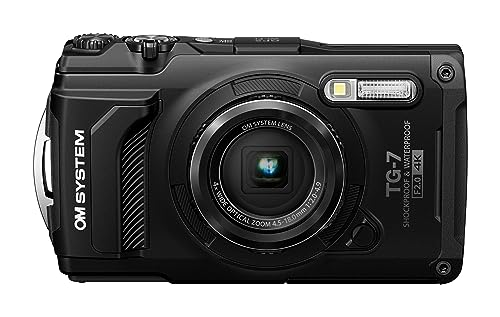
OM SYSTEM Tough TG-7 — Best for weather and water
Start with the camera that removes fear from the equation entirely. The TG-7 is waterproof to real depths without a housing, survives drops onto rock, works frozen on a ski lift, and rinses clean under a tap after a day in sand and salt. That invulnerability changes behaviour, which is the point: its owner shoots in the rain instead of sheltering, takes it into the surf instead of watching from the dry sand, and hands it to children without a speech. The photographs that result — wet, close, unbothered — are a genre no cautious flagship can enter.
The optics support the bravado: a bright lens for dull days, macro modes that turn rockpools and frost patterns into a second hobby, and GPS and field sensors that log the swim, the summit and the conditions. Video plays a capable supporting role. The sensor is compact-camera class, so low-light polish and cropping depth trail the system bodies — the standing trade of this entire category — but at the waterline, on the ridge, in the downpour, the relevant comparison is not against a mirrorless camera. It is against no photograph at all.
Families who holiday near water have made this line a perennial bestseller, and a season with one explains why: it becomes the beach camera, the boat camera, the skiing camera and the bad-weather camera simultaneously, amortising its cost across every day the expensive gear stays home. If your outdoors is measured in weather rather than in miles, begin the list here and consider the matter settled.
- Format: rugged compact, waterproof and crushproof as sold
- Lens: bright zoom with macro and microscope modes
- Sensors: GPS plus temperature, depth and compass logging
- Files: RAW capture, rare in a camera this tough
- Video: 4K recording for shoreline clips
Strengths
- Shoots in weather and water that sideline every rival here.
- Invulnerability changes the owner’s behaviour, not just the spec sheet.
- Macro modes open the small outdoors — pools, frost, insects — beautifully.
Trade-offs
- Small sensor limits dusk quality and heavy cropping.
- Video stabilisation sits below the dedicated action cameras.
- No viewfinder; bright-day framing is screen work.
Best for: beaches, boats, ski days, wet walks and accident-prone adventures.
Not suited for: dusk wildlife or photographers who crop distant subjects hard.
Winter sports instructors keep a version of this camera in a jacket pocket all season, and their use case generalises: any job or hobby conducted in weather, with gloves, around water, is this camera’s parish. It has photographed more ski lessons, sailing courses and river surveys than any flagship ever will, precisely because its owners never once weighed the decision to bring it. In outdoor photography, the brought camera is the specification that swallows all the others, and no body in this guide is brought more casually.

Fujifilm X-T5 — Best sealed system for stills
For the stills photographer whose outdoors is walked rather than swum, the X-T5 is the connoisseur’s field body: weather-sealed, dial-driven so exposure can be set with gloves and without a screen, and built around a high-resolution sensor whose files hold a bright fellside and a shadowed valley in one frame. Fujifilm’s colour — the film simulations landscape photographers build pilgrimages around — flatters outdoor light in a way that reduces editing to an optional pleasure, and the sealed primes and zooms of the system complete a kit that treats rain as lighting rather than as a threat.
Size is the quiet argument. This is a system camera that travels like a compact’s bigger sibling: a body and two lenses make a daypack kit for a week of walking, where full-frame equivalents add weight that hills eventually tax. The tilting screen serves the low, ground-level compositions outdoor photographers love, and in-body stabilisation steadies the dawn and dusk frames when the tripod stayed sensibly at home. Video is capable and present, though stills are plainly the first language.
It concedes the action crown to the Canon below and the invulnerability crown to the OM SYSTEM above; its kingdom is the considered outdoor photograph — landscape, travel, street, the portrait at the viewpoint — made in any weather the photographer can stand. Photographers who shoot outside weekly, in seasons, for years, tend to end up with a body like this and a relationship with it that outlasts several phones. The X-T5 is built for exactly that tenure.
- Format: weather-sealed APS-C mirrorless, high resolution
- Controls: traditional dials workable with gloves
- Colour: film simulations tuned for landscape and travel
- Stabilisation: in-body, for dawn and handheld work
- Lenses: sealed primes and zooms across a deep system
Strengths
- Sealing and dials make weather a subject instead of a stop.
- Resolution and colour produce finished outdoor files in camera.
- Kit weight suits walking distances that punish bigger systems.
Trade-offs
- Tracking of frantic action trails the Canon specialist.
- Sealing depends on using sealed lenses to complete the system.
- Video tools are a supporting act beside creator bodies.
Best for: walkers, landscape and travel photographers shooting in all seasons.
Not suited for: swimmers, divers or touchline sports specialists.
Street photographers claim a share of this body too, and their reasoning travels well to every outdoor genre: the dials read like a landscape’s own instruments, the files need so little correction that an evening’s walk yields an evening’s finished photographs, and the whole apparatus looks like an heirloom rather than a surveillance device, which changes how strangers receive it. A camera that lowers the world’s guard is a field tool of the first order, whatever the field happens to be.

Canon EOS R10 — Best for outdoor action
The outdoors moves: dogs hit the water at speed, children descend hills by every available means, birds decline to pose, and touchline sport happens in weather. The R10 is the body for that motion at a sane price — fast bursts, subject tracking that separates a player or a spaniel from a cluttered background, and a deep, confident grip for long lenses on cold sidelines. Its files hold together in the flat, bright light of a playing field and the files’ colour flatters grass, sky and skin in one frame.
Reach is its second language. Paired with Canon’s affordable telephotos, it becomes a genuine wildlife-starter and sports system — the heron at the reservoir, the winger at the far touchline — without the cost or the intimidation of professional glass. Video serves the highlight reel honourably. It lacks the Fujifilm’s sealing pedigree and the TG-7’s invulnerability, so a rain cover joins the kit for the wettest fixtures, and its low-light polish is a step behind the leaders once the subject stops moving and the light goes home.
For the parent, dog owner or amateur naturalist whose outdoors is defined by subjects that will not wait, those are the right compromises in the right order. Action is the one outdoor problem that cannot be solved later, in editing or in memory; the R10 solves it at the moment it happens, which is the only moment there is.
- Format: APS-C mirrorless with enthusiast controls
- Burst: fast continuous shooting for sport and wildlife
- Autofocus: subject detection for people, animals and vehicles
- Mount: Canon RF, with affordable telephoto reach
- Video: 4K for outdoor highlight reels
Strengths
- Tracking and bursts catch the outdoors in motion.
- Telephoto path is affordable and genuinely capable.
- Grip and controls suit cold, gloved sidelines.
Trade-offs
- Weather sealing is modest; a rain cover earns its place.
- No built-in flash for fill at outdoor portraits.
- Dusk stills trail the Fujifilm’s polish.
Best for: sports parents, dog walkers, birders and outdoor action.
Not suited for: photographers who shoot mainly in rain or at the waterline.
Junior sport deserves a specific mention, because Saturday-morning leagues are this camera’s natural habitat and its owners’ defining test: low sun, fast children, touchlines crowded with umbrellas. The R10’s tracking ignores the umbrellas, its bursts forgive the photographer’s timing, and its price forgives the mud. Many family archives of real quality begin at exactly that touchline, with exactly this class of body, and the children in them are grown before the camera is outgrown.

GoPro HERO12 Black — Best for outdoor video
Outdoor video has a grammar of its own — the trail unfolding, the wave approaching, the descent arriving — and the HERO12 speaks it fluently: stabilisation that renders a mountain-bike run watchable, waterproofing that treats rivers as locations, and endurance improved over its predecessors to cover the long middle of an outdoor day rather than its first hour. Mounted on a chest, a helmet, a handlebar or a dog, it films the outdoors from inside the experience, which is a perspective no camera held at arm’s length can counterfeit.
The outdoor-specific virtues compound quietly. Voice control starts a recording when hands are committed to oars, bars or rock; the wide lens forgives aiming entirely; and the files’ colour survives the green of forests and the blue of altitude with unusual honesty. Time-lapse and night modes serve the campsite hours — star trails over the tent are this camera’s party piece — and the accessory ecosystem means any mounting problem encountered on a trail has a manufactured answer.
Stills are snapshots, low light is managed rather than mastered, and nobody will mistake its footage for a cinema camera’s. But as the outdoor day’s moving record — the summit approach, the river run, the ride home at dusk — it has no rival at its size in this guide, and its toughness means the record gets made in the weather the day actually had. Outdoor video is a genre of presence, and presence is this camera’s whole design.
- Format: action camera, waterproof as sold
- Stabilisation: flagship electronic stabilisation with horizon lock
- Endurance: extended battery life for long trail days
- Modes: time-lapse and night effects for campsite hours
- Mounting: the category’s deepest accessory ecosystem
Strengths
- Films the outdoors from inside the activity itself.
- Stabilisation and sealing shrug off trails, rivers and weather.
- Endurance covers a day’s middle, not just its start.
Trade-offs
- Stills are souvenirs rather than a portfolio.
- Low-light video softens sooner than larger-sensor rivals.
- Long static recordings in heat need shade and airflow.
Best for: hikers, riders, paddlers and anyone whose outdoors is filmed.
Not suited for: stills photographers or dusk-and-darkness specialists.
Field researchers and expedition medics carry this camera for a reason beyond sport: it documents. A route condition, a river level, a campsite at dusk — recorded steadily, waterproofly, with location data attached — is evidence as much as entertainment, and the HERO12’s indifference to weather makes it the witness that is always awake. Not every outdoor film is a highlight reel; some are records a team will rely on, and reliability under weather is the whole of that law.

Nikon Z50 II — Best value travel body
Travel is the outdoors with luggage limits, and the Z50 II is the travel photographer’s arithmetic made metal: a compact mirrorless body with focusing intelligence inherited from Nikon’s flagships, a sensor whose files flatter everything from a market at noon to a harbour at dusk, and a price that leaves room in the budget for the journey itself. Subject detection finds the street performer’s face and the gull on the wing with equal indifference to your settings, which is precisely the help a traveller — busy travelling — actually needs.
The kit builds gracefully: the compact standard zoom for the walk, one fast prime for the evenings, and the whole system crosses a continent in a daypack’s top compartment. Nikon’s colour has a daylight honesty that suits travel’s mixed diet of landscapes, portraits and food, and video is a strong supporting act for the trip’s filmed diary. Weather sealing is modest rather than heroic — a cover for the downpour, common sense for the dust — and a single card slot asks for an evening download routine in the hotel.
As a household’s outdoor second body it is equally persuasive: the camera a teenager can be trusted with on the duke-of-edinburgh expedition, the spare that becomes the main on the day the flagship’s battery dies at the viewpoint. Value, in the outdoors, is not cheapness. It is capability per gram and per mile, and by that measure this little Nikon leads the entire page.
- Format: compact APS-C mirrorless
- Autofocus: subject detection inherited from flagship bodies
- Files: daylight colour with an honest, travel-friendly look
- Size: daypack-friendly body and kit zooms
- Mount: Nikon Z, growing shelf of compact lenses
Strengths
- Flagship-flavoured focusing at a traveller’s weight and price.
- Daylight files flatter the whole travel diet without editing.
- Small kit leaves the pack — and the budget — room for the trip.
Trade-offs
- Sealing is modest; heavy weather wants a cover.
- Single card slot demands a nightly download habit.
- Telephoto reach requires a deliberate lens purchase.
Best for: travellers, walkers and families wanting one light system camera.
Not suited for: expedition abuse or professional weather work.
Gap years and long tours have a way of selecting this class of body by elimination: light enough to keep, capable enough to respect, priced so that its loss would sting rather than end the trip. Travellers write home about cameras less often than about places, but when they do write, it is usually about the one that was simply always there — at the border-town dawn, on the night train, at the viewpoint nobody planned. The Z50 II is engineered for that “always there,” and a year of it is worth more than a flagship’s fortnight.

Sony RX100 VII — Best pocket for travel
There are outdoor days when any bag is too much — the city break, the viewpoint at the end of a climb, the festival where the camera must vanish when the music starts. The RX100 VII is the answer those days give: a genuine telephoto zoom and a large-enough sensor in a jacket pocket, plus the feature outdoor photographers underrate until noon — a pop-up viewfinder that restores framing when the sun turns the screen into a mirror. From a clifftop it reaches the lighthouse; in a street it disappears; at a viewpoint it is simply there, which heavier systems, left at the hotel, are not.
Autofocus is startlingly serious for the size, with eye detection and tracking that serve portraits and passing wildlife alike, and video quality embarrasses many larger cameras. The debits are the physics of smallness: battery life measured in outings, controls that reward smaller fingers, and low-light files that work harder than the system bodies’ once dusk settles. Weather sealing is minimal, so the pocket it lives in doubles as its rain cover — an arrangement travellers have accepted happily for a decade of this line.
Judge it as the outdoors’ insurance policy. The best outdoor photograph is the one taken, and no camera in this guide is taken more often, to more places, in more weathers-that-might-turn, than the one that fits a pocket and asks nothing. For travellers who measure kit by what they will actually carry up the hill, the argument ends here.
- Format: pocketable premium compact, long zoom
- Viewfinder: pop-up electronic finder for glare
- Autofocus: eye detection and tracking, flagship-flavoured
- Sensor: 1-inch-class, strong daylight files
- Video: 4K with microphone input
Strengths
- Real telephoto reach that fits a jacket pocket.
- Pop-up viewfinder defeats noon glare completely.
- Presence: the camera that attends every outing by default.
Trade-offs
- Battery life demands a spare on long days.
- Minimal sealing; rain means pocket time.
- Small controls challenge gloved or large hands.
Best for: city breaks, climbs, festivals and travellers who pack light.
Not suited for: wet-weather work or all-day shooting on one battery.
Commuters and city walkers may be its most devoted owners of all, because the RX100 turns the daily outdoors — the river path, the market, the lunchtime park — into a practice ground no bag camera can join. A photographer who shoots twenty frames a day, every day, in real weather and real glare, improves at a rate no weekend expedition can match, and the portfolio that results has a quality specifications cannot confer: it was actually taken. Presence compounds, and this camera is presence in its purest commercial form.
How Do the Six Outdoor Cameras Compare in the Field?
| Camera | Field speciality | Weather manners | Glare answer | Biggest caution |
|---|---|---|---|---|
| OM SYSTEM Tough TG-7 | Water and weather | Waterproof, drop-proof, frost-proof | Screen only | Dusk quality |
| Fujifilm X-T5 | Sealed stills system | Sealed body and lenses | Viewfinder | Action tracking |
| Canon EOS R10 | Outdoor action | Modest; add a cover | Viewfinder | Rain without protection |
| GoPro HERO12 Black | Adventure video | Waterproof as sold | Wide lens, minimal framing | Stills are secondary |
| Nikon Z50 II | Travel value | Modest sealing | Viewfinder | Single card slot |
| Sony RX100 VII | Pocket travel | Minimal; pocket is the cover | Pop-up viewfinder | Battery stamina |
Weight, the table’s invisible seventh column, should be read into every row by the reader’s own shoulders. The mirrorless systems differ by less than a water bottle; the pocket camera differs by a whole way of travelling. On a two-mile dog walk the difference is nothing; on a twenty-mile ridge it is the difference between a camera carried and a camera cursed, and cursed cameras stay home next time — the only equipment failure that matters in the long run.
The glare column is this table’s sleeper. Outdoor beginners obsess over sealing and resolution, then lose their first summer to a screen they cannot see at noon. Four of the six answer glare with an eyepiece; the two that cannot — the TG-7 and the GoPro — compensate by needing so little framing, or surviving so much weather, that the trade is honest. Everything else in the table is a matter of taste; that column is a matter of physics.
How Should You Shoot Outside at Noon, in Rain and at Dusk?
A word on practice before the weather lessons: the outdoors forgives rehearsal like no other genre, because the subjects — the view, the dog, the touchline — are there every week in roughly the same light. Photographers who shoot the same walk monthly build a fluency no workshop sells, and every camera in this guide rewards that fluency identically. Choose the walk first, if you like; the camera verdicts below will still be true when you return from it.
Noon first, because it is unavoidable: keep the sun behind you or accept it as a sculptor, expose for the highlights and let the shadows be rescued at home, and put faces in the shade of a hat, a wall or a tree whenever the occasion allows — open shade is the midday photographer’s studio, free in every park on earth. Use the viewfinder, set a smaller aperture for depth, and stop fighting the light you have been given; contrast is the midday look, and fighting it produces only evidence of the fight.
Wind, the forgotten condition, deserves its sentence between the two: it shakes long lenses, bullies tripods and carries the dust and spray that do the slow damage. Brace against anything solid, keep shutter speeds honest, and let the camera’s stabilisation earn its keep rather than asking it to perform miracles at a second’s exposure on a clifftop. Outdoor craft is mostly this — a hundred small accommodations to a world that is not a studio and refuses to behave like one.
Rain reverses the commandments: protect the highlights less and the lens more, wipe constantly, and shoot toward the light when you can, because backlit rain turns a street into a stage. Dusk asks for the opposite discipline — open the lens, steady the camera against anything vertical, raise sensitivity without apology, and let the blue hour’s colour do the work your flash cannot. The photographers whose outdoor albums span whole days are not using three cameras. They are using three sets of manners, and every body in this guide supports all three.
What Mistakes Do Outdoor Photographers Keep Making?
Leaving the camera behind “because of the weather” is the founding error, and it is a purchasing failure before it is a photographic one — the sealed and tough picks exist to abolish that sentence. Second comes the noon squint portrait, shot in direct sun because the view was behind the subjects, when two steps sideways would have put the view and the kind light in the same frame. Third, photographers change lenses in wind and dust with the camera facing up, then blame the sensor’s spots on the manufacturer; the outdoors taxes carelessness at a fixed rate, payable in editing hours.
Over-packing is scheduling’s cousin: the photographer who carries three bodies photographs with none of them well, forever mid-decision while the light performs. The outdoors rewards commitment — one body, at most two lenses, and the discipline to let the unchosen shots go. Every pick in this guide is capable of being that one body for somebody; the mistake is refusing to let any of them be it for you.
The subtlest error is scheduling. Outdoor photography’s best light occupies the day’s first and last hours, and the camera that lives by the door — charged, carded, ready for the dog’s dawn walk — harvests more of that light in a month than a flagship harvests in a year of planned expeditions. Buy for the edges of the day, carry for all of it, and the outdoors will do the rest.
How Do the Seasons Reorder This List?
Spring is the list as written: mixed weather, returning light, every pick in its element. Summer promotes the glare-fighters and the water cameras — viewfinders at noon, the TG-7 and the GoPro at the shore — and taxes batteries with heat and photographers with dust. Autumn is the Fujifilm’s season and the walker’s generally, when low light and colour reward the stills systems and the R10’s touchlines multiply. Winter reorders ruthlessly: cold demotes the small-batteried pocket camera, promotes anything that works with gloves and wakes fast, and makes the tough camera’s frost-proofing a headline rather than a footnote.
The practical lesson is to buy for your worst season, not your best. A camera chosen for a July beach will be forgiven a January it cannot survive exactly once — on the January morning it stays home. Photographers who shoot all year choose the body their February respects and let July take care of itself, because July, photographically, always does.
What About Outdoor Portraits, Families and Dogs?
The outdoors’ commonest subjects deserve their own paragraph of rankings. Family groups in bright places reward the friendly systems — the Nikon’s detection, the Canon’s colour, the pocket Sony’s discretion — and punish anything that makes a group wait in the sun while menus are negotiated. Portraits at the day’s edges belong to the fast-lens systems, Fujifilm first, where a wide aperture melts a hedge or a harbour into backdrop. Dogs, the outdoors’ most honest models, belong to the R10 and the GoPro between them: one for the portrait of the leap, one for the film of the run, both indifferent to mud in a way their owners learn to imitate.
Children at play outdoors split the difference — tracking to catch them, sealing to survive what they are playing in, and a camera tough or cheap enough to be handed over when they demand, reasonably, to take the photograph themselves. The TG-7’s whole existence is justified by that handover. An outdoor camera that cannot be lent to a seven-year-old at the beach is, in a family, only half an outdoor camera.
How Should You Care for a Camera That Lives Outside?
Field care is a liturgy of small habits: the strap always on, the cap or a clear filter always over the glass, lens changes made back-to-wind and face-down, and a cloth that lives in the same pocket every trip so its location is never a decision. Salt is the coastal camera’s slow enemy — a wipe with a barely damp cloth after a sea day, before the camera sleeps, is the whole defence — while sand is the fast one, and the answer there is the tough camera or a zipped bag, never optimism. Batteries rotate, cards download nightly on trips, and the camera dries at room temperature, open-doored, after wet work rather than being sealed into a bag with its own weather.
Files deserve the same respect as hardware. Outdoor archives are the ones families actually print — the summit, the shore, the dog mid-leap — so the download-and-backup habit is not administration, it is the preservation of the household’s mythology. A camera can be replaced in a week. A decade of ridges cannot.
How Much Should an Outdoor Camera Cost, Honestly?
The outdoors is the one genre where money past a point buys fragility as often as quality. The most expensive bodies are studio-bred instruments that happen to travel; the bodies in this guide were chosen because their price includes the qualities the field actually spends — sealing, stamina, toughness, presence. A sensible outdoor budget therefore weights the unglamorous: the camera, then the strap and case that protect it, then the spare battery and the second lens, and only then any thought of a grander body. Photographers who total the whole field kit before falling for a flagship rarely regret the arithmetic.
Second-hand deserves its usual paragraph, with an outdoor caveat: used field gear has lived a field life, so inspect seals, mounts and dials in person and favour the tough and sealed models, whose second-hand risk is lowest precisely because they were built for the life they have had. A used TG-7 or a previous Fujifilm body, honestly bought, will out-photograph a new delicate camera on every wet weekend of the year — and wet weekends, in most climates, are a third of the calendar.
What Does a Year of Outdoor Shooting Teach That No Guide Can?
It teaches your weather. Every photographer who persists develops a private meteorology — the exact quality of October light on their own hills, the hour the sea mist arrives, the playing field’s one kind corner at 4 p.m. — and that knowledge, which no camera contains, eventually outweighs every difference in this guide. The bodies above were chosen to be worthy students of that education: quick enough not to miss the lesson, tough enough to attend in all weathers, and consistent enough that their owner learns the light rather than relearning the camera.
There is a social dividend, too, that nobody warns beginners about: the outdoor photographer’s archive becomes the group’s memory. The walking club, the team, the family’s summers — whoever carried the camera becomes, without election, the historian, and the photographs outlive every other souvenir of the shared days. It is a responsibility that sneaks up through a hobby, and it is one more reason to choose a camera that will still be working, and still be carried, when the history starts to matter.
It also teaches economy. A year outdoors burns away the fantasy of the complete kit and leaves a photographer with one body, two lenses and a set of habits, producing more and better work than the collector of systems ever did. If this guide has a secret agenda, it is to start you at that economy rather than at the collection: pick the body your terrain respects, learn your own sky with it, and let the seasons, not the catalogues, write the sequel.
How Do You Photograph the Outdoors Without Disturbing It?
A closing discipline, because the outdoors is a host and not a set. Wildlife sets the strictest terms: distance is respect, a long lens is a courtesy, and no photograph justifies a flushed bird, a trampled nest site or a baited anything. The telephoto paths in this guide exist partly as ethics — reach lets the subject keep its day. Landscapes ask less and still ask something: paths exist so that the hundredth photographer’s boots do not widen the scar the first one left, and the sealed, walk-anywhere kit in this guide is fully compatible with staying on them.
People complete the etiquette. A camera at a viewpoint is expected; a camera following strangers’ children at a beach is not, and the discretion of the smaller picks — the pocket Sony, the tough compact handed to your own family — is a social feature as real as their sealing. The outdoor photographer’s reputation travels ahead of them in small communities of walkers, wardens and regulars. Shoot as if you intend to be welcomed back, because the best light, in the best places, is a standing invitation extended only to the considerate.
Final Recommendation
Let your terrain sign the cheque. Wet, wild and watery outdoors belongs to the OM SYSTEM Tough TG-7, whose invulnerability is a creative licence. Walking photographers who shoot stills in all seasons should take the Fujifilm X-T5 and its sealed, dial-driven calm; movers — sport, dogs, birds — belong with the Canon EOS R10; filmed adventures with the GoPro HERO12 Black; travellers counting grams and money with the Nikon Z50 II; and travellers counting only grams with the Sony RX100 VII in the pocket. If a single purchase must serve a whole family’s outdoors — the beach week, the football season, the walking holiday — the honest compromise is the Nikon for value or the Fujifilm for keeps, with the TG-7 added the first time a camera meets the sea. Households that start there rarely feel under-equipped; they feel, instead, suspiciously free of the upgrade conversation, which in this genre is the sound of a decision made correctly. Whichever you carry, carry it at the day’s edges and in the weather you’d rather avoid: the best cameras for shooting outside are the ones that treat the outdoors as it is, not as the brochure promised.
Frequently Asked Questions
Is weather sealing actually necessary?
For photographers who only shoot in fair weather, no — and they know who they are. For everyone else, sealing is the difference between photographing the storm and describing it afterwards. Note that sealing is a system property: a sealed body behind an unsealed lens is a promise half kept, which is why the Fujifilm verdict discusses lenses in the same breath.
Why do my outdoor portraits look harsh at midday?
Overhead sun carves shadow into every eye socket and forces a squint. Move the subject into open shade — the edge of a building’s shadow, a tree’s light side — keep the bright background, and the same noon light turns kind. A hat brim and a two-step relocation fix more portraits than any filter ever sold.
Can one camera really cover landscape, family and wildlife outdoors?
Two of these come close: the Fujifilm for the stills-led version of that life, the Nikon for the value-led one, both with a telephoto added for the wildlife third. The honest caveat is that wildlife reach is a lens budget, not a body feature — plan the glass and any of the system bodies will serve the triple life respectably.
Are phone photos not enough outside?
Outside is where phones are strongest — bright light forgives small sensors — and the honest answer is that for a sunny walk, they are close. The separation comes at the edges this guide lives on: the rain, the dusk, the zoom across the valley, the dog at full run, the print for the wall. Buy from this page when your outdoors regularly visits those edges; the phone will keep the middle, and between them the whole day is covered.
How do I keep condensation from fogging the lens?
It forms when a cold camera meets warm, damp air — coming indoors from a winter walk is the classic. Seal the camera in a bag before entering so condensation forms on the bag, not the glass, and give it time to equalise. In the field, a lens cloth and patience beat any gadget; fog clears, and the dawn is worth the wait.
Do I need a full-frame camera for landscapes?
No. Landscape rewards depth of field, dynamic range and patience more than sensor acreage, and the APS-C systems here — the Fujifilm above all — produce prints that fill walls. Full frame earns its weight for dusk wildlife and the most demanding commercial work; for the walked landscape, the lighter systems in this guide are not a compromise but a strategy.
What should I carry besides the camera?
A strap that cannot slip, a spare battery kept warm in winter, a cloth, a small dry bag, and a rain cover if your body is only modestly sealed. That kit, plus any pick here, covers the overwhelming majority of outdoor days; everything else is optimisation.
One habit outlasts every recommendation in this guide, so it gets the final word: put the camera where the weather can reach it. By the door, on the hook with the coats, in the bag that actually leaves the house — an outdoor camera stored carefully is a contradiction, and the photographs that fill family walls were taken by cameras that lived slightly rough lives in the open air of the hallway. Choose yours, hang it by the door, and let the seasons make their introductions — spring’s mixed light first, then summer’s glare, autumn’s colour and winter’s honest cold, each finding the camera ready and its owner increasingly fluent in the only curriculum the outdoors has ever offered: showing up, in all weathers, and paying attention.
Related Guides
The outdoors specialises quickly. Walkers drawn to the high places should continue with our cameras for hiking and landscape trips, while coastal households will get more from our waterproof camera roundup for beach and boat. And for the days when the outdoors comes to you — the garden, the park, the street outside — our travel camera picks take the same argument on the road. Whatever you choose, take it out this weekend in whatever weather arrives — the first roll of real conditions will teach you more about your new camera, and about your own outdoors, than a month of fair-weather testing, and the photographs will already be the kind worth keeping.


