kajuandouglas.com is reader-supported. When you buy through links on our site, we may earn an affiliate commission.
Where to Buy a Camera for Pictures of Kids, and Why Childhood Sets the Brief
Children are the most photographed subjects on earth and the least cooperative, which makes them the perfect examiners of a camera. The best cameras for pictures of kids must focus on a face that changes direction mid-sentence, fire at the half-second when the expression actually happens, survive being grabbed by a jam-covered hand, and be present — in the kitchen, at the park, in the car — for moments that announce themselves never and vanish instantly.
That brief inverts the usual hierarchy of camera virtues. Resolution is nearly irrelevant; a childhood is printed at album sizes and loved at any sharpness. What matters is autofocus that finds a small moving eye and forgives the photographer for being a parent first — distracted, one-handed, laughing too hard to hold still. Every pick below was judged by a parent’s reality rather than a studio’s.
The list spans the family’s shapes: a mirrorless body whose eye autofocus feels like a superpower at sports day, a starter system that grows with the children, a wide compact that fits the whole birthday party in one frame, a pocket zoom for the grandparent division, an action camera for the pool and the bike helmet, and an instant camera that makes children into photographers themselves.
Two responsibilities run through the guide alongside the gear. The first is technical honesty: no camera photographs a childhood by itself, and the technique sections — readiness, eye level, burst discipline, the monthly print — will improve your archive more than the difference between any two picks here. The second is human: children become people with views about their own images, and the sharing section treats that development with the seriousness it deserves.
Read this guide as a parent first and a shopper second. The camera is the smallest part of a childhood archive; the habits are the archive. But the right camera removes friction from every habit, and friction, in a house with small children, is the difference between a record and a regret.
A promise about tone, because parents are marketed to cynically in this category. Nothing in this guide will claim that a camera can preserve childhood, make a family happier or substitute for being present. Cameras record; parents do the rest. What follows is simply an honest account of which recording tools remove the most friction between a family and its own memory.
Key Takeaways
- Kids are judged by autofocus and presence, never by resolution.
- The Canon EOS R6 Mark II finds a moving child’s eye like it has a grudge against blur.
- The Canon EOS R50 grows from baby’s first year to sports day in one system.
- The Sony ZV-1F fits the entire birthday party into a single honest frame.
- The GoPro HERO13 Black survives the pool, the bike and the jam-covered hand.
- Print monthly and ask older children before sharing — the archive belongs to them too.
In this guide
Quick Picks
| Camera | Badge | Why it made the list |
|---|---|---|
| Canon EOS R6 Mark II | Best for moving kids | Eye autofocus and bursts that turn sports day, dance shows and playground chaos into sharp archives. |
| Canon EOS R50 | Best family system to grow with | Guided friendliness for the baby years, lens growth for the school years, video for everything between. |
| Sony ZV-1F | Best for parties and gatherings | An ultra-wide lens that fits the whole party, with simplicity every relative can operate. |
| Sony RX100 VII | Best for grandparents and pockets | A pocket zoom that covers the stage and the garden, with a viewfinder for sunny days at the park. |
| GoPro HERO13 Black | Best for pools, bikes and rough play | A waterproof action camera that films the ride, survives the drop and photographs childhood from inside the game. |
| Fujifilm Instax Mini 12 | Best first camera for kids themselves | An instant camera children can operate in minutes, whose prints turn a childhood into objects they own. |
How Did We Judge Cameras Against Real Children?
We imagined the moments that defeat cameras rather than the ones that flatter them: a toddler reversing direction at full sprint, a nativity play from the ninth row, a birthday candle blown out in a darkened kitchen, a first bicycle circuit filmed by a running parent. Bodies scored on whether a photograph survives those moments in focus, in time and in one piece.
Eye autofocus was the headline test, because a child’s portrait lives or dies in the nearer eye and no parent has time to place a focus point on a moving target. Picks were credited for detection that finds small faces in crowds — the school photo problem — and for tracking that holds through the chaos of other children crossing the frame.
Readiness formed the second sieve: startup speed, whether the camera can live charged by the door, and controls a sleep-deprived operator can manage one-handed while the other hand holds a smaller hand. A camera that needs a ceremony before shooting will miss the childhood it was bought for, whatever its specifications.
Finally, the family’s economics and ethics: durability against the household’s real hazards, a price the family budget survives alongside everything else childhood costs, and — for the picks children will hold themselves — the dignity of a tool that treats a young photographer as a real one.
Which Cameras Actually Keep Up With Childhood?

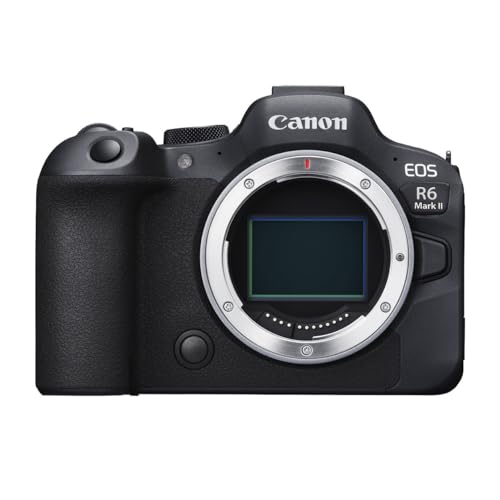
Canon EOS R6 Mark II — Best for moving kids
Parents who have used lesser autofocus describe this body’s eye detection in religious language, and the conversion is understandable. Point it at a child doing anything — sprinting, spinning, being tackled by cousins — and it finds the eye, holds the eye, and delivers the frame a parent actually wanted: the expression, sharp, at the moment it happened rather than a polite blur of where it had been.
Its burst depth serves childhood’s statistics. The perfect expression in a sequence of twenty frames is the nineteenth, and a buffer that survives the whole sequence — the jump, the splash, the landing, the grin — is the difference between an archive of almosts and an archive of the thing itself. Sports day, the dance show and the beach all obey that arithmetic.
Now take it to the school play, the second examination in this review. Ninth row, stage lighting of theatrical ambition and municipal execution, a small shepherd who is the centre of the family’s universe: the Canon’s high-ISO files and telephoto-friendly system produce the portrait the programme promised, without flash, without disturbing a single neighbouring parent.
Its low-light grace covers the other half of childhood — the kitchen at dawn, the birthday candles, the bedtime story in lamplight — with files that keep faces tender rather than crunchy. Parents print these frames for grandparents, and the quality survives the printing with room to spare.
The honest costs are a professional body’s price and size, which this guide will not disguise: it is the choice for the parent who is also a serious photographer, or who intends to become one on the strength of the best subject they will ever have. For that parent, it is not an extravagance; it is the correct tool arriving on time.
Buy it if your children’s childhood deserves a professional witness and your budget can appoint one. Its owners do not describe it as a camera purchase. They describe it as the decision to take the archive seriously, made once and honoured daily.
School photographers who work the circuit professionally confirm its parent reputation from the other side of the lens: the families whose albums they envy at consultations are disproportionately the ones where a parent carried a serious body and learned it. Aspiration, equipped, is a family trait worth funding.
Its silent shutter earns a nursery’s gratitude: the sleeping baby, the christening’s solemn minute and the school assembly’s hush can all be photographed without a mechanical announcement. Childhood contains more sacred silences than any other subject, and this body respects all of them.
A final parental consideration: its files will out-resolve every screen and album the family currently owns, which is another way of saying the archive is future-proofed against the grandchildren’s technology. Buy quality for subjects who cannot be re-photographed; there is no subject that phrase fits better.
One more assignment proves it yearly: the family reunion, where three generations arrange themselves once a decade and the photograph becomes legal evidence of love. A professional body in a parent’s hands at that moment produces the frame that will hang in four houses. Reunions do not repeat for a camera upgrade.
There is a final, practical mercy in its speed: parents operate on stolen minutes, and a camera that is awake, focused and finished before the moment cools respects the scarcest resource in the house. Professional speed, in a family, is a form of kindness.
- Type: full-frame mirrorless
- Strength in brief: the eye, found, every time
- Workflow fit: sports day, stage, playground chaos
- Lens note: telephotos for the ninth row
Strengths
- Eye autofocus that survives childhood’s chaos
- Bursts deep enough for the nineteenth frame
- Candlelight files that stay tender
Trade-offs
- Professional price and size
- Overkill for purely casual archives
- Menus reward an evening’s setup
Best for: Photographer-parents and sports-day specialists.
Not suited for: Families wanting a pocket or toy-proof camera.

Canon EOS R50 — Best family system to grow with
The R50 is the family camera as a long-term plan. In the baby year, its guided modes and gentle automation let an exhausted parent produce beautiful photographs one-handed at 3 a.m.; by the school years, the same body — with a portrait lens added, then a telephoto for the football — has grown into the archive’s serious instrument without the family ever changing systems.
That growth path is its defining argument against every compact in this guide. Childhood escalates its photographic demands on a schedule — wider rooms, faster sports, darker halls, longer stages — and a system answers escalation with a lens, while a finished camera answers it with a replacement. Families who buy the R50 are buying the answer to demands they cannot yet imagine, which is what parenting is.
Watch it at the first-birthday party, the second scene of its portrait. The flip screen frames the cake smash from the baby’s own height, the autofocus holds a face that is mostly icing, the video captures the singing for the grandparents abroad, and the files go to the family chat before the candles are cleared. One camera, every department of the modern family occasion, handled.
Its colour flatters children the way grandparents remember them — warm, bright, kind — and its JPEGs need so little work that the archive actually gets shared and printed instead of accumulating as unprocessed intentions. In family photography, a finished photograph is worth three theoretically superior ones.
Limits arrive on schedule and are honestly survivable: no in-body stabilisation for the running-alongside video, low-light files that ask for the fast prime the family will buy anyway, and controls the parent-photographer may outgrow — into a sibling body that shares every lens, which is the system working as designed.
Buy it as the family’s first serious camera, ideally in the baby year, and let it grow up alongside its subjects. Few purchases in this entire series align so exactly with the shape of the life they serve.
Its hand-me-down economics deserve a family paragraph: when the parent upgrades in a decade, the R50 descends to the eldest child as a first real system, lenses shared across the household. Equipment that circulates downward through a family amortises like furniture and teaches like a tutor.
For the parent returning to photography after the baby years — a common and honourable biography — it functions as a re-entry vehicle: forgiving enough for rust, serious enough for ambition, and priced so that the return does not require a family summit. Many a photographer’s second act starts on exactly such a body.
And its video will be the family’s time machine in twenty years — the voices, the kitchen acoustics, the birthday song slightly out of tune. Parents consistently report that the clips, not the stills, are what make them cry at the decade’s distance. This body makes those clips easy enough to actually exist.
Its flip screen has an unsung family use: the parent in the photograph. Self-timer group frames, video messages recorded solo, the parent visible in the archive as a participant rather than a rumour — family records suffer chronically from the photographer’s absence, and this body treats that absence as a design problem.
Its second decade is already visible in households that bought its predecessors: the camera that shot the first day of school shoots the graduation, slightly worn, entirely adequate, heavy with association. Tools that accompany a whole childhood become family members, and this line has form.
- Type: APS-C mirrorless
- Strength in brief: grows up with its subjects
- Workflow fit: baby year to sports day
- Lens note: one mount, every childhood stage
Strengths
- One-handed kindness for exhausted parents
- Lenses answer each new childhood stage
- Files share and print without a workflow
Trade-offs
- No in-body stabilisation
- Dark halls want the fast prime
- Keen parents may outgrow its dials
Best for: New parents building a decade-long archive.
Not suited for: Pocket-only families or pool-side shooting.

Sony ZV-1F — Best for parties and gatherings
Childhood’s biggest photographic problem is not motion; it is company. The birthday party, the christening, the cousins’ invasion — these events overflow every normal lens, and the ZV-1F’s ultra-wide view was practically designed in answer: the whole room, the whole table, the whole delighted mob, in one frame from the doorway, with faces big enough to matter.
Its simplicity multiplies the family’s photographers. Hand it to an aunt, a grandparent, an older sibling, and the frames come back usable, because the camera’s automation is genuinely trustworthy and its lens forgives positioning entirely. A childhood archive shot by many hands is richer than one shot by a single designated photographer, and this camera is the enabler of that democracy.
See it at the video-call birthday, the second scene of its case. The emigrant grandparents attend on the big screen; the little Sony photographs the party, then becomes its broadcast camera, wide enough to hold the cake ceremony for the far side of the world. Modern childhoods are distributed across continents, and this camera treats that as normal rather than as an edge case.
Its files are sized for the family’s real outputs — shares, prints at album sizes, the grandparents’ fridge via the printed postcard — and its colour is cheerful in the mixed lighting of real homes. Nobody should ask it for the school stage or the football pitch; within the home’s walls, it is close to perfectly briefed.
Battery and charging simplicity suit the household drawer it will live in: any USB cable revives it, and its readiness at party o’clock owes more to that humility than to any specification. Cameras that live charged get used; this one is engineered to live charged.
Buy it for the household’s social archive — the parties, gatherings and calls that constitute most of a family’s photographic memory. It will not be the family’s only camera forever, and it may well be its most-used one this year.
Nursery and toddler groups have adopted its class as the session camera for a simple reason: it photographs the whole circle from the corner a parent actually sits in, and its files go to the group’s private album before snack time. Community childhoods need exactly this unobtrusive competence.
Its product-focus trick, designed for vloggers’ merchandise, turns out to be a parent superpower for the held-up drawing, the found shell, the lost-tooth evidence: tap, and the treasure is sharp while the room melts behind it. Features find their true callings in family service.
Let it be the camera of the family group chat’s golden age — the years when the chat is the family’s living room. Its whole design serves that room, and archives are healthiest where they are most loved, which is there.
For blended and sprawling families, its width is diplomacy: nobody is cropped out of the christening photograph, no step-grandparent relegated to a second frame. Archives have politics, and the widest lens in the room is often the peacemaker.
Keep it honest company for the big camera rather than a rival: families who run both find the little Sony takes the parties and the Canon takes the portraits, and the archive is fuller for the division of labour. Households, like professionals, benefit from a two-body system scaled to their lives.
- Type: fixed-lens ultra-wide compact
- Strength in brief: the whole party, one frame
- Workflow fit: birthdays, christenings, family calls
- Lens note: ultra-wide, forgiving of everyone
Strengths
- Fits gatherings no rival here matches
- Every relative becomes a photographer
- Broadcasts the party to distant family
Trade-offs
- No reach for stages or pitches
- Files sized for sharing, not walls
- Low light softens the cheer
Best for: Party households and dispersed families.
Not suited for: Sports-day or stage photographers.

Sony RX100 VII — Best for grandparents and pockets
Grandparents are childhood photography’s second army, and the RX100 VII is their finest weapon: pocket-sized for the handbag and the coat, with a zoom that reaches the stage from the ninth row and the far end of the football pitch, and autofocus fast enough for grandchildren who have never once sat still on request.
Its viewfinder is the feature its owners evangelise, because childhood happens outdoors — parks, beaches, sports days — where screens surrender to glare and a camera that cannot be composed with might as well be a phone. Through the viewfinder, grandparents produce photographs that make the family’s designated photographer quietly competitive.
Take it on the grandparents’ holiday with the grandchildren, the second scene of its portrait. One device covers the castle, the ice-cream portrait, the boat trip and the evening restaurant, at a quality that prints for the hallway wall — while the parents’ mirrorless kit, too valuable and bulky for the beach bag, stays at the cottage. The holiday archive exists because this camera attended it entirely.
Its files respect the family’s future: sharp enough for the album’s larger pages, honest in the dim village hall, and consistent across years because the camera’s rendering does not chase fashion. A grandparent’s archive should read as one long, calm testimony, and this body produces exactly that tone.
The costs are miniaturisation’s usual ones — small controls that arthritic hands should test before buying, a small battery, a premium price for a finished answer. Test the handling in a shop with the actual grandparent; the right answer varies by hand, and this guide respects that more than any specification.
Buy it for the grandparent division and for parents who will only ever carry a pocket. Presence at the unrepeatable is its whole promise — and in childhood, presence is the only category that finally matters.
It is also the camera family historians recommend for the relative who ‘isn’t technical’: its automatic modes are the most trustworthy in this guide relative to its quality, so the archive it produces needs no excuses and no rescues. Competence that requires no expertise is a gift to give an older relative.
Retired professionals choose it for grandchildren duty with a consistency that amounts to a verdict: the people who can operate anything select, for the subjects they love most, the camera that will simply be there and be good. The industry should print that sentence on the box.
Judge it by the photographs on the grandparents’ hallway wall in ten years: the stage, the beach, the garden, the goal. That wall is selected by love from thousands of frames, and this camera’s share of it, in household after household, is the review that matters.
Its macro-adjacent close focus serves the small archaeology of childhood — the found feather, the tooth, the caterpillar — at a quality that prints for the nature table. Childhood is mostly small things, closely seen, and this pocket camera sees them properly.
And for the parent who travels for work, it is the camera that comes home with the trip’s photographs for the children — the other half of the family archive, the away half, which children treasure with a completeness that surprises the traveller. Presence in both directions is its quiet achievement.
- Type: one-inch sensor zoom compact
- Strength in brief: the ninth row from a pocket
- Workflow fit: grandparents, holidays, sports day
- Lens note: wide-to-tele, always along
Strengths
- Reach for stages and pitches
- Viewfinder defeats park glare
- Quality that prints for the hallway
Trade-offs
- Small controls need a hands-on test
- Premium price, finished answer
- Small battery for long video days
Best for: Grandparents and pocket-carrying parents.
Not suited for: Families planning a growing lens system.

GoPro HERO13 Black — Best for pools, bikes and rough play
Every other camera in this guide observes childhood; the HERO13 participates in it. Strapped to the bike helmet, the chest harness, the pool’s edge or the dog, it records the first descent, the first solo swim and the skatepark’s social order from the child’s own point of view — footage and stills no parent with a telephoto can obtain at any price, because the parent was never inside the game.
Its toughness is the enabling specification. Waterproof, drop-surviving and indifferent to jam, sand and snow, it is the camera a parent can hand to a seven-year-old without a waiver, and the photographs children make of their own world — the den, the gang, the view from the climbing frame — are a genre of archive no adult can manufacture.
Now mount it for the holiday’s waterpark day, the second scene of its case. The big cameras stay in the room safe; the GoPro rides the slides, films the underwater grin, and stills the moment the little one surfaces victorious. Families return from such days with the footage the reunion will watch in thirty years, precisely because one camera in the kit was unbreakable enough to be there.
Its stills are wide, bright and honest in daylight, sized for sharing and album prints; its video is the family’s action archive outright. Low light is its declared weakness — dusk softens it quickly — and its fixed wide view flatters no one’s portrait. It is a specialist, and childhood is full of its speciality.
Accessories multiply its childhoods: mounts for bikes, boards, helmets and pets, each cheap enough to be a birthday present that extends the camera’s world. Few photographic gifts keep giving at that rate, and godparents have noticed.
Buy it for the active family and the child old enough to hold a world of their own. It will not replace the family camera; it will complete the archive with the chapters only it can write.
Swim schools and junior sports clubs issue its class for coaching review, and parents who borrow the habit — filming the stroke, the kick, the descent — find the archive doubling as a training record. Childhood footage that teaches as well as remembers earns its storage twice.
Its time-lapse and interval modes give patient children a science instrument: the garden’s day, the tide, the caterpillar’s progress, recorded by a camera that can be left in the weather. Childhood archives that include the child’s own experiments are richer than any portrait series.
It also teaches children risk’s documentation: the jump filmed is the jump remembered accurately, and more than one family reports that reviewing footage together — the wipeouts included — has become a ritual as bonding as the activities themselves.
Foster and adoptive families add a testimony worth honouring: its point-of-view footage lets a child narrate their own new world in their own framing, which can be a profound instrument of belonging. Tools are neutral; in the right hands this one is a voice.
Its footage also future-proofs the family’s stories against memory’s editing: the height of the jump, the speed of the descent, the exact sound of the laughter. When the reunion argues the legend in thirty years, this little camera’s files will be the court of appeal, and everyone will be glad they exist.
- Type: waterproof action camera
- Strength in brief: childhood from inside the game
- Workflow fit: pools, bikes, holidays, kids’ own films
- Lens note: fixed wide, stabilised everything
Strengths
- Survives everything childhood does to it
- Point-of-view footage no parent can fake
- Children become photographers safely
Trade-offs
- Dusk softens it quickly
- Wide view flatters no portraits
- Stills are sharing-sized, not wall-sized
Best for: Active families and adventure holidays.
Not suited for: Stage, portrait or low-light archives.

Fujifilm Instax Mini 12 — Best first camera for kids themselves
The Instax Mini 12 closes the list by handing the camera over. It is the first real photographic instrument most children can own outright: simple enough for a five-year-old, satisfying enough for a teenager, and productive of the one thing digital childhood lacks — prints the child can hold, trade, annotate and keep in a shoebox that will outlast every account password in the house.
Its pedagogy is disguised as fun. Because each frame costs film, children learn framing, patience and selection by instinct — the same discipline this series praises in adult beginners, delivered at pocket-money scale. The prints that result, imperfect and beloved, teach the second lesson too: a photograph’s value is the moment, not the megapixels.
See it at the sleepover and the school trip, the second scenes of its double life. Prints are traded like currency, stuck into journals, signed by friends; the class’s year accumulates on bedroom walls in a way no shared album has ever made a child feel. Childhood archives are usually made of children; this camera lets children make the archive, and the difference shows in what gets photographed — their world, not the adult view of it.
Running costs are the honest footnote every instant review in this series repeats: film is a per-pack commitment, and a keen child will need it budgeted like a hobby’s consumable, because it is one. Families who treat film as the art-supply budget it resembles never resent it; families surprised by it do.
Quality is the format’s warm, small, forgiving rendering — wrong for documents, perfect for friendship. Its photographs will not enlarge, will not be graded, will not impress a camera club; they will be kept, which is the archive’s first virtue and the one this whole keyword ultimately serves.
Buy it for the child, and buy the film in sensible quantity alongside. In a guide full of cameras for photographing kids, this is the one that trusts kids with photography — and trust, as every parent learns, is how photographers are made.
Grandparents report its prints achieve what their own albums did: they are fought over, in the kindest way, by grandchildren dividing a holiday’s harvest. Objects create inheritance rituals that files never have, and the rituals are part of the archive’s survival strategy.
Schools use it to teach sequencing — a story in five prints, arranged and rearranged on a desk — which is film editing, narrative and photography in one exercise costing five frames. Educators who discover it tend to build a term around it.
Close with its simplest statistic: households that own one print more photographs in a month than households that do not print in a year. In a guide about pictures of kids, that statistic is not a footnote. It is close to the whole argument.
Its prints also solve the separated-family problem with grace: a print made at Dad’s house travels to Mum’s fridge in a school bag, no accounts, no permissions, no platforms. In divided households, the physical photograph remains the most diplomatic technology ever invented.
Finally, it is the only camera in this guide whose output a toddler can collect. The shoebox of prints a child keeps under the bed is the seed of every archive in this series — proof that the instinct to keep photographs is not taught by technology, only served by it. Serve it early.
- Type: instant film camera
- Strength in brief: the child’s own instrument
- Workflow fit: sleepovers, school trips, first albums
- Film note: budget packs like art supplies
Strengths
- Children operate it in minutes
- Prints become owned, traded treasure
- Teaches framing by costing every frame
Trade-offs
- Film is a continuing household cost
- Small, gentle prints only
- No files for the family vault
Best for: Children from five upward, and their friendships.
Not suited for: Parents needing the main family archive.
How Do the Six Kids’-Photography Picks Compare?
Childhood divides cameras by a single test: were they there, in focus, when it happened? The grid maps the six onto the family’s real occasions.
| Camera | Badge | Standout trait | Watch out for |
|---|---|---|---|
| Canon EOS R6 Mark II | Best for moving kids | The professional witness | Set up eye detection before the event |
| Canon EOS R50 | Best family system to grow with | The camera that grows up too | Add the fast prime in year one |
| Sony ZV-1F | Best for parties and gatherings | Democracy in a camera | Keep it charged in the kitchen drawer |
| Sony RX100 VII | Best for grandparents and pockets | The second army’s weapon | Test the controls with real hands |
| GoPro HERO13 Black | Best for pools, bikes and rough play | Inside the game | Buy the mount kit with the camera |
| Fujifilm Instax Mini 12 | Best first camera for kids themselves | The handover camera | Include film in the gift, always |
How Do You Photograph Children at Their Own Eye Level?
Kneel. The single most reliable improvement in any family’s archive is the photographer’s knees: at a child’s eye level, the world composes itself from the child’s perspective, faces fill with expression rather than forehead, and backgrounds become the room’s middle instead of its floor. Adults photograph children from a great height and then wonder why the archive feels like surveillance.
Eye level also changes the child’s behaviour. A parent kneeling with a camera is a participant; a parent standing with one is an audience, and children perform for audiences while living for participants. The archive’s honesty is decided by that difference more than by any camera in this guide.
Make it a physical habit with a place: the low stool by the play area, the habit of sitting on the floor for the evening’s photographs. The picks with flip screens — the R50 foremost — exist partly to spare the knees, and older photographers should use them without a shred of shame.
What Burst Discipline Captures the Expression Without Drowning the Archive?
Shoot bursts at peaks, not as a lifestyle. The jump, the blow of the candles, the finish-line lunge deserve a sequence from which the one true frame is chosen that evening; the afternoon does not. A parent who bursts everything edits nothing, and the unedited archive is where childhoods go to be lost in plain sight.
Cull on the day, kindly but firmly: keep the best of each sequence, the one candid between poses, and delete the duplicates while the memory of the moment can still judge them. Future you, facing ten thousand frames, will bless the parent who kept three hundred good ones.
And keep the outtakes that fail beautifully — the mid-sneeze, the cake catastrophe, the sibling photobomb. Family archives are loved for their accidents as much as their triumphs, and a cull that keeps only perfection produces a record nobody recognises as their childhood.
How Should Families Share Children’s Photos Responsibly?
With the child’s growing personhood in view. Babies cannot consent; teenagers emphatically can, and the wise family archive evolves its rules as its subjects grow — asking before posting, honouring vetoes, and keeping some occasions deliberately unshared so that childhood retains a private interior the internet never enters.
Prefer closed circles for the everyday archive: family groups and shared albums over public feeds, especially for school uniforms, locations and routines. The cameras in this guide all feed private sharing as happily as public, and the choice of audience is a parenting decision that deserves the same deliberation as the choice of camera.
Teach the archive’s etiquette by practising it: the parent who asks, credits and respects a child’s ‘not that one’ is raising a person who will handle other people’s images honourably. In a century of photographs, that may be the most valuable thing a family camera ever teaches.
What Monthly Print Ritual Keeps a Childhood From Living Only on a Phone?
Choose the month’s ten frames together, print them small, and put them where the family lives — the fridge’s rotating gallery, the hallway string, the album that stays on the shelf guests open. Ten prints a month is a hundred and twenty a year: a childhood, curated by its own household, at a cost lower than the streaming subscriptions nobody remembers buying.
Let children choose some of the ten. Their selections — the blurry dog, the friend’s grin, the puddle — correct the adult archive’s bias toward milestones and reveal what the childhood actually felt like from inside. Future historians of the family will treasure the children’s choices most.
Date the prints on the back, in pencil, with names. The archive’s future readers cannot ask the photographer, and a print that knows when and who is a document; a print that does not is a riddle. Thirty seconds per print, repaid for a century.
How Do You Handle the Stage, the Hall and the Ninth Row?
Arrive early, sit on the aisle at the closest defensible row, and let a telephoto do what feet cannot. The R6 Mark II and RX100 VII in this guide exist for this geography; whichever you carry, set it before the lights fall — exposure for the stage’s brightness, focus mode for faces — because the performance will not pause for a menu.
Respect the room’s rules absolutely: no flash where it is banned, no shutter noise where silence is the price of the recording, no standing in another family’s sightline for your frame. The school play is a commons, and the parent who photographs it honourably is invited to keep doing so for a decade of siblings.
Film one song, photograph the rest. The archive needs both, and the parent who attempts both simultaneously usually archives neither — while also missing the play as a spectator, which is the loss nobody mentions and everybody feels. Divide the duties across the run’s performances or the family’s adults.
Why Do the Best Family Photographs Happen Between the Occasions?
Because expression relaxes there. The car journey’s singing, the kitchen’s homework negotiations, the dog walk’s weather — unguarded life produces the faces families actually remember, while occasions produce the faces families performed. An archive of only occasions is a record of a family’s theatre; the life was in the intervals.
Equip for the intervals: a camera charged by the door, a pocket camera in the coat, the phone forgiven its role for the truly spontaneous. The picks in this guide were chosen for readiness as much as for quality, because the interval does not wait for a camera bag to be fetched from upstairs.
Keep one ritual frame that captures the intervals deliberately — the monthly window portrait, the same-spot seasonal photograph — so that the ordinary years, which blur in memory fastest, acquire anchors. Grandparents consistently identify these, not the birthday line-ups, as the archive’s treasures.
How Do You Keep Photographing as the Children Grow Up?
By renegotiating, openly. The toddler’s total availability becomes the eight-year-old’s conditions and the teenager’s editorial control, and the family archive survives by treating those stages as its constitution rather than its decline. The parent who adapts — fewer, better, asked-for photographs — keeps access that the parent who insists loses entirely.
Shift genres with them: from portraits to their sports, their performances, their projects, their friendships at a respectful distance. The camera that follows a child’s interests rather than their face stays welcome, and the archive becomes a record of a person unfolding rather than a face ageing.
Hand over the means, as the Instax pick in this guide suggests, and let the growing child’s own photographs enter the family record alongside yours. The archive that becomes a conversation between generations outlives the one that remained a monologue — and it begins, usually, with a parent brave enough to share the camera.
How Do You Build a Childhood Archive Both Parents Can Actually Use?
One system, two keepers: a shared monthly folder both parents can add to from their own devices, a shared album for the prints, and passwords held in common against the future. The single-keeper archive is the family equivalent of the single card slot — a known fragility that love, unassisted by organisation, keeps recreating.
Divide the labour by gift rather than by rota: one parent shoots the occasions, the other keeps the intervals; one prints, the other backs up. Archives maintained by two people’s strengths outlast archives maintained by one person’s guilt, and children benefit from seeing both parents in the role of rememberer.
Review the archive together on the year’s turning — birthdays and new year are the natural audits — choosing the prints and noticing the gaps while next year’s occasions can still fill them. An archive with an annual general meeting is an archive with a future.
Which Mistakes Do Loving Parents Make With Family Photographs?
The posed monopoly is the tenderest error: an archive of children arranged, grinning and miserable in doorways, while the actual childhood — messy, hilarious, unrepeatable — went unphotographed because it was not an occasion. Photograph the life, and let the line-ups be the archive’s punctuation rather than its text.
The unprinted, unshared backlog follows: thousands of frames on one phone, one parent the sole keeper, the other parent unable to find the nativity photograph at need. Share the archive, print the month, keep two copies in two places — the family’s memory is a commons and must be governed like one.
The third mistake is outstaying the welcome: photographing past a child’s clear reluctance, posting past a teenager’s veto, turning the camera into the family’s surveillance rather than its celebration. The archive’s value depends on the love of its subjects, and a childhood that experienced the camera as an intruder will not thank the photographer at the reunion. Put it down sometimes. Be in the photograph, and in the moment, instead.
Final Recommendation
For the parent who will photograph childhood seriously, the Canon EOS R6 Mark II is the archive’s professional witness; for most families, the Canon EOS R50 is the recommendation that fits the decade — kind in the baby year, capable at sports day, shareable throughout. The Sony ZV-1F owns the parties, the Sony RX100 VII the grandparents and the pockets, the GoPro HERO13 Black the water and the wheels, and the Fujifilm Instax Mini 12 the children’s own hands.
Whichever arrives in your house, institute the rituals with it: eye level, burst at the peaks, print in the month, ask before sharing. Childhood will supply the moments at a rate no family can fully honour. These cameras, and those habits, are how you honour more of them than regret requires.
Frequently Asked Questions
What is the best camera here for a new baby?
The Canon EOS R50, for its one-handed kindness, quiet operation around sleeping infants and growth into the school years — bought in the baby year, it is the archive’s foundation. For pure pocket presence at the hospital-and-home stage, the Sony RX100 VII is the alternative grandparents swear by.
How do I get sharp photos of a toddler who never stops?
Eye autofocus, a fast shutter and burst discipline, in that order — the R6 Mark II automates the first two better than anything here, and the guide’s burst section teaches the third. Add light wherever you can: near a window, a toddler’s portrait sharpens itself.
Is a big camera worth it just for family photos?
If the family includes a parent who loves photography, yes — the R6 Mark II’s section argues that case without blushing. If no one in the house loves the craft itself, the R50 or RX100 VII will produce the archive with less friction, and an archive produced beats a masterpiece postponed every year of a childhood.
What camera should I buy my child?
The Fujifilm Instax Mini 12 for most children from about five — real photography, instant treasure, survivable economics if film is budgeted as art supplies. For the older, adventurous child, the GoPro HERO13 Black becomes their own film department, as its review describes.
Can I use an action camera as our main family camera?
As the activity camera, gloriously; as the only camera, you will miss portraits, stages and candlelight, where its wide lens and low-light limits bind. Families happiest with a GoPro pair it with any other pick here and let each serve its kingdom.
How do I photograph a school play without disturbing anyone?
Aisle seat, telephoto reach, settings made before the lights fall, no flash, and the courtesy of filming one song while photographing the rest — the guide’s stage section gives the full protocol, and the R6 Mark II and RX100 VII are its instruments.
Should I post my children’s photos publicly?
That is a parenting decision this guide deliberately informs rather than makes: the sharing section lays out the consent-by-age approach most thoughtful families now use — closed circles for the everyday, the child’s own veto honoured as they grow, and some occasions kept entirely private by design.
What is the one habit that improves family photos most?
The monthly print, chosen together and dated on the back. It forces selection, creates the physical archive children actually grow up inside, and feeds back into better shooting within a season. Cameras differ; that habit compounds identically on all of them.
What if my child hates being photographed?
Believe them, and adapt: photograph their world, their projects and their occasions from a respectful distance, negotiate the frames that matter, and let some seasons pass with the camera mostly down. Children whose boundaries are honoured usually return to the archive as collaborators in their own time — and the photographs from the distant years, of their interests rather than their faces, often become the ones they treasure most.
Related Guides
Childhood photography grows into family archiving, printing and the next generation’s own cameras, and these guides continue each: our family archive and backup handbook for parents a guide to printing and album-making for busy households the children’s photography projects book — ideas by age


