kajuandouglas.com is reader-supported. When you buy through links on our site, we may earn an affiliate commission.
Where to Buy a First Camera, and What “Intro” Should Honestly Mean
A note on the words, in plain sight: by intro photographers this guide means introductory photographers — people buying their first real camera — and it takes that brief seriously enough to rank teaching above specifications. The best cameras for intro photographers are not the cheapest cameras, nor the simplest; they are the ones whose first month produces good photographs, whose second year is not outgrown, and whose controls explain photography while the beginner is busy enjoying it.
Where to buy: each linked name below leads to that camera’s Amazon listing, and a beginner’s basket should be almost aggressively plain — the camera with its kit lens, one memory card, a spare battery, and nothing else. Every accessory a shop adds in month one is a lesson postponed and a bag made heavier; the second purchase should be chosen by the beginner’s own first hundred photographs, not by a sales assistant’s first five minutes.
The six divide by the kind of beginner holding them. Canon’s R50 teaches everybody; Nikon’s Z30 teaches creators; Sony’s ZV-E10 II teaches businesses in embryo; Nikon’s Z50 II teaches photographers; Canon’s R10 teaches the sideline; and Sony’s pocket RX100 VII teaches the honest minimalist who will never carry a system. Somewhere in that list is the beginner you actually are, as opposed to the one the advertisements address.
One reassurance before the list: every camera here produces photographs a phone cannot, in light a phone cannot use, with a depth a phone imitates. The differences among them are differences of temperament and trajectory, not of permission. A beginner cannot choose wrongly from this page — only more or less personally.
So the verdicts that follow are written to the beginner’s actual calendar — the school play, the sideline, the desk channel, the first trip — rather than to a laboratory. Match the camera to the calendar and the match will hold for years, because lives change more slowly than product lines do.
Key Takeaways
The first-camera summary, for beginners reading with a basket open:
- Intro means introductory: the best first camera teaches while it helps, and is not outgrown in year two.
- The Canon EOS R50 is the default answer — guidance that explains, quality that encourages, and a decade of lenses waiting in one friendly, carryable body.
- Creators start on the Nikon Z30 or Sony ZV-E10 II; photographers-in-earnest on the Nikon Z50 II.
- Buy plainly at first: camera, kit lens, one card, a spare battery — and let the first hundred photographs, not a sales assistant, choose every purchase that follows.
- The Sony RX100 VII is the honest minimalist’s answer: no system, no bag, no excuses.
- Every camera here beats a phone in real light; choose by temperament, not by fear.
- Print five photographs in the first month and live with them — paper teaches a beginner faster than any screen, because paper does not flatter.
In this guide
Quick Picks
Six beginners, six first cameras — the guided, the creator, the ambitious, the earnest, the sideline, the minimalist.
| Camera | Badge | Why it earns its place here |
|---|---|---|
| Canon EOS R50 | Best First Camera for Most Beginners | Guidance that teaches, quality that lasts, and a lens system to grow into for a decade. |
| Nikon Z30 | Best for Beginners Who Film First | A video-first starter with Nikon colour and a screen that assumes a crew of one. |
| Sony ZV-E10 II | Best Step-Up Starter for Serious Creators | Beginner-friendly creator controls over a system with professional headroom. |
| Nikon Z50 II | Best for Beginners Who Mean Photography | A real viewfinder, flagship-bred focus, and files that teach a beginner what good looks like. |
| Canon EOS R10 | Best for Beginners Who Shoot Action and Family Sports | Speed, reach-friendly crop, and Canon guidance for the sideline and the school play. |
| Sony RX100 VII | Best for Beginners Who Will Not Carry a System | One pocket camera, no lenses to buy, and quality that ends the phone debate. |
How Did We Choose the Best Cameras for Intro Photographers?
We ranked the first month and the second year together. The first month asks: does the camera produce good photographs while its owner still knows nothing, explain itself without a manual’s misery, and get carried — because a first camera in a cupboard teaches only regret. The second year asks: is there anywhere to grow — a lens, a mode, a genre — without selling the camera and starting again?
Autofocus that handles focusing while the beginner learns composition scored heavily, as did colour that makes early work look encouraging rather than forensic. Price honesty mattered in a specific way: we favoured cameras whose total first-year cost — body, kit lens, the inevitable fast prime — stays sane, because a beginner’s budget is also their lesson budget, their printing budget, and their trip budget.
What we discounted: flagship specifications a beginner cannot yet use, and toy simplicity that a beginner outgrows by spring. The intro camera is a teacher with a future, and every pick here is both.
One more criterion deserves naming: repairability of morale. A beginner’s camera will be blamed for the beginner’s mistakes, fairly or not, and the bodies here were chosen partly for how rarely they deserve the blame — focus that works, colour that encourages, files that forgive. A first year is a fragile asset; equipment should protect it.
What Should a Beginner Actually Learn First?
Not the exposure triangle as a diagram — as a set of three trades the camera can demonstrate. Light sensitivity against noise, shutter speed against motion, aperture against depth: every camera here can teach those trades live, on real subjects, with the screen showing the consequence before the shutter fires. The beginner who plays with one trade per outing, on a subject they care about, learns in a month what a manual teaches in a season of resentment.
Composition comes second and matters more: the habit of moving closer, of checking the frame’s edges, of waiting for the expression instead of spraying at the event. No camera teaches that directly, but the friendly ones here leave enough attention free — by handling focus and exposure kindly — for the beginner to spend on seeing. That is the deepest sense in which a first camera teaches: it buys the beginner’s attention for the lessons only experience can give.
Should a Beginner Buy a System or an All-in-One?
It depends on a prediction about yourself, and the prediction should be honest rather than flattering. If there is any real chance the hobby catches — if you already linger over other people’s photographs, already wish your phone had done better at the wedding, already have opinions about light — buy the system, because its second year is a lens rather than a replacement. The R50 and its kin exist for that beginner.
If the honest prediction is a camera for trips, family, and the occasional beautiful day, carried in a pocket and never accompanied by a bag, the all-in-one is not a compromise but the correct instrument — and the RX100 VII in this list exists to prove that a pocket camera can be a serious answer rather than an apology. The only wrong purchase is the one that contradicts the beginner’s actual life.
Which First Cameras Teach Best? The Six Picks in Detail
Matched to six kinds of beginner — be honest about which one is holding this guide.

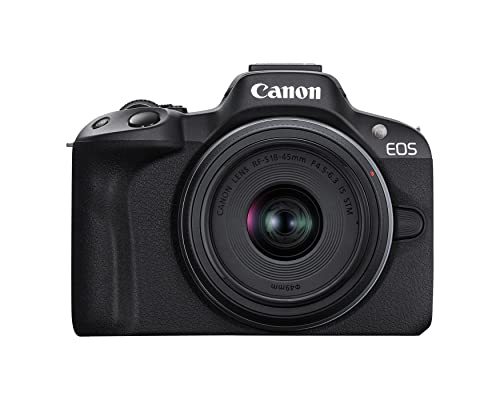
Canon EOS R50 — Best First Camera for Most Beginners
Every beginner deserves a first camera that behaves like a good teacher: patient with mistakes, clear in its explanations, and incapable of making its student feel stupid. The EOS R50 is that teacher in camera form. Its guided interface translates the exposure triangle into plain language and live previews, its automatic modes are honest enough to produce genuinely good photographs in week one, and beneath the kindness sits a real mirrorless system — sensor, autofocus, and lens mount — that will not need replacing when the student stops being one.
Most fundamental of all, beginners actually take the camera out. Because it is light, friendly, and quick to reward, the R50 gets carried during the fragile first months when photography either becomes a practice or becomes a purchase regret. Its subject detection quietly handles the focusing while the beginner learns composition, then hands over control in stages as the guided modes are outgrown — training wheels that remove themselves, which is the only kind worth having.
Its second life is the creator’s: the flip screen, the video manners, and Canon’s flattering colour make it the starter camera of a thousand channels and small shops. Beginners who arrive for stills and discover film — or the reverse — find the R50 fluent in both, which matters because a beginner’s genre is the one thing nobody can predict at the shop counter.
The honest limits are a starter’s limits, and they are well chosen: an APS-C sensor that asks for a fast lens in dark rooms, no in-body stabilisation, and controls that assume help is welcome. Each is a reasonable trade for the price of admission, and each has a known remedy inside the same system when the beginner is ready to want it.
Choose it as the default first camera — for yourself, for a teenager, for anyone whose enthusiasm deserves equipment that encourages rather than examines. More photography careers, and more lifelong hobbies, start on cameras like this than on any flagship.
Gift-givers should hear its strongest testimony: this is the camera teenagers actually use after the birthday. Its phone-like friendliness bridges the world they live in, and its quality gives them a reason to graduate within it — the rare present that changes a habit rather than decorating a shelf.
Its resale kindness deserves a beginner’s attention too: if the hobby does not catch, an R50 finds a second home at a fair price within the week, because every creator community runs on them. A first camera that is easy to leave is, paradoxically, one beginners commit to more freely.
- Type: APS-C mirrorless, guided interface
- Signature: teaches while it helps
- Detection: faces, animals, vehicles
- Screen: flips for creators and learners
- Role: the first camera
Strengths
- Good photographs in week one.
- Guidance explains, never scolds.
- System grows for a decade.
Trade-offs
- Dark rooms want a fast lens.
- No in-body stabilisation.
- Helpful menus assume trust.
Best for: first-time buyers, teenagers, and gift-givers who want the gift used.
Not suited for: beginners who already know they want full-frame extremes.

Nikon Z30 — Best for Beginners Who Film First
A growing share of beginners do not want to become photographers who also film; they want to become creators who also photograph, and the Z30 was designed from that direction. It has no viewfinder because its audience frames on screens; it has a flip display, a tally light, and microphone provisions because its audience is its own crew; and it renders all of it in Nikon’s calm, natural colour, which flatters beginners by making their footage look considered before they know how they did it.
Set the camera at desk height, frame on the screen, and the talking-head apprenticeship gets done properly: exposure, light, and presence learned in the genre the beginner actually intends to publish. Its autofocus keeps a face honest through a presenter’s movements, its compact body keeps the setup to a drawer rather than a studio, and its stills — from the same APS-C sensor family as its bigger siblings — cover the thumbnail, the product shot, and the occasional real photograph with more quality than the video-first badge suggests.
Around the edges of the creator brief it is thoughtfully complete: long recording manners for lessons and streams, a grip shaped for a small tripod’s life, and a lens range that includes the wide zooms a one-person production lives on. Beginners in education, crafts, commentary, and commerce will find their whole first year inside its capabilities.
The debits are the mirror of its design: photographers who discover a love of the viewfinder will find none here, the lack of in-body stabilisation puts walking footage on the lens and the technique, and the Z mount’s lens shelf, while growing, asks a little more deliberation than Canon’s. Beginners should buy it knowingly — as a creator’s first camera that photographs well, not a photographer’s that films.
Choose it when the ambition arrives with a channel name already attached, when the desk is the studio, and when the beginner’s first audience is waiting on a platform rather than in a gallery. It is the starter camera for the filmed life.
Livestreaming beginners praise a practical mercy: it behaves like a high-quality webcam with proper lenses when the desk demands it, so the same purchase covers the stream, the lesson recording, and the thumbnail. One body, three jobs, no capture-card drama.
Its stills have a second career in the classroom: teachers filming their own lessons use its photographs for the handouts and the course pages, in the same Nikon colour as the films. Consistency across a course’s materials looks like production values, because it is.
- Type: APS-C creator mirrorless, no finder
- Signature: screen-first design
- Colour: calm Nikon naturalism
- Recording: lessons and streams welcome
- Role: the filming beginner’s camera
Strengths
- Built for a crew of one.
- Colour flatters beginners instantly.
- Stills exceed the video badge.
Trade-offs
- No viewfinder to grow into.
- Walking footage leans on technique.
- Lens choices need a shortlist.
Best for: beginning creators, teachers, and desk-based channels.
Not suited for: beginners dreaming of viewfinder photography.

Sony ZV-E10 II — Best Step-Up Starter for Serious Creators
Some beginners know, correctly, that they will not stay beginners — and resent equipment that plans to be outgrown. The ZV-E10 II is the starter for them: creator-first on the surface, with product-showcase focus, a defocus switch, and a screen that flips for the solo operator, but underneath it sits Sony’s deep lens system and an autofocus that professionals respect, so the camera’s ceiling is nowhere in the first three years of its owner’s growth.
Production discipline arrives from day one, not year two. Because its tools assume a one-person business — the tally light, the product focus, the microphone provisions — the beginner learns the workflow of a working creator rather than the habits of a hobbyist, and the stills it produces for the grid and the listings carry real lens quality from the first fast prime onward. It is a starter camera that behaves like a first employee.
Its learning curve is the honest price: more capability means more settings to meet, and Sony’s menus reward an evening with the manual more than Canon’s guidance does. Beginners who enjoy systems will call that depth; beginners who want the camera to disappear should take the R50’s kindness instead. Knowing which beginner you are is the entire decision between them.
Limits follow its creator brief: no viewfinder, stabilisation that leans on lenses for walking work, and a control layout that serves the filmed product before the quiet photograph. Within the brief — channels, shops, tutorials, portfolios — those are priorities correctly ordered, and the market of working solo creators has voted accordingly.
Choose it when the beginner is a business in embryo: the shop, the course, the channel with a plan. It costs a beginner’s commitment and returns a professional’s runway.
Shop-owning beginners describe the ZV-E10 II’s first month as an apprenticeship with a patient foreman: every mistake is recoverable, every tool is labelled by use, and the work — listings, tutorials, portraits — ships while the learning continues. That is the correct shape of a business’s first equipment.
It also future-proofs the beginner’s content against their own rising standards: footage and stills from year one remain usable in year three’s portfolio, because the sensor and the lenses were never the weak link. Beginners rarely forgive equipment that makes their early work unusable; this body never commits that sin.
- Type: APS-C creator mirrorless
- Signature: headroom disguised as a starter
- Focus: product showcase and eyes
- System: Sony’s deep lens shelf
- Role: the serious beginner’s camera
Strengths
- Ceiling is years away.
- Production workflow from day one.
- Autofocus professionals respect.
Trade-offs
- Menus reward homework.
- No viewfinder for bright days.
- Walking footage needs help.
Best for: beginning shop owners, course creators, and ambitious channels.
Not suited for: beginners wanting the camera to disappear.

Nikon Z50 II — Best for Beginners Who Mean Photography
For the beginner whose ambition is photography itself — the craft, the prints, the long education of the eye — the Z50 II is the starter that takes the ambition seriously. It has a proper viewfinder that teaches seeing, subject detection inherited from Nikon’s flagships that keeps early efforts sharp where it matters, and files with the colour and range to show a beginner, in their own work, what a good photograph actually looks like. That feedback loop is the finest teacher in this list.
Raise, compose through the finder, commit — that photographer’s discipline takes hold. Its handling — a real grip, dials that fall into a learnable pattern — rewards the deliberate practice that turns a beginner into a photographer, and its video is strong enough that the student’s occasional film does not require a second body or an apology.
It also respects a beginner’s budget logic in the long run: the body is capable enough that the second purchase becomes a lens rather than a replacement, and Nikon’s small bright primes transform its low-light manners for less than the cost of starting over in another system. Beginners who buy it tend to keep it as their second body even after a flagship arrives, which is the market’s verdict on its staying power.
The trades are a serious camera’s trades: less hand-holding than the Canon’s guided modes, a lens range still maturing, and no in-body stabilisation to forgive a shaky apprenticeship. A beginner who wants to be taught by a person rather than an interface — a class, a mentor, a camera club — will find those trades exactly right.
Choose it when the dream is photographs on walls, when a viewfinder feels like home from the first hold, and when the beginner wants a camera that grades their homework honestly. It is the starter as an education.
Camera clubs have adopted it as the loaner that converts: a beginner borrows the Z50 II for a field trip and returns with photographs good enough to argue about. Equipment that produces arguable photographs is equipment that produces photographers.
Its files print with a maturity that startles beginners at their first exhibition — the club’s wall, the school’s corridor — because the colour and range were never beginner-grade to begin with. Confidence, in a first year, is built from exactly such surprises.
- Type: APS-C mirrorless, viewfinder-first
- Signature: flagship-bred subject detection
- Files: colour that teaches quality
- Handling: grip and dials for practice
- Role: the photography student’s camera
Strengths
- Files show beginners what good is.
- Focus keeps early work sharp.
- Stays as a second body forever.
Trade-offs
- Less guidance than Canon offers.
- Lens shelf still maturing.
- No stabilisation safety net.
Best for: photography students, camera-club beginners, and print dreamers.
Not suited for: beginners wanting maximum hand-holding.

Canon EOS R10 — Best for Beginners Who Shoot Action and Family Sports
Beginners are not one tribe: some begin at a desk, and some begin on a sideline, photographing a child’s football, a dog’s agility debut, a school’s athletics day. The R10 is the starter built for the second tribe. It brings Canon’s friendly guidance to a faster body — brisk bursts, subject detection for people and animals, and an APS-C sensor whose crop turns a modest telephoto into sideline reach — so the beginner’s first season of action produces keepers instead of a blur album and a resolution to give up.
Anticipation, above all, is what action shooting teaches. Action teaches exposure and timing faster than any other genre, and the R10’s speed lets a beginner stay in the lesson rather than fighting the equipment: pre-shooting manners forgive late reactions, the autofocus tracks a runner through a crowd’s clutter, and the files hold up when cropped toward the moment that mattered. Parents graduate from this camera with a family sports archive that looks professional to everyone who was not on the sideline freezing.
Off the field it is a complete family camera — the same Canon colour, the same guidance, a flip screen for the creator cousin in the household — and its size keeps it in the car, where sideline life actually stages from. It is the pick for households whose calendar is a fixture list.
Its limits are a step-up starter’s: no in-body stabilisation, a sensor that wants light or fast glass indoors, and a body whose enthusiast leanings assume the beginner will meet it halfway. Families whose action is mostly indoors — gyms, stages — should weigh the low-light picks elsewhere; families outdoors will not miss what they traded.
Choose it when the beginner’s subjects move, when the telephoto is the lens that matters, and when the family archive is written in fixtures and seasons. It is the starter as a season ticket.
Dog-sport beginners — agility, flyball, the dock-diving classes — have made it their standard for a reason beyond speed: its animal detection understands the actual subject of their lives. A camera that finds the dog’s eye at full sprint teaches its owner what their sport looks like frozen, which is half the joy of the archive.
Its crop reach flatters the school concert too: from the parent’s seat, a modest telephoto frames the stage like a press pass. Beginners discover, through this camera, that access is often just focal length plus the courage to arrive early.
- Type: APS-C mirrorless, speed-leaning
- Signature: bursts and subject tracking
- Reach: crop multiplies modest telephotos
- Guidance: Canon’s friendly teaching
- Role: the sideline starter
Strengths
- First season produces keepers.
- Tracking forgives late reactions.
- Complete family camera off-field.
Trade-offs
- Indoor gyms stretch its sensor.
- No in-body stabilisation.
- Assumes a willing student.
Best for: sports parents, dog-sport beginners, and outdoor families.
Not suited for: indoor stage and gym specialists.

Sony RX100 VII — Best for Beginners Who Will Not Carry a System
There is a beginner this list must not fail: the one who will never carry a bag, never change a lens, and never read a manual — but who wants photographs decisively better than a phone’s and is honest about all three facts. The RX100 VII is that beginner’s camera. It is a complete photographic education in a pocket: a real zoom, a viewfinder that pops up like a secret, flagship-bred autofocus, and files whose quality makes the phone comparison embarrassing in exactly the light where phones fail.
Photography becomes a daily carry, not a system hobby. Because it is always there, its owner shoots more in a month than a system beginner shoots in a season, and volume — reviewed honestly — is the fastest teacher there is. Its automatic modes are good enough to learn from: shoot the same scene in auto and in aperture priority, compare, and the exposure triangle stops being a diagram and becomes a memory.
Its stills serve every beginner destination — the shared album, the blog, the print for the wall at home sizes — and its video covers the family’s and the trip’s moving record with a steadiness phones envy. For travel especially, it is the beginner camera with no asterisk: the whole kit is the camera, a spare battery, and a pocket.
The limits are the format’s physics and finality: the smallest sensor here sets its ceiling in the darkest rooms and the largest prints, and there is no lens to buy your way past a limitation — the camera is the system, entire. Beginners who suspect they will want more should start with the R50; beginners who know themselves should buy this and never think about equipment again.
Choose it for honesty about your own habits. The best first camera is the one that is present for the first year of photographs, and nothing on this page is present like a pocket.
Travel beginners give it the highest praise a camera can earn: it was there. Around necks and in jacket pockets across a whole trip, it produces the album the phone was supposed to make — and its owner returns a photographer, which was not on the itinerary.
Its pop-up viewfinder converts phone shooters more reliably than any specification: the first time a beginner composes through it in bright sun, the screen era ends. Small mechanisms, large conversions — the RX100 VII is full of them.
- Type: premium pocket compact
- Signature: the whole system in a pocket
- Focus: flagship-bred eye tracking
- Zoom: real range, no lens changes
- Role: the carry-everywhere starter
Strengths
- Present for the whole first year.
- Quality ends the phone debate.
- Auto modes teach by comparison.
Trade-offs
- Ceiling in dark rooms and murals.
- No lens path past its limits.
- Battery is a day’s supply.
Best for: travellers, minimalists, and honest non-carriers.
Not suited for: beginners planning a lens collection.
How Do the Six Compare at a Glance?
Six first cameras compared on the two questions that matter: the first month’s kindness and the second year’s headroom.
| Camera | Character | Watch out for |
|---|---|---|
| Canon EOS R50 | Guided beginner mirrorless | APS-C low-light appetite |
| Nikon Z30 | Screen-first creator starter | No viewfinder by design |
| Sony ZV-E10 II | High-headroom creator starter | Menu depth for newcomers |
| Nikon Z50 II | Serious APS-C photography starter | Guidance is self-directed |
| Canon EOS R10 | Action-leaning beginner mirrorless | Indoor light appetite |
| Sony RX100 VII | Pocket all-in-one starter | The camera is the whole system |
How Should a Beginner Spend the First Thirty Days?
Day one: charge everything, set the date, and photograph the house you live in, in the light it actually has. Week one: one subject you love, shot daily, in the camera’s most helpful mode, with ten minutes each evening deleting ruthlessly and keeping the three frames that teach something. Week two: one trade at a time — an evening of shutter speeds on moving water or traffic, an afternoon of apertures on a patient face or a patient cat.
By day thirty, print five photographs at a real size and put them where you live. The print is the beginner’s first honest mirror: focus, colour, and intention all show on paper as they never do in the warm glow of a phone screen. Beginners who print in month one improve at a rate their screen-only peers never match, because paper does not flatter, and flattery is the enemy of the whole education.
What Are the Most Common Mistakes Beginners Make?
The first is buying the second camera first — the flagship whose complexity taxes every outing until the hobby feels like homework. The second is the opposite: buying so cheaply that the camera’s own quality becomes the lesson’s ceiling, and concluding wrongly that the fault is talent. This list exists between those two errors, and its whole argument is that the middle is not a compromise but a curriculum.
The third mistake is accessory fever in month one — the bag, the filters, the second lens bought before the first hundred photographs have voted. Beginners should let their own archive write the shopping list: the photographs you attempted and failed are the only honest catalogue. Until that catalogue exists, the kit lens and the spare battery are the entire correct purchase.
How Does a Beginner Know the Hobby Has Caught?
By the evidence of the calendar: the camera has been out three weekends running, the phone’s roll now contains screenshots of other people’s photographs, and there is a sentence beginning ‘next time I want to try’ forming about light. When that sentence appears, the beginner has become a photographer with a first camera rather than a consumer with a gadget, and the second purchase — the fast prime, almost always — should be allowed to happen with ceremony.
The cameras in this list were chosen to survive that conversion without embarrassment. A beginner who catches the hobby on an R50 or a Z50 II owns a body that will serve the second year as faithfully as the first, and the hobby’s economics stay kind: lenses accumulate, the body endures, and the education compounds instead of restarting.
What Should a Beginner Photograph When Nothing Is Happening?
The house, the street, the dog, the weather — the beginner’s parish is the ordinary, and it is a better school than the spectacular. A window’s light across a week of breakfasts teaches exposure; the same corner at four seasons teaches seeing; the family’s routines teach timing and consent. Beginners who wait for occasions photograph twelve days a year; beginners who photograph Tuesdays photograph hundreds, and the archive shows it.
Set small, completable projects: the street’s doors, the dog’s expressions, one tree through a season, the market’s hands. A project gives the beginner’s outings a question, and a question is what turns a walk with a camera into an education. Every camera here is equal to such projects; the beginner’s job is only to keep asking them.
How Do Beginners Learn to Delete?
Early, kindly, and by ratio. The beginner’s card should come home full and leave the evening a tenth its size: keep the frames that teach or delight, delete the duplicates and the almosts without ceremony, and never let a thousand unreviewed photographs accumulate into a debt that makes the camera feel like homework. Deleting is not destruction; it is editing, and editing is half the craft.
The print ritual enforces it gently — five frames a month earn paper, and the competition for those five slots teaches selection faster than any tutorial. Beginners who learn to delete become photographers with archives; beginners who keep everything become custodians of a hard drive they are afraid to open.
Should a Beginner Join a Class, a Club, or the Internet?
All three teach different subjects. A class teaches the technical trades in an order that prevents superstition; a club teaches seeing, through the monthly discipline of other people’s photographs and the print on a wall; the internet teaches volume, vocabulary, and the audience’s honest appetite. The beginner with one evening a week should give it to the club, whose lessons arrive attached to faces and field trips — and whose loaner cameras and second-hand lenses quietly halve the hobby’s cost.
Whichever route is chosen, the camera’s job is to not be the obstacle. That is the practical meaning of every pick in this guide: equipment whose help is available, whose quality is not the ceiling, and whose company on a Tuesday evening is a pleasure. Education is a social and habitual achievement wearing a technical costume.
How Does a Beginner Choose a First Subject Worth a Season?
By proximity and affection, in that order. The subject within walking distance gets photographed weekly; the subject loved gets photographed well. Dogs, gardens, a child’s sport, a street’s architecture, a partner’s cooking, the weather over one hill — the beginner’s canon is full of such parochial masterpieces, because mastery is mostly attention compounded, and attention compounds fastest where the heart and the calendar already are.
Resist the borrowed ambition: the beginner who buys for safaris photographs the dog anyway, on a camera optimised for neither. This guide’s six were matched to the lives beginners actually lead — desks, sidelines, families, trips — and the matching, more than any specification, is what the first year will feel like from inside.
What Is the Beginner’s Relationship With the Manual?
A reference, not a scripture. Read the ten pages that cover charging, the guided modes, and how to move photographs to a phone; let the rest wait for the questions the first month asks. Every camera here rewards that order, because its designers hid the apprenticeship inside the automatic modes — the beginner who shoots and reviews is studying the manual’s contents in the only order that makes them memorable.
Keep the camera’s own help close instead: the guided interfaces, the in-camera tips, the playback zoom that shows exactly where focus landed. The beginner who learns to interrogate their own photographs — why is this one sharp, that one orange, the third one alive — has found the teacher who never leaves, and the camera’s role is simply to keep the lessons coming.
How Should a Gift-Giver Choose a Beginner’s Camera?
By the beginner’s life, not the giver’s nostalgia. The teenager’s camera should speak creator; the new parent’s should speak one-handed and silent; the retiring parent’s should speak travel and grandchildren, with a viewfinder their eyes already understand. The six here divide almost exactly along those lines of life, and a gift matched to a life gets used daily, while a gift matched to a giver’s own hobby gets used at Christmas.
Include the plain basket — card, spare battery, a strap they will actually wear — and the one accessory that is really a permission slip: a small printed invitation to a first outing together, camera in hand. Beginners begin faster in company, and the giver who supplies the company has given the actual present.
What Does the Second Year Ask of a First Camera?
Range, in every sense: a new focal length for the genre that emerged, low light for the venues that turned out to matter, speed for the subjects that refused to pose. The system picks here answer with lenses; the pocket pick answers by remaining the perfect second camera beside whatever the second year brings. Either way, the first camera should end year two promoted rather than replaced — the test this list applied to every candidate.
The second year also asks for honesty about the first: which photographs does the beginner actually take, framed how, in what light, of whom? That archive — not the advertisements, not a friend’s genre — writes the second purchase order. A beginner who has kept and reviewed a year of work owns the best buying guide in photography: their own.
How Do Beginners Keep Momentum Through the Discouraging Month?
It arrives around week six, when the easy wins are banked and the photographs plateau at competent. The veterans’ answer is unglamorous: shrink the assignment until it is completable — one doorway, one hour, one lens setting — and let completion rebuild the appetite that ambition starved. A camera that is light, charged, and forgiving is a genuine ally in that month, which is another reason this list prizes carry and kindness over specification.
Company helps more than equipment: the club evening, the friend with the same homework, the family’s expectation of the Sunday print. Momentum in a first year is a social achievement, and the beginner who arranges witnesses for their practice has understood the hobby’s real mechanics earlier than most.
What Should a Beginner Do With a Photograph That Almost Worked?
Diagnose it in one sentence, then reshoot the sentence. Almost-photographs are the curriculum in its purest form — the focus on the ear instead of the eye, the moment a half-second late, the background’s lamp growing from a head — and each names exactly one skill. The cameras here, with their honest playback and focus confirmation, make the diagnosis easy; the beginner’s job is the reshoot, ideally within the week, while the lesson is still warm.
Keep a small folder of almosts and their corrections. Reviewed at the year’s end, the pairs tell the education’s story more truthfully than the portfolio does, and they are the document a beginner should consult before any further purchase — because the almosts, not the advertisements, know what is actually needed next.
How Does a Beginner’s Eye Change in the First Year?
It starts by seeing subjects and ends by seeing light. The beginner’s early archive is a catalogue of things — the dog, the sunset, the birthday — each centred and announced. Somewhere in the middle months the photographs begin to be about the hour, the window, the weather the thing was standing in, and that migration is the entire art arriving on schedule. No camera causes it, but the kind ones here leave the attention free for it, by refusing to consume the beginner’s whole mind with their operation.
Protect that migration with one habit: revisit the same subject across the year — the same tree, doorway, face — and let the set, rather than any single frame, show the eye changing. Beginners who keep such a series own the most encouraging evidence in photography: proof, in their own hand, that seeing is a skill and it is compounding.
What Is the Right Amount of Gear for a Beginner, Stated Plainly?
One camera, one lens, one card, two batteries, and a strap that is worn rather than admired. That kit photographs ninety percent of a beginner’s year at the full quality of the system it belongs to, and its plainness is a pedagogy: every limitation met is a lesson about light, distance, or patience rather than an appointment with a shop. The second lens, when the archive demands it, will feel less like shopping than like graduation.
Everything beyond that kit should have to argue its way into the bag against the archive’s evidence. Beginners who adopt that rule spend their first year becoming photographers; beginners who reverse it spend their first year becoming collectors, which is a fine hobby and a different one.
What Buying Mistakes Do Intro Photographers Make?
Overbuying is the expensive classic, and it wears two disguises: the flagship bought for a beginner’s hands, and the accessory mountain bought for a beginner’s bag. Both convert a pleasure into an obligation. The cameras here were chosen partly for what they make unnecessary in year one.
The second mistake is buying for someone else’s genre — the landscape body for a beginner whose life is family and street, the creator camera for a beginner who dreams in prints. The beginner’s real subjects are visible in their phone’s camera roll right now; audit it before the shop visit, and let it, rather than an advertisement, choose the category.
A third mistake is letting a beginner’s camera be chosen by a non-beginner’s pride — the parent who buys the camera they wish they had owned, the partner who buys the camera that impresses their friends. The beginner’s hands, eyes, and Tuesdays are the specification. Fit the camera to the student, and the student will surprise everyone, including the giver.
And the smallest mistake with the longest shadow: never printing. A beginner whose work lives only on screens receives only a screen’s soft judgement, and the education slows to the pace of flattery. Five prints a month is the cheapest tuition in photography, and every camera here is rich enough to pay it.
Final Recommendation
For most beginners, the answer is the Canon EOS R50: kind in month one, capable in year three, and priced like an invitation rather than an examination. Beginners who film first should take the Nikon Z30; beginners building a business, the Sony ZV-E10 II; beginners who mean photography itself, the Nikon Z50 II and its honest files.
The Canon EOS R10 keeps the sideline, the Sony RX100 VII keeps the pocket, and every one of the six will teach its owner more in a year of carrying than a flagship teaches in a year of cupboard. Buy the teacher that matches the student, charge the battery tonight, and photograph the house in its actual light — the education starts with the next frame.
And one promise this guide can make on the evidence: a beginner who carries any of these six for a year — really carries it, Tuesdays included — will not be a beginner at the end of it, whatever the next camera turns out to be.
Finally, a word to the beginner reading this with the basket already open and the doubt already loud: the photographers you admire began exactly here, with a first camera that was not the best one — merely the right one, carried daily. Yours is on this page. The rest of the story is Tuesdays.
Related guides
Frequently Asked Questions
What is the difference between these and a phone, really?
Sensor size, lens quality, and control. These cameras gather far more light, focus with real authority on faces and moving subjects, and let the photographer decide the trades a phone decides silently. The difference shows first in dim rooms, at any distance, and in prints — which is to say, in most of the photographs that matter.
How much should a beginner spend on a first camera?
Enough for a camera from this class — a real sensor, a real lens system or a serious compact — and plainly little beyond it at first: card, spare battery, and the kit lens. The fast prime that transforms indoor photographs is the correct second purchase, chosen after the first hundred frames explain why.
Will I outgrow a beginner camera quickly?
Not these. The system bodies here accept years of lenses and serve as second bodies long after; the RX100 VII is a complete instrument that professionals carry beside their systems. Outgrowing is a property of toy cameras, and this list contains none.
Should a beginner learn on automatic or manual?
On the camera’s guided and semi-automatic modes, in that order: let the camera handle focus and exposure while you learn composition, then take one variable at a time — aperture first, for most subjects. The Canon and Nikon picks here are specifically good at that staged handover.
Is a viewfinder important for a beginner?
It teaches composition and steadiness like nothing else, and photographers-in-earnest should insist on one — the Z50 II and R10 have them. Screen-first beginners, especially creators, may never miss it; the Z30 and ZV-E10 II are built on that honest assumption.
What lens should a beginner buy after the kit lens?
A fast prime near the classic reportage length for your sensor. It transforms indoor and evening photographs, teaches depth of field by touch, and costs less than any other upgrade with its impact. Let your first hundred photographs confirm the focal length your eye already prefers.
Related Guides
Start the education with our beginner guides to exposure, lenses, and first prints: the exposure triangle learned on real subjects best first prime lenses for beginners how to print your first five photographs


