kajuandouglas.com is reader-supported. When you buy through links on our site, we may earn an affiliate commission.
Where to Buy
The best cameras for amateur photographers — the keyword is often typed “amatuer,” and if that was you, welcome, you are exactly who this guide is for — share one defining quality: they reward curiosity faster than they punish mistakes. An amateur photographer is learning to see: experimenting with light, missing focus, discovering what a fast lens does to a portrait, filling cards with attempts. The camera for that journey must be capable enough that its ceiling never interrupts the learning, and kind enough that its floor never discourages it. The six picks below, all available through the Amazon listings linked here, were chosen on that balance; check the model name on the listing against the pick before you buy.
Notice what this guide does not do: it does not push you to the professional flagship, and it does not strand you on a toy. Amateur photography’s needs are specific. You need reliable autofocus while you learn composition, a viewfinder or screen you can judge exposure on, lenses you can afford to collect one at a time, and a camera pleasant enough to carry on ordinary days — because amateurs improve in proportion to the photographs they take, and cameras that stay home teach nothing.
It also does not pretend the camera is the whole purchase. A second lens, a decent bag, a spare battery, and eventually a tripod will join it. The systems below were chosen partly for the affordability of that growth: mounts where a keen amateur can build a real kit over two or three birthdays without selling the body to fund the glass.
Key Takeaways
- The Canon EOS R50 is the friendliest starting point in photography right now: guided help, lovely colour, and autofocus borrowed from professional bodies.
- The Nikon Z50 II is the enthusiast’s amateur camera — a proper viewfinder, confident handling, and speed for wildlife and family action.
- The Fujifilm X-T5 is for the amateur in love with the process: dials, film colours, and the highest resolution here for landscapes and detail.
- The Canon EOS R10 adds speed and control for amateurs whose subjects move — sport, pets, children, birds.
- The Sony ZV-E10 II suits the amateur whose photography leans toward video and sharing, with autofocus that never makes you think.
- The Nikon Z30 is the minimalist’s pick: small, simple, and honest, for photographers who want the camera to disappear.
- Whichever you choose, the second lens — a fast prime — will change your photography more than any body upgrade in your first two years.
In this guide
Quick Picks
| Badge | Pick | Why it stands out |
|---|---|---|
| Best First Camera | Canon EOS R50 | Guided shooting that teaches, kind colour, and a system you can grow for a decade. |
| Best Enthusiast Amateur | Nikon Z50 II | A real photographer’s handling and viewfinder with speed for action and wildlife attempts. |
| Best for the Love of It | Fujifilm X-T5 | Traditional dials, beloved film colours, and resolution that rewards careful landscapes. |
| Best for Moving Subjects | Canon EOS R10 | Fast bursts and tracking autofocus for sport, pets, and everything that will not sit still. |
| Best Photo-Video Blend | Sony ZV-E10 II | Creator-easy video plus strong stills, backed by the widest affordable lens shelf. |
| Best Small and Simple | Nikon Z30 | A compact, unintimidating camera for everyday carrying and uncomplicated learning. |
How We Chose These Picks
We defined the amateur generously and precisely: someone who shoots for the love of it, is actively learning, and wants a camera that will still be serving them when the learning plateaus into style. That definition excluded two kinds of camera — the fully automatic point-and-shoot that makes every decision and teaches nothing, and the professional body whose price consumes the lens budget and whose complexity taxes every outing. What remained is the class this guide covers: interchangeable-lens cameras with real manual control, excellent automatic help, and systems beneath them.
Criteria followed the amateur’s real frustrations. Autofocus had to be trustworthy, because beginners cannot yet tell whether a soft photo was their focus error or the camera’s. Exposure tools — histograms, zebras, honest screens and viewfinders — had to be present and legible. The lens mount had to offer an affordable fast prime and a decent telephoto, the two lenses amateurs actually buy. And the body had to be carryable: size and weight were treated as image-quality features, since the camera in the bag takes the photograph and the camera in the cupboard does not.
We also weighed the pleasure of the thing. Photography is a hobby; the camera that delights its owner — with dials that click, colours that please, a grip that fits — gets used, and use is the whole curriculum. That is why a traditionalist’s camera like the X-T5 and a minimalist’s like the Z30 can share a list with the guided R50 without contradiction: they delight different amateurs, and the reviews below are written to help you recognise which amateur you are.
What Should an Amateur Photographer Learn First, and How Does the Camera Help?
Light before settings, always. The amateur who learns to notice light — its direction, its softness, the hour it turns kind — improves faster than the one who memorises aperture tables, because cameras can automate settings but cannot choose where you stand. Every pick here automates gracefully enough to let a beginner concentrate on light and position first, then take over the controls one at a time as curiosity demands: aperture for portraits, shutter speed for motion, manual everything on the day it finally clicks.
The second lesson is focus discipline: one subject, chosen deliberately, with the focus point placed on it rather than left to the camera’s guess. Modern autofocus in these bodies makes that lesson pleasant — tap the screen, or let eye detection find the portrait subject — and reviewing at full magnification afterwards teaches the difference between sharp and nearly. The third lesson is volume with review: shoot a hundred frames on a walk, then sit with them and choose five, and articulate why those five. Cameras with fast, pleasant review and easy transfer to a phone or tablet — all of these — grease that loop.
Notice that none of the first lessons require a better camera than the humblest pick here. That is the amateur’s good news: the bottleneck is the eye, and the eye trains free. Buy the camera whose handling you enjoy and whose system you can afford to feed with lenses, then spend your first year on light, focus, and honest review.
Full-Frame, APS-C, or Keep It Simple: Where Should an Amateur Start?
Every pick in this guide is APS-C, and that is a considered editorial decision, not an omission. For the amateur’s subjects — family, travel, street, landscape, pets, the occasional bird — APS-C sensors deliver image quality that was professional-grade not long ago, in bodies and lenses small and affordable enough to be carried and collected. The money an amateur does not spend on full-frame becomes the fast prime, the telephoto, the trip away — the things that actually produce photographs.
Full-frame becomes the right conversation later, for specific reasons: a deep commitment to low-light work, a printing practice at large sizes, or a drift toward paid work. When that day comes, the lenses and habits built on these systems carry over in spirit even when the glass changes mount. Amateurs who begin by buying full-frame “to save upgrading” usually discover they have bought heavier bags and slower lens collections, and upgrade their photography less.
Simplicity, meanwhile, is a genuine school of its own. The Z30’s minimalism and the R50’s guidance are not lesser paths; they are the paths for amateurs who know the camera must serve the seeing, not the other way round. Choose the complexity you will enjoy, because enjoyment is the engine of the whole enterprise.

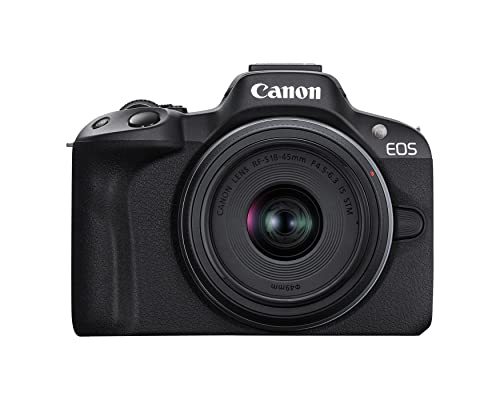
Canon EOS R50 — Best First Camera
If an amateur asked us to choose for them sight unseen, we would hand them the R50 and a clear conscience. Canon built it for exactly this person: an on-screen guide that explains settings in human language, a Creative Assist mode that describes effects as “brighter” and “background blurred” instead of numbers, and underneath the kindness, a genuinely capable camera — strong sensor, autofocus that finds people, animals, and vehicles, and Canon’s famously flattering colour for the family photographs that will fill its first year.
The growth story is what elevates it above mere beginner gear. The RF mount opens onto Canon’s whole modern system; the manual controls are all present when the guided modes are outgrown; and the video is good enough that the amateur’s inevitable filming experiments look respectable. Its compromises are size-class ones — no in-body stabilisation, a modest buffer for long bursts — that an amateur will rarely meet in the first years. As a first serious camera, it is the safest recommendation in this guide.
- Sensor: APS-C with clean, colourful images
- Guidance: on-screen explanations and Creative Assist for learners
- Autofocus: subject detection for people, animals, and vehicles
- Video: capable 4K for family films and experiments
Strengths
- Teaches photography gently without ever locking the student out of manual control.
- Colour and skin tones that make family photos look good immediately.
- Small and light enough to be carried daily, which is where learning happens.
Trade-offs
- No in-body stabilisation; steadiness comes from lenses and technique.
- Affordable native lens range is still maturing compared with Sony’s.
- Enthusiasts may eventually want the second control dial the R10 class offers.
Best for: new photographers who want one camera to learn everything on, kindly.
Not suited for: amateurs already certain they need enthusiast handling and speed from day one.

Nikon Z50 II — Best Enthusiast Amateur
The Z50 II is the amateur camera for people who already know they love this. Nikon gave it the handling of a serious tool — a bright electronic viewfinder you compose through rather than at, confident grip, fast and clever autofocus with subject detection that tracks birds and animals as readily as faces — and the speed to attempt the photographs beginners are usually told to wait for: the bird leaving the feeder, the dog at full stretch, the grandchild mid-splash.
It is also a notably complete hybrid, with video quality and features that respect the amateur who films the school concert and the holiday with the same body. Nikon’s colour renders the natural world with a fidelity landscape and wildlife beginners appreciate, and the Z mount’s growing lens range includes the affordable telephotos that turn garden birds into a hobby. Of the six here, this is the one an ambitious amateur is least likely to outgrow — the ceiling sits years away for most.
- Sensor: APS-C with strong low-light and colour performance
- Viewfinder: bright EVF for composing in any light
- Autofocus: advanced subject detection including animals and birds
- Speed: fast bursts for action, sport, and wildlife attempts
Strengths
- Handling and viewfinder that make photography feel like photography.
- Autofocus and speed that open action and wildlife genres to an amateur.
- Video abilities that keep it a one-body household for stills and film.
Trade-offs
- Less hand-holding than the R50 — beginners must bring a little more intent.
- No in-body stabilisation, so technique and lenses carry the steadiness.
- Slightly larger presence than the smallest picks for everyday carry.
Best for: keen amateurs who want a camera to grow into for years, especially nature and family-action shooters.
Not suited for: the casual beginner who wants the camera to explain everything as it goes.

Fujifilm X-T5 — Best for the Love of It
Some amateurs fall for photographs; others fall for photographing. The X-T5 is for the second kind. Its top plate carries real dials for shutter speed, ISO, and exposure compensation, its lenses have aperture rings, and its film simulations — colour recipes modelled on beloved film stocks — make the act of shooting feel like a craft with a heritage. That tactile pleasure is not nostalgia for its own sake: amateurs who enjoy the process shoot more, and shooting more is the whole game.
Beneath the romance sits the most resolution in this guide, a sensor that rewards the careful landscape and the detailed still life with files of genuine richness, in a body smaller than its capability suggests. Fujifilm’s lens range is the connoisseur’s shelf — compact primes with character — and the colour straight from camera can end the editing chapter for amateurs who would rather be out shooting. Video is capable but clearly the second language here; this is the stills romantic’s camera, and it knows it.
- Sensor: highest-resolution APS-C here, superb detail
- Controls: traditional dials and aperture-ring lenses
- Colour: film simulations with a devoted following
- Build: compact, weather-resistant, made to be carried and used
Strengths
- The shooting experience itself — dials, rings, and colour that make practice a pleasure.
- Resolution and detail for landscapes, architecture, and considered work.
- Compact prime lenses keep the whole kit elegant and portable.
Trade-offs
- Traditional layout is a learning curve for the screen-raised beginner.
- Autofocus is very good, a step behind the action specialists for erratic subjects.
- Video features trail the video-first picks in depth.
Best for: amateurs drawn to landscape, street, and the deliberate craft of photography.
Not suited for: action specialists or video-leaning creators, who are better served elsewhere here.

Canon EOS R10 — Best for Moving Subjects
The R10 answers the amateur whose world will not sit still: junior football, the dog’s agility class, birds on the estuary, children generally. Its party pieces are speed — rapid continuous shooting — and an autofocus system that acquires a subject and holds it through the frame with a tenacity that turns the keeper rate of action photography from luck into statistics. For the amateur, that reliability is educational: when focus stops being the variable, you can finally learn timing and composition.
Around that speed sits a well-rounded enthusiast body: a viewfinder, a proper control layout with room to develop manual habits, Canon’s colour, and video that handles the family’s filming without complaint. It shares the R50’s honest compromises — no in-body stabilisation, a lens ecosystem still filling its affordable shelves — and adds the handling depth the R50’s audience eventually asks for. Buy the R50 to start gently or the R10 to start hungrily; this is the hungry one.
- Sensor: APS-C with fast readout for action work
- Autofocus: tenacious subject tracking for sport and wildlife
- Shooting: rapid bursts that capture the decisive instant
- Controls: enthusiast layout with viewfinder and dials
Strengths
- Keeper rates on moving subjects that make action genres fun instead of frustrating.
- Handling that supports the transition from automatic to fully manual shooting.
- A balanced all-rounder beyond its speed — family, travel, and video included.
Trade-offs
- No in-body stabilisation; fast shutter speeds and lenses do the work.
- Buffer depth limits the longest action sequences.
- Less beginner guidance than the R50 offers on screen.
Best for: amateurs whose subjects move — sport, wildlife, pets, and family chaos.
Not suited for: slow, contemplative shooters, who will find the X-T5’s charms more relevant.

Sony ZV-E10 II — Best Photo-Video Blend
The modern amateur often arrives from video — a phone full of clips, a channel in embryo — and starts asking stills questions second. The ZV-E10 II meets that amateur where they live. It is a creator’s camera first, with autofocus so competent it disappears from consciousness, a screen made for presenting and reviewing, and video quality that flatters beginners; and its stills, from the same APS-C sensor class as the rest of this list, are sharp, clean, and entirely respectable for the family album and the learning curve alike.
Its trump card for the amateur is the E-mount: the deepest range of affordable lenses in this guide, including the fast primes that teach depth of field and low-light shooting for the least money. A photographer can build a real education on this mount one modest lens at a time. The costs are a photographer’s quibbles — no viewfinder, controls angled toward video — which matter if your heart is in stills, and barely at all if your practice is the blend.
- Sensor: APS-C, strong stills and standout video
- Autofocus: effortless face and eye tracking
- Screen: fully articulating, made for creators
- Lenses: the widest affordable ecosystem in this guide
Strengths
- The natural bridge camera for amateurs who film as much as they photograph.
- Autofocus that removes focus from the beginner’s worry list entirely.
- Lens prices that let an amateur collect glass at hobby speed.
Trade-offs
- No viewfinder — bright-day stills composition is screen-only.
- Video-first ergonomics feel odd to traditional photographers.
- No in-body stabilisation for handheld stills at slow speeds.
Best for: hybrid amateurs — social creators, family filmmakers, and learners who share everything.
Not suited for: viewfinder devotees and stills purists, better matched by the Nikon or Fujifilm.

Nikon Z30 — Best Small and Simple
The Z30 is the camera for the amateur who suspects — correctly — that they will learn fastest with the least between them and the photograph. It pares the mirrorless camera to its essence: a good APS-C sensor, a flip screen, clear menus, Nikon’s honest colour, and a body small enough to be carried on the dog walk, the commute, and the school run, which is where an amateur’s real portfolio accumulates. It was designed with video creators in mind, and its stills inherit that simplicity: point it, trust it, review it, learn.
Simplicity has edges, and they are visible: no viewfinder, no in-body stabilisation, and a control set that the advancing amateur may eventually find spare. But there is a stage of photography — the first year, the everyday-carry year — for which those absences are features, and the Z30 serves that stage with unusual grace. Many owners keep it as the second, pocketable body long after a larger camera arrives, which tells you the size was the point all along.
- Sensor: APS-C with natural Nikon colour
- Size: among the smallest interchangeable-lens bodies here
- Interface: simple menus and a flip screen for easy review
- Video: clean and long-running for family and creator use
Strengths
- Everyday-carry size that maximises the photographs an amateur actually takes.
- Unintimidating operation that keeps the focus on seeing, not settings.
- Colour and image quality identical in spirit to its bigger Nikon sibling.
Trade-offs
- No viewfinder for bright light or traditional composition.
- Minimal controls will eventually feel limiting to the advancing enthusiast.
- No in-body stabilisation.
Best for: beginners who value simplicity and carry, and any amateur wanting a discreet daily camera.
Not suited for: action specialists or dial-loving traditionalists — see the Z50 II and X-T5 above.
How Do the Six Amateur Cameras Differ?
| Pick | Character | Viewfinder | Best amateur genre | Main limit |
|---|---|---|---|---|
| Canon EOS R50 | Guided and friendly | Yes | Family, travel, learning | No in-body stabilisation |
| Nikon Z50 II | Enthusiast and capable | Yes, bright | Wildlife, action, all-round | Less hand-holding |
| Fujifilm X-T5 | Traditional and tactile | Yes | Landscape, street, craft | Video is second language |
| Canon EOS R10 | Fast and focused | Yes | Sport, pets, birds | Buffer depth |
| Sony ZV-E10 II | Creator-first | No | Hybrid photo and video | Screen-only composition |
| Nikon Z30 | Minimal and small | No | Everyday carry, simplicity | Spare controls |
Which Second Lens Should an Amateur Buy First?
A fast prime at a standard focal length — the lens class every mount in this guide offers affordably — and it is not close. A prime forces the beginner’s two best habits: moving to compose instead of zooming from a chair, and thinking about aperture because the lens finally offers a range worth thinking about. Portraits gain the blurred background every amateur covets, low-light photography becomes possible without a flash’s harshness, and the fixed focal length teaches framing faster than any zoom. Nearly every photographer we know dates their improvement from the month the prime arrived.
Second in line depends on the genre pulling you. Wildlife and sport amateurs go telephoto next — the reach that turns the Z50 II’s and R10’s autofocus loose on distant subjects. Landscape and travel amateurs go wide, or simply deeper into primes. The mistake is collecting lenses by price or novelty — the fisheye, the bargain manual oddity — before the standard prime and one genre lens have built the foundation. Two lenses owned and mastered beat five lenses owned and carried resentfully.
What Mistakes Do Amateur Photographers Make Buying Their First Camera?
Buying the body their hero uses, at a price that leaves nothing for lenses, is the classic. The professional’s camera is a professional’s tool because of the glass in front of it and the decade behind it; the amateur version of that photograph is a mid-range body, a fast prime, and a year of practice. Second is buying by resolution, chasing numbers that will never be visible in the family album while ignoring the handling that decides whether the camera gets carried.
Third is neglecting the unglamorous kit: the spare battery that saves the wedding day, the bag that makes carrying pleasant, the card reader that makes reviewing a habit. Fourth — and the one this guide most hopes to prevent — is buying a camera so complex or so precious that it stays home. The amateur’s camera must be a companion. Choose the one you will take to the market on Saturday, and your photography will improve at the speed of Saturdays.
How Should an Amateur Practise in the First Ninety Days?
Give the first month to one subject you love and can reach daily — the dog, the garden, the street on your walk, the child who tolerates you. Repetition against a constant subject isolates the variables: you see what the light does at different hours, what the aperture does at different settings, what your own position does to the background, because the subject stays still while everything else changes. Photographers call this a study; amateurs who do one emerge with instincts no tutorial installs.
The second month belongs to deliberate constraints. A week with the prime lens only. A week photographing only in the hour after sunrise or before sunset. A week of vertical frames, a week of getting closer than feels polite to objects. Constraints feel like games and function like drills, and the cameras here support them gracefully — the X-T5’s dials make manual weeks tactile, the R50’s guides make them safe, the Z30’s simplicity makes them pure.
The third month is for the honest edit. Gather the quarter’s work, choose twenty frames, and print them — small prints are fine, physical is the point. On paper, away from the forgiving glow of a screen, your patterns announce themselves: the horizon you always tilt, the subject you always centre, the light you always miss. Choose the pattern that most limits you and make it the next month’s study. That cycle — shoot, print, notice, study — is the amateur’s real education, and it runs beautifully on every camera in this guide.
What Genres Suit Beginners Best, and Which Camera Follows You There?
Family and everyday life is the amateur’s home genre, and every pick serves it — the R50’s colour and guidance, the Z30’s presence, the ZV-E10 II’s blend with video. Street photography rewards small, quick, discreet tools: the Z30 and X-T5 with a compact prime are the naturals, and their quiet operation keeps the beginner invisible while confidence builds. Landscape asks for patience and detail — the X-T5’s resolution and the Z50 II’s viewfinder in bright light — while travel rewards the body you will actually carry all day, which for most amateurs is the R50 or Z30 with one or two small lenses.
Wildlife and sport are the demanding genres, and they are why the R10 and Z50 II exist in this list: their autofocus and speed convert a beginner’s frustration into a learning curve. Portraiture belongs to whichever body wears the fast prime — all of them transform with one — and macro, the garden’s secret world, opens with any of these systems’ close-up lenses. The lesson is that genre follows curiosity, and the systems here were chosen so that a change of curiosity never requires a change of camera — only, at most, a change of lens.
How Do You Learn to Edit Without Ruining Good Photographs?
Start with the photographs these cameras make straight from the camera — Canon’s colour, Fujifilm’s simulations, Nikon’s rendering are all respectable finishing schools — and edit only what the camera could not know: the crop that strengthens, the horizon that levels, the exposure the scene fooled the meter on. Beginners who edit in that order learn restraint, and restraint is the whole of editing taste. The heavy filters and presets can wait until you can articulate what a photograph needs; applied earlier, they become a style you hide behind rather than develop.
Shoot raw plus jpeg for a season if your curiosity runs to editing: the jpeg is the camera’s opinion, the raw is your workshop, and comparing the two is an education in itself. Keep edits reversible, keep originals untouched, and revisit a favourite photograph after a month — the edit you make with distance is nearly always gentler and better. Your future self, with a better eye, will thank the amateur who preserved the files to practise on.
What About the Phone in Your Pocket — Friend, Rival, or Teacher?
Every amateur arrives with a phone that already takes startlingly good photographs, and the honest guide addresses it. The phone wins on presence and computational magic in bad light; the cameras here win on everything that constitutes learning and control — real depth of field, real telephoto, deliberate settings, lenses, and files that print large and grade gracefully. The amateur who buys a camera is not buying image quality alone; they are buying the craft, and the craft is the hobby.
Used together, the two are allies. The phone scouts compositions, documents the everyday when the camera is home, and shares the camera’s work to the world in seconds via the wireless transfer every pick here offers. Many amateurs find the phone photographs more, not less, once a camera teaches them to see — the eye, once trained, uses every tool it finds. Do not let anyone frame the purchase as a war between devices; it is an apprenticeship, and the phone is the notebook to the camera’s manuscript.
How Much Should an Amateur Spend, and Where Should the Money Go?
Think in thirds across the first two years: roughly a third on the body, a third on lenses, and a third on everything else — bag, batteries, cards, tripod, the printing that teaches, the trip that inspires. The bodies in this guide were chosen to sit comfortably as that first third at several budget levels, and their mounts ensure the lens third buys glass that stays useful for years. The amateur who spends the whole budget on the body has not bought a better photography life; they have bought a heavier first year.
Within the body budget, pay for autofocus and handling before resolution, and for the viewfinder if your photography lives outdoors. Within the lens budget, the fast prime first, as argued above. And keep a small reserve unspent: the accessory you discover you need in month two — the wrist strap, the second battery, the circular polariser for the holiday — is always more valuable than the accessory a bundle guessed you might want in month zero.
What Does Progress Actually Look Like After a Year?
It looks like a hit rate. The beginner’s card holds one keeper in fifty frames; the year-old amateur’s holds one in ten, and — more telling — the misses are near-misses, experiments that almost worked, rather than accidents. It looks like intention: photographs made because the light was noticed, the background chosen, the moment waited for. And it looks like a shelf or a folder with a shape to it — the beginnings of a personal subject, the thing you photograph that nobody else does, which is style arriving on schedule.
None of that progress is body-dependent beyond the threshold this guide enforces, which is the deepest reason for its choices. Any of these six cameras, carried for a year by an amateur who reviews honestly and shoots weekly, produces that photographer. The differences between them — guidance, dials, speed, size — are differences in companionship along the same road. Choose the companion you will enjoy, and walk.
How Do You Take Care of a First Camera So It Lasts the Whole Apprenticeship?
Cameras die of neglect in predictable ways, and amateurs who learn the short liturgy early keep their tools for a decade. A strap, always, because the drop is the hobby’s most common tragedy. A bag with padding that the camera actually lives in, rather than the floor of the car. A blower for dust before any cloth touches a lens, because wiping grit is how coatings scratch. Batteries charged before they are desperate, cards formatted in the camera rather than the computer, and the sensor left alone unless a spot survives the blower — sensor cleaning is a skill to learn deliberately, not discover accidentally.
Weather deserves a sentence of respect: none of these bodies is waterproof, the X-T5 and Z50 II shrug off drizzle with weather resistance, and all of them forgive more than beginners fear provided they dry slowly in open air afterwards, never on a radiator. The camera that is cared for becomes the camera that is trusted, and trusted cameras get carried into the rain, the dust, and the crowd — which is, once again, where the photographs are.
Should an Amateur Join a Club, Take a Course, or Learn Alone?
Alone works, but company accelerates. A local camera club’s monthly critique — strangers telling you kindly why the photograph does not work — compresses a year of solitary guessing into an evening, and club outings put you in locations at hours you would never choose alone, which is where growth hides. A structured beginner course suits the amateur who learns by curriculum; the cameras here, with their guided modes and standard layouts, are all course-compatible in the sense that any tutor will know their language.
The solitary path has its own honourable tradition: one good book, a weekly assignment you set yourself, and the ninety-day cycle described above. Whichever you choose, build one feedback channel that is not social media, whose applause measures charm rather than progress. A printed portfolio reviewed quarterly — by a club, a tutor, or your own increasingly honest eye — is the amateur’s true report card, and every camera in this guide produces prints worthy of the exercise.
What Settings Should an Amateur Master, in What Order?
First, the focus point: choosing where the camera focuses, every frame, until it is as automatic as steering. Second, exposure compensation — the humble dial that says brighter or darker than the meter thinks — because it is the fastest route to intentional exposure and it works in every automatic mode these cameras offer. Third, aperture, for depth: the portrait lesson, the landscape lesson. Fourth, shutter speed, for motion: freezing the dog, blurring the waterfall. Fifth, ISO, understood as the price of the other two, to be spent knowingly rather than feared.
That order is deliberate: it follows the frequency with which each control decides real photographs. Amateurs who learn in this sequence find manual mode, when they finally switch to it, strangely familiar — it is only the five decisions made simultaneously. The guided bodies here will show you each setting’s effect as you learn it, the dial-led X-T5 will put them under your fingers, and the fast bodies will forgive your timing while you practise. However you arrive, arrive in that order and the craft assembles itself.
How Do You Photograph People Well as an Amateur?
People are the amateur’s first subject and lasting one, and the technique is mostly kindness plus three habits. Put the light beside them, not behind you — a window to the side models a face; a flash from the camera flattens it. Focus on the nearer eye and let the autofocus in these bodies, which finds eyes on its own, do the precision work. And take more frames than feels necessary, talking between them, because the portrait that matters is the one after the posed smile relaxes — amateurs who shoot in gentle bursts with the R10 or Z50 II learn this fastest, but every body here can do it.
The fast prime, when it arrives, transforms amateur portraiture more than any other single purchase: backgrounds melt, indoor light suffices, and subjects begin asking for the photographs instead of enduring them. Until then, step back with the kit zoom and use its longer end for portraits — the perspective flatters and the background compresses kindly. Either way, print the good ones and give them away; nothing recruits willing subjects for your practice like a portrait they love.
What About Video — Should an Amateur Photographer’s Camera Film Well Too?
It should, because the amateur’s life does not divide into stills days and filming days: the same birthday, holiday, and dog walk produce both, and a body that films competently keeps one camera in the bag instead of two. Every pick here films well; they differ in emphasis. The ZV-E10 II is built video-first, the Z50 II and R10 are true hybrids, the R50 and Z30 film simply and well, and the X-T5 films capably while clearly preferring stills. Choose by your honest ratio — and if you cannot estimate it, assume more video than you expect, because that is the direction nearly every amateur’s practice drifts.
The stills photographer’s video needs are modest and specific: autofocus that tracks a face without pumping, a screen that flips for the family group film, and sound that accepts a microphone when the occasion matters. All six deliver that baseline. What the amateur does not need is cinema specification — the codecs and frame rates of the filmmaking guide — and paying for them at the cost of stills handling is the one wrong trade in this list.
How Do You Choose Between Two Finalists Without Agonising?
Handle them, if you possibly can, even briefly. The amateur camera is a companion object, and ten minutes in the hand settles questions no review can: whether the grip fits, whether the viewfinder suits your eye, whether the menus feel like a language you could learn. If handling is impossible, choose by the photographs you most want to make in the next six months — not the next six years — because the body that serves the immediate work gets used, and used cameras teach their owners which upgrade, if any, the future actually requires.
And then stop researching. The amateur’s scarcest resource is not money but momentum, and every week spent comparing is a week of photographs unmade. The six cameras here were shortlisted precisely so that any of them is a right answer; the wrong answer is the seventh month of deliberation. Pick your companion, take it out this weekend, and let the pictures begin the real comparison.
What Is the Kindest Way to Give One of These Cameras as a Gift?
Amateur cameras are disproportionately gifts — the parent arming a teenager, the partner feeding a new obsession — and the giving has a craft. Include the unglamorous essentials in the same box: the memory card, the second battery, the bag, so the camera works completely on its first morning. Resist the accessory bundle; a book of photography the recipient will actually open, or a voucher toward the fast prime in three months’ time, will be remembered longer than a pouch of filters.
Then protect the gift from its own price tag. The recipient should feel licensed to carry the camera everywhere and risk it a little, because a camera guarded like jewellery teaches nothing. If the number makes you anxious, choose the less expensive pick from this list and give it with genuine freedom — a used-daily R50 will make a photographer faster than a cosseted flagship, and the photographs, not the receipt, are the gift’s real content.
Final Recommendation
For most amateurs, the answer is the Canon EOS R50: kind, capable, and built to be learned on. If you already know the hobby has you — especially if nature and action call — take the Nikon Z50 II and grow for years. If the craft itself seduces you, its dials and colours make the Fujifilm X-T5 the amateur camera as love affair. For moving subjects on a Canon path, the R10; for the video-blended life, the Sony ZV-E10 II; for the minimalist everyday carry, the Nikon Z30.
Then do the thing that matters more than the choice: carry it. Photograph the ordinary week, review honestly, buy the prime lens when the kit lens starts to bore you, and let a year of Saturdays make you the photographer the camera was always waiting for.
Frequently Asked Questions
Is a mirrorless camera too much for a beginner?
No — modern mirrorless cameras are the easiest serious cameras ever made for beginners, because the screen and viewfinder show the exposure before you take the picture. The guided picks here, especially the R50, explain themselves as you go. What makes a camera “too much” is price and preciousness, not capability; a mid-range body you use daily beats a flagship you protect.
How many megapixels does an amateur need?
Every camera in this guide has more than enough for large prints, cropping, and any screen. Resolution differences within this class matter to the landscape specialist — one reason the X-T5 exists here — and are otherwise the least important specification on the page. Autofocus, handling, lenses, and your own practice will decide your image quality.
Should I buy a kit lens or body only?
Buy the kit. The standard zoom teaches you which focal lengths your photography actually uses, covers the family’s needs from day one, and costs little bundled. Buy body-only only when you are certain the fast prime will be your main lens — some street and portrait amateurs do exactly that, happily. Decide the second lens after a season of kit-lens evidence.
Can I learn photography on automatic mode?
You can learn the most important parts — light, composition, timing, review — entirely on automatic, and these cameras’ automatics are excellent teachers because they show you the settings they chose. Take manual control one variable at a time when curiosity strikes: aperture first for most amateurs. The photographers who stall are not the ones who used auto; they are the ones who never reviewed their pictures.
When will I know I have outgrown my first camera?
When the same limitation costs you photographs repeatedly — the action the autofocus could not hold, the low light the sensor could not clean, the control you reach for that is not there. One frustration is an anecdote; a pattern is a purchase justification. Most amateurs find the bodies in this guide carry them for years before any pattern forms.
Do I need a tripod as an amateur?
Not on day one, and yes by the time landscapes, night scenes, or still life call. A tripod slows the amateur down in the productive way — composition becomes deliberate when the camera is fixed — and it unlocks the long exposures that handheld technique cannot. Buy it once you know which genre is asking for it, buy it sturdier than feels necessary, and until then, walls, tables, and beanbags improvise honourably. The cameras’ stabilised lenses and high-ISO cleanliness postpone the purchase longer than they used to.
Is it worth buying an extended warranty or protection plan?
For cameras that will travel, shoot around water and children, or serve as a teenager’s daily carry, accidental-damage cover can be rational — price it against the repair or replacement of the specific body, not against fear. For a careful adult’s home-and-holiday camera, the manufacturer’s warranty plus the care habits described in this guide usually suffices. Either way, register the camera, keep the receipt with the serial number recorded, and photograph the kit for your records; that paperwork, done once, is worth more than most plans.
What if my photos are still disappointing after a month?
Then you are on schedule. The first month’s disappointment is almost never the camera — it is the gap between the photograph in your head and the craft in your hands, and it closes with exactly the practice this guide describes: one subject studied, constraints imposed, prints reviewed honestly. Show the work to one experienced photographer and ask for the single biggest weakness; fix that one thing for a month. Amateurs who iterate like this improve visibly every season, on every body in this list, without exception.
How do I keep improving after the first year?
Raise the standard of your review, not your equipment. Print larger, cull harder, and take on a project with a theme and an end — an exhibition, a book, a series for the wall — because projects force the editing and sequencing skills that casual shooting never demands. When a genuine pattern of limitation emerges, the upgrade conversation in this guide will be waiting; until then, the most productive purchase is usually the train ticket to somewhere your camera has not been.
How can I practise composition at home when bad weather keeps me indoors for a week?
A week indoors can sharpen composition faster than a week wandering outside, because the subjects stay still and the light changes slowly enough to study. Pick one ordinary object, such as a chair beside a window, and photograph it at several times of day without moving it, noticing how direction and softness reshape the same arrangement. Then work through deliberate constraints: one viewpoint but five different framings, then one framing explored from different heights and distances, cropping with your feet rather than the zoom. Arrange a small still life from kitchen items and rebuild it three times, each time removing one element until nothing in the frame is accidental. Print or display the strongest version large for a day and live with it, writing down what holds your eye and what feels cluttered. Finish the week by recreating a photograph you admire using only household objects, not to copy it, but to discover the decisions hidden inside it. When the weather finally clears, take the same exercises outside; you will find yourself placing edges, backgrounds and empty space with an intention that casual outdoor shooting rarely teaches as clearly.
Related Guides
Continuing the journey? See our guides to cameras for beginners who want to learn photography properly, mirrorless cameras for family and travel photography, and cameras with the best colour straight from the camera.