kajuandouglas.com is reader-supported. When you buy through links on our site, we may earn an affiliate commission.
Where to Buy
An adventure camera earns its place by being carried everywhere and working every time it is pulled out — survival plus presence, in that order. The six below were ranked against days like a ridge walk in sideways rain, because a camera that serves you there has nothing left to prove to a beach holiday. If it cannot survive the trip, its image quality is a rumour.
Notice what the ranking refuses to worship: delicacy dressed as excellence. The finest sensor in the world photographs nothing from inside a dry bag it never leaves, and adventure travellers learn that arithmetic exactly once, expensively. Every pick here was chosen to be present — sized for a real pack, sealed against real weather, ready in the seconds a real moment allows.
Expect the reviews to be blunt about limits, including the limits of toughness itself. Each body below has at least one genuine weakness, and each review names it, because a weakness known at home is a packing decision while a weakness discovered at altitude is a story you tell through gritted teeth. Read the compromises as carefully as the praise.
Use the detailed sections in any order, but save the two practical parts for the packing stage. One covers carrying a camera through adventure without babying it; the other covers shooting in rain, spray and freezing wind. Between them they will save more photographs — and possibly more cameras — than any single choice on this page.
Key Takeaways
- OM SYSTEM Tough TG-7 leads here: storms and river crossings cannot bench it.
- Weather and willpower remain the variables; never the camera.
- Pack weight shapes itineraries, so compact systems earn their place early.
- Sealing, glove-friendly handling and battery life outweigh specifications off-grid.
- Picks lacking verified listings stay prose-only here, though each suits hard travel.
- Lash down the simplest kit covering your route.
In this guide
Quick Picks
| Pick | Badge | Why it earns its place |
|---|---|---|
| OM SYSTEM Tough TG-7 | Best Overall for Adventure | OM SYSTEM Tough TG-7 earns the Best Overall for Adventure slot, staying dependable while a ridge in sideways rain |
| GoPro HERO13 Black | Best Mounted Action Pick | Chosen as Best Mounted Action Pick: the GoPro HERO13 Black handles a ridge in sideways rain without fuss |
| DJI Osmo Action 5 Pro | Best for Long Outdoor Days | The DJI Osmo Action 5 Pro takes the Best for Long Outdoor Days place, keeping a ridge in sideways rain within reach |
| OM SYSTEM OM-5 Mark II | Best System for Serious Travellers | For Best System for Serious Travellers duties the OM SYSTEM OM-5 Mark II stands out during a ridge in sideways rain |
| Sony RX100 VII | Best Pocket Quality | Sony RX100 VII fills the Best Pocket Quality role with calm competence during a ridge in sideways rain |
| Insta360 X4 | Best for Reframed Adventure Stories | The Best for Reframed Adventure Stories badge suits the Insta360 X4, treating a ridge in sideways rain as routine |
How We Chose These Picks
The long list was cut by failure, as it should be. Adventure photographs die in predictable ways: the camera that stayed in the bag because the bag was buried, the lens change attempted in spindrift, the battery that surrendered to cold an hour before the summit light. Models that could not answer those ordinary deaths left the ranking early, whatever their studio reputations.
We scored presence alongside performance. Waking speed with gloves on, focusing that behaves when the subject is moving and the photographer is shivering, files that survive being copied in a tent — those carried the weight that specifications usually steal. A camera’s best photograph matters less out here than its worst-day behaviour, and the ranking was built accordingly.
One rule governed every link on this page: a purchase link appears only where a camera is confirmed in this site’s verified pool, under the exact name the pool carries. Other worthy models are written about plainly and left unlinked. The rule is strict because the alternative — a tidy page of invented listings — is how buying guides lose the right to be believed.
What Should You Understand Before Choosing the Best Cameras For Adventure Travel?
Describe your real adventure in one honest sentence before comparing anything. Not the expedition of your imagination — the trips you actually take, with their actual weather: a ridge walk in sideways rain on the good days and worse on the others. That sentence settles most of the argument, because the camera for a wet ridge and the camera for a dry studio are different species sharing a name.
Then decide how the photographs will live afterwards. Most adventure pictures are shared from a phone at the first signal, printed occasionally, and edited lightly if at all. That favours colour that looks right in the field and transfers that work over a tired connection. Travellers who print big or edit patiently should weight the system options here more heavily; the reviews say where that patience gets repaid.
Hands — cold, gloved, tired hands — deserve their own paragraph. You will operate this camera on ridges, in kayaks and on the backs of motorbikes, often one-handed, often by feel. Weight decides whether it leaves the hostel at all; control layout decides whether it obeys when your fingers have stopped filing reports. Any finalist that only feels good in a warm shop should be treated as a suspect, not a choice.
Finally, the camera is one item in a survival system, not the system itself. Power for the cold, storage for the remote stretch, a dry place for the lens change that cannot wait — these decide whether the body is in your hand and working when a kayak rolling through green water unfolds. The comparison below weighs the six as travelling systems, which is why the smallest option here is a headline pick rather than an apology.

OM SYSTEM Tough TG-7 — Best Overall for Adventure
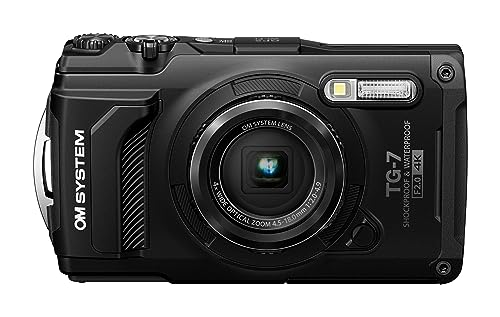
Field test, not lab test: a ridge walk in sideways rain. That is the examination the OM SYSTEM Tough TG-7 sat to earn its place here. It is a genuinely waterproof, crush-resistant compact made to be treated roughly, and on a trip where the itinerary is written by weather, that description is a survival trait before it is a feature. The badge of best overall for adventure simply records the result: this camera kept working, and kept being carried, when conditions stopped being polite. It asks for no shelter, no ceremony and no second bag, which is how adventure kit should behave.
Gloves on, wind up, light going: that is the handling test, and the OM SYSTEM Tough TG-7 passes it by being obvious. Controls sit where cold fingers expect them, the body settles into one hand while the other holds a paddle, a rail or a map, and nothing requires a bare-handed menu expedition at the worst moment of the day. By the second week your hands will run it inside gloves, in the dark, without a thought wasted.
The files tell the trip honestly. Colour from the OM SYSTEM Tough TG-7 keeps weather looking like weather — rain grey, river green, the brief gold of a clearing evening — and macro modes that open up the tiny subjects other travel cameras walk straight past. Nothing is prettified into a brochure, and the files still accept a firm edit back home when a frame deserves one. For a journey you will retell for years, that honesty is the correct house style. Back home, on a wall or a big screen, the files keep the day’s weather intact — a rarer gift than sharpness.
Now the trade, stated plainly. The OM SYSTEM Tough TG-7 exchanges the extremes for dependability: the most ambitious image quality, the most specialised lenses and techniques, the studio certainties — those live elsewhere, in heavier and more fragile houses. A few advanced settings also hide deeper in menus than a gloved hand would vote for. Within the wide country of adventure travel, those borders are rarely visited; outside it, they are the whole map. Treat the boundary as route information: it tells you which ambitions to pack and which to leave with the heavy kit.
Ownership on the road is a logistics drill: power rationed between lodgings, cards filling in the middle of nowhere, files that must survive until civilisation. The OM SYSTEM Tough TG-7 keeps the drill simple. Charging fits the evening routine of any hut or hostel, transfers behave when a connection finally appears, and the body absorbs the knocks of a kayak rolling through green water without collecting grievances. None of that requires basecamps, porters or luck — just a camera whose habits match the trail’s.
Against the other five, the OM SYSTEM Tough TG-7 makes its case the way it makes its photographs: without fuss. Size serves handling, handling serves readiness, and readiness serves the frames that only exist for a minute. If the badge of best overall for adventure matches the trips you actually take, the argument is complete and the packing can begin. After that, the variables are weather and willpower, which is where an adventurer wants them.
- Role in this line-up: best Overall for Adventure
- Files: colour suiting adventure travel, still grading gracefully afterwards
- Handling: controls placed for swift, unrushed adventure travel changes
- Carry profile: proportioned for trail and summit days far from shelter
- Ownership note (adventure travel kit): cards, spare power and a case cost extra
Strengths
- The OM SYSTEM Tough TG-7 (adventure travel) locks focus dependably while a ridge in sideways rain
- Files from the OM SYSTEM Tough TG-7 (adventure travel) look polished immediately yet keep room for retouching
- Handling stays composed during adventure travel when moments accelerate
Trade-offs
- Push it outside adventure travel and compromises surface quickly
- The complete adventure travel kit costs more than the camera
- Several advanced adventure travel settings hide deep in menus
Best for: travellers whose routes include a ridge walk in sideways rain and who want best overall for adventure without a porter’s help.
Not suited for: studio-minded photographers whose work needs the extremes this camera traded away.

GoPro HERO13 Black — Best Mounted Action Pick
Some cameras are bought for studios. The GoPro HERO13 Black was clearly built for the other kind of day — a kayak rolling through green water and whatever the map does next. It is a rugged action body with interchangeable lens mods and strong stabilisation. Adventure travel does not ask for the most delicate instrument; it asks for the one still functioning at the far end of the rough section, which is exactly the argument behind the badge of best mounted action pick. On the far side of the rough section, that indifference to conditions reads as luxury.
What you notice by the third day is how little ceremony the GoPro HERO13 Black demands. Out of the bag, awake, framed, back in the bag — a rhythm measured in seconds, repeated at every viewpoint, river crossing and summit register. During a motorbike crossing a high pass at dusk, when stopping at all is a negotiation with the weather, that rhythm is the whole ballgame. That fluency also keeps stops short, which your companions — and the daylight — will thank you for.
Judge adventure files by what survives the journey home. These do: detail holds up on a big screen, the rendering does not rely on the small bright display that flattered everything at the time, because a mounting ecosystem that reaches places no sensible camera should ever go. Skin, rock, water and weather all come through as themselves, which sounds modest until you compare the alternatives. Prints from a trip like this get handled for years, and the rendering survives the handling.
No camera on this page is invincible or universal, and this one’s limits are at least honest ones. Ask the GoPro HERO13 Black to behave like a camera costing far more, in a specialism it never claimed, and disappointment will arrive on schedule. Ask it to survive a motorbike crossing a high pass at dusk and produce the photograph anyway, and it will — which is the exchange the badge of best mounted action pick actually promises. Most owners find the edge once, on a day that did not matter, and plan around it ever after.
Count the unglamorous kit honestly. A spare battery for the cold day, cards enough for the remote stretch, a dry bag, a cloth — the GoPro HERO13 Black keeps its demands inside that sensible list and adds nothing precious of its own. Adventure budgets are finite, and every demand a camera makes is a demand something else in the pack must refuse. It also forgives the classic travel accidents: the forgotten charge, the hasty frame, the bag dropped in dust.
The short field verdict: the GoPro HERO13 Black earns its place by surviving and showing up. Travellers whose routes look like a motorbike crossing a high pass at dusk will feel that virtue every time it comes out of the bag working. It will not make the weather kind or the pass shorter; it will simply never be the reason the photograph did not happen. Gear debates end at the first storm survived; this one shortens the distance to that proof.
- Slot in this shortlist: best Mounted Action Pick
- Output: attractive adventure travel colour, with latitude for editing
- Controls: dials reachable quickly during adventure travel adjustments
- Size in the bag: matched to trail and summit days far from shelter
- Budget note (adventure travel kit): memory cards, batteries and protection cost extra
Strengths
- The GoPro HERO13 Black (adventure travel) keeps subjects pinned in focus throughout a ridge in sideways rain
- Images from the GoPro HERO13 Black (adventure travel) arrive clean, still leaving headroom for editing
- The body feels calm throughout adventure travel, even as events speed up
Trade-offs
- Work beyond adventure travel exposes limits specialists reject
- Budget for the full adventure travel outfit: body price is just the start
- A few powerful adventure travel options sit buried in settings
Best for: adventurers who rank best mounted action pick first and treat their camera as kit, not as cargo.
Not suited for: anyone expecting the camera to compensate for route-finding, fitness and judgement.

DJI Osmo Action 5 Pro — Best for Long Outdoor Days
Start with what the DJI Osmo Action 5 Pro is: a dual-screen action camera built for bright days and wet assignments. Add that its colour and battery endurance appeal to all-day outdoor shooters, and you have the two facts that matter when the plan dissolves into a motorbike crossing a high pass at dusk. Everything else in this section is commentary. The badge of best for long outdoor days rests on those pillars and on a simpler one still — owners keep carrying it, day after day, which is the only review adventure gear cannot fake. Fellow travellers will borrow it in the rain and hand it back with a new standard for their own gear.
There is a toughness of manner here as much as of construction. The DJI Osmo Action 5 Pro does not sulk about being used hard: it responds the same soaked as it did dry, the same at altitude as at the trailhead. Gear that behaves identically on day one and day nine lets you stop thinking about gear entirely, which is where adventure photography actually begins. Salt, grit, altitude and drizzle were plainly in the room when its handling was decided.
There is a documentary plainness to the images that suits wild places. The DJI Osmo Action 5 Pro does not dress a ridge up as an epic or flatten it into a record shot; it lands between, where memory lives, helped by the fact that its colour and battery endurance appeal to all-day outdoor shooters. Photographs from a motorbike crossing a high pass at dusk should smell faintly of the day they were taken, and these do. It is imagery that trusts the place to be interesting enough, which wild places always are.
Where does it ask for compromise? At the margins of ambition rather than the margins of weather. The most demanding low-light work, the most exacting print standards, the longest professional assignments — plan those with other tools. Everything short of that, this camera treats as its home terrain, and a guide owes you that boundary drawn clearly rather than discovered expensively. A limit known in advance is a packing decision; a limit found mid-trip is an anecdote with a price.
Weeks in, the praise from owners converges on a single word: present. The DJI Osmo Action 5 Pro was there for the unplanned detour and the unrepeatable light because carrying it never became a decision. Adventure cameras are not judged by their best photograph but by their attendance record, and this one’s attendance is close to perfect. What remains, once survival is assumed, is the interesting part — where you point it, and why.
Line the six up by what they demand of you and the DJI Osmo Action 5 Pro sits at the undemanding end, which on a hard trip is the flattering end. Every decision in it — build, controls, file character, appetite for power — points at the same summit. Choose it when best for long outdoor days describes your travelling life, then spend your savings on the boots. Pack it, lash it down, and let the trip itself write the rest of the review.
- Position in this line-up: best for Long Outdoor Days
- Files: flattering adventure travel palette tolerating retouching well
- Handling: layout supporting fast adventure travel tweaks mid-scene
- Carry profile: built around the demands of trail and summit days far from shelter
- Ownership note (adventure travel kit): storage, power and cover need separate funds
Strengths
- The DJI Osmo Action 5 Pro (adventure travel) finds focus calmly as a ridge in sideways rain unfolds without warning
- The DJI Osmo Action 5 Pro (adventure travel) produces finished-looking photographs with grading flexibility
- Controls stay reassuring under adventure travel pressure, focusing attention on subjects
Trade-offs
- Assignments outside its adventure travel brief reveal the compromises
- Total adventure travel outlay climbs once extras join
- Some adventure travel refinements live deep in menus
Best for: anyone whose honest travelling style is best for long outdoor days, in weather that does not read forecasts.
Not suited for: travellers who refuse to learn, by feel, the handful of controls bad weather demands.

OM SYSTEM OM-5 Mark II — Best System for Serious Travellers
Field test, not lab test: a ridge walk in sideways rain. That is the examination the OM SYSTEM OM-5 Mark II sat to earn its place here. It is a weather-sealed traveller with computational tricks and a compact lens ecosystem, and on a trip where the itinerary is written by weather, that description is a survival trait before it is a feature. The badge of best system for serious travellers simply records the result: this camera kept working, and kept being carried, when conditions stopped being polite. It asks for no shelter, no ceremony and no second bag, which is how adventure kit should behave.
Gloves on, wind up, light going: that is the handling test, and the OM SYSTEM OM-5 Mark II passes it by being obvious. Controls sit where cold fingers expect them, the body settles into one hand while the other holds a paddle, a rail or a map, and nothing requires a bare-handed menu expedition at the worst moment of the day. By the second week your hands will run it inside gloves, in the dark, without a thought wasted.
The files tell the trip honestly. Colour from the OM SYSTEM OM-5 Mark II keeps weather looking like weather — rain grey, river green, the brief gold of a clearing evening — and the small footprint of the whole system leaves the bag’s room for everything else. Nothing is prettified into a brochure, and the files still accept a firm edit back home when a frame deserves one. For a journey you will retell for years, that honesty is the correct house style. Back home, on a wall or a big screen, the files keep the day’s weather intact — a rarer gift than sharpness.
Now the trade, stated plainly. The OM SYSTEM OM-5 Mark II exchanges the extremes for dependability: the most ambitious image quality, the most specialised lenses and techniques, the studio certainties — those live elsewhere, in heavier and more fragile houses. A few advanced settings also hide deeper in menus than a gloved hand would vote for. Within the wide country of adventure travel, those borders are rarely visited; outside it, they are the whole map. Treat the boundary as route information: it tells you which ambitions to pack and which to leave with the heavy kit.
Ownership on the road is a logistics drill: power rationed between lodgings, cards filling in the middle of nowhere, files that must survive until civilisation. The OM SYSTEM OM-5 Mark II keeps the drill simple. Charging fits the evening routine of any hut or hostel, transfers behave when a connection finally appears, and the body absorbs the knocks of a kayak rolling through green water without collecting grievances. None of that requires basecamps, porters or luck — just a camera whose habits match the trail’s.
Against the other five, the OM SYSTEM OM-5 Mark II makes its case the way it makes its photographs: without fuss. Size serves handling, handling serves readiness, and readiness serves the frames that only exist for a minute. If the badge of best system for serious travellers matches the trips you actually take, the argument is complete and the packing can begin. After that, the variables are weather and willpower, which is where an adventurer wants them.
- Role in this selection: best System for Serious Travellers
- Output: polished adventure travel colour, plus room to refine tones
- Controls: positioned for prompt adventure travel changes, rhythm intact
- Footprint: sensible for days spent on trail and summit days far from shelter
- Budget note (adventure travel kit): cards, extra power and case need budgeting
Strengths
- The OM SYSTEM OM-5 Mark II (adventure travel) holds focus consistently whenever a ridge in sideways rain develops quickly
- Pictures from the OM SYSTEM OM-5 Mark II (adventure travel) need little rescue, though editors keep latitude
- Grip and layout keep nerves low during adventure travel
Trade-offs
- Stretch the adventure travel brief and this pick stops fitting
- Ownership spending for adventure travel extends beyond the body figure
- Occasional adventure travel features require menu-diving, not direct controls
Best for: travellers whose routes include a ridge walk in sideways rain and who want best system for serious travellers without a porter’s help.
Not suited for: studio-minded photographers whose work needs the extremes this camera traded away.

Sony RX100 VII — Best Pocket Quality
Some cameras are bought for studios. The Sony RX100 VII was clearly built for the other kind of day — a kayak rolling through green water and whatever the map does next. It is a premium pocket camera with a useful zoom range and rapid focusing. Adventure travel does not ask for the most delicate instrument; it asks for the one still functioning at the far end of the rough section, which is exactly the argument behind the badge of best pocket quality. On the far side of the rough section, that indifference to conditions reads as luxury.
What you notice by the third day is how little ceremony the Sony RX100 VII demands. Out of the bag, awake, framed, back in the bag — a rhythm measured in seconds, repeated at every viewpoint, river crossing and summit register. During a motorbike crossing a high pass at dusk, when stopping at all is a negotiation with the weather, that rhythm is the whole ballgame. That fluency also keeps stops short, which your companions — and the daylight — will thank you for.
Judge adventure files by what survives the journey home. These do: detail holds up on a big screen, the rendering does not rely on the small bright display that flattered everything at the time, because its flip screen and microphone input stretch it beyond ordinary compacts. Skin, rock, water and weather all come through as themselves, which sounds modest until you compare the alternatives. Prints from a trip like this get handled for years, and the rendering survives the handling.
No camera on this page is invincible or universal, and this one’s limits are at least honest ones. Ask the Sony RX100 VII to behave like a camera costing far more, in a specialism it never claimed, and disappointment will arrive on schedule. Ask it to survive a motorbike crossing a high pass at dusk and produce the photograph anyway, and it will — which is the exchange the badge of best pocket quality actually promises. Most owners find the edge once, on a day that did not matter, and plan around it ever after.
Count the unglamorous kit honestly. A spare battery for the cold day, cards enough for the remote stretch, a dry bag, a cloth — the Sony RX100 VII keeps its demands inside that sensible list and adds nothing precious of its own. Adventure budgets are finite, and every demand a camera makes is a demand something else in the pack must refuse. It also forgives the classic travel accidents: the forgotten charge, the hasty frame, the bag dropped in dust.
The short field verdict: the Sony RX100 VII earns its place by surviving and showing up. Travellers whose routes look like a motorbike crossing a high pass at dusk will feel that virtue every time it comes out of the bag working. It will not make the weather kind or the pass shorter; it will simply never be the reason the photograph did not happen. Gear debates end at the first storm survived; this one shortens the distance to that proof.
- Slot in this line-up: best Pocket Quality
- Files: confident adventure travel colour editors can adjust freely
- Handling: layout making quick adventure travel corrections feel deliberate
- Carry profile: shaped by the realities of trail and summit days far from shelter
- Ownership note (adventure travel kit): cards, batteries and storage add extra spend
Strengths
- The Sony RX100 VII (adventure travel) tracks the decisive subject steadily during sideways rain
- Output from the Sony RX100 VII (adventure travel) reads polished on delivery, forgiving later surgery
- It feels planted throughout adventure travel, never twitchy at the decisive second
Trade-offs
- Tasks beyond adventure travel expose its narrower talents
- The honest adventure travel cost includes accessories the base purchase omits
- Certain advanced adventure travel choices demand menu patience
Best for: adventurers who rank best pocket quality first and treat their camera as kit, not as cargo.
Not suited for: anyone expecting the camera to compensate for route-finding, fitness and judgement.

Insta360 X4 — Best for Reframed Adventure Stories
Start with what the Insta360 X4 is: a spherical camera that records everything around it and lets you choose the view later. Add that its reframing workflow rescues moments you pointed the wrong way, and you have the two facts that matter when the plan dissolves into a motorbike crossing a high pass at dusk. Everything else in this section is commentary. The badge of best for reframed adventure stories rests on those pillars and on a simpler one still — owners keep carrying it, day after day, which is the only review adventure gear cannot fake. Fellow travellers will borrow it in the rain and hand it back with a new standard for their own gear.
There is a toughness of manner here as much as of construction. The Insta360 X4 does not sulk about being used hard: it responds the same soaked as it did dry, the same at altitude as at the trailhead. Gear that behaves identically on day one and day nine lets you stop thinking about gear entirely, which is where adventure photography actually begins. Salt, grit, altitude and drizzle were plainly in the room when its handling was decided.
There is a documentary plainness to the images that suits wild places. The Insta360 X4 does not dress a ridge up as an epic or flatten it into a record shot; it lands between, where memory lives, helped by the fact that its reframing workflow rescues moments you pointed the wrong way. Photographs from a motorbike crossing a high pass at dusk should smell faintly of the day they were taken, and these do. It is imagery that trusts the place to be interesting enough, which wild places always are.
Where does it ask for compromise? At the margins of ambition rather than the margins of weather. The most demanding low-light work, the most exacting print standards, the longest professional assignments — plan those with other tools. Everything short of that, this camera treats as its home terrain, and a guide owes you that boundary drawn clearly rather than discovered expensively. A limit known in advance is a packing decision; a limit found mid-trip is an anecdote with a price.
Weeks in, the praise from owners converges on a single word: present. The Insta360 X4 was there for the unplanned detour and the unrepeatable light because carrying it never became a decision. Adventure cameras are not judged by their best photograph but by their attendance record, and this one’s attendance is close to perfect. What remains, once survival is assumed, is the interesting part — where you point it, and why.
Line the six up by what they demand of you and the Insta360 X4 sits at the undemanding end, which on a hard trip is the flattering end. Every decision in it — build, controls, file character, appetite for power — points at the same summit. Choose it when best for reframed adventure stories describes your travelling life, then spend your savings on the boots. Pack it, lash it down, and let the trip itself write the rest of the review.
- Position in this shortlist: best for Reframed Adventure Stories
- Output: pleasing adventure travel tones, retaining post-work flexibility
- Controls: arranged so adventure travel adjustments never feel fumbled
- Size and weight: planned with trail and summit days far from shelter firmly in mind
- Budget note (adventure travel kit): storage media and spare power need money back
Strengths
- The Insta360 X4 (adventure travel) settles focus fast enough that sideways rain rarely escapes unrecorded
- Frames from the Insta360 X4 (adventure travel) appear assured immediately yet tolerate thoughtful post-processing
- Everything falls under the fingers naturally in adventure travel when chances arrive
Trade-offs
- Demand work far from adventure travel and cracks appear quickly
- Expect the finished adventure travel kit to outrun camera-only pricing
- Not every useful adventure travel option surfaces quickly in the menus
Best for: anyone whose honest travelling style is best for reframed adventure stories, in weather that does not read forecasts.
Not suited for: travellers who refuse to learn, by feel, the handful of controls bad weather demands.
How Do the Six Picks Compare Side by Side?
| Pick | Badge | Strongest suit | Watch out for |
|---|---|---|---|
| OM SYSTEM Tough TG-7 | Best Overall for Adventure | Dependability when subjects move unpredictably | Limits appear outside its home territory |
| GoPro HERO13 Black | Best Mounted Action Pick | Files needing the least rescue afterwards | Accessories worth budgeting from the start |
| DJI Osmo Action 5 Pro | Best for Long Outdoor Days | Simplicity that speeds every step | Size suits some hands better than others |
| OM SYSTEM OM-5 Mark II | Best System for Serious Travellers | Consistency across an entire outing | Menus reward a patient first week |
| Sony RX100 VII | Best Pocket Quality | Versatility when plans change mid-shoot | Kit costs extend beyond the camera |
| Insta360 X4 | Best for Reframed Adventure Stories | Comfort throughout long handheld sessions | A learning curve awaits complete beginners |
Read the table as a spectrum of toughness and ambition rather than a podium. The first camera is the balanced default for most adventurers; lower rows exchange slices of that balance for reach, refinement or sheer strangeness of viewpoint. Start at the badge that matches your travelling life and interrogate that review hardest — it is the one trying to take your money.
How Do You Pack a Camera for Adventure Without Babying It?
Packing starts with a repeatable routine you can perform cold, tired and in the dark: camera in the same place, cloth in the same pocket, spare card in the same sleeve, every single day. Start smaller than your ambition suggests — one body, one way of seeing, the discipline to leave the rest — because constraints like these are what keep a kit present instead of packed away in self-defence.
Protection, out here, is mostly position. Keep the camera where a fall lands on you rather than on it, where spray arrives last, where your hand already rests. Crouch, climb, step closer, step back — the free movements that improve photographs also tend to move the camera out of harm’s way, and with a ridge walk in sideways rain as your terrain, both kinds of improvement compound daily.
Review each evening with a traveller’s ruthlessness and a friend’s kindness. Keep the frames that show the place truthfully, delete the accidents while the lesson is still warm, and study the near-misses longest of all. Was the moment late, the lens fogged, the position a coward’s metre too far? The answer, written down, becomes tomorrow’s packing list and tomorrow’s plan in a single line.
Share the photographs while the trip is still happening. A frame shown to the people sharing your weather teaches more than a hundred posted to an audience at home, because explaining why you took it — here, now, with the rain still audible — exposes what you intended with an honesty that comfort never achieves. Intention, spoken on the trail, becomes the standard for the rest of the route.
What Is the Right Way to Shoot in Rain, Spray and Freezing Wind?
Begin with the smallest routine that survives the conditions: camera ready before the subject appears, position chosen for shelter as much as for view, one setting you refuse to renegotiate with numb fingers. In bad weather, technique is mostly the craft decisions made in advance, because the storm will not pause while you consult a menu — and the photographs belong to whoever decided earliest.
Light in rough country rewards the observant over the equipped. Watch how a valley fills with gold for ten minutes after rain, how open shade under a cliff flatters a companion’s face, how backlight turns spray into a curtain of sparks. None of that requires an accessory; all of it requires being outside, ready, at the unfashionable hour when the weather is deciding what to do next.
Shoot in brief, deliberate spells rather than staying exposed for hours. A few frames when the moment peaks, then shelter the camera and yourself, then again when it peaks anew. Review honestly in the evening, note the one recurring fault — fogged lens, timid position, settings left over from yesterday’s sunshine — and let the note govern the morning. Endurance in adventure photography is mostly this: refusing to spend yourself all at once.
Build a finishing ritual that works in a tent. Files copied the same night, the best few marked somewhere they will survive the journey, one photograph shared with someone whose reaction you trust — a companion on the route beats a thousand followers for honesty. Cameras earn their keep across a whole expedition through that rhythm, not through one heroic frame.
What Mistakes Do Buyers in This Niche Keep Making?
Buying a delicate, excellent camera for the trip of a lifetime, then keeping it in a dry bag for the entire trip of a lifetime.
Judging a travel camera by a weekend at home, before weather, gloves and altitude have had their say in the verdict.
Spending the whole budget on the body and then rationing batteries and cards across a remote stretch as if photographs weighed nothing.
Leaving every setting on automatic from trailhead to summit, then blaming the camera for the decisions it was never allowed to make.
Comparing specifications at a desk while ignoring the size and sealing that decide whether the camera is present at the pass at all.
Skipping the shakedown trip — the wet weekend near home where packing mistakes are cheap and lessons stick before they matter.
How Do You Practise Shooting in Bad Weather Pre-Expedition?
Practise the evening review until it is reflex: open the day’s files at full size and pick out the one decision that mattered most — the shelter you chose, the ten seconds you waited out the gust, the lens you did not change in the spindrift. Named decisions become portable decisions, and portable decisions are the entire luggage of a travelling photographer.
What Does Deliberate Practice Look Like for Adventure Photographers?
Drill the carry until weather cannot interrupt it. Strap set for the layers you will actually wear, bag opening rehearsed with gloves, spare card and battery findable by touch in their fixed places. Photographs begin with presence, and presence on a hard trip is a rehearsed routine wearing the disguise of a talent.
How Can Weekend Hikes Rehearse Packing and Glove-Friendly Handling?
Practise with your travelling companions in the frame and in the review. Shared evenings over the day’s photographs, honest laughter over the worst frame of the week, prints promised and actually sent afterwards — a camera that belongs to the group’s story gets carried to the places a private gadget never reaches.
Which Habits Keep Cameras Working Through Rain, Spray and Frost?
Let bad weather rehearse you before it examines you. Shoot a local storm on purpose: cover in the bag, cloth in use, gear dried and aired before anything is stored. The discipline sounds domestic and decides expeditions, because cameras rarely die in the rain — they die in the damp bag in the days after the rain, quietly and preventably.
How Do You Practise Backing Up Photographs Off-Grid?
Keep the edit as restrained as the packing. Straighten the horizon the mountain gave you, set the exposure the light deserved, correct the colour toward the day as it was, and stop there. Heavy-handed processing on adventure photographs is a particular dishonesty: the place was already enough, and your future self, retelling the trip, will want the evidence unembellished.
Now the closing exercise this guide is built around. Take the camera you chose back to a ridge walk in sideways rain — and to a kayak rolling through green water, and to a motorbike crossing a high pass at dusk — and shoot each subject in two passes: the way you would have before this guide existed for you, and then with the single sharpest lesson from it applied deliberately. Lay the pairs side by side in the evening and be honest about the difference; that difference is your preparation, made visible.
Run the same exercise again in worse weather, because adventure specialises in worse weather at the decisive moment. If the repeat still outdoes the first try when the wind is up and the light is leaving, the lesson has left the page and taken up residence in your hands and habits — the only two places it can protect a photograph.
Add a third pass under a weight limit: only what fits the day pack, nothing else, however beloved. Constraints expose which parts of your kit are skill and which were insurance you never claimed on. Adventure kits are built by exactly this audit, repeated until the pack list reads like a short story instead of a catalogue.
Finish the cycle with a shakedown: one full day, unremarkable and local, shot entirely with the packed kit in whatever weather arrives. Aim for unheroic. If the camera fades into the background of that day and the frames still please you, the kit is ready — and what remains is the one variable no purchase controls, which is the mountain itself.
Last, photograph your own packing before the real departure: layer order, pocket order, the camera’s exact resting place. On the first morning of the trip, tired and rushed in the dark, that photograph is a map drawn by the calmest version of you. The trail will supply enough improvisation without your kit demanding more.
Final Recommendation
Start with the OM SYSTEM Tough TG-7 for the balanced answer, if travelling matters more to you than deliberating: it asks the least of you and survives the most. Drop further down the list when one particular strength — mounting, endurance, system quality, pocket refinement, the reframed view — speaks to your routes more directly than general toughness does. Whichever body you pack, give it a fair shakedown first: learn its three most important controls with gloves on, shoot the wet weekend, and let it arrive on the real trip already an old friend.
Frequently Asked Questions
Is a tough compact enough, or do adventures need a system camera?
For more travellers than the industry admits, yes. A tough compact covers the overwhelming majority of adventure photographs — weather, water, knocks and all — and its owner actually carries it, which settles arguments no specification can. A system camera earns its weight when the traveller is a committed photographer with specific work in mind: deliberate landscapes, serious low light, a project. Honest answer: buy the system for a project, the tough compact for a life.
How many batteries do remote days really demand?
More than the brochure arithmetic suggests, because cold, altitude and long days all tax power at once. Count backwards from your longest stretch without a socket, assume the worst day rather than the average one, and carry for that. Batteries are the cheapest insurance in the entire pack — light, small, and the difference between a camera and a paperweight at the one sunset that mattered.
Can action cameras replace a travel camera entirely?
Entirely? For the moving parts of a trip, nearly — and for the reflective parts, not quite. Action cameras own the mounted, soaked and shaken moments, and their footage is superb. But the deliberate photograph — the portrait at the pass, the stillness after the storm — still belongs to a camera built for deliberation. Most serious travellers end up with one of each, used for what each is, and the order of purchase should follow which kind of moment they would miss more.
How do I protect gear when there is no dry place to change a lens?
You mostly decline to change it. Choose the lens for the day before the day chooses its weather, keep the body sealed and pointed down while any change is unavoidable, and use your own back as the windbreak. A zoom that covers the day’s range is not a compromise out here; it is a strategy. The cleanest sensor on the mountain belongs to the photographer who opened their camera least.
What is the best way to back up photographs off-grid?
Redundantly, cheaply and every night. Copy to a second card, a phone or a small drive before sleep; keep the copies in different bags; and treat the original card as sacred until a copy exists somewhere else. Off-grid, the rule is simple: a photograph that exists once does not fully exist. The travellers who come home with everything are not luckier than the others — they are just boring about backups.
Related Guides
Keep exploring with our notes on accessories that earn their grams in a travelling kit, our field-tested system for everyday carry on the move, and our beginner-friendly introduction to the settings worth mastering before a first expedition.