kajuandouglas.com is reader-supported. When you buy through links on our site, we may earn an affiliate commission.
Where to Buy
Most people searching for the best action cameras for low light concernts have already been burned once: the daylight footage looked glorious, then the birthday dinner, the night ride home, the gig in the brick-walled bar turned into grainy soup. If that is you, shop this list differently from a normal camera list. The Amazon listings linked below are the exact models named, and the detail that decides your happiness is not the headline resolution — it is sensor size, how the camera handles noise reduction, and whether its brightest modes survive after dark. Check those on the listing, in that order, before the badge on any box tempts you.
Low light is where action cameras stop being interchangeable. In sunshine, nearly every modern model produces pleasant footage, because light forgives small sensors and aggressive processing. After dark the forgiveness ends. Streetlights smear, faces under a porch light go waxy, and a camera that looked identical to its rival at noon reveals itself as a different species at nine in the evening. This guide is built around that nine-o’clock test: every pick below earned its place for what it does when the light is gone, scarce, or the colour of a sodium streetlamp.
Set your expectations honestly before you spend. No action camera, at any price, turns night into day; the physics of a small box with a wide lens forbids it. What the best of them do is keep footage watchable — faces recognisable, motion readable, noise that looks like film grain rather than television static. The gap between the strongest and weakest picks here is the gap between a night clip you share and a night clip you delete on the walk home. Choose by the darkest thing you regularly film, not by the brightest.
Key Takeaways
- The Insta360 Ace Pro 2 leads this list because its large sensor gathers more light than any conventional rival here, and its night processing cleans shadows without embalming faces.
- The DJI Osmo Action 5 Pro runs it close, with a sensor nearly as generous and the most trustworthy colour as light fades.
- The DJI Osmo Pocket 3 cheats physics with a gimbal and a large sensor, allowing slower, cleaner night footage no fixed action camera can match — if you can hold it rather than mount it.
- GoPro’s HERO13 Black and HERO12 Black are usable at night within limits: fine for lit streets and venues, visibly strained in true darkness.
- The AKASO Brave 7 LE is the honest budget answer — acceptable in decent artificial light, out of its depth beyond it, and priced accordingly in spirit.
- Technique rescues more night footage than hardware: frame rate, stabilisation settings and standing still matter enormously after dark.
In this guide
Quick Picks
| Badge | Pick | Why it stands out |
|---|---|---|
| Best Overall After Dark | Insta360 Ace Pro 2 | The largest sensor here, with night processing that respects detail. |
| Best All-Rounder | DJI Osmo Action 5 Pro | Near-flagship night ability inside the toughest, longest-running body. |
| Best for Night Walks and Vlogs | DJI Osmo Pocket 3 | A gimbal plus a big sensor equals slow-shutter night footage that glides. |
| Best Mounted Night Rider | GoPro HERO13 Black | The mount-anything flagship, respectable under streetlights. |
| Best Value After Dark | GoPro HERO12 Black | Last generation’s sensor, this generation’s sensible night compromise. |
| Best Budget Experiment | AKASO Brave 7 LE | Cheap enough to test whether you film at night at all. |
How We Chose These Picks
We ranked these cameras the way night shooters actually suffer: by what happens to a face under mixed lighting, to a street scene with bright signs and black corners in the same frame, and to moving footage where stabilisation and shutter speed start fighting each other. Sensor size was the first sort, because it is the one specification that cannot be patched by software later. Processing was the second, because two cameras with similar sensors can produce wildly different night footage depending on how intelligently they trade noise against detail. Everything else — mounts, screens, battery — was judged as a supporting act.
We also penalised dishonesty. Several cameras advertise night modes that amount to a brighter, noisier version of the same picture, or slow-motion modes that collapse the moment light drops, because high frame rates demand short exposures that starve the sensor. Picks that keep their promises after dark scored over picks with longer feature lists and shorter tempers. Where a camera’s night ability depends on a specific mode, we say so in its review rather than letting you discover it in a dark car park.
Finally, we kept one budget seat at the table on purpose. Plenty of readers are not sure night filming is really their hobby yet; they have a night market trip, a winter commute, a band practice. For them the correct recommendation is a cheap experiment, honestly labelled, not a flagship bought on spec-sheet anxiety. The Brave 7 LE holds that seat, with its limits stated as plainly as its virtues.
Why Do Action Cameras Struggle After Dark?
Three physical facts conspire against them. First, the sensor is small — it must fit in a box designed to be dropped, frozen and drowned — and a small sensor collects fewer photons per pixel, which the camera experiences as noise. Second, the lens is very wide and fixed, chosen for capturing action without aiming, and wide lenses at night gather scenes full of contrast: black sky, blazing sign, dim face, all demanding different exposures at once. Third, action cameras assume motion. Their stabilisation and shutter choices are tuned for moving cameras in bright places, and the settings that smooth a mountain-bike descent are close to the opposite of what a night street wants.
Manufacturers fight back with three weapons, and this list is really a ranking of those weapons. Bigger sensors collect more light per frame — the Ace Pro 2 and the DJI pair wield this one. Smarter processing averages and analyses multiple frames to separate real detail from random noise — every brand claims it, few do it gracefully. And mechanical stabilisation, the Pocket 3’s gimbal, lets the shutter stay open longer without blur, gathering more light per frame in a way no software can imitate. When you understand which weapon a camera relies on, its night behaviour stops being mysterious: you can predict that the gimbal camera will love slow walks and hate being helmet-mounted, before you ever press record.
There is also a ceiling nobody escapes. In true darkness — an unlit trail, a rural road under cloud — every camera here produces footage that ranges from moody to unusable, and the honest upgrade is a light, not a lens. A small video light transforms night filming more completely than any generational sensor improvement, and several picks below accept lights gracefully on their mounts and cages. Buy the camera for the lit world you film in; buy a light for the unlit one.
Why Do Best Action Cameras for Low Light Concernts Lists Disagree With Each Other?
Because ‘low light’ hides at least four different tests. A candlelit restaurant rewards colour accuracy and gentle noise reduction. A neon street rewards highlight control, so signs do not blow out into white blobs. A night ride rewards stabilisation that does not smear every streetlight into a comet. A concert rewards autofocus-free consistency and audio that survives volume. A camera can win one test and place fourth in another, and most roundups quietly choose whichever test their favourite passes. We have tried to name the test each pick wins, in its review, so you can match the pick to your nights rather than to ours.
Reviewers also disagree about how much noise is acceptable, and here taste genuinely rules. Some viewers prefer a grainy but detailed image, the way film looked; others prefer a clean, smooth image even if fine texture is planed away. Modern processing increasingly lets you choose your side — several picks below offer different processing intensities or flatter profiles for those who edit. If you grade footage yourself, favour the cameras that give you the raw material and stay out of the way. If you share from the camera, favour the ones whose automatic choices match your taste, because you will live with them nightly.
How Does Stabilisation Behave Once the Light Goes?
Stabilisation is the quiet villain of night footage. Electronic systems work by comparing successive frames and warping the image into steadiness, and in the dark those frames are noisy, slower and less distinct — exactly the raw material the algorithm least wants. The symptoms are familiar to anyone who has filmed a night walk: edges that wobble like jelly, streetlights that streak into comets on every step, a strange breathing at the corners of the frame. Stronger stabilisation settings make it worse, not better, because they ask the software to find certainty in frames that contain less of it.
This is why the Pocket 3’s gimbal feels like a magic trick after dark. It never asks the image to steady itself; the motors hold the lens still in the physical world, so the sensor can take its time gathering light while the picture stays calm. It is also why experienced night shooters downgrade their action cameras’ stabilisation after sunset, choosing the gentlest setting that keeps walking footage watchable, and why a humble tripod or a café table beats every algorithm ever shipped. When you read the pick reviews below, notice how often stabilisation behaviour, not resolution, separates the cameras that feel calm at night from the ones that feel seasick.
There is a second, sneakier interaction: motion blur. At night the shutter stays open longer, so anything moving — your hands, your subject, the bus you are filming from — paints itself across the frame. Stabilisation cannot remove blur that happened inside a single frame. Slow subjects, slow pans and a braced camera are the only cures, which is why night technique is mostly the art of moving less. The cameras help, each in their measure. The stillness is yours to supply.
Which Kind of Night Are You Actually Filming?
Say it precisely, because the answer reorders this list. If your nights are people — dinners, birthdays, grandparents telling stories at a kitchen table — your god is skin tone, and the Ace Pro 2’s face-preserving processing is worth more than any mount or mode. Buy for the face and forgive everything else. If your nights are journeys — the ride home, the night train window, the run through a lit city — stabilisation and highlight control rule, and the DJI’s composure under streetlights, or a GoPro’s mountability, moves to the front of the queue.
If your nights are events — gigs, festivals, night markets, fireworks — you need a camera that starts fast, exposes consistently without hunting, and records audio that does not disintegrate at volume. That profile favours the Pocket 3 in the hand and the DJI on a mini-tripod at the crowd’s edge. And if your nights are work — deliveries after dark, security walks, documenting a site or a shift — endurance and ruggedness outrank beauty entirely, which is the Action 5 Pro’s home ground: the camera that is still awake and unbroken at 3 a.m. wins, whatever its grain looks like.
Most buyers are a blend, of course, but blends have a dominant ingredient, and that ingredient should pick the camera. The reviews below name each pick’s dominant night, in plain terms, at the end of every section. Find your night in those verdict lines and the shortlist will choose itself — which is what a shortlist is for.
Which Cameras Actually Deliver After Dark?

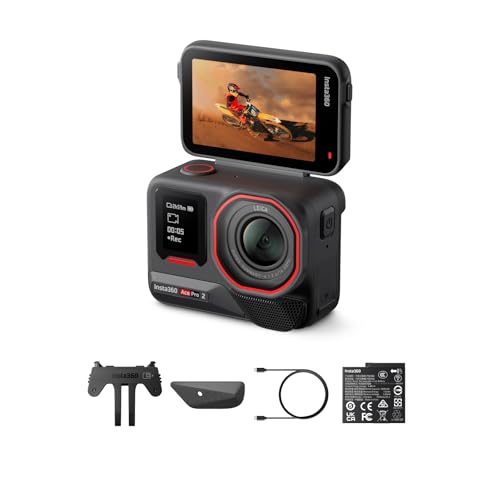
Insta360 Ace Pro 2 — Best Overall After Dark
If night is your main shooting condition rather than an occasional accident, begin and possibly end your search here. The Ace Pro 2’s sensor is the largest fitted to a conventional action camera in this roundup, developed with a legendary optics partner, and the advantage is not subtle in the situations that ruin other cameras: a face lit by one window, a street where the only light spills from shopfronts, a campsite where the fire is both subject and light source. It gathers enough light to keep its sensitivity lower, and lower sensitivity is the whole game — it is the difference between grain you can live with and static you cannot.
Its dedicated night processing deserves the praise it gets, because it behaves like a photographer rather than a filter. Shadows are cleaned while edges survive; skin does not turn to wax; a brick wall in the background stays brick instead of melting into watercolour. Lesser systems force a choice between noisy-and-detailed or clean-and-smeared, applied to the whole frame with a trowel. This one makes the choice locally, thousands of times per frame, and the result is night footage that holds up on a television rather than only on a phone. For anyone filming people after dark — family evenings, street food tours, night markets — that face-preserving quality is the feature, whatever the spec sheet leads with.
Daylight owners lose nothing for choosing it. The flip screen is the best reviewing tool here, the body is properly waterproof for the rain that so often accompanies night shooting, and its stills are the strongest of the action cameras in this list. The compromises are ecosystem and identity: mounts and accessories exist but in a fraction of GoPro’s variety, and the camera’s talents skew toward the handheld, considered style rather than being bolted to a helmet and forgotten. It also asks you to learn its modes to get the famous results; the night magic lives in a specific mode, not in every preset.
None of that displaces it. Judged purely on the question this article asks — which action camera should you buy if low light is the concern — the Ace Pro 2 is the answer with the fewest apologies attached.
- Form: action camera with flip touchscreen
- Sensor: largest in this group, with dedicated night processing mode
- Video: high-resolution capture; night mode prioritises clean shadows and faces
- Body: waterproof without a case for rain and shallow water
- Power: swappable battery, fast charging
Strengths
- Cleanest faces and shadows after dark of any pick here
- Large sensor keeps sensitivity — and therefore noise — down
- Excellent stills for an action camera, day or night
Trade-offs
- Accessory range is a fraction of GoPro’s
- Best night results live in a specific mode you must choose
- Style suits handheld shooting more than mount-and-forget abuse
Best for: night-first shooters — evening vloggers, night-market wanderers, anyone filming people after dark. Not suited for: riders who need the deepest mount catalogue and zero mode management.

DJI Osmo Action 5 Pro — Best All-Rounder
The Osmo Action 5 Pro is what happens when a company refuses to choose between toughness and darkness. Its sensor sits a half-step behind the Ace Pro 2 in size and ahead of everything else here, and DJI’s processing squeezes it intelligently: night streets keep their contrast, highlights from signs and headlights are held rather than surrendered, and colour stays believable as the light turns artificial and mixed. In the real world of sodium orange and LED white sharing one pavement, that colour discipline is worth more than a fraction more sensor, because nothing dates night footage like skin the colour of a traffic cone.
Where it pulls ahead of the Insta360 is everything surrounding the sensor. Battery endurance is the best in this group by a wide margin, and night shooting eats batteries — cold evenings, long exposures of attention, screens at full brightness to judge focus in the dark. The body is sealed deeper and built harder, shrugging off the rain, frost and knocks that accompany winter nights, and both its screens are bright and glove-aware enough for mitten-season filming. Mount it, cage it, freeze it: this is the camera for the night ride in November, not just the night market in June.
Its stabilisation deserves specific praise after dark. Electronic stabilisation crops and warps more aggressively as light falls, and weaker systems turn night walks into funhouse mirrors at the frame edges. DJI’s holds its composure longer than most, keeping street scenes level and legible at walking pace. It is not immune — run with it at midnight and physics collects its debt — but at the speeds night filming actually happens, it is the most trustworthy electronic system here after the Pocket’s gimbal.
Choose the Action 5 Pro if your nights are outdoors, active and cold, and choose it over the Ace Pro 2 if you value endurance and ruggedness a shade more than the last degree of shadow cleanliness. It is the night camera for people whose other hobby is weather.
- Form: dual-screen rugged action camera
- Sensor: large sensor with strong highlight handling
- Video: high-resolution capture, stabilisation that stays composed at night
- Body: deep waterproofing, cold-tolerant build
- Power: class-leading battery endurance, swappable
Strengths
- Best battery life here — decisive on long cold evenings
- Colour stays natural under mixed artificial light
- Toughest body in the group for winter and wet nights
Trade-offs
- Shadow detail a shade behind the Ace Pro 2
- Accessory catalogue still smaller than GoPro’s
- Night slow-motion modes narrow as light falls, as on all rivals
Best for: outdoor night shooters, winter riders, travellers filming long evenings on one battery. Not suited for: studio-style night vloggers who prize the flip screen and the cleanest possible faces above endurance.

DJI Osmo Pocket 3 — Best for Night Walks and Vlogs
The Pocket 3 is the cheat code in this comparison, and it is only fair to say so plainly. It is not really an action camera: it is a large-sensor camera on a motorised gimbal, the size of a chocolate bar, and that gimbal changes the mathematics of night. Because the camera is mechanically steadied, it can use slower shutter speeds without smearing your movement across the frame, and a slower shutter is literally more light per frame. Walking through a night market, the Pocket 3 produces the smooth, luminous, floating footage that makes viewers ask what cinema camera you used. No fixed action camera in this list can do that walk as beautifully. Physics forbids it.
The sensor matches the ambition — a genuinely large one-inch-class sensor, the biggest light-gatherer here — paired with a fast lens and subject tracking that locks onto a face and keeps it framed and exposed as you move through changing light. For the night vlogger, the evening city-break filmmaker, the couple documenting a festival of lights, this is not merely the best tool in the list; it is a different category of result. Its three-microphone array also captures the ambience of a place — buskers, crowds, rain on awnings — with a fullness the action cameras’ weather-sealed mics cannot approach.
Now the honesty. You cannot bolt it to a chest mount and ride a trail at midnight; the gimbal is a precision instrument that wants a hand, not a crash. It is not waterproof, and a rainy night shoot needs its case or your courage. Battery is built in, so a long night ends when it ends unless you carry a power bank and patience. Battery doors, mounts, abuse: the whole action-camera covenant is absent. This is a camera for held, deliberate, walking-pace nights.
If your low-light problem is ‘my evening footage looks cheap,’ the Pocket 3 solves it more completely than anything else sold in this size. If your problem is ‘my night rides look noisy,’ it cannot help you at all. Knowing which sentence is yours is the entire decision.
- Form: pocket gimbal camera, rotating touchscreen
- Sensor: one-inch-class, the largest here, with fast lens
- Stabilisation: three-axis mechanical gimbal enabling slower night shutter speeds
- Audio: multi-microphone array with strong ambient capture
- Power: built-in battery; plan charging for long nights
Strengths
- Night walking footage of a quality no action camera here matches
- Face tracking keeps subjects exposed correctly through changing light
- Best ambient audio in the group by a wide margin
Trade-offs
- Not waterproof and not built for crashes or mounts
- Built-in battery limits very long sessions
- Gimbal needs care in bags, pockets and weather
Best for: night vloggers, city-break filmmakers, festival and night-market walkers. Not suited for: anyone whose camera must be mounted, soaked or dropped.

GoPro HERO13 Black — Best Mounted Night Rider
GoPro’s flagship enters this list with a smaller sensor than the leaders and a reputation earned in daylight, so let us be precise about what it does after dark. Under streetlights, in lit venues, on a floodlit slope or a city ride, the HERO13 produces perfectly serviceable, often punchy night footage, stabilised by the most mature electronic system in the business. Its virtue for night riders and skiers is not the sensor; it is that the camera mounts anywhere, survives anything, and its footage cuts seamlessly with the daylight GoPro material the same riders already own. Ecosystems are a night feature too: the cage that holds your camera also holds the small light that fixes your darkness.
Push it into genuinely dim conditions and the compromises surface. Sensitivity climbs, noise follows, and the processing smooths fine detail to keep the picture tidy — faces at a distance go soft, foliage turns to felt. Its low-light mode helps by trading frame rate for exposure time, which suits static scenes and slow pans, not fast action. Night specialists will also notice the highlights: bright signs and headlights can bloom where the DJI and Insta360 hold their nerve. None of this is failure; it is the profile of a daylight flagship visiting the night, competent within city limits.
Where the HERO13 quietly wins is control for those who edit. Its flatter colour profile and manual exposure tools let a colourist pull a night scene toward a deliberate look rather than accepting the camera’s, and its huge frame-rate and resolution menu — in daylight — means one camera covers the whole trip. Add the interchangeable lens system for creative night perspectives, the magnetic mounting that makes cold-fingered changes painless, and the simple fact that every rental counter and dive shop on earth supports it, and the flagship’s case writes itself for the mounted-action crowd.
Buy it if night is a chapter of your filming, not the whole book. The riders, skiers and travellers who shoot all day and into the evening will be well served; the dedicated night owl should look at the top of this list instead.
- Form: flagship action camera, interchangeable lens options
- Sensor: smaller than the leaders; relies on processing and modes at night
- Video: extensive resolution and frame-rate menu, low-light mode trades rate for exposure
- Mounting: magnetic system plus the widest cage, light and accessory support
- Power: swappable endurance battery
Strengths
- Mounts anywhere and survives the night-ride use case completely
- Manual controls and flat profile reward editors
- Every accessory, cage and light you might add already exists
Trade-offs
- Noise and detail loss arrive earlier than on the large-sensor picks
- Highlights from signs and headlights can bloom
- Low-light mode limits frame rate, suiting slower scenes
Best for: riders, skiers and travellers whose filming runs from daylight into lit evenings. Not suited for: dedicated night shooters filming in genuinely dark places.

GoPro HERO12 Black — Best Value After Dark
The HERO12 Black is the HERO13’s night performance at a friendlier point in the range, and for low-light shoppers that trade is unusually painless, because the two cameras’ after-dark behaviour is close enough that the setting matters more than the generation. Lit streets, venues, campsites with lanterns, the school play: the older flagship handles all of it with the same stabilisation lineage and the same honest limitations in true dark. The money difference, spent on a small video light and a cage to hold it, improves your night footage more than the newer badge would. That arithmetic is the whole review, and it is a strong one.
What you give up versus the newer model lives mostly in daylight and convenience: no satellite positioning, a narrower lens-mod story, slightly less refined power behaviour in some modes. At night specifically, you give up very little. The same low-light logic applies — let the camera trade frame rate for exposure on static scenes, keep sensitivity capped if you edit, and do not ask a small sensor to film an unlit field. Owners of existing GoPro mounts and batteries will find the HERO12 slots into their kit without a single new accessory, which for many households is the deciding argument all by itself.
It also remains the easiest camera here to buy used or discounted with confidence, because its failure modes are known, its spares are everywhere, and every tutorial ever filmed about night settings for this family applies to it. A first-time night shooter could do far worse than learn on the camera the internet has already troubleshot for them.
Choose the HERO12 if you want into the GoPro world for mixed day-and-night use without paying the newest-model toll, and spend the saving on light. Choose anything above it on this list if night is the main event and the budget stretches.
- Form: previous-generation flagship action camera
- Sensor: same class as its successor; night behaviour closely matched
- Video: broad mode menu with low-light exposure trade-offs
- Compatibility: full GoPro mount, cage and battery ecosystem
- Power: swappable battery
Strengths
- Night performance near the flagship’s for notably less commitment
- Savings convert directly into a light and cage that help more
- Deepest pool of tutorials, spares and used-market confidence
Trade-offs
- Same small-sensor ceiling in true darkness as the flagship
- No satellite positioning for topside logging
- Fewer creative lens options than the current model
Best for: value-minded riders and travellers entering the GoPro ecosystem. Not suited for: buyers who want the newest daylight features alongside their night filming.

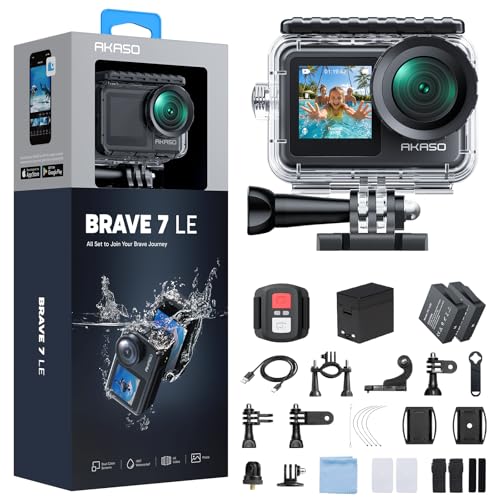
AKASO Brave 7 LE — Best Budget Experiment
Every list needs its truth-teller, and the Brave 7 LE is this one. It is a genuinely inexpensive action camera with weather sealing, two screens and a spec sheet that imitates the flagships at a distance. In decent artificial light — a lit kitchen, a bright street, a venue with real lighting — it produces cheerful, usable footage, and for the reader whose night filming amounts to a holiday evening parade or a child’s school concert, that may honestly be enough. Cameras should be bought for the life you have, and plenty of lives are lived in lit rooms.
Beyond that light, the bill arrives. The small sensor and modest processing produce noise that dances rather than settles, stabilisation works harder and achieves less as darkness thickens, and fine detail — faces across a room, text on a sign — dissolves early. Its night footage is recognisably night: dim, grainy, atmospheric in the way a postcard of a storm is atmospheric. If your ambition is a moody record of an evening rather than a clean one, the camera will not stop you. If your ambition is the clean footage at the top of this page, no setting on this camera reaches it, and pretending otherwise would be a disservice.
And yet its seat on this list is earned, twice over. First, as an experiment: it costs little enough to discover whether night filming is your hobby before the flagship money moves. Second, as a risk camera — the one you mount where a flagship would make you flinch, on the bumper, the dog’s harness at dusk, the bonfire’s edge. Footage from a brave cheap camera beats the footage a protected expensive camera never took because its owner was careful. Many two-camera households started exactly here.
Buy it to learn, to lend, or to risk. Do not buy it as a cheap route to the Ace Pro 2’s nights, because that route does not exist, and anyone who tells you it does is selling something — probably this camera, dishonestly.
- Form: budget action camera with dual screens
- Sensor: small sensor; suited to lit scenes after dark
- Video: headline resolutions match flagships; night detail does not
- Body: weather-sealed for rain and splashes
- Power: swappable batteries, typically supplied generously
Strengths
- Inexpensive enough to be an experiment or a risk camera
- Perfectly usable footage in well-lit evening scenes
- Dual screens and weather sealing at a budget point
Trade-offs
- Noise and detail loss arrive early as light falls
- Stabilisation weakens noticeably in the dark
- No processing mode closes the gap to the large-sensor picks
Best for: beginners testing the night-filming hobby, and owners wanting a camera they can afford to endanger. Not suited for: anyone whose main subjects live in genuinely dim light.
What Should You Test in the First Evening With a New Camera?
Do not let the first night be an important one. Take the new camera on an unimportant evening — a walk you take anyway, a street you know — and deliberately film the four shots that expose every weakness: a face under a single warm light, a bright sign against a black sky, a slow pan across mixed street lighting, and thirty seconds of walking. Watch the results on the biggest screen you own, because phones forgive what televisions prosecute. You are learning your camera’s accent: where its noise lives, how its exposure thinks, which of its modes flatters your actual streets rather than a reviewer’s.
Then change one thing at a time. Try the night mode against the standard mode on the same corner. Try the lower frame rate on the same walk. Try stabilisation gentled down a step. Ten minutes of this unglamorous comparison teaches more than a month of other people’s opinions, because low-light performance is personal — it depends on your light, your subjects and your tolerance for grain. By the second evening you will know which settings are yours, and the camera will have stopped being a purchase and started being a tool. Every pick in this guide rewards that evening; none of them performs its best without it.
How Can You Get Better Night Footage From Any of These Cameras?
Start with frame rate, the setting beginners ignore and professionals reach for first. Halving your frame rate roughly doubles the light each frame can gather, so the 24 or 25 frames per second that filmmakers favour is not an aesthetic affectation — it is a low-light strategy. Next, manage stabilisation: electronic systems crop and sample in ways that cost light and detail, so for static or slow night scenes, reduce stabilisation to its gentlest effective setting or brace the camera and turn it off. A camera resting on a café table with stabilisation off will embarrass a handheld flagship with everything on.
Then light your subject, however modestly. A pocket video light, a companion’s phone torch diffused through a napkin, standing your subject nearer the window or the streetlamp — all of these add more image quality than any menu contains. Expose for the face, not the scene: tap or set exposure on the person, accept that the background may fall dark, and remember that viewers forgive a black background instantly and a black face never. Finally, cap your sensitivity if the camera allows it. A ceiling on ISO trades a little brightness for a lot of cleanliness, and brightness can be lifted in editing far more gracefully than noise can be removed.
Above all, stand still more. Night amplifies movement’s cost: every step is a shutter-speed problem, every pan a smear. The night footage people admire is mostly filmed by people moving slowly, stopping often, and letting the city move instead. Your camera, whichever badge it wears, is better than your habits. Improve the habits first; they are free, and they transfer to every camera you will ever own.
What Mistakes Do Night Shooters Keep Making?
The first is filming the test at home and trusting it. A living room under warm bulbs is low light the way a paddling pool is the sea; take the camera to your real darkest venue before deciding it failed or passed. The second is chasing slow motion after dark. High frame rates are light-hungry by arithmetic, and the buttery night slow-motion in advertisements was shot with cinema lights or a cinema camera. The third is leaving every setting on automatic and then blaming the sensor: auto exposure at night hunts, breathes and pumps as lights pass, and five minutes learning your camera’s exposure lock will do more for your footage than a generation of hardware.
Fourth, and most human: forgetting that audio carries night scenes. Evening footage lives on ambience — rain, crowds, a busker two streets away — and the camera pressed against a jacket zip or a gloved hand records the evening as rustling darkness. Hold the camera in the open, keep fingers off the microphone ports, and let the night sound like itself. Your future viewers will feel the scene before they can see it, which at night is exactly the right order.
What About Filming Concerts and Gigs at Night?
Live music is low light with complications: the stage is bright and strobing while the crowd is black, the volume attacks the microphones, and venues may have opinions about cameras at all. The cameras that cope share three traits — exposure that does not panic when a strobe fires, highlight control that keeps a lit performer from becoming a white ghost, and audio with enough headroom to survive a chorus. Of this list, the Pocket 3 in a steady hand produces the most watchable gig footage, its gimbal eating the crowd’s sway and its microphones capturing something resembling the room. The Ace Pro 2 is the action-camera answer, with the cleanest read on a lit face in a dark room.
Practical gig craft matters as much as the badge. Film whole songs rather than fragments, because exposure settles and so does the crowd around you. Keep the camera below the sightlines of the people behind you, both as manners and because a raised camera is a waved camera. And check the venue’s policy before the night rather than during it; a camera surrendered at the door films nothing at all, however large its sensor. The best night camera is the one that is actually in your hand when the lights go down.
Final Recommendation
Match the weapon to your nights. For handheld filming of people and places after dark, the Insta360 Ace Pro 2 is the strongest conventional action camera here, and the DJI Osmo Action 5 Pro is its equal for anyone whose nights are longer, colder and wetter. If your evenings are walked rather than ridden, the Osmo Pocket 3 stands alone — nothing else in this size makes night look that good. Riders and travellers embedded in the GoPro world should take the HERO13 Black, or the HERO12 Black and a light with the change. And if you are simply not sure the night is yours yet, the Brave 7 LE will tell you cheaply and honestly. What none of these cameras will do is rescue an unlit scene or a hurried hand — give your pick light and stillness, and it will give you the night back.
A closing thought for the undecided: the difference between the top and bottom of this list is real, but it is smaller than the difference between a considered shot and a careless one. We have watched a Brave 7 LE, braced on a wall under a streetlamp by someone who understood light, produce a more moving night clip than a flagship waved from a moving car by someone who did not. Buy the best sensor your budget honestly allows, then go and learn your streets at night. The camera is the smaller half of the craft; the evening is the larger, and it is free to practise in.
Frequently Asked Questions
Does a bigger sensor really matter that much in an action camera?
Yes — it is the single most predictive specification for low-light quality. A larger sensor gathers more light per frame, which lets the camera use lower sensitivity, which produces less noise and cleaner detail. Processing can narrow the gap, and a gimbal can sidestep it by allowing slower shutter speeds, but sensor size is the foundation the rest is built on. That is why the large-sensor picks sit at the top of this list.
Should I film at 24fps or 60fps at night?
Choose the lower frame rate whenever the scene allows it. Each frame at 24fps can gather light for roughly twice as long as a frame at 60fps, which translates directly into brighter, cleaner night footage. Reserve high frame rates for bright artificial light or for slow-motion in lit venues. For most evening filming, a cinematic frame rate is both the prettier and the more practical choice.
Can a small video light really replace a better camera?
For close subjects, often yes. Within a few metres, even a modest light restores colour and detail that no sensor upgrade can recover from darkness, because it fixes the actual problem — the absence of light. It cannot help landscapes, streets or anything distant, which is why the strongest night kit is a good sensor and a small light together. Buy the camera for range; buy the light for faces.
Why does my night footage look smooth and waxy?
That is aggressive noise reduction planing away detail along with noise, a common trait of smaller sensors working hard in the dark. You can reduce it by adding light, lowering the camera’s sensitivity ceiling, choosing a pick with gentler processing such as the Ace Pro 2, or selecting a flatter picture profile and handling noise yourself in editing, where you control the trade-off instead of the camera deciding for you.
Do I need a waterproof camera for night shooting?
More often than night shooters expect. Night and weather travel together — rain on city streets, frost on a ride, sea spray at a harbour fireworks show — and a sealed camera removes a whole category of hesitation. Every conventional action camera in this list is waterproof to some degree, which is one of their genuine advantages over the Pocket 3 for outdoor nights. If your evenings are indoor and dry, it matters little; if they are British, coastal or wintry, it matters a great deal.
Is the Pocket 3 a real alternative to an action camera for night filming?
For held, walking-pace filming it is not just an alternative but the best option here, thanks to its gimbal and large sensor. For anything mounted, crashed, soaked or frozen, it is not an action camera at all and should not be asked to be one. Many night shooters end up owning both styles eventually: the gimbal for the city, the action camera for the storm.
How long will the battery last on a cold night shoot?
Shorter than the box suggests, and the gap grows with the cold. Night shooting keeps screens bright and processing busy, and cold batteries surrender charge early, so plan on carrying a warm spare in an inside pocket for any evening longer than an hour. The DJI Osmo Action 5 Pro’s endurance advantage is largest exactly here. A camera that dies at the fireworks finale has failed at its only job, whatever its sensor size.
Which is better for night filming: a cage with a light or a bigger sensor?
They solve different distances. A bigger sensor improves everything in the frame at every range, including the street, the sky and the far side of the square. A light improves only what it reaches — brilliantly, within a few metres, and not at all beyond them. If your subjects are people near you, the light is astonishing value. If your subject is the night itself, the sensor is the answer. Serious night shooters eventually own both and stop arguing.
Why does night footage from an action camera look worse than the same scene on a phone?
Physics, mostly. A modern phone stacks multiple frames into every second of video and leans on a large sensor with pixels several times the area of those in a typical action camera, so it can average noise away in a way a small single-frame sensor cannot match. The action camera’s priorities run the other direction: a tiny waterproof body, a very wide lens that gathers a scene rather than a subject, and stabilisation that crops and warps the frame in real time. Each of those choices costs low-light performance. You can claw some of it back with settings. Locking the frame rate to the lower option doubles the exposure time available to every frame; capping the maximum ISO below the camera’s ceiling stops the gain from climbing into the grainy territory where detail dissolves; and turning stabilisation down in static scenes removes the micro-crops that soften edges. Mounting the camera instead of holding it helps more than any menu: a still camera at a modest ISO produces cleaner night footage than a moving camera at any setting, because the sensor finally gets the stable, longer look at the scene it was starved of.
Related Guides
Filming in other hard places? See the best action cameras for diving for cameras that handle darkness underwater, the best action cameras for sound if the night’s audio matters as much as its picture, and the best action cameras for vacations for evening-friendly travel picks.