The best and worst TV antennas are often sold side by side, in nearly identical boxes, with nearly identical promises. The difference is in the details: a real brand with a stated range and a real amplifier, versus a no-name panel with an inflated mileage claim and a noisy booster that makes reception worse. This guide does both jobs. The first half names the six best TV antennas in this roundup, three indoor amplified models and three outdoor models, each one verified as a new listing with its full title checked. The second half names the worst patterns in TV antennas, the claims and designs that waste money, so the money goes to an antenna that works instead of one that only promises. The six picks below were verified as new listings with their full titles checked, and the worst section that follows names the patterns to avoid rather than linking bad products, because the worst antenna is usually the one that looks like a bargain.
The six picks below were chosen the same way as the rest of this site's antenna guides: real brands, stated ranges, and verified new listings. The indoor three are amplified flat and hover antennas for city and suburban homes. The outdoor three are a directional panel, a long-range outdoor model with a J mount, and an omnidirectional antenna for homes where the towers sit in different directions. The worst section that follows is not a list of links to bad products; it is a guide to recognizing them before buying, because the worst antenna is usually the one that looks like a bargain.
In this guide
Quick picks: best and worst tv antennas
| # | Product | Where to buy |
|---|---|---|
| 1 | Winegard FlatWave FL5500A Amplified Indoor TV Antenna | Check on Amazon |
| 2 | GE Hover Amplified HD Digital TV Antenna | Check on Amazon |
| 3 | Philips Hover Amplified HD TV Antenna | Check on Amazon |
| 4 | Antennas Direct ClearStream 4V Outdoor TV Antenna | Check on Amazon |
| 5 | GE Outdoor HD Digital TV Antenna | Check on Amazon |
| 6 | Channel Master Omni+ 50 Omnidirectional TV Antenna | Check on Amazon |
How the picks were chosen
The picks were chosen on five points. First, brand and track record: Winegard, GE, Philips, Antennas Direct, and Channel Master have sold TV antennas for years, and their range ratings are at least anchored in real designs. Second, stated range: the indoor picks run 40 to 60 miles and the outdoor picks cover long-range and omnidirectional reception, so the set spans the homes that actually buy TV antennas. Third, form: flat, hover, directional, and omnidirectional designs are all here, because the right form depends on the home. Fourth, NextGen TV and 4K support stated in the listing, which marks current stock rather than old inventory. Fifth, verification: every ASIN was checked by its full listing title, and any renewed or used listing was dropped.
Quick comparison
| Product | Key detail | Best for |
|---|---|---|
| Winegard FlatWave FL5500A Amplified Indoor TV Antenna | 60-mile amplified flat antenna, NextGen TV | Most indoor installs within 60 miles of the towers |
| GE Hover Amplified HD Digital TV Antenna | Hover design sits on top of the TV, amplified | TV-top installs where a wall panel is unwanted |
| Philips Hover Amplified HD TV Antenna SDV7219N/27 | Philips hover antenna with booster and AC adapter | Simple TV-top setups with a complete kit |
| Antennas Direct ClearStream 4V Outdoor TV Antenna | Outdoor directional antenna with reflectors, NextGen TV | Outdoor installs with aimable towers |
| GE Outdoor HD Digital TV Antenna, Long Range | Long-range outdoor antenna with J mount included | First outdoor antenna installs and attic installs |
| Channel Master Omni+ 50 Omnidirectional TV Antenna | Omnidirectional 50-mile antenna for roof, attic, or RV | Scattered towers and RV installs |
Best and worst TV antennas: what matters most
Range is the number that matters most and the number most often inflated. A real 60-mile antenna is a real thing; a 150-mile or 200-mile flat panel is usually a 60-mile design with a bigger number on the box. Direction matters next: a directional antenna pulls harder in one direction and needs aiming, while an omnidirectional antenna hears in every direction but with less gain, which suits homes with towers scattered around them. Amplification helps at the edge of reception and hurts up close, where it can overload the tuner. VHF support matters because many stations still broadcast on VHF, and an antenna that only does UHF will miss them. Finally, mounting matters: an indoor antenna lives or dies by its window, and an outdoor antenna lives or dies by its mount, its height, and its grounding. The cable matters as much as the antenna: a long, thin coax run loses signal, and an outdoor antenna with a long run to the television needs a good-quality cable and, for a weak signal, an amplifier near the antenna rather than at the television.
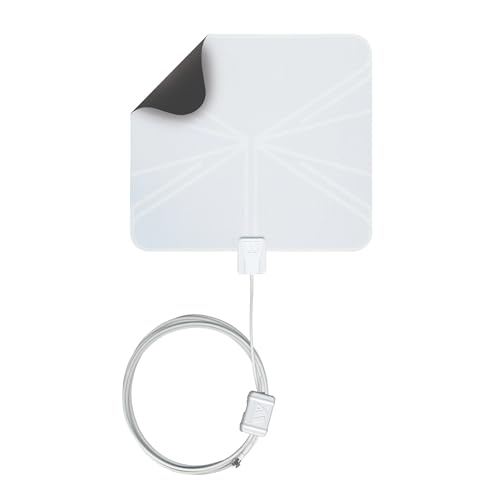
Winegard FlatWave FL5500A Amplified Indoor TV Antenna
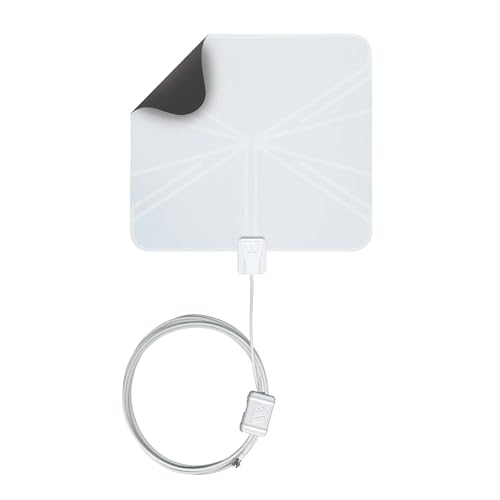
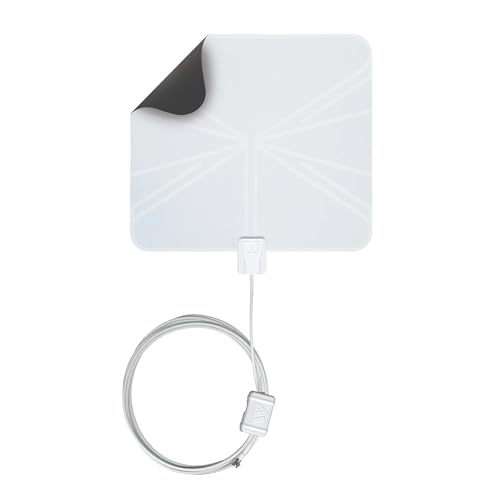
The FlatWave FL5500A leads this guide because it is the most proven indoor antenna here. A thin dual-color panel with a built-in amplifier and a 60-mile range rating, it mounts on a wall or window and states NextGen TV support, which covers the current ATSC 3.0 broadcasts as well as the older ones. Its multidirectional design means it does not need precise aiming, and its flat form disappears against a wall. For the common case, a home within 60 miles of the towers that wants free local channels without an outdoor install, this is the best TV antenna in this roundup. The multidirectional design is the detail that makes the FlatWave forgiving: it does not need to be aimed precisely at the towers, so a buyer who does not know the exact tower direction can still get a good result.
Key specs: Amplified; 60-mile range; multidirectional; ultra-thin; dual-color; indoor rated; 4K Ultra-HD and NextGen TV. The multidirectional design needs no precise aiming, and the ultra-thin dual-color panel mounts on a wall or window.
Strengths:
- 60-mile range covers most metro and suburban homes
- Proven flat design from a long-standing antenna brand
- Stated NextGen TV support for current broadcasts
Trade-offs:
- Amplifier needs mains power near the antenna
- Flat panel placement can take a few tries to get right
- 60-mile rating assumes good conditions and a clear path
A home within 60 miles of the towers that wants the safest indoor amplified antenna with no outdoor work. It is also the safest first purchase in this guide, because it is the most proven indoor antenna here.
Best for: Most indoor installs within 60 miles of the towers
Not suited for: Fringe homes beyond 60 miles, where an outdoor antenna is needed
Check price on Amazon: Winegard FlatWave FL5500A Amplified Indoor TV Antenna

GE Hover Amplified HD Digital TV Antenna
The GE Hover is the best TV antenna for a living room where a wall panel is not wanted. It sits on top of the television, which keeps the cable run short and the install to a matter of minutes, and its built-in amplifier lifts weak VHF and UHF signals with 4K and 1080P support stated in the listing. The hover form is the whole idea: no wall mount, no window suction, no bracket. It is not the longest-range antenna here, but for a TV-top install it is the most practical one. The hover form is the whole idea of this antenna: it sits on the television, keeps the cable run short, and removes the wall-mount chore entirely, which is why it suits a living room where a panel on the wall would look wrong.
Key specs: Amplified; hover design mounts on top of the TV; long range; supports 4K 1080P HDTV, VHF and UHF; indoor amplified signal booster; 5-foot coax cable; model 37075. The hover design sits on top of the television, and the 5-foot coax cable reaches the tuner without an extension.
Strengths:
- No wall mounting; sits on top of the TV
- Built-in amplifier with stated VHF and UHF support
- Short cable run and a fast, simple setup
Trade-offs:
- Top-of-TV height may be lower than a good window spot
- Needs a flat-topped TV with room for the antenna
- 5-foot cable limits movement away from the TV
A living room where the antenna should live on the TV, with the towers within normal indoor range. It suits a living room where the antenna should live on the television rather than on the wall.
Best for: TV-top installs where a wall panel is unwanted
Not suited for: Homes that need a high window to clear an obstruction
Check price on Amazon: GE Hover Amplified HD Digital TV Antenna

Philips Hover Amplified HD TV Antenna SDV7219N/27
Philips takes the same top-of-TV idea and ships it as a complete kit: hover antenna, signal booster, coax cable, and AC adapter in the box. That completeness is the reason to pick it over the GE Hover, because there is nothing extra to buy and nothing to forget. The listing states 4K and 1080P support with VHF and UHF reception, and the hover form keeps the install simple. Between the two hover antennas, choose on price and availability; both are solid, and both beat a wall panel for a TV-top setup. The complete kit is the reason to choose the Philips over the GE Hover: booster, coax, and AC adapter are all in the box, so there is nothing extra to buy and nothing to forget on the day of the install.
Key specs: Amplified; hover design mounts on top of the TV; long range; supports 4K 1080P HD, VHF and UHF; signal booster; coax cable and AC adapter included; model SDV7219N/27. The signal booster and AC adapter are included in the box, and the model number is SDV7219N/27.
Strengths:
- Complete kit with booster and AC adapter included
- Top-of-TV design with no wall mounting
- Stated VHF and UHF support with 4K and 1080P
Trade-offs:
- Top-of-TV height may be lower than a high window
- Hover form suits flat-top TVs best
- Amplifier needs a nearby outlet
A home that wants a top-of-TV antenna with everything in the box and no extra parts to buy. It suits a buyer who wants a complete top-of-TV kit with nothing extra to buy.
Best for: Simple TV-top setups with a complete kit
Not suited for: Fringe reception, where a higher window or outdoor antenna is needed
Check price on Amazon: Philips Hover Amplified HD TV Antenna
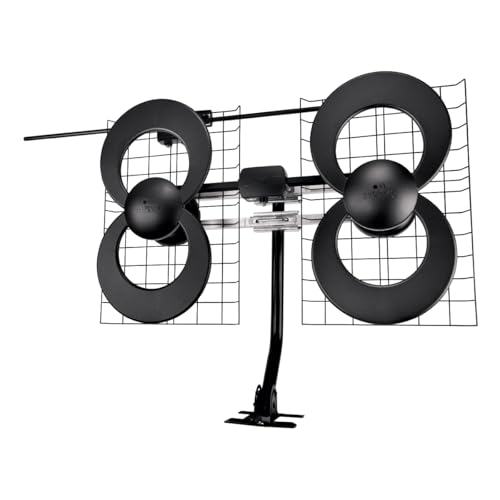
Antennas Direct ClearStream 4V Outdoor TV Antenna
The ClearStream 4V is the best outdoor TV antenna in this guide for a home that can aim at its towers. It is a directional outdoor antenna with a 20-inch mast, reflectors, and dedicated Hi-VHF elements, which is the combination that pulls in distant UHF and VHF stations together. The listing states UHD 4K, 8K, and NextGen TV support, and the multi-directional design gives some forgiveness in aiming. It needs a proper outdoor mount and a coax run into the house, which is more work than an indoor panel, but the reception it delivers is in a different class. The Hi-VHF elements are the specialist detail here: many antennas do well on UHF and poorly on VHF, and the ClearStream 4V's dedicated elements are what pull in the VHF stations that other outdoor antennas miss.
Key specs: Outdoor; 20-inch mast; reflectors; Hi-VHF elements; UHF and VHF signals; multi-directional; UHD 4K, 8K, and NextGen TV. The 20-inch mast, reflectors, and Hi-VHF elements are the combination that pulls in distant UHF and VHF stations together.
Strengths:
- Directional design with reflectors pulls distant stations
- Dedicated Hi-VHF elements cover VHF stations other antennas miss
- Stated 4K, 8K, and NextGen TV support
Trade-offs:
- Needs an outdoor mount and a coax run into the house
- Directional, so it needs aiming at the towers
- Outdoor install means weather, height, and grounding to plan for
A home with roof or attic access that can aim an outdoor antenna at its towers and wants the strongest reception in this guide. It suits a home with roof or attic access that can aim an outdoor antenna at its towers.
Best for: Outdoor installs with aimable towers
Not suited for: Renters or homes where no outdoor mounting is allowed
Check price on Amazon: Antennas Direct ClearStream 4V Outdoor TV Antenna

GE Outdoor HD Digital TV Antenna, Long Range
The GE Outdoor antenna is the practical outdoor pick: a long-range outdoor model with a J mount included in the box, weather resistant, and rated for attic or outdoor use. The J mount is the detail that saves a separate purchase and a separate trip, and the attic option matters for homes where a roof mount is not wanted or not allowed. The listing states 4K and 1080P support with VHF and UHF reception. It is less specialized than the ClearStream 4V, with no separate Hi-VHF elements called out, but it is simpler to buy and simpler to install, and for many homes that is the better trade. The J mount included in the box is the practical detail that saves a separate purchase and a separate trip, and the attic option gives homes without a roof mount a way to install an outdoor antenna under cover.
Key specs: Outdoor; long range; supports 4K 1080P HD smart TV, VHF and UHF; J mount included; for attic or outdoor; weather resistant; model 29884. The J mount is included in the box, and the antenna is rated for attic or outdoor use with weather resistance.
Strengths:
- J mount included, so there is no separate mount to buy
- Attic or outdoor use gives an install option for most homes
- Weather resistant with stated VHF and UHF support
Trade-offs:
- Less specialized for distant VHF than the ClearStream 4V
- Outdoor install still needs height and a coax run
- Long-range rating depends on a clear path to the towers
A home that wants a straightforward outdoor antenna with the mount in the box and the option of an attic install. It suits a first outdoor install, because the J mount is in the box and an attic install is an option.
Best for: First outdoor antenna installs and attic installs
Not suited for: Distant VHF stations, where a dedicated Hi-VHF design wins
Check price on Amazon: GE Outdoor HD Digital TV Antenna
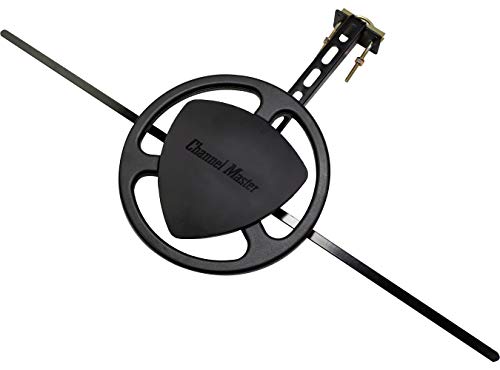
Channel Master Omni+ 50 Omnidirectional TV Antenna
The Channel Master Omni+ 50 is the best TV antenna in this guide for a home whose towers sit in different directions. It is omnidirectional, hearing 360 degrees with no aiming, and it carries a 50-mile range rating with a mounting bracket included for roof, attic, and RV installs. That flexibility is the point: a directional antenna pointed at one tower group misses the stations behind it, while the Omni+ 50 hears them all, at the cost of some gain in any one direction. For a home between two tower groups, or an RV that moves, it is the right design. The omnidirectional design is the answer for a home whose towers sit in different directions: it hears 360 degrees with no aiming, so one antenna covers stations that a directional antenna would need to choose between.
Key specs: Omnidirectional; 360-degree reception; 50-mile range; mounting bracket included for roof, attic, and RV; indoor and outdoor; digital HDTV antenna. The 50-mile range and 360-degree reception suit homes with scattered towers, and the bracket covers roof, attic, and RV installs.
Strengths:
- 360-degree reception with no aiming needed
- Roof, attic, and RV mounting with the bracket included
- 50-mile range suits metro and suburban homes
Trade-offs:
- Omnidirectional gain is lower than a directional antenna in one direction
- 50-mile range is shorter than the best directional outdoor models
- Still needs a mount, a coax run, and grounding for a roof install
A home with towers in more than one direction, or an RV, that needs one antenna to hear them all without aiming. It suits a home with towers in more than one direction, and an RV that moves between tower groups.
Best for: Scattered towers and RV installs
Not suited for: A single distant tower group, where a directional antenna pulls harder
Check price on Amazon: Channel Master Omni+ 50 Omnidirectional TV Antenna
Buying guide: choosing TV antennas
Start with the towers. Look up the broadcast towers for the area, note their distance and direction, and let that decide the form: indoor amplified for under 60 miles with a good window, outdoor directional for distance or a single tower group, omnidirectional for scattered towers. Then check the tuner, because an antenna cannot add ATSC 3.0 decoding to a TV that lacks it. For an indoor antenna, the window facing the towers is the first spot to try, and a channel scan at each spot tried is the only honest test. For an outdoor antenna, plan the mount, the height, the coax run, and the grounding before buying, and check the rules for the building, because a roof mount is a permanent change. Keep the coax run short, keep the amplifier powered, and rescan after any move. If the towers are close, try the antenna without amplification first, because too much gain can overload the tuner.
Using and caring for your TV antennas
Indoor antennas need little care: dust the panel, keep the coax connectors finger-tight, and rescan for channels when reception changes. Outdoor antennas need more: check the mount and the coax once a season, look for water in the connectors, and tighten anything the wind has worked loose. Keep the antenna clear of new tree growth, which can block a signal that was clear last year, and keep the grounding intact, because a grounded mast is a safety item, not a nicety. For a hover antenna, keep the top of the TV clear and the antenna level. For a flat panel on a window, keep it out of the hottest sun if possible, because heat can warp a thin panel over years. If reception degrades suddenly, check the amplifier power first; a booster that lost power looks exactly like a dead antenna.
Common mistakes to avoid
The worst TV antennas share a pattern, and it is worth naming. First, the inflated mileage claim: a flat indoor panel rated for 150 or 200 miles is selling a number, not reception, and the honest range of an indoor panel is 40 to 60 miles. Second, the no-name amplified panel with a noisy booster: cheap amplification adds noise along with gain, and a noisy booster can make a weak signal worse. Third, the UHF-only antenna in a VHF area: it will miss whole stations, and no amount of amplification brings them back. Fourth, the antenna bought for one tower group and pointed nowhere: direction matters, and an antenna that is never aimed is an antenna that never had a chance. Fifth, the outdoor antenna with no grounding and a long unsealed coax run: water in the cable and a floating mast are problems that show up months later. Sixth, buying on the box picture instead of the listing: check the brand, the stated range, the amplifier, and whether the listing is new, because renewed and used antennas are common in this category and a used antenna is a gamble on someone else's returns.
How to spot the worst TV antennas before you buy
The worst TV antennas are easy to spot once the pattern is known, and the pattern has five parts. The first is the inflated mileage claim. A flat indoor panel rated for 150 or 200 miles is selling a number, not reception: the physics of indoor reception caps an honest indoor panel at about 40 to 60 miles, and a number far above that is a marketing figure rather than a measured one. Outdoor antennas can honestly claim longer ranges, because height and a directional design do real work, but an indoor flat panel cannot. The second is the no-name brand. A TV antenna from a brand with no history, no support, and no other products is a gamble, because there is nobody to answer for it when the amplifier fails or the cable is short. The established brands in this guide, Winegard, GE, Philips, Antennas Direct, and Channel Master, have sold antennas for years and their range ratings are at least anchored in real designs. The third is the cheap amplifier. Amplification is the most expensive part of an indoor antenna to do well, and a no-name panel with a noisy booster can make reception worse than a passive antenna, because it amplifies noise along with the signal. A good amplifier is low-noise and powered properly; a bad one is a small box that gets warm and does nothing useful. The fourth is the missing band. Many stations still broadcast on VHF, and an antenna that only does UHF will miss them entirely, no matter how much amplification is added. Check the listing for VHF and UHF together, and be suspicious of any listing that only says digital or HD without naming the bands. The fifth is the renewed or used listing sold as new. Renewed antennas are common in this category, and the word renewed hides at the end of long titles, so read the full title before buying; a renewed antenna is a returned antenna, and its amplifier, cable, and mount may be incomplete or worn. Beyond the five, there are smaller tells: a listing with no model number, a listing that promises every channel in every direction with no aiming, and a listing whose reviews all sound alike. None of these proves an antenna is bad, but two or more together are a strong signal to buy something else. The safest approach is the one this guide follows: a real brand, a stated range that matches the home, an amplifier that is actually included, VHF and UHF together, and a verified new listing. An antenna that meets those points is rarely the worst one, and an antenna that fails them usually is.
Indoor, outdoor, and RV: matching the antenna to the home
The right TV antenna depends on the home as much as on the towers, and the three kinds of home in this guide need three different answers. A house with roof access and a clear view of the towers is the home an outdoor antenna was made for: a directional antenna on a mast, grounded and aimed, will pull in stations that no indoor antenna can reach, and it will hold them through weather that breaks an indoor picture. An apartment or a rented home is the opposite case: no roof access, no permanent mount, and often a rule against outdoor antennas, so an amplified indoor antenna on a window is the only honest answer, and the best one is the one that fits the window and the room. A home between two tower groups needs an omnidirectional antenna, because a directional antenna pointed at one group misses the stations behind it, and the Omni+ 50 in this guide is built for exactly that case. An RV is a special case of its own: the towers change every time the vehicle moves, so an omnidirectional antenna that needs no aiming is the practical choice, and the Omni+ 50's RV mounting is the reason it is in this guide. A rural home is the hardest case, because distance and terrain both work against it, and the honest answer is often an outdoor antenna on the tallest mast the property allows, with a distribution amplifier feeding the house. A city home is the easiest case, because the towers are close and an indoor antenna is usually enough, and the mistake to avoid is overbuying: a 60-mile amplified antenna in a home five miles from the towers is a waste of gain and a risk of overload. The size of the home matters too: a single television needs one antenna and a short cable, while a whole house needs a splitter and a distribution amplifier, and the amplifier belongs before the split rather than after it. The number of people matters as well, because a house where several televisions show different channels at once needs a stronger signal than a house with one television. Put together, the rule is simple: match the antenna to the home, the towers, and the number of televisions, and do not buy a bigger antenna than the situation needs, because a bigger antenna in the wrong place is worse than a smaller antenna in the right one.
Final recommendation
The best TV antenna for most homes is the Winegard FlatWave FL5500A: a proven amplified indoor panel with a 60-mile range and NextGen TV support. If the antenna must live on the TV, take the GE Hover or the Philips Hover. If the home can mount outdoors and aim, the Antennas Direct ClearStream 4V is the strongest reception in this guide, the GE Outdoor is the simplest outdoor buy with its J mount included, and the Channel Master Omni+ 50 is the answer for scattered towers and RVs. The worst TV antenna is the one with an inflated mileage claim, a no-name booster, and no VHF support, and it is easy to spot once the pattern is known: if the number on the box sounds too good, it is. Buy the antenna that matches the home, the towers, and the number of televisions, and do not buy a bigger antenna than the situation needs, because a bigger antenna in the wrong place is worse than a smaller antenna in the right one. The six picks here cover the real range of homes, from a city flat panel to a directional outdoor antenna, and the worst patterns in this guide are easy to spot once they are known: an inflated mileage claim, a no-name booster, no VHF support, and a renewed listing sold as new. An antenna that meets the five points in this guide will work, and an antenna that fails them is the worst kind, whatever the number on the box says.
Frequently asked questions
What is the best TV antenna overall?
For most homes, a proven amplified indoor antenna such as the Winegard FlatWave FL5500A, with a 60-mile range and NextGen TV support. Homes that can mount outdoors and aim at their towers will get stronger reception from a directional outdoor antenna such as the Antennas Direct ClearStream 4V. For most homes, a proven amplified indoor antenna such as the Winegard FlatWave FL5500A; homes that can mount outdoors and aim at their towers will get stronger reception from a directional outdoor antenna such as the Antennas Direct ClearStream 4V.
What is the worst kind of TV antenna to buy?
A no-name flat panel with an inflated mileage claim, a cheap noisy amplifier, and no VHF support. It promises 150 or 200 miles, delivers far less, and can make reception worse than a plain unamplified antenna. Buy on brand, stated range, and a verified new listing instead. A no-name flat panel with an inflated mileage claim, a cheap noisy amplifier, and no VHF support promises 150 or 200 miles, delivers far less, and can make reception worse than a plain unamplified antenna.
Do I need an outdoor antenna?
It depends on distance and obstacles. Within 60 miles with a good window, an amplified indoor antenna is usually enough. Beyond that, or with hills, trees, or buildings in the way, an outdoor antenna mounted high is the honest answer. Within 60 miles with a good window, an amplified indoor antenna is usually enough; beyond that, or with hills, trees, or buildings in the way, an outdoor antenna mounted high is the honest answer.
Why do some channels work and others do not?
Stations broadcast on different frequencies and from different towers. An antenna can do well on UHF and miss VHF, or hear one tower group and miss another. Direction, placement, and a rescan after moving the antenna are the fixes to try first. Stations broadcast on different frequencies and from different towers, so an antenna can do well on UHF and miss VHF, or hear one tower group and miss another; direction, placement, and a rescan are the fixes to try first.
Can one antenna serve several TVs?
Yes, with a splitter, but splitting divides the signal, so a weak signal may need amplification before the split. An outdoor antenna with a distribution amplifier is the usual setup for a whole house. Yes, with a splitter, but splitting divides the signal, so a weak signal may need amplification before the split; an outdoor antenna with a distribution amplifier is the usual setup for a whole house.
Can I use an outdoor antenna in an attic?
Yes, and it is a good option for homes where a roof mount is not wanted. An attic install loses some signal to the roof, so it works best within the antenna's stated range, and it needs a clear path through the roof to the towers.
Do I need a separate antenna for each TV?
No. One antenna can feed several televisions through a splitter, but splitting divides the signal, so a weak signal needs a distribution amplifier before the split, and the cable runs should be kept short.
How do I know which direction my broadcast towers are in?
Look up the towers for the area on a tower map or a reception website, note the direction and distance, and aim a directional antenna that way. An omnidirectional antenna needs no aiming, which is its advantage.
Should I buy the antenna with the highest mileage rating?
No. A mileage rating is measured under good conditions, and an inflated number on a cheap panel is a marketing figure; buy on brand, stated range, and a verified new listing instead.
More guides from KajuanDouglas
If this guide helped, these related roundups go deeper on the same topics: the best TV antennas the best TV antennas for Canada the best antennas for local channels.