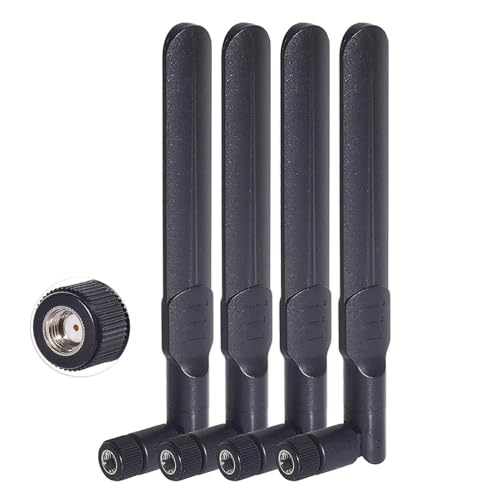
The best indoor amplified TV antennas bring back free television. A good amplified indoor antenna pulls in local broadcast channels — news, sports, network shows, and public television — in high definition, without a monthly bill. The amplifier is the key part: it boosts weak signals so channels that would be unwatchable on a passive antenna come through clearly, which matters most for homes that sit far from broadcast towers or behind hills and tall buildings.
An amplified antenna is not magic, and honest expectations matter. It cannot create a signal where none exists, and it works best when placed near a window facing the broadcast towers. What it does well is take a weak but present signal and lift it above the threshold where the television can lock onto it, turning a pixelated mess into a stable picture. The six antennas in this guide cover the main designs buyers choose: flat panel antennas that stick to a wall or window, hover antennas that sit on top of the television, and long-range amplified models with adjustable boosters.
Every antenna here is reviewed for the things that decide reception: amplifier design, cable length, placement flexibility, and supported resolutions. Read the comparison table first, then the detailed reviews, and use the buying guide to find the broadcast towers and place the antenna correctly before judging its performance.
In this guide
Quick picks: best indoor amplified tv antennas
| # | Product | Where to buy |
|---|---|---|
| 1 | Digital Amplified Indoor HDTV Antenna | Check on Amazon |
| 2 | Channel Master FLATenna with Booster | Check on Amazon |
| 3 | Philips Hover Amplified HD TV Antenna | Check on Amazon |
| 4 | Amplified TV Antenna Indoor VHF UHF | Check on Amazon |
| 5 | Long-Range Amplified Indoor Antenna with Signal Booster | Check on Amazon |
| 6 | 2026 Indoor TV Antenna with Magnetic Base | Check on Amazon |
How the Picks Were Chosen
Each antenna on this list was selected for real reception performance. The first filter was amplification: the antenna had to include a signal amplifier or booster, since that is what the search promises and what makes the difference for weak signals. A passive antenna, no matter how well designed, cannot help a home with marginal reception the way an amplified model can.
The second filter was compatibility: the antenna had to support VHF and UHF broadcasts in 1080p and 4K, since modern televisions display both, and a good antenna should not limit picture quality. Cable length came next, because an antenna that cannot reach a good window is useless no matter how strong its amplifier is. Placement flexibility mattered too: flat antennas that mount on a wall or window, hover antennas that sit on the television, and magnetic-base models that stick to metal surfaces all suit different rooms.
Finally, each pick had to be a real antenna with a clear brand and model and a stated amplifier or booster. No listings that hid the amplifier behind vague language made the cut, and no accessory such as a mount or cable alone qualified. The result is six amplified indoor antennas that cover the main buying decisions: the flat wall antenna, the hover antenna, the adjustable booster, and the long-range amplified model.
Quick Comparison
| Antenna | Design | Amplifier | Best For |
|---|---|---|---|
| Digital Amplified Indoor HDTV Antenna | Flat panel | Built-in amplifier | Wall or window mounting |
| Channel Master FLATenna with Booster | Flat panel | Adjustable booster | Fine-tuning weak signals |
| Philips Hover Amplified HD TV Antenna | Hover, on-top-of-TV | Built-in amplifier | Clean setup with no wall mounting |
| Amplified TV Antenna Indoor VHF UHF | Flat panel | Signal booster | Free local channels in 4K |
| Long-Range Amplified Indoor Antenna | Flat panel | Signal booster | Distant towers and weak signals |
| 2026 Indoor TV Antenna with Magnetic Base | Magnetic base | High-gain amplifier | Flexible placement on metal surfaces |
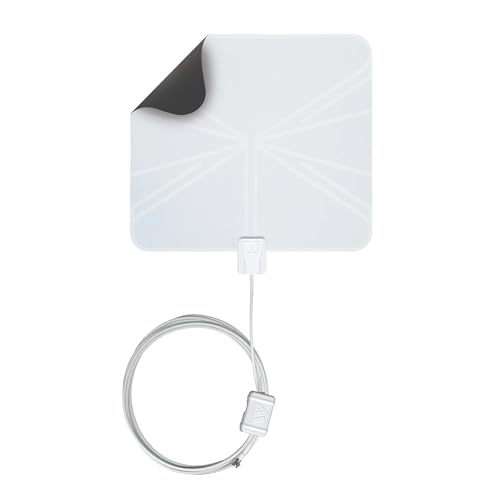
1. Digital Amplified Indoor HDTV Antenna

The Digital Amplified Indoor HDTV Antenna is the straightforward flat-panel pick: a slim amplified antenna that mounts on a wall or window and pulls in local channels in 1080p across VHF and UHF bands. Its detachable signal amplifier boosts weak broadcasts, and its thin profile means it disappears against a wall or window once installed. For a first amplified antenna, this is the simplest place to start.
Flat antennas work best when they have a clear path to the broadcast towers, and this model is designed to be placed high on a wall or directly on a window, where the signal is strongest. The detachable amplifier is a useful feature: it can be removed if the signal is already strong, since an amplifier on a strong signal can cause overload and actually worsen reception. That flexibility makes the antenna suitable for both weak-signal homes that need the boost and moderate-signal homes that need only a little help.
Strengths
- Built-in amplifier boosts weak VHF and UHF signals.
- Flat design mounts easily on a wall or window.
- Detachable amplifier can be removed for strong-signal areas.
Trade-offs
- Needs a good window or wall position to perform well.
- Flat design is less forgiving of poor placement than an adjustable model.
- Cable length limits how far the antenna can sit from the television.
Who it fits: the first-time antenna buyer who wants a simple amplified flat panel for local channels. Best for: wall and window mounting in moderate-signal homes. Not suited for: homes with very weak signals that need an adjustable booster.
Placement is everything with a flat antenna. Try a window first, facing the direction of the broadcast towers, and run a channel scan after each move. A few feet in any direction can change the result dramatically, and the best position is rarely the most convenient one. If the picture pixelates, move the antenna before blaming it: the amplifier boosts whatever signal arrives, and a better position delivers a cleaner signal to boost.
The detachable amplifier on this antenna is worth understanding in detail, since it is the feature that makes the antenna adaptable. In a home with weak signals, the amplifier stays connected and lifts every channel above the reception threshold. In a home with strong signals, the amplifier can be removed, and the antenna works as a passive panel without the risk of overload. That two-in-one design means the same antenna suits a downtown apartment and a suburban house, and the owner can test both configurations in minutes. Keep the amplifier and its power supply together in case the setup changes: a move to a new home or a new television position can turn a strong-signal setup into a weak-signal one, and the amplifier will be needed again.
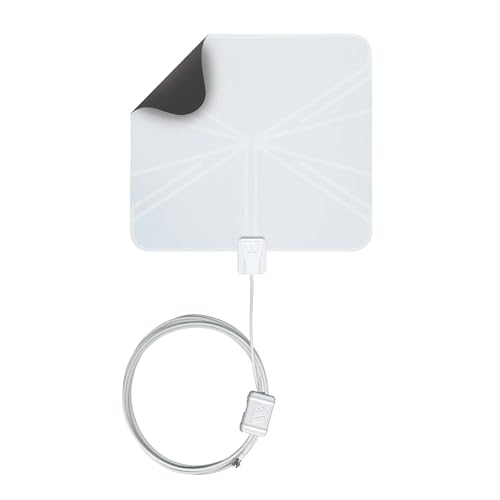
2. Channel Master FLATenna with Booster
Check price on Amazon: Digital Amplified Indoor HDTV Antenna

The Channel Master FLATenna with Booster is the best-known brand on this list, and its adjustable signal amplifier is the feature that sets it apart. Unlike fixed-gain amplifiers that boost everything equally, the FLATenna booster can be adjusted, which lets the owner dial in just enough gain for weak channels without overloading strong ones. That control matters in homes where some channels arrive strong and others barely register, since a single fixed boost cannot serve both.
Channel Master has made antennas for decades, and the FLATenna reflects that experience. The flat panel is thin and paintable, so it blends into a wall, and the booster is a separate unit that sits inline with the cable. For smart TVs and local channels, the combination of a quality panel and a tunable amplifier delivers stable reception where cheaper fixed-gain models struggle. It is the pick for owners who are willing to spend a few minutes tuning for the best result.
Strengths
- Adjustable booster lets the owner fine-tune gain for mixed signals.
- Trusted Channel Master brand with decades of antenna experience.
- Thin, paintable panel blends into the wall.
Trade-offs
- Adjustment takes trial and error to get right.
- Costs more than generic flat antennas.
- Still needs a good window or wall position to work well.
Who it fits: the owner with mixed signal strength who wants to tune the amplifier rather than accept a fixed boost. Best for: homes with some strong and some weak channels. Not suited for: buyers who want a plug-and-play antenna with no adjustment.
Start with the booster at a low setting and increase it gradually while rescanning channels. The goal is the lowest gain that brings in the weak channels reliably, since extra gain beyond that point adds noise and can overload strong channels. Note the best setting once it is found, and leave it there. The FLATenna rewards patience: a few minutes of tuning at installation pays off with stable reception for years.
Channel Master support and documentation are part of what the FLATenna price buys. The company publishes clear installation guidance, explains how to aim and tune the antenna, and supports its products long after purchase. That matters because antenna installation involves more trial and error than most buyers expect, and good guidance turns a frustrating afternoon into a straightforward job. The paintable panel is a smaller detail that matters in living rooms: it can be painted to match the wall, which makes the antenna nearly invisible once installed. For owners who care about how the room looks as well as how the television performs, that discretion is a genuine advantage.
3. Philips Hover Amplified HD TV Antenna
Check price on Amazon: Channel Master FLATenna with Booster

The Philips Hover Amplified HD TV Antenna takes a different approach to placement: it sits on top of the television itself. The hover design mounts on the top edge of the TV, putting the antenna high in the room without any wall mounting, drilling, or adhesive. It supports 4K and 1080p broadcasts, includes a built-in amplifier for long-range reception, and works with any smart TV. For renters and anyone who dislikes mounting hardware, it is the cleanest installation on this list.
Height helps antennas, and sitting on top of the television puts this one higher than a table-level antenna without requiring a wall mount. The Philips brand adds confidence in build quality and support, and the hover mount is stable on most modern flat-panel televisions. It is a good choice for apartments and living rooms where the television sits against an interior wall, since the antenna still gets height and a clear path over nearby furniture.
Strengths
- Hover design sits on top of the TV with no wall mounting needed.
- Built-in amplifier for long-range reception.
- Supports 4K and 1080p broadcasts.
Trade-offs
- Requires a television with a flat top edge that fits the mount.
- Less placement flexibility than a flat antenna with a long cable.
- Height is limited to the top of the television.
Who it fits: the renter or minimalist who wants an amplified antenna without drilling or sticking anything to a wall. Best for: clean installations on top of the television. Not suited for: wall-mounted televisions or rooms where the TV sits far from a window.
Check the television top edge before ordering: the hover mount needs a flat surface of a certain depth, and very thin or curved televisions may not suit it. If the television is wall-mounted, choose a flat antenna instead. Once installed, run a channel scan and try slight angle adjustments, since even a small rotation can change which channels lock in. The Philips Hover is at its best in a living room where the television is the centerpiece and the antenna should be invisible.
The hover mount on the Philips antenna solves a problem that flat antennas cannot: placement without commitment. Renters cannot drill holes or stick adhesive mounts on walls they do not own, and the hover design avoids both by resting on the television itself. That makes it the easiest amplified antenna to install and the easiest to move: it lifts off the television and onto another one in seconds. The built-in amplifier means there is no separate booster box to find a home for, and the clean look suits living rooms where visible hardware is unwelcome. It is the antenna for people who want television without installation work.
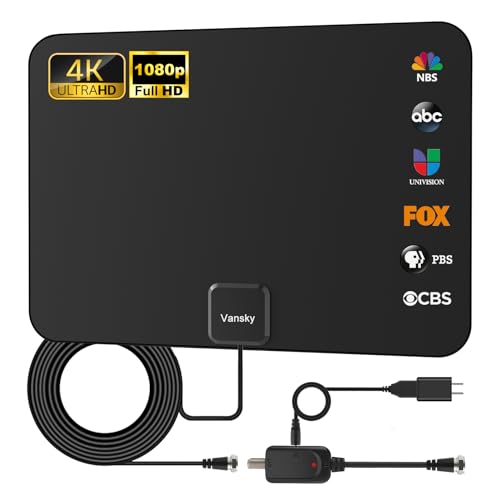
4. Amplified TV Antenna Indoor VHF UHF
Check price on Amazon: Philips Hover Amplified HD TV Antenna

The Amplified TV Antenna Indoor VHF UHF is a flat-panel amplified antenna built for free local channels in high definition. Its signal booster lifts weak VHF and UHF broadcasts, and its slim design mounts on a wall or window like other flat antennas. It is the value pick among the amplified models: a straightforward booster, a clean design, and support for the channels most viewers actually watch.
This antenna suits the buyer who wants amplification without paying for a brand name or an adjustable booster. The booster is fixed-gain, which means it always applies the same lift, and that is fine for homes where the signal is uniformly weak. In homes where some channels are strong and others weak, a fixed-gain booster can occasionally overload the strong ones, but for most suburban and urban homes the fixed boost is the right amount. The antenna supports the full range of local broadcasts, from network affiliates to independent stations.
Strengths
- Signal booster lifts weak VHF and UHF broadcasts.
- Flat design mounts easily on a wall or window.
- Good value for an amplified antenna.
Trade-offs
- Fixed-gain booster cannot be adjusted for mixed signals.
- Generic brand with less support than Channel Master or Philips.
- Needs a good placement to reach its potential.
Who it fits: the value buyer who wants amplified reception without a premium price. Best for: uniformly weak signals and budget-conscious buyers. Not suited for: homes with mixed strong and weak channels.
Try the antenna with the booster connected first, then without it, and compare the channel count. In some homes the booster helps dramatically, while in others the unamplified signal is already strong enough and the booster adds noise. Keep the configuration that delivers more stable channels, and rescan after any change. The best test is a full evening of viewing: channels that hold steady through weather changes are the ones that matter.
Fixed-gain amplification is simpler than it sounds, and for many homes it is exactly right. The booster applies the same lift to every channel, which works well when all signals arrive weak, as they do in homes far from towers or behind large buildings. The risk comes only in homes where some channels arrive strong: the same boost that helps weak channels can overload strong ones. The practical test is simple: run a channel scan with the booster connected, then run another with it disconnected, and keep the setup that delivers more stable channels. That two-minute test answers the question better than any specification sheet, and it is worth doing for every amplified antenna.
5. Long-Range Amplified Indoor Antenna with Signal Booster
Check price on Amazon: Amplified TV Antenna Indoor VHF UHF

The Long-Range Amplified Indoor Antenna with Signal Booster is built for homes far from broadcast towers. It combines a 360-degree reception pattern with a signal booster, so it picks up broadcasts from multiple directions without being aimed precisely at one tower. That omnidirectional design suits homes where towers sit in different directions, and the booster lifts the weak signals that distance creates.
Omnidirectional antennas trade peak gain for coverage: they receive from all directions at moderate strength, rather than from one direction at high strength. That trade is right for suburban homes surrounded by towers in several directions, and wrong for rural homes where all towers sit in one distant direction. In the right setting, this antenna pulls in channels that a directional antenna would miss, and the booster ensures those weak signals stay watchable. The 2026 design includes a modern flat panel that mounts on a wall or window.
Strengths
- 360-degree reception picks up towers in multiple directions.
- Signal booster lifts weak, distant broadcasts.
- No precise aiming needed during installation.
Trade-offs
- Omnidirectional design has less peak gain than a directional antenna.
- Marketing range claims should be treated with caution.
- Still needs a good window position for the best results.
Who it fits: the suburban home with broadcast towers in several directions and weak overall signal. Best for: multi-direction reception and distant towers. Not suited for: rural homes where all towers sit in one far direction.
Judge this antenna by the channel scan, not by the range claims on the listing. No indoor antenna can guarantee a specific mileage, since buildings, terrain, and weather all affect reception. Run a scan, count the stable channels, and compare with the antenna it replaces. If the channel count rises and the picture holds steady, the antenna is doing its job, whatever the marketing promises.
Omnidirectional reception is a trade that suits some homes perfectly and others not at all. A directional antenna focuses its sensitivity in one direction, which gives it more gain for distant towers in that direction but leaves it blind elsewhere. An omnidirectional antenna receives from all directions at moderate gain, which suits suburban homes where towers surround the house. The right choice depends on the tower map: if all local transmitters sit in one direction, a directional antenna wins, while if they surround the home, the omnidirectional design wins. Check the map before choosing, since the wrong pattern can leave channels missing that the right one would catch easily.
6. 2026 Indoor TV Antenna with Magnetic Base
Check price on Amazon: Long-Range Amplified Indoor Antenna with Signal Booster

The 2026 Indoor TV Antenna with Magnetic Base is the most flexible antenna on this list. Its magnetic base sticks to any metal surface — a filing cabinet, a metal shelf, a refrigerator — which opens up placement options that wall-mounted antennas cannot reach. It includes a high-gain amplifier for long-range reception and supports local channels on smart TVs in high definition.
Magnetic mounting is genuinely useful in rooms where the best signal spot is not a wall or window. A metal shelf near a window, a steel door frame, or a metal cabinet can all become an antenna mount, and the magnetic base holds firm while allowing quick repositioning. That flexibility makes it easy to test several positions in minutes and settle on the best one. The high-gain amplifier lifts weak signals, and the modern design suits living rooms, bedrooms, and home offices alike.
Strengths
- Magnetic base sticks to metal surfaces for flexible placement.
- High-gain amplifier for long-range reception.
- Easy to reposition during setup and tuning.
Trade-offs
- Needs a metal surface for the magnetic mount to work.
- Marketing range claims should be treated with caution.
- High-gain amplification can overload very strong nearby signals.
Who it fits: the owner who wants to test many placements quickly and mount the antenna on metal surfaces. Best for: flexible placement and rental homes. Not suited for: rooms with no metal surfaces near a good signal spot.
Use the magnetic base to audition positions: stick the antenna in a spot, run a channel scan, and move it if the results disappoint. A metal surface near a window is often the best combination, since the window gives a clear path and the metal gives a stable mount. Once the best spot is found, leave the antenna there and enjoy the channels. The ease of repositioning is the real feature here, and it makes setup faster than any wall-mounted antenna.
Magnetic mounting opens placement options that other antennas cannot use, and the best of them are often overlooked. A metal bookshelf near a window, a steel filing cabinet, or even a refrigerator can hold the antenna at a useful height with a clear path to the towers. That flexibility is especially valuable in bedrooms and home offices, where the television sits far from the best window and a flat antenna cannot reach it. The magnetic base also makes the antenna easy to lend or move between rooms: it lifts off one surface and sticks to another without any hardware. For renters and for homes with unusual layouts, that adaptability is the feature that matters most.
Indoor vs Outdoor Antennas: Which One Do You Need
An indoor antenna suits most homes within range of broadcast towers, and it has clear advantages: no roof work, no weather exposure, easy repositioning, and a low price. An outdoor antenna receives stronger signals and reaches farther, but it requires mounting, grounding, and weatherproofing, and it costs more to install. The choice depends on distance: homes within a moderate range of towers usually do well with an amplified indoor antenna, while homes far from towers or behind hills may need an outdoor model to receive anything reliably.
The honest test is the indoor channel scan. If an amplified indoor antenna delivers the channels that matter, there is no reason to install an outdoor one. If the scan finds few channels or the picture breaks up in bad weather, an outdoor antenna is the next step. Many households start indoors and upgrade only if needed, which is the sensible order: the indoor antenna is cheap, easy, and often enough, while the outdoor antenna is a bigger project that should be undertaken only when the indoor option has been fairly tested in the best position.
Check price on Amazon: 2026 Indoor TV Antenna with Magnetic Base
Buying Guide: Choosing an Indoor Amplified TV Antenna
Start by finding the broadcast towers. Free online tools show the distance and direction of local transmitters from any address, and that information decides everything else. If towers are close and in one direction, a simple flat antenna may be enough. If they are far or in several directions, an amplified omnidirectional model is the better choice. Never buy an antenna without checking tower distance first: it is the single most useful step in the whole process.
Amplifier type is the next decision. Fixed-gain amplifiers are simple and suit uniformly weak signals. Adjustable boosters, such as the Channel Master FLATenna, suit homes with mixed strong and weak channels, since the gain can be tuned to avoid overloading strong stations. Detachable amplifiers offer flexibility, since they can be removed if the signal turns out to be strong enough without one. In general, buy the amplifier that matches the signal: too much gain on a strong signal causes the same problems as too little gain on a weak one.
Cable length and placement matter as much as the antenna itself. A longer cable allows the antenna to reach the best window, while a short cable forces a compromise position. Flat antennas need a wall or window, hover antennas need a suitable television top, and magnetic antennas need a metal surface. Check the room before ordering, and measure the distance from the best window to the television. Finally, treat range claims with skepticism: no indoor antenna can guarantee a specific distance, since buildings, terrain, and weather all affect reception. The channel scan after installation is the only honest test.
How to Use and Care for Your Indoor Antenna
Install the antenna high and near a window facing the broadcast towers, then run a channel scan on the television. Move the antenna a few feet at a time and rescan after each move until the channel count stops improving. Once the best position is found, secure the antenna so it does not shift, and note the position in case it is ever disturbed. Rescan periodically, since broadcasters occasionally move channels and a rescan picks up new stations.
Keep the amplifier powered and the connections clean. A loose coaxial connection causes more reception problems than a weak antenna, so check that all connectors are snug. Keep the cable away from power cords and electronics that cause interference, and avoid sharp bends that damage the cable over time. If reception degrades suddenly, check the connections and rescan before assuming the antenna has failed: most reception problems are placement or connection issues, not antenna failures.
Signal interference is another factor worth checking when reception disappoints. LED light bulbs, phone chargers, and nearby electronics can all radiate interference that affects television reception, especially on VHF channels. If a channel breaks up at a particular time of day, try switching off nearby lights and chargers to see whether the picture improves. Moving the antenna a few feet away from electronics often helps, and keeping the coaxial cable away from power cables reduces interference further. A clean signal path, free of nearby noise sources, is as important as the antenna itself.
Keep the antenna secure once the best position is found, and note the position and settings so the setup can be restored quickly if the antenna is ever moved during cleaning or redecorating.
Common Mistakes to Avoid
The most common mistake is placing the antenna behind the television or inside a metal cabinet, where the signal is blocked before it arrives. An antenna needs a clear path to the towers, and hiding it defeats the purpose. Another frequent error is trusting range claims on the listing instead of checking actual tower distance. An antenna that promises an extreme range will still fail if a hill sits between the home and the tower.
Many owners also forget to rescan after moving the antenna. The television only finds channels during a scan, so a better position delivers nothing until a new scan is run. Finally, do not assume more amplification is always better. An amplifier on a strong signal causes overload, pixelation, and lost channels. If reception worsens after adding amplification, try removing the amplifier or turning the gain down before buying a different antenna.
Final Recommendation
For most homes, the Channel Master FLATenna with Booster is the best choice: its adjustable amplifier handles mixed signals better than any fixed-gain model, and the trusted brand backs it up. Renters and minimalists should choose the Philips Hover for its clean no-mount installation, while value buyers should choose the Amplified TV Antenna Indoor VHF UHF for solid performance at a low price. Homes far from towers should consider the Long-Range Amplified model or the Magnetic Base antenna for flexible placement, and first-time buyers should start with the Digital Amplified Indoor HDTV Antenna for simple, reliable performance. Check the tower map, place the antenna high near a window, rescan, and enjoy free television for years to come.
Finally, remember that an antenna is a one-time purchase that pays for itself quickly. A single month of cable television often costs more than a good amplified indoor antenna, and the antenna keeps delivering free local channels for years afterward. Choose the design that fits the room, place it high near a window, tune it with patience, and the reward is live local television without a monthly bill.
Whichever antenna is chosen, the setup routine is the same: check the tower map, mount the antenna high near a window, connect the amplifier, run a full channel scan, and adjust the position until the channels hold steady. A careful setup turns a modest antenna into a reliable source of free television.
Frequently Asked Questions
Do amplified indoor antennas really work?
Yes, when the signal exists to amplify. An amplifier boosts weak broadcasts so the television can lock onto them, which turns marginal channels into stable ones. It cannot create a signal where none reaches the home, and it works best near a window facing the broadcast towers. Homes within range of transmitters usually gain several channels with an amplified antenna compared with a passive one.
What is the difference between VHF and UHF channels?
VHF and UHF are two broadcast frequency bands. Most modern digital channels use UHF, while some local stations still broadcast on VHF. A good indoor antenna supports both, since a VHF-only or UHF-only antenna would miss stations on the other band. All six antennas in this guide support VHF and UHF reception.
Where should I place an indoor antenna?
High and near a window facing the broadcast towers. A window gives the clearest path to the signal, and height helps clear nearby obstacles. Avoid placing the antenna behind the television, inside a metal cabinet, or low on a wall behind furniture. Move the antenna a few feet at a time and rescan after each move to find the best spot.
Can an amplifier make reception worse?
Yes. An amplifier on an already strong signal can overload the television tuner, causing pixelation and lost channels. If reception worsens after adding amplification, remove the amplifier or reduce the gain. Amplifiers help weak signals and hurt strong ones, so the right amount of gain depends on the actual signal strength at the home.
How many free channels can I expect?
It depends on location. Homes near a city often receive dozens of channels, including major networks, local news, and specialty stations, while rural homes may receive fewer. A channel scan after installation gives the honest answer for a specific address. Free online tower maps show which stations broadcast nearby and how far away they are, which predicts the likely result before buying.
Do I still need an antenna if I have streaming services?
Yes, for local channels. Streaming services rarely carry local news, local sports, and network affiliates without an additional subscription, while an antenna delivers those channels free in high definition. Many households use both: streaming for on-demand shows and movies, and an antenna for live local television. The combination covers nearly everything without a cable bill.
How long does an indoor antenna last?
Many years, with almost no maintenance. An indoor antenna has no moving parts and faces no weather, so its lifespan is limited mainly by the amplifier electronics and the cable. Keep the connections clean, avoid sharp bends in the cable, and replace the amplifier power supply if reception degrades after years of use. A well-placed indoor antenna can serve a household for a decade or more.
Related reading on Kajuandouglas: Best 4K Indoor TV Antennas, Best TV Antennas for Rural Areas, and Best Antennas for Local Channels.