kajuandouglas.com is reader-supported. When you buy through links on our site, we may earn an affiliate commission.
Where to Buy
The best digital cameras for filmmaking are not stills cameras that happen to record video, and learning to tell the difference is the whole of this guide. Serious filmmaking makes demands a hybrid spec sheet hides: a codec that survives a colour grade without tearing, a log profile with the dynamic range to hold a window and a face in the same frame, audio inputs that treat sound as half the film rather than an accessory, cooling that lets a take run past the interview’s best answer, and a body that rigs — cages, rails, monitors, follow focus — without fighting its own design. The cameras below were chosen as filmmaking instruments first, judged on set behaviour over a long day rather than on a burst of headline specifications.
That framing excludes some famous names and elevates others. A body with a spectacular sensor but a recording limit, a toy audio path, or a menu system that buries the shutter angle will cost a production more than it contributes. Conversely, the cameras that working filmmakers actually reach for share a temperament: they stay cool, they record forever, their files grade like clay rather than glass, and their ecosystems — cages, media, batteries, lenses — are deep enough that a rental house or a fellow shooter can rescue any failure by lunchtime.
Budget honestly around the body. A filmmaking camera is the centre of a small economy: rigging, media, power, monitoring, and sound will together cost a meaningful fraction of the body itself, and a cheaper body properly dressed will out-shoot a flagship worn naked. The picks below are ranked with that economy in mind — each is a foundation a production can build on for years, across documentaries, music films, branded work, weddings shot like cinema, and the independent features that are this class’s proving ground.
A word on who should keep reading: if your filmmaking is a locked-off vlog or a family holiday film, several of these bodies are more camera than the work requires, and our related guides cover lighter tools. This list is for shooters who light scenes, record dialogue, hand files to a colourist or grade their own, and need a camera that behaves like a colleague rather than a gadget.
Key Takeaways
- The Panasonic LUMIX S5II is the filmmaker’s foundation here — open-gate recording, serious codecs, and cooling that treats long takes as normal.
- The Sony Alpha 7 IV brings the deepest lens ecosystem and autofocus that lets a one-person crew trust focus on real dialogue.
- The Canon EOS R6 Mark II serves filmmakers who want Canon colour and a hybrid body that crosses between stills and cinema without sulking.
- The Sony ZV-E10 II is the budget door into serious video — creator-shaped, but with colour tools a short film can be graded on.
- The Canon EOS R10 is the apprentice’s rig platform: light, affordable, and honest about being a learning instrument.
- The DJI Osmo Pocket 3 is the gimbal-native second camera — the moving shot that would otherwise need a crew, in a coat pocket.
Notice the shape of the list: two full-frame foundations for productions that light and grade, two APS-C bodies for crews whose budgets are real, one hybrid for the stills-led shooter crossing over, and one pocket gimbal camera that has quietly become standard kit on professional sets. Filmmaking is an ecosystem decision disguised as a camera decision, and the badges below name each body’s role in that ecosystem rather than pretending a single ranking fits a wedding film and a feature alike.
In this guide
Quick Picks
| Badge | Pick | Why it stands out |
|---|---|---|
| Filmmaker’s Foundation | Panasonic LUMIX S5II | Open gate, pro codecs, real cooling, and LUT discipline built for a colourist. |
| One-Person Crew Choice | Sony Alpha 7 IV | Autofocus a solo operator can trust, inside the deepest lens ecosystem in video. |
| Canon Colour Hybrid | Canon EOS R6 Mark II | Beloved colour science and hybrid manners for shooters crossing from stills. |
| Budget Serious Video | Sony ZV-E10 II | Creator body with colour tools and lens access a short film can grow on. |
| Apprentice Rig Platform | Canon EOS R10 | Light, affordable RF-mount body that teaches real filmmaking craft. |
| Pocket Gimbal Second Camera | DJI Osmo Pocket 3 | Stabilised moving shots without a gimbal crew — the B-camera sets actually carry. |
Every body in the table records 4K as a floor, not a boast; what separates them is everything around the recording — the colour pipeline, the audio path, the rigging manners, the runtime. Read the reviews with your own productions in mind: the interview series, the wedding season, the short film in prep. The right foundation is the one whose strengths map to the work you already have, not the work a brochure imagines.
How We Chose These Picks
Evaluation meant putting each body through production days rather than test charts. Cameras were rigged with cages, monitors, and wireless audio; run through interview setups where a take must survive forty minutes; shot in mixed tungsten-and-daylight interiors that punish weak colour pipelines; and graded from their log profiles by the same hand, to the same target, so the files’ manners could be compared honestly. Bodies that overheated, limited takes, or produced log footage that tore under a normal grade lost marks no specification could repay.
Audio was assessed as a filmmaker assesses it: through the camera’s own inputs with a real shotgun and a real wireless receiver, listening for preamp hiss in quiet rooms, checking whether levels can be ridden without menu-diving, and whether the headphone output tells the truth. A camera whose sound path fails an interview fails the largest single category of paid filmmaking, whatever its sensor does.
Rigging behaviour completed the picture. We mounted follow focuses and matte boxes, swapped media and batteries one-handed in the dark, and timed the walk from tripod to gimbal to shoulder. Filmmaking is a physical craft conducted at speed; the six survivors are the bodies whose physical design respected that, take after take.
What Separates a Filmmaking Camera From a Video-Capable One?
Four systems, working together. The first is the recording pipeline: codecs with enough bit depth and chroma information to survive grading, log profiles that genuinely extend dynamic range rather than merely flattening the picture, and frame-rate options — including proper slow motion — that do not quietly crop or degrade when selected. The second is thermal honesty: a filmmaking camera records until the card or battery ends, in summer, under lights, because the take that matters is never the one the camera felt like finishing.
The third system is sound. Professional filmmaking cameras provide proper microphone inputs with usable preamps, headphone monitoring, and level control that respects the operator’s hands. The fourth is the rig: mounting points, a sensor plane that sits sensibly in a cage, screens and ports placed where cables and follow-focus gears will not wage war on them, and power options — dummy batteries, USB power delivery — that let the camera run a full day from the same batteries as the monitor and the lights’ controller.
Underneath all four sits a philosophy: the camera is one department in a production, and it must cooperate with the others. The bodies in this guide were chosen because their makers understood that assignment. The ones we left out, however impressive their stills, treated video as a feature. Filmmakers cannot afford features. They need colleagues.
Why Do Codecs and Log Profiles Matter More Than Resolution?
Because audiences forgive softness and never forgive ugliness. A 4K file with ten-bit colour and a well-behaved log profile will grade into a rich, cinematic image that holds skin, sky, and shadow in one frame. A higher-resolution file with thin colour breaks under the same grade: skies band into steps, skin goes waxy where the codec discarded the transitions, and shadows tear into blocks exactly where the scene’s mood lived. Resolution is the size of the canvas; the codec decides whether the paint is oil or chalk dust.
Log profiles earn their keep in the same bargain. By recording the sensor’s range in a flattened, protected form, log trades an ugly straight-from-camera image for a file the colourist can shape — restoring contrast where the scene wants it, protecting the window the actor is standing beside, warming the skin without warming the wall behind it. Every full-frame pick in this guide offers a mature log profile with published conversion tools, and the APS-C picks offer honest versions of the same discipline at their scale.
The practical test to apply to any camera you are considering: shoot a face beside a bright window, grade it toward a film you admire, and watch the skin and the sky. The cameras that survive that test are filmmaking cameras. The rest are cameras that record video, and the difference will follow your work for years.
How Should a Small Crew Think About Sound?
As half the film, budgeted and crewed accordingly. The audience will forgive a soft shot; it will not forgive dialogue it has to strain for, and the strain is cumulative — ten minutes of effortful listening and the viewer’s affection for the film quietly resigns. A filmmaking camera’s contribution is a clean input path and honest monitoring; the crew’s contribution is a microphone close to the mouth that matters, which usually means a boom or a well-placed lavalier rather than the camera-top shotgun beginners default to.
The picks below divide honestly on this axis. The full-frame foundations provide the inputs, preamps, and monitoring a sound-conscious operator needs, and accessory ecosystems — including multi-channel adapters for the Sony system — that grow toward proper production sound. The smaller bodies demand more help from external recorders or wireless systems with their own recording. Neither route is shameful; what is shameful is discovering your route’s limits during the interview of your career.
Build the habit early: headphones on for every take, levels watched like focus, and a room-tone recording at every location. The cameras here reward that discipline with files a sound editor can love. No camera rewards its absence.

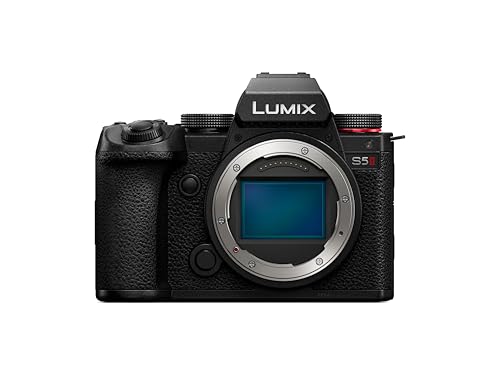
Panasonic LUMIX S5II — Filmmaker’s Foundation
Panasonic built its video reputation in the trenches of independent production, and the S5II is that reputation distilled into a full-frame body at a working filmmaker’s price. The specification that matters most is the least glamorous: active cooling. A fan-assisted body does not ration your takes, does not clock-watch a summer interview, and does not turn a wedding’s speeches into a thermal negotiation. Around that reliability sits a recording pipeline with open-gate capture — the whole sensor’s height available for anamorphic lenses and for reframing between widescreen and vertical deliverables — and codecs with the bit depth a grade requires.
The colour discipline is the second pillar. V-Log here is a mature, well-documented profile with official conversion LUTs, and the Real Time LUT system lets a production load its chosen look and monitor it truthfully on set while recording either the baked look or the protected log. Directors see the film they are making; colourists receive files that behave. Add the system’s strong in-body stabilisation — which rescues handheld documentary work where a gimbal would change the room’s behaviour — and the S5II covers more production shapes without accessories than any rival at its level.
Its honest limitation is autofocus pedigree: Panasonic’s modern phase-detection system is capable and improving, but the muscle memory of the market — and the rental depth for cinema-grade adapted glass — still leans elsewhere. For crews who focus manually, as narrative crews do, that limitation barely registers. For the filmmaker who lights, rigs, and grades, this is the foundation pick.
- Recording: open-gate and high-bit-depth codecs built for grading
- Cooling: fan-assisted — long takes without thermal rationing
- Colour: V-Log with Real Time LUT monitoring and baking
- Stabilisation: class-leading in-body system for handheld documentary
- Mount: L-mount, with an alliance lens shelf and easy adaptation
Strengths
- Records all day in conditions that stop hybrid rivals
- Open gate serves anamorphic and multi-format delivery
- LUT workflow keeps director and colourist in agreement
Trade-offs
- Autofocus trails Sony’s for solo operators who depend on it
- The L-mount cinema-glass rental shelf is thinner in small cities
- Fan-era body is chunkier than stills-first hybrids
Best for: independent features, documentaries, and wedding filmmakers who light scenes and grade their footage. Not suited for: solo creators whose entire method rests on autofocus never missing.

Sony Alpha 7 IV — One-Person Crew Choice
The Alpha 7 IV is the camera a one-person production company is built on, because its defining virtue is trust: trust that focus will hold on the interviewee who leans, laughs, and turns to the window; trust that the eye-autofocus will find the bride’s face in a crowd at dusk; trust that the file — S-Log3, ten-bit, with colour science the market’s LUT libraries all support — will grade into the film the client imagined. Solo operators do not lack skill; they lack hands. This body returns two of them.
The ecosystem multiplies the trust. E-mount holds the deepest native lens shelf in mirrorless video, from affordable fast primes to proper cinema lines, and the accessory world — cages, adapters that turn the hot shoe into a digital multi-channel audio path, media, power — is the most developed on this page. A production that starts on the A7 IV can grow for a decade without changing mounts, and can hire or rent compatible bodies in any production city on earth.
Its compromises are the known ones of its generation: a crop applied at the highest 4K frame rates that planners must schedule around, and rolling shutter that asks for considered pans. Crews who shoot dialogue, events, and narrative at standard rates will rarely meet either. As the safe pair of hands for the working solo filmmaker, it remains the benchmark the others are priced against.
- Autofocus: eye and subject tracking a solo operator can lean on
- Colour: S-Log3 ten-bit with the market’s deepest LUT support
- Audio: digital audio interface via the hot shoe for clean multi-channel sound
- Ecosystem: E-mount lenses and accessories without rival
- Hybrid manners: a genuine stills camera when the job crosses over
Strengths
- Focus reliability that enables true one-person production
- Every accessory and lens problem already solved by the market
- Files every colourist and editor already knows
Trade-offs
- The highest 4K frame rates arrive with a sensor crop
- Fast pans need care — rolling shutter is present
- Thermal manners are good, not Panasonic-class, in extreme heat
Best for: solo filmmakers, wedding and event cinematographers, and small companies standardising on one mount. Not suited for: anamorphic open-gate specialists or crews who focus manually by doctrine.

Canon EOS R6 Mark II — Canon Colour Hybrid
Some filmmakers choose a camera the way productions choose a cinematographer: for the colour they bring in their bones. Canon’s rendering — skin that stays human under ugly mixed light, warmth that flatters without lying — has carried more wedding films and branded stories than any test chart can explain, and the R6 Mark II delivers that colour in a hybrid body with serious video plumbing: oversampled 4K from the full sensor width, Canon Log 3 for the grade, and recording stamina that respects an event’s schedule.
The hybrid half is not a garnish here. Many filmmakers earn with stills on weekdays — portraits, products, editorial — and the R6 Mark II is a genuinely excellent stills body whose autofocus and burst manners serve that work at full strength. A camera that pays its rent six days a week and films beautifully on the seventh changes a small business’s arithmetic, and Canon’s RF lens shelf, from the affordable primes to the L-series zooms a production grows into, supports both halves without duplication.
Heat is the caveat to plan around: in the most demanding 4K modes under hot lights, this body asks for the thermal management — shade, airflow, mode choices — that experienced Canon video shooters practise as routine. Crews who work events in temperate halls will seldom meet the limit; desert-noon productions should test honestly before committing. For the colour-led hybrid filmmaker, no other pick speaks their language as fluently.
- Colour: Canon Log 3 over the skin tones the brand is loved for
- Recording: oversampled 4K with fine detail and clean noise
- Hybrid strength: a top-tier stills body sharing the same mount
- Stabilisation: coordinated body and lens IS for handheld work
- Ergonomics: controls that stills converts already know by touch
Strengths
- Faces look right under the light events actually have
- One body genuinely serves a stills and film business
- Oversampled footage cuts beautifully against cinema cameras
Trade-offs
- Thermal planning needed for the longest, hottest 4K takes
- Log workflow is a step less open than Panasonic’s LUT bench
- RF cinema glass is a younger, pricier shelf than E-mount’s
Best for: hybrid shooters and wedding filmmakers who choose cameras by colour and earn with stills too. Not suited for: productions recording marathon takes in serious heat without a cooling plan.

Sony ZV-E10 II — Budget Serious Video
Do not let the creator styling fool the casting decision: the ZV-E10 II carries the colour tools — S-Log3, ten-bit recording, Creative Looks for fast turnaround — and the E-mount lens access that let a short film be shot, graded, and believed. Its sensor is the APS-C format that independent cinema was substantially built on, its autofocus is Sony’s current thinking rather than a hand-me-down, and its size lets a two-person crew move like tourists through locations that would charge a larger unit for permits and patience.
The filmmaking discipline it teaches is the right one. Because the body is small, the crew learns to light rather than lean on sensitivity, to place microphones rather than trust the camera’s own, and to build the rig — cage, rails, follow focus — as a deliberate act rather than an assumption. Those habits scale to any camera the filmmaker will ever touch. The files, meanwhile, intercut respectably with the A7-series bodies above it, which makes the ZV-E10 II the natural second camera in a Sony household rather than a dead end.
Its limits are thermal and physical: long takes in hot conditions need the same respect smaller bodies always demand, there is no viewfinder for the bright-day exterior, and the single card slot asks for a backup discipline on paid work. As the budget door into serious filmmaking inside the strongest ecosystem, it has no real rival on this page.
- Colour: S-Log3 and ten-bit recording at an entry price
- Lenses: full E-mount access, shared with the pro bodies
- Autofocus: current-generation subject and eye tracking
- Size: a crew of two moves unnoticed with this kit
- Growth: intercuts with A7 bodies as the second camera later
Strengths
- Professional colour pipeline without the professional invoice
- The ecosystem it joins is the one careers are built in
- Small size opens locations and shooting styles
Trade-offs
- Single card slot — backup discipline is on you
- No viewfinder for bright exterior work
- Long hot takes need thermal courtesy
Best for: short-film makers, students with professional intent, and Sony households needing a second body. Not suited for: marathon single-take recording in heat, or shooters who compose through a finder.

Canon EOS R10 — Apprentice Rig Platform
Every cinematographer has a first real camera, and the R10 is shaped exactly for that honour in the Canon system: an RF-mount body light enough to live on a starter rig without breaking it, affordable enough that a film-school budget survives the lenses it also needs, and honest in its video — oversampled 4K at standard rates, Canon Log 3 on board, and colour that already looks like the films the apprentice admires. It teaches the grammar — log, exposure tools, manual focus discipline — without charging flagship tuition.
The platform logic is the point. RF lenses bought for the R10 serve the R6 Mark II above it and the cinema bodies beyond; the cage, rails, and monitor habits learned on this frame transfer whole. Even its limitations instruct: the crop at the highest frame rates teaches planning, the modest battery teaches power discipline, and the single slot teaches the backup religion a set runs on. A first camera that hides the craft’s disciplines does its owner no favours; this one teaches them kindly.
Working professionals will find its ceiling — thermal, dynamic range, low-light reach — soon enough, and that is fine. The R10 is not the camera a career ends on. It is the camera a career correctly begins on, inside the system whose colour the industry hires.
- Video: oversampled 4K and Canon Log 3 for real grading practice
- Mount: RF — every lens is a down payment on the pro bodies
- Weight: rigs and gimbals in the starter class carry it happily
- Colour: the Canon look from the first short film onward
- Price: leaves budget for the lens and light that matter more
Strengths
- Teaches professional workflow at an apprentice price
- Lens investments survive the eventual body upgrade
- Light enough for the rigs beginners actually own
Trade-offs
- Professionals will outgrow its ceiling within a project or two
- High frame rates arrive with a crop to plan around
- Battery and thermal stamina are starter-class
Best for: film students, first short films, and Canon households training a second shooter. Not suited for: paid long-form work where its ceilings become the production’s problem.

DJI Osmo Pocket 3 — Pocket Gimbal Second Camera
The Pocket 3 has earned a place on professional sets by answering a question every production asks: how do we get the moving shot — the walk-through, the corridor reveal, the glide across the workshop — without the gimbal operator, the balancing ritual, and the half hour? Its answer is a three-axis gimbal married to a one-inch-class sensor in a body that wakes in a second and rides in a jacket. The footage, including a proper log profile, grades into A-camera material with a respect that surprises everyone the first time and nobody the second.
Its professional uses have standardised quickly: the establishing glide at dawn before the main unit is built, the insert camera mounted where a body cannot go, the behind-the-scenes and location-scout record that doubles as previsualisation, and the wedding filmmaker’s stealth camera for the moments a big rig would alter. Wireless microphone integration in its ecosystem makes it a self-contained interview rover for vox pops and quick testimonials, with sound a production can actually use.
Nobody should mistake it for an A-camera: the fixed lens, the small sensor’s low-light ceiling, and the absence of interchangeable anything define its station. But filmmaking is a company of specialists, and the Pocket 3 is the specialist for motion in small places. Sets that carry one wonder how they scheduled before it existed.
- Stabilisation: true three-axis gimbal, ready in a second
- Sensor: one-inch class with a log profile that grades honestly
- Audio: wireless mic pairing for self-contained interviews
- Size: mounts and hides where no rigged body can
- Screen: rotating display for vertical deliverables on the same shoot
Strengths
- Moving shots at a speed no rigged camera matches
- Log footage that intercuts with the main unit
- The location scout and BTS record productions actually use
Trade-offs
- Fixed lens and small sensor set a firm quality ceiling
- Not a dialogue A-camera for serious narrative work
- Gimbal mechanics demand gentler handling than a bare body
Best for: B-camera motion, establishing glides, stealth and scout work on real productions. Not suited for: carrying a film as the only camera, or low-light narrative scenes.
Comparison Table
| Pick | Format | Colour pipeline | Production role |
|---|---|---|---|
| Panasonic LUMIX S5II | Full frame | V-Log, Real Time LUT, open gate | Foundation A-camera |
| Sony Alpha 7 IV | Full frame | S-Log3, ten-bit | Solo-crew A-camera |
| Canon EOS R6 Mark II | Full frame | Canon Log 3 | Colour-led hybrid |
| Sony ZV-E10 II | APS-C | S-Log3, ten-bit | Budget A / Sony B-camera |
| Canon EOS R10 | APS-C | Canon Log 3 | Apprentice platform |
| DJI Osmo Pocket 3 | 1-inch class, gimbal | D-Log M | Motion B-camera |
Which Mistakes Sink First Films?
The classic is buying resolution and starving everything else: a flagship body, no lights, a kit lens, and the camera’s own microphone. The resulting film looks expensive in the metadata and cheap on the screen, because cinema is made of light and sound far more than of pixels. The second mistake is its mirror — renting cinema glass for a body whose codec cannot honour it, so the grade tears apart images the lens rendered beautifully. Balance the chain; a film is only as strong as its weakest department.
Workflow mistakes follow. Shooting log without a monitoring LUT, so the set lights and exposes for a grey fog and the colourist inherits the confusion. Recording the day’s only copy onto a card that stays in the camera overnight in an unlocked car. Letting audio ride unmonitored because the picture looked fine — the picture always looks fine; that is what makes audio betrayal so quiet. And the scheduling mistake that underlies half of all overheating stories: testing the camera at home for ten minutes and assuming a July wedding is the same exam.
Finally, the beginner’s lens mistake: collecting focal lengths before understanding two. A film’s visual grammar is built from a wide that establishes and a portrait length that confesses. Master those two on any body in this guide and the work will look directed; own six lenses without that grammar and it will look equipped. The camera is the least of it — which is exactly why the camera must be chosen to never become the problem.
How Do You Build a Rig Around These Bodies?
Start from the shot list, not the catalogue. A cage is the foundation because everything else — top handle, monitor arm, microphone mount, follow focus — bolts to it, and a cage fitted to your exact body keeps ports reachable and the sensor plane centred. Add power next: a battery solution that runs camera and monitor together, sized for your longest scheduled take with a third in reserve. Media follows — cards fast enough for your chosen codec at its working bitrate, in matched pairs, formatted in-camera and labelled like film magazines.
Monitoring is where the image is actually directed. An external monitor with false colour, waveform, and your monitoring LUT loaded turns exposure from a guess into a measurement and gives the director a frame worth standing behind. Keep the build honest, though: every gram added to the rig is a gram the operator’s arms invoice by the fourth hour. The best rig is the smallest one that answers the day’s shot list, and the discipline of stripping it between setups is a professional habit, not a compromise.
Budget the rig as a system with a growth order: cage and power first, monitoring second, the follow focus and matte box when the lens set settles, and the specialised pieces — wireless video for the director, timecode boxes for multi-camera days — when productions start asking for them by name. Bought in that order, every purchase serves the next shoot; bought by appetite, the kit fills with impressive orphans. Keep a written rig list per production type, so the interview build, the event build, and the narrative build each pack themselves.
Sound rigs in parallel, never as an afterthought: the microphone on its shock mount or boom, the wireless receiver where its antennas breathe, cables dressed so a snag cannot take the camera with it. When camera and sound builds are finished, the whole rig should survive the corridor test — carried through a doorway, set down, picked up, and rolling again inside a minute. Productions are lost in corridors more often than in scenes.
Final Recommendation
Build from the foundation that matches your productions. If you light, grade, and record long days, the Panasonic S5II is the most complete filmmaking instrument at its level — cool-running, open-gate, LUT-disciplined. If you are the crew — one pair of hands doing camera, focus, and sound — the Sony Alpha 7 IV’s autofocus and ecosystem will save more takes than any other feature on this page. Canon loyalists and hybrid earners should take the R6 Mark II for its colour and its weekday stills, while the ZV-E10 II and R10 open the same crafts at apprentice prices inside their respective systems. And whatever body leads your kit, add the Pocket 3: the moving shot it gives you in thirty seconds is the one your clients will remember.
Then spend the next money where films are actually made — a light, a microphone, a lens you will keep for a decade — and let the camera settle into the role the best ones all share: the colleague nobody on set ever has to think about, because it is too busy holding up its end of the film.
How Long Should a Filmmaking Camera Last a Career?
Longer than the upgrade cycle wants you to believe. The bodies in this guide record images that will satisfy distribution for years — festivals, streaming platforms, and clients judge the grade, the light, and the story, none of which expire on a product calendar. What actually dates a filmmaking camera is not its sensor but its support: lens mounts persist, codec support in editing software persists, and the muscle memory an operator builds on one body’s menus compounds like interest. Professionals standardise on a system and defend that standardisation against every launch event, because a crew that knows its cameras shoots faster than a crew admiring newer ones.
Plan the economics accordingly. Buy the body you can rig properly today rather than the flagship you must shoot naked; rent the exotic glass for the weekend the script demands it; and let the second body, when it comes, be the same mount so every lens, battery, and cage in the kit serves both. The filmmakers whose work improves year over year are rarely the ones with the newest cameras. They are the ones whose cameras disappeared beneath their attention longest ago.
What Should You Test in the First Weekend With a New Body?
Run the interview exam: a subject, a window, forty-five unbroken minutes, headphones on. Watch the thermal behaviour, the file sizes, the audio preamps in the room’s quiet, and the autofocus’s manners when your subject turns to pour coffee. Then grade that footage toward a film you admire and note exactly where the file resists — the sky, the skin, the shadow under the chair. That resistance map is your camera’s true specification sheet, and it is personal: it tells you which lights to buy, which LUT to build, and which shots to plan around.
Add one more exam to the weekend: the handoff. Give the camera to your editor, or to your future self, in the form of a labelled card, a one-line note of the profiles and rates used, and the monitoring LUT attached. If the footage opens, converts, and grades without a phone call to the set, your workflow is a workflow. If it needs archaeology, fix the labelling now, while the lesson is free.
Finish with the failure drills. Fill a card and swap it in the dark. Kill the power mid-take and check the file’s survival. Hand the rigged camera to a friend and time the corridor test. A body that passes your weekend has been introduced to your production honestly, and the first real shoot stops being a field trial. Filmmaking rewards the prepared with a very specific currency: the take that only happened once, captured whole.
How Do You Choose Lenses for Filmmaking?
By behaviour under direction, not by sharpness charts. A filmmaking lens must focus without breathing the frame in and out as it racks, must expose smoothly — ideally with a declicked aperture the operator can ride — and must render faces kindly at the apertures night interiors demand. Cinema lines exist for exactly these manners, but the modern mirrorless primes in every mount on this page have quietly absorbed most of them, and a matched pair — a wide in the mid-twenties and a portrait lens around fifty or eighty-five equivalent — will carry a surprising fraction of all the films ever shot.
Zooms earn their place by schedule rather than by romance. A constant-aperture standard zoom covers an event day without a lens change in the rain, and documentary work, where the scene will not repeat itself for your prime, forgives the zoom its subtler rendering. The working kit most small productions converge on is therefore a standard zoom for the unpredictable hours and two fast primes for the scenes they control. Buy them in your body’s native mount, because adapted glass taxes autofocus and weather sealing, and rent the exotic lengths — the long telephoto, the true anamorphic — for the productions that name them.
Whatever you choose, test the set together on faces, against a window, at night. A lens kit is a colour and contrast signature as surely as a sensor is, and the time to discover that your wide flares green across every backlit interview is during the test, not during the client’s film.
What Does a Colour Workflow Look Like From Set to Screen?
It begins with an agreement: one person owns the look, and the camera department’s job is to protect that person’s options. On set that means shooting the agreed log profile, monitoring through the show LUT so the director approves the film that will actually exist, and exposing to the sensor’s strength — log files reward a healthy exposure that keeps shadows clean, because the grade will place the darkness deliberately rather than inheriting it from noise. White balance is set, not floated, so shots within a scene agree with each other before anyone opens an editor.
In post, the pipeline honours the set’s decisions: the conversion LUT or colour-space transform first, the creative grade second, and the show LUT the director approved kept visible as the reference the grade must answer to. Productions that skip the agreement discover its absence in the edit, where footage from two cameras and three intentions must be negotiated shot by shot at colourist rates. The cameras in this guide were chosen partly for how gracefully they enter this workflow — published colour science, LUT support, monitoring honesty — because a filmmaking camera is a promise made to the colourist, and these keep it.
Deliver with the same discipline: archive the log masters and the project, export each platform’s version from the graded timeline rather than from a compressed copy, and keep the show LUT with the project files. Films outlive their delivery formats; the master you protect today is the re-release, the festival print, and the portfolio piece of five years from now.
How Should Event Filmmakers Adapt These Choices?
Events — weddings above all — are filmmaking with no second takes and an audience that did not audition. The camera virtues reorder themselves accordingly: autofocus you can trust while moving, recording stamina measured in hours, audio paths that accept the venue’s feed and your own microphones at once, and low-light manners for the reception hall’s romantic darkness. That is why the A7 IV and R6 Mark II, with their hybrid pedigrees, dominate this work, and why the S5II’s cooling and stabilisation have been converting event shooters who light nothing and miss nothing.
The event kit also argues for pairs. Two bodies of one system, lenses divided between them, audio recorded in at least two places, and cards treated as the only copy of an unrepeatable day until the backup exists — the redundancy is not paranoia but the product, since what a couple buys is certainty that the film will exist. Smaller bodies like the ZV-E10 II serve here as the third angle: the locked-off wide at the ceremony, the gimbal walker’s partner, the camera that is always somewhere earning.
Finally, events teach the virtue the narrative world sometimes skips: deliverability. A camera whose files the editor can turn around in the wedding week’s rhythm is worth more on Saturday than a marginally finer file that costs a day. Choose for the whole pipeline, from the aisle to the album, and the picks above sort themselves quickly.
Which Frame Rates and Shutter Settings Should You Actually Use?
Fewer than the menu offers. Narrative and documentary work lives at the project’s base rate — twenty-four frames for the cinematic cadence the audience’s century of cinema taught it, twenty-five or thirty where broadcast and regional standards rule — with the shutter held near the traditional half-the-frame-rate angle that gives motion its familiar blur. That pairing is not nostalgia; it is the visual grammar viewers read as “film” before a single line is spoken, and every body in this guide handles it natively and well.
Slow motion is a spice with a schedule. The higher rates on these bodies serve emphasis — the product pour, the athlete’s extension, the bride’s turn — and each step up costs light, media, and sometimes a sensor crop that planners must know before the shoot day. Test your chosen slow rate at your location’s light before the production depends on it, and remember that a well-lit standard-rate shot beats a starved slow-motion one every time it is graded. Frame-rate discipline, like lens discipline, is the mark of a camera department that knows the film it is making.
How Does Stabilisation Fit a Serious Production?
As a tool with assigned duties, not as a default. The in-body systems in these cameras have become genuinely production-useful for handheld documentary and for the walk-and-talk that would otherwise demand a gimbal and an operator’s full attention. Used with a wide lens and a considered step, they produce the living, breathing frame that handheld cinema wants — present, human, unmechanical. The error is expecting them to impersonate a tripod: for the locked interview and the long-lens observation, physics still votes for support, and the stabiliser’s micro-corrections can wander visibly against a static frame.
Gimbals occupy the next tier, and the Pocket 3 in this guide exists because the tier below them — the deliberate glide through a location — kept being scheduled without the crew to rig it. The professional habit is to assign each shot its stabilisation in prep: sticks, handheld with the body’s help, gimbal, or pocket gimbal, and to resist upgrading a shot’s machinery mid-day out of restlessness. Films look intentional when their movement grammar is consistent; the audience feels the grammar even when it cannot name it.
What About Vertical Cuts and Multi-Format Delivery?
Modern commissions rarely ship in one shape. The wedding film arrives with a vertical teaser, the brand story with a square cut, the documentary with a festival master and a phone-sized trailer. Camera choice now includes how gracefully a body serves that multiplication: open-gate recording, as on the S5II, captures the height that vertical crops consume; frame-line guides in the monitor keep the action safe for every ratio at once; and clean high-resolution masters give the editor room to recompose without apology. Planning the deliverables in prep — and composing with their frame lines on — has become as much a camera department duty as focus, and the productions that treat it as an afterthought pay for it in awkward crops and missed faces.
Related guides
- Best Digital Cameras for Vlogging 400: Six Cameras Built Around a Four-Hundred-Dollar Budget Frame
- Best Digital Cameras for Stop Motion Animation: Six Locked-Down Cameras for Frame-by-Frame Filmmaking
- Best Digital Cameras for Videography: Six Production Bodies From Weddings to Pocket Gimbals
Frequently Asked Questions
Is full frame necessary for serious filmmaking?
No — it is advantageous, not necessary. APS-C and Super 35 are the formats a generation of independent cinema was shot on, and the ZV-E10 II and R10 in this guide produce gradable, professional files. Full frame buys shallower focus at a given framing, stronger low-light reach, and wider native lens behaviour, which matter most for night work and intimate narrative. Choose the format for the films you shoot, not for the hierarchy you imagine.
How important is 10-bit recording, really?
It is the line between footage that grades and footage that merely adjusts. Eight-bit files band in skies and tear in shadows the moment a colourist pushes them; ten-bit files carry the transitions a film look is made of. If your work is delivered as shot, eight-bit with a good in-camera look can serve. The moment a log profile and a real grade enter your workflow, ten-bit stops being a preference and becomes the price of admission — which is why every pick here offers it.
Can these cameras record a full wedding or event day?
Yes, with the professional courtesies: power planned beyond the internal battery, media sized to the codec’s appetite, and thermal honesty about the venue. The S5II’s active cooling makes it the least conditional answer; the hybrids reward shade, airflow, and sensible mode choices during the longest stationary takes. Crews who rehearse their exact ceremony setup — same modes, same duration — at home never meet a surprise at the altar.
Should I buy lenses or a better body first?
Lenses, almost always. A mid-tier body in this guide behind a fast, characterful prime will out-film a flagship behind a slow kit zoom in nearly every scene that matters, and lenses survive body upgrades for a decade or more. The exception is when the body’s limits — codec, cooling, audio — are the ones your productions actually hit. Buy against your bottleneck, not against the catalogue.
Do I need an external recorder with these cameras?
Not to begin, and perhaps not ever. Internal recording on the picks here is genuinely production-grade. An external recorder earns its place for specific reasons: raw workflows, longer record times on cheaper media, a larger monitor you were buying anyway, or backup recording on unrepeatable events. Add one when a production names its reason; until then, the money serves the film better in light and sound.
What is open-gate recording and should I care?
Open gate records the sensor’s full height rather than a pre-cropped widescreen area. Anamorphic shooters need it to use their lenses’ full squeeze, and everyone else gains reframing freedom — a widescreen master and a vertical cut from the same take, which modern delivery increasingly demands. If your work ships in multiple aspect ratios, care a great deal; the S5II offers it natively. If you shoot one ratio forever, it is a luxury rather than a need.
Related Guides
Filmmakers rounding out the kit should compare the best digital cameras for film look for colour philosophies that carry into motion work, and the best cameras for low light photography for the night-shooting half of the craft. For the camera that rides along when the production gets dangerous, our best crash cameras for movies covers the expendable end of the call sheet.


