kajuandouglas.com is reader-supported. When you buy through links on our site, we may earn an affiliate commission.
Where to Buy
The best digital cameras for vlogging 400 — and let us be open about that number from the first line, because honesty about money is this guide’s whole method — are the cameras a creator can realistically assemble around a budget in the region of four hundred dollars. That figure in the search phrase is a budget frame, not a price tag: it describes what a starting or upgrading vlogger has set aside for the camera at the centre of the kit, and this guide treats it exactly that way. No specific product price is quoted anywhere below, because prices wander; instead, each pick is labelled by its relationship to the frame — comfortably inside it, at its edge, or a deliberate stretch — so you can plan with the number as a compass rather than a promise.
That framing matters because vlogging at this level is an exercise in allocation. The camera is the heart of the kit, but it is not the kit: a microphone that respects your voice, a small light for evening rooms, a tripod or grip that keeps the frame steady — these compete for the same budget, and a creator who spends everything on the body films beautiful footage that sounds like it was recorded inside a wardrobe. The picks below were therefore judged as centres of a realistic four-hundred-ish total plan, with honest notes on which ones leave room for the supporting cast and which ones consume the frame and must justify doing so.
What does a vlogging camera owe its owner at any budget? A flip screen, so the presenter can see themselves; autofocus that finds a face and stays there while the presenter moves, gestures, and holds products to the lens; video that looks clean in a bedroom’s ordinary light; audio input for the microphone the budget must also buy; and a size that encourages daily carrying, because a vlog is a diary and diaries are written daily or not at all. The six picks meet those duties at different points around the frame — two inside it, two at its edge, two as considered stretches for creators whose channels have begun to pay them back.
Key Takeaways
- The Sony ZV-1F is the frame’s natural centre — a vlogging-native camera with a wide lens and nothing to learn.
- The AKASO Brave 7 LE is the budget’s adventure wing, an action camera that vlogs from bikes, boats, and beaches.
- The GoPro HERO12 Black sits at the frame’s edge as the durable, stabilised choice for outdoor channels.
- The Nikon Z30 is the edge-of-frame interchangeable-lens step, bought for the system it starts rather than the body alone.
- The Canon EOS R50 is the stretch worth saving for — a creator’s mirrorless that outgrows the beginner stage entirely.
- The Canon PowerShot G7 X Mark III is the compact stretch, a beloved vlogging classic for faces and evenings.
One warning belongs at the top: the second-hand market is this budget’s shadow kingdom, full of previous-generation bargains and occasional heartbreak. Several picks below are realistic used purchases as well as new ones, and the buying-advice sections explain how to shop used without buying someone else’s problem. The frame is small; the strategy around it does not have to be.
In this guide
Quick Picks
| Badge | Pick | Why it stands out |
|---|---|---|
| The Frame’s Centre | Sony ZV-1F | Vlogging-native design, wide lens, and face-first focus at the budget’s heart. |
| Adventure on a Budget | AKASO Brave 7 LE | An action camera kit that leaves most of the frame unspent for audio and light. |
| Edge-of-Frame Workhorse | GoPro HERO12 Black | Stabilised, waterproof outdoor vlogging with a creator’s ecosystem. |
| System Starter at the Edge | Nikon Z30 | A mirrorless foundation whose lenses and skills compound for years. |
| The Worthwhile Stretch | Canon EOS R50 | A full creator’s camera that a growing channel will not outgrow. |
| Compact Classic Stretch | Canon PowerShot G7 X Mark III | The face-flattering compact a generation of vloggers built channels on. |
Read the table as a budget map rather than a podium. The first two picks leave money for the microphone and light that this guide will keep recommending; the middle two spend the frame on durability or on a system; the last two ask the creator to stretch — with eyes open, for defined reasons, and only when the channel’s trajectory justifies it.
How We Chose These Picks
Every candidate was required to survive a week of actual vlogging rather than a day of testing: a daily walking piece to camera, two sit-down videos in a bedroom’s mixed light, a product held to the lens, an outdoor segment in wind, and an evening segment after dark. We filmed the way a starting creator films — alone, quickly, between the other obligations of a life — and judged the footage the way an audience does, which is mostly by whether the face is in focus, the voice is clear, and the frame feels alive rather than administered.
Budget realism governed the shortlist from the start. Candidates were sorted by their honest relationship to the frame — new, at typical street positioning, or realistically used — and anything that could only join this guide by pretending the frame was twice its size was excluded, however lovely. That is why no full-frame body appears below: at this budget, pretending otherwise would be a disservice dressed as aspiration. The stretches that remain are stretches of a size a saving creator can actually close.
Audio pathways were weighted as heavily as sensors, because at this level the microphone decision decides the channel’s perceived quality. Each pick’s route to good sound — a proper input, a capable accessory system, or honest built-in audio for quiet rooms — is named in its review, along with the situations where that route runs out. A camera that traps its owner with unusable sound is not a bargain at any point in the frame.
Finally, we considered the second year. A vlogging camera is bought by a beginner and inherited by the creator that beginner becomes; picks that teach real skills, join real systems, or hold a resale value that funds the next step were favoured over sealed dead ends. The frame is a starting line, and this guide treats it as one.
Why Does the Microphone Outrank the Sensor at This Budget?
Because audiences experience quality in a specific order, and it is not the order camera marketing teaches. A viewer forgives a slightly soft image instantly — they may not even register it — but a voice recorded across a room, echoing off bare walls through a camera’s distant built-in microphone, reads as amateur within two sentences and costs subscribers the creator never knows they lost. At the frame this guide serves, the single most valuable production purchase after the camera itself is the microphone that puts the voice close, and the picks were chosen partly for how gracefully they accept one.
This arithmetic should shape the whole plan. A creator who centres the budget on the ZV-1F or the Brave 7 LE and reserves a real share for audio and a small light will publish videos that look and sound a class above a creator who stretched every cent into a body and films it in a dim room with its own microphone. The stretch picks earn their place only when the channel’s income or the creator’s savings can fund the supporting cast afterward; otherwise the centre of the frame is the wiser home.
There is a psychological dividend, too. A modest camera with great sound publishes today; an aspirational camera bought at the frame’s breaking point often waits — for the microphone, for the light, for confidence — while the channel that would have justified it goes unmade. Vlogging rewards the prolific, and the prolific are made by kits that are complete, not by kits that are impressive.
What Does a Realistic Kit Around This Frame Look Like?
Picture the finished desk rather than the camera box. At its centre, one of the six bodies below. Beside it, the microphone — a wireless lavalier for the walking talker, a compact shotgun for the sit-down presenter, a simple wired lavalier for the strictest budget. A small LED panel or a ring light for the evening sessions, because bedrooms are dimmer than creators admit. A mini tripod or grip that doubles as a handle for walking shots. A spare battery and a second card, because a vlog filmed daily eats both. That is the whole cathedral; everything else is decoration.
The allocation logic matters more than any item. Sound first among the accessories, because it cannot be fixed in editing. Light second, because it flatters every camera ever made and rescues the small-sensor picks in evening rooms. Support third, because a steady frame is the cheapest production value in the craft. Only after those three does a second lens, a fancier body, or a backdrop earn a hearing — and by then the channel usually has the audience, and sometimes the income, to judge the upgrade honestly.
Creators shopping used should apply the same logic with a detective’s habits: buy bodies with verifiable histories, test the sensor for spots with a plain wall shot, confirm the battery holds a charge through a long record, and treat a missing charger or a suspiciously worn mount as the story it probably is. The frame rewards patience; the used market punishes haste.

Sony ZV-1F — The Frame’s Centre
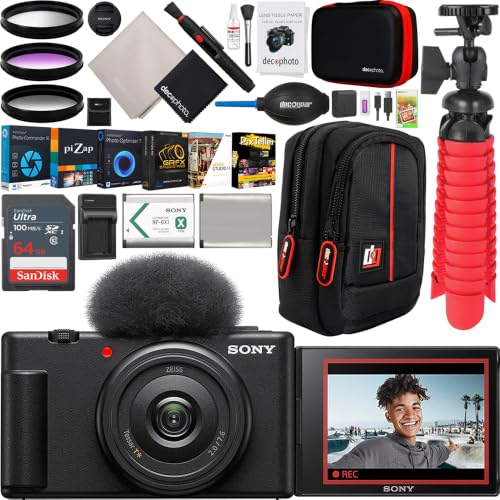
The ZV-1F is the rare camera designed from a blank page for exactly the person reading this guide. Its wide fixed lens frames a presenter and their room without the backward walk into furniture that narrower lenses demand; its face and eye focus simply handles the presenting problem; its screen flips to face the speaker; and its whole interface assumes a crew of one. At the centre of the frame, it leaves the budget’s edges free for the microphone and light that complete the kit — which is why it, and not a grander body, tops this list.
Its deeper virtue is the removal of excuses. There is no lens to choose, no mount to research, no setting whose wrongness ruins a take unnoticed; the camera wakes, frames wide, finds the face, and records a bright, steady, shareable vlog. For the creator whose bottleneck is publishing rather than pixel quality — and at the start, it always is — that frictionlessness compounds into a back catalogue while the perfectionist is still comparing bodies. Channels are built out of published videos, and this camera publishes.
The boundaries are the fixed lens and the stills, which are snapshots rather than a photography practice. A creator who outgrows it will know precisely why — they will want lens choice, or low-light depth, or both — and the ZV-1F will hand them a trained audience and a clear upgrade brief. As the frame’s centre and the beginner’s truest friend, it has no serious rival here.
- Lens: wide and fixed, framing presenter and room together
- Focus: face and eye priority that simply handles presenting
- Screen: full flip for self-framing and product pieces
- Audio: a proper input for the budget’s microphone
- Role: the complete-kit centre that leaves room for sound and light
Strengths
- Zero-friction publishing — the beginner’s real bottleneck, solved
- Designed for a crew of one, in every control
- Leaves budget alive for microphone and lighting
Trade-offs
- Fixed lens ends the growth path at this body
- Stills are snapshots, not a photography practice
- Low light leans on the lamp the budget must buy
Best for: new and daily vloggers, presenters, room-based channels. Not suited for: creators needing lens choice or serious stills.

AKASO Brave 7 LE — Adventure on a Budget
The Brave 7 LE rewrites what the frame can buy by changing the camera’s species. As an action camera it sidesteps the mirrorless price structure entirely, arriving as a kit — waterproof housing, mounts, the works — at a point comfortably inside the budget, with most of the frame still unspent for the microphone, light, and support that the other picks force into competition. For the outdoor channel — the cycling diary, the fishing vlog, the skate and surf and trail life — that arithmetic is not a compromise; it is the only plan that covers the whole production.
Its vlogging manners are better than its price suggests. A front screen lets the presenter frame themselves on the trail; stabilisation smooths the walking pieces; the waterproofing means the rainy-day episode films anyway, which for an outdoor channel is the difference between a schedule and a hope. The footage, judged honestly, is a class below the GoPro’s polish — and entirely sufficient for the platforms where these channels live, especially when the saved budget has bought clear audio to carry it.
Cast it as the frame’s opportunist: the camera that lets an outdoor creator be fully equipped, today, at the cost of flagship envy. Channels that grow can graduate to the HERO12 below with their mounts, habits, and audience intact. Channels that stay will never have overspent finding out.
- Kit: housing and mounts included — a production in a box
- Screen: front display for self-framing outdoors
- Build: waterproof life for weather-proof schedules
- Budget: leaves most of the frame for audio and light
- Footage: honest action quality for platform delivery
Strengths
- The only pick that funds the whole kit inside the frame
- Outdoor channels can publish in any weather
- A complete starter with no accessory ambush
Trade-offs
- Footage polish trails the GoPro clearly
- Indoor and low-light work is its weakest ground
- Audio routes are workable rather than elegant
Best for: outdoor and action channels starting on the full frame budget. Not suited for: indoor presenters or low-light room channels.

GoPro HERO12 Black — Edge-of-Frame Workhorse
The HERO12 Black sits at the frame’s edge as its outdoor flagship: the stabilisation benchmark, the waterproof standard, the camera whose footage defined the action aesthetic every platform now recognises. For the vlogger whose channel is a moving outdoor life — riding, running, boating, building, travelling hard — it delivers the smooth, durable, wide-eyed coverage that is that genre’s native language, with a creator ecosystem of mounts and media tools that no rival at the frame can match.
Its position at the edge is a deliberate purchase of certainty. What the extra commitment buys over the AKASO is polish under pressure: steadier footage at speed, more graceful light handling at the day’s edges, and an editing pipeline — from its companion software to the vertical formats platforms demand — that treats a working creator’s time as valuable. Channels earning from their outdoor content recoup that certainty quickly; channels starting out should weigh the Brave 7 LE’s whole-kit arithmetic with equal respect.
The GoPro’s vlogging limits are the action camera’s eternal ones — a fixed ultra-wide view that flatters landscapes and bends close faces, audio that wants its wind protection and ideally its media accessories, and an indoor personality that never quite relaxes. It is a specialist that happens to vlog superbly in its element, and this guide places it with that clarity.
- Stabilisation: the benchmark for moving outdoor footage
- Build: waterproof, crash-tolerant, mount-everywhere design
- Pipeline: creator software and vertical delivery built in
- Light: graceful handling at dawn and dusk edges
- Ecosystem: mounts and media accessories for every genre
Strengths
- The outdoor channel’s footage standard
- Durability that turns weather into content
- An editing flow that respects a working creator
Trade-offs
- Ultra-wide view distorts close presenting
- Indoor and evening rooms are not its home
- Consumes most of the frame by itself
Best for: outdoor, travel, and action channels with momentum. Not suited for: bedroom presenters or strict whole-kit budgets.

Nikon Z30 — System Starter at the Edge
The Z30 asks a different question of the frame: not “what camera does this buy?” but “what future does this start?” As Nikon’s creator-shaped mirrorless — flip screen, presenting-friendly focus, long-record manners for a body of its class — it vlogs credibly today, and as the front door of the Z-mount system it promises that every lens, skill, and accessory the creator adds will compound. Bought at the frame’s edge, typically as a body or a modest kit, it is the budget’s investment instrument.
Its vlogging personality is calm competence. Skin tones in ordinary room light come out pleasing in that particular Nikon way, and the handling suits a presenter who also wants to learn photography properly, because the same body teaches both crafts without condescension. For the creator whose channel involves demonstrating, reviewing, or travelling — work where a real lens’s depth and a real system’s growth matter — the Z30 converts the frame from an expense into a foundation.
The honesty paragraph: at this frame, the Z30 consumes the budget’s centre and asks the microphone and light to wait or to be bought humbly, and its lens dreams cost real money later. Creators who need the complete kit today should centre the ZV-1F instead. Creators playing a two-year game, who will fund the system as the channel grows, will find no wiser edge-of-frame purchase in this guide.
- Screen: flip design with presenter-first focus manners
- System: the Z-mount ladder, climbed one lens at a time
- Colour: Nikon’s skin rendering in ordinary room light
- Records: long-form manners for podcasts and demonstrations
- Growth: a stills education riding in the same body
Strengths
- Buys a future, not merely a camera
- Credible vlogging from the first day
- Skills and lenses compound across years
Trade-offs
- Consumes the frame; accessories must queue
- Lens ambitions carry real future costs
- No stabilisation magic for walking shots
Best for: creators playing a multi-year system game on a starting frame. Not suited for: whole-kit-today budgets or action channels.

Canon EOS R50 — The Worthwhile Stretch
The R50 is this guide’s designated stretch — the camera just beyond the frame that a saving creator, or a channel with its first income, should aim at without guilt. The reason is simple: it ends the upgrade cycle for years. Its autofocus is a professional inheritance, its flip screen and creator manners are complete, its files satisfy clients as well as audiences, and its RF system gives the growing channel a lens ladder with no ceiling in sight. Bought once, it converts the camera question from a recurring anxiety into a settled foundation.
Consider the stretch as arithmetic rather than indulgence. A creator who buys at the frame’s centre, outgrows the body in eighteen months, and buys again has spent the stretch’s money anyway — plus the friction, the resale losses, and the months of working around limitations. The R50’s owner spends it once, earlier, and spends the eighteen months making better videos instead. That is the entire case, and for creators whose publishing rhythm is already real, it is a strong one.
The discipline the stretch demands is sequencing: the R50 first only if a basic microphone is already owned or immediately follows, because the audio law in this guide admits no exceptions, not even for excellent autofocus. Stretch for the body with the supporting cast planned, and this becomes the wisest purchase in the guide. Stretch for the body instead of the supporting cast, and it becomes the most elegant mistake.
- Focus: professional-grade subject and eye detection
- Screen: full articulation for every presenting geometry
- System: Canon RF lenses with no ceiling for growth
- Files: client-capable quality beyond the channel’s needs
- Value: one purchase that ends the upgrade cycle
Strengths
- The last beginner camera a creator needs to buy
- Autofocus trust for unrepeatable presenting moments
- A system that grows as far as the channel can
Trade-offs
- Lives beyond the frame — saving or income required
- Accessories must be sequenced honestly after it
- More camera than a casual diary will ever use
Best for: committed creators, growing channels, client-work ambitions. Not suited for: strict frames or first-week experimenters.

Canon PowerShot G7 X Mark III — Compact Classic Stretch
A generation of vloggers built their channels on this camera’s bloodline, and the G7 X Mark III remains the compact that face-to-camera creators dream about at this end of the market: a bright lens that keeps evening rooms flattering, colour that treats skin like a friend, a screen that flips for the presenter, and a pocketable body that goes to the café, the trip, and the event without a bag decision. As a stretch — or, very often at this frame, as a well-bought used example — it is the aesthete’s route into vlogging.
Its particular magic is social. The G7 X disappears at a dinner table, films friends without turning them into performers, and produces the warm, intimate footage that lifestyle channels are made of. The creator whose content is people, places, and evenings — rather than desks, products, or trails — will find its limitations theoretical and its rendering a signature. Many channels sound like their microphones; the G7 X’s channels look like their lives, only kinder.
The caveats are age and authority: its autofocus, while willing, is not the R50’s inheritance; its manual video control is a compact’s rather than a system’s; and used examples must be bought with the detective habits this guide described. For the face-first creator who values rendering over rigour, it remains — even as a stretch — the romantic choice, and romance has built more channels than specifications have.
- Lens: bright aperture for flattering evening rooms
- Colour: warm skin rendering, a lifestyle signature
- Screen: flip-up design for presenters and self-portraits
- Size: pocketable — the camera that attends everything
- Used market: a realistic frame purchase with careful shopping
Strengths
- The face-and-evening aesthetic at this end of the market
- Socially invisible — friends stay themselves on camera
- A proven channel-builder with a decade of evidence
Trade-offs
- Autofocus authority trails the mirrorless picks
- Compact-class manual control and stamina
- Used examples demand careful inspection
Best for: lifestyle, beauty-adjacent, travel and people-first channels. Not suited for: action content or creators wanting a lens system.
Comparison Table
| Pick | Position vs the frame | Channel home | Growth path |
|---|---|---|---|
| Sony ZV-1F | At its centre | Presenters, daily diaries | Replace when outgrown |
| AKASO Brave 7 LE | Comfortably inside | Outdoor starter channels | Graduate to GoPro class |
| GoPro HERO12 Black | At its edge | Outdoor and action | Ecosystem deepens |
| Nikon Z30 | At its edge | Presenters, reviewers | Z-mount system ladder |
| Canon EOS R50 | A deliberate stretch | Every genre, client-ready | RF system, years of headroom |
| Canon PowerShot G7 X Mark III | Stretch or well-bought used | Lifestyle and people | Replace when outgrown |
Which Mistakes Do Budget Vloggers Make Most Often?
The first is spending the whole frame on the camera and filming with its built-in microphone in an echoing room — the error this guide has flagged from its opening pages, because it is the one that most reliably caps a channel’s growth. The second is buying reach or resolution the channel never uses: the daily room vlogger does not need a telephoto, and the platform’s compression will humble everyone’s footage equally, while the flip screen and the face focus go used in every single take.
The third mistake is postponing publication until the kit feels complete. It never feels complete; there is always a lens, a light, a backdrop between the creator and the imaginary standard. The channels that succeed at this budget publish with the kit they have and upgrade from evidence — the audience’s actual complaints — rather than from catalogue longing. The fourth is neglecting the unglamorous consumables: the dead battery at the day’s best moment, the single card holding a month of episodes, the tripod with the broken leg that makes every frame a negotiation.
The fifth is copying a famous creator’s kit list without copying their genre. A desk reviewer’s dream camera is an outdoor channel’s burden; a traveller’s action camera is a presenter’s compromise. This guide is organised by channel home rather than by specification precisely because the correct budget camera is the one matched to the videos you actually make — a sentence worth rereading before any purchase in the frame.
How Should a Beginner’s First Ten Videos Be Planned?
As a curriculum rather than a launch. The first video teaches the kit: set up, record, edit, publish, and let it be imperfect in private ways only you will notice. Videos two through five explore the channel’s formats — the sit-down talk, the walking piece, the demonstration, the day-in-the-life — discovering which ones the camera, the room, and the creator’s own energy sustain happily. Videos six through ten repeat the winning formats with the lessons applied: the microphone closer, the light placed deliberately, the framing composed rather than found.
Judge the ten by production learning, not by audience. The metrics that matter at this stage are private: setup time falling, takes per video falling, the creator’s on-camera ease rising, the edit’s hours shortening. An audience built on a sustainable process compounds; an audience chased with unsustainable effort evaporates when the effort does. The cameras in this guide were chosen to make the process sustainable at the frame — quick to deploy, kind to a crew of one, honest in ordinary rooms.
Keep a simple production notebook from video one: what the light was, where the microphone sat, which settings served, what to change. By video ten that notebook is the channel’s first real asset, worth more than any single upgrade the frame could buy, because it converts experience into a system — and systems, as every guide in this series concludes, are what separate hobbies from practices.
Final Recommendation
For most readers, centre the frame on the Sony ZV-1F, fund the microphone and the small light from what remains, and publish this week. Outdoor beginners should run the same logic through the AKASO Brave 7 LE and enjoy being fully equipped immediately; outdoor channels with momentum should take the HERO12 at the edge. The Z30 is the patient investor’s edge purchase, and the two stretches divide by temperament — the R50 for the creator building toward clients and systems, the G7 X Mark III for the creator whose channel is faces, evenings, and a life filmed kindly.
Whichever route you take, hold the guide’s one law above every specification: sound first, light second, camera third in the spending order after the body is chosen — and publishing above all, because the frame’s purpose is not to own a camera. It is to start a channel. Start it.
What Changes When a Channel Starts Earning?
Income reorders the budget’s logic without repealing its laws. The first earnings belong to the bottlenecks the audience can hear and see: usually the microphone upgrade or the second light, then storage and backup, because a earning channel’s archive is now an asset with a value. The camera upgrade — very often the R50 stretch, deferred from the first purchase — arrives when the current body’s limits appear in the comments or cost a client, not when a newer model launches.
Earning also buys time, the scarcest production resource: an editor for the weekly video, a rented lens for the special, a second body so the channel survives a repair. Creators who reinvest in time outgrow creators who reinvest in glass, because the audience subscribes to the publishing rhythm and the presenter’s ease, both of which are bought with hours rather than with equipment.
The frame’s discipline remains the foundation under all of it. The channels that last are the ones whose costs never outran their evidence — each upgrade answering a demonstrated need, each purchase leaving the kit complete rather than impressive. That is as true at ten thousand subscribers as it was at ten, and it is why this guide treats a modest number with such respect: the habits formed around a small frame scale; the habits formed around indulgence do too.
How Do You Film Yourself Without a Crew, a Studio, or Silence?
The solo vlogger’s real location is a lived-in home: neighbours through the wall, a fridge that hums, light that changes as the afternoon moves. The craft at this budget is the art of the workable — facing the window rather than filming against it, so the free light flatters instead of silhouetting; choosing the room’s softest corner, where cushions and curtains tame the echo that makes voices sound distant; recording the day’s main piece when the building is at its quietest, and letting the walking segments carry the hours when it is not. Every pick in this guide was tested in exactly such a flat, because that is where its owner will actually live.
Self-framing is a learnable ritual. Mark the presenter’s spot with tape, set the focus there or trust the face detection these cameras were chosen for, record twenty seconds, and watch it before filming the piece — the cheapest reshoot in the craft is the one that happens before the performance. The flip screens on the ZV-1F, Z30, R50, and G7 X exist for this ritual; the action cameras’ front displays serve the same master outdoors. A creator who builds the check into every setup stops losing videos to chopped foreheads and wandering focus within a fortnight.
Backgrounds deserve the same thirty seconds of honesty. The audience reads the room behind a presenter as part of the channel’s character — the shelf, the plant, the poster’s corner — and a deliberate background, tidied once and kept, becomes a set by consistency rather than by cost. The frame buys many things, but a recognisable corner is free, and channels are recognised by corners as much as by faces.
What Does Editing Ask of a Budget Camera?
Forgiveness, mostly. The beginner’s footage arrives in the edit with imperfect exposure, wandering white balance, and framing that wishes it were closer — and the cameras here were chosen partly for files that tolerate the rescue: enough quality to crop a little, colours that do not shatter when lifted, and formats the free and inexpensive editors every beginner uses can actually open. A camera whose files demand professional software and a colourist’s patience is a hidden subscription the frame never agreed to.
Consistency is the edit’s second request, and it is free to give: one camera, one profile, one white-balance habit, so that episode twelve cuts together with episode one and the channel develops a look by accumulation. The creators who change bodies and settings monthly restart their visual identity with every upload; the ones who standardise — on any pick in this guide — become recognisable, and recognisability is the currency channels are paid in.
Finally, the edit asks for restraint at the record button. Ten disciplined minutes edit in an hour; forty hopeful minutes edit in a day, and the day is the beginner’s scarcest resource. Script the beats, film the plan, stop when the plan is captured. The camera’s stamina is rarely the limit at this budget; the editor’s evening always is.
How Should a Vlogger Handle Rooms That Sound Like Bathrooms?
Echo is the budget channel’s most common invisible ceiling, and it is a furnishing problem before it is a microphone problem. Bare walls, hard floors, and a desk in an empty room return every syllable to the microphone a second time, smeared. The cures cost almost nothing and predate cameras by centuries: film near soft things — the bed, the sofa, the wardrobe with its doors open — hang the duvet behind the camera on recording day, put the rug under the desk, and close the curtains. A room that sounds upholstered makes even a modest microphone sound close and warm.
Microphone distance finishes what furnishing starts. The law of the craft is proximity: a lavalier at the chest or a shotgun just out of frame captures the voice louder than the room; a camera-top microphone across the space captures the room with a voice in it. This is why the audio input on the ZV-1F, Z30, and R50 matters so much at this frame, and why the action cameras — whose microphones ride at arm’s length on a windy trail — pair with wind protection and, for serious dialogue, a separate recorder worn by the speaker.
Test the room before the series, not during it. Record one minute in each candidate corner, listen on headphones, and let your ears choose the set. That single experiment, costing nothing, has improved more starting channels than any purchase this guide could recommend — a fact worth sitting with before the frame is spent on anything else.
Why Do Some Beginners Quit With Good Cameras on Their Desks?
Because the camera was never the bottleneck, and buying it postponed discovering the real ones: the idea that must be renewed weekly, the thirty minutes of setup friction that makes filming feel like an event, the edit that eats the evening the next video needed. The kits in this guide are deliberately weighted against those true bottlenecks — quick to deploy, kind in ordinary rooms, honest about what they leave for the creator to supply — but no purchase can supply the publishing rhythm itself.
The survivors share recognisable habits. They keep the kit assembled and charged, a camera on its little tripod with the microphone mounted, so that filming is a decision rather than a project. They batch the friction — one setup, two videos — and they let formats repeat until the audience, not boredom, asks for variety. And they review their own footage the way this guide reviewed cameras: by what the audience experiences, in the order the audience experiences it.
If you are reading this guide before buying, you are already doing the rarest thing: preparing. Spend the frame as a kit, assemble it the day it arrives, and publish the imperfect first video within the week. The creators who quit owned cameras; the creators who lasted owned a practice. The difference was never in the box.
What Should a Travel Vlogger Pack When the Frame Must Fly?
Carry-on vlogging is a discipline of subtraction, and it favours this guide’s smaller citizens. The ZV-1F or G7 X with a mini tripod, a wireless microphone, and a power bank covers a city’s worth of content in a pouch; the action pair — Brave 7 LE or HERO12 — adds the weatherproof and mounted angles for the price of a fist’s worth of space. The mirrorless pair travels too, but asks the bag’s real estate and the traveller’s attention in proportion to their ambition.
The travel kit’s hidden half is data. Cards enough for the trip’s longest stretch without a laptop, a phone-based backup ritual each evening, and the finished cards stored apart from the camera — the same liturgy this series preaches to travellers generally, doubled in importance when the footage is the trip’s income. A channel’s archive in a single stolen bag is the one travel story no creator wants to tell.
Pack for the videos, not for the possibilities. The travel vlogger who carries one trusted body and knows its every habit returns with a series; the one who carries three bodies and a lighting case returns with a documentary about their luggage. At this frame, the constraint is not poverty — it is the editorial clarity that makes travel channels watchable.
How Do You Choose Between Filming Wide and Filming Close?
Every vlogging genre has a natural distance, and the frame’s cameras divide by how gracefully they serve it. The wide habit — presenter and world together, the room or the landscape sharing the story — belongs to the ZV-1F’s and the action cameras’ lenses, and it flatters travel, lifestyle, and day-in-the-life formats where the setting is half the content. The close habit — the face large, the background soft and quiet, the product held between — belongs to the mirrorless pair and the G7 X, and it flatters commentary, beauty-adjacent work, reviews, and any channel built on a personality’s presence.
Beginners often choose by imitation, filming a commentary channel wide because their favourite traveller does, and wonder why the intimacy never arrives. The test is the content’s own question: does the audience come for the place or for the person? Place-channels go wide and mobile; person-channels go close and still, with the camera on its tripod and the light arranged like a portrait sitting. Most mature channels eventually do both — which is one honest reason the R50 stretch exists, since a lens system is, in the end, a choice of distances.
Whichever distance is yours, commit for a season. A channel that alternates randomly between fisheye corridors and soft close-ups looks undecided; a channel with a settled visual grammar looks authored. The audience learns how to watch you, and that learning is a form of loyalty no upgrade can purchase.
What Does a Channel’s Second Camera Usually Turn Out to Be?
Ask creators a year in, and a pattern emerges that this guide’s table quietly predicts: the second camera is almost never a bigger version of the first — it is the opposite pole. The presenter who centred the ZV-1F adds an action camera for the world outside the room; the outdoor creator who centred the HERO12 adds a compact or the Z30 for faces and evenings; the R50 owner adds the little Sony or an action body as the sacrificial second angle. Vlogging kits grow by complement, not by duplication, because the second camera’s job is to cover the first one’s blind side.
This is worth knowing at the first purchase, because it changes what “outgrowing” means. The ZV-1F is not discarded when the R50 arrives; it becomes the B-camera, the travel-light body, the loaner that recruits a friend into the craft. The Brave 7 LE is not embarrassed by the HERO12’s arrival; it becomes the mount-it-anywhere risk-taker. A frame spent on cameras with second lives is never wasted, which is one more reason this guide favours honest specialists over compromised generalists at the budget’s heart.
Plan the pair loosely from the start — centre and wing, room and world, face and adventure — and the channel’s equipment story writes itself across years instead of restarting with every purchase. The frame, spent with that map in mind, is not a limitation at all. It is the first chapter of a kit that grows the way channels do: by addition, in the direction of the work.
Frequently Asked Questions
Is four hundred really enough to start vlogging seriously?
Yes — provided the frame is spent as a kit rather than as a camera. A centred pick like the ZV-1F or the whole-kit arithmetic of the Brave 7 LE, plus a real microphone and a small light, produces videos whose quality audiences experience as professional, because sound and light are what audiences actually judge. What the frame cannot buy is a flagship body with a complete kit around it; creators who need that combination should save toward the R50 stretch with the accessories sequenced honestly.
Should I buy new or used at this budget?
Both routes are respectable, with different risks. New buys warranty, battery health, and the current model’s manners — the ZV-1F’s natural route. Used buys a class above — the G7 X Mark III and previous-generation mirrorless live there — at the cost of detective work: verify the sensor, the mount, the battery’s stamina, and the seller’s story. Never buy used in a hurry, and never spend the microphone money rescuing a suspicious bargain.
Do I need a flip screen for vlogging?
For a presenter who films alone, effectively yes. Self-framing without one is guesswork that wastes takes and confidence, which is why every pick in this guide offers a flip or front screen solution — the action cameras with their front displays, the compacts and mirrorless bodies with their articulating panels. A creator who always works with a camera operator may waive the requirement; the solo vlogger should treat it as law.
How important is 4K for a starting channel?
Less important than focus, sound, and light — and the platforms’ compression will narrow everyone’s footage toward a common denominator regardless. Shoot the best quality your workflow handles comfortably, because a resolution that doubles your editing time costs you publishing frequency, and frequency is a starting channel’s growth engine. The picks here all record video well beyond a beginner’s delivery needs; choose among them on focus, audio, and handling.
Can an action camera really be a main vlogging camera?
For outdoor channels, yes — the HERO12’s stabilisation and durability are a genre’s native tools, and the Brave 7 LE proves the format at the frame’s floor. For indoor presenting, the fixed ultra-wide view and the audio compromises make action cameras a second choice behind the ZV-1F or Z30. Match the species to the channel’s habitat and the question answers itself.
Does the camera matter more than the presenter’s consistency?
No, and the frame’s arithmetic quietly proves it: two channels with identical kits diverge within months according to who published weekly and who published when inspiration visited. The camera’s contribution to consistency is indirect but real — a kit that deploys in two minutes gets used on the tired days, and the tired days are where streaks, and therefore channels, are actually built. Choose the body in this guide whose setup friction your real life can survive, and let that unglamorous criterion outrank a marginally finer sensor every single time.
What should I do on the day the camera arrives?
Assemble the whole kit, charge everything, and film the first video before the day ends — however rough, however private. Set the quality defaults once, tape the presenter’s mark on the floor, test the microphone at its real distance, and record the room’s sound on headphones before trusting it. Then publish or schedule that first piece within the week, because the channel’s founding date matters more than its founding quality. Every creator in this guide’s testing who filmed on arrival day was still publishing at month three; the ones who spent week one “setting up properly” were, disproportionately, the ones whose cameras became furniture.
When should I upgrade from my first vlogging camera?
When a specific, recurring limitation is costing you videos, viewers, or clients — and you can name it in one sentence. “My footage falls apart in evening rooms” names a light or a body upgrade; “my walking shots wobble” names support or stabilisation; “clients ask for a second angle” names a B-camera. Upgrades bought against a named limitation transform a channel; upgrades bought against a feeling merely rearrange the desk.
Related Guides
Creators ready to grow beyond the frame will find the full production chapters in our best digital cameras for videography, where the R50’s bigger siblings compete. The outdoor path continues in the best digital cameras for travel point and shoot, and those filming products for their channels should read the best digital cameras for product photography before the next launch video.


