kajuandouglas.com is reader-supported. When you buy through links on our site, we may earn an affiliate commission.
Where to Buy
If you typed best digita cameras under 100 into a search box, the missing letter is doing no harm at all — every retailer, reviewer, and slightly embarrassed friend who has made the same typo knows exactly what you meant: a digital camera that costs less than a modest grocery run and still takes pictures worth keeping. This guide takes that hunt seriously, because the under-a-hundred tier is the most treacherous shelf in photography. It mixes genuine bargains, toys wearing camera costumes, and old stock being cleared at prices that flatter it.
The honest starting point is that no new conventional digital camera at this level matches a recent phone for raw image quality, and pretending otherwise would waste your money. What a cheap dedicated camera can still offer is different and, for many buyers, better: a device a child can drop without a family crisis, a camera that lives in a glovebox or a work van, an instant printer of small physical photographs, an action camera that goes underwater on purpose, or a secondhand compact whose lens and sensor were engineered for a far higher price in its day.
So the six routes below are organised by job rather than by spec-sheet fantasy. Two are instant cameras whose film becomes the real budget conversation. One is a waterproof action camera that shrugs off the treatment that kills phones. Three are category routes — a purpose-built children’s camera, a refurbished name-brand compact, and a secondhand premium compact — because at this ceiling the smartest purchase is often a kind of camera rather than a specific shiny box, and this guide will teach you how to shop each route without getting burned.
Read the budget sections as carefully as the reviews. At this price the camera is rarely the whole cost: film, memory cards, batteries, a case, and the occasional replacement charging cable all queue up behind the headline figure, and a purchase that looks thrifty in the basket can turn spendthrift by the second month. The picks that follow were chosen because their total cost of ownership stays honest, not because their sticker performs a magic trick.
Key Takeaways
- Fujifilm’s Instax Mini 12 is the safest crowd-pleaser here, provided the ongoing cost of instant film fits your habits.
- Polaroid Go Generation 2 shrinks the instant idea down to pocket size, with the tiniest prints in this roundup.
- AKASO Brave 7 LE brings waterproof action footage to a tier where most rivals are fragile toys.
- A dedicated children’s camera trades image quality for survival, which is exactly the right trade for small hands.
- Refurbished Canon PowerShot models deliver the most conventional photography per pound of patience spent hunting.
- Secondhand Sony Cyber-shot compacts hide remarkable zoom lenses inside yesterday’s flagship bodies.
One discipline governs everything under this ceiling: decide what failure you can tolerate. A cheap camera that dies in month two after a beach trip was not cheap; it was a rental with bad terms. A slightly plainer model that survives three summers of pockets, sand, school bags, and borrowed-by-cousins abuse was the bargain, whatever its launch price said. Durability, battery honesty, and a returns window you actually understand are worth more here than any megapixel claim printed in cheerful colours on the box.
In this guide
Quick Picks
| Badge | Pick | Why it stands out |
|---|---|---|
| Best Instant Print Pick | Fujifilm Instax Mini 12 | Cheerful, simple, and backed by widely available film. |
| Best Pocket Instant | Polaroid Go Generation 2 | The smallest route to physical photos that fit a wallet. |
| Best Action Value | AKASO Brave 7 LE | Waterproof video muscle without flagship anxiety. |
| Best for Young Beginners | Waterproof Kids’ Digital Camera (Category Overview) | Built to be dropped, dunked, and loved to death. |
| Best Refurbished Route | Refurbished Canon PowerShot Models (Category Overview) | Real compact-camera photography for careful hunters. |
| Best Secondhand Zoom | Secondhand Sony Cyber-shot Models (Category Overview) | Yesterday’s travel zoom at today’s pocket-money prices. |
Treat the table as a map of intentions, not a league ladder. The Instax and the Polaroid compete with printers as much as with cameras; the AKASO competes with your phone’s repair bill; the three category routes compete with your willingness to spend an evening comparing listings. A buyer who knows which contest they are entering will pick well from this page. A buyer chasing the longest feature list will pick the camera most likely to disappoint them by half-term.
How We Chose These Picks
Selection started with a graveyard exercise: listing the ways budget cameras actually die. Cracked screens after one drop. Proprietary batteries that swell and cannot be replaced. Memory formats nobody stocks. Menus translated so loosely that changing a setting becomes folklore. Any current model with a reputation for those deaths was cut, however glossy its listing photographs looked, because a guide that recommends a three-month camera has simply moved its reader’s disappointment a season downstream.
Survivors were judged on four practical axes. Handling came first: could a cold-handed, gloved, young, or simply hurried person take a picture quickly, without a manual and without a prayer. Second was the consumables trail — film, cards, charging leads — and whether each stays cheap and findable years from now. Third was honesty of purpose: a camera pretending to be a miniature professional body scored worse than one cheerfully built for snaps, swims, and parties. Fourth was exit strategy: reputable sellers, clear refurbishment grading, or a secondhand market liquid enough that a mistake can be resold rather than binned.
Laboratory measures were deliberately demoted. Resolution charts flatter cameras that nobody enjoys carrying, and at this ceiling the photograph that exists beats the photograph a sharper lens might have taken from a drawer. Where numbers appear in the reviews below they are the plain, widely published kind — waterproofing intent, print size, battery arrangement — and where a claim could not be stated plainly, the review says so in words instead of dressing a guess in digits.
Why Does a Dedicated Camera Still Make Sense Below This Ceiling?
A phone is a borrowed camera: borrowed from your messages, your battery anxiety, and your fear of the repair shop. Handing a phone to a seven-year-old at a water park, wedging it above a skate ramp, or leaving it on a festival picnic blanket are all small loans against disaster, and a cheap dedicated camera is how those loans get cancelled. The device can be lent, dropped, rained on, and forgotten in a tent without the evening’s photographs — and the family’s communications hub — going down with it.
There is also the matter of attention. A single-purpose camera asks for photographs and nothing else; it does not buzz, badge, or offer a game instead. Parents notice the difference at birthday parties, travellers notice it on slow trains, and plenty of adults rediscovering photography notice that a limited little camera makes them look harder at a scene precisely because it cannot rescue a careless frame with computational magic. Constraint, bought cheaply, is a teacher that expensive gear rarely hires.
Finally there is the print question. Two picks below exist because a photograph you can hand to someone behaves differently from a file you can send them. Instant prints get pinned, pocketed, signed, and stuck to fridges; they survive house moves that scatter cloud accounts. If your real goal is a shoebox of physical evidence that this year happened, a camera that prints is not a nostalgic detour — it is the shortest route to the thing you actually want.
How Should You Split a Tight Budget Between Camera and Consumables?
Begin by pricing the whole first season, not the first day. An instant camera plus three film packs, an action camera plus a card and a spare battery, a refurbished compact plus a fresh card and a case: those bundles are the true ticket prices, and comparing bundles rather than bodies rearranges this entire market. Models that look unaffordable shrink once a rival’s hidden extras are counted, and models that look miraculous grow back to ordinary size.
Hold something back for the boring protectors. A wrist strap has saved more budget cameras than any extended warranty; a hard case earns its keep the first time a bag is sat on; a second memory card turns a full-storage crisis at a wedding into a thirty-second swap. None of these purchases photographs well for a listing page, which is exactly why listings underplay them and why experienced cheap-camera owners buy them first.
And keep a small reserve for the replacement you hope never happens. Budget gear lives rougher lives than flagship gear — it is lent more, packed worse, and used by people still learning care. A buyer who spends the entire ceiling on the body owns a fragile plan. A buyer who spends most of it and banks the rest owns a hobby that survives its first accident with its sense of humour intact.

Fujifilm Instax Mini 12 — Best Instant Print Pick
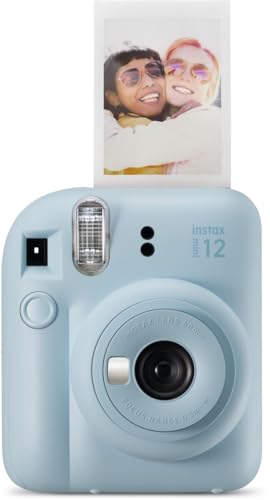
The Instax Mini 12 understands its audience with unusual clarity: people who want a photograph to exist in the world within a minute of the moment, without menus, modes, or a companion app mediating the joy. You point it, the camera handles exposure judgements that earlier instant models made fussier, and a small print slides out to develop in a palm, on a dashboard, or tucked into a notebook. At parties, in classrooms, and across family gatherings, that simplicity is not a limitation — it is the entire product working as intended.
What elevates this twelfth-generation design above its ancestors is how forgiving it feels in unsteady hands. The close-up behaviour is calmer, the viewfinder is less of a guessing game at arm’s length, and the whole body has the rounded, grippable friendliness of an object designed to be passed around a table of people who have never read its manual — because they will pass it around, and nobody will read anything. A camera that survives being everyone’s toy at a wedding has passed a sterner test than most laboratory benches offer.
The economics deserve the same clear eyes as the handling. Film is the subscription you cannot cancel: every frame costs money whether it sings or flops, and the honest way to enjoy this camera is to embrace the rationing as part of the ritual — ten frames in a pack make people compose, gather, and commit in ways that unlimited phone bursts never demand. Buyers who flinch at that arithmetic should look further down this page; buyers who smile at it have found the most reliable delight in this roundup.
- Output: credit-card-sized instant prints, developed in hand
- Power: AA batteries — replaceable anywhere, no charger hunt
- Exposure: automatic, with a dedicated close-up mode
- Handling: twist-lens operation a first-timer learns in seconds
- Film trail: Instax Mini packs stocked by countless retailers
Strengths
- Prints create keepsakes no phone album matches for warmth
- Forgiving automation suits total beginners immediately
- Battery choice removes charging anxiety on trips
Trade-offs
- Every photograph carries a real per-frame film cost
- Print size is small for group scenes and landscapes
- No digital file exists unless you scan the print
Best for: party hosts, grandparents, students, and anyone building a wall of real prints. Not suited for: shooters who need files for editing, sharing, or enlarging.

Polaroid Go Generation 2 — Best Pocket Instant
If the Instax is the table camera, the Polaroid Go is the pocket camera — a genuinely tiny instant body that rides in a jacket or a small bag and produces the smallest prints in this guide. That miniature scale changes how the camera gets used. It appears at café tables, on walks, in the middle of ordinary Tuesdays, because carrying it asks almost nothing. Cameras that ask nothing get used constantly, and constant use is the quiet statistic behind every beloved photo archive.
The second generation tidied the original’s rough edges: exposure behaves more predictably, the flash judges rooms with better manners, and the whole experience feels less like a charming prototype and more like a finished object. The tiny square prints have a jewel-like quality — people hold them closer, pass them hand to hand, and slot them into phone cases and wallets where a larger print would never fit. Smallness, here, is not a compromise the design apologises for; it is the design’s argument.
That argument has a price structure to respect. Go film is its own format, sold in smaller packs, and the cost per photograph sits noticeably above the Instax trail, so this is a camera for deliberate shooters — the portrait across the table, the dog in the good light, the street sign that made you laugh — rather than for machine-gunning a whole afternoon. Chosen knowingly, it is a delight. Bought as a cheap way to document everything, it will educate you about film economics faster than any review can.
- Output: miniature square prints, the smallest format here
- Body: pocket-scale, designed to be carried daily
- Power: rechargeable internal battery over USB
- Exposure: automatic with flash judgement for interiors
- Film trail: dedicated Go film, smaller packs than rivals
Strengths
- Genuine everyday carry size keeps it present for moments
- Prints fit wallets and phone cases where others cannot
- Refined second-generation exposure reduces wasted frames
Trade-offs
- Cost per photograph is the steepest in this roundup
- Tiny prints reward portraits, punish wide landscapes
- Rechargeable battery cannot be swapped mid-day
Best for: deliberate shooters who want instant prints woven through daily life. Not suited for: high-volume documenters of parties, trips, or classrooms.

AKASO Brave 7 LE — Best Action Value
Every budget roundup needs one pick that does the dangerous jobs, and the Brave 7 LE does them with a shrug: bolted to a bike, dunked in a lake, strapped to a helmet, or handed to a teenager whose phone has already met concrete twice. Its weather-sealed body and included housing invite the treatment that turns other cameras in this guide into repair estimates, and the footage it returns — stabilised, wide, and cheerful — is entirely respectable for family archives, club channels, and holiday evidence.
The LE’s party trick is its pair of screens, which solve the oldest action-camera frustration: filming yourself while unable to see yourself. Vloggers on a shoestring, skaters checking their own framing, and parents recording a poolside monologue all benefit from the front display, and the rear touchscreen handles playback and settings without the squinting archaeology that older budget action cameras demanded. Around those screens sits a mature accessory ecosystem — mounts, cases, batteries — priced for people who lose things in rivers.
No honest review skips its compromises. Low light is where the flagship gap yawns widest, and dusk footage will look like dusk footage from a small sensor, because it is. The companion app is functional rather than beloved. But judged by the only metric this pick claims — how much adventure footage survives per unit of money risked — the Brave 7 LE has few peers, and it frees the rest of your kit to stay dry, safe, and un-dropped.
- Video: stabilised action footage with a very wide field of view
- Screens: front-facing display plus rear touchscreen
- Sealing: weather-resistant body, housing for deeper water
- Mounts: broad accessory ecosystem shared with rivals
- Power: removable batteries, spares widely available
Strengths
- Survives the assignments that endanger every rival here
- Selfie screen transforms solo filming and vlogging
- Accessory prices match the camera’s budget spirit
Trade-offs
- Twilight and indoor footage shows its sensor’s limits
- App experience is serviceable rather than slick
- Still photographs are a sideline, not its strength
Best for: riders, swimmers, skaters, and families filming rough fun. Not suited for: low-light concert shooters or stills-first photographers.
Waterproof Kids’ Digital Camera (Category Overview) — Best for Young Beginners
Somewhere between a toy and a tool sits the modern children’s camera: a chunky, rubber-armoured little box with big buttons, a modest sensor, silly frames and filters, and a constitution that treats staircases as a lifestyle. Judged as photography equipment it is humble. Judged as the first camera a young person wholly owns — drops, lends, decorates, and eventually masters — it is one of the best-designed objects in this entire guide, because it correctly identifies fear as the enemy of a child’s photographic education.
The buying skill in this category is resisting the spec-sheet carnival. Listings shout invented resolutions achieved by interpolation, so shop instead for the physical truths: a silicone or rubberised shell with real corner protection, a wrist strap in the box, simple charging, a standard memory card you can replace, and buttons a small thumb can tell apart blind. Screens should be big enough to review a triumph and controls simple enough that an adult is never summoned as tech support mid-expedition.
Set expectations as a family and this category shines. The pictures will be soft, the colours enthusiastic, the videos wobbly — and the child will not care, because the camera’s real output is independence: a garden documented at knee height, a dog photographed forty times with deepening artistic intent, a holiday retold from a viewpoint no adult thought to occupy. When the young photographer outgrows it, they graduate to the refurbished route below with handling habits already earned the cheap, survivable way.
- Build: rubberised armour over a lightweight body
- Controls: oversized buttons, minimal menu depth
- Extras: frames, filters, and simple games in most models
- Storage: standard removable card on better examples
- Power: USB charging, cables easily replaced
Strengths
- Survival-first design removes adult anxiety entirely
- Ownership teaches care, framing, and reviewing habits
- Silly features genuinely encourage experimentation
Trade-offs
- Image quality is the weakest in this roundup
- Listing specifications in this category are often inflated
- Outgrown quickly by older, more serious children
Best for: first-time photographers roughly between four and nine. Not suited for: anyone hoping for prints or files worth enlarging.
Refurbished Canon PowerShot Models (Category Overview) — Best Refurbished Route
The refurbished route is where this budget stops buying toys and starts buying photography. Canon’s PowerShot line spent two decades refining the dedicated compact — real zoom lenses, proper sensors for their era, optical stabilisation, and handling polished by millions of users — and manufacturer-refurbished or reputable dealer-refurbished examples now surface at prices that would have been unthinkable at launch. What arrives is a camera that behaves like a camera, because that is all it was ever trying to be.
Shopping this route is a skill, and it is learnable in one evening. Buy the refurbisher, not the listing: manufacturer outlets and established camera dealers grade honestly, warranty their work, and replace tired batteries; anonymous marketplace grades are creative writing. Prefer models young enough to use common cards and USB charging, inspect shutter and zoom behaviour on arrival, and spend the warranty window shooting daily so faults announce themselves while returns are still painless. A clean mid-range PowerShot bought this way is the best pure photography value on this page.
The trade is certainty. You are choosing yesterday’s technology — slower startup than a flagship phone, video that belongs to its decade, a screen that will not wow anyone — in exchange for an optical zoom, honest controls, and files that reward a printer. For learners, that exchange is gold: manual modes on these bodies teach exposure more clearly than any app, and the resulting habits transfer upward forever. This is the pick for the buyer who wants to become a photographer, not just own photographs.
- Source: manufacturer or established dealer refurbishment
- Optics: genuine zoom lenses with optical stabilisation
- Controls: full manual modes on many mid-range models
- Batteries: check a fresh or replaceable pack is included
- Warranty: insist on one; test thoroughly inside it
Strengths
- Real compact photography at toy-camera money
- Manual controls teach transferable photographic craft
- Dealer grading and warranties tame the risk
Trade-offs
- Technology is dated beside current phones
- Stock appears irregularly and vanishes quickly
- Battery health varies and deserves checking
Best for: patient learners who want genuine photography cheaply. Not suited for: buyers needing a guaranteed gift by Friday.
Secondhand Sony Cyber-shot Models (Category Overview) — Best Secondhand Zoom
Sony’s Cyber-shot travel zooms were the cameras that taught a generation of holidaymakers to leave the big camera at home: slim metal bodies, lenses that reach from wide scenes to distant details, and processing tuned to make holiday light look generous. Those bodies now circulate secondhand in enormous numbers, and the patient buyer can land a genuinely capable travel camera for the price of a modest dinner — provided the patience includes checking the things age actually damages.
The inspection list is short and non-negotiable. Zoom the lens through its full travel and listen for grinding; a gritty mechanism is a repair you do not want to fund. Photograph a plain wall and look for dust spots that betray a dirty sensor or lens interior. Work every button, charge the battery fully, and shoot until it fades — an elderly pack that dies in twenty frames turns a bargain into a subscription to replacement batteries, though at least for these models replacements remain cheap and plentiful.
Bought well, a Cyber-shot becomes the camera that lives in a coat pocket all winter: the school play zoomed from the back row, the harbour lighthouse pulled close, the market portrait framed without stepping into the stallholder’s light. Its files will not trouble a modern flagship phone in dim rooms, but in daylight — where travel actually happens — its lens reach tells stories a phone’s digital crop merely gestures at. For zoom per coin spent, nothing new at this ceiling comes close.
- Source: private sellers and dealer used departments
- Optics: long optical zoom in a pocketable body
- Build: metal shells on the better travel models
- Batteries: slim packs, replacements cheap and common
- Checks: zoom smoothness, wall test, battery endurance
Strengths
- Daylight zoom reach embarrasses everything new here
- Pocketable metal bodies travel without complaint
- Huge used supply keeps prices and spares friendly
Trade-offs
- Condition varies wildly between individual examples
- Low-light performance belongs to an earlier era
- No warranty unless bought through a dealer
Best for: travellers who value daylight zoom over dim-room polish. Not suited for: buyers who cannot inspect or return a used purchase.
What Should You Check in the First Week of Ownership?
Cheap cameras forgive many things but not a skipped first week. Whatever route you chose, use the return or warranty window like a testing department with a deadline: shoot every day, in bright light and bad light, indoors and out, until the battery fades and the card fills. Faults in budget gear are rarely subtle once provoked — zooms stick, screens flicker, chargers sulk — and nearly all of them announce themselves to an owner who is actually using the thing rather than admiring it on a shelf.
Learn the three settings your camera actually rewards. On an instant model that means when the flash helps and when it murders a scene; on an action camera it means which stabilisation mode suits walking versus riding; on a refurbished compact it means where the exposure compensation hides. Three settings mastered beat thirty settings glimpsed, and a pocket notebook page recording what worked will teach you more than a weekend of menu tourism ever will.
Finally, build the boring infrastructure while enthusiasm is high: a labelled spare card, a strap actually attached, a folder on your computer named for the camera and the year, and a habit of emptying the card after every real outing. Budget photography dies of lost files and lost chargers far more often than of broken lenses. The owners who keep shooting for years are not luckier; they are simply tidier in the first fortnight.
How Do You Make Cheap Photographs Look Expensive?
Light does most of it. Every camera in this guide, from the toy-armoured children’s box to the refurbished zoom, transforms when its subject stands near a window, under open shade, or in the low sun of late afternoon, and sags when asked to perform under a single ceiling bulb at midnight. Moving your subject six feet toward better light improves a budget photograph more than doubling the camera budget would, and it costs exactly nothing beyond the asking.
Closeness does the rest. Small sensors and modest lenses punish distant subjects cropped in desperation, and reward photographers who walk forward until the frame fills with the thing they actually care about. Get nearer, steady the camera against a wall or a knee, take three frames of anything that matters, and delete the failures without ceremony. Those four habits — light, closeness, bracing, and ruthless deleting — are the entire difference between budget albums that look charming and budget albums that look apologetic.
Comparison Table
| Pick | Role | Character | Watch-out |
|---|---|---|---|
| Fujifilm Instax Mini 12 | Instant prints | Physical keepsakes, AA power | Film cost per frame |
| Polaroid Go Generation 2 | Pocket instant | Smallest prints, daily carry | priciest film trail |
| AKASO Brave 7 LE | Action and water | Dual screens, rugged mounts | Weak twilight footage |
| Waterproof Kids’ Digital Camera (Category Overview) | First ownership | Armour, giant buttons | Softest image quality |
| Refurbished Canon PowerShot Models (Category Overview) | Refurbished compact | Manual control, honest zoom | Dated speed and video |
| Secondhand Sony Cyber-shot Models (Category Overview) | Used travel zoom | Daylight reach, metal body | Condition lottery |
Which Mistakes Waste a Small Camera Budget?
Chasing invented numbers is the classic first error in this tier. Interpolated resolutions, fantasy zoom figures, and night-vision claims printed on no-name listings describe cameras that exist only in the advertisement; the photograph that comes out will introduce you to the real product. Buy physical truths — lens, armour, battery arrangement, seller reputation — and let the arithmetic on the box entertain somebody else.
Forgetting the consumables is the second. A camera whose film, cards, or batteries devour the savings by month two was never the bargain it posed as, and the reviews above keep returning to running costs because running costs are where budget photography is actually decided. Price the season, not the sticker, and keep the strap-and-case money sacred: protection bought on day one is the cheapest insurance in this entire market.
The third error is buying a fragile camera for a rough job out of optimism. A slim, screen-dominated body handed to a small child, taken to the surf, or lent to a building site will not rise to the occasion; it will simply break, and the replacement will cost more than choosing the armoured or waterproof pick in the first place. Match the camera’s constitution to the life it will actually lead, and the under-a-hundred tier stops being a lottery and becomes what it should be: the best-value shelf in photography.
Which of These Routes Suits a Gift You Cannot Supervise?
Gifts fail differently from personal purchases: the giver cannot hover, explain, or troubleshoot, so the camera must succeed inside someone else’s household rituals. Instant cameras win birthdays and leaving parties because the first print appears within minutes of unwrapping, in front of an audience, and the delight is public. The Instax suits a recipient who will shoot socially and often; the little Polaroid suits the friend who will carry it daily and shoot sparingly but deliberately.
For a child, give the armoured category without a flicker of doubt, and include the memory card and a note granting explicit permission to take the thing outside, get it wet, and photograph the dog from underneath. Adult anxiety is the invisible accessory that ruins children’s cameras; the note removes it. For a teenager showing real curiosity, the refurbished compact is the grown-up gift — it says their interest is being taken seriously — but only from a dealer whose warranty will still be alive at Christmas.
Action cameras make superb gifts for the relative whose hobbies already involve water, wheels, or altitude, and mediocre gifts for everyone else, because the mounting and reviewing ritual asks more commitment than a casual recipient may offer. When in doubt between two routes, choose the one whose consumables are easiest for that household to buy locally. A gift that can be fed without a treasure hunt is a gift that is still shooting next year.
How Long Should a Camera at This Level Realistically Last?
Managed honestly, longer than the internet suggests. Instant bodies are mechanically simple and routinely serve for years of parties; their deaths are usually battery-compartment corrosion from forgotten cells, which a twice-yearly check prevents. Action cameras die by water — a seal nicked by sand, a housing latch closed on a hair — so rinsing, inspecting seals, and treating housings as consumables stretches their lives from seasons into years. Children’s cameras, paradoxically, often outlive their owners’ interest, which is the best outcome a first camera can have.
Refurbished and secondhand compacts carry the most variable clocks. A dealer-refurbished body with a fresh battery can serve a learner faithfully through years of weekends, while a tired zoom mechanism may retire within months; this is precisely why the warranty window and the first-week testing ritual matter so much on those routes. Judge each example as an individual, not as a model line, and retire a camera without bitterness when a repair quote exceeds its replacement cost — at this tier, replacement is a legitimate maintenance strategy.
Across all six routes, storage decides more lifespans than usage does. Cameras die in damp drawers, in bags with leaking bottles, and in cars that bake through summers. A dry shelf, a silica packet in the case, batteries removed before long rests, and a card emptied rather than left full of the only copies — those habits, applied to the cheapest camera here, will outlast a flagship stored carelessly. Longevity at this price is a behaviour, not a purchase.
What Is the Smartest Way to Buy When Stock Keeps Changing?
Budget stock churns: refurbished shelves empty overnight, marketplace listings vanish, and instant-camera bundles appear and evaporate with the retail seasons. Work with the churn rather than against it. Set alerts for the two routes you have genuinely shortlisted, decide your walk-away condition for each in advance — warranty length for refurbished, inspection rights for secondhand, film price for instant — and let a listing that meets your written conditions trigger the purchase without a fresh round of dithering.
Keep a small, current shortlist document if you are shopping the used routes over weeks: model names you have researched, the checks you will run, the accessories each needs, and the total bundle cost you calculated. Listings reward the prepared because good examples sell in hours, and the buyer who must research from zero while a clean PowerShot sits listed is a buyer who will meet its next owner instead. Preparation converts luck into a system.
And when a purchase lands, stop shopping. The under-a-hundred tier is a hall of mirrors in which a marginally better deal always glitters one listing further on, and owners who keep browsing after buying own two disappointments: the camera they have and the one they imagine. Shoot the camera you bought for a full season. Its photographs — not its listing — will tell you whether the next step is a better lens, a bigger print, or simply more film.
How Do You Spot a Genuine Bargain in a Forest of Listings?
Price history is the first lantern. A camera perpetually discounted from a fantasy anchor price is not on sale; it is wearing a costume, and the costume’s purpose is to make an ordinary object feel like a rescue. Genuine bargains in this tier look different: a superseded model sliding as its replacement lands, a refurbished batch released by a dealer, a colour nobody wanted attached to a camera everybody should. Learn those three silhouettes and the forest thins considerably.
Reviews require translation at this level. Read the angriest verified accounts first and sort them by failure type rather than by fury: deaths, defects, and disappointments are different species, and only the first two should disqualify a camera outright. Disappointment usually means the buyer wanted a different product, which is information about matching, not about quality. A cheap camera with furious reviews about its dim-light files and contented reviews about its beach service is telling you exactly where it belongs.
Finally, interrogate the seller’s future. Will this shop exist when the battery fades; does the maker publish manuals, sell spares, answer anything at all. The cheapest camera from a vanishing seller is a disposable wearing a bargain’s smile, while a slightly dearer unit from a permanent institution carries an invisible warranty of continuity. At this ceiling, permanence is a feature worth paying a little for, because the camera’s second year is where its value is actually decided.
What Accessories Earn Their Money at This Level — and Which Steal It?
The strap earns it, the case earns it, and the second memory card earns it in that order, because loss and fullness end more budget photography than breakage ever will. A strap fitted on day one converts the drop from a funeral into a anecdote. A hard case converts a sat-upon bag into a story. A spare card converts the full-storage wedding crisis into a pause shorter than the bouquet toss. Buy those three before any other object is allowed near the basket.
The honest middle tier holds a spare battery for cameras that eat proprietary packs, a basic cleaning cloth that lives in the case, and — for instant shooters — a small album bought early, while the print collection is young enough to organise without archaeology. Each of these purchases is unglamorous in direct proportion to its usefulness, which is how a buyer can recognise the species: at this level, the duller the accessory, the harder it works.
The thieves wear novelty’s clothing. Decorative skins, miniature tripods built for ornaments, lens attachments that clip a fisheye fantasy over an already modest optic, and lighting gadgets powered by optimism — each steals budget from the contingency slice while adding photographs nobody keeps. A useful test before buying any accessory: name the last three photographs it would have improved. Silence is the correct answer more often than the listing hopes, and the money saved returns to film, cards, and the reserve that keeps the hobby alive.
How Should Beginners Practise With a Camera That Forgives Everything?
Deliberately, in small assignments with endings. Photograph the street you live on at three different hours and compare what the light did while you were not looking. Photograph one person — a willing one — in five places and notice how backgrounds argue with faces. Photograph everything red in the house, everything round in the garden, the dog from the dog’s own altitude. Cheap cameras make magnificent teachers precisely because their limits force the lesson onto the seeing, where it belongs, instead of onto the settings, where beginners hide.
Review with a pencil, not a scroll. After each outing, choose the three frames that worked and write one sentence about why, in a notebook that lives with the camera case. The sentences accumulate into a personal style faster than any tutorial, because they are drawn from the student’s own evidence. Failures deserve one sentence too — the honest kind, about light or distance or haste — and then deletion without ceremony, because an archive that keeps every attempt teaches the eye to stop judging.
Print something monthly, however small. A cheap print on the fridge reorganises a beginner’s ambitions more effectively than a folder of files: suddenly composition is about what deserves the wall, and the next outing’s frames get planned with a destination in mind. The cameras in this guide were chosen to feed that loop affordably — a print here, a shared file there — because photography learned as a loop of seeing, choosing, and showing becomes a permanent possession, long outliving whichever humble instrument taught it.
When Is a Phone Genuinely the Better Cheap Camera?
Often enough that honesty requires a section. If the photographs you want are dim restaurant portraits, night streets, and anything requiring the computational sorcery that modern phones perform invisibly, the phone in your pocket is not merely better than this tier — it is better than cameras costing several times this tier, and buying a budget compact for those subjects purchases disappointment at retail. The same applies to video calls, instant sharing, and any workflow where the photograph must be somewhere else within the minute.
The dedicated camera’s territory is everything the phone does badly by being a phone: being lent, being dropped, being left in a tent, being operated by a child, being present when the phone is dead, lost, or deliberately left behind for a digital Sabbath. It is also the territory of intention — the walk taken with a camera rather than with a notification machine produces different photographs, a fact every photographer who has tried both recognises in their own archive within a month.
So the mature answer is division of labour rather than a duel. Let the phone keep the night, the admin, and the urgent. Let the cheap dedicated camera own the beach, the bike, the child’s hand, the glovebox, and the print. Households that assign the territories stop asking which device wins and start noticing that their archive has quietly doubled in range — which was, underneath all the shopping, the actual ambition from the beginning.
How Do You Care for Cheap Cameras So They Outlive Their Price?
Sand is the first enemy and the least respected. A single beach day can retire a zoom mechanism whose owner never felt a thing go wrong, so the rituals matter: camera in a sealed bag between shots, hands brushed before handling, never set down on a towel that is itself mostly beach. Rinse nothing that is not rated for rinsing. Blow, do not wipe, when grit appears near moving parts, because wiping is how grit becomes a permanent resident of the lens’s travel.
Damp is the second, slower enemy. Cameras stored in bathrooms, cars, and the bottom of sports bags absorb a climate that fogs elements and corrodes contacts across a single season. A dry shelf, a case that breathes, and a small desiccant packet renewed when it changes colour will defeat damp for pennies. Batteries join the same discipline: remove them before long storage, because a leaked cell has ended more budget cameras than every staircase in the world combined, and it does so silently, in the dark, over holidays.
What Should You Do With the Photographs a Cheap Camera Makes?
Print the best of them at ordinary sizes and discover the tier’s open secret: at the dimensions real life uses — the fridge door, the album page, the framed five-by-seven on a grandmother’s shelf — a well-seen budget photograph is indistinguishable in joy from a flagship’s. The limitations of cheap cameras live at enlargements nobody commissions and in corners nobody examines. On the wall, what survives is the seeing: the light chosen, the moment caught, the subject loved. Those were free all along.
Share them in the direction of the people who appear in them. The group photograph sent to the group, the print handed to the host, the child’s picture posted to the grandparent — circulation is what separates an archive from a hoard, and budget photography, unburdened by professional preciousness, circulates beautifully. A cheap camera’s files ask nothing about licensing, watermarking, or workflow; they simply go where they are loved, which is a freedom expensive photography often forgets it envies.
Final Recommendation
If one recommendation must stand for the whole tier, let it be this: buy the route that matches the life in front of the lens. The Instax Mini 12 for households that gather, the Polaroid Go for pockets that travel, the AKASO for weekends that get wet, the armoured children’s camera for small first owners, the refurbished PowerShot for learners with patience, and the secondhand Cyber-shot for daylight travellers. Every one of those pairings succeeds because the camera’s strengths and the owner’s habits pull in the same direction.
So check the film price, test inside the warranty, attach the strap, and then go and fill a card with ordinary days — because the camera that gets carried, dropped, forgiven, and carried again is the one that turns a typo’d little search for digita cameras under 100 into a shelf of photographs nobody would trade for a sharper lens.
Frequently Asked Questions
Can a camera at this level really beat a phone?
At specific jobs, yes — and at general photography, honestly, no. It beats a phone at being dropped, dunked, lent to children, left in a tent, and at producing a physical print the moment a moment happens. Buy it for those jobs and it will feel like a triumph; buy it expecting to out-shoot a modern phone at a dim restaurant and it will feel like a punishment you purchased voluntarily.
Is instant film a sensible ongoing expense?
Sensible is the wrong test; predictable is the right one. Film costs the same on a rainy Tuesday as at a wedding, so the habit is sustainable exactly when the per-print price feels like a fair trade for a physical object at the moment of shooting. Many owners ration happily — prints for people and occasions, phone for everything else — and that mixed economy is how instant cameras stay joyful rather than becoming guilty shelf ornaments.
How risky is the refurbished route, really?
Through a manufacturer outlet or an established dealer, modestly risky and well fenced: grading is honest, batteries are checked, and a warranty converts most failures into exchanges. Through anonymous listings with creative condition descriptions, the risk is entirely yours and the savings rarely compensate. The route is not risky; specific sellers are. Choose the seller first and the model second, and the refurbished shelf becomes the best classroom in budget photography.
What memory card should a budget buyer choose?
A modest card from a known maker, bought from a reputable seller, sized for a weekend rather than a world tour. Counterfeit cards haunt the cheapest listings and fail silently, taking a holiday with them, so the saving is never worth it. Two smaller genuine cards beat one enormous suspicious one: they rotate, they back each other up, and emptying them regularly is the habit that keeps budget archives alive.
When should a cheap camera simply be replaced?
When the repair quote approaches the cost of the routes in this guide, when its battery or film format becomes genuinely hard to feed, or when its faults start deleting occasions — missed birthdays outrank mechanical sentimentality. Photograph the old warrior one last time, retire it to a shelf of honour, and let its replacement inherit the strap, the case, and the habits it taught you.
Related Guides
Round out the picture with our best instant cameras for parties and family gatherings for the print-first side of the hobby, our best action cameras for family adventures when the weekends get rougher, and our best cameras for kids who are ready for a real upgrade once a young photographer has earned a step up.


