
kajuandouglas.com is reader-supported. When you buy through links on our site, we may earn an affiliate commission.
Where to Buy
Retail shrinkage is a quiet tax levied at the till, the fitting room door and the stockroom threshold, and the camera above the register is the oldest answer shops have. Choosing the best commercial security cameras for retail stores, though, is not the home-security question wearing a uniform. A shop films strangers lawfully going about their business, employs staff who deserve both protection and dignity, keeps evidence that may one day be read by police or an insurer, and answers to signage and consent expectations that a hallway camera never meets. The hardware is the easy half of this purchase; the judgement is the other half, and this guide spends on both.
An honesty frame before the picks. The six cameras below are pool-verified consumer and prosumer models — the tier a single shop, café or boutique can buy, mount and run without an integrator. They are not a substitute for a professionally specified system, and one full section of this guide is devoted to the threshold: the store sizes, risk levels and regulatory situations where the correct recommendation stops being any camera in this table and becomes a professional installer with a maintenance contract. Small retailers deserve that honesty more than they deserve a longer product list.
Within their tier, the picks were judged on the retail axes that matter. Coverage of the money points — till, entrance, high-value shelves, stockroom door — with detail sufficient to identify, not merely to detect. Retention and export good enough that an incident discovered on Friday can still be produced, intact, on Monday. Behaviour toward customers and staff that a shop can defend: visible cameras, honest signage, no audio surprises, privacy respected where the law and decency draw their lines. And running costs a small business can predict, because a camera system whose subscription quietly doubles is a shrinkage of its own kind.
Read the privacy and threshold sections even if you skim the picks. Cameras in a shop are a promise made to three audiences at once — customers, staff and the authorities who may review the footage — and the shops that keep that promise deliberately are the ones whose footage is worth having when it matters.
Key Takeaways
- Retail cameras exist to identify at the money points — till, door, stockroom — not merely to detect motion somewhere in the building.
- Signage, staff notice and no-audio discipline are part of the system, not paperwork after it; footage gathered carelessly can be worthless or worse.
- Retention must cover the shop’s discovery lag for shrinkage, which is measured in weeks, not the days a home camera assumes.
- Every camera below comes from this site’s verified pool and suits single-site small retail; multi-site and high-risk operations cross the professional threshold described later.
- A fixed camera that never looks away beats a patrolling PTZ at the till; movement belongs at entrances and floors.
- Export and time-stamp integrity decide whether footage helps with police and insurers — test the export path before you need it.
One scene organises the whole guide: it is a quiet Tuesday, the stock count is wrong again, and the manager opens the camera app with a date, a till and a suspicion. Everything below — placement, retention, export, signage — exists to make that Tuesday end with a clear, lawful, usable answer instead of a shrug and a overwritten memory card.
In this guide
Quick Picks
| Badge | Pick | Why it stands out |
|---|---|---|
| Best Floor and Entrance Mover | REOLINK Argus PT Ultra | Battery pan-tilt that watches entrances and yards where wiring a shop camera is impractical. |
| Best Till and Counter Camera | Arlo Essential Indoor Pan Tilt | Polished event intelligence and tracking for the counter, with the subscription archive a business can lean on. |
| Best Detail for Identification | eufy 4K Indoor Camera E30 | High-resolution indoor coverage with local-first storage that keeps the shop’s footage in the shop. |
| Best Whole-Floor Value | TP-Link Tapo C210 | Full-circle pan-tilt coverage of a small floor from one honest, inexpensive position. |
| Best Fixed Companion | Wyze Cam v4 | The never-blinking eye for the stockroom door or the till, at a price that permits several. |
| Best for Doors and Yards | Blink Outdoor 4 | Long-battery outdoor coverage for delivery doors, yards and car parks without cable runs. |
Notice the architecture the table implies: movers for entrances and floors, fixed eyes for the till and the stockroom door, outdoor sentries for the delivery side. A shop that buys six of any single row has misunderstood its own floor plan. The pick sections assign each camera its post, and the placement section turns those posts into a system.
How We Chose These Picks
Identification came first in the judging — the retail verb that outranks all others. A home camera succeeds when it notices; a shop camera succeeds when its footage can answer who, wearing what, carrying which item, at which minute. We favoured cameras whose resolution, lens and low-light behaviour serve that answer at realistic shop distances — across a counter, down an aisle, through a door’s changing light — and marked down any design whose footage would remain at the level of “a person, probably” at the exact moment a manager needs a face.
Evidence handling formed the second sieve. Retention options, local-versus-cloud archives, the cleanliness of exporting a clip with its timestamp intact, and the account structure for giving a manager — but not every employee — access: these decide whether an incident becomes evidence or anecdote. Pairings with dignified local recording scored well for small shops, because the footage of a business’s customers carries responsibilities that some owners prefer to keep on the premises.
Operational temperament came third. A shop system must survive staff turnover, router changes, a cleaner unplugging things, and the owner’s absence on holiday. We favoured cameras whose apps a new manager can learn in an afternoon, whose alerts can be tuned to trading hours, and whose failure mode is a visible offline notice rather than a silent gap discovered after the incident. Reliability in retail is a roster problem as much as a hardware one.
Finally, total cost honesty. Each pick’s section states its economic character — subscription-leaning, local-first, or budget-modular — because a shop planning five cameras over two years needs the system’s whole appetite, not the first camera’s price. The cheapest camera that must be replaced, re-subscribed or supplemented is rarely the cheapest system, and retail margins punish that discovery monthly.
Where Do Retail Cameras Actually Earn Their Keep?
A shop has four money geographies, and cameras earn in proportion to how deliberately they are posted to them. The entrance is the identification gate: every person who will ever matter to an incident passes it twice, in the day’s best light, facing predictably. A camera that owns the entrance — at a height and angle that captures faces rather than the tops of heads — is worth three cameras wandering the aisles, and it should be the first position funded in any shop.
The till is the transaction record. Refund disputes, sweethearting, till-snatch and the honest mistake all happen within one square metre, and the camera there should frame the counter, the drawer and the customer’s hands as a single legible scene. Audio is not required for that legibility and, as the privacy section argues, is usually a liability; a silent, clear view of the money changing hands settles most disputes before they become accusations.
The stockroom door is the shrinkage frontier, because stock that leaves by the back rarely performs for the entrance camera. A fixed eye on that threshold — door, corridor, the route to the bins and the delivery bay — converts the shop’s most mysterious losses into a short list of dated events. High-value displays form the fourth geography: the cabinet, the rail, the shelf whose items justify a dedicated view and, often, the visible camera as deterrent theatre. A camera everyone can see prevents incidents that a hidden one would merely record, and prevention never needs exporting.

REOLINK Argus PT Ultra — Best Floor and Entrance Mover
Shops inherit awkward buildings: a listed frontage that cannot be drilled, a yard gate fifty metres from the nearest socket, a seasonal overflow unit wired for lights and nothing else. The Argus PT Ultra’s battery pan-tilt is the answer this guide gives those addresses. It mounts where wires cannot go, pans across an entrance court or a delivery yard, and records locally with the cloud as an optional off-site copy — an architecture a small business can run without an electrician’s invoice preceding the first frame.
On a shop floor its movement should be used sparingly and deliberately. A PTZ that tours constantly is a camera that is always looking somewhere else; the retail pattern is a home position on the entrance, motion-triggered attention, and manual steering when the floor demands it. Configured that way, the Reolink covers the wide, changing geographies — the yard, the car park edge, the seasonal marquee — that fixed cameras would need three bodies to watch.
Battery stewardship is the operational price, and a shop must roster it like one: a charging rhythm, a spare-battery habit if the position is critical, and alerts tuned so the camera is not waking for every passing car on the road beyond the gate. Shops that treat it as infrastructure get infrastructure behaviour; shops that forget it own a camera that sleeps through the one night it was bought for.
- Type: battery outdoor pan-tilt
- Archive: local card first, optional cloud copy
- Retail post: entrances, yards, gates, overflow units
- Stewardship: battery rhythm must be rostered
Strengths
- Mounts where shop wiring cannot reach.
- Pan-tilt covers wide, changing outdoor geographies.
- Local recording keeps footage on the premises.
Trade-offs
- Battery care becomes a staff duty.
- Event-based recording can miss pre-incident context.
- A touring camera is always looking somewhere else.
Best for: entrances, yards and awkward buildings in single-site retail. Not suited for: the till, where a fixed wired eye belongs.

Arlo Essential Indoor Pan Tilt — Best Till and Counter Camera
The counter is where retail footage goes to court — to the chargeback dispute, the refund argument, the police report — and the Arlo’s polish is pointed exactly there. Its event intelligence labels and files the counter’s day into a timeline a manager can actually search, its pan-tilt follows movement across a wide counter run, and its subscription archive means the footage survives even if the camera itself is grabbed in the incident it recorded. For the shop’s most contested square metre, that off-premises survival is not a luxury.
Set-up discipline decides its value. Aim the home position at the drawer and the customer’s standing place, draw the activity zone to exclude the street beyond the window, and let person events — not every motion — summon the manager’s phone. Tuned so, the Arlo turns the counter into the best-documented metre of the business; left on factory enthusiasm, it files the whole street’s day and teaches its owner to ignore it, which is the one unforgivable outcome for a till camera.
The subscription is the honest cost, and for this post it is the easiest in the guide to justify: the counter is where footage has monetary value, and a business can price the plan against a single settled dispute. Shops that resent subscriptions on principle should post the eufy below at the till instead and accept its different trade — local archive, no off-site survival — with open eyes.
- Type: wired indoor pan-tilt
- Archive: subscription cloud, off-premises by design
- Retail post: till, counter, service desk
- Discipline: zones and person alerts tuned to trading
Strengths
- Searchable, labelled timeline of the counter’s day.
- Footage survives the camera being taken or damaged.
- Tracking follows action along a wide counter.
Trade-offs
- Full value rides on the ongoing subscription.
- Untuned alerts will train staff to ignore it.
- Cloud-held customer footage needs a clear policy.
Best for: tills and counters in shops that handle disputes and chargebacks. Not suited for: owners who refuse subscriptions on principle.
eufy 4K Indoor Camera E30 — Best Detail for Identification
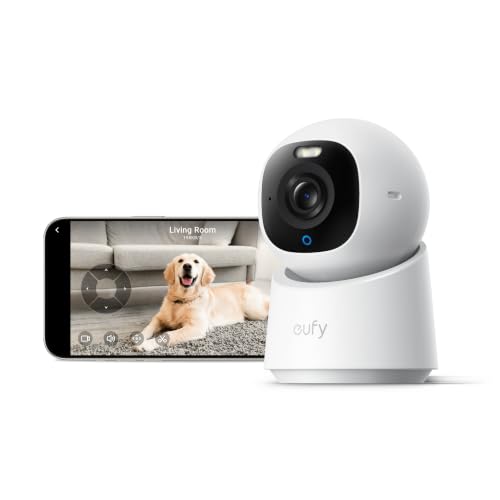
Identification is a resolution problem before it is anything else, and the E30’s 4K-class eye is this table’s sharpest answer to it. Posted over a boutique’s floor or a pharmacy’s high-value shelves, it renders the details incidents turn on — the item in the hand, the print on the jacket, the face at the door — at a level the 1080p generation of shop cameras gestures at. For small premises where one camera must cover a whole selling floor, that detail is the difference between footage as evidence and footage as mood.
eufy’s local-first philosophy suits retail’s responsibilities. The archive can live on the premises, under the shop’s own lock, with no subscription rent and no third-party server holding a month of customers’ faces — an arrangement many owners, and some jurisdictions’ expectations, prefer. The pan-tilt movement lets one position sweep a floor for a live check while its home view guards the door, and on-device intelligence keeps the event list relevant without phoning home.
The cautions are the local archive’s mirror: footage kept in the shop can be taken with the shop’s equipment in a serious break-in, so the positions that guard against theft of goods may want the cloud-backed Arlo pattern instead, and high resolution hungers for storage — card capacity and retention settings must be planned together, or the sharpest camera in the guide will overwrite its own evidence fastest. Detail is a system, not a sensor.
- Type: wired indoor pan-tilt, high resolution
- Archive: local-first, no subscription required
- Retail post: selling floor, high-value shelves, door
- Planning: storage size must match the resolution’s appetite
Strengths
- Identification detail leads this group.
- Footage stays on the premises by default.
- No subscription rent for the core system.
Trade-offs
- Local archive shares the premises’ risks.
- High resolution consumes retention quickly.
- One camera, however sharp, still covers one floor.
Best for: boutiques and small stores where identification detail is the point. Not suited for: shops whose main fear is a break-in that takes the recorder too.

TP-Link Tapo C210 — Best Whole-Floor Value
The C210 is the camera a small shop buys when the budget allows one position and the floor demands coverage: a full pan-tilt circle from a ceiling corner or a high shelf, a timeline that stays navigable, local recording with an enhancement plan available, and an app the Saturday manager already half-knows from home. Cafés, salons, corner shops and galleries — premises where the floor is one room and the risks are opportunistic — are its natural constituency.
Its retail craft is the patrol used honestly. A slow dwell at the door, a dwell at the till end of the room, a dwell down the aisle: a tour built from the shop’s money geographies rather than a showroom sweep. Between tours the home position guards the entrance, and motion tracking handles the incident that walks in. Configured with that intent, one C210 gives a small floor a sense of being watched that larger shops buy with four fixed cameras — while the fixed Wyze below remains the better buy for the one threshold that must never be left, the stockroom door.
Value has a ceiling and it is the single viewpoint: one camera cannot see around a gondola, behind a pillar or into the fitting-room corridor, and its footage of a busy Saturday is a wide story rather than a close identification. Shops that grow into those blind spots should add fixed companions rather than replacing the Tapo — the architecture this guide keeps recommending, one mover plus anchored eyes, assembles itself naturally around this pick.
- Type: wired indoor pan-tilt
- Archive: local card, optional enhancement plan
- Retail post: whole small floor from one position
- Pattern: money-geography tour, entrance as home
Strengths
- One position covers a small floor’s full circle.
- Local recording keeps basics free of rent.
- Friendly app lowers the staff learning curve.
Trade-offs
- Single viewpoint leaves structural blind spots.
- Wide coverage trades away close identification.
- Tours must be designed, not left as a sweep.
Best for: cafés, salons and one-room shops needing honest whole-floor cover. Not suited for: large floors or identification-critical posts alone.

Wyze Cam v4 — Best Fixed Companion
Every retail system needs a camera with no ambitions: fixed on the stockroom door, or the till’s flank, or the corridor to the safe, recording its one scene with total fidelity and no interest in anything else. The Wyze v4 is that camera at a price that changes the maths — a shop can post two or three fixed eyes for what one flagship mover costs, and in loss prevention the arithmetic of coverage usually beats the romance of features.
Its plan philosophy suits the role. The budget-structured cloud adds smart detection and off-site copies, while the local card keeps recording through any lapse — a resilience pattern a business should demand of the camera guarding its most sensitive threshold. A stockroom door camera that stops recording because a subscription hiccupped is a parable, not a system; the Wyze’s graceful degradation is a professional virtue at an unprofessional price.
Placement is its whole skill. Fixed means the framing chosen on install day is the evidence available forever, so mount it at face height for the door’s traffic, test the night view with the corridor’s real lighting, and resist the ceiling-corner habit that produces a documentary about the tops of heads. Given that care, this modest camera will produce the single most useful clip in the building, on the Tuesday the stock count fails, while its grander siblings were watching the floor.
- Type: wired fixed camera
- Archive: local card behind a budget cloud plan
- Retail post: stockroom door, till flank, safe corridor
- Skill: framing at install is the whole game
Strengths
- Price permits several fixed posts per shop.
- Local recording survives subscription lapses.
- Never looks away from its assigned threshold.
Trade-offs
- No movement — blind outside its one frame.
- Interface refinement sits a step below Arlo and Google.
- Identification detail is adequate, not leading.
Best for: stockroom doors, corridors and till flanks in any small shop. Not suited for: standing alone over a whole selling floor.

Blink Outdoor 4 — Best for Doors and Yards
The back of the shop is where retail’s unglamorous losses gather: the delivery door propped for air, the yard where returns wait, the car park where staff cars and trouble both park. The Blink Outdoor 4 covers that geography on batteries that measure their service in seasons rather than weekends, mounted in minutes on walls that may never have seen a drill, and reporting through a subscription-structured cloud with local options in its ecosystem for the archive-minded.
Its retail temperament is the sentry’s: long stillness, instant attention. Motion at the delivery door outside trading hours is the event this camera exists for, and its alerts should be scheduled to the shop’s real rhythm — silent during the delivery window’s bustle, keen at midnight. Shops that tune that schedule get a back door that reports; shops that leave it always-on get a hundred clips of their own staff and a sentry they learn to ignore.
Battery longevity is the headline, but the discipline is shared with the Reolink: a critical outdoor post deserves a battery check in the weekly routine, and a camera guarding the yard should not be the one whose low-battery warning everyone has been dismissing since spring. Within that routine, the Blink is the easiest outdoor coverage a small retailer can add — no cable, no electrician, and a yard that stops being the building’s blind side.
- Type: battery outdoor fixed camera
- Archive: cloud-structured, local options in ecosystem
- Retail post: delivery door, yard, car park
- Discipline: alerts scheduled to trading hours
Strengths
- Long battery service suits set-and-forget posts.
- Installs in minutes where cables cannot go.
- Outdoor build handles the delivery side’s weather.
Trade-offs
- Fixed view — placement must be right first time.
- Event clips can trim an incident’s beginnings.
- Cloud features lean on the subscription structure.
Best for: delivery doors, yards and car parks of small retail premises. Not suited for: continuous recording of a busy back-of-house.
How Do the Six Cameras Divide a Shop Between Them?
| Pick | Post | Archive character | Watch style |
|---|---|---|---|
| REOLINK Argus PT Ultra | Entrance court, yard gate | Local first, cloud optional | Moving, battery |
| Arlo Essential Indoor Pan Tilt | Till and counter | Subscription cloud | Moving, tracked |
| eufy 4K Indoor Camera E30 | Selling floor, valuables | Local first | Moving, high detail |
| TP-Link Tapo C210 | Whole small floor | Local plus plan | Moving, patrol |
| Wyze Cam v4 | Stockroom door | Card behind cloud | Fixed, constant |
| Blink Outdoor 4 | Delivery door, car park | Cloud-structured | Fixed, sentry |
A one-camera shop should buy by its worst geography, not its average one: the post where loss or dispute is likeliest gets the first camera, and the table’s post column is the shopping list in order. A three-camera shop — the commonest grown-up small system — typically fields the till, the door and the stockroom threshold, and discovers that most incidents volunteer themselves to one of those three witnesses.
What Does a Retail Camera Setup That Holds Up Require?
Walk the floor with the money, not with the drill. List where cash is handled, where stock enters and leaves, where the valuable and the concealable live, and let that list — not the ceiling’s convenient joists — choose the posts. Photograph each intended view with a phone from the mounting height before any camera is bought; the tops-of-heads problem and the backlit-door problem are both visible in that test shot, free of charge.
Mount for faces at the identification posts: lower than instinct suggests, angled to meet customers’ faces as they pass the door or stand at the till, and tested at the day’s worst light — the low sun through the shopfront that silhouettes everyone at five o’clock. Then set retention before recording anything: decide the shop’s discovery lag for shrinkage and disputes, configure archives to exceed it, and verify a week later that the oldest day is still there. Retention mis-set is the commonest silent failure in small retail systems, discovered, like all the worst ones, on the Tuesday it matters.
Write the house rules while the ladder is out. Who holds the admin account, which staff can view live but not export, how footage requests from police or insurers are handled, when clips are deleted, and where the signage goes — the next section’s territory, decided now rather than improvised later. Then test the whole chain with a rehearsed incident: stage a “theft” at the till, find it in the timeline, export it with its timestamp, and hand it to the owner on a drive. A system that has passed its own rehearsal is a system; one that has not is a hope with lenses.
Schedule the boring maintenance into the shop’s existing rhythms: lens cloth with the Monday clean, battery and storage checks with the stock count, a quarterly review of who still holds app access after staff changes. Retail systems fail socially more often than electronically, and the rota is the patch.
What Do Customers and Staff Need to Know? Privacy, Signage and Consent
A shop is not a home, and the people in its footage are not the owner’s family. Customers enter a commercial space where visible cameras and clear signage are the accepted social contract in most places: a notice at the door that recording is in progress, cameras in plain sight over the floor and till, and none — ever — in fitting rooms, toilets or other spaces where privacy is absolute. That line is not a settings preference; crossing it converts a security system into a liability and, in many jurisdictions, an offence.
Staff deserve the same deliberateness. Tell the team where the cameras are, what they are for, who can view the footage and for what purposes — loss prevention and safety, stated plainly — and put it in writing as part of the shop’s policies. Covert filming of employees is legally fraught in many places and corrosive everywhere; a workforce that knows the till camera protects them in disputes with abusive customers will defend the system, while a workforce that discovers a hidden camera will never trust the shop again. Cameras pointed at staff-only areas to monitor work, rather than to guard thresholds and stock, deserve particular legal care before installation, not after complaint.
Audio is the quiet trap. Many cameras record sound by default, and audio recording of conversations is regulated more strictly than silent video in numerous jurisdictions — the shopkeeper’s camera can become an eavesdropping device by accident of a factory setting. The defensible default for retail is video without audio: disable sound recording unless you have taken specific advice that your use is lawful, and let the signage say what the system does. Finally, footage is personal data in the eyes of modern privacy law in many regions: keep it only as long as the retention policy states, secure the accounts that reach it, and treat a customer’s request about footage of themselves as a legal process to handle properly, not a nuisance to wave off. This guide is not legal advice — local rules vary — but a shop that builds on visibility, notice, silence and restraint will be aligned with the spirit of nearly all of them.
When Should a Shop Stop Buying Cameras and Hire a Professional?
The threshold is real, and crossing it knowingly is a sign of a well-run business rather than a failed DIY. Hire professionals when the premises grow past one floor’s sightlines — multi-room, multi-floor or multi-site operations need designed coverage, central recording and someone accountable for the gaps. Hire them when the risk profile sharpens: jewellers, pharmacies with controlled stock, late-night premises and cash-heavy businesses carry threat and insurance requirements that consumer cameras were never certified to answer, and an insurer’s specification, where one exists, outranks any buying guide.
Hire them, too, when the compliance load professionalises: chains answering to a head office’s data policy, businesses whose footage routinely enters legal proceedings, and any operation where retention, audit trails and access logging must be demonstrated rather than asserted. A professional system brings vandal-resistant housings, recorders that survive the shop, maintenance contracts and — the unglamorous core of the offer — a named party responsible when the system fails. The cameras in this guide serve the single-site shop superbly; the threshold is where “the shop’s cameras” become “the company’s surveillance estate,” and recognising that border is part of buying well.
Which Mistakes Make Retail Footage Worthless?
Mounting for the ceiling’s convenience instead of the incident’s geography is the founding error — cameras that film the tops of heads, the backs of tills and the glare of the window, while the door, the drawer and the stockroom threshold go unwatched. Every post in this guide exists because some real shop learned that lesson on its worst Tuesday.
Retention set by default comes next: the system that keeps three days, in a business that counts stock monthly, is a system designed to have overwritten every answer it ever recorded. Set retention from the discovery lag, verify it, and let storage sizes follow the policy rather than the other way round.
Alert fatigue is the operational killer. A till camera that buzzes for every passer-by trains its manager to silence it within a fortnight, after which the shop owns an expensive diary nobody reads. Tune zones, schedules and person filtering until the alerts that arrive are the ones that matter — a retail system should speak rarely and mean it.
And the governance mistakes close the list: shared passwords on a sticky note, ex-employees still holding app access, footage handed out without a log, audio recording nobody decided to enable. None of these is a camera fault; all of them decide, in the end, whether the footage protects the shop or embarrasses it.
One last perspective for the owner reading this at midnight with a stock discrepancy open in another tab: a camera system is not an accusation machine, and the shops that benefit most from theirs are the ones that treat it as a fairness instrument. It clears the honest cashier faster than it catches the dishonest one; it settles the customer’s mistaken memory without anyone being called a liar; it tells the owner which door, which hour and which process leaks, so the fix can be a shelf moved or a routine changed rather than a suspicion carried. Buy it for the truth, post it in the open, and the losses it prevents will include several you never knew you were spared.
Final Recommendation
Build the small system deliberately: the Arlo or the eufy E30 at the till and floor where identification pays, a Wyze standing eternal watch on the stockroom door, the Tapo patrolling a one-room floor or the Reolink and Blink dividing the entrances and the yard between them — movers where the geography changes, fixed eyes where it must never be missed. Put the signage up before the first recording, tell the staff what the system is for, turn the audio off, set retention by your slowest discovery, and rehearse one incident end to end before trusting any of it. Then respect the threshold: when the business outgrows one floor, one site or one owner’s attention, hand the estate to professionals with the same deliberateness. A shop’s cameras are a promise to customers, staff and the truth — keep it visibly, and the footage will keep the shop.
Deterrence or Evidence: What Is the Camera Really For?
Shopkeepers buy cameras for two different jobs and rarely separate them. The deterrent camera works by being seen: mounted visibly at the door, announced by signage, perhaps paired with a monitor showing the entrance feed where customers can watch themselves arrive. Its success is measured in incidents that never happen and therefore never appear in any timeline — the opportunist who reads the room and leaves the stock alone. The evidence camera works by seeing clearly: positioned for faces and hands, indifferent to whether anyone notices it, judged entirely by the Tuesday it answers.
The two jobs pull design in opposite directions, and the mature system assigns them deliberately. Deterrence wants height, visibility and theatre at the entrance; evidence wants proximity, angle and discretion at the till and the stockroom door. A single camera asked to do both usually does the first adequately and the second poorly, because the conspicuous high corner that deters is precisely the tops-of-heads viewpoint that cannot identify. This is another argument for the mixed architecture running through the picks: let the door camera perform, and let the quiet fixed eyes testify.
There is also a staff dimension to deterrence that honest shops acknowledge. A visible system changes behaviour on both sides of the counter — most employees welcome the till camera that exonerates them in disputes, and the tiny minority planning to steal from the drawer are deterred by the same lens. Framing the system to the team as protection that happens to watch, rather than surveillance that happens to protect, is not spin; it is the accurate description of a well-posted retail system, and it is why the signage section insists the conversation happen in the open.
How Do Shop Lighting and the Window Defeat Good Cameras?
The shopfront window is retail imaging’s nemesis: a wall of daylight behind every entering customer, turning faces into silhouettes for any camera foolish enough to face it. Entrance cameras should therefore be angled along the door’s traffic rather than square into the glass, or posted to catch faces a few steps inside where the light has balanced — and every candidate view deserves the five-o’clock test, when low sun performs its daily sabotage and the morning’s perfect framing goes black at the eyes.
Inside, mixed lighting writes its own traps. Cool fluorescents over the floor and warm spots over the displays give one camera two colour temperatures to reconcile, while the till’s pendant lamp can bloom into a halo exactly where the money changes hands. The fixes are placement and patience: shift the camera a metre, tilt the view below the lamp line, let the camera’s exposure settle on the counter rather than the window. Night deserves its own check, because the shop after closing is a different country — display lighting off, streetlight through glass, the infrared view of the stockroom door in near-darkness — and the camera that charmed at noon must be verified at midnight before it is trusted with the night.
What Should Happen in the Hour After an Incident?
Systems are judged in this hour, so rehearse it like the fire drill. First, preserve: note the time window generously — incidents are always earlier and later than the first guess — and export the relevant footage from every camera covering the geography before routine retention can touch it, keeping originals unedited and logging who exported what, when. Second, protect the scene’s other evidence: the till roll, the stock count, the door’s access record, while memories and paperwork still agree with the cameras.
Third, decide the audience calmly. Police reports, insurer notifications and staff conversations each need the footage in different forms, and the shop that hands its entire archive to every requester has misunderstood both privacy and evidence. Copies for each purpose, originals retained, requests logged — the chain of custody habits that make consumer-camera footage behave like professional evidence are administrative, not technical, and they cost nothing but forethought.
Finally, review the system, not just the suspect. Every real incident is an audit the shop did not schedule: a blind spot found, a retention gap exposed, an alert that arrived tuned to the wrong hour. Fix one thing from each incident and the system compounds in competence across a year of trading; fix nothing, and the next incident will be filmed, beautifully or badly, in exactly the same way.
What About Temporary Shops, Markets and Seasonal Trading?
Pop-ups, market stalls and Christmas-season units are retail too, with worse infrastructure and the same shrinkage. The battery picks in this guide — the Reolink over the stall’s entrance, the Blink on the stock tent — were practically designed for them: mounted in minutes, removed without a trace, reporting to a phone that is also the till. Their event-based recording suits premises that exist for eight trading weeks and cannot justify a recorder’s residency.
The disciplines travel unchanged. Signage at a market stall is as much the contract as signage in a high-street window; staff — often family, often temporary — deserve the same plain notice; retention should cover the season’s own discovery lag, which for a pop-up may be the January reconciliation after the unit has closed. And the threshold logic inverts gracefully here: a temporary shop should almost never hire the professional system, because its whole estate must fit in a van in January. Buy the honest consumer tier, run it visibly and lawfully, and let it go when the season does.
What Will an Insurer or a Court Actually Ask of the Footage?
Retailers often discover, at claim time, that having footage and having usable footage are different assets. Insurers ask predictable questions: is the timestamp accurate and provably set, does the clip show the incident continuously rather than in event fragments, can the shop demonstrate the footage has not been edited, and how long after the event was it preserved? The systems in this guide can answer all four — when their clocks are synchronised, their retention was set generously, and their exports were made promptly and logged. None of those is a camera feature; all of them are the owner’s habits, which is why the setup section rehearses them.
Event-only recording deserves a specific warning in this light. A camera that wakes on motion may clip an incident’s first seconds — the approach, the concealment’s beginning — and a fragmented record invites arguments a continuous one settles. For the till and the stockroom door, where footage’s legal value concentrates, prefer the recording mode and the camera whose archive is unbroken through trading hours, and let event-based sentries guard the yard where their fragments matter less.
Accuracy of the clock is the smallest, saddest failure in retail evidence: footage timestamped an hour adrift because nobody set daylight saving, correlating with nothing — not the till roll, not the alarm log, not the police timeline. Put clock-checking in the quarterly routine beside access reviews. Evidence is a chain of boring accuracies, and the chain is only ever as strong as its most neglected link.
How Do You Keep Accounts and Access Clean as Staff Change?
A shop’s camera system accumulates people the way its till accumulates coins: every manager, supervisor and trusted Saturday hire who ever needed the app still has it, unless somebody’s job includes taking it back. Make it somebody’s job. The admin account belongs to the business, held by the owner, with two-factor protection and a password in the shop’s proper records — never a personal login of whoever happened to install the cameras, because that person will eventually leave, taking the shop’s eyes with them in a pocket.
Grant access by role and review it at every departure: view-live for shift leads, export rights for managers only, admin for the owner alone. The quarterly review in the maintenance rhythm exists for this list as much as for batteries and clocks. When a trusted employee leaves on good terms, the revocation is a courtesy performed promptly and kindly; when one leaves otherwise, it is the first task, before the locks, because the cameras watch the locks.
Write the rules where new staff will meet them — the same policy conversation the privacy section demands — so that access, purposes and limits are the shop’s stated culture rather than its discovered one. A system whose governance is boring is a system whose footage will be believed; in retail security, credibility is the whole product.
Related guides
Frequently Asked Questions
How many cameras does a small shop actually need?
Most single-room shops are honestly served by three posts: the entrance for identification, the till for transactions, and the stockroom door for shrinkage. One camera is a start if it takes the worst post; a fourth and fifth add the high-value display and the delivery side. Beyond a handful of positions, the design questions multiply faster than the coverage, which is the professional threshold approaching.
Do I have to tell customers and staff about the cameras?
In most jurisdictions, yes in practice and often in law: visible cameras with clear entrance signage for customers, and plain written notice for staff covering positions, purposes and who can view footage. Rules vary by place, so confirm locally — but secrecy is almost never the defensible design, and never in spaces like fitting rooms or toilets, where cameras do not belong at all.
Should retail cameras record audio?
The defensible default is no. Audio recording of conversations is regulated more strictly than video in many places, tills rarely need sound to settle disputes, and a silent system with honest signage is far easier to justify to staff, customers and authorities. Disable it unless specific local advice says your use is lawful.
How long should a shop keep its footage?
Longer than its discovery lag: the interval between an incident and the shop learning of it. Till disputes surface in days; shrinkage surfaces at stock counts, which may be monthly. Set retention to cover the slowest cycle plus margin, balance it against privacy expectations of not keeping footage indefinitely, and write the period into the shop’s policy.
Can police or insurers use footage from these cameras?
Generally yes, when it is clear, timestamped and exported intact — which is why this guide insists on rehearsing an export before any real incident. Keep the original file unedited, note who exported it and when, and hand over copies rather than the only version. Footage gathered in defiance of signage or privacy rules may face challenges, which is a practical reason, beyond decency, for running the system visibly and lawfully.
What is the single best first camera for a shop?
The one aimed at your likeliest loss. For most small shops that is the till-and-door combination: an identification-grade camera like the eufy E30 or the Arlo pan-tilt covering the counter and entrance axis, with signage announcing it. Add the stockroom’s fixed eye second; the floor’s wide coverage third.
Can one camera cover both the till and the entrance?
Sometimes, in the smallest shops where till and door share one axis — and the test is the phone photograph from the mounting point at the day’s worst light. If faces at the door and hands at the drawer are both legible in that frame, one well-placed pan-tilt can hold both posts; if either is a silhouette or a guess, the posts deserve separate cameras, and the fixed companion tier exists precisely to make that affordable.
What should a shop do with footage of an incident involving a minor?
Handle it with extra care and specific advice. Preserve it as evidence if a genuine incident occurred, restrict access to the fewest people possible, share it only through proper channels such as police, and never circulate it among staff or on social media. Local law and safeguarding expectations govern the details; the shop’s instinct should be maximum restraint, documented.
How should a shop handle a customer who objects to being filmed?
Calmly, and with the signage as your friend: explain that cameras cover the till and entrances for everyone’s safety, that footage is kept for a stated period and viewed only for incidents, and offer the manager if the conversation needs one. A customer who still objects is free to shop elsewhere, and a shop that can describe its system this plainly — purpose, places, retention, access — will find objections rare and brief.
Are dummy cameras worth adding?
Rarely, and never as a substitute at a real post. A dummy may extend deterrence theatre to a low-risk corner, but it records nothing, fools nobody who studies it, and creates a false sense of coverage that distorts decisions. The budget fixed tier in this guide has narrowed the honest camera’s price to the point where the dummy’s saving buys almost nothing except the risk.
Related Guides
The recording plans behind these cameras are compared in our guide to cloud services for security PTZ cameras, and the wired infrastructure for larger premises is covered in our guide to coax cable for security cameras; shop owners planning a first install should also read our overview of cameras for small offices and workplaces for the staffing side of the same decisions.

