kajuandouglas.com is reader-supported. When you buy through links on our site, we may earn an affiliate commission.
Where to Buy
Finding the best canon cameras for amateur video starts with a forgiving truth: your first videos will be rough for reasons no camera can fix, so the right body is the one that removes obstacles while you learn. Shaky framing, wandering focus and mumbled audio are beginner problems. A helpful Canon answers them with guided menus, face-tracking autofocus you can trust, a screen that flips toward you, and recording limits that do not punish a long take. Everything ranked below was judged by how kindly it treats a newcomer who shoots family films, hobby channels, school projects and first short clips.
Amateur does not mean unserious. It means the learning curve is still the main event, and the camera should teach while it records. Canon’s recent mirrorless line is unusually good at that double job: the same body that holds your hand through its first month also hides genuine manual depth for the month you outgrow the hand-holding. The picks span friendly starters, a step-up all-rounder, a pocket compact for people who hate menus, one full-frame ceiling to grow toward, and two prose-only mentions for models outside our verified pool that still deserve a place in your thinking.
Buy through authorised dealers or the maker’s own renewed store when you shop the mirrorless rows, because warranty support matters more to a beginner than to anyone: you will have questions, and a real support channel answers them. Compact and step-up rows appear at every major retailer. Wherever you buy, budget the unglamorous companions in the same order — a fast memory card, a second battery, and a simple microphone if voices matter — because an amateur kit fails at its accessories far more often than at its sensor.
Key Takeaways
- Forgiveness is the beginner specification: guided menus, reliable face tracking and a flip screen matter more than headline resolution.
- The Canon EOS R50 is the natural first step — small, encouraging, and honest about its 4K.
- Canon’s EOS R10 adds speed and controls for amateurs who already know they will stay with the hobby.
- The PowerShot G7 X Mark III serves creators who want a pocket camera and no lens decisions at all.
- Full-frame polish waits at the top of the table; most beginners should meet it in year two, not month one.
- Sound decides whether amateur footage feels amateur — plan a microphone before you plan a second lens.
A word about ambition before the table. Beginners often buy for the filmmaker they hope to become in three years, then discover the heavier, more complicated camera stays home while the moment happens elsewhere. The ranking below quietly rewards the opposite instinct: the camera you will actually carry, switch on quickly, and forgive yourself for using on automatic while your eye catches up with your intentions. Skill grows on footage actually shot, not on specifications admired from a shelf.
In this guide
Quick Picks
| Badge | Pick | Why it stands out |
|---|---|---|
| Best First Mirrorless for Video Learners | Canon EOS R50 | Guided menus, dependable face tracking and honest 4K in a body that never intimidates. |
| Best Step-Up for Committed Beginners | Canon EOS R10 | More speed, more controls and room to grow without changing systems. |
| Best Pocket Pick for Camera-Shy Creators | Canon PowerShot G7 X Mark III | A flip screen, a bright lens and no interchangeable-lens homework whatsoever. |
| Best Grow-Into-It Full Frame | Canon EOS R6 Mark II | The polished ceiling: superb stabilisation and low-light video for year two. |
| Best Bare-Bones Budget Start (Prose-Only) | Canon EOS R100 | The simplest RF-mount entry, for learners who want minimal controls and minimal cost. |
| Best Lightweight Full-Frame Alternative (Prose-Only) | Canon EOS R8 | Full-frame quality in a travel-friendly body once the beginner phase ends. |
Read the badges as learning stages rather than ranks of worth. The first three rows solve the beginner problem directly; the fourth names where the road leads; the two prose-only rows mark honest alternatives we cannot link from our verified pool but would be hiding from you if we pretended they did not exist. A reader who recognises their own stage in that sequence already knows which detailed review to read first.
How We Chose These Picks
Testing amateur gear demands amateur conditions, so the evaluation handed these bodies to genuine beginners alongside experienced shooters. Each camera filmed a birthday in a dim restaurant, a walking tour narrated at arm’s length, a child’s football match from the touchline, and a quiet indoor interview. Notes were taken on how often the beginner asked for help, how often focus hunted during simple movement, and how the footage felt on a family television that evening — the screen where amateur video actually lives.
Menus were scored as teaching tools. A beginner mode that explains itself in plain language earns more here than a professional shortcut buried three levels deep, because the first month decides whether a camera becomes a habit or a cupboard resident. Recording behaviour mattered equally: bodies that overheated during a school play or stopped mid-speech were marked down hard, whatever their resolution, since a missed ending teaches a beginner only frustration.
Growth headroom formed the third criterion, applied gently. A first camera need not serve a decade, but it should not wall off the second year either. Mount future, accessory ecosystem, and the availability of affordable lenses all counted — which is why Canon’s RF system anchors the mirrorless rows, and why the fixed-lens compact is presented honestly as a complete, finished tool rather than a stepping stone.
What Does a Beginner Actually Need From a Video Camera?
Start with focus, because focus is where beginner footage dies. A new videographer cannot yet ride a focus ring while framing, walking and talking, so the camera’s eye must do that work: detecting a face, holding it through turns and gestures, and recovering gracefully when a second person enters the frame. Canon’s subject-detection autofocus, descended from its professional bodies, performs this quiet miracle across the mirrorless rows below, and it is the single largest quality jump a beginner buys when moving up from a phone.
The screen is the second teacher. A fully articulating display lets a solo creator check framing from in front of the lens, lets a parent film at a toddler’s height without kneeling in the mud, and folds flat to protect itself in a bag. Every mirrorless pick here offers one, and the compact’s tilting screen serves the same master. Beginners underestimate this feature at purchase and bless it weekly thereafter; treat it as non-negotiable for video-first buying.
Forgiveness in exposure runs third. Amateur scenes are badly lit by professional standards — mixed kitchen light, grey playgrounds, restaurant gloom — and a camera whose automatic exposure and colour stay pleasant in those conditions produces watchable footage while its owner learns. Canon’s colour science has a long reputation for flattering skin straight out of camera, which matters enormously when the editor is also a beginner who has never opened grading software.
Finally, respect the humble limits: recording length, heat, and battery endurance. A camera that stops during the school concert’s final song has failed at its only job that day. The reviews below note where each body stands on endurance, because amateur events — matches, recitals, ceremonies — run longer than the short clips reviewers usually shoot, and nobody warns the beginner about the gap until it swallows a memory.
Which of the Best Canon Cameras for Amateur Video Fits Your First Year?

Canon EOS R50 — Best First Mirrorless for Video Learners
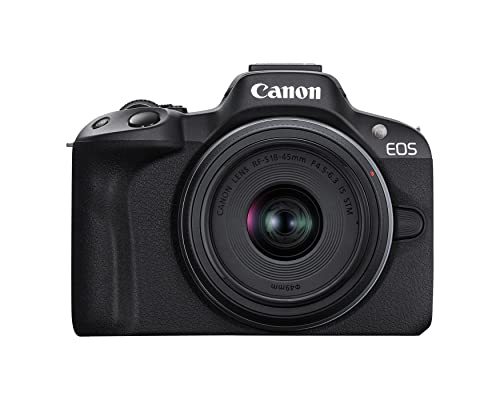
Here is the camera this guide would hand to a niece, a colleague, or any adult who announced at dinner that they want to start filming things properly. The R50 is small enough to carry without ceremony, friendly enough to operate within an hour, and capable enough that its owner will blame themselves — correctly, instructively — for early flaws rather than the tool. Its guided interface explains settings in ordinary words, its autofocus finds faces and stays with them, and its 4K video, sampled from a wider sensor area, looks clean and confident on the screens families actually own.
Consider how it behaves on an ordinary Saturday. The flip screen turns for a kitchen demonstration filmed alone; the camera rides in a jacket pocket’s larger neighbour, a small sling; a child’s improvised play is captured from the doorway without a tripod, a lighting plan, or a single menu dive. Afterwards the files move to a phone wirelessly for sharing before the grandparents have finished asking. That frictionless loop — shoot, enjoy, share, shoot again — is the habit-forming machinery of a new hobby, and the R50 operates it better than any rival at its level.
Honesty requires the boundaries. The body is light partly because it omits in-body stabilisation, so walking footage leans on the lens and the shooter’s care; the lens catalogue for its crop-sensor mount, while growing, is thinner than the full-frame shelf; and long continuous recording in warm rooms deserves a test before a truly important event. None of these are beginner problems in the first year. They are the natural borders of a first camera, and noticing them is itself a sign of graduation.
Graduation, when it comes, is painless, which is the final argument. The R50 teaches the RF mount, the Canon menu logic, and the exposure triangle in their modern forms, so its owner’s second body — whatever it is — feels like a reunion rather than a relocation. Lenses bought for it can travel upward within the system. As a first mirrorless for video, it is less a purchase than an enrolment, and the tuition is remarkably fair.
- Sensor: APS-C, video-friendly oversampled 4K
- Screen: fully articulating touchscreen
- Focus: face and eye detection for people
- Stabilisation: lens-based, no in-body system
- Role: the encouraging first step
Strengths
- Teaches while it records, patiently
- Autofocus a beginner can trust blindly
- Small enough to be carried daily
Trade-offs
- No in-body stabilisation for walking shots
- Crop-mount lens shelf still maturing
- Long hot-room takes need a rehearsal
Best for: first-time mirrorless owners filming family, travel and hobby channels. Not suited for: shooters who already grade footage or chase professional clients.

Canon EOS R10 — Best Step-Up for Committed Beginners
Some beginners arrive pre-committed: the dance student filming every rehearsal, the young athlete’s parent who has already shot a season on a phone and hit its ceiling, the hobbyist who reads manuals for pleasure. The R10 is their Canon. It keeps the friendly DNA of the smaller body — the same mount, the same forgiving colour, the same face-hunting autofocus — and adds the things a fast learner reaches for by month three: a deeper grip, more direct controls, faster burst and processing manners, and a general sense that the camera expects to be used hard.
The difference shows in busy scenes. At a school match, the R10’s quicker responses and surer handling make following play feel less like luck; in a workshop or studio corner, its extra dials mean exposure adjustments happen by touch while the eye stays on the subject. Video quality sits close to its sibling’s, with the same pleasing 4K character, but the experience of capturing it is calmer — and calm, for a beginner filming something unrepeatable, is worth real money.
Its boundaries mirror the family’s. Stabilisation still lives in the lens rather than the body, the crop mount’s lens shelf is the same growing one, and the price step buys handling and speed rather than a leap in image quality. A beginner who films mostly quiet, seated subjects may never feel what the extra money purchased. The honest summary is that the R10 rewards motion, frequency and ambition — shoot often and shoot lively subjects, and it earns its premium weekly.
Think of the choice between this and the R50 as a question about temperament, not talent. Nobody needs permission, or prior skill, to buy the R10; they need only the self-knowledge that they will use its extra pace. Beginners who recognise themselves in the rehearsal-filming, season-shooting descriptions above should step up without guilt. Everyone else can start smaller and lose nothing but a few dials they were not yet missing.
- Sensor: APS-C with faster processing manners
- Controls: deeper grip, more direct dials
- Focus: subject detection for people and animals
- Stabilisation: lens-based, as its sibling
- Role: the committed beginner’s workhorse
Strengths
- Handling that suits frequent, lively shooting
- Same forgiving colour and focus as the R50
- Headroom for a fast learner’s second year
Trade-offs
- Premium buys pace, not prettier files
- Still no in-body stabilisation
- Overkill for occasional, quiet subjects
Best for: committed beginners filming sport, rehearsals and busy family life. Not suited for: occasional shooters who would never feel its extra speed.

Canon PowerShot G7 X Mark III — Best Pocket Pick for Camera-Shy Creators
A whole tribe of creators wants better video without becoming, in any visible way, a camera person. No lenses, no mount decisions, no bag. The G7 X Mark III is built for that tribe: a pocket compact with a bright zoom lens, a screen that flips up for self-framing, clean 4K video, and — a detail its owners mention constantly — a proper microphone input, rare in its class, which lets a simple external mic transform its interview and vlog sound. It slips into the day rather than reorganising it.
Its natural habitat is the narrated walk, the café review, the travel diary, the desk video shot between other obligations. The lens’s brightness keeps indoor footage respectable where phone sensors begin to smear, the colours arrive ready to publish, and the whole ritual from pocket to published clip can take minutes. For beginners whose real project is a channel, a journal or a family archive — not photography itself — that compression of effort is the entire point, and this camera delivers it with unusual polish.
The compromises are the compact family’s eternal ones. The sensor is smaller than the mirrorless rows’, so dusk and deep indoor gloom test it sooner; the lens is fixed forever, so distant subjects stay distant; and autofocus, while willing, lacks the mirrorless bodies’ uncanny subject lock during chaotic movement. Battery life suits outings rather than event days. None of this troubles the pocket-creator use case, and all of it should steer event videographers toward the interchangeable-lens rows.
Judge it, finally, as a finished object. There is nothing to upgrade, nothing to research next month, no shelf of glass whispering from a wish list. Owners tend to keep these cameras for years precisely because the relationship is complete. For the amateur whose ambition is content rather than craft, that completeness is not a limitation wearing a smile — it is the product.
- Sensor: 1-inch type, bright fixed zoom
- Screen: tilts up for self-framing
- Audio: external microphone input fitted
- Stabilisation: optical, in the lens
- Role: the pocket creator’s finished tool
Strengths
- Genuinely pocketable, always present
- Microphone input lifts its sound class
- Nothing to upgrade or research later
Trade-offs
- Smaller sensor meets dusk sooner
- Fixed lens, fixed possibilities
- Battery sized for outings, not events
Best for: vloggers, travellers and desk creators who want zero lens homework. Not suited for: event shooters or anyone dreaming of interchangeable lenses.

Canon EOS R6 Mark II — Best Grow-Into-It Full Frame
Every beginner table deserves one honest look at the top of the stairs. The R6 Mark II is what Canon’s amateur virtues become when money stops rationing them: a full-frame sensor that films beautifully in the gloom where cheaper bodies smear, in-body stabilisation that steadies handheld footage like a gimbal’s polite cousin, autofocus that tracks people, animals and vehicles with professional calm, and recording endurance built for events rather than clips. It is overqualified for a first month and perfectly qualified for a third year.
Why include it in an amateur guide at all? Because some readers are not guessing about their commitment — the semi-professional in waiting, the wedding second-shooter in training, the enthusiast upgrading from an elderly DSLR they have already outgrown. For them, buying a starter body would be the wasteful option, a toll paid twice. The R6 Mark II also teaches generously despite its station: its automatic modes remain Canon-friendly, so a determined beginner can grow inside it rather than being locked out by it.
The costs are equally plain. Full-frame lenses are larger and dearer; the body itself is a serious object to carry all day; and its capabilities will expose, not hide, a beginner’s shaky technique — stabilisation helps, but it cannot compose. Heat and recording manners are strong for its class, yet the sheer file quality tempts owners into storage and computer demands that surprise the unprepared. This is a camera whose total ecosystem should be budgeted, not just its body.
Let the verdict be a mirror. If your filming calendar already includes paid work, dim venues and subjects who will not repeat themselves for your learning curve, this is your row and the starter rows would underserve you. If your calendar is birthdays and holidays, the same money spread across a smaller body, a lens and a microphone will produce happier footage for two years. Ambition is a fine reason to buy the ceiling; impatience is not.
- Sensor: full-frame, excellent in low light
- Stabilisation: in-body, strongly effective
- Focus: deep-learning subject tracking
- Video: high-quality 4K with event manners
- Role: the ceiling to grow into
Strengths
- Dusk footage other rows cannot match
- Stabilisation that rescues handheld work
- Built for unrepeatable events
Trade-offs
- Full-frame lenses swell the true budget
- Size and weight argue against daily carry
- Capability exposes shaky technique honestly
Best for: committed enthusiasts and professionals-in-training with dim, busy subjects. Not suited for: casual beginners who would leave it at home.
Canon EOS R100 — Best Bare-Bones Budget Start (Prose-Only)
The R100 exists for the beginner who looks at even the R50’s friendliness and asks for less: fewer buttons, fewer decisions, the smallest possible doorway into Canon’s RF mount. It covers the fundamentals — a proper APS-C sensor, interchangeable lenses, 4K video of a more modest character than its siblings’ — in the plainest body Canon makes, and for a learner whose alternative is no camera at all, plain and present beats sophisticated and postponed.
Its video manners are deliberately basic. The 4K carries a crop and simpler sampling than the R50’s, the screen does not perform the full articulating dance a solo creator wants, and the control layout assumes automatic modes will do most of the driving. Read those facts as a definition rather than an insult: this is a camera for learning composition, light and storytelling on stills and simple clips, with video as a supporting skill rather than the headline.
Who, precisely, should choose it? The student on a strict allowance, the parent buying a first real camera for a teenager, the stills-curious beginner who suspects video will be an occasional guest in their work. For those readers its simplicity is mercy. The committed video learner, by contrast, will feel its limits within months and should stretch to the R50 row, where the flip screen and finer 4K repay the difference every single shoot.
We list it without a purchase link because it sits outside our verified pool for this site; it appears because an honest beginner guide must acknowledge the true floor of the system it recommends. Buy it knowingly, as a first chapter with modest ambitions, and it will serve exactly as promised. Buy it expecting the R50’s video manners at a discount, and disappointment is scheduled in advance.
- Sensor: APS-C, stills-first character
- Video: modest 4K with a crop
- Screen: fixed, simpler than siblings
- Controls: minimal, automatic-friendly
- Role: the plainest doorway into RF
Strengths
- The system’s most affordable entry
- Simplicity that suits young learners
- Real interchangeable-lens future
Trade-offs
- Video features trail the R50 clearly
- No articulating screen for solo work
- Committed videographers outgrow it fast
Best for: students, teenagers and stills-first beginners on strict budgets. Not suited for: video-first learners who can stretch to the R50.
Canon EOS R8 — Best Lightweight Full-Frame Alternative (Prose-Only)
Between the starter rows and the R6 Mark II’s full professional manners sits an interesting middle address: the R8, a full-frame Canon in a body barely larger than the crop-sensor picks, carrying much of the flagship’s sensor quality and autofocus intelligence while trimming the heavyweight extras. For the amateur whose first year goes suspiciously well — whose channel grows, whose low-light subjects multiply — it is the upgrade that feels like a reward rather than a restart.
Its video story is a tale of quality over endurance. The footage itself is lovely: full-frame depth, clean high-sensitivity performance, the same trustworthy subject tracking, in a package a traveller can carry all day without negotiation. What it surrenders against the R6 Mark II is stamina and steadiness — no in-body stabilisation, a smaller battery, and recording manners better suited to clips and scenes than to hour-long ceremonies. Amateur filmmakers shooting scenes will not care; event shooters will.
That split defines its reader. The hobbyist filmmaker who works in takes — travel sequences, short narrative scenes, family films assembled from beautiful fragments — gets flagship-flavoured images without flagship weight or price of admission. The beginner filming whole matches and full recitals should look up-table instead. Knowing which filmmaker you are is the entire decision, and by the time this camera makes sense, you will know.
It stands in this guide as a prose-only mention, outside our verified link pool, included because beginner journeys do not end at beginner cameras and an honest map shows the next town. When the R50 has taught you everything it can and the R6 Mark II still feels like more camera than your calendar justifies, remember that this lighter full-frame road exists.
- Sensor: full-frame in a compact body
- Focus: flagship-grade subject tracking
- Stabilisation: lens-based only
- Endurance: clips and scenes over ceremonies
- Role: the lightweight upgrade path
Strengths
- Full-frame images without the bulk
- Autofocus inherited from pricier bodies
- A natural second body for R50 graduates
Trade-offs
- No in-body stabilisation
- Smaller battery, shorter sessions
- Not built for hour-long events
Best for: travelling hobbyists and scene-by-scene filmmakers stepping up. Not suited for: ceremony and match shooters who need stamina.
Beginner Bodies, Honestly Compared
| Pick | Sensor | Learning style | Deciding virtue |
|---|---|---|---|
| Canon EOS R50 | APS-C | Guided and gradual | Encouragement with real quality |
| Canon EOS R10 | APS-C | Faster, more hands-on | Pace for lively subjects |
| Canon PowerShot G7 X Mark III | 1-inch compact | None required | Pocket completeness, mic input |
| Canon EOS R6 Mark II | Full-frame | Grow inside it | Low light and stabilisation |
| Canon EOS R100 | APS-C | Automatic and plain | The floor of the system |
| Canon EOS R8 | Full-frame | Second-stage | Flagship flavour, travel weight |
Two columns do the deciding in this table. Learning style tells you how the camera will treat your first month; deciding virtue tells you what you will still be thanking it for in your second year. Beginners who match those two columns to their own temperament rarely regret a purchase, because regret in this category is almost never about image quality — every row films beautifully by historical standards — and almost always about friction: the body that felt like homework, the compact that could not grow, the flagship that never left the house.
Notice, too, what the table refuses to rank: there is no overall winner, because the amateur year is not one experience. The teenager, the travelling vlogger and the rehearsal-filming parent are all beginners, and a guide that crowned a single champion would be lying to two of them. Choose by stage and subject, and the table becomes a map instead of a podium.
What Mistakes Do New Videographers Make With a First Canon?
Buying the body and starving the kit is the classic opening error. A wonderful camera recording through its built-in microphone, onto a slow card, with one battery, produces a frustrating first month that the owner misattributes to the camera. Allocate for the companions from the start: the second battery, the fast card, the modest microphone, the small bag. The picks above were all judged as kits, and several verdicts assume those companions are present.
Filming everything at maximum settings runs a close second. Beginners equate bigger files with better films, then drown in storage, editing slowdowns and overheating margins during the very events that matter. Most amateur subjects — family, travel, hobby channels — look superb at sensible settings, and the editor you are becoming will thank you for files your computer can actually chew. Save the hero modes for the hero moments: the recital solo, the once-a-year light.
Neglecting audio while polishing video is the third, and audiences punish it fastest. Viewers forgive a soft image in a heartfelt clip; they abandon muffled, echoing speech within seconds. Every pick here either accepts an external microphone or pairs naturally with one, and a beginner who spends on sound before lenses will hear the difference in every published piece. Your second purchase after the camera should make voices clearer, not backgrounds blurrier.
Finally, beginners abandon automatic modes too early, out of a misplaced shame. Canon’s guided and automatic systems are genuinely good teachers: shoot on them, study what the camera chose, then change one variable at a time. The filmmaker who understands why the camera picked its settings owns those settings forever. Pride that skips the apprenticeship produces a year of avoidable technical failures dressed as artistic choices.
How Should a Beginner Practise Video in the First Month?
Give the month a curriculum of small, finished things. Week one: film a two-minute tour of your home, narrated, in one take per room, and watch it whole — you will learn more about your framing habits from that single viewing than from a week of tutorials. Week two: interview a willing relative for five minutes, with the camera on a stack of books, and listen to the sound with your eyes closed. Week three: follow a moving subject — a dog, a cyclist friend, a child on a scooter — and study how your autofocus and your feet cooperate. Week four: assemble the best fragments into one short film and show it to somebody.
Keep every exercise unrepeatable-proof: nothing in the month’s syllabus should matter if it fails. That safety is what makes practice honest, because a beginner protecting precious footage shoots timidly and learns slowly. The cameras above were chosen partly for how kindly they treat this syllabus — forgiving focus, forgiving exposure, files that move easily to a phone for the evening review that turns shooting into learning.
End each week by writing down one sentence about what the camera did that surprised you. Beginners who keep that tiny log discover their real needs — reach, steadiness, sound, low light — from evidence, and their second purchases, when they come, are surgical rather than hopeful. The month costs nothing but attention, and it converts a purchase into a practice, which is the only conversion that ever made anyone a filmmaker.
How Do You Keep Amateur Footage Watchable at Home?
Watchability is mostly mercy toward the viewer. Hold shots longer than feels natural while filming — the editor in you will want those extra seconds — and move the camera as if it were full of water: pans that drift, walks that sway gently, zooms avoided unless the lens and the moment both deserve them. The stabilisation in the lenses and bodies above forgives a great deal, but intention forgives more, and intention is free.
Light deserves one household rule: face the subject toward the day, not away from it. Beginners film people against bright windows and wonder why faces go dark; turning the scene around costs nothing and transforms the footage. Indoors at night, add the lamp you own before coveting the lens you do not. Canon’s colour rewards these small kindnesses with skin tones that look like memory rather than surveillance.
Sound at home obeys the distance rule: halve the distance to the speaker and you double the clarity, whatever the microphone. Film the interview from a chair’s width, not across the room; let the camera’s microphone work in its comfort zone or clip the external mic to a collar. Family archives are treasured for voices at least as much as faces, and the amateur who learns that early keeps the treasure intact.
How Does a Beginner Choose Between Crop Sensor and Full Frame?
The sensor question haunts beginner forums out of all proportion to its practical weight, so let this guide settle it with scenes instead of diagrams. A crop-sensor Canon like the R50 or R10 gathers a slightly narrower view from a given lens and asks a little more of its sensitivity in deep gloom. A full-frame body like the R6 Mark II sees wider, separates backgrounds more dramatically, and keeps its composure later into the night. On a family television, in ordinary light, the difference between their footage is smaller than the difference made by where the shooter stood.
Where the gap genuinely opens is the edges of the day and the edges of the room. Restaurants at night, school halls with tired lighting, living rooms after the lamps take over — here full frame’s calm at high sensitivity stops being a specification and becomes the difference between a scene that looks like memory and one that looks like evidence. Beginners whose lives film mostly in those hours have a real argument for the bigger sensor. Beginners filming gardens, beaches, sports days and bright kitchens are buying insurance against a darkness they rarely meet.
Weight writes the other half of the verdict. Crop bodies and their lenses travel in smaller bags, balance on smaller tripods, and come along on days when a full-frame kit would be negotiated with and finally left behind. The amateur archive is built from attendance. A camera present at forty ordinary afternoons contributes more treasure than a superior camera present at six special ones, and every beginner should price that arithmetic before pricing sensors.
Lenses complicate the story in one useful way: crop systems multiply reach, which flatters wildlife and sport, while full frame multiplies width and low-light grace. The beginner filming children on stages from the back of halls may find the crop body’s effective reach a genuine blessing, not a compromise. There is no hierarchy here, only fit — and fit is decided by your subjects, your rooms and your bag, never by a forum’s pecking order.
What Should a Beginner Learn First: Exposure, Focus, or Sound?
Sound, say the audiences who abandon muffled videos; focus, say the cameras that now handle it for you; exposure, says this guide — but exposure taught the beginner’s way, as three decisions rather than a triangle of jargon. How bright is the scene, how much motion blur feels natural, how hard is the sensor working. Canon’s guided displays translate those questions into pictures and plain words, which is why the R50 earns its teaching reputation: a learner can experiment for an afternoon and emerge understanding what changed and why.
Focus deserves a different kind of learning: not operation, but supervision. Modern Canon autofocus will find and follow a face with a reliability that would have seemed like sorcery a decade ago, yet it still needs an owner who notices when it has chosen the wrong face, the dog instead of the grandchild, the referee instead of the striker. Practise tapping the screen to assign your subject, practise checking the focus box before you press record, and you have learned ninety percent of focus craft at this level. The camera does the athletics; you do the directing.
Sound learning is embarrassingly physical. Move closer. Turn off the humming appliance. Notice the room’s echo before the interview, not after. Choose the chair away from the road-facing window. None of this requires a purchase, all of it transforms amateur footage, and the microphone you eventually buy will multiply habits you already own rather than rescue habits you never built. Beginners who spend their first month on proximity and quiet will outperform, on any audience’s ears, beginners who spend it on gear.
Sequence the three across the first season and the learning stays pleasurable: exposure in month one, while scenes are forgiving; focus supervision in month two, when subjects start moving; sound discipline in month three, when you begin filming people speaking at length. By the season’s end the camera’s automatic modes will feel like a colleague whose decisions you understand — which is the precise moment manual control stops being intimidating and starts being interesting.
How Do You Film Children and Family Events Without Missing Them?
Family filming fails in predictable ways, and each pick above was quietly tested against them. The first failure is absence: the camera in another room, in a bag, out of charge. The cure is staging, not specs — the camera lives by the door during celebration weeks, battery charged on a named day, card emptied after every transfer. Beginners laugh at this advice and then lose a first-steps video to a full card, once, and never again.
The second failure is distance. Beginners film the party from the corner, politely, and produce footage in which everyone they love is small and facing away. Family video obeys the photographer’s oldest law: get closer, then closer than feels polite, because you are not a stranger at this gathering — you are its memory-keeper, and your subjects will thank you in twenty years for the faces, not the wide establishing shot of the garden. The flip screens and face tracking in these picks exist to make close filming easy from low, unobtrusive angles.
The third failure is greed: filming everything and watching nothing. The amateur who records an entire birthday produces an archive nobody opens; the one who captures six honest minutes — the song, the candles, one game, one quiet conversation — produces the film the family requests at every gathering since. Shoot for the edit you will actually make. Stop recording when the moment has said its piece. Your future audience, and your future self at the editing desk, are both begging you to learn this early.
Finally, hand the camera over. The family videographer who never appears in the footage becomes a rumour in their own archive. Every body in this table is friendly enough to be passed to a teenager or a grandparent for the minutes that include you, and Canon’s automatic modes make that handover safe. Brief your stand-in with one sentence — keep the face in the box, don’t zoom — and step into your own family’s film.
How Should Beginners Think About Lenses During the First Year?
The kit lens that arrives with a mirrorless body has an image problem it does not deserve. Forums treat it as a placeholder, yet for a beginner it is a diagnostic instrument of real precision: its range covers the wide room shot, the walking narration, the portrait at the long end, and it does all three well enough that its failures are informative. When your footage keeps wanting to be wider in small rooms, or longer across playing fields, or cleaner in lamplight, the kit lens has just written your shopping list in evidence instead of advertising. Give it a season before you replace a single thing.
The first lens most beginners genuinely need, when the evidence arrives, is a bright prime: a fixed focal length that opens wide, drinks lamplight, and separates a face from a cluttered room with that gentle blur beginners covet. On Canon’s crop bodies such lenses are compact and comparatively affordable, and the discipline of a fixed view — moving your feet instead of a zoom ring — teaches framing faster than any tutorial. Buy it for the dusk problem or the portrait problem, whichever your season actually produced, and ignore the other until it appears.
Reach is the second common evidence. Children migrate to distant stages and far touchlines; wildlife visits the garden’s far corner; the crop sensor’s multiplication already helps, and a modest telephoto zoom completes the thought. Here the R10’s extra pace and the system’s affordable telephoto shelf justify themselves together. What beginners should resist is the everything lens bought in month one to avoid decisions: it is heavy, dim at the long end, and teaches nothing, because it never forces the question a prime or a dedicated telephoto asks on every outing — what is this shoot actually about?
Keep the year’s lens budget behind a single rule: no glass without footage that demands it. Show the clip where the current lens failed — the grainy recital, the tiny striker, the face lost in the cluttered background — and the purchase approves itself. That rule protects beginners from the hobby’s most expensive illusion, which is that the next lens contains the improvement that actually lives in the shooting itself. Lenses are answers. Let your first season ask clear questions, and the R50 or R10 you started with will still be revealing new competence when the second lens arrives.
What Editing Habits Turn Beginner Clips Into Films Worth Keeping?
Editing is where amateur footage either becomes a film or remains a folder, and the good news is that beginner editing is mostly subtraction. Cut the seconds before the action starts and after it ends; remove the duplicate take when one is clearly warmer; let a scene breathe at its natural length and no longer. The cameras above all produce files that ordinary laptops and free software handle happily at sensible settings, which removes the last excuse — the edit for a family film should take an evening, not a week, or it will not happen at all.
Build one small ritual: transfer the day’s clips the same evening, name the folder by date and event, and star the three moments that made you reach for the camera. That starring habit, repeated across a year, becomes the archive’s index, and it teaches selection — the editor’s core skill — in ninety seconds a day. Beginners who edit in this light, frequent way arrive at their second year with finished films. Beginners who stockpile footage arrive with hard drives and intentions.
Keep a copy somewhere separate from the computer, even if it is only a modest external drive in a drawer, because family films become irreplaceable faster than any other files a household owns.
Share the finished piece while it is still warm. A film sent to the family chat the same weekend teaches you what landed — which moment gets quoted back, which scene nobody mentions — and audience response, even from grandparents, is the fastest curriculum in amateur filmmaking. The next shoot quietly corrects itself toward the moments people loved. Filmmakers grow by finishing and releasing, not by privately accumulating almost-films, and every camera ranked above was chosen to keep that finishing loop short enough to survive a busy life.
Final Recommendation
Start where your temperament lives. Most beginners should buy the Canon EOS R50 and spend the savings on a microphone, a second battery and a year of shooting. Committed, lively-subject learners step up to the R10; pocket creators who refuse lens homework take the G7 X Mark III and publish tonight. The R6 Mark II waits honourably for those whose calendars already demand it, the R100 floors the system for the strictest budgets, and the R8 marks the lightweight road upward. Whichever row you choose, the assignment is the same: film something small this week, watch it whole, and begin.
Frequently Asked Questions
Is 4K necessary for amateur video, or is 1080p enough?
For most family and hobby publishing, good 1080p remains entirely respectable, and several picks shoot it beautifully with longer recording endurance. Choose 4K when you crop in editing, film for large screens, or want the cleaner oversampled look the R50 and R10 offer — and accept the larger files as the price. The honest beginner answer is that framing and sound will decide how your footage is judged long before resolution does.
Can a beginner handle a mirrorless camera, or should they start with a compact?
Modern Canon mirrorless bodies are designed to be handled by beginners: guided menus, touchscreen controls and automatic modes carry the first months while manual depth waits politely underneath. Choose the compact instead when you know, honestly, that lenses and settings hold no appeal at all — the G7 X Mark III’s completeness serves that reader better than a system they would resent. Temperament, not ability, is the deciding factor.
What is the first accessory an amateur videographer should buy?
A microphone, if voices feature in your filming; a second battery, if your events run long; a fast card, before either, if the one in the box is slow. In practice most beginners need the small trilogy within a month, and this guide’s verdicts quietly assume it. Lenses, lights and gimbals all queue behind those three unglamorous purchases, whatever the internet’s enthusiasm suggests.
How long will a first camera like the R50 remain useful?
Years, for most owners. Its autofocus, colour and 4K quality sit comfortably above the threshold where equipment limits a hobbyist’s films; the limits you meet first will be your own, which is exactly what a teaching camera is for. When a specific, repeated frustration finally names itself — reach, low light, endurance — you will know precisely what your second body must fix, and the R50 will sell or hand down gracefully within its popular system.
Do these cameras work for photography as well as video?
Yes — the mirrorless picks are hybrid machines whose stills quality matches their video manners, and many beginners discover photography through the video door. The R50 and R10 make fine family and travel stills cameras; the R6 Mark II is a professional stills body outright. Only the compact is video-leaning in spirit, and even it takes pleasing photographs. Buying for video does not exile you from stills on any row of this table.
Should a beginner buy used to afford a better body?
Used and maker-renewed channels can stretch a beginner budget a full tier, and Canon’s renewed store is a legitimate first port of call. The cautions are ordinary: buy where returns and warranties are written down, check recording behaviour and sensor condition on arrival, and keep the accessory budget intact rather than spending the saving twice. A patient beginner with a checklist buys used wisely; an impatient one buys new and sleeps better. Both are respectable strategies.
Related Guides
Continue with best canon cameras for videography when the craft deepens, best cameras for youtube beginners for channel-focused picks, and best mirrorless cameras under a starter budget for the wider field.


