kajuandouglas.com is reader-supported. When you buy through links on our site, we may earn an affiliate commission.
Where to Buy
A safari gives a camera nowhere to hide. Distance is real, light is either glorious or brutal, and the subject has its own opinions about your schedule. The six cameras below earned their places against that reality, with a leopard leaving the shade at dawn as the scene that mattered most — because if a camera serves you in that moment, it will serve you almost anywhere on the savannah.
Notice what this shortlist is not. It is not a ranking of the most powerful cameras money can buy, because raw power is rarely what a game drive rewards. It rewards reach that you can actually carry, focusing that holds a moving animal, and handling calm enough to use from a bouncing vehicle while your guide whispers directions you are trying not to miss.
A second thread runs through every judgement below: conditions will not cooperate. Batteries tire, dust arrives uninvited, and the leopard does not repeat the performance for a better angle. So the notes weigh behaviour in the field — waking speed, honesty of focus, files that survive an evening’s review — above any number printed on a box.
Read the detailed sections in whatever order your curiosity prefers, but keep the two practical parts for before you travel. One covers how much reach a vehicle genuinely demands; the other covers dust, bumps and heat. Between them they will save more photographs than any single upgrade on this page.
Key Takeaways
- Canon EOS R10 heads this safari shortlist because its reach-friendly system suits vehicle-based wildlife work beautifully.
- Reach honesty matters: judge lens and sensor together against the distances an open vehicle actually imposes.
- Dust, vibration and fierce midday contrast punish fragile kit, so sealing and support deserve early attention.
- Coherence across a whole trip — one system, familiar controls — survives the flight home better than novelty.
- Picks without a verified listing remain prose-only here, though each still earns consideration for safari travellers.
- Build the simplest outfit covering dawn drives and camp portraits first, then add specialised glass deliberately.
In this guide
Quick Picks
| Pick | Badge | Why it earns its place |
|---|---|---|
| Canon EOS R10 | Best Safari Starter System | Canon EOS R10 earns the Best Safari Starter System slot, staying dependable while a leopard crossing the track at dawn |
| Nikon Z50 II | Best Compact Safari Pick | Chosen as Best Compact Safari Pick: the Nikon Z50 II handles a leopard crossing the track at dawn without fuss |
| Sony Alpha 7 IV | Best Full-Frame Safari Body | The Sony Alpha 7 IV takes the Best Full-Frame Safari Body place, keeping a leopard crossing the track at dawn within reach |
| Canon EOS R6 Mark II | Best Low-Light Game Drive Pick | For Best Low-Light Game Drive Pick duties the Canon EOS R6 Mark II stands out during a leopard crossing the track at dawn |
| Fujifilm X-T5 | Best Dial-Led Alternative | Fujifilm X-T5 fills the Best Dial-Led Alternative role with calm competence during a leopard crossing the track at dawn |
| OM SYSTEM OM-5 Mark II | Best Lightweight Safari System | The Best Lightweight Safari System badge suits the OM SYSTEM OM-5 Mark II, treating a leopard crossing the track at dawn as routine |
How We Chose These Picks
The ranking began with failure, as honest rankings should. Safari photographs disappoint in predictable ways: focus that slid off the animal at the decisive stride, files that fell apart under gentle evening editing, controls that hid the one adjustment the moment required. We listed those failures first and let them cross names off the long list, one disappointment at a time.
Reach was weighed as a system, never as a body alone. A camera earns its place here alongside the lenses it can realistically carry, the support it can use in a vehicle, and the weight your luggage allowance and your shoulder will both accept. Models whose paper promise depended on glass nobody would actually pack sank quickly, whatever their reputation at home.
Links follow a strict rule on this page. Cameras confirmed in the site’s verified pool carry a purchase link under their exact pool name; other worthy models are discussed plainly, with no link invented for the sake of tidiness. That discipline costs a little convenience and buys the only thing a guide like this has to sell: recommendations you can check.
What Should You Understand Before Choosing the Best Cameras For A Safari?
Describe your real safari in one honest sentence and let it argue with the brochures. Not the brochure version — the vehicle you will actually sit in, the parks you will actually visit, the hours you will actually keep. A photographer in an open private vehicle with a patient guide needs a different kit from a guest in a shared minibus who shoots between other people’s shoulders, and pretending otherwise wastes money in both directions.
Then there is the question of what the photographs are actually for. Most safari pictures are shared quickly and printed modestly — an album, a framed print or two, an evening slideshow. That shifts value toward pleasing colour and dependable focusing in the moment, and away from maximum editing depth. Buyers who do print large or edit patiently should weight the full-frame options here more heavily, and the guide flags where that matters.
Hands deserve their paragraph. You will hold this camera braced against a door frame, half-standing through a roof hatch, for hours at a stretch. Weight decides whether it is still in your hands at the last sighting of the day; grip shape decides whether it stays there when the vehicle lurches. Try to handle finalists before you buy, and be suspicious of any choice that only feels good for ninety seconds in a shop.
Finally, remember the camera is the beginning of a system, not the whole of it. The lens, the beanbag, the spare cards and batteries, the cloth and cover for dust — these decide whether the body is present and ready when dust hanging over a waterhole at last light unfolds. The comparison below weighs the six as systems in that sense, which is why the lightest option here is a serious contender rather than a compromise.

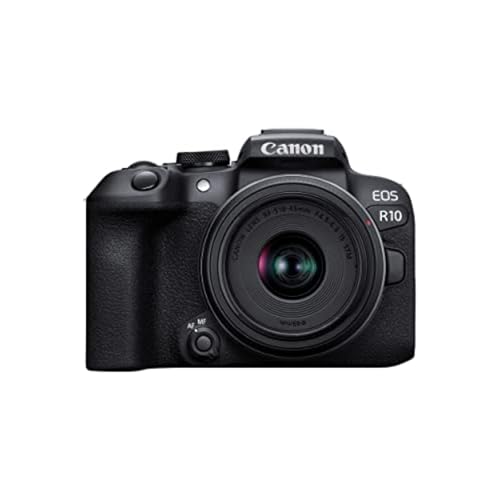
Canon EOS R10 — Best Safari Starter System
Everything about the Canon EOS R10 makes more sense once you picture a leopard leaving the shade at dawn. It is a quick, dial-rich body that rewards shooters who like direct control, and out on a track at first light that combination stops being a specification and becomes a temperament. The badge of best safari starter system is really a judgement about fit: this is the camera whose strengths line up with what a game drive actually demands, hour after dusty hour. Dawn does not wait for anyone, and neither do the animals; readiness is the whole game out here.
Spend a morning in the vehicle with the Canon EOS R10 and a rhythm develops. It comes awake on the beanbag without a fuss, the controls find your fingers before your eyes leave the animal, and the whole business of adjusting feels like a conversation rather than an interruption. When dust hanging over a waterhole at last light develops in front of you, that fluency is the difference between watching and recording. By the second morning your hands will be operating it while your eyes stay where they belong.
The files from the Canon EOS R10 have a measured honesty to them. Morning light keeps its gold without tipping into orange, shade keeps its detail, and its burst behaviour and tracking suit subjects that refuse to sit still. Editors will find room to work, but the more common safari experience — sharing a frame the same evening, straight from the camera — is where this rendering quietly shines. Evening slideshows at the lodge are an unforgiving test, and these files pass it without pleading.
Honesty about limits, then. The Canon EOS R10 will not repeal the physics of distance: a subject too far away stays too far away, whatever the badge says, and its compromises gather exactly where its design brief ends. Ask it to behave like a far costlier specialist body in punishing conditions and it will show you the join. Within the wide territory of ordinary game drives, though, those edges rarely trouble anyone. Read the limit as itinerary advice: it tells you which sightings to work for and which to simply enjoy.
Ownership on safari has its own arithmetic: dust worked into everything, batteries rationed between drives, cards filling faster than expected. The Canon EOS R10 keeps that arithmetic simple. Charging fits the lodge routine, transfers behave in the evening, and the camera shrugs off the vehicle’s vibration and the track’s corrugations without developing new complaints by day four.
Against the other five, the Canon EOS R10 argues through coherence. Its handling, focusing and files pull in one direction, and that direction is the one a leopard leaving the shade at dawn rewards. If the badge of best safari starter system matches the way you intend to travel, the rest of this guide is mostly confirmation. In a category full of exaggeration, coherence is the quality that survives the flight home.
- Role in this line-up: best Safari Starter System
- Files: colour suiting safari shooting, still grading gracefully afterwards
- Handling: controls placed for swift, unrushed safari shooting changes
- Carry profile: proportioned for dusty game drives and brief wildlife sightings
- Ownership note (safari shooting kit): cards, spare power and a case cost extra
Strengths
- The Canon EOS R10 (safari shooting) locks focus dependably while a leopard crossing the track at dawn
- Files from the Canon EOS R10 (safari shooting) look polished immediately yet keep room for retouching
- Handling stays composed during safari shooting when the moment suddenly accelerates
Trade-offs
- Push it far outside safari shooting and its compromises surface quickly
- The complete safari shooting kit costs more than the camera alone suggests
- Several advanced safari shooting settings hide deeper in menus than shooters like
Best for: travellers whose sightings will look like a leopard leaving the shade at dawn and who want best safari starter system without turning the vehicle into a equipment van.
Not suited for: specialists whose work lives at extremes this camera was never briefed to cover.

Nikon Z50 II — Best Compact Safari Pick
Consider the moment this guide keeps returning to — dust hanging over a waterhole at last light — and ask what a camera must do in the ten seconds it lasts. The Nikon Z50 II answers with a particular character: it is a compact system model with a bright viewfinder and bold, pleasing colour. That is why it carries the badge of best compact safari pick here, not because it tops a chart, but because its virtues arrive in the order a safari needs them. It is the sort of choice that looks modest in a shop and wise on the third consecutive early start.
Handling on safari is mostly about not thinking. The Nikon Z50 II helps by keeping its important decisions on the outside of the body, where cold early fingers can find them, and by responding the same way at dawn as it did the evening before. Predictability sounds dull until a sighting lasts forty seconds and every one of them counts. That fluency also keeps the vehicle quiet, which the animals — and your fellow passengers — appreciate.
Look closely at what the Nikon Z50 II does with difficult savannah light. Highlights on a lion’s back roll off gently instead of blowing to white, while the shadow side of the frame keeps enough information to matter, because the controls sit where your thumbs go looking for them, so handling feels considered. Colour stays believable: dust looks like dust, and grass keeps the dry, pale tone it actually has in the dry season. Prints, when people make them, keep that same calm; the rendering does not rely on screen brightness.
Every camera in this guide gives something up, and the Nikon Z50 II gives up the extremes. The most demanding low-light work, the most exotic lens ambitions, the professional workloads that run for weeks — those belong to other tools. Naming that is not a criticism of the badge of best compact safari pick; it is the map edge that lets you trust everything inside the border. Most buyers discover the border once, nod, and spend the rest of the trip happily inside it.
The unglamorous ledger matters out here. Cards, power, a cloth for the front element, a cover against the dust that arrives whenever another vehicle passes — the Nikon Z50 II keeps its side of that ledger short. It spends battery predictably enough to plan a full day around, and it writes files without the little dramas that sour an evening’s review.
The briefest fair summary is this: the Nikon Z50 II understands the assignment. Photographers whose days are measured in drives and sightings will feel that understanding every time it wakes on the beanbag ready. It will not make the animals appear — nothing can — but it will not be the reason a sighting went unrecorded. It is, in the end, a camera that respects both the wildlife and the person holding it.
- Slot in this shortlist: best Compact Safari Pick
- Output: attractive safari shooting colour, with latitude for editing
- Controls: dials reachable quickly during safari shooting adjustments
- Size in the bag: matched to dusty game drives and brief wildlife sightings
- Budget note (safari shooting kit): memory cards, batteries and protection cost extra
Strengths
- The Nikon Z50 II (safari shooting) keeps moving subjects pinned in focus throughout a leopard crossing the track at dawn
- Images off the Nikon Z50 II (safari shooting) arrive clean, still leaving headroom for careful editing
- The body feels calm in the hand throughout safari shooting, even as events speed up
Trade-offs
- Work beyond safari shooting exposes limits specialists would not accept
- Budget for the full safari shooting outfit: body price is only the start
- A few powerful safari shooting options sit buried in settings pages
Best for: photographers who put best compact safari pick first and plan to shoot from a vehicle seat, beanbag braced, for most of the trip.
Not suited for: anyone hoping the camera will substitute for position, patience and an early alarm.

Sony Alpha 7 IV — Best Full-Frame Safari Body
There is a kind of photographer the Sony Alpha 7 IV seems designed for: patient, vehicle-bound, watching light change across grassland. It is a full-frame body that splits its talents between deep stills and serious video, and editors get real latitude from its files when a scene mixes bright sky with deep shade. Hold those two qualities together and the badge of best full-frame safari body explains itself. The sections below test whether that promise survives dust, distance and the long quiet stretches between sightings. Guides notice passengers whose gear disappears into the background of the day; this is that kind of gear.
What you notice after several drives is how little the Sony Alpha 7 IV asks you to look down. Framing, checking and adjusting happen at the edge of attention while the animal holds the centre of it. That is the correct division of labour on a vehicle, and it is a large part of why this camera sits comfortably in a guide built around elephants crossing far beyond the reach of a phone. Cold fingers, warm dust, low sun: the handling was clearly considered against all three.
There is a restraint to these images that suits wild subjects. It does not reach for drama it has not earned; it renders the animal, the light and the distance truthfully, helped by the fact that editors get real latitude from its files when a scene mixes bright sky with deep shade. For photographs that must stand up years later, when the trip has become a story told at dinners, that truthfulness outlasts any fashionable look. It is rendering that respects the animal enough not to dress it up for an audience.
Where will you feel the Sony Alpha 7 IV strain? At the margins of the day and the margins of the map: the last grey minutes before sunrise, the animal that is mostly a rumour at extreme range. A guide that pretended otherwise would insult your intelligence. Plan around those margins — position, patience, an earlier stop — and the camera repays the planning generously. The honest border also protects your budget from a spiral of compensating accessories.
By the final drive, what owners value in the Sony Alpha 7 IV is cumulative calm. Nothing has rattled loose in their confidence: the focusing behaved at a leopard leaving the shade at dawn, the files looked right on the lodge screen, and the body still feels like a tool rather than a patient. Safari gear earns trust slowly and loses it fast; this one keeps it.
Line the six up and this is the one whose decisions agree with each other. Size serves the handling, handling serves the focusing, and the focusing serves files you will be glad to keep. Choose it when best full-frame safari body describes your trip better than any other promise on this page. Choose it, then spend your remaining attention on tracks, wind direction and light — the things that matter.
- Position in this line-up: best Full-Frame Safari Body
- Files: flattering safari shooting palette tolerating retouching well
- Handling: layout supporting fast safari shooting tweaks mid-scene
- Carry profile: built around the demands of dusty game drives and brief wildlife sightings
- Ownership note (safari shooting kit): storage, power and cover need separate funds
Strengths
- The Sony Alpha 7 IV (safari shooting) finds focus calmly even as a leopard crossing the track at dawn unfolds without warning
- The Sony Alpha 7 IV (safari shooting) produces finished-looking photographs while preserving flexibility for grading
- Controls stay reassuring under safari shooting pressure, keeping attention on subjects
Trade-offs
- Assignments outside its safari shooting brief reveal the engineering compromises
- Total safari shooting outlay climbs once essential extras join the camera
- Some safari shooting refinements live deep in the menu tree
Best for: readers whose honest ambition is best full-frame safari body, and whose patience for wildlife already exceeds their patience for menus.
Not suited for: buyers unwilling to learn the small set of controls that safari shooting actually uses.

Canon EOS R6 Mark II — Best Low-Light Game Drive Pick
Everything about the Canon EOS R6 Mark II makes more sense once you picture a leopard leaving the shade at dawn. It is a full-frame hybrid pairing strong stabilisation with focusing that clings to a moving subject, and out on a track at first light that combination stops being a specification and becomes a temperament. The badge of best low-light game drive pick is really a judgement about fit: this is the camera whose strengths line up with what a game drive actually demands, hour after dusty hour. Dawn does not wait for anyone, and neither do the animals; readiness is the whole game out here.
Spend a morning in the vehicle with the Canon EOS R6 Mark II and a rhythm develops. It comes awake on the beanbag without a fuss, the controls find your fingers before your eyes leave the animal, and the whole business of adjusting feels like a conversation rather than an interruption. When dust hanging over a waterhole at last light develops in front of you, that fluency is the difference between watching and recording. By the second morning your hands will be operating it while your eyes stay where they belong.
The files from the Canon EOS R6 Mark II have a measured honesty to them. Morning light keeps its gold without tipping into orange, shade keeps its detail, and its images stay coherent when the light thins out and contrast turns awkward. Editors will find room to work, but the more common safari experience — sharing a frame the same evening, straight from the camera — is where this rendering quietly shines. Evening slideshows at the lodge are an unforgiving test, and these files pass it without pleading.
Honesty about limits, then. The Canon EOS R6 Mark II will not repeal the physics of distance: a subject too far away stays too far away, whatever the badge says, and its compromises gather exactly where its design brief ends. Ask it to behave like a far costlier specialist body in punishing conditions and it will show you the join. Within the wide territory of ordinary game drives, though, those edges rarely trouble anyone. Read the limit as itinerary advice: it tells you which sightings to work for and which to simply enjoy.
Ownership on safari has its own arithmetic: dust worked into everything, batteries rationed between drives, cards filling faster than expected. The Canon EOS R6 Mark II keeps that arithmetic simple. Charging fits the lodge routine, transfers behave in the evening, and the camera shrugs off the vehicle’s vibration and the track’s corrugations without developing new complaints by day four.
Against the other five, the Canon EOS R6 Mark II argues through coherence. Its handling, focusing and files pull in one direction, and that direction is the one a leopard leaving the shade at dawn rewards. If the badge of best low-light game drive pick matches the way you intend to travel, the rest of this guide is mostly confirmation. In a category full of exaggeration, coherence is the quality that survives the flight home.
- Role in this selection: best Low-Light Game Drive Pick
- Output: polished safari shooting colour, plus room to refine tones
- Controls: positioned for prompt safari shooting changes, rhythm intact
- Footprint: sensible for days spent on dusty game drives and brief wildlife sightings
- Budget note (safari shooting kit): cards, extra power and case need budgeting
Strengths
- The Canon EOS R6 Mark II (safari shooting) holds focus with reassuring consistency whenever a leopard crossing the track at dawn develops quickly
- Pictures from the Canon EOS R6 Mark II (safari shooting) need little rescue, though editors keep ample latitude
- Grip and layout keep nerves low during safari shooting while scenes refuse to slow
Trade-offs
- Stretch the safari shooting brief and this pick stops feeling like the answer
- Ownership spending for safari shooting extends beyond the headline body figure
- Occasional safari shooting features require menu-diving instead of direct controls
Best for: travellers whose sightings will look like a leopard leaving the shade at dawn and who want best low-light game drive pick without turning the vehicle into a equipment van.
Not suited for: specialists whose work lives at extremes this camera was never briefed to cover.

Fujifilm X-T5 — Best Dial-Led Alternative
Consider the moment this guide keeps returning to — dust hanging over a waterhole at last light — and ask what a camera must do in the ten seconds it lasts. The Fujifilm X-T5 answers with a particular character: it is a system camera led by physical dials, with high-resolution stills and much-loved film simulations. That is why it carries the badge of best dial-led alternative here, not because it tops a chart, but because its virtues arrive in the order a safari needs them. It is the sort of choice that looks modest in a shop and wise on the third consecutive early start.
Handling on safari is mostly about not thinking. The Fujifilm X-T5 helps by keeping its important decisions on the outside of the body, where cold early fingers can find them, and by responding the same way at dawn as it did the evening before. Predictability sounds dull until a sighting lasts forty seconds and every one of them counts. That fluency also keeps the vehicle quiet, which the animals — and your fellow passengers — appreciate.
Look closely at what the Fujifilm X-T5 does with difficult savannah light. Highlights on a lion’s back roll off gently instead of blowing to white, while the shadow side of the frame keeps enough information to matter, because those old-school controls nudge you toward slower, more deliberate framing. Colour stays believable: dust looks like dust, and grass keeps the dry, pale tone it actually has in the dry season. Prints, when people make them, keep that same calm; the rendering does not rely on screen brightness.
Every camera in this guide gives something up, and the Fujifilm X-T5 gives up the extremes. The most demanding low-light work, the most exotic lens ambitions, the professional workloads that run for weeks — those belong to other tools. Naming that is not a criticism of the badge of best dial-led alternative; it is the map edge that lets you trust everything inside the border. Most buyers discover the border once, nod, and spend the rest of the trip happily inside it.
The unglamorous ledger matters out here. Cards, power, a cloth for the front element, a cover against the dust that arrives whenever another vehicle passes — the Fujifilm X-T5 keeps its side of that ledger short. It spends battery predictably enough to plan a full day around, and it writes files without the little dramas that sour an evening’s review.
The briefest fair summary is this: the Fujifilm X-T5 understands the assignment. Photographers whose days are measured in drives and sightings will feel that understanding every time it wakes on the beanbag ready. It will not make the animals appear — nothing can — but it will not be the reason a sighting went unrecorded. It is, in the end, a camera that respects both the wildlife and the person holding it.
- Slot in this line-up: best Dial-Led Alternative
- Files: confident safari shooting colour editors can adjust freely
- Handling: layout making quick safari shooting corrections feel deliberate
- Carry profile: shaped by the realities of dusty game drives and brief wildlife sightings
- Ownership note (safari shooting kit): cards, batteries and storage add extra spend
Strengths
- The Fujifilm X-T5 (safari shooting) tracks the decisive subject steadily during a leopard crossing the track at dawn
- Output from the Fujifilm X-T5 (safari shooting) reads polished on delivery and forgives later surgery
- It feels planted and predictable throughout safari shooting, never twitchy at the decisive second
Trade-offs
- Tasks beyond safari shooting make its narrower talents obvious
- The honest safari shooting cost includes accessories the base purchase omits
- Certain advanced safari shooting choices demand patience through layered menus
Best for: photographers who put best dial-led alternative first and plan to shoot from a vehicle seat, beanbag braced, for most of the trip.
Not suited for: anyone hoping the camera will substitute for position, patience and an early alarm.

OM SYSTEM OM-5 Mark II — Best Lightweight Safari System
There is a kind of photographer the OM SYSTEM OM-5 Mark II seems designed for: patient, vehicle-bound, watching light change across grassland. It is a weather-sealed system camera whose clever computational modes ride in a notably compact body, and the whole outfit stays small enough to leave luggage room for everything else a trip demands. Hold those two qualities together and the badge of best lightweight safari system explains itself. The sections below test whether that promise survives dust, distance and the long quiet stretches between sightings. Guides notice passengers whose gear disappears into the background of the day; this is that kind of gear.
What you notice after several drives is how little the OM SYSTEM OM-5 Mark II asks you to look down. Framing, checking and adjusting happen at the edge of attention while the animal holds the centre of it. That is the correct division of labour on a vehicle, and it is a large part of why this camera sits comfortably in a guide built around elephants crossing far beyond the reach of a phone. Cold fingers, warm dust, low sun: the handling was clearly considered against all three.
There is a restraint to these images that suits wild subjects. It does not reach for drama it has not earned; it renders the animal, the light and the distance truthfully, helped by the fact that the whole outfit stays small enough to leave luggage room for everything else a trip demands. For photographs that must stand up years later, when the trip has become a story told at dinners, that truthfulness outlasts any fashionable look. It is rendering that respects the animal enough not to dress it up for an audience.
Where will you feel the OM SYSTEM OM-5 Mark II strain? At the margins of the day and the margins of the map: the last grey minutes before sunrise, the animal that is mostly a rumour at extreme range. A guide that pretended otherwise would insult your intelligence. Plan around those margins — position, patience, an earlier stop — and the camera repays the planning generously. The honest border also protects your budget from a spiral of compensating accessories.
By the final drive, what owners value in the OM SYSTEM OM-5 Mark II is cumulative calm. Nothing has rattled loose in their confidence: the focusing behaved at a leopard leaving the shade at dawn, the files looked right on the lodge screen, and the body still feels like a tool rather than a patient. Safari gear earns trust slowly and loses it fast; this one keeps it.
Line the six up and this is the one whose decisions agree with each other. Size serves the handling, handling serves the focusing, and the focusing serves files you will be glad to keep. Choose it when best lightweight safari system describes your trip better than any other promise on this page. Choose it, then spend your remaining attention on tracks, wind direction and light — the things that matter.
- Position in this shortlist: best Lightweight Safari System
- Output: pleasing safari shooting tones, retaining post-work flexibility
- Controls: arranged so safari shooting adjustments never feel fumbled
- Size and weight: planned with dusty game drives and brief wildlife sightings firmly in mind
- Budget note (safari shooting kit): storage media and spare power need money back
Strengths
- The OM SYSTEM OM-5 Mark II (safari shooting) settles focus fast enough that a leopard crossing the track at dawn rarely escapes unrecorded
- Frames from the OM SYSTEM OM-5 Mark II (safari shooting) appear assured immediately yet tolerate thoughtful post-processing
- Everything falls under the fingers naturally in safari shooting when chances arrive unannounced
Trade-offs
- Demand work far from safari shooting and cracks appear sooner than expected
- Expect the finished safari shooting kit to outrun the camera-only price
- Not every useful safari shooting option surfaces quickly in the menus
Best for: readers whose honest ambition is best lightweight safari system, and whose patience for wildlife already exceeds their patience for menus.
Not suited for: buyers unwilling to learn the small set of controls that safari shooting actually uses.
How Do the Six Picks Compare Side by Side?
| Pick | Badge | Strongest suit | Watch out for |
|---|---|---|---|
| Canon EOS R10 | Best Safari Starter System | Dependability when subjects move unpredictably | Limits appear outside its home territory |
| Nikon Z50 II | Best Compact Safari Pick | Files needing the least rescue afterwards | Accessories worth budgeting from the start |
| Sony Alpha 7 IV | Best Full-Frame Safari Body | Simplicity that speeds every step | Size suits some hands better than others |
| Canon EOS R6 Mark II | Best Low-Light Game Drive Pick | Consistency across an entire outing | Menus reward a patient first week |
| Fujifilm X-T5 | Best Dial-Led Alternative | Versatility when plans change mid-shoot | Kit costs extend beyond the camera |
| OM SYSTEM OM-5 Mark II | Best Lightweight Safari System | Comfort throughout long handheld sessions | A learning curve awaits complete beginners |
Treat the table as a map of temperaments rather than a finishing order. The first camera listed is the balanced default for a first safari; further down are bodies that trade some of that balance for a particular gift — low-light depth, dial-led deliberation, or a system light enough to forget. Many experienced travellers will be happiest starting their reading at the row whose badge matches their own habits.
How Much Reach Do You Honestly Need From a Safari Vehicle?
Reach, honestly assessed, begins with where the vehicle stops. Guides park where the animal is comfortable, not where your lens wishes they would, so the working distance is set by the wildlife’s mood and the park’s rules. Within that reality, technique beats appetite: a steady rest, a calm breath and a well-timed frame from a moderate lens outshoot a huge lens waved around at full stretch.
Light is the second half of the reach question. The hours that matter — the first and last of the day — are exactly when light is scarcest, so the useful question is not how far a combination can see but how cleanly it works when the sun is a rumour. Watch how the light rakes across grass at dawn, how open shade flatters a face, how backlight turns dust into atmosphere, and buy for those conditions.
Shoot in deliberate bursts, then stop. A short sequence when the animal moves, a pause while it settles, another when it looks up — that rhythm produces keepers and spares you an evening deleting nine hundred near-identical frames. Review honestly back at camp, note the one recurring fault, and let tomorrow’s drive be the correction.
Finish each day properly and the next day starts ahead. Copy the files the same evening, keep the best few somewhere they will be seen again, and show one frame to your guide before dinner — a raised eyebrow from the person who found the animal has improved more photographers than any accessory. Cameras earn their keep across a whole trip, not in a single heroic moment.
How Do You Protect a Camera From Dust, Bumps and Midday Heat?
Protection begins with a routine small enough to survive tiredness. One location for the camera in the vehicle, one cloth that lives within reach, one cover that goes on whenever the convoy moves — constraints that simple teach faster than any elaborate system, and they keep working on day nine when enthusiasm has thinned.
Position yourself against the dust rather than chasing it. Sit on the sheltered side when you can, change lenses rarely and never in another vehicle’s dust plume, and keep the body pointed downwind while it is idle. Each of those habits costs nothing and saves more front elements than any filter; with a leopard leaving the shade at dawn as your subject, the camera that stays clean stays ready.
Review the day’s frames with the same discipline: ruthlessly, but kindly. Keep what shows something true — behaviour, character, the landscape’s scale. Let the accidents go. Linger longest on the near-misses and interrogate them: was the animal simply beyond honest reach, or did an unsteady rest waste a fair chance?
Share early, and share with the people who made the sightings possible. A frame shown to your guide teaches more than a hundred kept private, because explaining why you took it exposes what you intended — and intention, spoken aloud beside the person who found the animal, becomes a standard for the rest of the trip.
What Mistakes Do Buyers in This Niche Keep Making?
Choosing a camera for the single rarest animal on the wishlist instead of the drives you will repeat every morning and evening.
Writing a new body off after one weekend, before its menus have had any chance to become reflexes.
Blowing the whole budget on the body, then discovering that cards, batteries and a decent beanbag were never optional extras.
Shooting the entire trip on full automatic and then blaming the camera for exposures it was never consulted about.
Pixel-peeping at midnight in the lodge while ignoring the unsteady rest that actually cost the day’s best sighting.
Never doing a practice drive at home, where a local park and its deer could have taught the same lessons for free.
How Do You Practise Vehicle-Based Wildlife Photography Before Booking a Safari?
One habit repays practice more than any other: at the end of a shooting day, open the frames at full size and identify the best decision you made. It might be stopping the vehicle earlier, waiting ten seconds longer, or bracing the lens properly for once. Naming the win turns luck into method, and method is what survives the flight to the savannah.
What Does Deliberate Practice Look Like When Your Subjects Are Wild Animals?
Carry deserves rehearsal too, because photographs begin with presence. Practise lifting the camera from its rest to your eye in one motion, finding the spare card by touch, working the main dial with gloves on if your trip is a cold-season one. Details that sound domestic decide whether you are ready when a leopard leaving the shade at dawn happens or still fumbling with a zip.
How Can Local Wildlife Sessions Rehearse Reach, Patience and Quiet Handling?
Practise with company when you can. Fellow travellers in the vehicle are part of the craft: agree who shoots from which side, take turns at the roof hatch, and review each other’s frames in the evening without mercy or malice. Shared sessions and one standing joke about the week’s worst frame will do more for morale — and for everyone’s pictures — than solitary perfectionism.
Which Drills Prepare You for Dawn Game Drives and Sudden Sightings?
Dust and weather will test whatever you buy, so make the countermeasures boring before you go. A simple cover in the kit, a cloth that genuinely gets used, and the discipline of wiping down and drying gear before it is packed away at night will extend a camera’s life more reliably than any headline specification. Rehearse the routine until it survives exhaustion.
How Do You Practise Tracking Moving Animals Through a Long Lens?
Keep the evening edit restrained and in a fixed order. Level the horizon first, then judge the exposure, then the colour, and put the laptop away the moment the frame feels like the sighting did. Heavy-handed processing is usually anxiety in disguise; a leopard at dawn needs no help from a slider to be magnificent, and your future self will thank you for files that still look honest.
Close the preparation with the exercise this guide is built on. Go back — in imagination, or at a local reserve — to a leopard leaving the shade at dawn, to dust hanging over a waterhole at last light, to elephants crossing far beyond the reach of a phone. Work each subject in two passes: your old way first, then a second pass built entirely around the one lesson from this guide that lodged deepest. Compare the pairs without flinching; the difference is your readiness, measured honestly.
Repeat that exercise on a different day, in worse light, because safaris specialise in worse light at the crucial moment. If the second attempt still improves on the first, the lesson has become a habit rather than a resolution — and habits are the only preparation that reliably survives a 5 a.m. alarm and a cold vehicle.
Then do one final, deliberately ordinary session: an hour in unremarkable light with unremarkable subjects, shot with the exact kit you will carry. Nothing about it should be heroic. If the camera disappears into the background of that hour and the frames still please you, you are ready, and the remaining variable is the one no purchase can control — the animals themselves.
On the last evening before you fly, pack the camera the way you will carry it on the first drive, not the way it looks neat in a case. Rest position, cloth position, spare card position — set them once, photograph your own packing if it helps, and then leave it alone. The first morning is no time to invent a system.
Final Recommendation
If a single sentence must carry the verdict, it is this: the Canon EOS R10 is the safest pair of hands for a first safari, and the five alternatives exist for travellers whose trips tilt toward a particular strength — deeper low-light files, a lighter system, a more deliberate way of working. None of the six will embarrass you. Choose the one that fits your hands and the drives you have actually booked, then spend your remaining energy on the routines above, because they are what the animals will actually reward.
Frequently Asked Questions
Should I rent a long lens instead of buying one?
Often, yes — and it is one of the few cases where renting beats buying outright. A long telephoto used for ten days a decade is a poor purchase and a perfect rental, provided you rent it a weekend early and learn its habits at home. Buy the body and the versatile lens you will use all year; borrow the reach your safari needs, and return it without a cupboard of regret.
Is one versatile body better than two specialised ones?
For most travellers, one versatile body wins. It stays in your hands, its controls become reflexes, and it never sits in the lodge while the sighting happens. Two specialised bodies pay off only for committed photographers who genuinely shoot both ways every day — and who accept the dust risk of swapping between them in an open vehicle.
How do I handle the harsh contrast of midday on the savannah?
Mostly, you wait it out — and the waiting is productive. Midday contrast defeats every camera here; shadows go black, highlights go white, and animals sensibly sleep. Use those hours to review, rest and charge, or shoot the subjects midday flatters: stark landscapes, birds at the waterhole’s edge, graphic patterns of hide and shadow at close range.
Do I need a silent shutter around wildlife?
A silent shutter is a courtesy you will use more than you expect. Around relaxed animals it changes nothing, but around nervous ones — and around sleeping ones your guide has worked hard to approach — silence keeps you welcome. Learn where the setting lives before you need it, and treat quiet as part of good fieldcraft rather than a party trick.
What support works best in an open vehicle?
A beanbag over the door frame or the vehicle’s side is the support that earns its place on almost every drive. It steadies without the faff of legs, moves as fast as you do between sightings, and doubles as a rest for simply watching through the lens. Monopods help some photographers in larger vehicles; tripods mostly stay at the lodge, admired and unused.
What time of day produces the best safari photographs from a vehicle?
The first two hours after sunrise and the last two before sunset, by a wide margin. Low sun rakes across the grass, models an animal’s shape instead of flattening it, and spares you the white, exhausted sky that dominates midday frames. Animals cooperate too: predators are still moving, grazers are feeding, and the heat shimmer that softens distant subjects later has not yet begun. Keep the camera awake on the seat beside you rather than packed away, rest the lens on a beanbag against the door frame, and let the driver know you would rather stop early and often than chase one perfect sighting at noon.
Related Guides
Carry on with our practical notes on building a small body kit that travels well, browse our guide to the settings beginners should learn opening, or dip into our field notes on photographing everyday subjects with intent for your next trip out.