Disclosure: As an Amazon Associate, kajuandouglas.com earns from qualifying purchases. Links on this page are affiliate links; they cost you nothing extra. Prices and availability change often, so check the current Amazon listing before you buy.
Ranking the top 5 most quiet mechanical keyboard switches runs into an honest problem before it begins: nobody can publish a trustworthy decibel league table, because a switch’s volume depends on the board around it, the caps above it, the desk beneath it and the room beyond. What a ranking can do — and what this one does — is order the switches by the quality and completeness of their silencing, judged on design, on the consistency of their quiet across the whole stroke, and on how much of the mechanical feel survives the hush. The five ranked switches below, plus two bonuses, are the quiet end of the verified market: dampened linears and silenced tactiles from Cherry, Gateron, Akko, Durock, Kailh and TTC, each with its official image and listing.
The winner, Cherry’s MX2A Silent Red, takes the crown on the completeness of its quiet and the consistency of its manufacture. But quiet is a household negotiation as much as a specification, and the right answer depends on who is listening: a sleeping baby, a meeting full of colleagues, a partner in the same room, a microphone. The reviews therefore describe each switch’s voice in human terms, and the sections after the ranking cover the parts of a quiet setup that are not switches at all — because the quietest switch in a rattly board is a promise half kept. Read the ranking for the switches, the room sections for the reality, and the conversion steps for the method, and you will end with the thing every buyer in this category actually wants: a keyboard nobody else in the house ever has to think about.
Key Takeaways
- Cherry MX2A Silent Red ranks first for the completeness and consistency of its silencing; Gateron Silent Red is a close, softer-feeling second.
- Silent tactiles — Akko Penguin and Durock Silent Shrimp — prove a bump can survive silencing; they rank third and fourth for typists who need feedback.
- TTC Frozen Silent V2 and Kailh Box Silent Pink are the bonus picks: a premium engineered silent linear and a light, sealed-feeling option.
- No switch is silent alone: stabilisers, case, keycaps and desk decide how much of the switch’s quiet you actually hear.
- Judge quiet with your own phone recording, in your own room, before and after — the only measurement that describes your life.
How was “quietest” judged without a decibel table?
Three tests, applied in prose. Completeness: does the switch silence both ends of the stroke — the landing and the return — or only the louder one? A switch quiet on the way down and ticky on the way up fails the night test, because rhythm is what listeners notice. Consistency: does every switch in the pack quiet to the same degree, so the board sounds like one instrument rather than a choir of individuals? And survival of feel: does the keystroke still feel like a mechanical switch — spring, travel, event — or has the silencing eaten the product it was meant to save? The ranking weights completeness first, because the night is unforgiving, and feel last, because a quiet switch you dislike is a switch you will replace. Readers who want the full category rather than the ranking will find it in silent switches guide, which covers several of these switches alongside their louder-room alternatives.
One more judging note, because readers deserve to know what a ranking cannot do: it cannot hear your board. Two switches separated by one position here may swap places on a hollow case or under a heavy hand, and the guide’s later sections on rooms, weights and listeners exist to help you perform that swap intelligently. Treat the order as a prior — a well-reasoned starting belief — and your own paragraph test as the evidence that updates it. A ranking read that way is a tool; read as a verdict, it is merely an opinion with a table attached, and this one aspires to be the tool.
In this guide
Quick picks: the quiet five at a glance
| Rank | Switch | Type | Choose it for |
|---|---|---|---|
| 1 | Cherry MX2A Silent Red | Silent linear | The most complete, consistent quiet |
| 2 | Gateron KS-9 2.0 Silent Red | Silent linear | Softer feel, same serious quiet |
| 3 | Akko V3 Penguin | Silent tactile | Quiet with a bump for office accuracy |
| 4 | Durock Silent Shrimp T1 | Silent tactile | The strongest bump that stays quiet |
| 5 | Gateron KS-9 3.0 Silent Purple | Silent tactile | A newer-generation quiet tactile |
| Bonus | TTC Frozen Silent V2 | Silent linear | Premium engineered hush in a big pack |
| Bonus | Kailh Box Silent Pink | Silent linear | Light, sealed, 35gf quiet |

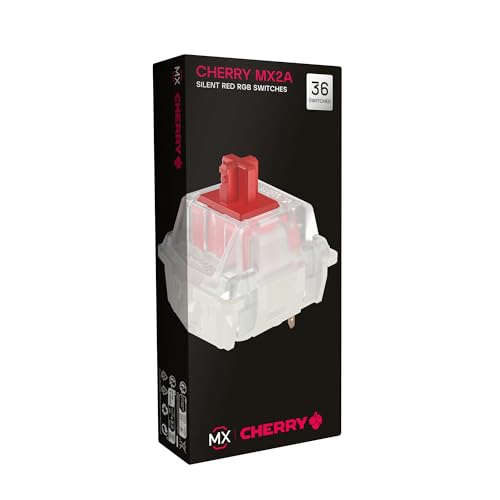
1. Cherry MX2A Silent Red — the quietest complete package
Badge: Quietest overall.
- Type: silent linear, smooth and quiet by design
- Generation: MX2A, Cherry’s current platform
- Pack: 36-switch kit, RGB version
- Character: a muted tap, identical from key to key
- Intended uses in the listing: DIY, hot-swap, custom and gaming keyboards
Cherry’s silent red has been the category’s reference for years, and in its MX2A generation it earns first place here on the unglamorous virtue that matters most at 2 a.m.: uniformity. Every switch in the kit quiets to the same soft tap, at both ends of the stroke, so a converted board settles into a single low murmur with no individual key announcing itself. The feel is a fraction firmer and more deliberate than its Gateron rival — a controlled press rather than a glide — and for the professional converting a board they intend to keep for years, that deliberateness reads as quality.
The 36-piece kit suits compact and tenkeyless boards; full-size conversions need a second kit, which is the ranking’s only recurring complaint about its winner. Buy it when the quiet must be total and the board is a keeper.
Strengths
- The most complete and consistent silencing in the ranking
- MX2A generation refinement throughout
- A firm, deliberate feel that survives the dampening
Trade-offs
- Kit size leaves full-size boards one purchase short
- Firmer feel may not suit the lightest-touch typists
- Premium positioning among silent linears
Best for: professionals, keepers of boards, total-quiet seekers. Not suited for: bargain full-size conversions.

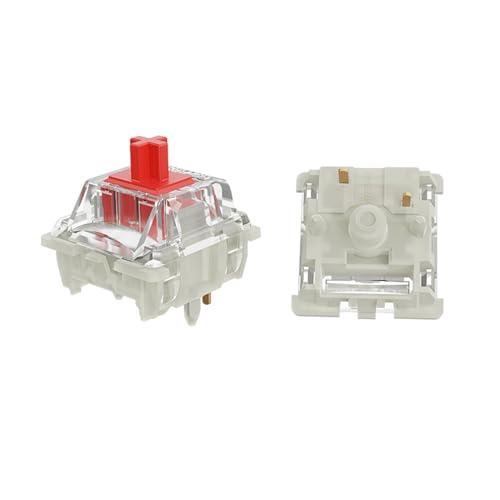
2. Gateron KS-9 2.0 Silent Red — the softer second
Badge: Best quiet linear for gamers and light typists.
- Type: silent linear, pre-lubed
- Pins: 5-pin
- Pack: 35 switches
- Housing: RGB LED compatible
- Character: light, smooth, a soft low thock
Second place here is a photo finish. Gateron’s silent red silences nearly as completely as the Cherry, with a lighter spring and a softer landing that many hands — gamers’ hands especially — prefer across a long session. The factory lubrication keeps the stroke clean, the quiet holds at both ends of the travel, and in a gaming household the difference it makes to voice chat and sleeping partners is transformative. It concedes first place only on the winner’s uniformity and firmer authority; on feel-first judging, plenty of typists will promote it, and this ranking will not argue with them.
Thirty-five switches cover compact boards; the 5-pin legs seat securely and trim easily for 3-pin plates. For a first quiet conversion that must also game, this is the ranking’s most forgiving recommendation.
Strengths
- Serious quiet with the softest, lightest feel in the top ranks
- Pre-lubed smoothness from the box
- The natural choice for night gaming
Trade-offs
- A shade less uniform than the Cherry across a full board
- Light spring invites accidental presses from resting fingers
- Pack size suits compact boards best
Best for: night gamers, light typists, first conversions. Not suited for: heavy-handed typists wanting a firm landing.

3. Akko V3 Penguin — quiet with a bump
Badge: Quietest tactile for office typing.
- Type: silent tactile, pre-lubed
- Force: 50gf as stated in the listing
- Pins: 5-pin, standard MX structure
- Pack: 45 switches
- Character: a friendly bump inside a hush
The Penguin is the ranking’s proof that quiet and feedback can coexist. Its bump survives the silencing with its information intact — the finger knows, the room does not — and that combination is the office typist’s whole requirement in a single switch. At 50gf it sits at the weight most hands find neutral, and Akko’s V3 consistency means the quiet is even across the board. It ranks below the two linears only because a tactile event, however well damped, carries a whisper more presence than a pure glide; typists who need the bump will consider that whisper the best bargain in the list.
Forty-five switches is a practical pack for the compact and tenkeyless boards of office life. If your work is words and your room is shared, stop reading the ranking here and buy this one.
Strengths
- A genuine bump with genuine quiet — the office ideal
- 45-piece pack fits working boards
- Pre-lubed, consistent V3 manufacture
Trade-offs
- A tactile event is never quite as hushed as a linear glide
- The bump softens slightly versus loud tactiles
- Gamers will still prefer the linears above
Best for: office typists and hybrid workers. Not suited for: pure gamers or absolute-quiet purists.

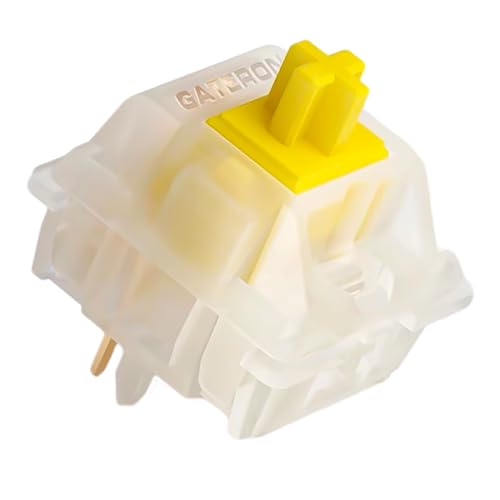
4. Durock Silent Shrimp T1 — the strong, silent bump
Badge: Quietest strong tactile.
- Type: silent tactile, pre-lubed
- Weight: 67g as stated in the listing
- Silencing: patented silencing rings
- Pins: 5-pin
- Pack: 90 switches
- Positioning in the listing: quiet office and night gaming
The Shrimp should not work as well as it does: a genuinely strong tactile bump, the kind deliberate typists crave, wrapped in silencing rings that keep the event almost as private as the Penguin’s gentler one. It ranks fourth because its strength is a specialisation — 67g is a commitment, and light typists will feel every gram by the afternoon — and because a big bump, however damped, speaks a little more than a small one. For the heavy-handed typist in a shared house, though, it is not fourth; it is the only entry on the list, and its 90-piece pack converts the full-size board that typist probably owns in a single purchase.
Strengths
- The strongest bump available at this quiet level
- 90-piece pack — the ranking’s best coverage
- Ring silencing is engineered, not padded on
Trade-offs
- 67g fatigues light typists
- Strength and quiet trade against each other at the margins
- Too deliberate for fast gaming
Best for: deliberate typists with full-size boards in shared homes. Not suited for: light-touch typists or gamers.

5. Gateron KS-9 3.0 Silent Purple — the newer-generation quiet tactile
Badge: Best for buyers who want the latest Gateron silent tactile.
- Type: tactile silent, pre-lubed
- Generation: KS-9 3.0
- Pins: 5-pin
- Pack: 35 switches
- Housing: RGB LED compatible
- Character: a composed, modern quiet bump
Gateron’s silent line did not stand still at the red that ranks second here, and the KS-9 3.0 Silent Purple is its tactile evolution: a newer-generation housing and tuning carrying a quiet bump for typists who want Gateron’s feel with feedback included. It ranks fifth on evidence rather than merit — the design is newer, its long-term community record shorter than the Penguin’s — but on the desk it is a composed, modern switch whose quiet is complete at both ends of the stroke and whose bump is sized for all-day typing rather than statement-making. Early adopters and Gateron loyalists will find it the most interesting switch in the ranking; cautious buyers will find the Penguin the safer expression of the same idea.
Strengths
- Newest-generation Gateron silent tactile tuning
- Complete silencing with a working-day bump
- Pre-lubed and RGB-friendly
Trade-offs
- Shorter track record than the Penguin
- 35-piece pack is compact-board sized
- Character is composed rather than distinctive
Best for: Gateron loyalists and early adopters wanting a quiet tactile. Not suited for: buyers who want the most proven option only.
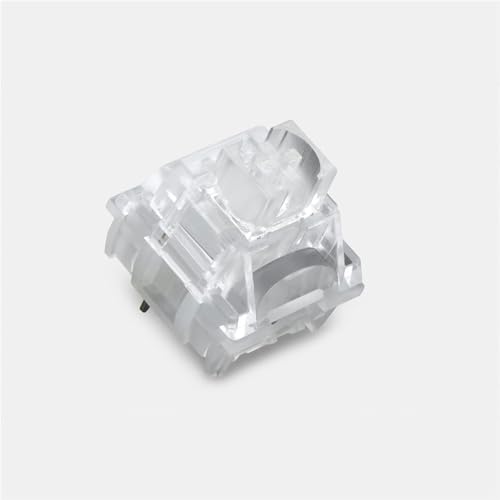
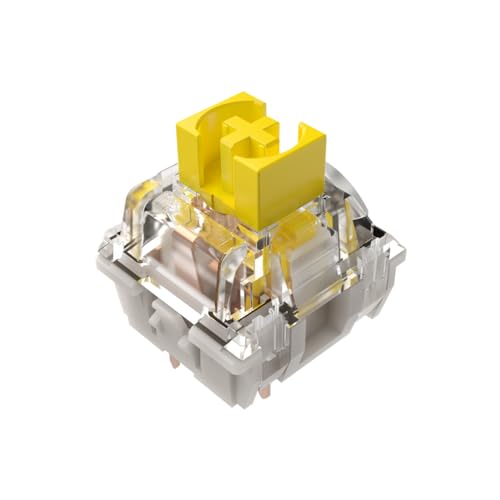
Bonus: TTC Frozen Silent V2 — the premium engineered hush
Badge: Best big-pack silent linear for a full conversion.
- Type: silent linear, pre-lubed
- Housing: transparent, RGB-friendly
- Pack: 110 switches
- Maker: TTC, via the Metrickeys listing
- Character: a cool, engineered quiet with a smooth stroke
The Frozen Silent V2 sits outside the five because its appeal is as much practical as acoustic: 110 switches in one pack converts any board in this guide’s world with rotation stock to spare, and TTC’s engineering gives the quiet a designed, uniform character that many buyers will rank above the Gateron on their own desks. Its transparent housing is the RGB-friendly choice in the list. Consider it the ranking’s shadow member — the switch most likely to be promoted into a future top five, and the one to buy when pack arithmetic and a premium feel matter as much as the last degree of hush. Its family context is mapped in ttc switches complete guide.
Strengths
- 110-piece pack converts anything, with spares
- Engineered, uniform quiet from a respected maker
- Transparent housing flatters RGB boards
Trade-offs
- Premium tier positioning
- Less community lore than the Cherry and Gateron standards
- Its feel is cool and precise — not everyone wants that
Best for: full-size conversions and TTC-curious buyers. Not suited for: small trial purchases.

Bonus: Kailh Box Silent Pink — light, sealed and quiet
Badge: Best light silent linear for small hands and gentle typists.
- Type: silent linear in Kailh’s box design
- Force: 35gf as stated in the listing
- Pins: 3-pin
- Pack: 36 switches
- Design notes in the listing: waterproof positioning
- Character: feather-light, soft, sealed-feeling
The lightest touch in this guide belongs to the Silent Pink: a 35gf box-design linear whose sealed attitude suits real desks and whose featherweight spring suits smaller hands and the gentlest typists. It is a bonus rather than a ranked five for the same reason it delights its owners — that lightness is a specialisation. Resting fingers will register on it; deliberate typists will find it vague. But in the nursery-adjacent study, on the family desk, under the hands of a young typist learning the mechanical world, its combination of quiet, lightness and environmental shrug is unmatched in this list.
Strengths
- The lightest, gentlest press in the guide
- Box design shrugs off dust and splashes
- 3-pin format fits the widest range of boards
Trade-offs
- Accidental presses are the price of 35gf
- Too light for deliberate or heavy typists
- 36-piece pack is a compact-board quantity
Best for: gentle typists, family desks, small hands. Not suited for: heavy-handed users or deliberate typists.
What else decides how quiet your keyboard is?
The switch is the largest voice in the choir, not the only one. Stabilisers under the long keys rattle independently of any switch and will betray the quietest conversion in this ranking until they are lubricated — the stabiliser grease and technique in the ultimate guide lube your mechanical keyboard switches are the standard cure. A hollow case drums; foam or a heavier case calms it. Thin keycaps ring; thick ones thud. A bare desk broadcasts; a mat absorbs. And the typist is a volume control: a bottom-out-heavy technique can double a silent board’s output, while the tactile entries in this ranking quietly train a lighter one by confirming the press before the landing. Work the chain in that order — switch, stabilisers, case, caps, surface, technique — and each link makes the next one’s improvement audible.
How do you convert a board to one of these switches?
Step 1: Choose by listener, not by ranking
Name the person or microphone the quiet is for. A sleeping household rewards the Cherry or Gateron linears; a meeting rewards the Penguin’s accuracy-with-hush; a deliberate typist in a shared study is the Shrimp’s whole reason to exist. The ranking orders quality; your listener orders the shortlist.
Step 2: Count, check pins, then order
Count the board’s keys and match the pack — the Frozen’s 110 and the Shrimp’s 90 are the one-purchase conversions; the 35 and 36-piece kits need doubling for large boards. Confirm 3-pin versus 5-pin, and that the board is hot-swappable, before money moves.
Step 3: Convert in zones and record the difference
Swap the alpha cluster first, record a phone voice memo of the same paragraph on old and new switches from the same distance, and let your own ears ratify the purchase before the rest of the board follows. Then finish the board, stabilisers included, in the same sitting.
Step 4: Give the quiet a week
The cushioned landing that every switch in this ranking shares feels foreign for days. Judge after a week of real use, in the room and at the hour that motivated the conversion — that judgement is the one your household will live with.
What mistakes do quiet-switch buyers make?
Believing a decibel number from a listing is the first; no two listings measure alike, and most measure in conditions nothing like your room. Buying the quietest switch and ignoring the stabilisers is the second — the spacebar will review your purchase to the whole house. Under-ordering for a full-size board is the third, and the pack table in this guide exists to prevent it. The fourth is choosing a featherweight like the Silent Pink for a heavy-handed typist, or the Shrimp for a light one: quiet cannot rescue a weight mismatch. And the fifth is expecting silence rather than quiet — a mechanical board hushed to a murmur is a triumph, and the buyer who demands a void will be disappointed by physics itself.
Final recommendation
Buy the Cherry MX2A Silent Red for the most complete quiet and a board you will keep; buy the Gateron Silent Red if your hands are lighter or your nights are for gaming. Typists should take the Penguin for the office or the Silent Shrimp for deliberate work in a shared home, Gateron loyalists should audition the Silent Purple, and anyone converting a full-size board in one purchase should look hard at the TTC Frozen’s 110-pack. The Kailh Silent Pink owns the gentle end of the world. Whichever you choose, finish the job — stabilisers, mat, a week of patience — and the result will be the thing this ranking actually sells: a mechanical keyboard that sounds like consideration.
Rankings end, but the test that matters happens on your desk, in your room, for your listener. Order the switch your situation names, run the paragraph test, and trust the doorway at midnight over every word of this guide — including the ranking itself. The switches collected here have ended more household keyboard arguments than any other upgrade in the hobby, and the one that ends yours is the true number one, whatever order this page printed them in.
How do the silencing designs in this ranking differ?
The seven switches silence by three philosophies, and the ranking makes more sense once they are named. The damper philosophy — Cherry’s and Gateron’s silent reds, the Penguin — places soft material where the stem lands and returns, absorbing the stroke’s two collisions directly. It is the proven approach: predictable, effective, and responsible for the cushioned landing the category is known for. The ring philosophy, Durock’s patented route in the Shrimp, distributes the cushioning around the stem so a strong tactile event can be hushed without being dismantled — the reason a 67g bump can sit in a quiet ranking at all. The engineered philosophy — TTC’s Frozen, Kailh’s box architecture in the Silent Pink — builds quiet into the switch’s structure and sealing, so the hush feels less like padding and more like precision. None wins absolutely. Dampers are the softest landing, rings preserve the most character, engineering feels the most normal — and the ranking’s order reflects how completely each execution serves the average night, not a hierarchy of ideas.
Quiet switches for gaming: what changes after dark?
Gaming after dark is where quiet switches earn their most emotional reviews, because the alternative is not playing. The linears in this ranking lose nothing in game: registration is a contact event, untouched by dampers, and the Gateron Silent Red in particular has become a default for players whose households sleep on the other side of a wall. What changes is the session’s social texture — voice chat carries your callouts without a percussion section, and the frantic movement-key rattle that used to announce a fight to the whole flat becomes a murmur only you can hear. The tactiles serve slower titles after dark; the Shrimp’s own listing names night gaming, and for deliberate, turn-based or strategy play its quiet authority is a genuine pleasure. The one caution is competitive rhythm play, where the lightest and fastest switches rule — that world’s equipment logic lives in the best switches for osu, and even its players keep a quiet board for the hours when the house is asleep.
Quiet switches for streaming and recording
A microphone is the least forgiving listener a keyboard will ever have: it sits close, it amplifies, and audio compression pumps quiet sounds up toward the voice. Streamers learn that a board which seems quiet in the room can sound like rainfall on the recording. The switches in this ranking remove the sharp transients compression loves most — the click and clack edges — leaving a low murmur that gates and noise suppression can actually handle. Pair a ranked switch with a desk mat and a microphone positioned for your voice rather than your desk, and the keyboard effectively leaves the broadcast. Podcasters and remote presenters report the same settling: the board stops being a character in the recording. If your living is made in front of a microphone, the Cherry’s uniformity is worth its premium to you specifically, because a single louder key in a board is a sound an audience learns to wait for.
Three listeners, three right answers
The newborn’s parent needs the quiet to survive the wall between the study and the nursery, at the hour when every sound is audited. Any of the top three serves; the Gateron’s softness gets the nod because exhausted typing is heavy typing, and its landing forgives. The open-plan colleague needs quiet at conversational distance plus the accuracy that prevents the louder sound of constant correction — the Penguin, whose bump keeps errors and backspaces down, is the considerate professional’s switch. The streamer needs quiet at microphone distance, which is no distance at all, and needs it uniformly — the Cherry, with the Frozen as the big-board alternative. Rankings flatten people into averages; listeners restore them. Identify yours, and this list reorders itself around them, which is what a good ranking should do when it is read properly.
How do quiet switches age?
Dampers are the mortal part of a silent switch: soft materials compress across years of landings, so an elderly silent switch grows fractionally louder and firmer, ageing gracefully toward an ordinary switch rather than failing. Springs tire on the usual schedule, housings collect the room’s dust — the Silent Pink’s box design and the Frozen’s engineering slow that part — and the board’s quiet drifts so slowly that owners usually notice only when a fresh replacement switch lands beside a veteran and sounds, for a week, like the new one is showing off. Rotation and spares, the habits this cluster’s guides keep recommending, apply with double force here: the switch you replace for wear should be replaced from the same pack the board was built with, so the newcomer matches its neighbours’ voices as closely as time allows.
Why does the same switch sound different in every room?
Sound is a relationship between a source and a space, and the space keeps changing its side of the bargain. Hard rooms — bare walls, wooden floors, a desk against a corner — reflect a keyboard’s output back at the listener and add their own resonance, so a silent board in a spare room can sound louder than a normal board in a furnished one. Soft rooms absorb: curtains, carpets, bookshelves and upholstered furniture all eat the high frequencies that make keyboard noise feel sharp. Night changes the equation again, not by changing the board but by removing the masking sounds — traffic, conversation, the house’s daytime hum — against which a murmur used to hide. This is why the guide insists on judging in the real room at the real hour, and why two honest reviewers can rank the same switches differently without either lying: they are reporting different rooms. Your room is the only review site that matters, and every switch in this ranking was chosen to perform well in the least forgiving version of it — quiet, hard-surfaced and occupied by someone you love.
A complete quiet-board recipe using this ranking
For readers who want the destination rather than the journey: choose the Cherry Silent Red for a compact or tenkeyless board, or the TTC Frozen’s 110-pack for a full-size one. Add the Penguin instead if your typing accuracy needs a bump, accepting its whisper of extra presence. Set the board on a desk mat thick enough to matter. Lubricate the stabilisers before the first evening’s typing, not after the first complaint. Use the thickest keycaps your board’s stems accept if its stock caps are thin, because caps are the cheapest voice change left once the switches are chosen. Record the paragraph test before and after, keep the spares from the pack in a labelled bag, and give your hands the week this guide keeps prescribing. That recipe, executed whole, produces a board whose sound surprises visitors — they notice the keyboard is mechanical only when they press a key and feel what the quiet was hiding.
What about the shortcuts — o-rings, foam and tape?
They have their place, and the place is after the switch, not instead of it. O-rings soften only the landing, shorten travel, and leave the return stroke ticking; case foam eats resonance, which is real but secondary; tape modifications change a board’s voice in ways their fans love and this ranking takes no position on. The pattern across all of them is partial treatment: each addresses one link of the noise chain while the switch — the source — keeps its full voice. A buyer with a fixed budget should therefore fund the chain in order: the ranked switch first, the mat and stabiliser grease alongside it, and the shortcuts with whatever remains. Reversed, the same money buys a loud switch in a well-damped case, which is a quieter room and a louder keyboard, and only one of those was the goal.
How did quiet switches get this good?
A generation ago, “quiet mechanical keyboard” was a contradiction the market resolved by selling membrane boards to offices and apologising. The change came in stages: Cherry’s first damped designs proved a switch could be hushed without being ruined; the streaming and open-office eras created a mass audience that needed the proof productised; and the current generation — MX2A refinement, Gateron’s layered KS-9 line, Akko’s V3 pair, Durock’s rings, TTC’s Frozen, Kailh’s sealed boxes — is the idea at maturity, a shelf of distinct quiet personalities rather than a single compromise with a silencer screwed on. The ranking above is what maturity looks like: seven switches, three silencing philosophies, two feels, and no entry a buyer needs to apologise for. The category’s next chapter is already audible in the Frozen’s engineering — quiet designed into structures rather than added as padding — and a future edition of this ranking will likely be led by it.
Keeping the quiet: care for damped switches
A quiet board asks for slightly different housekeeping from a loud one, because its failures are audible in a new way: not breakdown, but contrast. One scratchy key in a loud board disappears into the general noise; in a quiet board it becomes the loudest thing in the room. Keep grit out with a cover or a weekly brush-down, since debris against a damper both scratches and sounds. When a key does grow noisy, diagnose before replacing: a cap reseated, a stabiliser re-greased and a housing blown clean cure most cases, and the switch itself is the last suspect, not the first. Replace from the original pack when replacement is truly needed, so the new voice matches the aged choir as closely as possible. And keep the board’s quiet a habit rather than a project — a minute of care a month is the whole maintenance budget of the switches in this ranking, which is part of what their money buys.
Buying by board size: the pack arithmetic, settled
Compact boards up to tenkeyless are the easy cases: every kit in this ranking covers them, and the choice can be made purely on feel and listener. Full-size boards are where arithmetic becomes advice. The Frozen’s 110 and the Shrimp’s 90 are the only single-purchase full conversions here — the Shrimp with a handful to spare on most layouts, the Frozen with a genuine rotation stock. The Cherry, Gateron, Penguin and Pink kits all require a second purchase for a full-size board, which changes their true cost and should be counted before their ranking positions are compared. None of this is hidden by the sellers; it is simply arithmetic that listings leave to the buyer, and a ranking that respects its readers does it for them. Count your keys tonight, and tomorrow’s shortlist will be shorter and truer.
The return stroke: the forgotten half of quiet
Half of every keystroke’s sound happens on the way up, and it is the half that separates this ranking’s winners from the also-rans. A press is an act of intention — fingers expect its sound and forgive it. A release is the switch’s own event, a small snap of stem against housing top that listeners perceive as the keyboard’s idle chatter, the ticking between the words. Cheap silencing damps the landing and forgets the return; every switch ranked here damps both, which is why their boards sound calm rather than merely soft. When you audition a quiet switch — in a tester, in a converted zone, in the paragraph test — listen to the gaps between presses as carefully as to the presses themselves. A switch whose returns are hushed produces a board that sounds like breathing; a switch whose returns tick produces a board that sounds like a clock, and clocks are what sleeping households count. The ranking’s top two earned their positions substantially in those gaps.
Matching quiet switches to typing weight
Quiet does not abolish the oldest matching rule in this cluster: the switch must fit the hand. Heavy typists drive through dampers to the housing floor, and for them the firmer executions — the Cherry’s deliberateness, the Shrimp’s authority — stay quieter in practice than a soft switch being bottomed out with force, because an undriven damper cannot absorb an impact that overwhelms it. Light typists float across the Silent Pink and the Gateron Red with barely a landing to silence, and for them the ranking’s order inverts happily: the gentlest switches are also, in their hands, the quietest. The practical test is the one from the conversion section — record your own paragraph — performed with your natural force rather than a reviewer’s. A ranking can order designs; only your hands can order their results, and the difference between the two orderings is the most useful thing a trial conversion teaches.
What does quiet cost, and where is the value?
Silent switches carry a premium over their loud equivalents in every family here, and the premium buys engineering: dampers, rings, sealed structures, tighter consistency. Judged per year of use, the arithmetic is gentle — a board converted once and typed on for five years amortises its switches to a triviality per day, and the household peace it purchases is not trivial at all. Judged per pack, the ranking’s value entries are the big ones: the Frozen and the Shrimp convert full-size boards without a second purchase, which quietly erases much of their apparent premium. The Cherry’s premium buys uniformity, the Gateron’s accessibility buys the category’s best ratio of quiet to outlay for compact boards, and the Pink’s small kit buys a trial. There is no wasteful purchase in this ranking; there are only mismatches between a switch’s specialisation and a buyer’s actual listener, hand and board — and the whole guide exists to prevent exactly those.
The etiquette of quiet: keyboards in shared housing
A quiet keyboard is a social instrument, and its purchase is often a negotiation concluded. The etiquette worth observing runs both ways. The typist owes the household the reasonable conversion — a ranked switch, a mat, stabilisers that do not rattle — after which the board’s murmur is a fair sound of someone living their life. The household owes the typist the recognition that murmur is not noise pollution but presence, no more actionable than a page turning. Couples, flatmates and families who reach that settlement stop auditing each other’s sounds entirely, which is the real product this ranking sells. Students in dormitories should know the settlement is achievable even there: a Gateron Silent Red conversion is consistently reported as the upgrade that ended the keyboard conversation in shared rooms, and it costs less than the headphones everyone was about to buy each other. Readers choosing for a gaming household after dark will find the same logic, at higher tempos, in the best switches for gaming — where the quiet entries and the fast entries turn out, happily, to overlap.
A last word on measuring quiet yourself
Everything in this ranking can be verified on your own desk with a phone and a paragraph, and the guide closes by urging the experiment because it converts readers into measurers. Record the before. Convert one zone. Record the after, same distance, same paragraph, same honest typing force. Then play both recordings to the listener the conversion was for, in the room it was for, and let them judge blind if you can arrange it. Their verdict outranks this ranking, the manufacturer’s claims and your own hopes, because it is the only measurement taken in the conditions the switch will actually live in. Most such experiments end with the full conversion funded within the week — not because the difference is dramatic in the recording, but because it is dramatic in the doorway, at midnight, where it counts.
The family computer: quiet as a shared feature
One desk in many homes serves everyone’s computing — homework, household admin, a parent’s evening work, a teenager’s games — and it is the strongest argument in this guide for converting to quiet by default rather than by complaint. A family board on the Cherry or the Penguin offends no user and no bystander; its switches suit every hand that sits down, within the weight logic the guide describes, and its murmur becomes part of the house’s ordinary soundscape rather than an event anyone comments on. The Silent Pink earns a specific mention here: younger and smaller hands genuinely benefit from its lightness, and a family board that a child can type on comfortably, in the evening, in a shared room, is a small domestic triumph that this ranking is proud to recommend. Choose the family board’s switch by its lightest-handed regular user, keep the spares, and the quiet will simply become how the house sounds.
The quiet board as a household negotiation
It is worth ending the argument where it actually lives: not in a laboratory but in a home, where a keyboard’s noise is a social fact. The quietest switch in this guide will not save a board whose owner types like weather, and the loudest will not doom a typist whose household keeps different hours — the switch is one term in a negotiation among people, rooms and schedules. That is why the guide’s method is a test in your own space rather than a decibel table: the only threshold that matters is the one on the other side of your wall, your door, your call. Buy the switch that clears that threshold with the most feel left over, set the board up with the mat and the caps that finish the job, and then stop optimising — a quiet board’s final virtue is that it lets everyone, typist included, forget the subject entirely. Silence, achieved, should be silent about itself.
Frequently asked questions
What is the quietest mechanical keyboard switch?
On completeness and consistency of silencing, the Cherry MX2A Silent Red leads this ranking, with the Gateron Silent Red a softer-feeling close second. Absolute quietest depends on the board and room around the switch, which is why the guide ranks silencing quality rather than publishing a decibel figure.
Are silent tactile switches as quiet as silent linears?
Very nearly. A well-damped tactile like the Penguin comes close enough that the difference rarely matters in a real room; the strong Shrimp trades a whisper more presence for its big bump. The gap between a silent tactile and a loud linear is vastly larger than the gap between silent families.
Do quiet switches feel mushy?
The landing is cushioned by design. Light typists often notice little beyond the quiet; heavy bottom-out typists feel the cushion most. Engineered designs — the Shrimp’s rings, TTC’s Frozen — keep the landing firmer than basic damper designs, which is part of their appeal. If the word mushy is what has kept you from trying the category, the honest experiment is a single converted zone judged after a week rather than a minute: most typists who run it discover the sensation renames itself from mushy to cushioned somewhere around day three, and the ones who still dislike it have learned something true about their hands for the price of one small pack.
How many switches do I need to make my keyboard quiet?
Every key you use — roughly 61 for a compact board, 87 for tenkeyless, 104 for full-size — because one loud zone betrays the conversion. Match your count to the pack sizes above, remembering the Frozen’s 110 and the Shrimp’s 90 cover full-size boards alone.
Can I make only some keys quiet?
Yes, and night workers often quiet just the alpha cluster and spacebar zone. The sound difference between zones will be obvious, but if the loud keys are only used by day, a partial conversion is a rational saving rather than a compromise. Partial conversions also serve as the cheapest audition in this guide: quiet the keys you type most, live with them beside their loud neighbours for a fortnight, and the contrast will teach you more about your own preference than any ranking — including whether the full conversion is a need, a want, or a pleasure you can schedule for later.
Are quiet switches a good choice for a first mechanical keyboard?
For anyone whose keyboard will be heard by others, they are arguably the best first choice: the conversion question never arises, the household negotiation is settled from day one, and modern quiet switches like the Gateron Silent Red and the Penguin feel fully mechanical rather than compromised. A solo-room enthusiast may prefer to start loud and choose quiet later with full information — both paths are respectable, and the ranking serves the second as happily as the first.
Do quiet switches work in any hot-swap keyboard?
They use the standard MX stem and the usual 3-pin and 5-pin formats, so any hot-swap board that accepts your pin type accepts these switches. The Kailh Pink and any 3-pin entry fit the widest range directly; 5-pin switches may need their plastic legs trimmed for strict 3-pin plates, a standard and harmless adjustment. Soldered boards, as always, are a desoldering project rather than a swap.
Will a quiet switch make my keyboard silent on calls?
It will make it unobtrusive: the sharp clatter that microphones amplify disappears, leaving a murmur that call audio handles gracefully. Microphone placement still matters — keep the mic closer to your voice than to the board — but a ranked switch from this guide plus a mat is the setup most remote workers settle on.