Disclosure: As an Amazon Associate, kajuandouglas.com earns from qualifying purchases. Links on this page are affiliate links; they cost you nothing extra. Prices and availability change often, so check the current Amazon listing before you buy.
This akko switches complete guide exists because Akko quietly became one of the most important switch makers in the hobby — and one of the most confusing to shop. The company’s switches arrive in waves of colour-named families, Pro generations and silent variants, sold in 45-piece packs at prices that undercut the famous names while matching or beating their factory lubrication. The seven switches linked in this guide are the current, verified core of the range: three V3 Pro switches covering linear, light tactile and strong tactile; two silent switches for the shared-room world; and two newer linears — the Piano U1 and the LED-friendly Starlit — that show where the line is heading. Together they answer nearly every switch question a buyer can ask, at the tier where switch shopping stops requiring a spreadsheet.
The guide is organised the way the decision actually happens. First the anatomy — what the names, generations and specifications mean, so a listing reads like a label rather than a horoscope. Then each switch gets its own hearing: force, character, the board and typist it suits. Then the comparisons that decide real purchases, and a fitting guide so the pack you buy goes into the board correctly. By the end, the colour names will have become a map with a destination on it.
Key takeaways: Akko’s range resolves into three families that matter: the V3 Pro line (Creamy Yellow linear, Creamy Blue light tactile, Lavender Purple strong tactile), the silents (Penguin tactile, Fairy linear), and the newer linears (Piano U1, Starlit). All are 5-pin, MX-compatible and factory-lubed to a standard that embarrasses dearer switches. Buy by feel family first and force second — and know that 45 pieces cover a 60 or 65 percent board, while larger boards need two packs.
Where to buy and how this guide handles akko switches complete guide
Every switch linked below was confirmed in this site’s verified catalogue data, and each review ends with a Check price on Amazon link to that exact listing. Switch listings demand one specific discipline: the pack count and pin count are part of the product — the picks here are 45-piece, 5-pin packs — so confirm the options on the listing match the review before ordering, since the same page may offer different quantities. Where this guide discusses older Akko families, like the CS series that built the brand’s reputation, it does so in prose as range history; the linked recommendations are the current verified line.
A note on how feel is described in switch guides, this one included. Force figures quoted — the gram-force numbers in the listings — are the manufacturers’ own, and they describe springs, not souls: two switches at the same weight can feel entirely different through housing materials, stem design and lubrication. The reviews therefore pair every figure with its character in the terms the community has standardised — smooth or scratchy, deep or bright, bump early or late — and the comparison sections translate between families. Trust the pairing of number and character together; either alone will mislead you about a switch you have never pressed.
In this guide
Quick picks: Akko Switches Complete Guide
Seven switches, three families, one decoded brand. If you already know whether you are linear, tactile or silent, the shortlist is the fast lane; the hearings underneath give each switch its full character, and the sections after them handle the cross-brand comparisons and the fitting craft.
- Akko V3 Creamy Yellow Pro — the default linear: smooth, 50gf, the switch that made Akko’s name at this tier.
- Akko V3 Creamy Blue Pro — the gentle tactile: a 45gf pre-lubed bump for typists who want confirmation without weight.
- Akko V3 Lavender Purple Pro — the strong tactile: a pronounced pre-lubed bump for fingers that want an event per keystroke.
- Akko V3 Penguin — the silent tactile: bump without broadcast, for shared rooms and open microphones.
- Akko V3 Fairy — the silent linear: smooth and hushed, the night-shift switch.
- Akko Piano U1 — the refined linear: a 45gf lubed switch tuned for a clean, musical bottom-out.
- Akko Starlit — the RGB linear: an LED diffuser in the housing for boards that glow.
How this guide was assembled
The seven were chosen to cover the current Akko range the way a buyer meets it: by feel family, at the weights the families actually sell, in the pack format the listings use. The V3 Pro trio anchors the guide because it is the line’s present centre — the generation where Akko’s factory lubrication and dustproof stems became standard — and because its three members map cleanly onto the three questions every switch buyer asks: smooth, gentle bump, or strong bump. The two silents were included as a family rather than a footnote, because silent switches are a growing share of real purchases and Akko’s pair covers both silent philosophies. The Piano U1 and Starlit represent the line’s newer direction — refinement and RGB engineering — so the guide ends facing forward.
What was excluded matters too. Akko’s back catalogue is deep — the CS series and a dozen colour-named one-offs — and a complete guide names them in the history section rather than pretending they are current recommendations. Switches that could not be verified in current listings were not linked, however fondly remembered. The standard applied throughout: if a reader acts on a link in this guide, they should receive the switch the review describes, in the pack the review counts, at the character the review promises. In a category sold by colour names, that discipline is the guide’s whole reason to exist.
The picks in detail

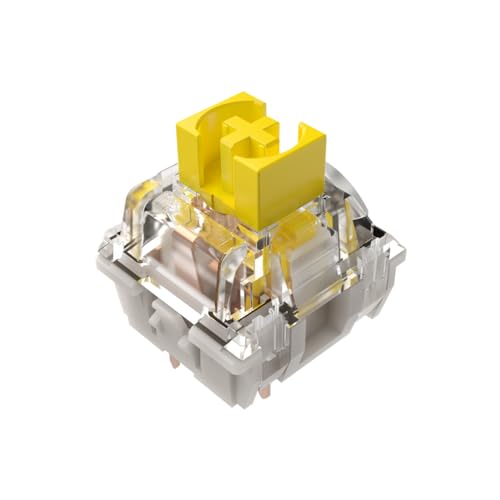
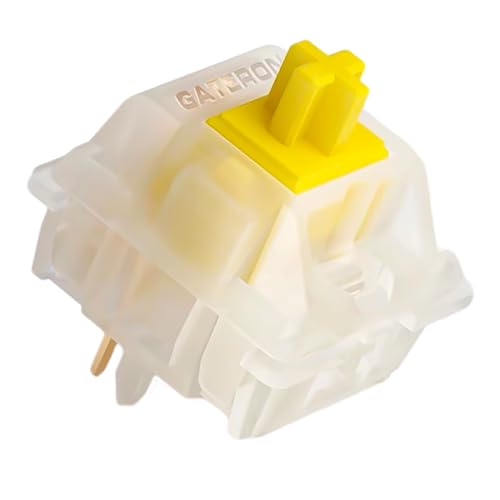
Akko V3 Creamy Yellow Pro — Best Akko linear for most people
At a glance: Linear; 50gf operating force; 5-pin; dustproof stem; factory-lubed; 45 pieces per pack; MX-compatible.
Creamy Yellow Pro is the switch that taught a generation of buyers that factory lubrication could be a feature rather than a rumour. It is a linear — a straight, uninterrupted travel from top to bottom — with a 50 gram-force spring that sits in the sweet middle of the linear weights: light enough for fast gaming repetition, substantial enough that resting fingers do not fire accidental letters. The ‘creamy’ in its name is the community’s word for its character: a smooth stroke with a softened, deep bottom-out sound, the opposite of the scratchy, rattly linears that gave budget switches their old reputation. In a gasket board it is the sound half the internet’s typing videos are chasing.
The V3 Pro generation’s details are the substance beneath the name. The dustproof stem — a walled stem design — reduces the wobble that makes keys feel loose and keeps dust out of the stem’s travel, and the factory lube is applied with a consistency that survives from the first switch in the pack to the forty-fifth. Owners routinely run these switches stock for years, which in switch economics is the whole argument: the pack costs what a pack costs, and the evening with a brush and a lube station that other switches demand is simply never owed.
Its limits are the linear’s eternal ones: no tactile confirmation for the typist who navigates by bump, and a character so smooth that heavy-handed typists may bottom out harder than they intend until their hands calibrate. Gamers will find nothing to miss. Typists between families should hear the honest summary — this is the linear to buy when you do not want to think about linears again, the default against which the rest of this guide’s switches are variations. Most Akko journeys start here, and a good share of them end here too, satisfied.
Strengths
- Creamy, deep and smooth — the reference budget linear
- 50gf spring suits gaming and typing alike
- Factory lube so consistent most owners never open a switch
- Dustproof stem reduces wobble and keeps travel clean
- 45-piece packs priced for whole-board swaps
- The switch that defines value in its class
Trade-offs
- No tactile bump for confirmation typists
- Very smooth travel lets heavy hands bottom out hard at first
- One weight only — spring swappers must look within the range
Best for: Gamers and smooth-stroke typists buying their first or final linear set.
Not suited for: Tactile loyalists who navigate by the bump.

Akko V3 Creamy Blue Pro — Best gentle tactile
At a glance: Tactile; 45gf operating force; pre-lubed; 5-pin; dustproof stem; 45 pieces per pack; MX-compatible.
Creamy Blue Pro is the tactile for people who find most tactiles exhausting. Its bump is present but civilised — a gentle rise and fall early in the travel at a light 45 gram-force — so the finger gets its confirmation without the small workout that strong tactiles charge per keystroke across a ten-thousand-word day. Pre-lubed from the factory, the bump arrives clean rather than scratchy, and the switch’s overall register is calm: this is the tactile that can live in a home office, on calls, in the next room from a sleeping household, without ever becoming a topic of conversation. Writers and programmers who type by feel and work by day in shared air are its natural nation.
Within the Akko range it occupies the deliberate middle: smoother and lighter than the Lavender Purple’s pronounced event, more communicative than the Creamy Yellow’s glide. That middle is where most tactile buyers actually live, which is why this switch, less famous than its siblings, may be the range’s most useful member. In a tray-mount board it stays polite; in a gasket board it becomes positively plush — the bump cushioned at both ends, the confirmation without the clatter.
The honest boundary is strength of character: typists who want the bump to be the point — the Holy Panda school of a round, emphatic event — will find Creamy Blue too diplomatic, and should read the Lavender Purple’s review next. Equally, gamers who rest fingers on keys may find even a gentle bump an interruption during rapid repeats. For the broad middle of typing humanity, though, this is the tactile that asks the least and gives the confirmation that matters, lubed and ready in the pack.
Strengths
- A gentle, clean bump that never tires the fingers
- Light 45gf weight suits all-day typing volume
- Pre-lubed — the bump arrives smooth, not scratchy
- Calm sound suits shared rooms and calls
- The range’s most versatile tactile
- Dustproof stem keeps travel consistent
Trade-offs
- Too diplomatic for strong-bump enthusiasts
- Rapid-repeat gamers may prefer a pure linear
- Less famous than its siblings — fewer community sound tests
Best for: Writers, programmers and office typists who want tactility without weight.
Not suited for: Strong-tactile connoisseurs and hair-trigger gamers.

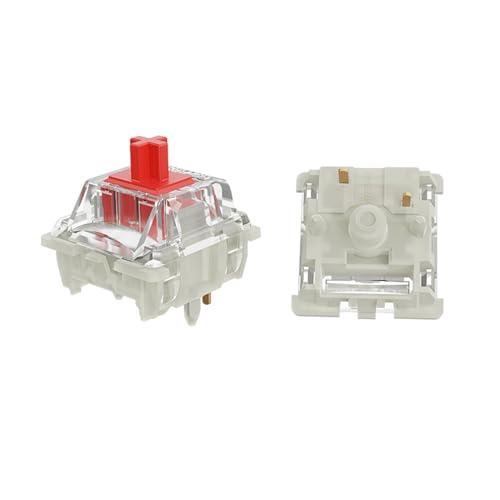
Akko V3 Lavender Purple Pro — Best strong Akko tactile
At a glance: Tactile with a pronounced bump; pre-lubed; 5-pin; dustproof stem; 45 pieces per pack; MX-compatible.
Lavender Purple Pro is the tactile with the volume turned up — not in sound, but in sensation. Its bump is the pronounced kind: a distinct, rounded event near the top of the travel that the finger climbs and falls from with real ceremony, the school of tactility that believes a keystroke should be an experience rather than a notification. Pre-lubed at the factory, that big bump stays smooth through its whole arc, which is the engineering trick lesser strong tactiles miss — an emphatic bump that is also scratchy is just an obstacle, while this one feels like a well-made mechanism doing exactly what it promised.
The switch rewards a particular typing style: deliberate, rhythmic, riding the bump rather than slamming through it. Typists who learn that style describe the Lavender Purple as the switch that made them faster, because the bump’s confirmation lets the fingers lift earlier and trust the actuation — the tactile’s whole ergonomic argument, delivered at full strength. In a firmer board the event stays crisp; in a gasket board it rounds into something almost plush, and either way it is unmistakably the protagonist of the board it is fitted to.
Strength is a commitment, and the costs are real: across a marathon day, a pronounced bump taxes fingers that a gentle tactile would spare, and rapid gaming repetition fights the bump on every return. This is also the Akko tactile most likely to divide a household’s opinion if the board is loud underneath it, though the switch itself is no clicky. Buy it as what it is — the range’s character actor, the tactile for people who have tried gentle and asked for more — and it will not disappoint. It never does anything by halves, including satisfaction.
Strengths
- A pronounced, rounded bump — tactility at full strength
- Pre-lubed so the big bump stays smooth
- Rewards rhythmic typing with real confirmation
- Dustproof stem and V3 Pro consistency
- The range’s character switch
- Makes a board feel deliberate and mechanical
Trade-offs
- Fatiguing for some across marathon typing days
- The bump fights rapid gaming repetition
- Too much event for subtlety seekers
Best for: Tactile enthusiasts who found gentle bumps underwhelming.
Not suited for: All-day high-volume typists with tired fingers, and FPS players.

Akko V3 Penguin — Best silent tactile
At a glance: Silent tactile; 50gf operating force; pre-lubed; 5-pin; MX structure; 45 pieces per pack.
The Penguin solves the silent switch’s oldest problem: most silent tactiles silence the bump along with the sound, leaving a mushy ghost of tactility. Akko’s silent tactile keeps a real bump — a clear, readable event — while its silencing structure absorbs the bottom-out and return noise that make a keyboard audible in the next room. The result is the switch for the typist who navigates by feel and lives by diplomacy: the partner asleep, the baby in the next room, the open microphone in the meeting, all unconsulted and unbothered, while the fingers lose nothing they were using. At 50gf it carries a touch more authority than the Creamy Blue, which suits the deliberate hand silent work often belongs to.
Silent switches achieve quiet through softened contact points, and the honest trade is a landing that feels cushioned where a standard switch feels crisp. The Penguin wears that trade as well as any silent tactile made: the cushion reads as softness rather than mush because the bump above it stays defined, and the factory lube keeps the whole travel clean. In a solid board the effect is startling the first evening — the sound of typing reduced to a low murmur, the board’s presence known only to its user.
Choose the Penguin when the room is the specification. It is not the switch for the sound enthusiast — its whole purpose is the absence they collect — and gamers chasing the crispest reset should know the silencing softens that edge by design. For the shared flat, the night desk, the office where your keyboard is everyone’s neighbour, it is the range’s act of consideration, and it asks for almost nothing in return: the bump survives, the peace does too.
Strengths
- A real tactile bump that stays silent
- Pre-lubed and consistent across the pack
- Suits shared rooms, night work and open microphones
- 50gf authority suits deliberate typists
- Standard MX structure fits mainstream boards
- The considerate switch that sacrifices little
Trade-offs
- Cushioned landing is softer than a standard switch’s crispness
- No sound character for enthusiasts to enjoy
- Silent design softens the rapid-reset edge for gaming
Best for: Shared-room and night typists who refuse to give up the bump.
Not suited for: Sound enthusiasts and crispness-first gamers.

Akko V3 Fairy — Best silent linear
At a glance: Silent linear; 50gf operating force; pre-lubed; 5-pin; MX structure; 45 pieces per pack.
The Fairy is the Penguin’s linear sibling: the same silencing discipline applied to a smooth, uninterrupted stroke, for the gamer and typist whose hours are antisocial and whose feel preference is glide. Silent linears live or die by their landing — the silencing that hushes them can turn the bottom-out to foam — and the Fairy’s factory tuning keeps the landing soft but defined, a quiet thud rather than a sponge. At 50gf it matches the Creamy Yellow’s weight, so a player can run the Yellow by day and the Fairy by night with the same springs under their fingers and no recalibration of the hand between them. That pairing logic is deliberate range design, and it is elegantly done.
In use, the Fairy turns a gaming board into a considerate one without changing its manners: rapid repeats stay clean, the stroke stays smooth, and the room hears a murmur where the standard linear announced a session. Streamers with sensitive microphones and players in bedsit geometry are its obvious nation, but so is anyone whose keyboard shares a wall with a nursery. The pre-lubing is up to the V3 family’s standard, which in a silent switch matters doubly, because a silent switch’s remaining sound is mostly friction — and friction is what the lube removes.
The trades mirror the Penguin’s: a cushioned landing where crispness was, and no acoustic character to collect. A silent linear also reveals a board’s other noises — stabiliser rattle that a louder switch used to mask will suddenly be the loudest thing you own, which is a compliment to the switch and a chore for the board. Fitted into a tuned board, the Fairy is the range’s peace treaty: full performance, no broadcast, and a 50gf spring that asks your fingers to change nothing at all.
Strengths
- Silent linear glide for night gaming and shared rooms
- Same 50gf weight as Creamy Yellow — an easy day/night pair
- Soft but defined landing, not a sponge
- Pre-lubed: friction noise engineered out
- Standard MX structure, 5-pin
- Keeps full gaming manners at a murmur
Trade-offs
- Cushioned bottom-out softens crispness
- Exposes stabiliser rattle the louder switches masked
- No sound character for enthusiasts
Best for: Night gamers, streamers and shared-room players who love linears.
Not suited for: Sound collectors and crisp-landing purists.

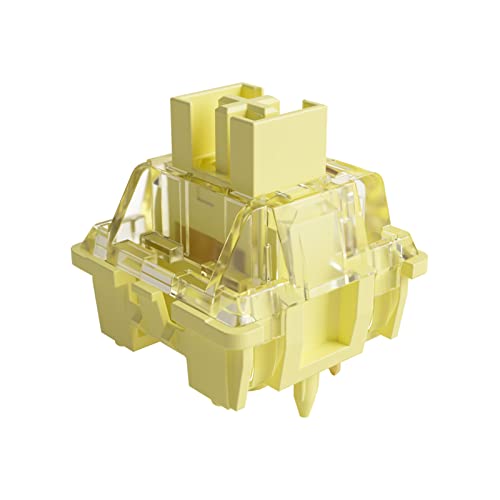
Akko Piano U1 — Best refined linear
At a glance: Linear; 45gf operating force; lubed; 5-pin; MX-style structure; 45 pieces per pack.
The Piano U1 is Akko refining its linear art: a 45gf switch — a touch lighter than the Creamy Yellow’s 50 — tuned, as its name promises, for a clean and musical bottom-out. Where the Yellow is the all-round default, the Piano is the typist’s linear: the lighter spring and the tuned housing produce a stroke that feels composed at writing speed, each key landing with a single, pitched note rather than a thud, so a fast page of typing takes on the even rhythm the name advertises. It is the switch for the user who has tried the default and wants the same idea with the edges polished for the desk rather than the arena.
Factory lubrication is again the quiet headline — the Piano arrives lubed and consistent, ready to run stock in the way this range has made normal. The 45gf weight deserves its own sentence, because it is the Piano’s main practical difference: fingers that found the Yellow’s 50gf a fraction firm across a long day will feel the relief immediately, while gamers who rest heavy fingers on movement keys should note that a lighter spring forgives less accidental pressure. Neither is a flaw; they are the two sides of a gram, and this guide’s job is to make the gram legible before it is purchased.
Against the Creamy Yellow, the Piano is a matter of register: brighter and lighter against deeper and weightier, the typist’s instrument against the all-rounder. Owners of both describe keeping the Yellow in the gaming board and the Piano in the writing board, which is the range working exactly as designed. If your board is a writing desk first and your touch is light, the Piano U1 is the Akko linear tuned for your hand — and its name, for once in switch marketing, is a fair description of the experience.
Strengths
- A lighter 45gf spring that spares long-day fingers
- Tuned for a clean, pitched, musical bottom-out
- Factory-lubed and consistent out of the pack
- The typist’s linear in the Akko range
- Standard MX-style fit, 5-pin
- Refinement of a proven formula rather than a reinvention
Trade-offs
- Lighter spring forgives less resting-finger pressure
- Brighter register than the deep Creamy Yellow
- Aimed at typists — gamers may prefer the 50gf default
Best for: Light-touch typists and writers who want a composed linear.
Not suited for: Heavy-resting gamers and deep-sound seekers.

Akko Starlit — Best Akko switch for RGB boards
At a glance: Linear; 45gf operating force; pre-lubed; 5-pin; LED diffuser built into the housing; 45 pieces per pack.
The Starlit exists for the boards that glow. Its housing carries an LED diffuser — a light-guiding element that takes the board’s per-key LED and spreads it evenly through and around the switch, so the backlight reads as a wash rather than a dot. Anyone who has fitted opaque switches to an RGB board and watched the lighting die unevenly knows the problem this solves: the Starlit is the Akko linear designed to be looked through, a 45gf pre-lubed linear whose party trick is optical and whose fundamentals — smooth travel, factory lube, the range’s consistency — are the family’s standard issue.
As a switch to type and game on, it sits beside the Piano in weight and register: light, smooth, quick, with the diffuser adding no penalty to the stroke that a finger can detect. The pairing to make is with the board: south-facing LED boards and shine-through keycap sets are where the diffuser earns its name, turning a good lighting setup into an even one, while on a dim or north-facing board the Starlit is simply a pleasant light linear whose special feature waits unused. Buy it for the board it flatters and it is the range’s most visual member; buy it for a dark board and you have bought a fine switch and a dormant diffuser.
The honest notes are that the diffuser is the point — buyers indifferent to lighting should take the Creamy Yellow or Piano and their simpler housings — and that transparent-housing switches traditionally trade a whisper of the deeper sound that opaque housings give, the light tax every RGB switch pays. For the RGB desk, that trade is the entire aesthetic, gladly paid. The Starlit completes this guide’s map of the range: Akko now has a considered answer for the glowing board, and it types as well as it shines.
Strengths
- Built-in LED diffuser evens out per-key backlight
- A proper 45gf pre-lubed linear underneath the optics
- Made for south-facing boards and shine-through caps
- Factory lube and range consistency
- Turns a good RGB setup into an even one
- No stroke penalty for the lighting feature
Trade-offs
- The diffuser is wasted on dark or dim boards
- Transparent housings trade a whisper of sound depth
- Lighting-indifferent buyers are better served by Yellow or Piano
Best for: RGB board owners who want their lighting even and their linears smooth.
Not suited for: Dark-desk minimalists and deep-sound hunters.
Reading an Akko listing: names, generations and numbers
Akko’s names are a code with three parts. The family word — Creamy, Lavender, Penguin, Fairy, Piano, Starlit — names the character: its feel family and intended mood. The generation — V3 and its Pro suffix in the current line — names the engineering: the V3 Pro switches brought the dustproof stem, refined housings and the factory-lube standard that this guide’s picks share. And the numbers name the physics: operating force in gram-force, pin count, pack count. Read in that order — character, generation, physics — a listing stops being a poem and becomes a label, and the range’s apparent chaos resolves into the three families this guide is built on.
The older CS series deserves its historical sentence, because older guides and second-hand listings still trade in it: the CS switches were Akko’s first great wave, the line that proved a value switch could be smooth, and many are still in daily service in boards across the hobby. The V3 Pro line is their successor in spirit and in catalogue position — better lubed, better stemmed, more consistent pack to pack. A buyer meeting a CS switch at a kind price is not being cheated; they are being offered the previous generation of a good idea, and this guide’s framework prices it exactly that way.
Force, travel and the numbers that actually matter
Operating force — the gram-force figures in these listings — measures the spring’s resistance, and it is the number your fingers will vote on most. The range here spans 45 to 50gf, a narrow band with real consequences: 45gf switches (Creamy Blue, Piano, Starlit) feel quick and spare light fingers across long days, while 50gf switches (Creamy Yellow, Penguin, Fairy) add the authority that keeps resting fingers honest. Bottom-out force runs higher than operating force in every switch, which is why a switch can feel light to start and firm to land. Judge the pair together, and judge them against your own hand’s weight — the only laboratory that will ever test your switches is attached to your wrists.
Pin count is the compatibility number: every pick here is 5-pin, the full MX format with two extra stabilising legs, which fits 5-pin boards directly and fits 3-pin boards after the extra legs are clipped — a ten-second, harmless modification with flush cutters. Pack count is the arithmetic number: 45 pieces cover most 60 and 65 percent boards, a 75 percent board wants counting before ordering, and tenkeyless and full-size boards need two packs with spares left over — spares being a feature, since a single switch’s failure in year two is a one-minute swap when the box is still in the drawer.
Akko against the field: Gateron, Outemu and the value tier
Akko’s switches live in the hobby’s most contested territory, and the honest comparisons are these. Against Gateron’s value lines, Akko’s V3 Pros trade blow for blow on smoothness and win on the romance of their characters — the Creamy identity is a genuine signature — while Gateron answers with a wider catalogue and its own famous yellows. Against Outemu’s budget switches, Akko is a clear tier up in consistency and lube. Against the premium boutique switches, Akko concedes the last degrees of exotic materials and spring tuning and wins on price and readiness: no lube station required, no group-buy calendar consulted. The range’s position — the switches you buy when you want the decision to be easy and the result to be good — is earned, and this guide’s seven are its proof.
One structural advantage deserves naming: Akko sells switches and the boards they live in under one roof, so its switches are tuned with real boards in mind and its boards ship with switches worth keeping. The buyer of an Akko board who later shops this guide is choosing a variation, not replacing a placeholder. That coherence is why the brand’s switches escaped the commodity tier.
Factory lube and the question of opening your switches
A generation ago, a switch guide’s longest chapter was the lubing tutorial, because every switch arrived dry and the craft of the brush was the price of smoothness. Akko’s V3 generation is part of the shift that retired that chapter: the factory lube on these seven is good enough that the median owner should never open a switch, and this guide says so as praise rather than provocation. The remaining reasons to open them are surgical — a single scratchy unit, a spring swap for the spacebar, the enthusiast’s pleasure in the ritual itself — and the how-to below covers the fitting craft that matters more: seating, testing and the stabiliser keys, where a board’s feel is actually decided.
How to choose: a buyer’s framework
Choose the feel family before anything else
Every switch decision in this guide cascades from one question: linear, tactile or silent? Linears — Yellow, Piano, Starlit — serve speed, smoothness and gaming, and differ among themselves in weight and purpose. Tactiles — Creamy Blue for gentle, Lavender Purple for strong — serve typing confirmation, and differ in how much event you want per key. Silents — Penguin for the bump, Fairy for the glide — serve the room, and ask only which feel you refuse to surrender. Answer the family question from your work and your walls, and the range narrows to two switches; answer the weight question from your hand, and it narrows to one. That is the whole method, and it has never needed a spreadsheet.
Count your board before you count your money
Switch packs punish optimistic arithmetic. Count your board’s keys — all of them, including the knob-adjacent oddities and the macro column — then add a margin for the spacebar experiments and the inevitable one that pings. A 45-pack covers the 60 and 65 percent heartland exactly; 75 percent boards straddle the line and must be counted, not assumed; tenkeyless and full-size boards take two packs and bank the spares. Spares are not waste: they are the warranty you administer yourself, in a drawer, at midnight, in one minute per switch. Buy the count your board demands and the guide’s prices stay honest; buy short and the second pack’s postage becomes the most expensive switch you own.
Match the switch to the board beneath it
Switches do not sound or feel alone — the board is their instrument. Gasket-mounted, foam-filled boards deepen linears and cushion tactiles, flattering the Creamy family especially; firm tray-mount boards keep tactiles crisp and expose scratch, which the V3 lube standard answers. Heavy aluminium cases lower every switch’s pitch; light plastic cases raise it. If your board is bright and hollow, the deeper switches (Yellow, Penguin) compensate; if it is already a bass instrument, the Piano and Starlit keep it articulate. Read your board’s character before choosing its voice, because the pair is the product you will actually hear.
When to mix switches on one board
A single switch set is the tidy default, but deliberate mixing is the range’s quiet pleasure: a heavier switch under the spacebar to tame the loudest key, tactiles on the modifiers of a linear board for ceremony at the edges, a silent pair under the arrows of a night board. Akko’s consistent housings and stems make its switches unusually mixable — the heights and fits match across the families here — so a mixed board looks and sits as one instrument. Mix by function, keep the alphas uniform so the typing field stays coherent, and let the odd keys carry the experiments. It is the cheapest customisation in the hobby and the one your fingers notice most.
Fitting Akko switches: from pack to board
Fitting a switch set is the friendliest mechanical job in the hobby — no solder on a hot-swap board, no tools beyond a puller — and it still rewards method. The sequence below assumes a hot-swappable board; soldered boards follow the same order with the soldering guide’s techniques at each joint. Work on a towel, keep the removed switches, and test before the keycaps go back on.
Step 1: Prepare: count, stage and photograph
Count the new pack against your board’s key count before opening anything, and lay the switches out where they cannot roll into the carpet’s archive. Photograph the board’s current layout if any keys live in unusual places. Pull the keycaps with a wire puller and set them in order on the towel — the fitting session is also the natural moment to wash them, since a switch swap with dirty caps is a renovation with the old curtains left up. Confirm your board is hot-swappable if you have never swapped on it: the sockets, not optimism, decide whether the next step is a pull or a soldering iron.
Step 2: Pull the old switches straight and true
Grip each switch with the switch puller at its north and south clips, squeeze to release the latches, and pull straight up with steady pressure — never rocking, never levering against the plate. A switch that resists is a switch whose clips are not fully released; reset the puller and squeeze again rather than escalating force. Inspect each removed switch’s pins as it comes out: straight pins go back into service or storage happily, while a folded pin explains any dead key you have been tolerating and can be straightened once, gently, with tweezers. Keep the old set boxed and labelled; it is your spare bank and your comparison library.
Step 3: Seat the new switches, pins aligned, corners first
Before pressing any switch home, sight its pins against the socket: the two metal pins must be straight and aimed at their holes, because a pin folded under a switch is the hobby’s most common dead key and its most preventable. Seat the board’s corner switches first to settle your technique, pressing each down with even, vertical pressure until it sits flush and clipped. Work in rows, and after each row run a finger across the tops: every switch should stand at the same height and angle, a small skyline with no towers. A switch sitting proud is a switch half-seated, and it will feel wrong for exactly as long as you leave it.
Step 4: Test every key before the caps go on
Connect the bare board and run a keyboard tester across every position, pressing each switch by fingertip. This is the moment the folded pin, the unseated switch and the rare dead unit announce themselves while the fix is still a ten-second pull rather than a keycap-off investigation. Exercise the stabilised keys once their caps are on — spacebar first, at its centre and both corners — because a switch can test perfectly alone and still sit under a stabiliser that needs its tuning. Only when the tester gives you a full, clean sweep does the board get its keycaps back and its place on the desk.
Step 5: Live with them for a week before judging
New switches ask for an honest probation. The first day measures novelty — every difference exaggerated, every old habit offended — while the seventh measures fit. Type and play your real work across the week, note whether your fingers tire or fly, whether the sound pleases at your real hours, whether the bump confirms or interrupts. If the verdict is wrong, the hot-swap board forgives completely: the set returns to its box as your spare bank, and the next family in this guide takes the sockets. That reversibility is the deepest reason to buy switches in considered packs like these — the experiment is the product, and its results are yours to keep either way.
Common mistakes to avoid
Bending pins by pressing before aligning
The switch-fitting injury is always the same: a switch pressed at a hurry, one pin meeting the plate instead of its hole and folding flat beneath the housing, producing a dead key blamed on the switch, the board and the brand in turn. The discipline costs two seconds per switch — sight the pins, aim them, then press — and across eighty switches it is the difference between a clean sweep on the tester and a troubleshooting evening. If a key does test dead, pull that switch first and look at its pins before suspecting anything electronic; the folded pin confesses on sight and straightens with tweezers and patience.
Buying one pack for a board that needs two
The 45-piece pack is sized for the compact heartland, and tenkeyless optimism has stranded many a build at the function row with an empty box. Count the board — really count it, including the keys you forget because your fingers find them for you — and buy the second pack for the larger layouts without resentment. The spares it leaves are the cheapest insurance in the hobby: a failed switch in year two becomes a one-minute swap instead of a one-week order, and the spacebar experiments the guide suggests become possible. Arithmetic first, aesthetics second, is the switch buyer’s version of the carpenter’s rule.
Judging a switch family by one hour on one board
A switch’s character is a duet with its board, and a one-hour audition on an unfamiliar deck grades the duet, not the singer. The Creamy Yellow in a hollow tray board and the same switch in a gasket case are cousins, not twins; the Lavender Purple’s bump at a rested morning hand and at a tired evening one are different events. Give a family its week, in your board, at your work, before the verdict — and be doubly careful with other people’s one-hour verdicts, recorded on boards you do not own, in rooms you cannot hear. This guide’s characters were written to survive that week, not the hour.
Ignoring the stabiliser keys in a switch swap
A new switch set under old, rattly stabilisers is a tailored suit over a squeaking shoe: the alphas sing and the spacebar clatters, and the set gets blamed for the board’s oldest fault. Every switch swap is the natural occasion for the stabiliser ritual — check the wire’s grease, the housings’ seating, the spacebar switch’s own weight, since a firmer switch under the bar is the oldest tuning trick in the hobby. Ten minutes at the big keys while the board is open buys the coherence the whole swap was for; skip it and you will be opening the board again by the weekend, with the keycaps to pull a second time as tuition.
Final recommendation
The Akko range, decoded, is three decisions wearing seven names. Start with the default that fits your family — Creamy Yellow for the linear majority, Creamy Blue for the gentle tactile, Lavender Purple for the strong — and let the silents, Penguin and Fairy, answer when the room joins the specification. Add the Piano when your touch is light and your desk is a writing desk, the Starlit when your board glows, and know that every one of them arrives lubed, consistent and ready to run for years without a brush ever touching it. That readiness, at this tier, is Akko’s whole argument — and on the evidence of these seven, it is a winning one.
Fit them with the puller-and-patience method, test before the caps go on, and give the set its honest week. Switches are the soul a board wears, and Akko has made the soul affordable enough to choose deliberately. Choose yours by family, weight and room — then stop shopping, because the board under your hands is about to become the one you meant to own.
Related guides
Frequently asked questions
Are Akko switches good enough to keep, or should I plan to replace them?
Keep them — that is the range’s founding surprise. The V3 generation’s factory lubrication, dustproof stems and pack-to-pack consistency put these switches at a standard where replacement is a preference, not a correction: owners run Creamy Yellows stock for years in boards that cost several times the switches’ price. The honest framing is that Akko collapsed the old ladder where a switch was bought twice — once in the pack, once at the lube station. Buy the family your fingers want, fit them properly, and the plan is simply to type on them.
How many Akko switches do I need for my keyboard?
Count your keys, then buy the packs that cover the count with spares. The 45-piece packs in this guide cover most 60 and 65 percent boards exactly; a 75 percent board must be counted individually, since layouts vary around the pack’s edge; tenkeyless and full-size boards need two packs. The leftovers are not waste — they are your spare bank for the failed switch, the spacebar experiment and the mixed-board ideas in this guide’s framework. When the count straddles a pack boundary, buy up: the most expensive switch in the hobby is the single one you have to order alone.
Will Akko switches fit my non-Akko keyboard?
Almost certainly yes. Every pick here uses the standard MX-style structure with 5-pin mounting, which fits the hot-swappable and soldered PCBs of the mainstream hobby — Keychron, RK, Epomaker and the rest of the boards in this series included. On a 3-pin board, clip the two extra plastic legs flush and the switch seats identically. The exceptions are the known islands: low-profile boards, optical boards and proprietary switch systems, which no standard MX switch fits. If your board came with hot-swappable MX switches, Akko’s will drop in like citizens.
What is the difference between Akko’s V3 Pro and the older CS switches?
Generation and finish. The CS series was Akko’s first great wave — good switches that proved the brand — while the V3 Pro line refines the formula with dustproof walled stems and a factory-lube standard consistent enough that hand-lubing became optional. In the hand, a V3 Pro feels like a CS switch that went to finishing school: same characters, cleaner execution. A CS set at a kind price remains a fair purchase; a buyer choosing fresh today should choose the V3 generation linked here.
Creamy Yellow or Piano U1 — which linear should I buy?
Decide by weight and register. The Creamy Yellow’s 50gf spring and deep, soft bottom-out make it the all-rounder: gamers, resting-finger typists and mixed desks live there happily, and its sound is the range’s famous cream. The Piano’s 45gf spring and brighter, more pitched landing suit the light-touch typist whose board is a writing desk — fingers tire less across the long day, at the price of forgiving less accidental pressure on resting keys. Neither is the upgrade of the other; they are the same idea tuned for two hands, and the hand you own casts the vote.
Do silent Akko switches feel mushy?
Less than the category’s reputation suggests. Silencing works by cushioning the contact points, so a silent switch’s landing is softer by design — but the Penguin keeps a defined tactile bump above that cushion, and the Fairy’s linear landing reads as a quiet thud rather than a sponge, because Akko’s factory lube removes the friction noise that makes lesser silents feel vague. The fair expectation: a silent Akko feels like its standard sibling wearing soft shoes, not like a different switch. Judge it in a tuned board, since silent switches expose stabiliser noise that louder switches used to hide.
Related guides
Akko’s switches live inside a wider switch world, much of it covered elsewhere in this cluster. These guides take the reader from this range to the brand’s boards, the kits the switches fit, and the soldering bench for the boards that need it.
- Akko’s keyboards and the boards these switches ship in
- keyboard kits that accept a fresh set of Akko switches
- building a first custom keyboard around your switch choice
- best keycaps to crown a new switch set
- soldering equipment for the boards without sockets
- keyboards for writers, where tactile choice is a career decision
- five easy modifications to pair with a switch swap